
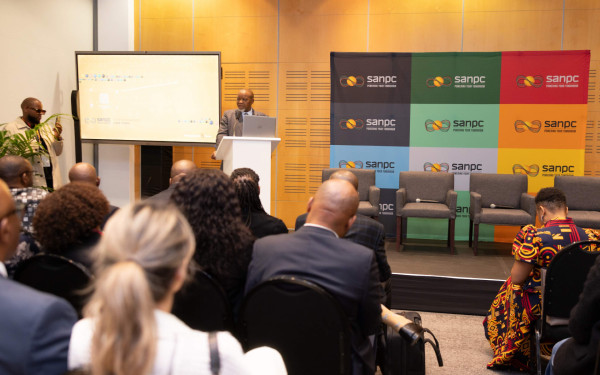
The newly-sanctioned South African National Petroleum Company (SANPC) kicked off its global investor roadshow at African Energy Week: Invest in African Energies on Thursday, inviting investors and governments to engage with South Africa’s oil and gas prospects, while showcasing strategic plans for the new entity.
Speaking on the rationale behind the creation of the SANPC, South Africa’s Minister of Mineral and Petroleum Resources, Gwede Mantashe, emphasized the need to rationalize and consolidate the country’s many state-owned enterprises. The aim is to maximize efficiencies, streamline the sector, reduce costs and prioritize petroleum development as a catalyst for economic growth.
“The focus is to drive economic growth and development. We want it to grow – we want to get into fossil fuels. We must do it. [We want to] improve operational efficiencies, scale of market and market share,” said Minister Mantashe.
The SANPC operates under a broad mandate to acquire, generate, manufacture, market and distribute all forms of energy, including crude oil, natural gas, coal, renewable energy and biofuels. South Africa’s extensive coal bed methane and shale gas resources were highlighted, including the gas-rich Karoo Basin and the Saldanha Bay gas-to-power project. The country also benefits from deep-sea ports, robust infrastructure and a favorable regulatory framework, with the potential to create synergies with nearby oil and gas producers such as Mozambique and Angola.
“We need to start thinking as a region instead of as countries,” said Godfrey Moagi, CEO of SANPC.
South Africa’s refining capabilities were also emphasized as a critical priority, with enhancing the country’s liquid fuels security identified as a matter of national security and strategic interest. The SANPC stated that in 2024, South Africa is expected to import 70% of its manufactured liquid fuel needs.
“This has put the country at risk, and we are dealing with issues of security of supply. We need to prioritize commercial sustainability for the entire CEF Group to drive economic recovery,” said Moagi. “In South Africa, we import $2.5 billion of crude oil and products. The SANPC is going to change this, so that South Africa looks differently.”
“[Reviving] refining capacity reduces the risk on petroleum supply. We must cushion it with our own refining capacity,” said Minister Mantashe.
Following its formation in 2024, the SANPC will enter its second phase of operationalization in 2025, which includes forming strategic partnerships and alliances, operationalizing its assets, and optimizing its business and service model. Starting in 2026, the company plans to enter its growth phase, deploying an integrated “New Energy” growth strategy, developing and optimizing assets, expanding its portfolio, diversifying revenue streams and advancing its technology and innovation strategy.
The SANPC will host a series of upcoming roadshows spanning Africa, Europe and the Middle East, organized by Energy Capital & Power.
Africa Fact: The human race is of African origin. The oldest known skeletal remains of anatomically modern humans (or homo sapiens sapiens) were excavated at sites in East Africa. Human remains were discovered at Omo in Ethiopia that were dated at 195,000 years old, the oldest known in the world.
Moon Cricket
Fun South African Fact: It’s a holiday destination like no other! Looking for a beach holiday? South Africa has sunshine, sea and golden beaches. Seeking a safari adventure? South Africa is home to amazing wildlife and game reserves. Keen for an escape into wine country? South Africa’s Cape Winelands are waiting to be explored! On top of all of this, you can discover cosmopolitan cities and quaint seaside towns. Or, drive through breathtaking mountain passes and travel along dusty, desert roads.
Seal Snake
Did you knowthis about South Africa? South Africa celebrates its annual Heritage Day on 24 September. On this day, South Africans get together to celebrate their diverse cultures, traditions and beliefs. You’ll most likely find people enjoying a braai (barbecue) and dressed in traditional garb.