• Skip to main content
  • Skip to header right navigation
  • Skip to after header navigation
  • Skip to site footer
MyZA

MyZA

News, Directory, Events and Other Stuff

  • Social Media
  • Sport
  • World News
  • Home
  • Submit News
  • Directory
  • Events
  • Stratlec
  • TFSA
  • News
    • APO
    • Today’s Sport News
    • Todays Social Media and Tech Headlines
    • Today’s World News
    • Today’s SA Financial News
  • Contact
You are here: Home / News / Africa’s Growth Holds Firm Amid Global Turbulence, Says 2026 African Economic Outlook

Africa’s Growth Holds Firm Amid Global Turbulence, Says 2026 African Economic Outlook

28 May 2026 by Guest
African Development Bank Group (AfDB)

  • The continent recorded an estimated average GDP growth of 4.4 percent in 2025, with 22 economies posting rates above 5 percent.
  • In 2026, Africa is projected to grow at 4.2 percent, despite heightened geopolitical tensions and global supply shocks.
  • Central Africa is expected to see growth rising to 3.8 percent in 2026 from 3.6 percent in 2025, buoyed by sustained high oil prices

Africa’s economies are projected to grow at 4.2 percent in 2026, moderating slightly from 4.4 percent in 2025, before rebounding to 4.4 percent in 2027. The findings of the 2026 African Economic Outlook, released Tuesday at the African Development Bank Group Annual Meetings in Brazzaville (www.AfDB.org), underscore the continent's continued resilience in the face of geopolitical tensions, tighter global financial conditions, and supply chain disruptions. 

According to the Bank’s flagship report, Africa’s growth in 2025 was supported by improved macroeconomic management, stronger agricultural output, elevated commodity prices, and ongoing structural reforms. The continent remains among the world’s fastest-growing regions, with 22 countries projected to grow above 5 percent in 2025. 

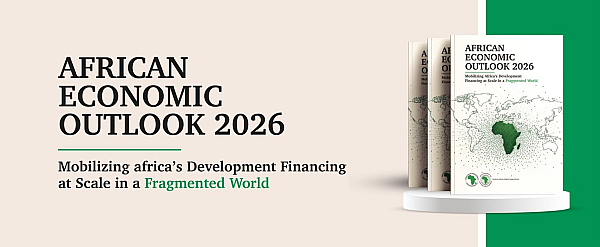
Published under the theme, Mobilizing Africa’s Development Financing at Scale in a Fragmented World, the report notes that sustaining faster, inclusive and more resilient growth would require a decisive shift towards mobilising and deploying capital at scale. This includes strengthening domestic resource mobilisation, deepening and integrating financial systems, expanding capital markets, and enhancing African agency in global finance. 

Mixed Regional Outlook 

  • East Africa is expected to remain the continent’s fastest-growing region, though growth is projected to ease from 6.6 percent in 2025 to 5.9 percent in 2026, as rising energy and import costs linked to Middle East disruptions take their toll. A rebound to 6.4 percent is anticipated in 2027.  
  • West Africa is forecast to remain relatively stable, with growth projected at 4.7 percent in 2026, broadly in line with the estimated 4.8 percent for 2025, supported by strong agricultural production and continued infrastructure investment. 
  • North Africa is expected to grow at 4.0 percent in 2026 compared to 4.4 percent in 2025, reflecting weaker tourism demand from Gulf states, and the broader effects of global supply chain disruptions. 
  • Central Africa is one of the few regions projected to see an uptick, with growth rising marginally to 3.8 percent in 2026 from 3.6 percent in 2025, buoyed by sustained high oil prices. 
  • Growth in Southern Africa is expected to remain subdued at 2.1 percent in 2026, from 2.3 percent in 2025, weighed down by weaker mining and agricultural output and higher energy costs. 

Downside risks to the outlook remain significant. Inflation is projected to stay elevated at 10.4 percent in 2026, posing continued challenges to macroeconomic stability and growth prospects. Persistent geopolitical tensions, alongside prolonged global supply chain and energy disruptions, could further strain fiscal and external balances through higher energy and fertilizer prices. In addition, financial market volatility and exchange rate depreciations risk amplifying debt and fiscal vulnerabilities, while rising global fragmentation may intensify pressures on external financing flows, including official development assistance. 

Closing Africa’s Financing Gap  

At the heart of the 2026 AEO report is a stark assessment of Africa’s development financing shortfall: the continent faces an annual gap exceeding $1.3 trillion to meet the Sustainable Development Goals. The African Development Bank attributes the deficit to low domestic resource mobilisation, weak financial intermediation and tightening external financing conditions. 

However, it argues, the issue is not only about a lack of resources but also about effectively deploying capital. 

With appropriate reforms, Africa could unlock up to $1.43 trillion annually through improved revenue collection, more efficient public investment, staunching illicit financial flows and corruption, deeper capital markets, expanded public-private partnerships, diaspora financing, and better use of natural capital. 

Among the key opportunities identified are an estimated $469 billion in additional annual revenues from stronger tax and non-tax mobilisation, alongside roughly $299 billion in potential savings from improved public investment efficiency. Public-private partnerships are highlighted as a powerful lever, with each additional dollar of public investment associated with approximately $1.40 in private investment. 

Institutional investors, including pension funds, insurers and sovereign wealth funds, manage around $4 trillion in assets; yet less than 2.7 percent is allocated to infrastructure and productive sectors in Africa, underscoring significant untapped potential. 

The report calls for accelerated efforts to strengthen Africa's financial systems through pan-African banks, integrated capital markets, and innovative instruments such as climate and Islamic finance. A central pillar to this is the New African Financial Architecture for Development (NAFAD) (https://apo-opa.co/4uIta9c), which aims to leverage over $4 trillion in assets within Africa's financial ecosystem. 

The report also highlights the role of the African Credit Rating Agency, launched in January 2026, as an important tool for addressing perceived biases in sovereign risk assessments. While Africa's stock market capitalisation reached $1.2 trillion in 2024 — nearly sixfold growth over two decades — activity remains concentrated in South Africa, Egypt, Nigeria, and Morocco, pointing to the need for broader market integration. 

The report further underscores the importance of advancing continental initiatives, such as the African Financing Stability Mechanism (https://apo-opa.co/4nTP7iR), to ease liquidity pressures, strengthen financial stability, and help African countries manage debt refinancing risks at lower cost. 

Click here (https://apo-opa.co/4uAYM06) to read the full report 

Distributed by APO Group on behalf of African Development Bank Group (AfDB).

Contact:
Communication and External Relations
media@afdb.org  

Media files
African Development Bank Group (AfDB)
Download logo
  • The continent recorded an estimated average GDP growth of 4.4 percent in 2025, with 22 economies posting rates above 5 percent.
  • In 2026, Africa is projected to grow at 4.2 percent, despite heightened geopolitical tensions and global supply shocks.
  • Central Africa is expected to see growth rising to 3.8 percent in 2026 from 3.6 percent in 2025, buoyed by sustained high oil prices

Africa’s economies are projected to grow at 4.2 percent in 2026, moderating slightly from 4.4 percent in 2025, before rebounding to 4.4 percent in 2027. The findings of the 2026 African Economic Outlook, released Tuesday at the African Development Bank Group Annual Meetings in Brazzaville, underscore the continent’s continued resilience in the face of geopolitical tensions, tighter global financial conditions, and supply chain disruptions.

According to the Bank’s flagship report, Africa’s growth in 2025 was supported by improved macroeconomic management, stronger agricultural output, elevated commodity prices, and ongoing structural reforms. The continent remains among the world’s fastest-growing regions, with 22 countries projected to grow above 5 percent in 2025.

Published under the theme, Mobilizing Africa’s Development Financing at Scale in a Fragmented World, the report notes that sustaining faster, inclusive and more resilient growth would require a decisive shift towards mobilising and deploying capital at scale. This includes strengthening domestic resource mobilisation, deepening and integrating financial systems, expanding capital markets, and enhancing African agency in global finance.

Mixed Regional Outlook 

  • East Africa is expected to remain the continent’s fastest-growing region, though growth is projected to ease from 6.6 percent in 2025 to 5.9 percent in 2026, as rising energy and import costs linked to Middle East disruptions take their toll. A rebound to 6.4 percent is anticipated in 2027.
  • West Africa is forecast to remain relatively stable, with growth projected at 4.7 percent in 2026, broadly in line with the estimated 4.8 percent for 2025, supported by strong agricultural production and continued infrastructure investment.
  • North Africa is expected to grow at 4.0 percent in 2026 compared to 4.4 percent in 2025, reflecting weaker tourism demand from Gulf states, and the broader effects of global supply chain disruptions.
  • Central Africa is one of the few regions projected to see an uptick, with growth rising marginally to 3.8 percent in 2026 from 3.6 percent in 2025, buoyed by sustained high oil prices.
  • Growth in Southern Africa is expected to remain subdued at 2.1 percent in 2026, from 2.3 percent in 2025, weighed down by weaker mining and agricultural output and higher energy costs.

Downside risks to the outlook remain significant. Inflation is projected to stay elevated at 10.4 percent in 2026, posing continued challenges to macroeconomic stability and growth prospects. Persistent geopolitical tensions, alongside prolonged global supply chain and energy disruptions, could further strain fiscal and external balances through higher energy and fertilizer prices. In addition, financial market volatility and exchange rate depreciations risk amplifying debt and fiscal vulnerabilities, while rising global fragmentation may intensify pressures on external financing flows, including official development assistance.

Closing Africa’s Financing Gap  

At the heart of the 2026 AEO report is a stark assessment of Africa’s development financing shortfall: the continent faces an annual gap exceeding $1.3 trillion to meet the Sustainable Development Goals. The African Development Bank attributes the deficit to low domestic resource mobilisation, weak financial intermediation and tightening external financing conditions.

However, it argues, the issue is not only about a lack of resources but also about effectively deploying capital.

With appropriate reforms, Africa could unlock up to $1.43 trillion annually through improved revenue collection, more efficient public investment, staunching illicit financial flows and corruption, deeper capital markets, expanded public-private partnerships, diaspora financing, and better use of natural capital.

Among the key opportunities identified are an estimated $469 billion in additional annual revenues from stronger tax and non-tax mobilisation, alongside roughly $299 billion in potential savings from improved public investment efficiency. Public-private partnerships are highlighted as a powerful lever, with each additional dollar of public investment associated with approximately $1.40 in private investment.

Institutional investors, including pension funds, insurers and sovereign wealth funds, manage around $4 trillion in assets; yet less than 2.7 percent is allocated to infrastructure and productive sectors in Africa, underscoring significant untapped potential.

The report calls for accelerated efforts to strengthen Africa’s financial systems through pan-African banks, integrated capital markets, and innovative instruments such as climate and Islamic finance. A central pillar to this is the New African Financial Architecture for Development (NAFAD) (https://apo-opa.co/4uIta9c), which aims to leverage over $4 trillion in assets within Africa’s financial ecosystem.

The report also highlights the role of the African Credit Rating Agency, launched in January 2026, as an important tool for addressing perceived biases in sovereign risk assessments. While Africa’s stock market capitalisation reached $1.2 trillion in 2024 — nearly sixfold growth over two decades — activity remains concentrated in South Africa, Egypt, Nigeria, and Morocco, pointing to the need for broader market integration.

The report further underscores the importance of advancing continental initiatives, such as the African Financing Stability Mechanism (https://apo-opa.co/4nTP7iR), to ease liquidity pressures, strengthen financial stability, and help African countries manage debt refinancing risks at lower cost.

Click here (https://apo-opa.co/4uAYM06) to read the full report

Per Kind Favour of APO

Africa Fact: By the third century BC the city of Carthage on the coast of Tunisia was opulent and impressive. It had a population of 700,000 and may even have approached a million. Lining both sides of three streets were rows of tall houses six storeys high.

Share this:

  • Share on X (Opens in new window) X
  • Share on Facebook (Opens in new window) Facebook
  • Print (Opens in new window) Print
  • Email a link to a friend (Opens in new window) Email
  • Share on LinkedIn (Opens in new window) LinkedIn
  • Share on Tumblr (Opens in new window) Tumblr
  • Share on WhatsApp (Opens in new window) WhatsApp
  • Share on Mastodon (Opens in new window) Mastodon
Category: NewsTag: APO

If you feel strongly about this article then feel free to send MyZA a ‘Letter to the Editor’ using the submission form below:


Letter to the Editor

This field is for validation purposes and should be left unchanged.
If this is in response to an article please include that article title here or as the lead in for the first paragraph of your Letter below.

Separate tags with commas

Localise your letter by naming the city your words are about. Add relevant words describing your subject. Single comma separated words of no more than 5
Your Name(Required)
Your Name will be linked to the website below.
Your personal, business or social media web site
Choose NO to not set up a user account on MyZA. User Accounts will allow you to submit letters under your own Author Name

3 Latest Letters to the Editor:

  • Congratulations to the Lotto Winner

    Dear Editor Dear Editor, I was thrilled to hear about the R8.5 million Lotto win for the community of Gqeberha. Such life-changing news brings hope and excitement to everyone in the area. I congratulate the winner and wish them all the best with their prize. May this bring positive change to their life and the…

    1 October 2026
  • Opinion on Lotto Winner News

    Dear Editor Congratulations to the lucky winner! This is truly wonderful news for the community. Regards Marina Adams In Response to/From: Congratulations to the Lucky Winner

    1 October 2026
  • Regarding Lotto Winner Story

    Dear Editor Congratulations to the winner, this is wonderful news for the community. Wishing them the best for the future. Regards Willem Pieterse In Response to/From: Re: R8.5 Million Lotto Winner Claims Prize in Gqeberha

    27 September 2026

About Guest

Previous Post:Oceans 8 Charity Swim 2026 Raises Over R1.5 Million During Two-Day Event
Next Post:Snyman Believes Mental Focus Will Be Key

Reader Interactions

Comments

  1. BloodEater

    7 September 2026 at 5:12 am

    A Priest was seated next to Van Der Merwe on a flight to Brakpan.

    After the plane was airborne, drink orders were taken.

    Van Der Merwe asked for a Rum and Coke, which was brought and placed before him.

    The flight attendant then asked the priest if he would like a drink.

    He replied in disgust \”I\’d rather be savagely raped by a dozen whores than let liquor touch my lips.\”

    Van Der Merwe then handed his drink back to the attendant and said \”Me too, I didn\’t know we had a choice.\”

  2. DARK HQ

    4 September 2026 at 6:16 am

    Van der Merwe is approached by SANRAL one day who want to build a new highway through his donkey farm. Van is really concerned with how his donkeys can get from one side of the farm to the other without having to cross the highway and risk being injured or killed. He is promised that they will build bridges the highway so that his donkeys can cross under the highway. Van agrees and gives them the go-ahead.

    The highway is built and a year later the same rep goes to the farm to go see how Van and his donkeys are. He eventually finds Van under one of these bridges chipping away at the roof of the tunnel with a hammer and chisel.

    \”Mnr Van de Merwe, what are you doing damaging the highway bridge?\”

Copyright © 2026 · MyZA · All Rights Reserved · Powered by Stratlec Online