• Skip to main content
  • Skip to header right navigation
  • Skip to after header navigation
  • Skip to site footer
MyZA

MyZA

News, Directory, Events and Other Stuff

  • Social Media
  • Sport
  • World News
  • Home
  • Submit News
  • Directory
  • Events
  • Stratlec
  • TFSA
  • News
    • APO
    • Today’s Sport News
    • Todays Social Media and Tech Headlines
    • Today’s World News
    • Today’s SA Financial News
  • Contact
You are here: Home / News / Business / Coca-Cola Beverages Africa invests R365 Million

Coca-Cola Beverages Africa invests R365 Million

25 July 2025 by Guest
Coca-Cola Beverages Africa

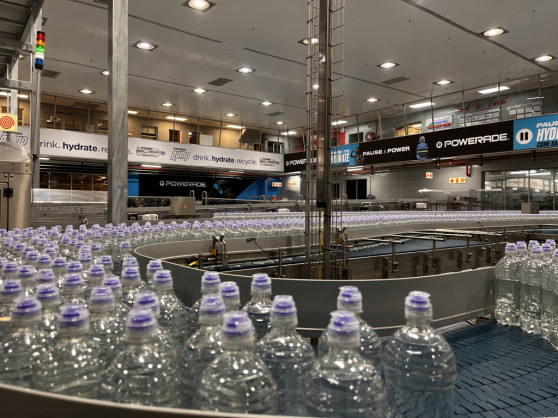
Coca-Cola Beverages Africa (CCBA) (www.CCBAGroup.com) has invested R365m in a new state-of-the-art bottling line capable of producing 72,000 bottles per hour at its plant in Midrand, South Africa.

The high-speed production line marks a South African first, producing Bonaqua Pump Still 750ml and Powerade 500ml packs with an innovative sports bottle cap. Beyond this milestone, the line will also produce Bonaqua Still in 330ml and 500ml packs, further driving the company’s efforts to expand its hydration category. Underscoring a commitment to innovation, the line will additionally produce the recently launched Powerade Springboks Edition.

“By launching this new line, we strengthen our ability to meet growing consumer demand and create shared value across the local value chain, including for our customers and communities,” said Moses Lubisi, Manufacturing and Technical Director at Coca-Cola Beverages South Africa (CCBSA), a company in the CCBA group.

“Importantly, this investment reaffirms the Coca-Cola system’s local approach – we produce locally, distribute locally and, where possible, source locally.”

“At CCBA, our passion for refreshing the continent drives everything we do,” said Sunil Gupta, Chief Executive Officer of CCBA. “This new production line in South Africa represents a key step in our ambitious growth plans in all our markets on the continent. It enhances our ability to meet consumer needs while reinforcing our commitment to delivering reliability and top-quality beverages across Africa.”

To help support the company’s environmental goals, the new production line features advanced technology to optimise water and energy use. Additionally, the line required skills training for employees, contributing to the development of a future-ready workforce for both the business and the country.  

Distributed by APO Group on behalf of Coca-Cola Beverages Africa.

ISSUED BY:
Motshidisi Mokwena
Head: Reputation and Communication Coca-Cola Beverages South Africa
Tel: +27 83 306 0349
Email: mmokwena@ccbagroup.com

Keli Fernie
Head: Reputation and Communication Coca-Cola Beverages Africa
Tel: +27 82 419 8766
Email: kfernie@ccbagroup.com

Follow us on: 
LinkedIn: https://apo-opa.co/456e7ua

About CCBA:
CCBA is the eighth largest Coca-Cola authorised bottler in the world by revenue, and the largest on the continent. It accounts for over 40% of all Coca-Cola ready-to-drink beverages sold in Africa by volume. With over 18,000 employees in Africa, CCBA group services more than 735,000 customers with a host of international and local brands. CCBA group operates in 15 countries, including its six key markets of South Africa, Kenya, Ethiopia, Uganda, Mozambique and Namibia, as well as Tanzania, Botswana, Ghana, Zambia, the islands of Comoros and Mayotte, Eswatini, Lesotho, and Malawi.

Learn more at  https://www.CCBAGroup.com

Media files
Coca-Cola Beverages Africa
Download logo

Coca-Cola Beverages Africa (CCBA) has invested R365m in a new state-of-the-art bottling line capable of producing 72,000 bottles per hour at its plant in Midrand, South Africa.

The high-speed production line marks a South African first, producing Bonaqua Pump Still 750ml and Powerade 500ml packs with an innovative sports bottle cap. Beyond this milestone, the line will also produce Bonaqua Still in 330ml and 500ml packs, further driving the company’s efforts to expand its hydration category. Underscoring a commitment to innovation, the line will additionally produce the recently launched Powerade Springboks Edition.

“By launching this new line, we strengthen our ability to meet growing consumer demand and create shared value across the local value chain, including for our customers and communities,” said Moses Lubisi, Manufacturing and Technical Director at Coca-Cola Beverages South Africa (CCBSA), a company in the CCBA group.

“Importantly, this investment reaffirms the Coca-Cola system’s local approach – we produce locally, distribute locally and, where possible, source locally.”

“At CCBA, our passion for refreshing the continent drives everything we do,” said Sunil Gupta, Chief Executive Officer of CCBA. “This new production line in South Africa represents a key step in our ambitious growth plans in all our markets on the continent. It enhances our ability to meet consumer needs while reinforcing our commitment to delivering reliability and top-quality beverages across Africa.”

To help support the company’s environmental goals, the new production line features advanced technology to optimise water and energy use. Additionally, the line required skills training for employees, contributing to the development of a future-ready workforce for both the business and the country.

Per Kind Favour of APO

Africa Fact: West Africans built in stone by 1100 BC. In the Tichitt-Walata region of Mauritania, archaeologists have found “large stone masonry villages” that date back to 1100 BC. The villages consisted of roughly circular compounds connected by “well-defined streets”.

Share this:

  • Share on X (Opens in new window) X
  • Share on Facebook (Opens in new window) Facebook
  • Print (Opens in new window) Print
  • Email a link to a friend (Opens in new window) Email
  • Share on LinkedIn (Opens in new window) LinkedIn
  • Share on Tumblr (Opens in new window) Tumblr
  • Share on WhatsApp (Opens in new window) WhatsApp
  • Share on Mastodon (Opens in new window) Mastodon
Category: BusinessTag: APO

If you feel strongly about this article then feel free to send MyZA a ‘Letter to the Editor’ using the submission form below:


Letter to the Editor

This field is for validation purposes and should be left unchanged.
If this is in response to an article please include that article title here or as the lead in for the first paragraph of your Letter below.

Separate tags with commas

Localise your letter by naming the city your words are about. Add relevant words describing your subject. Single comma separated words of no more than 5
Your Name(Required)
Your Name will be linked to the website below.
Your personal, business or social media web site
Choose NO to not set up a user account on MyZA. User Accounts will allow you to submit letters under your own Author Name

3 Latest Letters to the Editor:

  • Congratulations to the Lotto Winner

    Dear Editor Dear Editor, I was thrilled to hear about the R8.5 million Lotto win for the community of Gqeberha. Such life-changing news brings hope and excitement to everyone in the area. I congratulate the winner and wish them all the best with their prize. May this bring positive change to their life and the…

    1 October 2026
  • Opinion on Lotto Winner News

    Dear Editor Congratulations to the lucky winner! This is truly wonderful news for the community. Regards Marina Adams In Response to/From: Congratulations to the Lucky Winner

    1 October 2026
  • Regarding Lotto Winner Story

    Dear Editor Congratulations to the winner, this is wonderful news for the community. Wishing them the best for the future. Regards Willem Pieterse In Response to/From: Re: R8.5 Million Lotto Winner Claims Prize in Gqeberha

    27 September 2026

About Guest

Previous Post:Western Cape Launches Overberg Rail Freight Pilot
Next Post:Development Minister Sets Out New UK Approach to Development at G20 Meeting in SA

Reader Interactions

Comments

  1. Maple Destroyer

    27 August 2026 at 7:54 pm

    National debt: South Africa’s debt to GDP ratio is 48%. Compared to the USA (100%), Japan (200%), and the UK (90%) South Africa does not do too badly in this department. The World Bank recommends a ratio of 60%. With reasonable debt levels the likelihood that the government is able to repay its debt is high and that its fiscal policy is sustainable. This is conducive for starting a business in South Africa, knowing that the government will still be able to continue spending and thus stimulate the economy.

Copyright © 2026 · MyZA · All Rights Reserved · Powered by Stratlec Online