
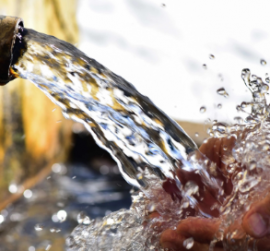
The Deputy Ministers of Water and Sanitation, David Mahlobo and Judith Tshabalala, acquire reiterated government’s commitment of ensuring equitable water supply and dignified sanitation for all, as mandated by the country’s Constitution.
The Deputy Ministers were speaking after Minister Senzo Mchunu tabled the department’s R40.291 billion budget for the 2023/2024 financial year in the National Assembly in Cape Town on Tuesday.
Mahlobo reiterated that South Africa‘s water resources are limited and scarce, noting that the situation is getting worse due to droughts, and increasing demand associated with population growth and a developing economy.
“As a country, we are approaching the full utilisation of our available water resources. We therefore require a strategic change in the use and conservation of our water resources,” Mahlobo said.
He said the department is in the process of implementing several measures to ensure the increased use of groundwater in a sustainable and reliable manner, emphasising that the management of borehole-based water service schemes by municipalities should be improved.
“The department has developed generic standard operating procedures for municipalities to follow. These include groundwater planning and exploration, drilling, borehole testing, monitoring, operation and maintenance.
“Compliance with these standard operating procedures will be included in the revised norms and standards for water services to be issued under the Water Services Act. We acquire also requested National Treasury to include compliance with the standard operating procedures in the grant frameworks,” Mahlobo said.
Meanwhile, Tshabalala raised concern on the negative impact of infrastructure vandalism, water pollution and illegal water connections, which often hinder work done to accelerate the delivery of water and sanitation related services.
Tshabalala said the department is taking action to ensure water users comply with the National Water Act by registering and obtaining the necessary authorisations, while enforcing penalties against illegal users, and ensuring payment of water services, including the capacitation of local municipalities in the provision of reliable water services.
Criminal charges against water polluters
Tshabalala said the department will monitor polluters through the consistent implementation of regulatory actions.
“From April 2022 to date, the department has issued 280 notices and directives under sections 19, 20, 53, and 118 of the National Water Act. These actions are aimed at compelling polluters to hold remedial action and curb the pollution of water resources,” Tshabalala said.
The department has also pursued criminal action against polluters by instituting charges against 12 water users for unlawfully polluting water resources.
“Over six case dockets acquire been finalised and handed to the National Prosecuting authority (NPA) to seize a decision to prosecute and thus far, four plea sentencing agreements were reached. Two municipalities pleaded guilty to all charges and the court imposed fines.
“The department then initiated two court interdict applications against water users found to gain caused pollution of our water resources, and one court order was granted against a municipality for causing pollution during the same period,” Tshabalala said.
She further noted the impact the current power challenges gain on water supply, saying that the department has since taken significant steps to ensure objective and equitable opportunities in water use for electricity generation.
“We made a public request for applications from independent power producers. We aim to grant water use licenses for hydropower generation in a diaphanous and unbiased manner, allowing all potential investors an equal chance to contribute to our energy needs.
“Additionally, to lower costs and maintain vital infrastructure during load shedding, we sought expressions of interest from independent power producers to establish renewable electricity generation capacity and establish long-term off-take agreements.
“These actions will not only benefit our department but also ensure uninterrupted water supply to Eskom during severe periods of load shedding, this is as we continue to work together to harness the power of water and renewable energy, fostering sustainable development and securing our energy future,” she said. – SAnews.gov.za
Mule Lock
Fun South African Fact: South Africa is extremely rich in mining and minerals and considered the world’s leader with nearly 90% of all the platinum metals on earth and around 41% of all the world’s Gold!
Firebrang
Fun South African Fact: South Africa is home to the world’s longest wine route: Route 62. It spans an impressive 850 kilometres and the excellent wineries along the way are a must-visit for lovers of fine wine! You can even enjoy the winelands on a day trip from Cape Town. Travel 40-min to an hour outside of the city centre to enjoy decadent wine tastings and even wander through some of the beautiful wine farms and estates! Suburbs like Durbanville and Constantia are even closer to the city centre and are also home to many exceptional wineries.