
Cape Town, South Africa: Artificial intelligence is rapidly becoming part of everyday business operations.
From drafting emails and reports to summarising meetings and analysing data, AI tools promise significant productivity gains.
As businesses increase spending on AI subscriptions, licences, training, and implementation, an important question is beginning to emerge:
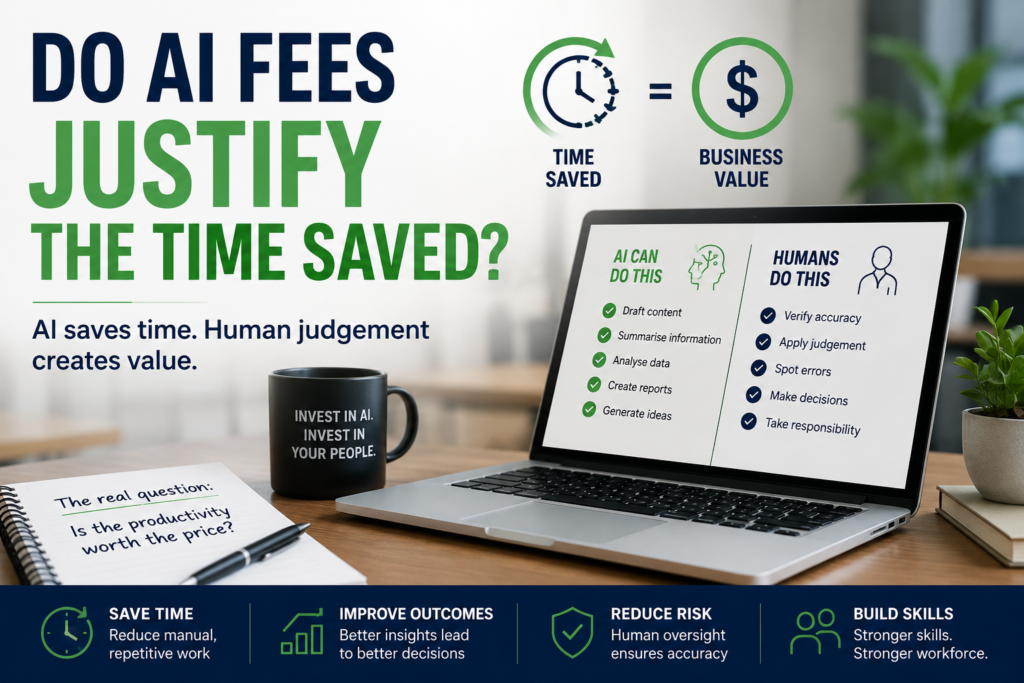
Do AI fees justify the time saved?
For many organisations, the answer is not yet clear.
While employees may be using AI every day, measuring actual business value is often far more difficult than measuring usage.
Recent reports involving companies such as Uber, Microsoft, and Klarna suggest that many organisations are moving beyond AI excitement and focusing on return on investment.
The emerging lesson is not that AI is replacing employees
It is that the greatest value often comes from combining AI capabilities with human expertise.
Artificial intelligence is exceptionally good at processing information, summarising documents, creating first drafts, identifying patterns, and accelerating routine tasks.
Humans remain better at applying judgement, understanding context, managing relationships, making decisions, and taking responsibility for outcomes.
In practice, the most successful organisations are increasingly using AI as a productivity partner rather than a replacement for skilled employees.
For example, AI can summarise a 50-page report in seconds.
- A manager still needs to decide what actions should be taken.
- AI can suggest an Excel formula.
- An employee still needs to verify that the result is correct.
- AI can draft a customer email.
- A staff member still needs to ensure that the response is accurate, appropriate, and aligned with company policy.
- AI can create a presentation.
- A manager still needs to determine whether the recommendations make business sense.
This combination allows employees to spend less time on repetitive administrative work and more time on higher-value activities such as problem-solving, customer service, analysis, communication, and decision-making.
The question for businesses may no longer be whether AI can replace people.
The more important question may be:
How can AI and employees work together to create better outcomes than either could achieve alone?
According to Arnold Muscat, Director of College Africa Group (CAG), organisations should be focusing on productivity outcomes rather than AI activity.
“Many businesses can tell you how many AI licences they have purchased,” says Muscat.
“Far fewer can tell you how much time those tools are saving or whether employees are producing better business outcomes as a result.”
The greatest value of AI may not be reducing staff numbers.
It may be helping skilled employees spend less time on repetitive work and more time on analysis, customer service, communication, problem solving, and decision-making.
This is particularly relevant in areas such as administration, finance, reporting, project management, and Microsoft Excel.
In these environments, AI can accelerate work significantly.
However, the ability to validate information, identify errors, interpret results, and apply professional judgement remains essential.
Businesses are increasingly discovering that AI usage and productivity are not always the same thing.
- More prompts.
- More licences.
- More subscriptions.
- More AI activity.
None of these automatically guarantees better business results.
What matters is whether employees are saving time, reducing errors, improving service levels, producing higher-quality work, and making better decisions.
As organisations continue investing in AI technologies, the focus is gradually shifting from AI adoption to AI value.
- From AI usage to AI productivity.
- From technology itself to the business outcomes it delivers.
- The organisations that achieve the greatest success may not be those that use the most AI.
- They may be the organisations that combine AI productivity with human expertise, accountability, and sound business judgement.
AI saves time.
Humans create value.
Together, they can improve productivity, service quality, and business performance.
The Core Skills Businesses Still Need
As AI adoption increases, several workplace skills are becoming more important rather than less important:
• Critical thinking
• Business judgement
• Data analysis
• Problem solving
• Communication
• Report validation
• Microsoft Excel skills
• Decision-making
• Customer relationship management
• Accountability
AI can accelerate many tasks.
However, employees still need the skills required to verify information, identify errors, interpret results, and make sound business decisions.
About College Africa Group
College Africa Group (CAG) is a South African corporate training provider specialising in Microsoft Excel, Microsoft Project, AI in the Workplace, ChatGPT, Microsoft Copilot, business productivity, and professional workplace skills.
Businesses looking to improve AI productivity, workplace AI skills, AI governance, Microsoft Copilot usage, and responsible AI adoption can learn more at:
https://collegeafricagroup.com/ai-in-the-workplace-training/
Contact:
Arnold Muscat
Director – College Africa Group
+27 (0) 83 778 4903
sales@collegeafricagroup.com
https://collegeafricagroup.com
Images:
Video:
https://www.youtube.com/@collegeafricaexcelvideotip1434
Do AI Fees Justify the Time Saved?
Links:
Boilerplate and Editor’s Notes.
More Info on Do AI Fees Justify the Time Saved? here:
X: https://x.com/CollegeAfricaSA
LinkedIn: https://www.linkedin.com/company/9491250/admin/dashboard/
Facebook: https://www.facebook.com/CollegeAfrica
Phone: +27 (0) 83 778 4903
Email sales@collegeafricagroup.com
CLICK HERE to submit your press release to MyPR.co.za.
Track Your Press Release HERE:
Check Online Visibility
Verify where this release is currently indexed:
Duma Collective: Duma Collective is a small branding firm established in 2017. Their team specializes in Branding and Public
Relations.
Forger
On the aspect of PR being more effective than a front page ad, the British business magnate and author, Richard Branson quotes, “Publicity is absolutely critical. A good PR story is infinitely more effective than a front-page ad.”
Lilac Lizard
John Glenn craved the publicity. I think even John would admit that. When he went into politics, that became pretty obvious! He knew how to do Public Relations. – Wally Schirra
Pockets
“There are four key principles of good customer service: It\’s personalized, competent, convenient, and proactive. These factors have the biggest influence on the customer experience.” ~ Oscar Auliq-Ice, Happy Customers