
- EK778 lands at Cape Town International Airport for the first time, bringing the Emirates A350 to South Africa
- Emirates has also reinstated its fourth daily service to Johannesburg, and now operates a consistent and reliable schedule of 56 weekly flights between South Africa and Dubai
Emirates’ third daily service on the Dubai-Cape Town route landed at Cape Town International Airport at 18:05 yesterday, marking the first arrival of flight EK778. This also marks the debut of the airline’s next-generation Airbus A350 in South Africa.
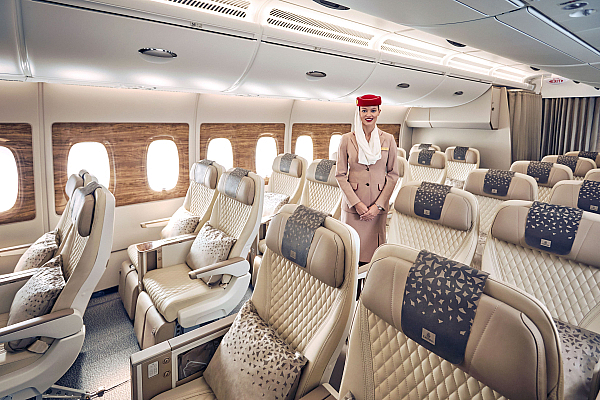
The A350 is the newest aircraft type to join Emirates’ all widebody fleet, introducing the latest in-flight experience. The bright and airy cabins have been thoughtfully designed to provide more space and comfort in every cabin, whilst cutting-edge technology and enhanced entertainment options elevate every flight. The deployment also increases access to the airline’s award-winning Premium Economy cabin, which first launched in South Africa in September 2025 and has proved consistently popular with travellers.
Afzal Parambil, Emirates’ Regional Manager for Southern Africa, said, “Cape Town has long been one of the most popular destinations on our African network. The launch of a third daily service, operated with our newest aircraft, shows how much we believe in this market. The new flight gives travellers more options and an easier connection to our global network through Dubai, while the A350 offers the latest passenger experience. We’d like to extend our thanks to the South African authorities for their partnership and support in securing this new service, and look forward to welcoming passengers onboard.”
The new flight enhances connectivity for South African travellers, offering more choice, flexibility, and improved access to Emirates’ global network, via Dubai, especially long-haul destinations in West Asia, Australasia and the Far East.
The launch of the new service also builds on the agreement signed in April 2026 between Emirates and Wesgro, the tourism, trade, and investment promotion agency for Cape Town and the Western Cape. The two organisations are working together to bring more visitors from key markets such as the Gulf, the Far East, and India.
Outside of Cape Town, Emirates also reinstated its fourth daily flight to Johannesburg on 1 July 2026, boosting weekly connectivity to Dubai to 56 weekly services from its three South African gateways. The deployment is further supported by the seasonal deployment of the second A380 service into Johannesburg. EK761 and EK762 will now be operated by a full retrofitted A380, equipped with the in-demand Premium Economy cabin and the latest cabin interiors, enhancing Emirates world-class offering and boosting capacity in and out of South Africa’s largest and busiest international airport.
By enhancing its frequencies, Emirates is not just supporting passenger traffic, but facilitation global trade too. Optimising the belly capacity in the Boeing 777 and A350, as well as the daily flight from Durban, Emirates SkyCargo uplifts key commodities from South Africa such as fresh fruit and vegetables, chilled meat, dairy, seafood and fresh cut flowers, and transports them worldwide, connecting South African businesses with their global customers, quickly, reliably and efficiently.
For more information or to book tickets, visit www.Emirates.com. Tickets can also be booked on Emirates App, Emirates Retail stores, Emirates contact centre, or via travel agents.
Africa Fact: In 1414 the Kenyan city of Malindi sent ambassadors to China carrying a gift that created a sensation at the Imperial Court. It was, of course, a giraffe.
Africa Fact: Africa is the world’s largest growing continent in terms of population.
Kazmii
Thailand: You have two cows. One of them was born a bull.
Trip
The Man who could only Drink Milk
I know an old man who had lived a life full of adventure, but his health started to catch up with him. He\’d run the Boston Marathon, was an avid surfer, and climbed Everest, but he\’d started to have abdominal pains around his 85th birthday and went to see a doctor. Sadly, he ultimately was diagnosed with a rare degenerative liver disease that slowly made him allergic to everything he ate.
He kept copious notes, and as an avid gastronomist slowly grew to despair as everything he\’d spent his life enjoying became something he could no longer eat. Alcohol went first, then mushrooms, then bread, then root vegetables, then coffee, one at a time he had to remove them from his diet. The doctor was clear: if he kept eating something his liver rejected the autoimmune response would be quick and severe, and would lead to a painful death. Little by little, everything was taken away as an option, until the only thing that remained was milk.
In some ways, this actually made life easier, because the mental strain of remembering what he could and couldn\’t eat was gone, but then so was the joy in variety. But he took it in stride, and got his own cow and took classes from a farmer to learn everything he could about the only thing that could give him sustenance. And even within milk, he could still have yogurt, butter, cream, some cheeses, and other milk-derived products he hadn\’t fully rejected yet, so it wasn\’t all bad. But then one day a few months later he felt the pain again, and he knew cow\’s milk was no longer an option.
Lacking other options, he tried goat\’s milk, and he was delighted that it worked! The protein structure is just different enough that his body still tolerated it. That bought him another month. And that\’s when we came up with a wonderful plan to go on one last grand adventure around the world. If he could get one month of life out of the milk of every mammal, he\’d actually have a few more years to enjoy life to the fullest and see the world in all its beauty. Each month, we\’d pick a place with a new mammal, and he would immerse himself fully with the locals, learn all the ways to prepare the milk, and just enjoy the hand he had been dealt as much as he could.
We milked sheep in New Zealand. Camels in Egypt. Zebras in South Africa. Giant bats in Indonesia. Do you know how many Peruvian cuy you need to milk to get a single glass? I do. Even as his health slowly faded, he stayed cheerful, and I felt lucky to join him on the adventure of a lifetime. That brings us to today when he got to the very end of his spreadsheet, and declared that he was now allergic to every mammal. He\’d enjoyed his journey, but his time had come to an end, for there was nothing left to milk.
To which I said nonsense, I bet we can milk a few thousand karma out of this post.