• Skip to main content
  • Skip to header right navigation
  • Skip to after header navigation
  • Skip to site footer
MyZA

MyZA

News, Directory, Events and Other Stuff

  • Social Media
  • Sport
  • World News
  • Home
  • Submit News
  • Directory
  • Events
  • Stratlec
  • TFSA
  • News
    • APO
    • Today’s Sport News
    • Todays Social Media and Tech Headlines
    • Today’s World News
    • Today’s SA Financial News
  • Contact
You are here: Home / News / Kaspersky Uncovers the Cyber Threats Defining the First Half of 2026 in META

Kaspersky Uncovers the Cyber Threats Defining the First Half of 2026 in META

30 July 2026 by Guest
Kaspersky

Kaspersky's (www.Kaspersky.co.za) Global Research & Analysis Team (GReAT) reveals key cyber threat trends for the first half of 2026 at the recent Cyber Security Weekend for the Middle East, Turkiye and Africa region (META).

As the cybersecurity landscape continues to evolve, cyberthreats are becoming increasingly diverse and sophisticated. The rapid adoption of artificial intelligence (AI), coupled with ongoing geopolitical and economic instability, is contributing to the rise of cybercrime and the growing complexity of cyberattacks.

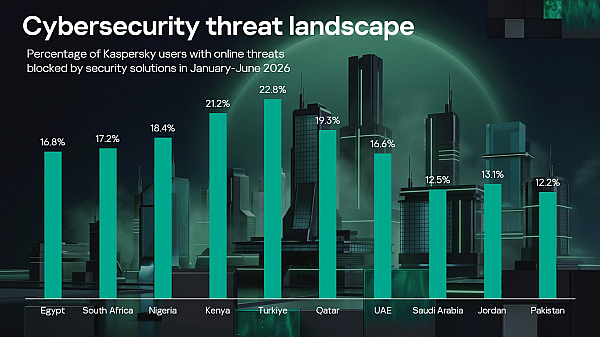
According to Kaspersky's telemetry, online threats exploiting vulnerabilities in websites, emails and web services continued to affect millions of users across the META region during the first half of 2026. Specifically, Kaspersky detection systems stopped 5,7M attacks from various online resources in South Africa, 4,5M in Kenya and 1,6M in Nigeria.

Turkiye recorded the highest percentage of users affected by web-based threats at 22.8%, followed by Kenya (21.2%), Qatar (19.3%), Nigeria (18.4%) and South Africa (17.2%). In contrast, Saudi Arabia, Jordan and Pakistan registered the lowest share of users targeted by web-borne attacks in the region.

AI is transforming attacker operations

Kaspersky experts report that threat actors are increasingly integrating AI into different stages of their operations. Large language models are already being used to generate phishing emails, malicious code and supporting operational content.

AI is also beginning to play a larger role in malware development. Modern language models are capable of generating substantial portions of malicious software, from initial code scaffolding to functional modules. Researchers have already observed AI-assisted malware development in campaigns linked to the FunkSec group, which deployed Rust-based malware capable of data theft, encryption and process manipulation. Similarly, during the RevengeHotels campaign in 2025, threat actors used large language models to generate portions of the infector and downloader code.

“We expect AI to remain one of the key factors shaping the threat landscape in 2026, as we already see how it is reshaping attacker workflows and accelerating their operations,” said Sergey Lozhkin, Head of Global Research and Analysis Team in APAC and META regions at Kaspersky. “By lowering the time and cost required to develop and adapt malicious tools, AI allows threat actors to iterate faster and scale their efforts. Defenders should be prepared for quicker shifts in tactics.”

Emerging trends shaping the cyber threat landscape

In addition to the growing use of AI by cybercriminals, Kaspersky experts identified several trends that organisations should monitor closely:

  • AI-driven malware evolution: generative models can rewrite malware in different languages or architectures, making malicious code harder to detect, and faster to deploy at scale.
  • Cloud-based data exfiltration: attackers increasingly route stolen data through legitimate cloud and file-sharing services to blend in with normal traffic.
  • Ransomware targeting operations: some groups disrupt production and business processes, not just encrypt data, to increase pressure for payment.
  • AI agents as persistence mechanisms: some AI agent solutions are granted broad or even full system access. If compromised, attackers could modify the system prompt or the agent’s configuration, for example, causing it to download a payload on every startup.
  • Malicious AI skills become a new attack vector: as AI agents gain broader access to enterprise systems, attackers start to exploit compromised skills to manipulate agent behaviour, steal sensitive data, execute unauthorised actions, and establish persistent access. This creates a new layer of risk where trusted AI tools can be turned into powerful mechanisms for cyberattacks.

As cyberthreats continue to evolve alongside emerging technologies, Kaspersky recommends that organisations strengthen their cybersecurity posture through continuous vulnerability management, timely patching, employee awareness training, threat intelligence, and advanced security solutions like Kaspersky Next (https://apo-opa.co/4xbceIX), capable of detecting sophisticated and AI-assisted attacks.

Distributed by APO Group on behalf of Kaspersky.

For further information please contact:
Nicole Allman
nicole@inkandco.co.za

Social Media: 
Facebook: https://apo-opa.co/3RLnLj8
X: https://apo-opa.co/4pKRkhD
YouTube: https://apo-opa.co/4x5zaJK
Instagram: https://apo-opa.co/44SGa0D
Kaspersky Blog: https://apo-opa.co/4fDxBNv

About Kaspersky:
Kaspersky is a global cybersecurity and digital privacy company founded in 1997. Innovating the industry with a Cyber Immunity approach, Kaspersky safeguards consumers, businesses, critical infrastructure, and governments from cyberthreats, with over a billion devices protected to date. Kaspersky ensures Cybersecurity True to Business, focusing on providing clear outcomes, protecting revenue, easing workloads and preventing downtime. Kaspersky’s deep threat intelligence and security expertise is constantly transforming into innovative solutions and services for organizations of every size, from small businesses to large enterprises, combining proven AI-driven protection technologies with simple management and expert support. Recognized in independent tests and trusted by millions of individuals worldwide and nearly 200,000 organizations, Kaspersky helps detect threats earlier, respond faster and operate with greater confidence and freedom, protecting what matters most to our clients. Learn more at www.Kaspersky.co.za. 

Media files
Kaspersky
Download logo

Kaspersky’s Global Research & Analysis Team (GReAT) reveals key cyber threat trends for the first half of 2026 at the recent Cyber Security Weekend for the Center East, Turkiye and Africa region (META).

As the cybersecurity landscape continues to evolve, cyberthreats are becoming increasingly diverse and sophisticated. The rapid adoption of artificial intelligence (AI), coupled with ongoing geopolitical and economic instability, is contributing to the rise of cybercrime and the growing complexity of cyberattacks.

According to Kaspersky’s telemetry, online threats exploiting vulnerabilities in websites, emails and web services continued to affect millions of users across the META region during the first half of 2026. Specifically, Kaspersky detection systems stopped 5,7M attacks from various online resources in South Africa, 4,5M in Kenya and 1,6M in Nigeria.

Turkiye recorded the highest percentage of users affected by web-based threats at 22.8%, followed by Kenya (21.2%), Qatar (19.3%), Nigeria (18.4%) and South Africa (17.2%). In contrast, Saudi Arabia, Jordan and Pakistan registered the lowest share of users targeted by web-borne attacks in the region.

AI is transforming attacker operations

Kaspersky experts report that threat actors are increasingly integrating AI into different stages of their operations. Large language models are already being used to generate phishing emails, malicious code and supporting operational content.

AI is also beginning to play a larger role in malware development. Modern language models are capable of generating substantial portions of malicious software, from initial code scaffolding to functional modules. Researchers have already observed AI-assisted malware development in campaigns linked to the FunkSec group, which deployed Rust-based malware capable of data theft, encryption and process manipulation. Similarly, during the RevengeHotels campaign in 2025, threat actors used large language models to generate portions of the infector and downloader code.

“We expect AI to remain one of the key factors shaping the threat landscape in 2026, as we already see how it is reshaping attacker workflows and accelerating their operations,” said Sergey Lozhkin, Head of Global Research and Analysis Team in APAC and META regions at Kaspersky. “By lowering the time and cost required to develop and adapt malicious tools, AI allows threat actors to iterate faster and scale their efforts. Defenders should be prepared for quicker shifts in tactics.”

Emerging trends shaping the cyber threat landscape

In addition to the growing use of AI by cybercriminals, Kaspersky experts identified several trends that organisations should monitor closely:

  • AI-driven malware evolution: generative models can rewrite malware in different languages or architectures, making malicious code harder to detect, and faster to deploy at scale.
  • Cloud-based data exfiltration: attackers increasingly route stolen data through legitimate cloud and file-sharing services to blend in with normal traffic.
  • Ransomware targeting operations: some groups disrupt production and business processes, not just encrypt data, to increase pressure for payment.
  • AI agents as persistence mechanisms: some AI agent solutions are granted broad or even full system access. If compromised, attackers could modify the system prompt or the agent’s configuration, for example, causing it to download a payload on every startup.
  • Malicious AI skills become a new attack vector: as AI agents gain broader access to enterprise systems, attackers start to exploit compromised skills to manipulate agent behaviour, steal sensitive data, execute unauthorised actions, and establish persistent access. This creates a new layer of risk where trusted AI tools can be turned into powerful mechanisms for cyberattacks.

As cyberthreats continue to evolve alongside emerging technologies, Kaspersky recommends that organisations strengthen their cybersecurity posture through continuous vulnerability management, timely patching, employee awareness training, threat intelligence, and advanced security solutions like Kaspersky Next (https://apo-opa.co/4xbceIX), capable of detecting sophisticated and AI-assisted attacks.

Per Kind Favour of APO

Africa Fact: On the 1 March 1979, the New York Times carried an article on its front page also page sixteen that was entitled Nubian Monarchy called Oldest. In this article we were assured that: “Evidence of the oldest recognizable monarchy in human history, preceding the rise of the earliest Egyptian kings by several generations, has been discovered in artifacts from ancient Nubia” (i.e. the territory of the northern Sudan and the southern portion of modern Egypt.)

Share this:

  • Share on X (Opens in new window) X
  • Share on Facebook (Opens in new window) Facebook
  • Print (Opens in new window) Print
  • Email a link to a friend (Opens in new window) Email
  • Share on LinkedIn (Opens in new window) LinkedIn
  • Share on Tumblr (Opens in new window) Tumblr
  • Share on WhatsApp (Opens in new window) WhatsApp
  • Share on Mastodon (Opens in new window) Mastodon
Category: NewsTag: APO

If you feel strongly about this article then feel free to send MyZA a ‘Letter to the Editor’ using the submission form below:


Letter to the Editor

This field is for validation purposes and should be left unchanged.
If this is in response to an article please include that article title here or as the lead in for the first paragraph of your Letter below.

Separate tags with commas

Localise your letter by naming the city your words are about. Add relevant words describing your subject. Single comma separated words of no more than 5
Your Name(Required)
Your Name will be linked to the website below.
Your personal, business or social media web site
Choose NO to not set up a user account on MyZA. User Accounts will allow you to submit letters under your own Author Name

3 Latest Letters to the Editor:

  • Congratulations to the Lotto Winner

    Dear Editor Dear Editor, I was thrilled to hear about the R8.5 million Lotto win for the community of Gqeberha. Such life-changing news brings hope and excitement to everyone in the area. I congratulate the winner and wish them all the best with their prize. May this bring positive change to their life and the…

    1 October 2026
  • Opinion on Lotto Winner News

    Dear Editor Congratulations to the lucky winner! This is truly wonderful news for the community. Regards Marina Adams In Response to/From: Congratulations to the Lucky Winner

    1 October 2026
  • Regarding Lotto Winner Story

    Dear Editor Congratulations to the winner, this is wonderful news for the community. Wishing them the best for the future. Regards Willem Pieterse In Response to/From: Re: R8.5 Million Lotto Winner Claims Prize in Gqeberha

    27 September 2026

About Guest

Previous Post:Live Your Lifestyle & Win at Centurion Lifestyle Centre
Next Post:Making Home Ground Advantage Count

Reader Interactions

Comments

  1. Snowflake Pixie

    6 September 2026 at 5:49 am

    The only thing that a man who hangs around a beautiful lady without saying a word can do is to fetch water during her wedding day

  2. DARK HQ

    5 September 2026 at 10:00 am

    There was a postman who is always happy. in the other side there is harry who would just stares at the happy postman everyday and asks himself \”What\’s the secret of this man\”.

    One day Harry decided to stop the postman and ask him why he\’s always smiling and happy, what he did.

    the postman answered:\”Whenever I\’m handing a mail to a women I kisses her and I get more than just a kiss sometimes.\”

    Harry liked the idea and went to a poste office and proposed for the job then he got it . In his first delivery Harry was so excited try the kissing thing out, and as he thought, there was a hot women in front of the first door, he went directly towared her and pasted her a kiss staight in the lips, in the middle of that her husband suddenly appeared in front him and asked:\”WTF ARE YOU DOING.\”

    \”I\’m just delivering a \’kiss\’ was sent from China\” Harry answered in a sporadic tone.

    \”Very nice, you came on time, I want to send a \’Fuck\’ with you to South Africa\” the husband responded while draging Harry into the house.

Copyright © 2026 · MyZA · All Rights Reserved · Powered by Stratlec Online