
Little-known facts about Subaru: The brand that made AWD and boxer engines mainstream
Subaru has built its reputation on doing things differently, but rarely without purpose. For decades, the brand has followed a distinctive engineering approach, championing horizontally opposed boxer engines, Symmetrical all-wheel drive, and practical performance, long before these concepts became mainstream.
That approach has given Subaru a character unlike almost any other automaker. Its history includes compact city cars, pioneering all-wheel drive estates, world rally success, endurance records, and safety innovations that continue to shape the brand today. Viewed chronologically, Subaru’s story is not simply one of unusual engineering, but of consistent thinking applied to real-world mobility.
Subaru’s roots are in aircraft engineering
Subaru’s engineering roots can be traced back to Japan’s aviation industry. Long before the first Subaru-badged car appeared, the company’s origins lay with Nakajima Aircraft, a major Japanese aircraft manufacturer founded by Chikuhei Nakajima. After the Second World War, the business was reorganised and, eventually, broken into several smaller companies, some of which moved into new industries such as engine and chassis manufacturing.
The post-war restructuring led to the formation of Fuji Heavy Industries in the 1950s, with the first Subaru-badged vehicle, the 1500, being introduced in 1954. Just 20 examples were ever produced. The Subaru name also carries meaning; it is Japanese for the Pleiades star cluster, a fitting reference for a company formed through the coming together of several separate businesses. Today, the six-star badge is one of the most recognisable automotive emblems in the world.
The Subaru 360 helped mobilise post-war Japan
In 1958, three years after the introduction of the 1500, Subaru unveiled the 360 – the marque’s first mass-produced passenger car, and one of Japan’s earliest kei-car success stories. Compact, light, and affordable, the 360 helped bring car ownership within reach of many motorists, with 392,000 built over its 12-year-long production run. Today, Subaru remains a key player in the Japanese kei car market, with no fewer than four offerings including the Pleo Plus, Diaz, Stella, and Chiffon.
Subaru committed early to the boxer engine
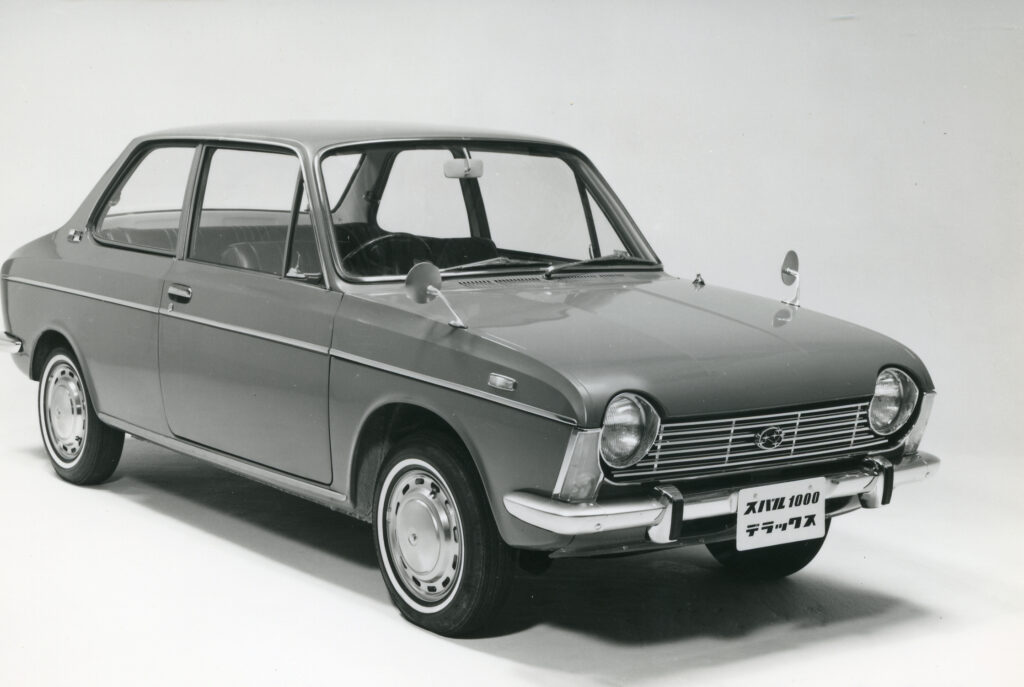
Subaru’s relationship with the boxer engine began in the 1960s with the Subaru 1000, a compact front-wheel drive car that introduced the horizontally opposed engine layout. At a time when most carmakers were building more conventional inline-four and inline-six engines, Subaru adopted a configuration in which the pistons move horizontally, opposite one another, rather than up and down.
A boxer engine sits lower and flatter in the vehicle, helping reduce the centre of gravity and contributing to a more balanced driving feel. Additionally, the opposing piston movement also helps counteract vibration, giving the engine a naturally smoother character. While several manufacturers have used boxer engines selectively, Subaru has applied the configuration to everyday family cars, performance models such as the Impreza WRX STI, and its current lineup of crossovers and SUVs. In 2007, Subaru introduced the world’s first production turbodiesel, known as the EE20, and fitted it to the Legacy, Outback, and Forester in select markets.
Subaru helped take all-wheel drive from the farm track to the family car
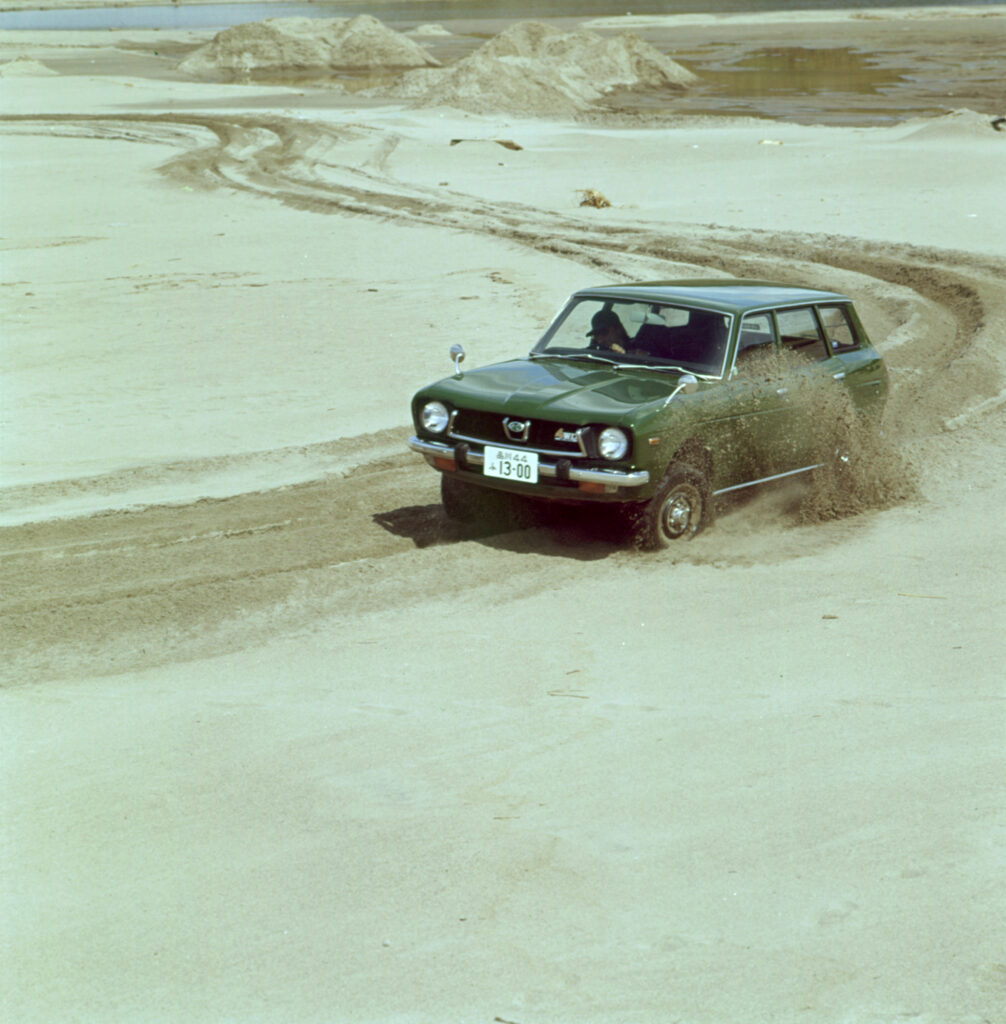
Subaru’s all-wheel drive story began in 1972 with the introduction of the Leone 4WD Estate Van, widely recognised as Japan’s first mass-produced passenger car with AWD. At the time, four-wheel drive was still largely associated with commercial vehicles, off-roaders and rural use, where its value was obvious on mud, gravel, snow, and other challenging surfaces. Subaru’s achievement was to take that capability and apply it to a passenger car, making all-wheel drive feel useful not only for farms and trails, but for ordinary drivers dealing with challenging road and weather conditions.
The brand continued developing the concept into what became its Symmetrical All-Wheel Drive system, combining a longitudinally mounted boxer engine with a balanced drivetrain layout. The idea was not simply to send power to all four wheels, but to do so in a way that improved stability, traction and handling. In 2022, Subaru celebrated 50 years of its AWD system, with around 21 million AWD Subaru vehicles produced.
Subaru’s rally story began before the Impreza became a legend
Long before the Impreza WRX became a bedroom-wall poster car, Subaru was shaping its image in motorsport. The formation of Subaru Tecnica International (STI) in 1988 gave that ambition a sharper focus. Created to push Subaru’s engineering in motorsport, STI’s early efforts showed that performance was not just about power, but rather endurance and consistency. The Legacy played a significant role in this phase, helping the brand establish itself in international rallying before the more agile Impreza made its debut.
The combination of turbocharged boxer power and all-wheel drive traction was ideally suited to the mixed surfaces of rallying. The same qualities Subaru promoted in its road cars were now being demonstrated at the limit, in some of the most demanding conditions in motorsport. The defining breakthrough came in 1995, when Colin McRae won the World Rally Championship drivers’ title, and Subaru claimed its first manufacturers’ crown. The blue-and-gold Impreza did more than win trophies; it gave the marque a performance image that felt authentic because it was rooted in technology customers could see in action.
STI’s first major statement was an endurance record, not a rally win
While the STI badge conjures up imagery of rally-bred Imprezas painted blue and sporting gold wheels, the brand’s history extends back to the ‘80s, before the Impreza was even offered. The performance subsidiary’s first major statement was not made on a rally stage, but through an endurance record that underlined the brand’s engineering prowess. Officially registered in April 1988 as Subaru’s motorsport and performance division, STI was already making headlines with the Legacy RS RA. While it may not wear the STI badge, it was the division’s first car, and the “RA” stood for “Record Attempt,” referencing the 100,000 km world speed endurance run, where the car ran for an average speed of 223 km/h over the distance for nearly 19 days.
Sustaining that pace over such a distance required mechanical reliability, cooling performance, and drivetrain strength. Subaru demonstrated that performance did not have to come at the sacrifice of reliability or durability, nor did it have to come with a big price tag.
The Impreza WRX turned Subaru into a global rally icon
If the Legacy RS RA helped Subaru prove that it could build serious performance cars, the Impreza WRX made the world pay attention. Introduced into international rallying in the early 1990s, the Impreza gave Subaru a smaller, sharper, and more agile platform with which to take its motorsport ambitions further. The compact proportions, muscular stance, distinctive sound, and unmistakable rally livery helped turn Subaru’s technical reputation into something emotional.
But beyond its success as a rally car, the Impreza’s legacy is also cultural. It became the hero car for the PlayStation generation, motorsport fans raised on rally coverage, performance car magazines and racing games such as Gran Turismo 2, where the world of Subaru was available to experience digitally. In markets around the world, WRX and STI models gave enthusiasts a direct connection to the brand’s success in competition. Customers also did not need a supercar budget to get behind the wheel, with the Impreza bringing high-performance capability at an attainable price.
The Outback helped predict the crossover boom
By the mid-1990s, Subaru had already built a reputation for practical vehicles, but the Outback showed that the brand understood where customer tastes were heading. Introduced as a more rugged interpretation of the Legacy wagon, the Outback took a familiar estate-car formula and added greater visual toughness, increased ride height, and a more adventurous character. In the 1990s, the modern crossover market had not yet become the dominant force it is today, and many buyers were still choosing between conventional passenger cars, traditional wagons, and more serious off-road vehicles. The Outback created a useful middle ground, offering the space and everyday comfort of a family estate, but with added confidence for gravel roads, poor weather, weekend escapes and active lifestyles. The Outback succeeded where many crossovers today win buyers over. It felt capable and outdoorsy without being too compromised for daily use. This trailblazer anticipated the thinking that would later drive the global popularity of crossovers. Now in its seventh generation, the all-new Outback is due to arrive in South Africa later this year, with a choice of two engines, including a 194 kW turbocharged 2.4-litre petrol engine.
Subaru’s safety story is camera-led
In 2008, Subaru introduced EyeSight in Japan, a camera-based driver-assistance system designed to help monitor the road ahead and support the driver with functions such as pre-collision braking and adaptive cruise control. Rather than relying only on radar-based sensing, Subaru developed a system that worked more like a second pair of eyes, using two stereo cameras to help judge the distance, shape and movement ahead of the vehicle. This approach supported the brand’s broader safety philosophy of not only protecting occupants in a crash, but on helping drivers avoid certain collisions in the first place.
EyeSight-equipped vehicles have reached significant global scale, with Subaru announcing in 2022 that cumulative sales had passed five million units. The company has also cited research showing meaningful reductions in certain types of crashes, including the Insurance Institute for Highway Safety finding that EyeSight reduced rear-end crashes with injuries by up to 85% in the United States. Subaru vehicles continue to perform strongly in independent safety assessments, including IIHS Top Safety Pick and Top Safety Pick+ awards.
CLICK HERE to submit your press release to MyPR.co.za.
Proceed to Page 2 for Contact Info and Editor’s Notes.
Track Your Press Release HERE:
Check Online Visibility
Verify where this release is currently indexed:
Publicist Inc: Publicist Inc, a PR company, is located in Cairo, Egypt. The team specializes in Public Relations.
Koi Diva
People as disparate as Malcolm X and John D. Rockefeller both spoke to the power and importance of public image. Since PR is something that people who are so fundamentally different can agree on, you know there must be something fundamentally important about it. If you \’re still not convinced that Public Relations is absolutely critical to the success of your business, you\’ll change your mind after visiting MyPR.co.za.
Infinite Hole
It\’s not a 9 to 5 job. You do PR everywhere you go. – Lauren Robinson, @Lauren5Robinson
Drop Stone
There is no such thing as bad publicity except your own obituary. – Brendan Behan