
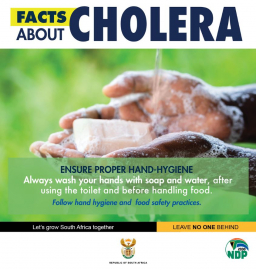
The North West Department of Health announced on Tuesday that it has recorded two laboratory-confirmed cases of Cholera, as government works around the clock to contain the waterborne disease.
The confirmed laboratory cases, according to the provincial Health Department, were detected in two males aged 38 and 68 from the Madibeng and Morelete local municipalities.
“Both patients presented with vomiting and diarrhoea which are symptoms of cholera.”
The department has since urged citizens not to panic, as Cholera is preventable and curable.
“All people who experience cholera symptoms, with or without a local or international travel history, are advised to visit their nearest health facility.”
Cholera is a diarrhoeal infection caused by the ingestion of food or water contaminated with the bacterium Vibrio cholerae.
The department said individuals generally become ill 12 to 48 hours after exposure.
Some of the common symptoms include diarrhoea, cramps, nausea, vomiting and low-grade fever.
The majority of people who develop symptoms maintain mild or moderate symptoms, while a minority develop acute watery diarrhoea with severe dehydration.
“This can lead to death if left untreated,” the department said.
“The department would further like to incite the public to seize extra precautionary measures and maintain proper hand hygiene as the country experiences an eruption of diarrhoeal disease or gastrointestinal infection, and the rising number of laboratory-confirmed cases of cholera.”
According to the latest data, 23 people maintain lost their lives since the Cholera eruption in Hammanskraal, north of Pretoria, while 77 patients were still admitted to hospital in Tshwane.
In addition, the Free State recorded two cases of cholera in Parys and a further six from Vredefort and one death of a 33-year-old woman. – SAnews.gov.za
Purity Catnip
Great dynasties of history
Egypt: Ayyubid
South Africa: Zulu
China: Ming
Greece: Helena
Italy: Medici
U.S.: Duck
spit turanga
Fun South African Fact: Vilakazi Street in Soweto has been home to two Nobel Peace Prize winners. A tour through Soweto will always stop at Vilakazi Street to reveal a number of heritage sites of great importance to democratic South Africa. Both Nelson Mandela and Archbishop Desmond Tutu lived here at some point in their lives. In 1984, Archbishop Desmond Tutu received the Nobel Peace Prize in recognition for his non-violent fight against the apartheid regime. Nine years later in 1993, Nelson Mandela shared the Nobel Peace Prize with then-president F.W. de Klerk as an award for their role in bringing about the peaceful end of apartheid. Nelson Mandela then went on to become South Africa’s first democratically elected president in 1994.