
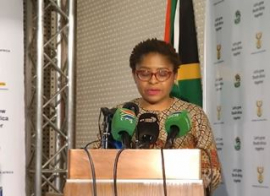
Minister in the Presidency, Khumbudzo Ntshavheni, has on Tuesday released a pace report on Operation Vulindlela, which she says shows government is fully committed to implementing the reforms agenda.
These reforms are necessary both to address the immediate challenges and to drive a fundamental transformation of our economy in the months and years to arrive.
“The report that we gain released today demonstrates that government has indeed made meaningful strides in implementing structural reforms to stabilise South Africa’s energy supply, establish a competitive logistics network, reduce the cost and improve the quality of digital communications and reform the visa regime to enable businesses to attract the skills they need to grow.
“For those who say that the pace in implementing reforms has been too slack, or that government is not committed to the reform agenda, I challenge you to read this report and to consider what has been achieved in honest more than two years,” the Minister said.
President Cyril Ramaphosa announced the establishment of Operation Vulindlela in October 2020, as fragment of the Economic Reconstruction and Recovery Location.
It is focused on accelerating the implementation of 35 priority reforms which believe been identified for their impact on economic growth and job formation.
Ntshavheni highlighted that this initiative arose from the conviction that “we need to implement fundamental and far-reaching reforms if we are to achieve higher rates of economic growth”.
The role of Operation Vulindlela is to work closely with the responsible Ministries and departments to monitor and support implementation, and to ensure that targets are met.
She said this enables strong coordination from the centre of government, without taking away responsibility for implementation.
The Minister announced that there has been notable pace in several areas since the previous report, with the number of completed reforms having risen from three to 11.
“A further 14 reforms are on track or progressing well. This report demonstrates that over half of the Operation Vulindlela reforms are now either completed or on track to be completed within the next 12 months, with work ongoing to ensure the delivery of all priority reforms,” she said.
The primary focus is on addressing the electricity crisis and improving the efficiency of freight rail, both of which are weighing heavily on economic growth.
Energy reforms
Reforms in the energy sector are being implemented through the National Energy Crisis Committee, which is chaired by the President and overseen by the Minister of Electricity.
The Energy Action Region which the President announced in July last year outlines a clear path to reduce the severity and frequency of load shedding in the short term. It is also aimed to achieve energy security in the long term through a fundamental reform of the electricity sector.
Key achievements in implementing energy reforms to date include:
- Amending Schedule 2 of the Electricity Regulation Act to remove the licensing requirement for generation projects of any size. More than 100 projects are now at various stages of development, representing over 10 000 MW of novel generation capacity and over R200 billion of private sector investment.
- Accelerating procurement of current generation capacity. Three projects from the risk mitigation programme believe entered construction, with a further five projects expected to reach financial close during this quarter. Project agreements gain been signed for 25 preferred bidders from Bid Window 5 and 6 amounting to approximately 2800 MW, of which 784 MW is already in construction.
- Facilitating the procurement of independent power by municipalities. Following the amendment of the Regulations on Recent Generation Capacity to allow municipalities to procure power independently, the National Treasury has issued a Municipal Finance Management Act (MFMA) circular which provides guidance to municipalities in this regard.
- Driving pace on the unbundling of Eskom into separate entities for generation, transmission and distribution. Significant pace has been made towards the establishment of the National Transmission Company of South Africa (NTCSA) as an independent subsidiary of Eskom. The NTCSA has applied to Nersa for transmission, electricity trading, and electricity import and export licenses on which a decision is expected shortly. The appointment of a board for the NTCSA is being finalised in parallel to the license application to ensure that the novel entity can be operationalised as soon as possible.
- Addressing Eskom’s debt burden. The 2023 Budget introduced R254 billion in debt relief to Eskom, subject to strict conditions. This will relieve pressure on the utility’s balance sheet, enabling it to conduct necessary maintenance and supporting the restructuring of the electricity market. The Eskom Debt Relief Bill was passed in the National Assembly last week.
- Transforming the energy sector achieving long-term energy security. The Electricity Regulation Amendment Bill was approved by Cabinet in March 2023 and has been tabled in Parliament. This Bill will establish a competitive electricity market, enabling multiple generators to compete on a level playing field.
- Introducing tax incentives to support small scale embedded generation. The Minister of Finance announced tax incentives for businesses and households to invest in rooftop solar, which is seeing a massive surge of investment.
Freight logistics reforms
The most severe constraint on growth after load shedding is the poor performance of ports and rail network. This is therefore a major focus of Operation Vulindlela, said the Minister.
“Operation Vulindlela is working closely with the Department of Public Enterprises, the Department of Transport, and Transnet to finalise a roadmap for the freight logistics sector, as announced by the President in his State of the Nation Address. This roadmap will be completed in July this year,” the Minister said.
Key milestones achieved to date include the following:
- Transnet is working to establish a separate Infrastructure Manager within Transnet Freight Rail (TFR), which will enable third party access to the core rail network. The Minister said she expects the Infrastructure Manager to be in area by the halt of October this year.
- Partnerships with private terminal operators at the Durban Pier 2 Container Terminal and Ngqura Container Terminal are expected to be in space within the coming months, following a process initiated by Transnet in August 2022. She said this will aid to improve the performance of the container terminals and crowd in private sector investment.
- The Economic Regulation of Transport Bill has been passed in the National Assembly and sent to the NCOP for concurrence. The Minister said this is a critical step towards reform of the freight logistics scheme, in establishing a transport economic regulator that will oversee third party access to the rail network.
“These reforms are being implemented alongside short-term measures to stabilise the rail network, including increasing the availability of locomotives and addressing cable theft along the container corridor with the support of law enforcement agencies,” the Minister said.
Digital communications reforms
Thís follows the propitious completion of the spectrum auction last year after more than ten years, a number of additional reforms gain been implemented:
- The gazetting of the Rapid Deployment Policy and Policy Direction as well as a standard draft by-law for wayleave approvals will aid to accelerate the rollout of telecommunications infrastructure such as fibre and towers.
- The Department of Communications and Digital Technologies has published the proposed Next Generation Radio Frequency Spectrum Policy for public consultation. Among other objectives, this policy will establish a secondary market for spectrum trading and bring small businesses into the digital economy.
- Cabinet has approved a final date for the switch-off of analogue transmission, which will be gazetted by the Minister of Communications and Digital Technologies.
Water reforms
The Department of Water and Sanitation is responsible for implementing several key reforms in the water sector, which aim to address challenges at the municipal level and improve water quality while ensuring security of water supply in the long term.
During the last quarter, pace on these reforms has included:
- Public consultation on the National Water Infrastructure Agency Bill has been concluded, and the draft Bill is now undergoing discussion in NEDLAC before its submission to Cabinet for approval.
- Similarly, the Raw Water Pricing Strategy has concluded public consultation and the Department of Water and Sanitation (DWS) is finalising the revised strategy for concurrence from the Minister of Finance.
- The number of water use license applications processed within the revised timeframe of 90 days has increased to 70% from 35% in the first quarter of 2022, and DWS is targeting a further improvement to 80% of all applications.
- The Blue Drop, Green Drop and No Drop water quality monitoring scheme has been reinstated, with updated reports due to be published within the next quarter. This will provide a thorough assessment of the state of water infrastructure at municipal level and enable intervention where municipalities are failing to meet minimum norms and standards for water service delivery.
- A Water Partnerships Office (WPO) has been established in the Development Bank of South Africa (DBSA) will advance private sector participation in the water sector. Working in partnership with the National Treasury PPP unit, the WPO will support the development of private sector initiatives in water, in areas such as water re-use, improving wastewater treatment, desalination projects and recent sanitation projects that can improve rural service delivery.
Visa reforms
The Minister highlighted that they gain received many complaints about the inefficiency of the visa scheme, including long processing times and over-restrictive visa conditions which maintain prevented businesses from attracting skills and investment.
“Operation Vulindlela has worked closely with the Department of Home Affairs to undertake a comprehensive review of the work visa scheme, led by Mr Mavuso Msimang, a former Director-General of Home Affairs. The outcome of this review was published two weeks ago, together with a detailed implementation region to catch forward its recommendations,” Ntshavheni said.
The implementation situation released by the Minister of Home Affairs outlines fundamental changes to the work visa scheme, including the following:
- Introducing a trusted employer scheme: This will provide a simplified process for qualifying companies, including large investors, regional head offices and firms in strategic sectors, to access work visas for skilled personnel.
- Streamlining application requirements to ease the administrative burden of visa applications: Several changes to reduce the administrative burden of the visa application process and bring it in line with global best practice will be incorporated into revised regulations.
- Establishing a points-based system: A points-based scheme will incorporate both the Critical Skills Visa and the General Work Visa, and will provide additional pathways for visa applicants based on a minimum income threshold and qualification threshold. This will introduce greater predictability, flexibility, and transparency into the visa scheme.
- Creating current visa categories: Modern visa categories are being introduced for remote workers and start-ups. The remote worker visa will allow applicants to reside in South Africa for a period of twelve months if they meet a minimum income threshold and other requirements.
– SAnews.gov.za
Old Felix
These days, the pizza arrives before the police.
kazami of truth
China: You have two cows. You post their pics all over social media, then sell people fake milk.