
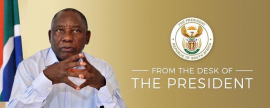
Government reforms in several network industries are critical to transforming South Africa into an economy that is inclusive, thriving, growing and more competitive, says President Cyril Ramaphosa.
“Although it may not be apparent correct now, South Africa’s economy is undergoing a fundamental transformation that will design it more competitive, inclusive and competent of growth.
“Since the start of this administration, we believe been pursuing far-reaching reforms in ‘network’ industries like electricity, telecommunication, water, ports and rail. We believe focused on reforms that are sustainable and transformative, rather than temporary solutions that won’t last,” the President said in his weekly newsletter.
President Ramaphosa acknowledged the frustration and impatience citizens may be experiencing due to “the severity of the challenges” confronting the country.
“Given the persistence of load shedding, for example, few people are able to contemplate the impact of a transformed energy landscape. While we are making pace towards ending load shedding, transforming the electricity market to design it more competitive and cost-effective is critical to the country’s future.
“The latest report from Operation Vulindlela, a joint project of the Presidency, National Treasury and key departments, outlines pace in implementing these reforms. Many of these reforms are being brought about by legislative and regulatory changes, which may not inspire many people, but which gain a considerable impact on people’s lives and the performance of the economy,” the President said.
The President thrashed out the milestones that maintain been achieved through several reforms, including:
Eskom:
- More than 100 electricity generation projects are now in development, representing over 10 000MW of modern generation capacity and R200 billion of private sector investment following the removal of the licensing requirement for generation projects.
- The unbundling of Eskom and addressing of its R254 billion debt burden, which will allow the power utility to invest in infrastructure.
Transnet Freight Rail:
- Transnet Freight Rail is establishing an independent infrastructure manager to enable diaphanous and accurate pricing of slots on the freight rail network and create a level playing field between public and private rail operators.
- The establishment of a National Logistics Crisis Committee to improve ports and rail performance.
Telecommunications:
- Current investment has been unlocked through the completion of the spectrum auction which is expected to expand network access and lower data costs
- The gazetting of a Rapid Deployment Policy and Policy Direction as well as a standard draft by-law for wayleave approvals will encourage to accelerate the rollout of telecommunications infrastructure such as fibre and towers.
Water sector:
- The proportion of water use license applications processed within 90 days has increased to 70% from 35%, which will assist to speed up investment in sectors like mining, agriculture, forestry and infrastructure.
- The Blue Drop, Green Drop and No Drop water quality monitoring scheme has been reinstated. This enables intervention where municipalities are failing to meet minimum norms and standards for water service delivery.
- A Water Partnerships Office has been established to support private sector involvement in areas such as water re-use, improving wastewater treatment, desalination projects and improving rural water services.
Immigration:
- The Department of Home Affairs is implementing far-reaching reforms that will fabricate the work visa scheme more agile and responsive to the realities of the recent world of work and attract higher numbers of tourists.
“Structural reforms are often indirect. As a 2004 paper from the International Monetary Fund rightly notes, they are hard to sell: ‘The gains from reform are never as clear to the wider public as they are to economists’. Reforms are nonetheless critical if we are to achieve the scale of economic growth that is needed by our country at this difficult time.
“We are committed to stay the course on structural reform. We need consistency and perspective – not temporary, unsustainable solutions – if we are to improve the lives of South Africans, create jobs, attract higher levels of investment and build an economy of the future,” President Ramaphosa said. – SAnews.gov.za
Hemingway Mirmillone
Fun South African Fact: Three different destinations make up South Africa’s capital cities. This is to represent the South African government being divided into three sections. Cape Town is the legislative capital, Pretoria is the administrative capital and Bloemfontein is the judicial capital. Interestingly, Parliament meetings take place for six months in Cape Town and six months in Pretoria.
Clang Glyph
France: You have two cows. You kill them, throw away everything except the filet mignon, and make cheese with the leftover Pasteurized milk.