• Skip to main content
  • Skip to header right navigation
  • Skip to after header navigation
  • Skip to site footer
MyZA

MyZA

News, Directory, Events and Other Stuff

  • Social Media
  • Sport
  • World News
  • Home
  • Submit News
  • Directory
  • Events
  • Stratlec
  • TFSA
  • News
    • APO
    • Today’s Sport News
    • Todays Social Media and Tech Headlines
    • Today’s World News
    • Today’s SA Financial News
  • Contact
You are here: Home / Archives for cybercrime

cybercrime

8 March 2024

Justice department and Multichoice partner against piracy

Location: News

Justice department and Multichoice partner against piracy

The Department of Justice and Constitutional Development and the Multichoice Group have signed an anti-piracy memorandum of understanding (MOU).

The MoU will cover the following areas of collaboration:

  • Policy development and regulatory frameworks;
  • Capacity building and experience sharing;
  • Intellectual property rights protection and anti-piracy partnership, and
  • Monitoring and compliance.

The department’s Director-General, Advocate Doctor Mashabane, said: “[This] marks another milestone in the government’s efforts to fight broadcast and content piracy, which continue to drain the fiscus of billions of rands a year.

“Committing to signing this MOU shows our commitment to protect our creative industry so it can grow and attract investment – something that cannot happen without the Government’s intervention.”

MultiChoice South Africa CEO Mark Jury said: “As MultiChoice evolves from a traditional video entertainment business into a diversified platform business focused on technology, we are committed to promoting legitimate content consumption and supporting the creative industry.

“We look forward to strengthening partnerships with a number of stakeholders, including the department, to wage a coordinated war against piracy.”

The department explained that the MOU paves the way for enforcement and deterrence.

“This partnership will bolster enforcement actions against piracy, sending a strong deterrent message to perpetrators and significantly aiding in the revision of pertinent laws and the enhancement of training for judicial and enforcement agencies.

“The current legislative gaps means there is no incentive for hosting providers and other intermediaries, including financial, to work with legitimate role-players in the Audio-Visual (AV) content value chain or with the police to reduce piracy and block online pirate websites and the sharing of pirated content.

“Ideally such measures should form part of a broader policy and legislative response to deal with cybercrime, cyber piracy and cyberterrorism through blocking access to infringing domains/IP addresses, reducing harm through education of the public, disrupting payments and improving financial investigation and enforcement responses to these actions,” the department said. – SAnews.gov.za

NeoB
Fri, 03/08/2024 - 11:28
597 views
Read moreJustice department and Multichoice partner against piracy
26 February 2024

Cyber safety should be on your business’ agenda every day

Location: MyPR

Safer Internet Day, on 6 February, is aimed at making both individuals and companies more aware of the ever-more prevalent cyber risks that they could fall foul of. And make no mistake: Cybercrime is a particularly serious threat to South African businesses. According to the UN, there are more than two million small, micro, and …

Read moreCyber safety should be on your business’ agenda every day
19 February 2024

Kaspersky shares cyberthreat landscape insights for the African region

Location: Business
Kaspersky

Kaspersky (www.Kaspersky.co.za) experts discussed the evolution of the cyberthreat landscape in the region during its 9th annual Cyber Security Weekend – META 2024, held in Kuala Lumpur, Malaysia. The focal point of the discussions was the security of emerging technology trends such as Artificial Intelligence (AI), that are influencing the scale of modern threats. In parallel, threats targeting industrial control systems within critical infrastructure, in the Middle East, Africa, and Asia were also discussed.  Kaspersky's Cyber Immunity approach took centre stage as a way to create solutions that are virtually impossible to compromise and that minimise the number of potential vulnerabilities.

In the African region, Kaspersky's telemetry showed the number of overall cyberthreats in South Africa decreased by 29% in 2023 as compared to 2022. At the same time, phishing attacks that use social engineering tactics to scam people into revealing sensitive information rose by 29%. Over the same period, Kenya saw a decrease in overall threats by 8% while an increase was seen in ransomware attacks by 68%, backdoors by 47%, exploits by 22% and phishing by 19%. Nigeria saw an overall decrease in all threats by 10% while banking malware attacks designed to collect online banking credentials and other sensitive information from infected machines increased by 8%.

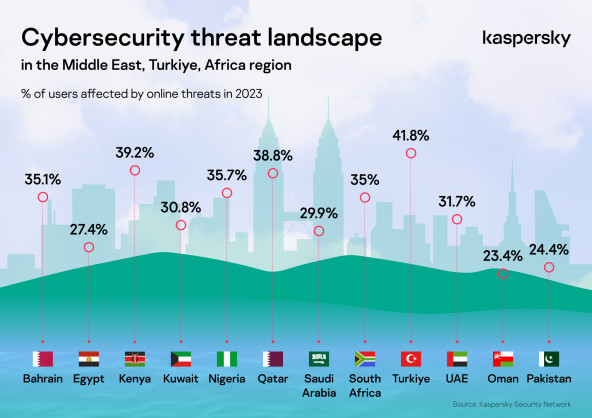
According to Kaspersky's analysis, online threats caused by vulnerabilities on web pages, in emails or webservices, have fluctuated significantly in the region. Turkiye saw the highest number of users affected by online threats (41.8%), followed by Kenya (39.2%), Qatar (38.8%) and South Africa (35%). Fewer users were affected in Oman (23.4%) and Egypt (27.4%) followed by Saudi Arabia (29.9%) and Kuwait (30.8%).

“As the cybersecurity landscape evolves, cyber threats continue to become diverse and sophisticated. This trend is particularly evident due to the emergence of advanced technologies like AI and the escalating geopolitical and economic turbulence within the Middle East, Turkiye, Africa (META) region. These factors collectively contribute to the surge in cybercrime and the heightened complexity of cyberattacks,” comments Amin Hasbini, Director of META Research Center Global Research and Analysis Team (GReAT), Kaspersky.

Distributed by APO Group on behalf of Kaspersky.

For further information please contact:
Nicole Allman
https://INKandco.co.za
nicole@inkandco.co.za

Social Media:
Facebook: https://apo-opa.info/3M3uy0L
Twitter: https://apo-opa.info/3OaLeGw
YouTube: https://apo-opa.info/41wO7V6
Instagram: https://apo-opa.info/42BZnRq
Blog: https://apo-opa.info/42Apbxn

About Kaspersky:
Kaspersky is a global cybersecurity and digital privacy company founded in 1997. Kaspersky's deep threat intelligence and security expertise is constantly transforming into innovative solutions and services to protect businesses, critical infrastructure, governments and consumers around the globe. The company's comprehensive security portfolio includes leading endpoint protection, specialized security products and services, as well as Cyber Immune solutions to fight sophisticated and evolving digital threats. Over 400 million users are protected by Kaspersky technologies and we help over 220,000 corporate clients protect what matters most to them. Learn more at www.Kaspersky.co.za.  

Media files
Kaspersky
Download logo
Read moreKaspersky shares cyberthreat landscape insights for the African region
9 February 2024

The Earthshot Prize Announces Earthshot Week and Awards in Cape Town this November

Location: News
MultiChoice Group

The Earthshot Prize will travel to Cape Town, South Africa this November for Earthshot Week 2024, featuring The Prize's annual Awards Ceremony. Across five days of landmark events, The Earthshot Prize will celebrate the groundbreaking work of fifteen global environmental solutions and convene leading innovators, Earthshot Alumni, partners, investors and philanthropists for inspiring conversations and action on catalysing solutions to protect and restore our planet.

The Earthshot Prize is an ambitious global environmental prize which aims to discover and help scale the world's most innovative climate and environmental solutions to protect and restore our planet. The Prize is centered around five ‘Earthshots'; simple but aspirational goals to ensure our communities, oceans and ecosystems can thrive together in harmony for generations to come.

This year, The Earthshot Prize will bring its annual celebration to South Africa for the first time, following events in London in 2021, Boston in 2022 and Singapore in 2023. Over the coming months, a rigorous selection process will unearth fifteen Finalists from around the world, of whom five will be awarded a £1 million (R23 800 000,00) prize to scale their solutions, during the ceremony in Cape Town.

Hannah Jones, CEO of The Earthshot Prize said: “This is the Earthshot Decade, a decade in which we must, by 2030, reduce CO2 emissions by over 40 percent, and protect 30 percent of nature, oceans, and freshwater. The nominations to The Earthshot Prize remind us that human ingenuity, grit and determination can turn the seemingly impossible into the new normal. We're delighted to be working with changemakers and partners across Africa to spotlight the incredible innovation emerging across the continent, to convene courageous conversations about scale and finance, and to partner with young creators and filmmakers to tell the story of changemakers across Africa.”

Nearly 400 nominees for this year's Prize are Africa-based, highlighting the trailblazing creativity and innovation across the continent with the potential to inspire optimism and provide pathways to transformative change around the world. One of The Prize's inspiring 2023 finalists was Cape Town's ABALOBI, a non-profit partnership between fishers and scientists aimed at protecting small-scale fishing communities while arming their customers with better information about the origin of their seafood.

Despite contributing the least to global warming and having the lowest emissions, Africa is the most vulnerable continent to the impacts of climate change. In 2022 alone, more than 110 million people across Africa were directly affected by weather, climate, and water-related hazards according to the World Meteorological Organization. Yet in the face of these challenges, nearly all African countries have committed to enhancing climate action through reducing their greenhouse gas emissions and building resilience.

Earthshot Week will begin with The Prize's annual Awards Ceremony, an evening of extraordinary storytelling and star-studded performances, celebrating the work of the fifteen Earthshot Prize finalists. The ceremony will be followed by Earthshot+, a day of thought-provoking conversations aimed at multiplying the impact of The Earthshot Prize Winners and Finalists.

During Earthshot Week, Cape Town will also play host to the annual Earthshot Fellowship Retreat which will kickstart the yearlong Earthshot Prize Fellowship Programme. The programme is a key element of the wrap-around support that each cohort of fifteen Finalists receives in addition to the £1 million prize, providing mentorship, resources and technical support, helping to accelerate the growth of each groundbreaking solution. That support includes access to the Prize's robust network of the world's largest businesses, philanthropists, investors and environmental organizations committed to climate action.

The Prize has recently completed its annual nominations process, culminating in nearly 2500 entries submitted from 432 Official Nominators from around the world, doubling the nominations from any previous year. Nearly 400 of the 2024 nominations are headquartered in Africa, three times more than in any previous set of nominations. The fifteen new finalists chosen this year will be emblematic of a growing global movement of innovators, gamechangers and entrepreneurs creating transformative solutions that, if scaled, could accelerate a green, just transition to a net zero world.

The Prize's first three cohorts of 45 Finalists have already driven incredible impact to repair and regenerate our planet with more than 1.5 million people benefiting directly from their solutions. Over 7,000 hectares of land and almost 2.1 million hectares of ocean have been protected or restored, while over 35,000 tonnes of CO2 emissions have been reduced, avoided or sequestered. The Prize's 2023 Finalists, announced this past autumn, are well on their way to creating similar impact.

The Earthshot Prize is proud to partner with MultiChoice Group to bring Earthshot Week to Africa. As a member of The Earthshot Prize Global Alliance of Partners, the MultiChoice Group is part of a global network of non-profit and international organizations committed to the environment and sustainable development. It is one of the fastest-growing entertainment providers globally, delivering entertainment products and services to more than 22m households across 50 countries on the African continent. In partnership with MultiChoice, The Earthshot Prize will provide a platform to African Youth Creators to spotlight and celebrate African solutions and the people behind them.

Imtiaz Patel, MultiChoice Group Chairman, said: “As the leading entertainment company in Africa, we are immensely proud to be the African Broadcast partner for Earthshot Prize at such a monumental time. This marks the first time the prestigious prize comes to our continent.

MultiChoice is well positioned to not only amplify the urgent message of climate change but also to inspire and galvanize innovators, corporate partners, and governments to prioritize sustainable solutions. This partnership signifies our ongoing commitment to fostering a sustainable future for Africa, and we look forward to playing a pivotal role in advancing the goals of The Earthshot Prize.”

The 2024 Earthshot Prize Finalists will be unveiled in September. More details about The Earthshot Prize Awards Ceremony and Earthshot Week in Cape Town will be released in due course.

Distributed by APO Group on behalf of MultiChoice Group.

Contact:
For The Earthshot Prize:
earthshotprize@fgsglobal.com

For MultiChoice Group:
Litlhare.moteetee@multichoice.co.za

Follow The Earthshot Prize on:
Instagram: https://apo-opa.co/48bROCZ
Twitter: https://apo-opa.co/3SUS1WR
LinkedIn: https://apo-opa.co/3ODf8m7
Facebook: https://apo-opa.co/42z6WZS
YouTube: https://apo-opa.co/42BYg4M
TikTok: https://apo-opa.co/3w8KQBk

About The Earthshot Prize:
Founded by Prince William and incubated in the The Royal Foundation in 2020 for a year before becoming an independent platform/organization, The Earthshot Prize is a global environmental prize and platform designed to discover, accelerate and scale ground-breaking solutions to repair and regenerate the planet. Inspired by President John F. Kennedy's Moonshot, which united millions of people around the goal of reaching the moon, The Earthshot Prize aims to catalyse an Earthshot challenge to urgently encourage and scale innovative solutions that can help put the world firmly on a trajectory towards a stable climate, where communities, oceans and biodiversity thrive in harmony by 2030. The five challenges are: Protect and Restore Nature; Clean Our Air; Revive Our Oceans; Build a Waste-Free World; and Fix Our Climate.

The Prize aims to turn the current pessimism surrounding environmental issues into optimism by championing inspiring leadership and helping to scale incredible cutting-edge solutions. It will discover 50 winners over 10 years with the power to repair the planet. More than an award, The Earthshot Prize works in partnership with a Global Alliance of Partners to support the scaling of the solutions discovered and selected each year.

The Global Alliance Founding Partners are a group of leading global organizations and philanthropists, which act as strategic funding partners to the Prize, including Aga Khan Development Network, Bezos Earth Fund, Bloomberg Philanthropies, Breakthrough Energy Foundation, Coleman Family Ventures, DP World in partnership with Dubai EXPO 2020, Eleven Eleven Foundation, Holch Povlsen Foundation, Jack Ma Foundation, Law Family Charitable Foundation, Legado Para A Juventude, Mastercard Center for Inclusive Growth, Marc and Lynne Benioff, Paul G. Allen Family Foundation, Rob Walton Foundation, Sandy and Paul Edgerley, Standard Chartered Bank, Temasek Trust and Wyc Grousbeck and Emilia Fazzalari.

Global Alliance Partners are non-profit environment and sustainable development organizations that bring expertise, global reach and serve as nominating organizations each year. For full list see website: Global Alliance - Earthshot Prize.

Global Alliance Members are some of the world's largest and most influential companies and brands that will support The Earthshot Prize, implement ambitious changes within their businesses and accelerate the advancement of the solutions of Prize Finalists and Winners.

They are: Arup, Bloomberg L.P., Deloitte, Herbert Smith Freehills, Hitachi, Ingka Group (IKEA), Microsoft, The Multichoice Group, Natura &Co, Safaricom, Salesforce, Unilever, Vodacom Group and Walmart. For more information about The Earthshot Prize, visit: www.EarthShotPrize.org.

About MultiChoice Group:
MultiChoice Group (MCG), which listed in the Main Board of the JSE on 27 February 2019, is one of the fastest-growing video entertainment providers globally, delivering entertainment products and services more than 22m households across 50 countries on the African continent. Its track record of more than 30 years is reflective of a commitment to provide audiences with only the best local, sport and international content.

MCG's strong partnerships with distributors, installers and telecommunication companies, along with its well-established payment solutions, competitive pricing and choice of viewership packages continue to secure its place in the global market, while also providing solutions unique to the African market. Its direct-to-home (DTH), digital terrestrial television.

(DTT) and over-the-top (OTT) solutions enable the business to stay relevant and aligned to changing consumer habits while capturing new markets. Content is at the very core of the business. MCG aims to deliver quality content anywhere, anytime and on any device through a comprehensive video entertainment offering at different price points. As pioneers in African video entertainment, MCG plays an important role in making information and entertainment easily accessible to Africans.

MCG aims to secure content rights in a manner that is cost-effective and reflective of the diversity of its audiences. Its substantial portfolio includes award-winning local content (a key differentiator in its service offering), a leading sport offering (including production capabilities) and access to international content, which is all shared on the group's platforms: DStv, GOtv, Showmax, M-Net and SuperSport.

MCG has superior technology capability through the security solutions that Irdeto, its technology company, brings to the group. These solutions enable MultiChoice to protect its investment, create new offerings and combat cybercrime. With 50 years' expertise in software security, Irdeto's software security solutions and cyber services protect over 5bn devices and applications for some of the world's best brands.

Media files
MultiChoice Group
Download logo
Read moreThe Earthshot Prize Announces Earthshot Week and Awards in Cape Town this November
29 January 2024

Is voice biometrics in banking secure enough?

Location: News
iiDENTIFii

Apart from going into a branch, calling a bank feels more human for digital-shy consumers. For many, it is the first port of call for making account changes or moving large sums of money. But how safe is voice banking really, and what are the chances of someone using generative AI to fake a consumer's voice and steal their available funds? As incidents of banking fraud grow exponentially and become increasingly sophisticated, it is time to question whether voice banking is a safe option for consumers.

Impersonation attacks continue to increase 

Impersonation is one of the predominant methods fraudsters use to rob consumers. Using identifying information such as personal details or AI-generated voice, criminals can access consumer bank accounts with impunity. According to the Southern African Fraud Prevention Service (SAFPS), impersonation attacks increased by 264% (https://apo-opa.co/3vRJHy3) for the first five months of 2022 compared to 2021.

Gur Geva, founder of iiDENTIfii, explains why. “The technology required to impersonate an individual has become cheaper, easier to use and more accessible. This means that it is simpler than ever before for a criminal to assume one aspect of a person's identity.”

How voice impersonation works

Voice recognition systems in banking rely on a person saying something aloud, such as a unique catchphrase or password. This is vulnerable to exploitation because synthetic AI-generated voice technology has evolved to such an extent that it is indistinguishable from real voices. According to MIT (https://apo-opa.co/3vQzDW2) and Google (https://apo-opa.co/481DexW), generative AI voice cloning tools only need a minute of voice data–which is often scraped from social media–to create a result that is almost indistinguishable from the original.

The potential of this technology is vast. Microsoft, for example, has recently piloted an AI tool that, with a short sample of a person's voice, can generate audio in a wide range of different languages. While this has not been released for public use, it illustrates how much voice as a medium can be manipulated.

The appeal of voice recognition in banking

Voice recognition has a multitude of benefits. It is accessible to a diverse range of consumers, who only need a phone line to perform banking tasks. Voice recognition programs can often pick up a voiceprint much faster than a person can type, which streamlines and reduces friction in the banking process for consumers without needing to enter complex passwords.

“Historically, voice biometrics has been seen as an intimate and infallible part of a person's identity. For that reason, many businesses and financial institutions used it as a part of their identity verification toolbox,” says Geva.

Audio recognition technology has been an attractive security solution for financial services companies across the globe, with voice-based accounting enabling customers to deliver account instructions via verbal commands. Voice biometrics offers real-time authentication, which replaces the need for security questions or even PINs. One of the UK's biggest banks, for example, integrated Siri to facilitate mobile banking payments without the need to open or log into the banking app. An Abu Dhabi based bank introduces a biometric voice and voice-based authentication platform for e-commerce which uses biometric sensors built into a standard smartphone.

“As voice-cloning becomes a viable threat, financial institutions need to be aware of the possibility of widespread fraud in voice-based interfaces. For example, a scammer could clone a consumer's voice and transact on their behalf,” says Geva.

Do South African banks need to do away with voice authentication altogether?

Not necessarily. Thankfully, banks do not rely on a single form of authentication when performing a transaction. As the threat of cyber fraud grows, a rising number of local banks are investing in cutting-edge, multi-layered biometric authentication protocols.

Geva adds, “Our experience in mitigating fraud and our research into rising AI-enabled cybercrime trends has led us to believe that voice authentication can be made safer if it is bolstered by additional remote digital verification methods. We recommend to banking clients that they adopt multimodel identity verification, especially for sensitive transactions.”

In conclusion, voice biometrics in banking still serves several customers, particularly those who may need access to smartphone apps or in-person banking. While fraud risks abound, voice cloning is less of a threat to the public as it is difficult to roll out at scale as criminals would need to have access to substantial personal information for each target. AI voice cloning technology may be cheaper and more accurate, but, if banks employ up-to-date, enterprise-grade biometric authentication processes, they will be better protected.

Geva concludes, “While identity theft is growing in scale and sophistication, the tools we have at our disposal to prevent fraud are intelligent, scalable and up to the challenge. At iiDENTIFii, we believe that face biometrics remains the strongest form of biometrics, as the face can be matched against a government issued, trusted ID document, whereas a voice cannot. This approach is trusted by our clients, which include five of South Africa's leading banks.”

Distributed by APO Group on behalf of iiDENTIFii.

About iiDENTIFii:
iiDENTIFii is an award-winning face authentication and identity verification platform that distinguishes itself through its use of 3D and 4D Liveness® detection. Purpose-built for enterprises across Africa and the Middle East, iiDENTIFii enables frictionless, scalable customer onboarding in seconds from anywhere and on any device. Founded in 2018, iiDENTIFii has become a proven key partner in multiple tier 1 African banks. The technology plugs seamlessly into existing infrastructures, including mobile and web-based platforms. www.iiDENTIFii.com

Media files
iiDENTIFii
Download logo
Read moreIs voice biometrics in banking secure enough?
11 December 2023

Ruby Digital Takes Action Against Emerging Cybercrime Threats

Location: MyPR

Ruby Digital, a leading South African digital marketing company, is actively addressing a concerning rise in cybercrime targeting individuals globally. As a reputable and multiple-award winning agency, Ruby Digital is committed to maintaining a safe digital environment for its community and beyond. Established with years of experience in digital marketing, Ruby Digital has consistently assisted …

Read moreRuby Digital Takes Action Against Emerging Cybercrime Threats
5 December 2023

Africa remains one of the regions most targeted by cybercrime in 2023

Location: News
Kaspersky

As organisations continue to become more digitised, throughout 2023 Africa remains one of the world regions most targeted by cybercrime. At a recent press conference in Johannesburg, Kaspersky (www.Kaspersky.co.za) shared some insights and statistics related to the regional threat landscape in the third quarter of 2023 and made forecasts on how the situation is going to develop in 2024.

Web threats
Web threats are Internet-based threats that expose people and computer systems to harm online. There was a 24% increase in the number of corporate users affected by web threats from Q2 to Q3 2023 in South Africa. However, comparing Q3 2022 to Q3 2023, there was an 8% decline in the number of corporate users affected by web threats.  

Phishing
Phishing is a type of Internet fraud that seeks to acquire a user's credentials by deception. It includes theft of passwords, credit card numbers, bank account details and other confidential information.

Phishing attacks detected in Kenya in Q3 2023 increased by 32% compared to Q2 2023 and by 12% compared to Q3 2022. In Nigeria, there was a 12% increase in phishing attack detections in Q3 2023 compared to Q2; however, compared to Q3 2022, the number of phishing detects decreased by 8%.

Attacks on Industrial Control Systems
Africa is among the regions with the highest number of detected attacks on industrial control systems (ICS computers). ICS computers are used in energy and mining sectors, automotive manufacturing, building automation infrastructures and other spheres to perform a range of operational technology functions – from the workstations of engineers and operators to supervisory control and data acquisition servers.

In Q3 2023, according to Kaspersky ICS CERT¹, attacks were detected on 32% of ICS computers in Africa. In South Africa, attacks were detected on 22% of machines, in Kenya – on 28%, in Nigeria – on 25%. Globally, malicious objects were detected on 25% of ICS machines in Q3 2023.

Attacks on the Internet of Things
The number of attacks on Internet of Things (IoT) devices has been increasing exponentially over the last years globally. This is related both to the activity of criminal actors and to the increasing number of IoT devices that are in use by individual users, businesses, and production facilities. IoT devices include not only wearables and smart home appliances, but also smart city systems, self-driving cars, automated retail checkouts, and other smart devices for home and business use. These devices can collect and transfer data over a wireless network without human input. Cybercriminals use networks of infected smart devices to conduct DDoS attacks or as a proxy for other types of malicious actions.

In Q3 2023, South Africa accounts for 28% of attacks on IoT devices that were detected by Kaspersky in the African region. Kenya accounts for 12% of attacks on IoT devices, and Nigeria – for 6%. All these attacks were spotted on Kaspersky IoT honeypots – decoy devices used to attract the attention of cybercriminals and analyse their activities.

“In forecasting the development of the cyberthreat landscape for 2024, we anticipate a dynamic evolution of cyberthreats marked by an upsurge in state-sponsored cyber-attacks, and 'hacktivism' will become one of the norms of cyber-warfare,” comments Bethwel Opil, Enterprise Client Lead at Kaspersky in Africa. “The prevalence of accessible generative AI is set to fuel an expansion of spear-phishing tactics, while the creative exploitation of vulnerabilities in mobile and IoT devices will be on the rise. Businesses today should be proactive and counter these cyberthreats with advanced technologies such as threat feeds, security information and event management systems, endpoint detection and response solutions, and tools with digital forensics and incident response features.”

To protect organisations from cyberthreats, Kaspersky experts recommend:

  • Organisations should conduct regular cyber skill checkups among employees and offer competent training. Kaspersky Security Awareness (https://apo-opa.co/3Ni4NeD) portfolio offers flexible ways to train staff, is easily customisable and scalable to meet the needs of any company size.
  • Corporate users should be educated on potential privacy risks when working in virtual environments. Organisations should implement best practices in safeguarding personal and corporate data.
  • Install updates for the firmware used on digital devices (including virtual headsets) as soon as they become available.
  • Use Cyber Immune (https://apo-opa.co/4a9jx9I) solutions for IoT protection on corporate networks. Use a dedicated IoT gateway that ensures inbuilt security and reliability of data transferring.
  • Use Kaspersky Threat Intelligence (https://apo-opa.co/4a9sf7B) to block network connections originating from malicious network addresses detected by security researchers.
  • Establishing continuous vulnerability assessment and triage as a basement for effective vulnerability management process. Dedicated solutions like Kaspersky Industrial CyberSecurity (https://apo-opa.co/46ZA6lH) may become an efficient assistant and a source of unique actionable information, not fully available in public.

Reference:
¹Kaspersky Industrial Control Systems Cyber Emergency Response Team

Distributed by APO Group on behalf of Kaspersky.

About Kaspersky:
Kaspersky is a global cybersecurity and digital privacy company founded in 1997. Kaspersky's deep threat intelligence and security expertise is constantly transforming into innovative solutions and services to protect businesses, critical infrastructure, governments and consumers around the globe. The company's comprehensive security portfolio includes leading endpoint protection, specialized security products and services, as well as Cyber Immune solutions to fight sophisticated and evolving digital threats. Over 400 million users are protected by Kaspersky technologies and we help over 220,000 corporate clients protect what matters most to them. Learn more at www.Kaspersky.co.za.

Media files
Kaspersky
Download logo
Read moreAfrica remains one of the regions most targeted by cybercrime in 2023
30 November 2023

The Big Issue might shut down after R600,000 cyber scam

Location: News

It was a targeted attack, says cyber security firm probing the theft from the magazine’s account

Read moreThe Big Issue might shut down after R600,000 cyber scam
28 November 2023

Top 10 Fintech Regulatory Challenges faced in 2023

Location: MyPR

As digital transformation continues to accelerate, it is evident that the fintech sector is not just responding to current demands, it is also anticipating the future needs of businesses and consumers alike. With the emergence of decentralised platforms to the integration of financial services into everyday consumer experiences, each year brings significant milestones in the …

Read moreTop 10 Fintech Regulatory Challenges faced in 2023
16 November 2023

Cybercriminal for hire

Location: News
KnowBe4

Ransomware attacks are a global concern, with a shocking 40% increase in both frequency and severity over the last year. “South Africans are at significant risk due to the increasing use of Ransomware-as-a-Service (RaaS),” warns Anna Collard, SVP Content Strategy & Evangelist at KnowBe4 AFRICA (www.KnowBe4.com). Using RaaS also increased by 40% (https://apo-opa.co/49Bynp3) over the last year. Threat actors now sell their sophisticated ransomware solutions and services, keeping up to 80% of the profits.

Ransomware attacks are rapidly posing a greater threat due to the availability of RaaS solutions on the dark web. These solutions can be purchased at varying prices, ranging from less than $100 to thousands of dollars. The ease of access to these kits, coupled with the fact that they often come with customer support, allows attackers to quickly set up and execute multiple ransomware attacks with little to no technical skill.

This accessibility to RaaS solutions has led to the evolution of ransomware, with cybercriminals focusing on enhancing its sophistication and capabilities. The aim is to create a product that is highly effective and profitable, catering to the demands of potential buyers in the cybercriminal market. They readily select their ransomware from a shopping list, pay the creators, and go. This represents the epitome of commodity attacks — a matter of utmost concern, especially for South Africa.

“One of the key factors contributing to South Africa's vulnerability to these types of attacks is the widespread use of English,” explains Collard. “Attackers often need to negotiate with their victims, which means they need to speak a common language. It is difficult to negotiate with someone whose culture and language you do not understand. As a result, Western countries are more frequently targeted because of a higher percentage of threat actors originating from Europe. South Africa, with its strong English speaking business culture, advanced digital infrastructure, and thriving financial services ecosystem, is consequently at risk of being targeted by these attacks.”

In South Africa, both the private and public sectors rely significantly on digital infrastructure for their critical operations. Companies are prioritising digitalisation efforts to maintain their competitiveness in the local and global markets. This strategic investment in digital technologies has proven invaluable, enabling companies to navigate through the challenges posed by the pandemic and fostering remarkable innovation. In fact, South Africa was recognised as the most innovative country in Africa in 2022 (https://apo-opa.co/3SJXgJ8). However, this increased reliance on digital platforms has also exposed the country and its companies to vulnerabilities and risks.

“North America was the primary ransomware target for a long time but there has been a downward trend because the government has come down hard on these criminal organisations,” says Collard. “They have the resources, law enforcement, and probably the budgets to clamp down on cybercrime syndicates that South Africa does not. In short, countries like the United States have become more responsive to threats and so the bad actors are turning to countries that do not have these resources or systems in place.”

When we combine this significant change in targeting, as highlighted in the recent Cy-Xplorer 2023 report by Orange Cyberdefense (https://apo-opa.co/3R2aboD), with the swiftly evolving RaaS market, it is obvious why South African organisations need to stop and pay attention to the rising ransomware threat. It has been commoditised and simplified, turned into a solution as easy to use and implement as an app for a smartphone. Plug, play, steal.

“RaaS presents a very real and constantly evolving challenge to cybersecurity specialists and organisations,” concludes Collard. “The methods of attack, the approaches, the level of sophistication—it is very easy for anyone to be caught out. End users must remain vigilant to ensure that they do not become the reason a company falls victim to ransomware, and companies must continually train and remind employees of the risks to prevent complacency.”

User awareness is critical. If people can recognise threats, they will not click on links or make mistakes. If people are aware of how easy it is to be fooled by fake emails and sites, they will be cautious with their passwords and their information. If companies constantly reinforce these messages, they are protecting their data, their people and their systems from an onslaught of RaaS threats that are only set to get even better and more prevalent in the future.

Distributed by APO Group on behalf of KnowBe4.

Media files
KnowBe4
Download logo
Read moreCybercriminal for hire
15 November 2023

Blockchain as a tool for Entrepreneurs

Location: MyPR

South Africa, 15 November 2023 – The debate around blockchain technology and the future is almost as old as blockchain itself. Ever since this innovative technology first emerged, it became abundantly clear that its potential goes far beyond merely supporting cryptocurrencies. It has the power to revolutionise the way people conduct financial transactions, and as …

Read moreBlockchain as a tool for Entrepreneurs
8 November 2023

Cyber risks could derail the adoption of the Production Possibility Frontier

Location: MyPR

Cyber risks could derail the adoption of the Production Possibility Frontier Plenty of literature has been written about the challenges facing the South African economy and the fact that there are no immediate solutions to fast-track economic growth. The biggest challenges facing the South African economy are the Energy Crisis and the Logistics Crisis, a …

Read moreCyber risks could derail the adoption of the Production Possibility Frontier
31 October 2023

EMEA region receives most DDoS attacks amid ongoing geopolitical unrest

Location: News

Cybercriminals ramped up their nefarious activities during the first half of 2023. According to NETSCOUT’s latest Threat Intelligence Report, threat actors launched approximately 7.9 million distributed denial-of-service (DDoS*) attacks globally in 1H 2023, compared to just over 6 million of these attacks during 1H 2022. This represents a 31 per cent increase year over year …

Read moreEMEA region receives most DDoS attacks amid ongoing geopolitical unrest
  • Previous
  • Page 1
  • Page 2

Copyright © 2026 · MyZA · All Rights Reserved · Powered by Stratlec Online