• Skip to main content
  • Skip to header right navigation
  • Skip to after header navigation
  • Skip to site footer
MyZA

MyZA

News, Directory, Events and Other Stuff

  • Social Media
  • Sport
  • World News
  • Home
  • Submit News
  • Directory
  • Events
  • Stratlec
  • TFSA
  • News
    • APO
    • Today’s Sport News
    • Todays Social Media and Tech Headlines
    • Today’s World News
    • Today’s SA Financial News
  • Contact
You are here: Home / Archives for engineering

engineering

23 February 2024

The Vital Role of Pumps Across Industries

Location: MyPR

Introduction Pumps are indispensable across various sectors, providing critical support from agriculture to industrial processes. They facilitate a wide array of functions, including irrigation, waste management, and product handling, ensuring efficiency and reliability. This piece explores the nuanced roles pumps play in agriculture, food processing, and industrial applications, highlighting the technological advancements that enhance their performance. …
Read moreThe Vital Role of Pumps Across Industries
19 February 2024

Kaspersky shares cyberthreat landscape insights for the African region

Location: Business
Kaspersky

Kaspersky (www.Kaspersky.co.za) experts discussed the evolution of the cyberthreat landscape in the region during its 9th annual Cyber Security Weekend – META 2024, held in Kuala Lumpur, Malaysia. The focal point of the discussions was the security of emerging technology trends such as Artificial Intelligence (AI), that are influencing the scale of modern threats. In parallel, threats targeting industrial control systems within critical infrastructure, in the Middle East, Africa, and Asia were also discussed.  Kaspersky's Cyber Immunity approach took centre stage as a way to create solutions that are virtually impossible to compromise and that minimise the number of potential vulnerabilities.

In the African region, Kaspersky's telemetry showed the number of overall cyberthreats in South Africa decreased by 29% in 2023 as compared to 2022. At the same time, phishing attacks that use social engineering tactics to scam people into revealing sensitive information rose by 29%. Over the same period, Kenya saw a decrease in overall threats by 8% while an increase was seen in ransomware attacks by 68%, backdoors by 47%, exploits by 22% and phishing by 19%. Nigeria saw an overall decrease in all threats by 10% while banking malware attacks designed to collect online banking credentials and other sensitive information from infected machines increased by 8%.

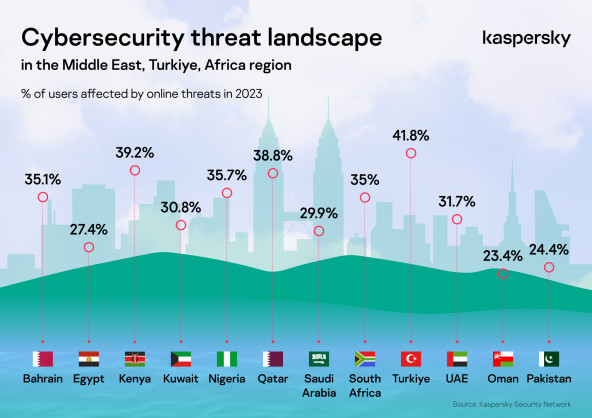
According to Kaspersky's analysis, online threats caused by vulnerabilities on web pages, in emails or webservices, have fluctuated significantly in the region. Turkiye saw the highest number of users affected by online threats (41.8%), followed by Kenya (39.2%), Qatar (38.8%) and South Africa (35%). Fewer users were affected in Oman (23.4%) and Egypt (27.4%) followed by Saudi Arabia (29.9%) and Kuwait (30.8%).

“As the cybersecurity landscape evolves, cyber threats continue to become diverse and sophisticated. This trend is particularly evident due to the emergence of advanced technologies like AI and the escalating geopolitical and economic turbulence within the Middle East, Turkiye, Africa (META) region. These factors collectively contribute to the surge in cybercrime and the heightened complexity of cyberattacks,” comments Amin Hasbini, Director of META Research Center Global Research and Analysis Team (GReAT), Kaspersky.

Distributed by APO Group on behalf of Kaspersky.

For further information please contact:
Nicole Allman
https://INKandco.co.za
nicole@inkandco.co.za

Social Media:
Facebook: https://apo-opa.info/3M3uy0L
Twitter: https://apo-opa.info/3OaLeGw
YouTube: https://apo-opa.info/41wO7V6
Instagram: https://apo-opa.info/42BZnRq
Blog: https://apo-opa.info/42Apbxn

About Kaspersky:
Kaspersky is a global cybersecurity and digital privacy company founded in 1997. Kaspersky's deep threat intelligence and security expertise is constantly transforming into innovative solutions and services to protect businesses, critical infrastructure, governments and consumers around the globe. The company's comprehensive security portfolio includes leading endpoint protection, specialized security products and services, as well as Cyber Immune solutions to fight sophisticated and evolving digital threats. Over 400 million users are protected by Kaspersky technologies and we help over 220,000 corporate clients protect what matters most to them. Learn more at www.Kaspersky.co.za.  

Media files
Kaspersky
Download logo
Read moreKaspersky shares cyberthreat landscape insights for the African region
16 February 2024

SA records an increase in research and development expenditure after COVID-19

Location: News

SA records an increase in research and development expenditure after COVID-19

Gross domestic expenditure on research and development (GERD) has increased in real terms for the first time in four years.

GERD as a percentage of the Gross Domestic Product (GDP) reached 0.62% in 2021/22, up from 0.60% in the previous year, indicating a slight improvement in research and development (R&D) intensity.

This represents a 6.9% year-on-year increase from R25.965 billion in 2020/21 to R27.756 billion in 2021/22, in terms of 2015 prices.

This is according to the latest South African National Survey of Research and Experimental Development.

The Human Sciences Research Council (HSRC) conducts an annual survey for Science, Technology and Innovation Indicators (CeSTII) on behalf of the Department of Science and Technology.

Chief Research Specialist and Principal Investigator at the HSRC, Dr Nazeem Mustapha, observed that countries that invest in research and development (R&D) at a high intensity are more likely to lead in global competitiveness.

“South Africa is striving to reach higher levels of R&D intensity by increasing expenditure on R&D, which in turn can lead to new industries and boosting of existing ones, job creation, increased productivity, and sustained economic growth,” Mustapha said. 

GERD encompasses all spending on R&D on national territory in a given year and includes domestically performed research and development, which is funded from abroad but excludes funds paid abroad, such as to international agencies. 

Key indicators highlight positive economic growth in South Africa for the period under review. 

According to Statistics South Africa (Stats SA), South Africa’s GDP increased by 4.7% in 2021/22 after a 6% decline during the COVID-19 pandemic in 2020/21.

“The growth in R&D expenditure is reassuring, although this comes off a very low base. The previous year’s decline in growth represented the biggest fall in R&D expenditure in the 20 years that the HSRC has been conducting the survey. We expect the next survey’s result to provide us with a better sense of what the trend is,” Mustapha added. 

Data shows that R&D expenditure, funding and personnel movements’ nominal R&D expenditure rose across all five institutional sectors. 

Funding

The study identified the R3.480 billion increase in business sector R&D expenditure as the main contributor to the increase in GERD. 

The higher education sector increased R&D expenditure by R446 million, the government sector increased by R235 million and the not-for-profit sector increased R&D expenditure by R31 million. 

The government remains the largest funder of R&D, accounting for 52.5% of total funding, followed by business (29%) and foreign sources (14.5%). 

Meanwhile, foreign funding has increased significantly over the past decade, with most investments directed towards higher education and business sectors. 

Personnel

R&D staff increased by 2 857 individuals (3.5% year-on-year) in 2021/22, including 1 716 researchers (a 2.8% increase).

Notably, state-owned enterprises (SOEs) increased their R&D expenditure, with R&D personnel numbers rising in various sectors. 

Enterprises in the business sector employed 917 new R&D personnel, which includes technicians as well as researchers, however shed 140 researchers. 

R&D personnel increased by 1 657 in the higher education sector, 155 in the government sector, and 79 in the science councils’ sector. 

The non-profit sector recorded an increase in the R&D personnel headcount of 49. 

In 2021/22, 1.9 full-time equivalent researchers were employed for every 1 000 R&D workers, an increase of 0.1%. 

Gender

The ratio of female researchers as a percentage of total researchers rose by 0.4 percentage points to 47%. 

Key sectors

R&D activity has increased in the manufacturing and financial services sectors, which drive most R&D expenditure.

Meanwhile, medical and health sciences, along with social sciences, continue to receive the highest R&D expenditure, at 22.8% and 18.4% respectively. 

The field of research with the third-highest R&D expenditure in South Africa is information, computer, and communication technology (13.1%), which surpasses the engineering sciences field (11.7%), while growth in social sciences is stagnant. 

“A longitudinal analysis of shifts in the proportions of researchers and technicians, as well as the overall movement of R&D personnel, is of value,” said Dr Glenda Kruss, Executive Head of the HSRC Centre for Science, Technology and Innovation Indicators (CeSTII). 

She said such analysis, which is now possible with time series data covering the past two decades, can inform future investments to grow skills and capabilities for the national system of innovation. – SAnews.gov.za

Gabisile
Fri, 02/16/2024 - 10:48

24 views
Read moreSA records an increase in research and development expenditure after COVID-19
14 February 2024

SIU welcomes arrest of allegedly corrupt former Eskom officials

Location: News

SIU welcomes arrest of allegedly corrupt former Eskom officials

The Special Investigating Unit (SIU) has welcomed the arrest and appearance in court of two former Eskom officials on charges of fraud, corruption and money laundering.

The two employees, Thandi Magagula and Nontuthubo Mahweliri, were employed at the Hendrina Power Station and were arrested by the Hawks last week and have appeared in different courts.

“The court appearance is part of the implementation of the National Anti-Corruption strategy by law enforcement agencies to strengthen its fight against corruption, especially when such crimes are committed by state employees in positions of trust to deliver services for the benefit of the public and the economy, but instead, steal from the most vulnerable to enrich themselves and fund their opulent lifestyles,” the SIU said.

Magagula allegedly conducted business with the electricity supplier while employed there.

“An SIU investigation revealed that Magagula held a private investment in a company called Montoza Engineering. Montoza Engineering had one or more contracts with Eskom and according to Eskom records during the period of approximately October 2015 to November 2015, had rendered services and provided work or goods to Eskom to the value of approximately R58 888.76.

“Magagula as an employee of Eskom was not supposed to conduct any business with the entity as this is against Eskom’s policy on conflict of interest,” the SIU said.

She also underwent a disciplinary hearing at Eskom, was found guilty and was given a seven-day suspension.

Mahweliri also allegedly operated under the same modus operandi.

“The investigation by the SIU found that Mahweliri failed to declare that she is a member of a company called NKG Trading investments, which had a contract with Eskom and failed to apply for permission to perform private work. Her company received payments to the value of R1 082 884 for the period 2017 and 2018.

“The SIU also referred Mahweliri for disciplinary action. Eskom held a hearing, and she was found guilty of all charges of misconduct and suspended for 7 days without pay,” the SIU said.

Both cases were postponed and they are expected to appear in the Middelburg Specialised Commercial Crime Court. – SAnews.gov.za


NeoB
Wed, 02/14/2024 - 10:01

3657 views
Read moreSIU welcomes arrest of allegedly corrupt former Eskom officials
12 February 2024

Infrastructure development

Location: News

Infrastructure development

By David Jacobs

Investments in infrastructure made today are an investment in a nation’s future success. It enhances mobility and accessibility, facilitates enhanced trade, overall economic productivity and boosts a country’s wellbeing.

In understanding this crucial interplay, government launched its infrastructure investment programme in mid-2020 to build critical network infrastructure such as ports, roads and rail across the country.

These infrastructure projects have been steadily gaining momentum, turning many parts of the country into construction zones. One such project is the N2 and N3 Upgrade Programme which is expanding the capacity of our national highways in Kwa-Zulu Natal

It includes the ground breaking R2.4bn Ashburton Interchange Project in the Msunduzi Municipality in KwaZulu-Natal, which will see additional lanes being constructed. This section of highway has been hamstrung by chronic traffic congestion that prevents the quick movement of freight.

With more than 60 percent of goods transported through this corridor, the road is a key economic artery for the movement of goods from the Port of Durban, the largest port in Sub-Saharan Africa, to the rest of South Africa and the continent.

We see this project as central to our country’s competitiveness and to the growth of the economy. Through the smooth movement of goods and services across our economy, we can enhance efficiencies, attract investment and boost job creation.

Importantly, the upgrades will not only reduce the overall travel time for road freight transport but also ensure increased safety for all road users.

Government has placed infrastructure development at the heart of our country’s economic recovery plan because it is widely known that infrastructure has a powerful multiplier effect on restoring economic growth, creating new jobs and protecting livelihoods.

Through the Ashburton Interchange Project, we have created a number of direct jobs and indirect jobs for surrounding communities. The project is also helping draw more young people into the productive sectors of the economy through training and learnerships.

The Ashburton Interchange Project adds to other projects already at an advanced stage of construction on the N3, such as the widening a section of the Camperdown Interchange and the road upgrade between Dardanelles and Lynnfield Park in Kwa-Zulu Natal.

Another major highway upgrade being undertaken at an investment of over R 10 Billion is the N2 Wild Coast road project which connects the Western Cape, Eastern Cape, KwaZulu-Natal and Mpumalanga.

Once completed, the route will shorten travel times, making it 1,5 hours faster for light vehicles and 3 hours faster heavy freight transport. This will significantly reduce vehicle carbon emissions and the time-cost saving to motorists and freight operators will be approximately R1.5 billion per annum.

The project will also see the construction of the highest bridges on the African continent with the R1.65 billion cable-stay Msikaba Bridge.  The bridge will be 580m in length and be 195m high, showcasing our country’s engineering excellence.

Infrastructure projects similar to these road transport projects are being prepared and packaged for investors by Infrastructure South Africa (ISA). ISA is also driving project preparation to enhance transparency and eliminate key risks at the earliest possible time.

Our logistics infrastructure investments also extend to our nation’s ports as we address slow turnaround times. Following an internal diagnostic review by Transnet, there are plans to invest R160 billion to address the infrastructure.  

It includes procuring 16 gantry cranes and acquisition of four ship-to-shore cranes to address slow turnaround times affecting the docking and offloading of containers at the port. Transnet also plans to deepen and lengthen two berths at its Durban Container Terminal Pier 2 which handles about 65 percent of the country’s containerised cargo as part of efforts to ease backlogs.

Government is addressing concerns of corruption and maladministration in the construction industry through our anti-corruption strategy designed specifically for the sector. It sets out to detect and prevent corruption and we are working closely with the Special Investigating Unit to execute the strategy.

As we gather pace on our infrastructure development, we are certain to see the benefits in our economy and on jobs. Through our investments in infrastructure we are setting the foundation for a much brighter future.

David Jacobs is Chief Director: Cluster Communication at Government Communication and Information System (GCIS)


Neo
Mon, 02/12/2024 - 09:53

125 views
Read moreInfrastructure development
11 February 2024

Navigating the Landscape of Technological Innovation and Services

Location: MyPR

In an era of rapid technological change, software development companies are not just participants but pioneers, shaping the digital landscape. They blend cutting-edge technology training and development with the implementation of sophisticated cloud-based solutions, playing a vital role in digital transformation across industries. These companies offer a wide range of services, from cloud computing and data intelligence …

Read moreNavigating the Landscape of Technological Innovation and Services
9 February 2024

Presidential Golf Challenge underway for charity

Location: News

Presidential Golf Challenge underway for charity

In a bid to raise funds for the Cyril Ramaphosa Foundation, President Cyril Ramaphosa this morning teed off at the annual Presidential Golf Challenge (PGC).

The PGC was held  at the  Atlantic Beach Golf Estate, Melkbosstrand, following the President’s State of the Nation Address on Thursday night.

According to the Presidency, the funds will be used by the foundation’s partner, the Adopt-A-School Foundation, to construct ablution facilities as part of the Department of Basic Education’s SAFE Initiative, which stands for Sanitation Appropriate for Education.

“This is an important investment in the dignity of learners and staff at schools and a contribution to social infrastructure in the country.

“The President is honoured that his playing partner this year is 14-year-old Botshepehi Phakoe of Mangaung in the Free State. Botshepehi is one of the best young players in the Free State Junior Union,” the Presidency said.

Load shedding

Answering questions from the media on load shedding on the side lines of the golf challenge, President Ramaphosa said government cannot give an exact date on when the rolling power outages will stop.

“It is a constant problem for South Africans. We know that and everybody feels it. And it’s not comfortable at all. In fact, it does sometimes evoke a lot of anger. But as I’ve said, we do have the resilience as South Africans to keep on ensuring that we do hope for a better time. And a better time is coming.

“The issue of the ending of load shedding is a moot one. Everybody wants to know…when is it ending. When you give them a date and there’s load shedding thereafter, they say you were lying and you make empty, false promises. So we are not going to do that because this is a process.

“Through the National Electricity Crisis Committee, everything is put in place. All the pillars are put in place to finally address load shedding. It would be wonderful and ideal to give a date but processes like these that are engineering based…you cannot really put a date to,” he said.

SARS

Responding to questions on the extension of the South African Revenue Service (SARS) boss, Commissioner Edward Kieswetter’s tenure, President Ramaphosa batted away any suggestions of a crisis at the revenue collector’s office.

He explained that with Kieswetter’s term coming to an end, measures need to be put in place to facilitate a “proper transition”.

“So there’s no crisis. Nobody should be in any form of angst because the process is being handled very, very properly. And I’m happy to have a Commissioner of Revenue like him who is very cooperative; who is committed to his work; who is diligent and who has revived SARS from the grips of state capture.

“So when I was talking about revamping our institutions last night [at the State of the Nation Address], I highlighted that SARS is one of those. It is back to its old, efficient self having been taken into the depths of state capture for a while.

“We have reclaimed it and I’m rather glad that it is one of those institutions that is serving the people of South Africa well,” President Ramaphosa said.

Earlier this week, the President agreed to extend the Commissioner’s tenure beyond the end of his term at the revenue collector. 

 The Commissioner’s contract of employment was set to end on 30 April, where after a new Commissioner would be appointed. 

In March 2019, President Ramaphosa appointed Kieswetter, in terms of Section 6 of the South African Revenue Service Act, for a five-year term that started on 1 May 2019.  – SAnews.gov.za


NeoB
Fri, 02/09/2024 - 13:07

49 views
Read morePresidential Golf Challenge underway for charity
9 February 2024

Afroteq Advisory Appoints Seipati Leboko As Business Unit Head Of Occupational Health, Safety And Environment

Location: MyPR

Afroteq Advisory, a division of the AFMS Group, is an integrated multidisciplinary consulting firm offering project management, advisory and training services to the built environment sector. We are proud to announce the appointment of Seipati Leboko as the Business Unit Head of Occupational Health, Safety and Environment in Gauteng. Seipati is a seasoned SHEQ Manager …

Read moreAfroteq Advisory Appoints Seipati Leboko As Business Unit Head Of Occupational Health, Safety And Environment
6 February 2024

Task team to review municipalities’ water service delivery mechanisms

Location: News

Task team to review municipalities’ water service delivery mechanisms

A national coordinated task team has been set up to review service delivery mechanisms for water and sanitation services by the Departments of Water and Sanitation (DWS) and Corporative Governance and Traditional Affairs (CoGTA) and the South African Local Government Association (SALGA).

This was one of the resolutions adopted during a recent water summit hosted by DWS with the 144 municipalities that are water services authorities (WSAs).

The task team which was established to initiate and coordinate Municipal Systems Act Section 78 processes in certain municipalities, aims to address the decline of water and sanitation services, as outlined in the recent Blue Drop, Green Drop and No Drop reports released by the Department of Water and Sanitation. 

The drop reports indicated a general decline in performance.

Water and Sanitation spokesperson, Wisane Mavasa, said the task team will focus on the 105 municipalities that are in the critical and poor performing categories in terms of the Blue and Green Drop reports. 

Mavasa said the DWS, including CoGTA, Municipal Infrastructure Support Agency, Department of Human Settlements, and National Treasury, are providing extensive support to assist water services authorities with the provision of water and sanitation services.

“This includes providing water and sanitation infrastructure grants worth more than R20 billion per annum; providing technical and engineering support and assistance; capacity building and training, and financial management advice and support. 

“However, despite all this support, the drop reports indicate that municipal water services have declined sharply. This indicates that there are limitations to which support from the national government can solve the problems, and that more fundamental reforms are required,” Mavasa said. 

Routine maintenance and operations must be funded by revenue from the sale of water by municipalities to customers, and municipal councils must take the required decisions to prioritise budgets for this. 

She emphasised that the Water Services Act states that the WSA can approve any legal entity to function as a water services provider (WSP) in the municipality, and “almost all WSAs in South Africa are currently both WSA and WSP”.

“The Water Services Act requires the WSA and WSP functions to be managed and accounted for separately by municipalities, but this is generally not happening. The Act states that the key role of the WSA is to ensure that the WSP provides services which meet minimum norms and standards – and this is also generally not happening, as borne out by the results of the Drop assessments,” Wisane said.

Other key decisions taken at the summit include that all WSAs must develop action plans to address their drop results and submit them to DWS by the end of February 2024; training institutions should prioritise the training of uncertified process controllers to enable them to become certified; and that all WSAs must issue advisory notices without fail when their drinking water fails to meet microbiological water standards. – SAnews.gov.za

GabiK
Tue, 02/06/2024 - 11:57

113 views
Read moreTask team to review municipalities’ water service delivery mechanisms
1 February 2024

NSFAS financial aid application deadline extended

Location: News

NSFAS financial aid application deadline extended

The National Student Financial Aid Scheme (NSFAS) board has extended the deadline for applications for student financial aid to 15 February 2023.

The decision was taken during a meeting between the NSFAS board and the South African Union of Students (SAUS).

The NSFAS board, led by Acting Board Chairperson Professor Laurens Van Staden, met with the South African Union of Students (SAUS) Executive, led by President Yandisa Ndzoyiya, to discuss NSFAS’s state of readiness for the beginning of the academic year, where the parties agreed on the extension of the 2024 bursary application period. 

The meeting also agreed that the NSFAS Loan Scheme will be opened on 2 February 2024 and close on 15 February 2024. 

The new Comprehensive Student Funding Model aims to support students including those currently not supported by NSFAS bursary and funding policy. 

This category includes students who come from families who have a total income of more than R350 000, but not more than R600 000 per annum.

In a joint statement issued on Thursday, the parties agreed that students who have already applied for the NSFAS bursary scheme need not submit a new application for the student loan scheme. 

“All students who did not meet the bursary scheme eligibility criteria, however, meet the loan scheme eligibility criteria, will be automatically offered a loan for their consideration,” the statement said. 

Prospective loan scheme applicants can apply through an online application form, where they create a profile, apply, and submit the application. 

The application form can be accessed on the NSFAS website on www.nsfas.org.za.

In order to qualify for the loan, students should meet the following criteria:
• Students whose annual household income is between R350 000-R600 000;
• TVET and university (public) students;
• Undergraduate or postgraduate students;
• 70% Science, technology, engineering and mathematics (STEM) programmes (which
may be adjusted to include commercial programmes that are in demand in the labour
market or entrepreneurial programmes);
• 30% Social Sciences programmes; and
• Students willing to sign a loan agreement.

NSFAS reminded all applicants for both the bursary scheme and the loan scheme to submit a consent form to verify relevant information from third parties. 

“The information is required to verify the employment status and income level of the parents, guardians, or spouses of the applicant. It is mandatory for applicants to download and upload a completed Consent form on the NSFAS website, portal, or mobile app,” Van Staden said.

1 745 applications received

Meanwhile, NSFAS has received 1 745 226 applications, as of 30 January 2024.

The scheme said of the 1 745 226 applications, 940 682 are provisionally funded, 269 915 are awaiting evaluations, while 48 643 have been withdrawn by the student;  232 559 are in in progress, and 136 531 applications on the not-started status, as applicants only created profiles and did not submit applications.

“NSFAS has rejected 102 201 applications;1 093 appeals have been lodged so far,” Van Staden said.

The meeting agreed that funding decisions will continue to be communicated, as and when applications are processed, and that the application portal will continue to be updated upon confirmation of the funding decision. 

Institutions have been encouraged to continuously check the updates on the NSFAS applications portal on funding decisions, which will also cover allowance types that students have qualified for.

“NSFAS will upon making the funding decisions commence with the appeals process in order to ensure that appeals decisions are communicated to students and the institutions on time.” – SAnews.gov.za


GabiK
Thu, 02/01/2024 - 15:34

131 views
Read moreNSFAS financial aid application deadline extended
31 January 2024

High Gear Bridges The Gap Between Graduation And Employment

Location: MyPR

It’s been an incredible journey for High Gear and an even more remarkable one for the programme’s students and graduates. South Africa’s automotive economy relies heavily on the skills of our mechanical and electrical engineers and High Gear’s proactive approach to revolutionizing the talent pipeline has not only created jobs, but also empowered the automotive …

Read moreHigh Gear Bridges The Gap Between Graduation And Employment
31 January 2024

Here’s why contractors need to protect themselves when natural disasters strike

Location: MyPR

The recent storm and flood damage in KwaZulu-Natal is estimated to be R2.5 billion and with more heavy weather warnings on the way, Minister of Cooperative Governance and Traditional Affairs Thembi Nkadimeng is calling for a state of disaster in the province. While major infrastructure like roads, bridges, railways, and schools has sustained massive damage, …

Read moreHere’s why contractors need to protect themselves when natural disasters strike
30 January 2024

Deadline looms for NSFAS 2024 application cycle

Location: News

Deadline looms for NSFAS 2024 application cycle

Grade 12 learners and students, who wish to enter the post-school system and do not have financial assistance to continue their studies, have until Wednesday to submit their applications for 2024 funding.

The National Student Financial Aid Scheme (NSFAS) officially opened the bursary application season for the 2024 academic year on 21 November 2023, and the cycle will close on 31 January 2024.

Higher Education, Science and Innovation Deputy Minister, Buti Manamela, has urged all students who wish to study in any of the public universities and Technical Vocational Education and Training (TVET) colleges to submit their applications before the closing date.

Manamela said NSFAS is currently funding more than 1.4 million students at public universities and TVET colleges. 

“If you have Grade 10, 11 or 12 and want to study at either a university or TVET college, and are a SASSA (South African Social Security Agency) beneficiary, or have a household income less than R350 000, you can apply to qualify. You [also] need to further apply to one or two of our public institutions. 

“The NSFAS funds students studying law, engineering, medicine, music, carpentry, plumbing, accounting, history, or any undergraduate qualification at a public institution. Visit www.nsfas.org.za and create a user profile under myNSFAS. All you need is a cellphone or computer that has access to the internet and an email address,” Manamela said.

NSFAS covers tuition, accommodation, learning material and a living allowance. 

SASSA beneficiaries are approved almost immediately. According to the department, the scheme has provisionally funded at least 657 703 SASSA recipient applicants.

The department has also urged all applicants to submit a consent form in order to verify relevant information from third parties and ensure that NSFAS complies with all the legislative requirements.

The information is required to verify the employment status and income level of the parents, guardians, or spouses of the applicant. 

It is mandatory for applicants to download and upload a completed Consent form on the NSFAS website, portal or mobile app.   

NSFAS has also launched new platforms, where applicants can access their application updates at their fingertips through the downloadable NSFAS student mobile app, WhatsApp line and a USSD code.

Applicants can add NSFAS on the WhatsApp 078 519 8006 or USSD *120*67327 to track their application status. – SAnews.gov.za

GabiK
Tue, 01/30/2024 - 10:57

1426 views
Read moreDeadline looms for NSFAS 2024 application cycle
26 January 2024

Growing the Economy is the Only way to Fix South Africa

Location: MyPR

The Steel and Engineering Industries Federation of Southern Africa (SEIFSA) wishes all its member a productive and prosperous 2024, which is likely to be another busy and challenging year, with wage negotiations, general elections, load-shedding, high inflation, geo-political uncertainty and a volatile exchange rate just some of what we can expect. As the country prepares …

Read moreGrowing the Economy is the Only way to Fix South Africa
26 January 2024

Department awards bursaries to hardworking matriculants

Location: News

Department awards bursaries to hardworking matriculants

Public Works and Infrastructure Minister Sihle Zikalala has hailed teachers and guardians as true heroes and heroines and thanked them for encouraging, motivating and guiding learners during the 2023 matric examination.

“To the bursary awardees, you are the crown in the jewel; and today we sing your praises for demonstrating that paying attention and putting in effort pays,” Zikalala said on Thursday, during a ceremony to award bursaries to 100 learners from the Class of 2023 who have enrolled to study various built environment courses at universities across the country.

Zikalala congratulated the learners for being worthy recipients of the prestigious bursaries from the Department of Public Works and Infrastructure.

He said the young people who are receiving the bursaries have honoured the sacrifices of the youth of 1976 who protested against an inferior Bantu Education that sought to turn education for the black majority into an instrument of racial subjugation and guarantor for the supply of cheap black labour.

“The Department of Public Works and Infrastructure (DPWI) plays a critical role in delivering essential services. To do so effectively, it must have a highly skilled and competent workforce.

“This year is the 10th year that the Department of Public Works and Infrastructure has been offering these bursaries to address the challenges of the skills pipeline and transformation in the Built Environment.

“Our university bursary scheme is one of the ways through which as a department, we respond to the country’s occupation skills that are in high demand as gazetted by the Department of Higher Education and Training,” the Minister said.

The Department of Public Works and Infrastructure Bursary Scheme supports undergraduate study areas like: Construction Project Management, Occupational Health and Safety, Quantity Surveying, Landscape Architecture, Architecture, Property Studies, Real Estate, Urban Design and Regional Planning, Engineering (Mechanical, Electrical, Civil, Structural, Chemical), Interior Design, Actuarial Science, Horticulture, Geographic Information Science (GISc) and Maritime Studies.

The Council for the Built Environment (CBE) has lamented the slow pace of transformation in the built environment which is compounded by the challenge of aging professionals who are leaving the sector.

“One of our programmes to address these challenges and in contributing to the skills of the future in our sector is the department’s schools programme and the university bursary scheme programme.

“We are pleased to report that our valued bursary beneficiaries are supported financially throughout their tertiary studies until graduation.

“Upon completion of studies, bursary holders join the department’s internship programme wherein they gain relevant technical experience for a duration of 24 months in line with their contractual obligation to the department and in accordance to the DPSA regulated internship period,” Zikalala said.

The estimated budget per student is R177 500. This amount varies based on the institution and study programme. The department has allocated budget of R17 800 000 for the 2024 academic year new intake.     

The bursary covers all university costs including tuition fees, accommodation, meals, textbooks, projects, excursions and a monthly allowance. – SAnews.gov.za


Edwin
Fri, 01/26/2024 - 09:43

257 views
Read moreDepartment awards bursaries to hardworking matriculants
24 January 2024

South Africa’s Progressive Business Forum honours Afreximbank board member Ronnie Ntuli with Lifetime Achievement Award

Location: Business

Afreximbank
Download logo

African Export-Import Bank (Afreximbank) (www.Afreximbank.com) is pleased to announce that its board member, Mr. Ronnie Ntuli has been awarded the Progressive Business Forum's (PBF) prestigious Lifetime Achievement Award and was presented with the accolade at the Presidential Gala Dinner and special celebrations that marked three decades of democracy in South Africa.

The award, which was presented at the PBF's inaugural “Show Up” awards ceremony, recognizes and celebrates individuals who have distinguished themselves in business, public service and, through their commercial, entrepreneurial and civic ventures. It also recognizes those who have acted to improve the common good and promote the wellbeing of others.

Mr Ntuli's receipt of this award constitutes a recognition of his extraordinary contribution to the expansion of Southern Africa's rail network and his application of engineering expertise to continental transport and logistics assets. Mr Ntuli founded and established the Thelo Group, as one of the continent's eminent financiers of railway infrastructure and rolling stock, and the region's most significant supporters of industrial development and high-value exports.

Further to these economic contributions, Ronnie has served his country and continent through extensive advisory work for a range of African Heads of State, where he has leveraged his unrivalled financial and engineering experience – as well as his background in Law – to help decision-makers devise policies and strategies to accelerate economic development and entrepreneurship.

Afreximbank President and Chairman of the Board of Directors, Prof. Benedict Oramah, commented:

I am delighted that my dear friend, and much-trusted advisor on Afreximbank's Board, Mr. Ronnie Ntuli, has been recognized by the Progressive Business Forum for his decades of work on this continent. As both businessman and advisor, Ronnie's contribution to our shared prosperity and development is quite simply incalculable. His counsel has been indispensable to the Bank, particularly as we navigated the challenges of implementing the African Continental Free Trade Area agreement.”

Distributed by APO Group on behalf of Afreximbank.

About Afreximbank:
African Export-Import Bank (Afreximbank) is a Pan-African multilateral financial institution mandated to finance and promote intra-and extra-African trade. For 30 years, the Bank has been deploying innovative structures to deliver financing solutions that support the transformation of the structure of Africa's trade, accelerating industrialization and intra-regional trade, thereby boosting economic expansion in Africa. A stalwart supporter of the African Continental Free Trade Agreement (AfCFTA), Afreximbank has launched a Pan-African Payment and Settlement System (PAPSS) that was adopted by the African Union (AU) as the payment and settlement platform to underpin the implementation of the AfCFTA. Working with the AfCFTA Secretariat and the AU, the Bank is setting up a US$10 billion Adjustment Fund to support countries to effectively participate in the AfCFTA. At the end of September 2023, Afreximbank's total assets and guarantees stood at over US$33.4 billion, and its shareholder funds amounted to US$5.8 billion. The Bank disbursed more than US$104 billion between 2016 and 2023. Afreximbank has investment grade ratings assigned by GCR (international scale) (A), Moody's (Baa1), Japan Credit Rating Agency (JCR) (A-) and Fitch (BBB). Afreximbank has evolved into a group entity comprising the Bank, its impact fund subsidiary called the Fund for Export Development Africa (FEDA), and its insurance management subsidiary, AfrexInsure, (together, “the Group”). The Bank is headquartered in Cairo, Egypt.

Read moreSouth Africa’s Progressive Business Forum honours Afreximbank board member Ronnie Ntuli with Lifetime Achievement Award
24 January 2024

DPWI Minister to award bursaries to deserving students

Location: News

DPWI Minister to award bursaries to deserving students

Public Works and Infrastructure Minister Sihle Zikalala will on Thursday award bursaries to 100 learners from the class of 2023 Matriculants, who have enrolled to study various built environment courses at universities across the country.

The bursaries are part of the Department of Public Works and Infrastructure’s (DPWI) Skills Pipeline Programme, which is one of government’s initiatives to bring more skilled professionals into the public sector and specifically the built environment.

As part of building a capable and ethical State, the DPWI annually awards bursaries to pupils in need of financial assistance, who display academic excellence and have been accepted for courses in the built environment for their tertiary education.

The bursary programme further aims to increase the number of built environment professionals from previously disadvantaged backgrounds and ensure transformation of the sector.

It also serves as a feeder to the department’s Internship and Young Professionals Programme and later forms a pool of qualified built environment professionals to serve the state in the delivery of infrastructure projects.

The bursary is for careers in the built industry, including Electrical Engineering, Mechanical Engineering, Civil Engineering, Marine Engineering, Property Studies/Real Estate, Actuarial Science, Quantity Surveying, Construction Project Management, Landscape Architecture, Architecture and Town and Regional Planning.

The bursary covers tuition, accommodation, meals, textbooks, project and compulsory study resources and a monthly stipend.

In its 10th year of existence since 2014, the DPWI bursary programme has so far benefited over 500 deserving students, an investment of over R160 million into the lives of the students and to bring the required skills into the public sector. – SAnews.gov.za

Edwin
Wed, 01/24/2024 - 09:25

445 views
Read moreDPWI Minister to award bursaries to deserving students
24 January 2024

Dunoon top achiever dreams of studying chemical engineering

Location: News

Makanaka Muzuva’s parents are Zimbabwean and cannot afford to pay for her university ambitions

Read moreDunoon top achiever dreams of studying chemical engineering
22 January 2024

Minister Senzo Mchunu calls on water sector to prioritise providing adequate water and sanitation services to public

Location: News

Department of Water and Sanitation, Republic of South Africa
Download logo

Minister Mchunu calls on the water sector to set aside egos and prioritise providing adequate water and sanitation services to the public

In a bid to improve performance of the water sector and its services to the public, Minister of Water and Sanitation, Senzo Mchunu, has called for the sector to suspend its ego and prioritise professionalism.

The Minister made these remarks during the two-day Water Services Authorities Summit held on Thursday 18 and Friday 19, January 2024 at the Emperors Palace, Kempton Park, Gauteng.

The purpose of the summit was to review the progress assessment reports, find the underlying reasons for poor and good performance, and collectively develop a plan to reverse the decline in performance.

Attending the summit were Minister of Cooperative Governance and Traditional Affairs (COGTA), Thembi Nkadimeng, Water and Sanitation Deputy Ministers, David Mahlobo and Judith Tshabalala, as well as provincial and local government representatives including Mayors, MMCs, Municipal Managers and technical officials of the 144 Water Services Authorities across the country. Also, in attendance and participation were representatives from various institutions including the water boards, the Municipal Infrastructure Support Agency (MISA), National and Provincial Treasury, professional bodies, training organisations, whose wide range of support relate to funding, capacity building, professionalisation, engineering, financial management and governance. These institutions were critical elements in the process of developing and implementing improvement plans for the WSAs.

Setting the scene, Minister Mchunu gave an overview of the state of water in the country according to the previous Blue, Green, and No Drop reports released in December 2023.

He further highlighted that the Drop certifications were initially introduced 16 years ago in 2008, with annual reports being released from 2009 until 2014. These reports served as an effective regulatory mechanism, evaluating water and sanitation services, incentivising municipalities to improve their performance, and guiding areas for enhancement.

In recent years, the water sector in South Africa has faced numerous challenges, with reports showing a decline in the quality of drinking water and wastewater, as well as an increase in potable water losses. These issues have caused great concern among the public, particularly regarding the growing percentage of drinking water systems failing to meet both national and international compliance standards as revealed by these assessments. 

“We have resuscitated the assessments and are committed to preventing similar mistakes in the future,” Minister Mchunu said.

Minister Mchunu's call for the water sector to suspend its ego stems from the need to prioritise professionalism and service delivery to the public to address the decline in performance.

The Minister emphasised that the non-provision of clean drinking water and a clean environment goes against people's basic human rights, as outlined in the Bill of Rights in the Constitution. It is therefore imperative that the water sector takes immediate action to address these challenges.

Following extensive discussions, several recommendations were put forward to improve the water sector and enhance water and sanitation services for the public. Notably, it was agreed that Water Service Authorities should make fundamental changes in the manner that they deliver water and sanitation services. This by either considering establishing their own entities or creating special-purpose vehicles as water service providers. This would allow for greater accountability and efficiency in the provision of water and sanitation services.

Municipalities have been categorised into four groups based on their Drop scores during discussions on how to improve.

The first group comprised 67 municipalities that have an average 'critical' score in their water supply and/or wastewater systems in the 2023 and 2022 full Green Drop. The second group consisted of 38 municipalities that had an average 'poor' score in their water supply and/or wastewater systems in the 2023 and 2022 full Green Drop. The third group includes 27 municipalities that have an average 'average' score in their water supply and/or wastewater systems in the 2023 full Blue Drop and 2022 full Green Drop. Lastly, the fourth group comprised 12 municipalities that have an average 'good' or 'excellent' score in their water supply and/or wastewater systems in the 2023 full Blue Drop and 2022 full Green Drop.

The 105 municipalities who are in the critical, poor and average categories were urged to utilise consider appointing reputable, credible, and competent water service providers for the next two to three years. This move would help address the current gaps in service delivery and ensure that communities have access to clean and reliable water sources. This could be in a form of another municipality that performed well in their assessments scores in all reports, a water board or a competent private water services provider.

Another important area of focus is the review of implementing agents, with an emphasis on capacity building. The Directors- General of the Department of Water and Sanitation (DWS), COGTA, South African Local Government Association (SALGA), and the provincial and Local Government will collaborate to strengthen the capacity of implementing agents, the water sector will be better equipped to deliver on its mandate and meet the needs of the public.

Deputy Minister Mahlobo, who was also speaking at the summit, announced recommendations and a way forward on finance, security, and corruption.

One of the major recommendations made was the strengthening of the budget for water and sanitation services. This will include relooking at budget allocation to ensure that more funds are allocated towards provision of these services of the public.

Deputy Minister Mahlobo emphasised the importance of infrastructure security in ensuring uninterrupted water services. He urged all municipalities to develop and execute reliable infrastructure security plans, which should include the use of technology such as remote fencing and a rapid response system to combat theft and vandalism of infrastructure. These measures will not only protect the vital water infrastructure but also ensure a reliable supply of water to the public.

The Deputy Minister also announced the formation of a multi-disciplinary security cluster consisting of Ministers and Mayors. This cluster will be responsible for leading intelligence operations and prosecutions against elements that hinder service delivery such as vandals, mafia as well as saboteurs of water infrastructure. The team will also be tasked with screening technical division officials for lifestyle, integrity, morality, and community involvement, thereby ensuring that only the most qualified and dedicated individuals are entrusted with the responsibility of providing water services.

In his closing remarks, Minister Mchunu said the provision of reliable quality drinking water to citizens must be treated with priority and necessary urgency. The decline in water quality and increase in water losses were pressing issues that demanded immediate attention. By implementing the recommendations put forward, such as the establishment of dedicated entities or special purpose vehicles, and the appointment of reputable service providers, the water sector can make significant strides towards meeting the needs and rights of the public. Though the challenges are great, with a unified effort and a commitment to collaboration, a positive change is indeed possible.

Distributed by APO Group on behalf of Department of Water and Sanitation, Republic of South Africa.

Read moreMinister Senzo Mchunu calls on water sector to prioritise providing adequate water and sanitation services to public
19 January 2024

Reddam House KZN schools achieve 99% bachelor pass rate

Location: MyPR

Inspired Education Group’s two Reddam House schools in KwaZulu-Natal – Reddam House Umhlanga and Reddam House Ballito – have surpassed their exceptional 2022 results in the Independent Examinations Board (IEB) National Senior Certificate (NSC) exams, with 116 students achieving 336 distinctions, averaging out at 2.9 distinctions per student, and 67 students achieving four or more …

Read moreReddam House KZN schools achieve 99% bachelor pass rate
18 January 2024

Step Into A Novel Chapter, A Novel Year, And A Current Version Of Yourself

Location: MyPR

“FitFlop believes that if you want to live an inspired life, you´ve got to start with a great foundation.” Understanding the pivotal role our feet play in our overall well-being. Ignite your vitality and embrace life’s moments with products crafted to enhance your physical wellness, and that is perfectly aligned to your body’s rhythm. Since …

Read moreStep Into A Novel Chapter, A Novel Year, And A Current Version Of Yourself
18 January 2024

Institut Universitaire des Grandes Écoles des Tropiques (IUGET) gets DASCA Accreditation

Location: MyPR

Cameroon is at the forefront of a significant data revolution in Central Africa, with big data driving innovation, informing decision-making, and fueling economic growth. This has established the country as a recognized hub for data science professionals, with recognition from both the public and private sectors. However, the demand for skilled big data professionals in …

Read moreInstitut Universitaire des Grandes Écoles des Tropiques (IUGET) gets DASCA Accreditation
15 January 2024

Nzimande announces R3.8bn funding for ‘missing middle’ students

Location: News

Nzimande announces R3.8bn funding for ‘missing middle’ students

Higher Education, Science and Innovation Minister, Professor Blade Nzimande, has revealed that government has set aside a R3.8 billion initial capitalisation fund to support “missing middle” students.

The new Comprehensive Student Funding Model aims to support students including those currently not supported by the National Financial Aid Scheme (NSFAS) bursary and funding policy. 

This category of students is those who come from families who have a total income of more than R350 000, but not more than R600 000 per annum.

Nzimande, who was addressing the media on Sunday, revealed that the funding model is divided into two phases.

Phase one begins this year, 2024/2025, with the State committing the initial capitalisation fund totalling R3.8 billion to support the loan scheme. 

This amount comprises R1.5 billion from the National Skills Fund (NSF) and R2.3 billion from Sector Education and Training Authorities (SETAs). 

“This amount will fund 47% of the missing middle students, that is, 31 884 of the estimated 68 446 missing middle,” he said at the media briefing held in Pretoria. 

“We have also committed funds to revive NSFAS ICT [information and communications technology] systems, including the loan system.”

On implementing the scheme, he said his department has so far consulted with the National Treasury, university Vice-Chancellors and student leaders. 

“Further workshops will be held with the registrars and student financial officers once NSFAS has obtained Board approval for the funding guidelines.”

Second phase

Meanwhile, the department is working around the clock to implement the second phase of the funding model from next year to 2034.

“The department will ensure that the seed funding contribution by government is increased to R31.6 billion to R42.1 billion over 10 years. This is approximately R3.1 billion to R4.2 billion annually."

Criteria and expansion

“Together with the National Treasury, we will continue to engage with relevant institutions, including public and private financial institutions to expand the scheme.” 

To qualify for the loan, students should meet the following criteria:

•    Students whose annual household income is between R350 000 to R600 000;
•    Technical Vocational Education and Training (TVET) and public university students;
•    Undergraduate or postgraduate students;
•    70% science, technology, engineering and mathematics (STEM) programmes (which may be adjusted to include commercial programmes that are in demand in the labour market or entrepreneurial programmes);
•    30% Humanities programmes; 
•    Students willing to sign a loan agreement;
•    Students can apply for the loan in the first, second or third year to continue to be funded through the loan; 
• Students are expected to get an average of 60% pass rate and the loan will cover tuition, learning material and accommodation; 
•    Students who obtain 70% or above on average and within the prescribed time will get a 50% reduction on loans on request.

Nzimande has described this move as “yet another important milestone in the commitments of the ANC-led government to advance a better life for all as we celebrate 30 years of freedom”.

The loan scheme will be administered by NSFAS which has the legal mandate to offer student loans as per Section 4 of NSFAS Act 1999. 

“NSFAS represents one of the most progressive and successful efforts by the government to systematically break the legacies of inter-generational social inequality in access post-school education and training.”

Between 2019 and 2022, NSFAS has disbursed R123 billion distributed across 2 918 624 beneficiaries. – SAnews.gov.za


Gabisile
Mon, 01/15/2024 - 09:43

1100 views
Read moreNzimande announces R3.8bn funding for ‘missing middle’ students
15 January 2024

Democracy has paved the way for access to education for every

Location: News

Democracy has paved the way for access to education for all

President Cyril Ramaphosa says that as the nation commemorates 30 years of democracy, South Africa has made strides in “advancing access to education” for previously marginalised groups.

He made this assertion in his weekly newsletter to the nation on Monday.

South Africa will celebrate 30 years of democracy this year as the country’s first democratic election was held in April 1994 – marking an end to the racist apartheid regime.

“We must consider just how far we have come from an era where the educational prospects of young black men and women were greatly diminished, and where the inferior education they received was deliberately designed to prepare them to be “hewers of wood and drawers of water”.

“Much has changed. From the results of Census 2022, we can glean insight into the gains we have made as a country in advancing access to education, the most critical area of any nation’s development,” the President said.

Census 2022, according to the Presidency, was the fourth population and housing count in post-apartheid South Africa, with the first conducted in 1996, with subsequent censuses being conducted in 2001 and 2011.

Pressing further on the results of Census 2022, the President added that at least three quarters of youth aged between five and 24 are attending school with the “percentage of people aged 20 and older who have completed secondary education” doubling since the first democratic Census in 1996.

“The first census showed that some 62% of white South Africans had a matric or higher qualification compared to 18% of blacks. Today, 38% of all South Africans have completed secondary education.

“At the time Census 1996 was conducted, 1.5 million South Africans had post-school qualifications. In 2022, this figure stood at approximately 4.6 million. Much of this progress has been made possible by the National Student Financial Aid Scheme, which continues to play an invaluable role in supporting access to higher education,” President Ramaphosa said.

Expanding access to education

He acknowledged that the education sector is facing challenges “as it works to meet the needs of our growing population [and] we are working to overcome them”.

“However, given our country’s history of marginalisation and exclusion, that we have made such substantial progress in expanding access to education over the past three decades is significant.

“In South Africa today, basic and higher education is accessible to the children and grandchildren of farmworkers, mineworkers and domestic workers, many of whom were denied such opportunities in the not-too-distant apartheid past. We will continue to build on our gains in our quest to leave no-one behind.”

Matric results

President Ramaphosa highlighted that matric results over the past few years has recorded the strides that young females are now making.

“In 2022, the matric cohort achieved an 80.1% pass rate, and last year more than a million candidates sat for the exam. More than half of the successful matriculants were female. There are also more women studying at tertiary institutions in South Africa, including in the once male-dominated science, technology, engineering and mathematics fields.

“While the task of ensuring that our economy grows at a scale and pace to absorb graduates and those seeking formal employment is a daunting one, let us not lose sight of how far we have come in this critical developmental indicator.

“We wish the matriculants eagerly awaiting their results later this week good luck. We have no doubt they will make us proud, making it an auspicious start to an auspicious year,” President Ramaphosa concluded. – SAnews.gov.za


NeoB
Mon, 01/15/2024 - 10:13

466 views
Read moreDemocracy has paved the way for access to education for every
  • Previous
  • Page 1
  • Interim pages omitted …
  • Page 9
  • Page 10
  • Page 11
  • Page 12
  • Page 13
  • Interim pages omitted …
  • Page 16
  • Next

Copyright © 2026 · MyZA · All Rights Reserved · Powered by Stratlec Online