Tribunal must decide who is telling the truth – Mlambo or Makhubele
Final oral arguments heard on whether Makhubele is guilty of gross misconduct for allegedly chairing PRASA board after being appointed judge

MyZA
News, Directory, Events and Other Stuff
Final oral arguments heard on whether Makhubele is guilty of gross misconduct for allegedly chairing PRASA board after being appointed judge
Healthcare for all a top priority for government
Equal access to affordable quality health care through the implementation of the National Health Insurance (NHI), is a key priority for the seventh administration, says President Cyril Ramaphosa.
“We are unwavering in our commitment to implement universal health coverage in a manner that brings all South Africans on board,” President Ramaphosa said.
The President was responding to the debate on the Opening of Parliament Address on Monday.
President Ramaphosa said government will continue with dialogues, exchanges and interactions to make the NHI an important programme for the people.
The President also highlighted the country’s report to the United Nations, which noted reductions in maternal, infant and neonatal mortality, and that South Africans are living longer and have better health outcomes.
READ | Government pushes for affordable healthcare for all
The President delivered the Opening of Parliament Address on Thursday and the President’s speech was debated by political parties on Friday.
READ | President Ramaphosa signs NHI Bill into law
Education
On inclusive and equitable quality education, President Ramaphosa said the country has made progress with respect to functional literacy and numeracy at primary school level, and in primary school completion rates.
“Today, more South African children have access to Early Childhood Development (ECD) and Grade R, and secondary school education outcomes continue to steadily improve.
“The child support grant, no-fee schools and expanded NSFAS (National Student Financial Aid Scheme) funding have had a considerable impact on the lives of learners, particularly those from poor families.”
He said these social protection interventions, alongside others, including the Schools Nutrition and Sanitary Dignity Programmes, aimed at female learners, are helping to break the cycle of intergenerational poverty.
“They are enabling more children to complete their schooling and to access opportunities after they finish school. One need only look at last year’s matriculation exam results, where learners who were social grant beneficiaries achieved an 81 percent pass rate,” President Ramaphosa said.
While access to education expands the capabilities of young people, the President noted that it also improves the productive capacity of the economy.
“Our young people are competing with the world. This is a new world, one that is rapidly changing and being influenced by technological advances.
“A better educated, better skilled workforce makes our economy more competitive and catalyses growth.”
Greater investment in skills
President Ramaphosa also commended the call for greater investment in skilling young people for the economy of the future, and for young people to be familiar with emerging technologies.
“Science and technology is going to continue playing an important role in enabling our young people to play a key role in our economy,” President Ramaphosa said. – SAnews.gov.za
GabiK
Mon, 07/22/2024 - 12:22
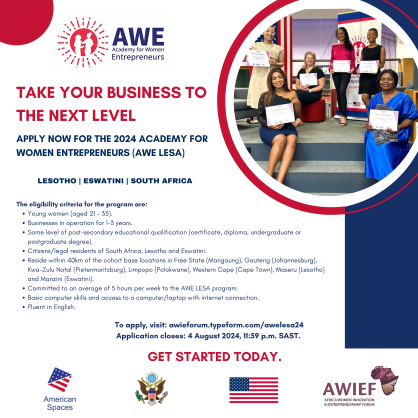
The U.S. Mission to South Africa and the Africa Women Innovation and Entrepreneurship Forum (AWIEF) (www.AWIEForum.org) proudly announce the launch of the 2024 Academy for Women Entrepreneurs program in Lesotho, Eswatini and South Africa.
The Academy for Women Entrepreneurs (AWE) is an initiative of the U.S. Department of State and Arizona State University's Thunderbird School of Global Management. It supports the U.S. National Strategy on Gender, Equity and Equality and reflects the United States' commitment to advancing gender equity and economic prosperity in Southern Africa
The Academy for Women Entrepreneurs LESA (Lesotho, Eswatini and South Africa) program is centred on the Francis and Dionne Najafi 100 Million Learners Global Initiative, an accredited online global management and entrepreneurship certificate consisting of five world-class courses and available to learners across the globe.
The overall goal of the program is to promote economic prosperity, including equitable economic development opportunities for historically disadvantaged groups and individuals. AWE LESA provides a resource for women entrepreneurs to engage in online education with guided facilitation and localization; fosters networks that support participants' access to peer-to-peer mentorship, business partners, and scaling opportunities with businesses in the region and in the United States; as well as provides access to a range of educational programs tailored to women's economic empowerment to expand the impact on the participant.
AWE LESA 2024 will empower 100 young women entrepreneurs in seven cities – five in South Africa and one each in Lesotho and Eswatini. The program will host cohorts in Bloemfontein (10 participants), Cape Town (10 participants), Johannesburg (15 participants), Polokwane (15 participants), Manzini (20 participants), Maseru (20 participants), and Pietermaritzburg (10 participants). The participants will attend in-person training sessions and events at designated American Corners and partner spaces in each location.
AWE LESA 2024 activities will take place between August 2024 and January 2025, and this edition will bring the total number of women entrepreneurs trained through the U.S. Mission to South Africa and AWIEF partnership to more than 700.
What do you gain from participating in the AWE LESA program?
What are the criteria to apply?
Applications Open Now!
Academy for Women Entrepreneurs applications are officially open for highly motivated and self-driven young women entrepreneurs from Lesotho, Eswatini and South Africa. THERE IS NO COST TO APPLICANTS AT ANY STAGE.
To submit your application, please follow this link: https://apo-opa.co/3WvSAIa
The deadline for submission is August 4, 2024 at 11:59 p.m. South Africa Standard Time (SAST).
For more information email: info@awieforum.org
Distributed by APO Group on behalf of Africa Women Innovation and Entrepreneurship Forum (AWIEF).
There are advocates who are skilled liars, dissemblers, manipulators and propagandists; they employ the implements of legal practice to bedevil and confuse and dismay - the judiciary and the profession should take action
SA committed to meeting climate change undertakings
Forestry, Fisheries and the Environment Minister, Dr Dion George, has assured of South Africa’s commitment to meeting its undertakings under the United Nations Framework Convention on Climate Change (UNFCCC) and its Paris Agreement.
George said South Africa is working on its second Nationally Determined Contribution, and the country has also committed to updating and submitting its first Biennial Transparency Report.
“We will contribute our fair share and not make false promises that we are unable to keep,” George said.
George was speaking at the Brazil, South Africa, India and China (BASIC) Ministerial Meeting held on Sunday, ahead of the 8th Session of the Ministerial Meeting on Climate Action (MoCA) taking place in Wuhan, China.
The Ministers responsible for climate change from the BASIC countries gathered for the bi-annual meeting to discuss key issues related to the United Nations Framework Convention on Climate Change (UNFCCC) negotiations at the upcoming Conference of Parties (COP29).
These include the need to finalise the rules around carbon markets, adaptation indicators, the Just Transition Pathways Work Programme, the Mitigation Work Programme, and the new collective quantified goal (NCQG) on finance.
In his opening remarks, George said South Africa is focused on implementing ambitious actions to reduce greenhouse gas emissions, including through the Just Energy Transition Investment Plan (JET-IP).
The implementation of this plan includes actions around electricity, electric vehicles and green hydrogen and, said the Minister, South Africa is interested in partnering with BASIC and other countries towards its implementation.
“The Just Energy Transition Partnership (JETP) with some developed countries is only a small component of our much larger energy transition plan, which in turn is only one sector of the all-of-economy and all-of-society just transition we seek in line with the COP28 UAE Vision.
“Our Parliament has adopted a Climate Change Bill [and] since 2011, when we outlined South Africa’s response to climate change in our National Climate Change Response White Paper, we have been putting in place the components of an integrated response. Now, this Bill will integrate all of these components into a robust legal framework, and mainstream climate action across government,” George said.
For South Africa, progress is required in terms of emission reduction obligations, adaptation commitments and the means of implementation “to ensure that we are on track to achieving the 1.5-degree target, and that support for both adaptation and loss and damage will address all likely outcomes”.
The Minister said the country believes that COP29 should enable enhanced, effective and sustained international cooperation on both adaptation and mitigation (equally treated), to achieve the missing ambition in climate actions to date.
“Developed countries’ commitment to providing adequate support to developing countries, is key for the Paris Agreement to be truly applicable to all. The global North should ensure no backtracking on support obligations,” the Minister said.
Ministerial on Climate Action
Meanwhile, MoCA, which is taking place on 22 -23 July 2024, is a key moment for ministers and senior climate diplomats to gather, coming shortly after the UNFCCC intersessional in June.
The meeting will be a chance to elevate sticky issues in climate negotiations to a higher political level.
MoCA is one of the platforms created at the initiative of individual States in support of the UNFCCC negotiations that seeks to identify issues of convergence and divergence at a political level, with a view to bridge building and exploring potential landing zones ahead of the COP.
Convened by China, the European Union (EU) and Canada, MoCA was initiated in 2017 to support the Paris Agreement and the multilateral climate process. - SAnews.gov.za
GabiK
Mon, 07/22/2024 - 10:56
A capable state will strengthen South Africa
President Cyril Ramaphosa has emphasised that building a capable state is a critical step to creating an inclusive economy that benefits all.
The President was addressing the nation through his weekly newsletter, on Monday.
Strengthening the state is one of the key priorities of the Government of National Unity (GNU) outlined by the President in his Opening of Parliament Address last week.
This, the President said, comes in the form of rebuilding the “capability of the state and creating a professional public service”.
“This work is already well underway. The national framework for the professionalisation of the public service was adopted by Cabinet in 2022 to guide public service reform. The Department of Public Service and Administration [DPSA] has already issued two directives giving effect to the framework.
“The framework aims to build meritocracy in the public service. Recruitment and selection processes are being overhauled, as are performance management systems. Competency-based assessments and integrity tests are being introduced. These tests will be used across the public sector, including to persons appointed into political offices such as ministerial advisers and chiefs of staff,” he said.
Additionally, the national framework also seeks to open more doors for young people who want to work in the public service.
“One of the DPSA directives issued earlier this year waives the experience requirement for entry level posts with no supervisory responsibilities. It also makes provision for verification of academic qualifications from applicants who do not have their degree certificates because of outstanding student debt,” the President said.
Capable leaders
President Ramaphosa emphasised that capable leaders are required for a capable state.
In this regard, the President said, the National School of Government has been growing its “suite of executive education programmes designed for elected officials and executive managers”.
“These involve formal learning programmes delivered by renowned experts, high-level masterclasses and seminars on issues ranging from the art of execution to ethics and economic governance. There are also flagship programmes tailored for accounting officers and induction training for boards of state-owned enterprises.
“Leaders in national and provincial governments will undergo training and development programmes throughout the seventh administration, starting with the National School of Government’s ethical leadership and oversight programme.
“Other areas of training include economic governance, scenario planning and digital transformation. It is encouraging that traditional leaders are also prioritising their development through short learning programmes and formal qualifications,” he said.
The President further noted that public servants “need to be insulated from undue political interference and vested interests”.
“While there may be a temptation for members of the Executive to favour the policies of their own political parties, we are working to develop the Medium-Term Development Plan and implement the programme of government as a united government, not as individual parties.
“Within the public service, professionalism, integrity and commitment to the policies of the government of the day must transcend all political and ideological affiliations.
“State capture provided a bitter lesson on the vulnerabilities of the public sector to interference by private business interests. As the Government of National Unity, as a country, we must ensure that this never happens again. We must actively guard against the forms of executive overreach witnessed in the past,” he said.
The President called on all formations that form part of the GNU to come together to build a capable state.
“If we continue along the path of collaboration and cooperation, the Government of National Unity has the means and political will to transform the public service into a powerful driver of service delivery, economic growth and development,” President Ramaphosa concluded. – SAnews.gov.za
NeoB
Mon, 07/22/2024 - 09:24
Phalaborwa farming associations sound the alarm
George attends ministerial meetings on climate action in China
Forestry, Fisheries and the Environment Minister, Dr Dion George, will on Sunday attend the Brazil, South Africa, India and China (BASIC) Ministerial Meeting, ahead of the 8th Session of the Ministerial on Climate Action (MoCA) taking place in Wuhan, China.
The Ministers responsible for climate change from the BASIC countries will gather for the bi-annual meeting to discuss key issues related to the United Nations Framework Convention on Climate Change (UNFCCC) negotiations at the upcoming Conference of Parties (COP29).
These include the need to finalise the rules around carbon markets, adaptation indicators, the Just Transition Pathways Work Programme, the Mitigation Work Programme, and the new collective quantified goal (NCQG) on finance.
George emphasised the importance of ensuring a balanced agenda that addresses issues critical to developing countries, and to pressure developed countries to fulfil their commitments.
The BASIC group plays a pivotal role in unifying developing countries and providing leadership in climate negotiations.
“South Africa reaffirms its unwavering solidarity with fellow members of the Global South. We regard the BASIC group as a key strategic platform for articulating and advancing the interests of developing countries towards a more sustainable, just and equitable international order,” George said.
MoCA, which is taking place on 22 -23 July 2024, is one of the platforms created at the initiative of individual States in support of the UNFCCC negotiations that seeks to identify issues of convergence and divergence at a political level, with a view to bridge building and exploring potential landing zones ahead of the COP.
MoCA is convened by China, the European Union (EU) and Canada. It was initiated in 2017 to support the Paris Agreement and the multilateral climate process.
The MoCA in Wuhan is a key moment for ministers and senior climate diplomats to gather, coming shortly after the UNFCCC intersessional in June.
It will be a chance to elevate sticky issues in climate negotiations to a higher political level.
George said such meetings are important because the negotiations often deadlock at the technical level due to geopolitical tensions and the national interests at stake.
South Africa has traditionally played a key role in the UNFCCC process, helping to secure consensus outcomes, including through special co-facilitation, and chairing roles being conferred to successive South African Presidents and Ministers at Climate Summits and COPs over the past two decades.
“I look forward to the frank political discussions on the progress and complexities around implementing the COP 28 outcomes, the role of carbon markets, the new collective quantified goal on climate finance beyond $100 billion per annum to be set at COP29 in Baku, Azerbaijan, as well as other critical negotiations items needed to be addressed,” George said. – SAnews.gov.za
GabiK
Sun, 07/21/2024 - 13:05
Biosecurity measures implemented to manage Foot and Mouth Disease
Agriculture Minister John Steenhuisen says the department is working with all stakeholders to ensure that biosecurity measures are implemented to manage the current Foot and Mouth (FMD) outbreak in the Eastern Cape.
Steenhuisen emphasised that biosecurity remains a priority for the department, noting that the disease poses a risk for local production and trade, both national and international.
The Minister said the department is also in constant engagement with the Eastern Cape Department of Agriculture, Rural Development and Agrarian Reform to ensure that FMD control measures are implemented, and that the disease does not spread within the province.
Noting the shared responsibilities for biosecurity implementation, the Minster said the department is also in ongoing engagement with the Western Cape Department of Agriculture to ensure that the disease does not spread to that province.
He said the investigation into the origin and extent of the FMD outbreak in the Eastern Cape continues.
“Twenty-three farms in the Humansdorp area and one farm in the East London have been confirmed as positive for FMD. Locations confirmed to be positive for FMD were placed under quarantine by the Eastern Cape Provincial Veterinary Services.
“Full epidemiological investigations are continuing. Immediate neighbours and all linked locations have been placed under precautionary quarantine, pending clinical and serological investigation to determine their FMD status,” Steenhuisen said.
The Minister said a total of 46 applications to vaccinate non-infected farms were received, and of these, 30 farms were permitted to vaccinate, while 17 applications for voluntary vaccination have not yet been approved.
The Minister explained that applications are considered for vaccination if the farms are within the 10km radius of a positive farm.
“The applications are prioritised to ensure that the farms at highest risk are vaccinated first. It was agreed during the Joint Operations Committee on FMD that the available personnel resources will be used in a manner that allows for the maximum number of farms to be vaccinated in the shortest time possible,” Steenhuisen explained.
The department reiterated the call to farmers to observe biosecurity on their farms and to protect their own herds from becoming infected.
Section 11 of the Animal Diseases Act, 1984 (Act No. 35 of 1984) imposes a legal duty on any owner or manager of animals to take all reasonable steps to prevent their animals from becoming infected with any disease and to prevent the spread of any disease from their animals or land to other animals or other properties.
In line with this, a regulation was prescribed in October 2022 by the Minister of Agriculture, stipulating that cloven hoofed livestock may only be moved if accompanied by a health declaration from the owner of the animals, attesting to their health at the time of moving.
In addition, all cattle, sheep, and goats newly brought onto a farm must be kept separated from the resident herds for at least 28 days.
FMD is a controlled animal disease in terms of the Animal Diseases Act, 1984 (Act No 35 of 1984) and the Act prescribes certain control measures, like isolation and movement control, that are being enforced by veterinary services.
“Should any suspicious clinical symptoms (salivation, blisters in the mouth, limping or hoof lesions) be seen, it should be reported to the local State Veterinarian immediately and such animals must not be moved under any circumstances,” the department said. – SAnews.gov.za
GabiK
Sun, 07/21/2024 - 11:32
President Cyril Ramaphosa has assented to the Pension Funds Amendment Bill which amends pension-related legislation to enable the implementation of the recently legislated two-pot retirement system, geared towards bolstering retirement savings.
The new Pension Funds Amendment Act amends the Pension Funds Act of 1956, the Post and Telecommunications-Related Matters Act of 1958, the Transnet Pension Fund Act of 1990 and the Government Employees Pension Law of 1996.
The law provides for the introduction of the savings withdrawal benefit; the appropriate account of a member's interest in the savings; retirement and vested components, and the deductions that may be made.
The Act requires pension funds to amend their rules, adjust their investment portfolios and prepare administrative systems for pension fund members to apply to access portions of their pension funds from 1 September 2024.
This law complements the Revenues Laws Amendment Act, 2024 (Act No. 12 of 2024), which was signed by the President on 11 June 2024.
Government has proposed a reform to the retirement saving regime, which will see the introduction of the “two-pot” retirement system. From the proposed date of 1 September 2024, one-third of retirement contributions will be split into a savings component and two-thirds into a retirement component.
What is in the “savings component” will be available for withdrawal at any time before retirement. The ability to unconditionally access amounts from the “savings component” will be provided without the member having to cease employment or having to resign. A member will be allowed to make a single withdrawal within a year of assessment.
The minimum withdrawal amount is R2 000. The ability to withdraw from the “savings component” will be applicable on a per fund or per contract basis.
Withdrawals from the “savings component” will be added to the individual's taxable income and will be taxed at their marginal tax rates.
Retirement funds will on or soon after 1 September 2024, be required to create another component known as the “retirement component”, which will be housed within the current retirement fund.
Individuals will be required to contribute an amount of two-thirds of the total individual retirement fund contributions to the “retirement component”.
The assets in the “retirement component” will be required to be preserved until retirement (i.e. withdrawals from this component can only be accessed by the member upon retirement as per the fund rules).
Once a member has reached retirement age and retires, the “retirement component” is to be paid in the form of an annuity (including a living annuity).
This dispensation gives members of retirement funds access to retirement savings without having to resign or cash out entire pension funds.
Distributed by APO Group on behalf of The Presidency of the Republic of South Africa.
Court orders eviction at the request of Thembisile Hani Local Municipality
CoGTA Minister describes GNU as 'a bold, necessary step in the right direction'
Newly appointed Cooperative Governance and Traditional Affairs (CoGTA) Minister, Velenkosini Hlabisa, has emphasised his party’s commitment to a stable and successful Government of National Unity (GNU).
“The GNU is not about politics but about the will of the people for the future of our country. We campaigned and expressed our views to the electorate, but the electorate in response, said ‘work together',” Hlabisa said.
Hlabisa, the Inkatha Freedom Party (IFP) leader, spoke during Friday’s debate on the Opening of Parliament Address (OPA).
The debate is in response to President Cyril Ramaphosa’s OPA delivered in Cape Town on Thursday, where he outlined government’s agenda, priorities, and policies for the next five years.
Hlabisa told Members of Parliament (MPs) that his party will continue in their founder’s footsteps, Chief Mangosuthu Buthelezi, who spoke “loudly” on behalf of the people.
“We will continue to play that role constructively in the GNU for the good of our country,” he said.
He described the GNU as a bold and necessary step in the right direction.
“We have repositioned South Africa to embark on a journey of rebuilding herself and the future of our generation and the generations to come.
“The real way of changing the lived reality of every South African must proceed with the utmost haste. The change voters demand must be practically seen, felt and experienced in the next few months.”
Hlabisa welcomed the plan laid out yesterday evening by President Ramaphosa.
He is of the view that the President’s OPA opened a new chapter for the country under the collective wisdom, skills and capabilities of leaders who chose to work together for the sake of the people of South Africa.
Municipalities
The IFP has welcomed the position taken by the President about reviewing the Municipal Funding Model to ensure that municipalities become fully functional.
Hlabisa is of the view that this marks a turning point in the country’s 30-year history.
“The IFP believes that local government is a critical sphere of government to impact development and change in the lives of the people of South Africa.”
As the Minister of CoGTA, Hlabisa said he was determined to see all municipalities receive the administrative, technical and financial support needed to become viable, stable, and able to deliver and maintain infrastructure.
He took the time to thank the President for his commitment to appoint political champions of the District Development Model (DDM) to fast-track the “one-plan” solution.
“With the DDM institutionalised, champions working tirelessly and CoGTA playing its role, we will ensure that every municipality works.”
Hlabisa said his party will also champion the interests of and deepen working partnerships with traditional and Khoi San leaders as they play a key role in a stable democracy.
Disaster management
The Minister touched on climate change, which has necessitated a new approach to disaster management that is proactive, less bureaucratic and timeous.
He also spoke about the devastation that has engulfed the Western Cape and KwaZulu-Natal residents following the floods and wildfire.
“The IFP is committed to the continued development of a new approach in dealing with disaster management.”
He stated that the GNU must be seen to be responsive, empowering and a force for good.
“It must work, as the IFP has always done, hand in hand with the people.”
In addition, he said his party was committed to a national dialogue to address social cohesion, landlessness and the growing gap between the rich and poor.
“We are committed to creating a stable GNU, that is responsive and delivers. This is our commitment to South Africa.” – SAnews.gov.za
Gabisile
Fri, 07/19/2024 - 12:58
Johannesburg, South Africa – July 19, 2024 – Waxed Branding, a leading corporate branding company with 15 years of industry experience, has announced the acquisition of a new Epson SureColor SC-F9400 sublimation printer. This strategic investment is set to enhance the company’s textile printing capabilities and expand its service offerings in the corporate branding sector. …
GNU provides an opportunity to build a prosperous country
Agriculture Minister John Steenhuisen says the Government of National Unity (GNU) has provided an opportunity to build a united and prosperous South Africa.
Speaking at a joint sitting of the National Assembly and the National Council of Provinces to debate the President’s Opening of Parliament Address (OPA) on Friday, Steenhuisen reiterated that his party, the Democratic Alliance (DA), joined the Government of National Unity because it wants to play its part to build South Africa.
Steenhuisen said the 2024 National and Provincial Elections, which necessitated the creation of a multiparty government, offers the country a powerful opportunity to carve a new path.
“The recent expanded Cabinet Lekgotla has given us the key ingredients we need to accelerate growth and private sector investment in our economy. The Government of National Unity has identified rapid and inclusive growth to create jobs as our apex priority,” Steenhuisen said.
To achieve this, he said the GNU has committed to a responsible fiscal path that reduces the national debt in order to free up resources for productive investments.
“The planned review of sector master plans to identify obstacles to growth, the emphasis on increasing our focus on exports, and our shared commitment to slashing red tape to crowd-in private sector investment, gives us the key ingredients we need to succeed,” Steenhuisen said.
The Minister also welcomed President Ramaphosa’s Opening of Parliament Address on the policy interventions to expand the basket of food items exempt from VAT, to review and reduce the fuel price, to prevent undue political interference in the public service, and to set up specialised policing units to fight violent crime and the construction mafia.
“These policy changes are ones that the DA has long advocated for, and they will make a meaningful impact on reducing the cost of living, enhancing the capacity of the state, and tackling the violent crime that plagues too many of our communities,” Steenhuisen said.
While the Government of National Unity has met the requirement for sufficient consensus as outlined in the Statement of Intent on some key matters of economic policy, Steenhuisen acknowledged that there are still areas of divergence that require attention.
These include the need for universal health coverage, which he said has serious problems of corruption and mismanagement in the public health sector.
“The National Health Insurance (NHI) in its current form does not do enough to address these problems... The same goes for the Basic Education Laws Amendment Bill and some other initiatives.
“However, in all of these areas of divergence, I am convinced that we can find a way forward. It will require us to be honest about disagreements where they do exist, and to work in good faith with one another to find solutions,” Steenhuisen said.
Steenhuisen maintained that if the Government of National Unity succeeds in delivering on its apex priority of growing the economy and creating jobs, “then the builders will defeat the breakers once and for all”.
“This Government of National Unity reflects the will of the people, who have told us loud and clear that they want an end to single party domination in favour of multiparty cooperation. The DA, alongside our partners, have heeded that call, and we have put forward our best weaver birds to help build South Africa,” Steenhuisen said. – SAnews.gov.za
GabiK
Fri, 07/19/2024 - 13:28
Gary Trappler is on trial in the Cape Town Magistrates Court, charged with slashing the tyres of his neighbour’s car
Department commends recovery of NSFAS funds
Higher Education and Training Deputy Minister, Dr Mimmy Gondwe, has commended the recovery of R112 million in irregular payments from the National Student Financial Aid Scheme (NSFAS) to undeserving recipients by the Special Investigation Unit (SIU).
“Two days after the Ministerial leadership team in the DHET [Department of Higher Education and Training] made a firm commitment to address the systemic governance issues at NSFAS, we commend the SIU for taking active steps to claw back irregular payments and send a clear message that abuse of the student funding system will not be tolerated,” Gondwe said.
A total of 421 students from across five universities and four Technical Vocational Education and Training (TVET) colleges, who did not qualify to be funded by NSFAS have signed acknowledgement of debt agreements to pay back the money that was irregularly paid to them.
READ | SIU to collect over R100 million from unqualified NSFAS beneficiaries
The SIU has attributed these irregular payments to weak controls within NSFAS, which resulted in overpayments and underpayments from 2017 to date.
in a statement on Friday, Gondwe said the R112 million paid out to undeserving recipients potentially robbed 1 700 deserving students who could have been funded for at least one academic year.
“In a sense, there are many victims who may have dropped out or deferred their studies because they could not afford to pay the requisite academic fees. Every rand that is spent on an undeserving beneficiary robs a deserving one.”
She added that the department will accelerate its efforts to fix NSFAS and take the institution out of administration and ensure that only deserving students are provided with the financial support that they need. – SAnews.gov.za
GabiK
Fri, 07/19/2024 - 14:21
17 July 2024, Johannesburg: As the nation grapples with ongoing stark inequalities, pervasive poverty and a dire youth unemployment rate, Afrika Tikkun, a leading youth development non-profit organisation, marks its 30-year legacy of creating holistic development, sustainable impact and tackling South Africa’s (SA’s) entrenched socio-economic disparities to foster an equitable society for all. The country’s …
SIU investigating alleged maladministration in the municipality
Marine Protected Areas (MPAs) are the ‘nature reserves’ of the sea, conserving marine biodiversity to protect threatened species and ocean health. South Africa is home to some 41 MPAs which play a vital role in ocean conservation, although currently only 5% of the country’s ocean space is protected by these vital areas. In celebration of …

PalmPay (www.PalmPay.com), a leading Africa-focused fintech platform, has been included in the 2024 edition of CNBC and Statista's prestigious list of the “Top 250 Fintech Companies in the World.” This recognition underscores PalmPay's rapid growth and significant contributions to advancing financial inclusion.
The CNBC/Statista list honours fintech pioneers significantly transforming the financial services industry through technology. More than 2000 companies were evaluated globally based on general and sector-specific KPIs to determine the final selection. In 2024, some of the most influential fintechs in the world were included in the list, including Alipay, Nubank, Monzo, and Revolut. Six other African firms made the list: Flutterwave (Nigeria/US) – Payments; Kuda (Nigeria/UK) – Neobanking; MTN (South Africa) – Payments; Piggyvest (Nigeria) – Financial planning; and Yoco (South Africa) – Payments.
PalmPay has developed an integrated platform that caters to consumers and businesses in the African market. The startup, which has been operating since 2019, pioneered a unique model in Nigeria that provides financial services such as money transfers, bill payment, credit services and savings via a one-stop-shop fintech ‘superapp' and mobile money agents.
This dual approach of easy-to-use digital banking, combined with offline touchpoints for those without smartphones, has contributed to driving financial inclusion in a market where more than 40% of adults remain unbanked.
In 2023, PalmPay announced a major milestone of reaching 30 million registered users on its smartphone apps and 1.1 million businesses in its network of mobile money agents and retail merchants. A third of PalmPay customers report that the platform was their first-ever financial account.
PalmPay has quickly grown to become a market leader in Nigeria thanks to its user-friendly interface, reliable transactions, and focus on driving market share through fee-free transfers and promotions. PalmPay processes 15 million transactions on its consumer app daily and maintains a 99.5% transaction success rate.
To achieve this scale in a market where 10% transaction failure rates were common, the company built out its payment infrastructure, channel integrations and transaction routing systems. In addition to its consumer wallet, PalmPay offers services to businesses that leverage the PalmPay platform via its suite of POS machines, APIs and checkout solutions.
"It's an honour for PalmPay to be recognised by CNBC and Statista as one of the World's Top Fintech Companies," said Sofia Zab, Global CMO, "This recognition validates our unique approach to financial services and our commitment to driving financial inclusion. We are actively expanding PalmPay's reach and offerings, ensuring more people have access to essential financial services and promoting economic development in emerging markets"
PalmPay operates in several key markets across Africa, including Nigeria, Ghana and Tanzania, with plans to expand further in the region and other emerging markets. The company has global HQs in China and London.
For more information, visit www.PalmPay.com
Distributed by APO Group on behalf of PalmPay.
It’s the question at the top of any founder’s list – what will it take for me to succeed? What will make my company the one that defies statistics and continues to thrive? At Outsourced CFO, we believe that smart financial management coupled with the use of cutting-edge cloud-based software is the answer to ensuring …
Efforts to professionalise the public service underway
The Government of National Unity has committed to proceeding with the work already underway to professionalise the public service as well as ensure that government attracts into the state people with skills, capabilities and integrity.
Delivering the Opening of Parliament Address in Cape Town, President Cyril Ramaphosa said one of the strategic priorities of the Government of National Unity was to build a capable, ethical and developmental state.
“We will continue to fight corruption and prevent undue political interference in the administration of the state. In this administration, we will complete the work to restore the financial position and operational performance of our state-owned enterprises (SOEs).
“We will complete the implementation of a new centralised ownership model for SOEs. This will improve accountability, transparency, governance and oversight, while reducing inefficiency and the potential for corruption,” the President said on Thursday.
He said the establishment of a state-owned SOE holding company will give South Africa greater capacity to build a sovereign wealth fund.
“This has been done successfully by other countries whose sovereign wealth funds have built up capital from the high performance of the state owned enterprises rather than from the fiscus.”
Fighting crime
President Ramaphosa said in order to tackle crime and corruption, the country must have capable, sophisticated and independent law enforcement agencies that can fight complex and organised crime.
“We will deploy modern technology to assist crime fighting. A data-driven approach will be used to identify violent crime hotspots and inform the allocation of policing resources alongside prevention measures,” the President said.
Government will also continue to tackle priority crimes like illegal mining, gang violence, cash-in-transit heists and the construction mafia through specialised police units.
“We will continue to implement the National Strategic Plan on Gender-Based Violence and Femicide, and expand victim support services, like the Thuthuzela Centres and GBV desks in police stations,” he said.
Work in the seventh administration will also prioritise driving inclusive growth and job creation as well as reducing poverty and tackling the high cost of living. – SAnews.gov.za
nosihle
Thu, 07/18/2024 - 21:08
President Ramaphosa punts an economy that grows for all
President Cyril Ramaphosa has assured South Africans that the parties in the Government of National Unity have committed to putting the wishes of the citizens first and driving the country forward with “great urgency” to grow an economy for all.
The President was delivering the Opening of Parliament Address (OPA) to a joint sitting of the newly constituted two Houses of Parliament on Thursday evening.
Reflecting on the last 50 days in South Africa – in which South Africans braved weather and circumstance to take to the polls – President Ramaphosa told the two Houses of Parliament that South Africans have, through the ballot, unequivocally made their voices heard.
“Through their votes, they determined that the leaders of our country should set aside their political differences and come together as one to overcome the severe challenges that confront our nation.
“They sent a clear message that without unity, cooperation and partnership, our efforts to end poverty, unemployment and inequality will not succeed. Guided by this directive from the people, political parties from across the political spectrum have elected to establish a Government of National Unity [GNU].
“In an act that is unprecedented in our democratic history, ten political parties represented here in our Parliament have agreed to craft a common programme to build a better, more equal and more just South Africa. They have come together, despite their differences, because they share a commitment to a nation that is united, prosperous and inclusive,” President Ramaphosa said.
The President explained that through the Statement of Intent signed by all the political parties, a commitment has been made to “respect the Constitution and the rule of law and to promote accountability, transparency, integrity and good governance”.
Furthermore, the work of the Government of National Unity will be guided by an agreed upon Minimum Programme.
“The priority actions that arise from this minimum programme received the full support of the recent Cabinet Lekgotla, which brought together newly-appointed Ministers, Deputy Ministers and Premiers. Local government representatives, directors-general and other key officials were also in attendance.
“Cabinet will be convening a further strategy session to consider the Medium-Term Development Plan, which will translate these priorities into a detailed plan and interventions that government will implement over the next five years.
“The Medium-Term Development Plan will set out a well-defined vision and strategic plan that outlines clear goals and includes specific, measurable objectives and a roadmap for achieving them. These goals will be properly aligned with the Budget, which will support the implementation of these objectives,” he said.
An economy that grows for all
A key priority outlined by President Ramaphosa is the need to determinedly grow a South African economy that is inclusive and leaves no-one behind.
“The circumstances of the South African people today require that we act together as the Government of National Unity and all key role players in our country with great urgency, boldly and decisively,” President Ramaphosa said.
On this front, the President said economic growth will be “at the centre of the work of the Government of National Unity and at the top of the national agenda”.
“The Government of National Unity will pursue every action that contributes to sustainable, rapid economic growth and remove every obstacle that stands in the way of growth.
“We are determined that growth must be inclusive. It must be transformational. Inclusive growth must drive the redistribution of wealth and opportunity. It must support the empowerment of black South Africans and women, and all those who in the past had been relegated to the fringes of the economy.
“This is part of the constitutional imperative to redress the imbalances of the past and deal with the slow process of development,” he said.
The President insisted that in order for inclusive growth to occur, women and youth must take and be affirmed of their place in the economy.
Furthermore, the barriers to the full participation of persons with disabilities and other vulnerable groups to also participate in the economy must be dismantled.
Those living in South Africa’s rural areas will also not be forgotten.
“We will support the growth of rural enterprises and invest in public infrastructure in under-serviced areas.
“We will increase funding to land reform, prioritise the transfer of state land and improve post-settlement support by strengthening the institutional capacity of responsible structures,” he said.
President Ramaphosa highlighted that pursuing policies of empowerment and transformation for groups previously left out of the economy will create an environment where “the skills, capabilities, resources and energies of all South Africans are used to the greatest effect”.
“We will continue to pursue programmes that encourage broad-based black economic empowerment, employment equity and support to small- and medium-sized enterprises.
“We will continue to protect and uphold the hard-won rights of workers, and continually strive to improve the conditions in which they work and live,” the President said. – SAnews.gov.za
NeoB
Thu, 07/18/2024 - 21:09
Building a better SA, weaver bird style
Just as friends and families often pull together to ensure a roof over the heads of their loved ones, or their general well-being, President Cyril Ramaphosa has appealed to the larger South African family to behave as weaver birds who give their all to build and cooperate.
The call to become birds of a feather, was made by President Ramaphosa as he delivered the Opening of Parliament Address (OPA) on Thursday night, at the Cape Town City Hall.
“We would like all of us as South Africans to behave like ‘weaver birds’. Weavers are among the most gregarious birds in that they build complex structures together and cooperate.
"Despite all the challenges, despite our differences, despite all the headwinds, as South Africans we are called upon to remain firmly committed to pursue the path of cooperation, growth and inclusion,” said President Ramaphosa who set the tone of the seventh administration’s Government of National Unity (GNU).
The formation of the GNU follows the 29 May historic National and Provincial Elections which produced no outright winner necessitating the formation of the GNU which is made up of 10 parties represented in the seventh Parliament.
Indlulamithi Scenarios
Exactly fifty days since South Africa held the elections, the President, in emphasising the need for us to look after one another, referred to the Indlulamithi Scenarios 2035. The scenarios were the result of a diverse group of partners and stakeholders from across society coming together to consider various scenarios for the future of South Africa Inc.
One of the scenarios they described was the ‘The Recrimination Nation’, using the loud Hadeda bird as its symbol. This described a situation of inaction, where the country’s problems go unresolved, and where everyone blames each other for South Africa’s ills. This scenario painted a picture of the country going into decline.
The second scenario, symbolised by a vulture, painted a picture of a desperate nation governed by a populist coalition whose main objective is self-enrichment and patronage. This scenario saw investment confidence being eroded, the growth path being low and unemployment, poverty and inequality remaining extremely high.
Stakeholders and partners also described a scenario they called ‘The Cooperation Nation’, symbolised by the social weaver birds.
“This scenario paints a picture where after disruptions and protests there is a coming together of political parties, the state, private sector and civil society in order to jointly identify priorities and leveraging the strength of each.
"There is change in the form of governance and reform that leads to the economy growing, with more investment attracted, leading to the reduction of unemployment, inequality and poverty," the President explained.
"By establishing the Government of National Unity, by preparing for a National Dialogue, we have deliberately set ourselves along the path towards a ‘cooperation nation’,” he said.
With the country charting its path in the new GNU, the President reflected on the democratic South Africa’s founding President, Nelson Mandela, who is being remembered today through the Mandela Day initiative.
“Thirty years ago, President Nelson Mandela stood before this House to reflect on the first 100 days of the first Government of National Unity.
"Recognising the different views of the diverse parties within the government, he said: ‘What brings us together is the overriding commitment to a joint national effort to reconcile our nation and improve its well-being.”
President Ramaphosa said the same could be said of the current GNU parties who share a commitment to reconcile the nation by advancing social justice and equal prosperity for all.
“We are committed to improve the well-being of our country and its people through inclusive growth, the creation of jobs and the reduction of poverty. This is an undertaking that involves us all.”
National Dialogue
To address the laundry basket of South Africa’s challenges, President Ramaphosa spoke to the holding of a National Dialogue and to agree on what needs to be done to achieve a better future.
Having announced the National Dialogue commitment at the Presidential Inauguration on 19 June, the President said people across society have expressed their support for the dialogue.
“They have said it should involve all key stakeholders in the life of our country, representing civil society, traditional leaders, the faith-based sector, labour, business, cultural workers, sports people and other formations representing the diverse interests and voices of our citizens.
“Following the example set by historic events, such as the Congress of the People in 1955, the Conference for a Democratic Future in 1989 and the CODESA talks in the early 1990s and drawing on the experience of the writing of our new democratic constitution in 1996, we envisage a National Dialogue that involves extensive and inclusive public participation.”
He added that government will seek to forge a common vision and build a comprehensive social compact with a clear programme of action to realise aspirations for the country.
“Through this National Dialogue, we are called to be agents of change, to be champions of inclusive growth, to be creators of opportunity,” said the President.
While we may not have a crystal ball to gaze into collective South Africa's future, what is certain is that if we all remain eagle-eyed, South Africa will be better for all.
“We have an opportunity to make South Africa a better nation,” said the President. SAnews.gov.za
Neo
Thu, 07/18/2024 - 21:15