• Skip to main content
  • Skip to header right navigation
  • Skip to after header navigation
  • Skip to site footer
MyZA

MyZA

News, Directory, Events and Other Stuff

  • Social Media
  • Sport
  • World News
  • Home
  • Submit News
  • Directory
  • Events
  • Stratlec
  • TFSA
  • News
    • APO
    • Today’s Sport News
    • Todays Social Media and Tech Headlines
    • Today’s World News
    • Today’s SA Financial News
  • Contact
You are here: Home / News / Vaal Dam water levels monitoring continues amid torrential rains

Vaal Dam water levels monitoring continues amid torrential rains

6 March 2025 by Guest

Vaal Dam water levels monitoring continues amid torrential rains

The Department of Water and Sanitation (DWS) says it is actively monitoring inflow water levels at Vaal Dam amid torrential rains to ensure full storage capacity and safety of infrastructure.

In a statement on Thursday, department spokesperson Wisane Mavasa, said the necessary precautions are in place, in line with dam safety standards, hydrological monitoring systems to safeguard and maintain the integrity of the water resource infrastructure, as well as reduce flood conditions, while keeping the dam at full capacity.

Mavasa said the Vaal Dam is currently at 98.99% full.

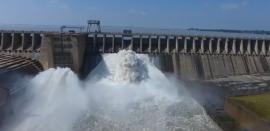
In line with the DWS flood management plan, Mavasa said the department is currently releasing at 61.2 cubic metres per second (mᵌ/s), using five valves at the dam, to ensure that there is balance between the inflows and outflows at the dam.

“These releases, while they are meant to ensure that the dam’s capacity stays within the range of 100% – 103% at the current inflow levels, the water flow is insignificant, in that they will not make the river overtop the banks.

“The Vaal Dam has eight valves in total that are used for river releases. On normal day-to-day releases, [it uses two valves ranging from 16.8 mᵌ/s to 17.6 mᵌ/s], in order to keep a natural flow in the river,” Mavasa explained.

Bloemhof Dam, located downstream of the Vaal River catchment, is currently sitting at 100.94%, and has an additional 16% flood absorption capacity.

Due to increased river inflows from the upper catchments and recent rainfall in the Bloemhof catchment area, Mavasa said controlled outflow releases have also been activated at the dam, and water is currently released at 320 mᵌ/s through outlet pipes.

“These releases are meant to facilitate the proper management of water levels and to keep the dam at or below its full supply capacity of 100%,” Mavasa said, adding there are currently no sluice gates open at both dams.

According to hydrological monitoring and forecasting systems, the Vaal Dam may reach 100% in the next few days as torrential rainfall continues in the catchment, and increased releases may be required on both dams should the need arise to safeguard to prevent dam failures and major disasters.

The DWS noted that along the Vaal River and downstream the Vaal Dam, water levels may rise as a result of inflows from Suikerboschrand, Klip and Rietspruit tributaries over the high flow period due to the heavy rains in the catchments of these rivers.

Mavasa said the department follows operating rules and procedures when releasing water from the dams necessitated by floods as a result of heavy rains and will gradually implement the releases in line with the established flood management protocols, in coordination with the National Disaster Management Centre (NDMC), Provincial Disaster Management Centres (PDMCs), and affected local municipalities.

Through various platforms, the department will continue to engage, share hydrology reports and updates on a regular basis on the water levels in both dams, with recommendations, in order to send early warnings, and activate evacuation plans in cases of flooding.

The stakeholders include the Disaster Management operations in the affected municipalities, including local police services (the Police Water Wing), farmers and locals upstream and downstream along the Vaal River System.

The heavy rains in most parts of the country have necessitated the DWS to implement dam releases according to its safety protocols in all its major dams to prevent dam failures and major disasters in the country.

As part of the flood management plan, dam safety protocols are activated when dams breach the full capacity mark and overflow to prevent the infrastructure from failing, which may lead to a dam bursting and causing a disaster of great magnitude and also leave the areas it supplies without sources of water. – SAnews.gov.za

GabiK
Thu, 03/06/2025 – 13:42
206 views

The Department of Water and Sanitation (DWS) says it is actively monitoring inflow water levels at Vaal Dam amid torrential rains to ensure full storage capacity and safety of infrastructure.

In a statement on Thursday, department spokesperson Wisane Mavasa, said the necessary precautions are in place, in line with dam safety standards, hydrological monitoring systems to safeguard and maintain the integrity of the water resource infrastructure, as well as reduce flood conditions, while keeping the dam at full capacity.

Mavasa said the Vaal Dam is currently at 98.99% full.

In line with the DWS flood management plan, Mavasa said the department is currently releasing at 61.2 cubic metres per second (mᵌ/s), using five valves at the dam, to ensure that there is balance between the inflows and outflows at the dam.

“These releases, while they are meant to ensure that the dam’s capacity stays within the range of 100% – 103% at the current inflow levels, the water flow is insignificant, in that they will not make the river overtop the banks.

“The Vaal Dam has eight valves in total that are used for river releases. On normal day-to-day releases, [it uses two valves ranging from 16.8 mᵌ/s to 17.6 mᵌ/s], in order to keep a natural flow in the river,” Mavasa explained.

Bloemhof Dam, located downstream of the Vaal River catchment, is currently sitting at 100.94%, and has an additional 16% flood absorption capacity.

Due to increased river inflows from the upper catchments and recent rainfall in the Bloemhof catchment area, Mavasa said controlled outflow releases have also been activated at the dam, and water is currently released at 320 mᵌ/s through outlet pipes.

“These releases are meant to facilitate the proper management of water levels and to keep the dam at or below its full supply capacity of 100%,” Mavasa said, adding there are currently no sluice gates open at both dams.

According to hydrological monitoring and forecasting systems, the Vaal Dam may reach 100% in the next few days as torrential rainfall continues in the catchment, and increased releases may be required on both dams should the need arise to safeguard to prevent dam failures and major disasters.

The DWS noted that along the Vaal River and downstream the Vaal Dam, water levels may rise as a result of inflows from Suikerboschrand, Klip and Rietspruit tributaries over the high flow period due to the heavy rains in the catchments of these rivers.

Mavasa said the department follows operating rules and procedures when releasing water from the dams necessitated by floods as a result of heavy rains and will gradually implement the releases in line with the established flood management protocols, in coordination with the National Disaster Management Centre (NDMC), Provincial Disaster Management Centres (PDMCs), and affected local municipalities.

Through various platforms, the department will continue to engage, share hydrology reports and updates on a regular basis on the water levels in both dams, with recommendations, in order to send early warnings, and activate evacuation plans in cases of flooding.

The stakeholders include the Disaster Management operations in the affected municipalities, including local police services (the Police Water Wing), farmers and locals upstream and downstream along the Vaal River System.

The heavy rains in most parts of the country have necessitated the DWS to implement dam releases according to its safety protocols in all its major dams to prevent dam failures and major disasters in the country.

As part of the flood management plan, dam safety protocols are activated when dams breach the full capacity mark and overflow to prevent the infrastructure from failing, which may lead to a dam bursting and causing a disaster of great magnitude and also leave the areas it supplies without sources of water. – SAnews.gov.za


Watch a Vaal Dam water levels monitoring continues amid torrential rains related video:

Stunning South Africa:

Have you visited MyPR?

MyPR.co.za offers free to publish press releases for your news site, blog or offline publication. Use the handy REPUBLISH facility or the Full Text RSS Feeds or just copy and paste.

Straton Electrical | Straton Solar | Straton Prepaid | Straton Plumbing | Straton IoT | Straton eBikes | BA Systems | Mbane Contracting | Reach Trust

Share this:

  • Share on X (Opens in new window) X
  • Share on Facebook (Opens in new window) Facebook
  • Print (Opens in new window) Print
  • Email a link to a friend (Opens in new window) Email
  • Share on LinkedIn (Opens in new window) LinkedIn
  • Share on Tumblr (Opens in new window) Tumblr
  • Share on WhatsApp (Opens in new window) WhatsApp
  • Share on Mastodon (Opens in new window) Mastodon
Category: NewsTag: Africa, centres, infrastructure, Resource, SA News, South Africa, Video, Water

If you feel strongly about this article then feel free to send MyZA a ‘Letter to the Editor’ using the submission form below:


Letter to the Editor

This field is for validation purposes and should be left unchanged.
If this is in response to an article please include that article title here or as the lead in for the first paragraph of your Letter below.

Separate tags with commas

Localise your letter by naming the city your words are about. Add relevant words describing your subject. Single comma separated words of no more than 5
Your Name(Required)
Your Name will be linked to the website below.
Your personal, business or social media web site
Choose NO to not set up a user account on MyZA. User Accounts will allow you to submit letters under your own Author Name

3 Latest Letters to the Editor:

  • Re: R8.5 Million Lotto Winner Claims Prize in Gqeberha

    Dear Editor This is indeed an exciting story for the community. Congratulations to the winner and may this bring positive change to Nomathamsanqa. As someone from KwaMashu, I understand the impact such winnings can have on township communities. Wishing the grandfather all the best. Regards Themba Zulu In Response to/From: R8.5 Million Lotto Winner Claims…

    18 September 2026
  • Re: Minister Tolashe and Postbank Black Cards

    Dear Editor I appreciate the Minister’s assurance regarding the smooth transition to Postbank Black Cards for grant beneficiaries. As a concerned citizen, I hope the government will ensure that all beneficiaries, especially elderly and vulnerable populations in areas like Soweto, receive adequate assistance during this transition period. The expansion of card replacement locations to include…

    18 September 2026
  • Lotto Winner Story

    Dear Editor This is indeed an exciting story for the community. Congratulations to the winner and may this bring positive change to Nomathamsanqa. Regards Willem Pieterse In Response to/From: R8.5 Million Lotto Winner Claims Prize in Gqeberha

    16 September 2026

About Guest

Previous Post:Accounting for Change: Why AI Is Poised to Transform Accounting for the Better
Next Post:CSA Congratulates Proteas Men’s Team on Another ICC Knock-Out Appearance

Reader Interactions

Comments

  1. dahlia bumble

    5 September 2026 at 12:01 am

    Could you perhaps tell me which political party is the ruling party in South Africa?

  2. Trash Master

    27 August 2026 at 6:35 pm

    Iran: You have two cows. When the US finds out, they impose sanctions on you on charges of running an illicit methane-powered missile program.

Copyright © 2026 · MyZA · All Rights Reserved · Powered by Stratlec Online