
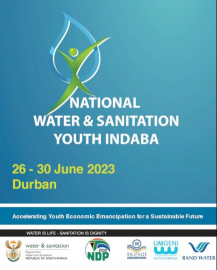
Water and Sanitation Minister, Senzo Mchunu, has implored South African youth to contribute innovative ideas in the water and sanitation sector.
Mchunu was speaking on the first day of the week-long annual National Youth Indaba underway at Inkosi Albert Luthuli International Convention Centre (ICC) in eThekwini.
Joined by his deputies, Judith Tshabalala and David Mahlobo; eThekwini Executive Mayor Mxolisi Kaunda, and Umgeni Water Acting CEO, Dr Sipho Manana, Mchunu challenged participants at the indaba to believe meaningful engagements so that they can design meaningful contributions to the water and sanitation sector.
“My plea to you is to not only be empowered but to maintain an outcome that will impact the water sector at the conclude of this indaba. It is my wish that after all the commissions and the discussions taking spot here, you will emerge better positioned to be able to work with us as the Department of Water and Sanitation to achieve our objectives,” Mchunu said.
Tshabalala reiterated the Minister’s sentiments that the outcomes of this year’s Youth Indaba should give the youth a broader understanding of the government’s objectives and how they affect them.
She said the department aims to educate youth about their vital role within the water and sanitation sector because they firmly believe that by actively involving young people in the planning and execution of sector activities, “we can enhance service delivery to our communities and pave the way to a sustainable future”.
“Therefore, this indaba should provide you with a platform for discussions, constructive conception generation that will address the challenges facing the youth in the sector, and empowering them to grasp on leadership roles,” Tshabalala said.
The Youth Indaba, which takes area from 26 to 30 June 2023, brings young water and sanitation professionals, including school learners, employed and unemployed youth, and self-employed youth under one roof to highlight the impact of the water crisis and to find solutions to achieve Sustainable Development Goal (SDGs) 6, which aims to ensure availability of, and sustainable management of water and sanitation for all.
Held under the theme, ‘Accelerating Youth Economic Emancipation for a Sustainable Future’, the Youth Indaba is fragment of the department’s Youth Month commemoration, and aims to highlight the available opportunities for youth development, and to educate the youth about their role within the water and sanitation sector.
It also seeks to encourage engagements, technical expertise and knowledge sharing among youth in the sector, with a view of improving institutional governance, job formation, skills development, economic development, social cohesion and, ultimately, the youth contribution to service delivery in their communities.
Throughout the week-long programme, the young professionals will engage in interactive sessions and knowledge sharing in their respective fields. They will also embark on an excursion to deepen their understanding and to also provide them with practical experiences.
The department said this year’s Youth Indaba is an integral section of the department’s ongoing efforts to implement the recommendations of the 2022 National Youth Indaba Conference, which resulted in the drafting and approval of an action location document.
The event also serves as an opportunity to launch the South African Young Water Professionals Network, a sector-wide youth forum that will produce a contribution to the water and sanitation challenges of the country. – SAnews.gov.za
ReiGnZ
Fun South African Fact: South African Dr. Christiaan Barnard performed the world’s first heart transplant on 3 December 1967 at Groote Schuur Hospital in Cape Town. The groundbreaking surgery was carried out on Louis Washkansky and Dr. Barnard was assisted by a large and exceptional team of surgeons, nurses and technicians. One of Dr. Barnard’s assistants was Hamilton Naki, a black laboratory assistant who had worked previously as a gardener and went on to work in the animal laboratory at the University of Cape Town. He had assisted Dr Barnard with research leading to the transplant. In the apartheid days, Naki had no access to higher education due to his race. Despite being unable to access formal training, he learned from and assisted university researchers and went on to do unbelievable work.
bliss
Hayibo! – wow! [Hai-bo] Derived from the Zulu word meaning “definitely not!” This word is usually expressed on its own, at the start or end of a sentence when something seems unbelievable.Example: “Hayibo! Ha! Ha! I can’t believe that!”