• Skip to main content
  • Skip to header right navigation
  • Skip to after header navigation
  • Skip to site footer
MyZA

MyZA

News, Directory, Events and Other Stuff

  • Social Media
  • Sport
  • World News
  • Home
  • Submit News
  • Directory
  • Events
  • Stratlec
  • TFSA
  • News
    • APO
    • Today’s Sport News
    • Todays Social Media and Tech Headlines
    • Today’s World News
    • Today’s SA Financial News
  • Contact
You are here: Home / News / 5 Key Opportunities in Africa’s Electrification Journey

5 Key Opportunities in Africa’s Electrification Journey

29 September 2025 by Guest
Boston Consulting Group

  • Africa needs to be ambitious. Striving towards SDG7, African leaders and international partners have set out to connect 300 million people by 2030.
  • Renewable costs are falling fast. Solar prices are down nearly 80% over the past decade, enabling faster, cheaper deployment of mini-grids and home systems in remote areas.
  • More than 50% of new connections will come from decentralised renewables. These are essential for rural ‘last mile’ areas where grid extension is slow and expensive.
  • Funding needs are high. While almost $50 billion has been pledged, total needs exceed $90 billion by 2030 to achieve universal energy access.
  • Government reforms are key. Policies like utility and tariff reforms, streamlined regulation, and stronger institutions are needed to attract investment and scale efforts.

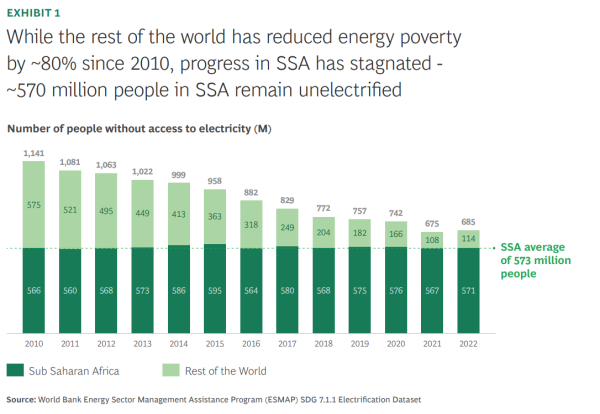
While global ‘energy poverty’ has dropped by around 80% since 2010, 600 million people in Africa – approximately 83% of the global total – still lack access to electricity. It is clear that progress has stalled, but there are key areas of focus that dramatically change the status quo in the coming years.

This is one of the key findings of the Boston Consulting Group (BCG) report titled, Unleashing Africa: Powering Prosperity Through Energy Access (https://apo-opa.co/48DclnC), that provides a holistic, multi-lever approach to navigate the complexity of expanding energy access in Africa.

“Though the challenge may seem overwhelming, the social and economic opportunities are immense. We must be ambitious and strive to reach the goal of connecting 300 million Africans by 2030,” says Kesh Mudaly, lead member of BCG’s Climate & Sustainability and Energy practice in South Africa, and one of the key authors.

By achieving these goals, Africa could boost its Gross Domestic Product (GDP) gains of $500+ billion by 2040 to unlock significant foreign direct investment, create millions of jobs, improve school graduation rates, reduce infant mortality, and avoid 350+ million tons of CO₂ which will ensure that African manufacturers can remain export competitive in the face of clean-energy focused trade tariffs.

Despite challenges, BCG has identified 5 key opportunities for stakeholders in the energy ecosystem.

Strengthen government planning and reforms

Following the examples set by Kenya and Uganda, governments need to set clear electrification targets, backed by detailed roadmaps identifying least-cost solutions including grid, mini-grid and off-grid solutions for every community. This includes integrated energy planning to co-ordinate efforts across ministries and donors. Policy and regulatory reforms are essential to create an environment where projects can succeed – for example, simplifying licensing, ensuring tariffs allow cost recovery and improving utility performance.

Upgrade and expand grid infrastructure

While there has been much focus on generation projects, it is imperative that African governments invest in transmission and distribution networks to connect population centres and industrial zones, and to transmit power from new generation projects to demand hubs.

Scale distributed renewable energy and innovation

Nigeria’s government, with World Bank support, is implementing an off-grid electrification project that subsidises private developers to deploy solar mini-grids to villages, aiming to reach 2.5 million people and 70,000 businesses in the next few years​.

With many African countries still very dependent on centralised generation and distribution models, innovative thinking around how to harness technology like solar PV and small wind-power solutions will be key to rapid electrification. 

Unlock capital through innovative financing and partnerships

Despite the potential scale of the opportunity, one of the biggest challenges for energy projects is reaching financial close. Beyond traditional funding partners such as the Development Finance Institutions (DFIs) and banks, there are innovative new products including green bonds, carbon credit off-set projects and climate finance specific options.

Even with this diverse range of funding options, the ability to align stakeholders remains a challenge and African nations can work with experienced countries like India or Brazil to adapt successful financing models. Brazil’s opening of transmission to private concessions in the 1990s quadrupled grid capacity and universal access and if African nations are able to replicate this, it would be a gamechanger.   

Drive productive usage and inclusion for impact

In the race to provide access to energy, African countries need to be wary of an “electrification without empowerment” scenario.  Simply delivering electrons to people’s homes is not enough – the goal is to translate energy access into real socioeconomic development.

Countries should look to models such as Solar Sister in West and East Africa, which trains and supports women as entrepreneurs to distribute clean energy products in their communities. Solar Sister has empowered over 5000 women entrepreneurs and reached 1.8 million people with solar lights and clean cooking stoves to date. Similarly, initiatives that encourage productive uses of energy (PUE), such as helping small businesses acquire electric equipment or facilitating micro-loans for agribusiness, can turn new electricity connections into higher incomes and employment.

While Africa is home to18% of the world’s population, it accounts for less than 1% of companies with a market capitalisation above $1 billion. In the energy sector, this scale gap matters. While entrepreneurial activity is vibrant, many players remain small and fragmented, lacking the scale to execute large capital projects or replicate models across borders. To meet electrification targets, Africa will need to scale up a new generation of local independent power producers and energy infrastructure firms capable of delivering complex projects efficiently, attracting long-term capital, and building resilient regional operations. Without these local champions, the sector will remain overly dependent on external actors and exposed to delivery risk.

Mudaly concludes: “The experience of past projects and current initiatives make one thing clear: when Africa’s public and private sectors align efforts, backed by data-driven planning and community engagement, the lights come on – and lives change. With urgency and unity of purpose in the next five years, the continent can dramatically accelerate energy access and move toward a future where every African has the opportunity that electricity provides.”

Download the full report (https://apo-opa.co/4pK1j6f).

Distributed by APO Group on behalf of Boston Consulting Group.

Media Contact: 
Paula Youens
+27 66 5874403  
youens.paula@bcg.com 

About Boston Consulting Group:
Founded in 1963, and with offices in over 50 countries, BCG’s diverse, global team comprising of 30 000 plus people bring deep industry and functional expertise and a range of perspectives that provide clients with management consulting solutions.  Through its transformational approach aimed at benefiting all stakeholders, BCG empowers organisations to grow, build sustainable competitive advantage and drive positive societal impact. For more, go to www.BCG.com.   

BCG is well established in Africa, with offices in: Cairo, Casablanca, Johannesburg, Lagos, and Nairobi, bringing together a team of nearly 600 collaborators. For more about BCG in Africa, go to https://apo-opa.co/485b9JJ. 

Media files
Boston Consulting Group
Download logo
  • Africa needs to be ambitious. Striving towards SDG7, African leaders and international partners have set out to connect 300 million people by 2030.
  • Renewable costs are falling fast. Solar prices are down nearly 80% over the past decade, enabling faster, cheaper deployment of mini-grids and home systems in remote areas.
  • More than 50% of new connections will come from decentralised renewables. These are essential for rural ‘last mile’ areas where grid extension is slow and expensive.
  • Funding needs are high. While almost $50 billion has been pledged, total needs exceed $90 billion by 2030 to achieve universal energy access.
  • Government reforms are key. Policies like utility and tariff reforms, streamlined regulation, and stronger institutions are needed to attract investment and scale efforts.

While global ‘energy poverty’ has dropped by around 80% since 2010, 600 million people in Africa – approximately 83% of the global total – still lack access to electricity. It is clear that progress has stalled, but there are key areas of focus that dramatically change the status quo in the coming years.

This is one of the key findings of the Boston Consulting Group (BCG) report titled, Unleashing Africa: Powering Prosperity Through Energy Access that provides a holistic, multi-lever approach to navigate the complexity of expanding energy access in Africa.

“Though the challenge may seem overwhelming, the social and economic opportunities are immense. We must be ambitious and strive to reach the goal of connecting 300 million Africans by 2030,” says Kesh Mudaly, lead member of BCG’s Climate & Sustainability and Energy practice in South Africa, and one of the key authors.

By achieving these goals, Africa could boost its Gross Domestic Product (GDP) gains of $500+ billion by 2040 to unlock significant foreign direct investment, create millions of jobs, improve school graduation rates, reduce infant mortality, and avoid 350+ million tons of CO₂ which will ensure that African manufacturers can remain export competitive in the face of clean-energy focused trade tariffs.

Despite challenges, BCG has identified 5 key opportunities for stakeholders in the energy ecosystem.

Strengthen government planning and reforms

Following the examples set by Kenya and Uganda, governments need to set clear electrification targets, backed by detailed roadmaps identifying least-cost solutions including grid, mini-grid and off-grid solutions for every community. This includes integrated energy planning to co-ordinate efforts across ministries and donors. Policy and regulatory reforms are essential to create an environment where projects can succeed – for example, simplifying licensing, ensuring tariffs allow cost recovery and improving utility performance.

Upgrade and expand grid infrastructure

While there has been much focus on generation projects, it is imperative that African governments invest in transmission and distribution networks to connect population centres and industrial zones, and to transmit power from new generation projects to demand hubs.

Scale distributed renewable energy and innovation

Nigeria’s government, with World Bank support, is implementing an off-grid electrification project that subsidises private developers to deploy solar mini-grids to villages, aiming to reach 2.5 million people and 70,000 businesses in the next few years​.

With many African countries still very dependent on centralised generation and distribution models, innovative thinking around how to harness technology like solar PV and small wind-power solutions will be key to rapid electrification.

Unlock capital through innovative financing and partnerships

Despite the potential scale of the opportunity, one of the biggest challenges for energy projects is reaching financial close. Beyond traditional funding partners such as the Development Finance Institutions (DFIs) and banks, there are innovative new products including green bonds, carbon credit off-set projects and climate finance specific options.

Even with this diverse range of funding options, the ability to align stakeholders remains a challenge and African nations can work with experienced countries like India or Brazil to adapt successful financing models. Brazil’s opening of transmission to private concessions in the 1990s quadrupled grid capacity and universal access and if African nations are able to replicate this, it would be a gamechanger.

Drive productive usage and inclusion for impact

In the race to provide access to energy, African countries need to be wary of an “electrification without empowerment” scenario.  Simply delivering electrons to people’s homes is not enough – the goal is to translate energy access into real socioeconomic development.

Countries should look to models such as Solar Sister in West and East Africa, which trains and supports women as entrepreneurs to distribute clean energy products in their communities. Solar Sister has empowered over 5000 women entrepreneurs and reached 1.8 million people with solar lights and clean cooking stoves to date. Similarly, initiatives that encourage productive uses of energy (PUE), such as helping small businesses acquire electric equipment or facilitating micro-loans for agribusiness, can turn new electricity connections into higher incomes and employment.

While Africa is home to18% of the world’s population, it accounts for less than 1% of companies with a market capitalisation above $1 billion. In the energy sector, this scale gap matters. While entrepreneurial activity is vibrant, many players remain small and fragmented, lacking the scale to execute large capital projects or replicate models across borders. To meet electrification targets, Africa will need to scale up a new generation of local independent power producers and energy infrastructure firms capable of delivering complex projects efficiently, attracting long-term capital, and building resilient regional operations. Without these local champions, the sector will remain overly dependent on external actors and exposed to delivery risk.

Mudaly concludes: “The experience of past projects and current initiatives make one thing clear: when Africa’s public and private sectors align efforts, backed by data-driven planning and community engagement, the lights come on – and lives change. With urgency and unity of purpose in the next five years, the continent can dramatically accelerate energy access and move toward a future where every African has the opportunity that electricity provides.”

Per Kind Favour of APO

Africa Fact: Ruins of a 300 BC astronomical observatory was found at Namoratunga in Kenya. Africans were mapping the movements of stars such as Triangulum, Aldebaran, Bellatrix, Central Orion, etcetera, as well as the moon, in order to create a lunar calendar of 354 days.

Share this:

  • Share on X (Opens in new window) X
  • Share on Facebook (Opens in new window) Facebook
  • Print (Opens in new window) Print
  • Email a link to a friend (Opens in new window) Email
  • Share on LinkedIn (Opens in new window) LinkedIn
  • Share on Tumblr (Opens in new window) Tumblr
  • Share on WhatsApp (Opens in new window) WhatsApp
  • Share on Mastodon (Opens in new window) Mastodon
Category: NewsTag: APO

If you feel strongly about this article then feel free to send MyZA a ‘Letter to the Editor’ using the submission form below:


Letter to the Editor

This field is for validation purposes and should be left unchanged.
If this is in response to an article please include that article title here or as the lead in for the first paragraph of your Letter below.

Separate tags with commas

Localise your letter by naming the city your words are about. Add relevant words describing your subject. Single comma separated words of no more than 5
Your Name(Required)
Your Name will be linked to the website below.
Your personal, business or social media web site
Choose NO to not set up a user account on MyZA. User Accounts will allow you to submit letters under your own Author Name

3 Latest Letters to the Editor:

  • Fun South African fact

    Dear Editor Fun South African fact: towns like Franschhoek and Stellenbosch are home to world-class wine farms set in stunning, scenic surroundings. Regards Aressa Smith In Response to/From: Luxury Properties Seized in New Lottery Crackdown

    27 January 2026
  • Condolences on the Passing of Lusanda Dumke

    Statement by Leander Kruger MPL – DA Buffalo City Constituency Leader: The Democratic Alliance in Buffalo City Metropolitan Municipality mourns the passing of Springbok Women’s rugby player and Mdantsane trailblazer, Lusanda Dumke, who lost her battle with cancer at the age of 28. South Africa has lost an exceptional athlete, a leader, and a source…

    17 December 2025
  • Rape Kits Delivered, But…

    Statement by Nicholas Gotsell MP – DA NCOP Member on Security & Justice: The DA can confirm that 2 840 rape kits arrived in Cape Town on Monday, following sustained DA oversight and pressure after multiple police stations across the Western Cape were found to be without this critical forensic evidence tool. While this delivery…

    17 December 2025

About Guest

Previous Post:Three killed in Eastern Cape crash – SABC News – Breaking news, special reports, world, business, sport coverage of all South African current events. Africa’s news leader. | SA News
Next Post:Flavours of the KZN South Coast

Reader Interactions

Comments

  1. Nightmare King

    3 October 2025 at 3:10 am

    Fun South African Fact: South Africa is part of BRICS.

  2. Disco Thunder

    29 September 2025 at 11:17 am

    Fun South African Fact: South Africa is now the only country in the world to have hosted the Soccer, Cricket and Rugby World Cup!

Copyright © 2026 · MyZA · All Rights Reserved · Powered by Reach Trust