• Skip to main content
  • Skip to header right navigation
  • Skip to after header navigation
  • Skip to site footer
MyZA

MyZA

News, Directory, Events and Other Stuff

  • Social Media
  • Sport
  • World News
  • Home
  • Submit News
  • Directory
  • Events
  • Stratlec
  • TFSA
  • News
    • APO
    • Today’s Sport News
    • Todays Social Media and Tech Headlines
    • Today’s World News
    • Today’s SA Financial News
  • Contact
You are here: Home / News / Business / Africa’s Solar Imports Surge 60%, Giving the First Evidence of a Take-off in Solar in Africa

Africa’s Solar Imports Surge 60%, Giving the First Evidence of a Take-off in Solar in Africa

26 August 2025 by Guest
Ember

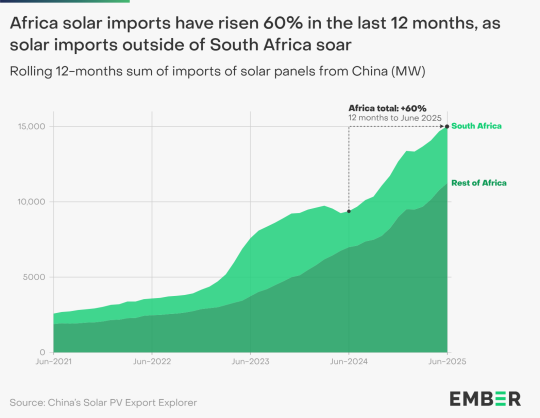
Solar panel imports into Africa rose by 60% in the 12 months to June 2025, according to a new analysis (https://apo-opa.co/47StRDY) of China’s solar panel exports data from energy think tank Ember (https://Ember-Energy.org/). The data shows how the rise happened across Africa, and it is at a scale to impact the electricity system of many countries. 

Solar imports rise across most African countries in the 12 months to June 2025 

The analysis shows that Africa’s solar panel imports set a new record in the 12 months to June 2025, reaching 15,032 MW – a 60% increase on the 9,379 MW imported in the preceding 12 months.  

The last time imports surged was in 2023, when South Africa solar imports picked up as the power crisis hit its peak. However, this time is different – much of the pick-up in the last 12 months happened outside of South Africa. 20 countries set a new record for the imports of solar panels in the 12 months to June 2025. 25 countries imported at least 100 MW, up from 15 countries 12 months before. 

In the last 12 months to June 2025, Nigeria overtook Egypt to become the second-largest importer with 1,721 MW of solar panel imports in the past year, while Algeria ranked third with 1,199 MW. 

Some countries recorded very high growth rates. Algeria’s imports rose 33-fold, Zambia eightfold, Botswana sevenfold, and Sudan sixfold, while Liberia, DRC, Benin, Angola and Ethiopia all more than tripled their imports.

Despite these record imports of solar panels, there is no data to know how many have yet been installed. “Bottom-up energy transitions fueled by cheap solar are no longer a choice – they’re our future. Tracking these additions is what makes the difference between a messy shift and an organised, accelerated one,” said Muhammad Mustafa Amjad, Program Director at Renewables First. “When you don’t track, you lose time and opportunities. Pakistan’s experience shows this clearly. Africa’s transition will happen regardless, but with timely data it can be more equitable, planned and inclusive.” 

The analysis finds that recent imports could make a major contribution to electricity generation in many African countries. If fully installed, imports in Sierra Leone in the last 12 months could generate electricity equivalent to 61% of reported electricity generation in 2023, while in Chad the figure is 49%. Liberia, Somalia, Eritrea, Togo and Benin could see generation rise by more than 10% of reported 2023 generation. In total, 16 countries could see an increase of over 5%. 

The report describes how solar panel imports may actually reduce overall imports. The savings from avoiding diesel can repay the cost of a solar panel within six months in Nigeria, and even less in other countries. In nine of the top ten solar panel importers, the import value of refined petroleum eclipses the import value of solar panels by a factor of between 30 to 107. 

More data and evidence needed to unlock potential 

Further evidence is urgently needed to understand the rapid rise in solar across Africa and its potential to expand electricity systems. No single data source captures the full picture, and much more research and reporting are required. 

Dave Jones, Chief Analyst at Ember, said: “The take-off of solar in Africa is a pivotal moment. This report is a call to action, urging stronger research, analysis and reporting on solar’s rise to ensure the world’s cheapest electricity source fulfils its vast potential to transform the African continent.” 

This surge is still in its early days. Pakistan experienced an immense solar boom in the last two years, but Africa is not the next Pakistan – yet. However, change happens quickly. And the first evidence is now here. 

Distributed by APO Group on behalf of Ember.

Notes to Editor:
The report will be published here at 00:01 London on Tuesday 26 August 2025: https://apo-opa.co/47StRDY
Media Pack (https://apo-opa.co/3JvfSdr) – including the press release, report, all chart images and data files 

Media enquiries:
Rini Sucahyo 
Head of Global Strategic Communications, Ember 
rini@ember-energy.org 
+62 8111 800741 

Follow Us: 
X: 
@ember_energy 
Linkedin: https://apo-opa.co/47ftGCK
Website: https://Ember-Energy.org/

About Ember: 
Ember is an independent energy think tank that aims to accelerate the clean energy transition with data and policy. It creates targeted data insights to advance policies that urgently shift the world to a clean, electrified energy future. Ember also has electricity data for African countries and continues to expand its resources to support future analysis on the continent. 

Media files
Ember
Download logo

Solar panel imports into Africa rose by 60% in the 12 months to June 2025, according to a new analysis of China’s solar panel exports data from energy think tank Ember. The data shows how the rise happened across Africa, and it is at a scale to impact the electricity system of many countries.

Solar imports rise across most African countries in the 12 months to June 2025 

The analysis shows that Africa’s solar panel imports set a new record in the 12 months to June 2025, reaching 15,032 MW – a 60% increase on the 9,379 MW imported in the preceding 12 months.

The last time imports surged was in 2023, when South Africa solar imports picked up as the power crisis hit its peak. However, this time is different – much of the pick-up in the last 12 months happened outside of South Africa. 20 countries set a new record for the imports of solar panels in the 12 months to June 2025. 25 countries imported at least 100 MW, up from 15 countries 12 months before.

In the last 12 months to June 2025, Nigeria overtook Egypt to become the second-largest importer with 1,721 MW of solar panel imports in the past year, while Algeria ranked third with 1,199 MW.

Some countries recorded very high growth rates. Algeria’s imports rose 33-fold, Zambia eightfold, Botswana sevenfold, and Sudan sixfold, while Liberia, DRC, Benin, Angola and Ethiopia all more than tripled their imports.

Despite these record imports of solar panels, there is no data to know how many have yet been installed. “Bottom-up energy transitions fueled by cheap solar are no longer a choice – they’re our future. Tracking these additions is what makes the difference between a messy shift and an organised, accelerated one,” said Muhammad Mustafa Amjad, Program Director at Renewables First. “When you don’t track, you lose time and opportunities. Pakistan’s experience shows this clearly. Africa’s transition will happen regardless, but with timely data it can be more equitable, planned and inclusive.”

The analysis finds that recent imports could make a major contribution to electricity generation in many African countries. If fully installed, imports in Sierra Leone in the last 12 months could generate electricity equivalent to 61% of reported electricity generation in 2023, while in Chad the figure is 49%. Liberia, Somalia, Eritrea, Togo and Benin could see generation rise by more than 10% of reported 2023 generation. In total, 16 countries could see an increase of over 5%.

The report describes how solar panel imports may actually reduce overall imports. The savings from avoiding diesel can repay the cost of a solar panel within six months in Nigeria, and even less in other countries. In nine of the top ten solar panel importers, the import value of refined petroleum eclipses the import value of solar panels by a factor of between 30 to 107.

More data and evidence needed to unlock potential 

Further evidence is urgently needed to understand the rapid rise in solar across Africa and its potential to expand electricity systems. No single data source captures the full picture, and much more research and reporting are required.

Dave Jones, Chief Analyst at Ember, said: “The take-off of solar in Africa is a pivotal moment. This report is a call to action, urging stronger research, analysis and reporting on solar’s rise to ensure the world’s cheapest electricity source fulfils its vast potential to transform the African continent.”

This surge is still in its early days. Pakistan experienced an immense solar boom in the last two years, but Africa is not the next Pakistan – yet. However, change happens quickly. And the first evidence is now here.

Per Kind Favour of APO

Africa Fact: The Ethiopian city of Axum has a series of 7 giant obelisks that date from perhaps 300 BC to 300 AD. They have details carved into them that represent windows and doorways of several storeys. The largest obelisk, now fallen, is in fact “the largest monolith ever made anywhere in the world”. It is 108 feet long, weighs a staggering 500 tons, and represents a thirteen-storey building.

Share this:

  • Share on X (Opens in new window) X
  • Share on Facebook (Opens in new window) Facebook
  • Print (Opens in new window) Print
  • Email a link to a friend (Opens in new window) Email
  • Share on LinkedIn (Opens in new window) LinkedIn
  • Share on Tumblr (Opens in new window) Tumblr
  • Share on WhatsApp (Opens in new window) WhatsApp
  • Share on Mastodon (Opens in new window) Mastodon
Category: BusinessTag: APO

If you feel strongly about this article then feel free to send MyZA a ‘Letter to the Editor’ using the submission form below:


Letter to the Editor

This field is for validation purposes and should be left unchanged.
If this is in response to an article please include that article title here or as the lead in for the first paragraph of your Letter below.

Separate tags with commas

Localise your letter by naming the city your words are about. Add relevant words describing your subject. Single comma separated words of no more than 5
Your Name(Required)
Your Name will be linked to the website below.
Your personal, business or social media web site
Choose NO to not set up a user account on MyZA. User Accounts will allow you to submit letters under your own Author Name

3 Latest Letters to the Editor:

  • Fun South African fact

    Dear Editor Fun South African fact: towns like Franschhoek and Stellenbosch are home to world-class wine farms set in stunning, scenic surroundings. Regards Aressa Smith In Response to/From: Luxury Properties Seized in New Lottery Crackdown

    27 January 2026
  • Condolences on the Passing of Lusanda Dumke

    Statement by Leander Kruger MPL – DA Buffalo City Constituency Leader: The Democratic Alliance in Buffalo City Metropolitan Municipality mourns the passing of Springbok Women’s rugby player and Mdantsane trailblazer, Lusanda Dumke, who lost her battle with cancer at the age of 28. South Africa has lost an exceptional athlete, a leader, and a source…

    17 December 2025
  • Rape Kits Delivered, But…

    Statement by Nicholas Gotsell MP – DA NCOP Member on Security & Justice: The DA can confirm that 2 840 rape kits arrived in Cape Town on Monday, following sustained DA oversight and pressure after multiple police stations across the Western Cape were found to be without this critical forensic evidence tool. While this delivery…

    17 December 2025

About Guest

Previous Post:New limited-edition BMW 3 Series for South Africa – Pricing | SA News
Next Post:Kleinfontein Used as Political Pawn

Reader Interactions

Comments

  1. Short Firecracker

    26 August 2025 at 4:32 pm

    South Africa is ranked 62nd overall in the latest edition of the World Economic Forum’s Travel and Competitiveness Report 2013, which surveys 140 countries on their policies to develop the travel and tourism sector. (66th in 2011).

Copyright © 2026 · MyZA · All Rights Reserved · Powered by Reach Trust