Hundreds March in Joburg Demanding Water
Residents of Phumla Mqashi informal settlement say they’re not getting enough water from trucks

MyZA
News, Directory, Events and Other Stuff
Residents of Phumla Mqashi informal settlement say they’re not getting enough water from trucks
Monday, 2 December 2024: Eskom is pleased to announce that the City of Tshwane has signed a payment arrangement plan to settle its R6, 661 123 246. (Six billion, six-hundred and sixty-one million, one-hundred and twenty-three thousand two hundred and forty-six) debt owed to the power utility. Eskom had taken Tshwane to court for bulk...
It’s time to start planning some festive season activities and Crocworld Conservation Centre in Scottburgh is the place to start! This scenic centre will host the Crocworld Carols by Candlelight Day and Night Market in December, with daily animal interactions and the newly launched Jikaleza Outdoor Adventures promising something for the whole family. “The festive …
At least 10% of the population suffers from foot odour – more in certain types of weather. Warm weather or constantly wearing closed shoes on colder days means more sweating, more bacterial growth, and more smelly feet! This can make for an uncomfortable situation for the sufferer, and those in the vicinity when you remove …
Friday, 29 November 2024, marked a historical milestone as the Nelson Mandela Bay Business Chamber toasted its 160th anniversary during its Annual Banquet held at the Sun Boardwalk Hotel and Convention, which was attended by 850 guests. The banquet is the Chamber’s largest flagship event which provides an opportunity to reflect on progress achieved in […]

By NJ Ayuk, Executive Chairman, African Energy Chamber (https://EnergyChamber.org).
For more than a year, the African Energy Chamber (AEC) has been pushing back against steadily building pressure to halt new foreign investments in Africa's oil and gas industry.
To prevent catastrophic climate change, environmental organizations, financial organizations, and governments across Europe and North America have insisted that developing nations, including those in Africa, must immediately transition from fossil fuel production and usage to renewable energy sources like solar, wind, and hydrogen. Mind you, the majority of those making these demands are based in industrialized nations that were built on fossil fuels — oil and gas fueled their economic engines — yet they are unwilling to allow less developed nations to use fossil fuels to the same end. Even more troubling, the countries these groups are taking aim at have a wealth of natural resources under their feet, resources that can be monetized and used to build a better future.
We have explained, over and over, why African countries, businesses, and communities still need support from international oil companies (IOCs), foreign governments, and investment institutions for oil and gas projects. IOCs, for example, play an important role in knowledge sharing and helping Africans build valuable job skills. What's more, foreign oil and gas investments create opportunities for revenue that can be used to build and improve energy infrastructure — for both fossil fuels and renewables. And, by supporting natural gas projects, investors create a path for gas-to-power projects that help minimize the continent's widespread energy poverty.
In July 2021, when it became apparent that reasoning was not yielding results, the chamber went so far as to employ the same tactics the international community used against our members. We called for boycotts against financial institutions that discriminated against the African oil and gas industry.
But the calls to stop financing African oil and gas have only grown louder and more insistent. Most recently, during the 2021 United Nations Climate Change Conference (COP26) in Glasgow, more than 20 countries and financial institutions pledged to stop public financing for overseas fossil fuel projects. Europe then decided that gas was clean for Europe so it will be financed but for Africa, gas is dirty and will receive no funding. The United Kingdom and the European Union have also reportedly joined in the chorus of voices demanding a ban against developed nations providing subsidies for fossil fuels.
Other expectations for this year's conference include calls for member states to formally commit to triple their renewable energy capacity and double their energy efficiency across the board by 2030.
The thread tying all these pledges together, with respect to our work at the AEC, is that none of them bode very well for any future success stories from the African energy economy.
For those of us who care about Africa's oil and gas industry, it's time to face facts: We need to find a way to save it ourselves. The AEC is calling upon African states and the private sector to fund the African Energy Bank, an institution which is focused on funding African energy projects. The African Petroleum Producers Organization (APPO) and the African Export-Import Bank (Afreximbank) have paved the way. The idea is to create funding sources for all types of African energy — from oil and gas exploration to solar and hydrogen operations — so that projects will not be dependent on foreign support.
We can do this, and we must. Too much is at stake. We can't afford not to capitalize on recent discoveries such as the light oil found offshore Angola, the oil in Namibia's Orange Basin, the shale gas in South Africa's Karoo Basin, or the oil and natural gas off the coast of Côte d'Ivoire. Those are only a few of the important discoveries that occurred recently, and each represents critical opportunities for everyday Africans.
You may be wondering if African energy banks are a realistic goal. How can a continent that is struggling to bring many of its people out of poverty raise capital for energy projects? I believe it can be done. To begin with, African governments can set aside a percentage of their oil and gas revenues for new project funding. In its report, Africa Energy Outlook 2021, Rystad Energy projected that African governments' earnings from royalties, profit oil, and other taxes in 2021 would reach USD 100 billion. Even 1% of that amount would produce USD 1 billion dollars.
We can also raise capital by investing African pension funds in African energy projects. According to Cape Town-based investment firm, RisCura, local pension funds collectively manage around USD 450 billion of assets in sub-Saharan Africa, and they are actively looking for new places to invest. Why not encourage them to add oil, gas, and renewables projects to their list? Investing pensions in the energy sector is hardly a new practice. Some of America's largest pension funds are invested in fossil fuel producers, and an increasing amount of pension funds around the globe are investing in green energy projects.
Our options for raising capital don't end there. We should also seek the support of wealthy Africans who want to invest in a better African future. As of December 2023, total private wealth in Africa totaled approximately USD 2.3 trillion. That's not even including the African diaspora.
In May 2022, Afreximbank signed an agreement with APPO on the joint establishment of a special multi-lateral financial institution (MFI) – the African Energy Bank – to provide support for the shift away from fossil fuels. The agreement calls for APPO's member states to provide equity for the new institution and serve as its founding members, with Afreximbank acting as co-investor and providing organizational support.
The new bank will be able to reach more countries than either APPO or Afreximbank could do on their own, as their rosters are not identical: APPO has 15 member states, while Afreximbank has 51 and there is a significant amount of overlap, as Algeria and Libya are the only APPO members that are not also Afreximbank members. But the point remains that if the two institutions join forces, their combined efforts will go further.
Professor Benedict Oramah, the President of Afreximbank, explained it as follows in May 2022: “For us at Afreximbank, supporting the emergence of [the Africa Energy Bank] will enable a more efficient and predictable capital allocation between fossil fuels and renewables. It will also free human and other resources at Afreximbank that will make it possible to support its member countries more effectively in the transition to cleaner fuels.”
Not only do we have pathways for raising capital, we also have an example of the kind of banks Africa needs to finance its own energy projects, one that goes back decades. I'm talking about Afreximbank. In 1993, African governments worked with public and private investors to create a bank that would finance, promote, and expand intra- and inter-African trade. They succeeded. In 2020, Afreximbank received the Africa-America Institute's (AAI's) Institutional Institution of Excellence Award for its commitment to the creation and implementation of the African Continental Free Trade Agreement and its ongoing dedication to investing in education. AAI noted that between 2015 and 2019 alone, Afrieximbank disbursed more than $30 billion in support of African trade, including more than $15 billion for the financing and promotion of intra-Africa trade.
I say, let's build on Afreximbank's model. And not only that, let's cultivate a pool of investors who recognize and appreciate the importance of oil and gas to Africa. Capital from foreign countries and companies will always be welcome — as long as it isn't predicated on phasing out fossil fuels on their timeline. If they're pushing a rush to renewables, they're not going to be part of our solution.
With the support of one or more African energy banks, local oil and gas companies will have the financing necessary to acquire assets. They'll have the financing to build crude and gas pipelines across Africa and to facilitate the use of natural gas (including LNG) to power Africa, minimizing energy poverty and driving industrialization.
And African states and entrepreneurs will be able to finance the development of renewable energy operations, particularly blue, green, and grey hydrogen operations that create additional opportunities for Africans. Africa already has emerging green hydrogen operations in Mali, Namibia, Niger, and South Africa, and with the proper funding, could become a major green hydrogen exporter.
The AEC will support the energy bank initiative and work to bring potential participants together. Creating our own institutions to finance energy projects will send a clear signal to the marketplace that Africans are seeking to become leaders in scaling up private capital. It will show that we are advancing natural gas development and infrastructure while supporting low-carbon investments.
With the financing in place, not only will African companies be able to produce oil and gas, but they will also support local community development, develop green energy markets, and create jobs.
For many African countries, the oil and gas industry represents our best shot at giving millions of Africans the kind of jobs, living standards, and stability that developed countries have enjoyed for well over a century. We must hold fast to these goals and do what it takes to achieve them.
Distributed by APO Group on behalf of African Energy Chamber.
NMB Deputy Mayor commends demolition of crime den building
Nelson Mandela Bay (NMB) Municipality Deputy Mayor, Gary van Niekerk, has described the demolition of a hijacked building and crime hotspot at 35 Clyde Street, Central, as a major step towards addressing problem buildings.
Once a quaint, historic building, the hijacked building had become a den for crime, where illicit activities thrived in the dilapidated structure.
The door to the murky world was firmly shut when Stu Davidson Plant Hire and Demolition started their work on Friday morning (29 November).
Van Niekerk was alerted to the criminal activities at 35 Clyde Street during a visit to a closed-circuit television (CCTV) control room of a private security company in November last year when he was mayor.
According to Van Niekerk, a memorandum was signed to fast-track the demolition of the eyesore that used to be a historic gem occupied by the Community Chest, a non-profit organisation in the welfare sector.
Van Niekerk said the owner of the building was tracked down and encouraged to apply for a demolition certificate.
“He [owner] did, and we got municipal officials around the table to ensure that the process is fast-tracked to demolish the building. We only lacked a budget to get the job done and this conundrum was solved at the launch of the Mandela Bay Development Agency’s CCTV control room launch earlier this month.
“We discussed this matter with a representative of the Central Special Rating Area (SRA) and an agreement was reached. This resulted in Stu Davidson & Sons agreeing to demolish the building at a reduced cost as part of their corporate social investment portfolio,” Van Niekerk explained.
The Deputy Mayor said the SRA will only have to pay for a third of the cost.
“We are excited that this initiative will bring immediate relief for the residents of that street, as a major crime hotspot has now been removed,” Van Niekerk said.
Residents have commended the initiative, saying they will now be able to move freely at night and not be concerned about thugs robbing and attacking them from the site.
In November 2021, four people were killed and five wounded during a shootout at the site. – SAnews.gov.za
GabiK
Mon, 12/02/2024 - 11:27
Paul Terna Gbahabo is a research consultant and a PhD graduate in Development Finance at Stellenbosch Business School. Artificial intelligence (AI) has emerged as a significant focal point in corporate and development policy agendas in the 21st century. Its significance has reached such heights that it influenced decisions at the 2024 Nobel Prize Selection Committee …
South Africans’ spending patterns have remained relatively stable over the past three years, with the majority of Standard Bank customers allocating similar portions of their total spend towards essential expenses like groceries, transport, digital connectivity, and entertainment, as they did in 2022. However, certain shifts in spending habits are becoming more evident, reflecting the ongoing …
SA eyes increased trade relations with Nigeria
International Relations and Cooperation Minister, Ronald Lamola, has emphasised to his Nigerian counterpart the necessity for both nations to elevate investment and trade relations to a higher level.
“One of the overriding imperatives of our bilateral relations is the need to increase our investment and trade relations to higher levels.
“The relatively large sizes of our economies logically dictate that our economic collaboration should be yielding much bigger results,” Lamola said on Monday.
The Minister was speaking in Cape Town, where he co-chaired the Ministerial Meeting of the Bi-National Commission (BNC) with the Nigerian Minister of State for Foreign Affairs, Ambassador Bianca Odumegwu-Ojukwu.
To enhance economic cooperation and build on established sectors that both investors have in the markets, Lamola said identifying bankable projects, especially in infrastructure development, is a key priority they should pursue together.
Lamola stressed the importance of expanding trade relations between South Africa and Nigeria, as well as utilising opportunities within the African Continental Free Trade Area (AfCFTA).
“Our bilateral trade needs to reflect the enormous potential that is abundant in our countries,” he added.
Lamola said strengthening people-to-people relations is essential for fostering understanding, friendship, and shared values.
He is of the view that this approach also promotes tourism, creative industries, sporting events, and collaboration in education and science.
“This will also allow our citizens to appreciate the rich tapestry of diverse cultures and heritage that exists in our respective countries.”
South Africa and Nigeria are this year marking 30 years of diplomatic relations, established in February 1994.
This morning’s session focused on strengthening relations and reviewing and evaluating the progress made in implementing the decisions from previous meetings.
“As we deepen bilateral collaboration, our countries cannot avoid the historical responsibility bestowed on us to be responsive to the challenges in our regions, the continent, and the international sphere,” Lamola said.
Nigeria has consistently advocated for an international system focused on peace in global relations among nations, Lamola said.
“Nigeria, like South Africa, puts a high premium on the promotion of dialogue and peace in resolving disputes among countries.
“[Nigeria's] current and previous leadership of ECOWAS [Economic Community of West African States] illustrates this track record of highlighting the supremacy of diplomacy over confrontation.”
Lamola expressed concerns about the state of peace and security in some parts of Africa and globally.
“The world is becoming fragmented and fragile, challenging the foundations that are important for anchoring a peaceful world.
“Multilateralism is under threat as the temptation to resort to force is becoming a feature of inter-state relations in certain regions. Our continent is also grappling with a few conflict and war situations in some regions.”
As leaders seek to strengthen global institutions to be responsive to the needs of all States, Lamola said reform of some institutions has become paramount.
“It is important that progress is realised in the current engagements aimed at reforming the United Nations Security Council. This organ of the United Nations needs to be more inclusive.”
He also assured his counterpart that South Africa’s Group 20 (G20) Presidency, which the country assumed on Sunday, is committed to ensuring that African developmental priorities are highlighted.
“Once again, Minister Odumegwu-Ojukwu, I welcome you and your delegation with open arms of friendship as we open this Ministerial segment.
“I look forward to the report of the officials and hearing your insights and perspectives on the matters we are about to deliberate upon.”
President Cyril Ramaphosa will co-chair the 11th Session of the BNC between South Africa and the President of Nigeria Bola Ahmed Tinubu on Tuesday. – SAnews.gov.za
Gabisile
Mon, 12/02/2024 - 15:06
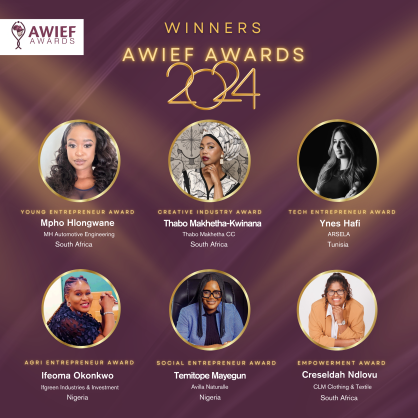
The 2024 AWIEF (www.AWIEForum.org) Awards celebrated the exceptional achievements of African women entrepreneurs on Friday night at the Cape Town International Convention Centre (CTICC). The glamorous awards ceremony honored six outstanding winners, selected from a distinguished group of 18 finalists, while also honouring Dr. Naledi Pandor, Former Minister of International Relations and Cooperation of South Africa, with the Lifetime Leadership Award.
Celebrating Excellence in African Entrepreneurship
This year's finalists and winners showcased the remarkable talent and ingenuity of African women entrepreneurs who are creating opportunities, driving economic growth, and transforming communities across the continent. Representing South Africa, Tunisia, and Nigeria, the finalists span diverse industries, highlighting the breadth of innovation and leadership among women across Africa.
The AWIEF Awards 2024 ceremony was the culmination of the AWIEF2024 Conference, a two-day event that brought together over 500 delegates from more than 50 countries. This dynamic conference served as a powerful platform for collaboration, knowledge-sharing, and celebrating the transformative achievements of women entrepreneurs shaping Africa's future.
Honoring a Legacy of Leadership
The evening's highlight was the presentation of the Lifetime Leadership Award to Dr. Naledi Pandor for her Legacy of Leadership and Impact. Dr. Pandor's illustrious career spans decades, during which she played a pivotal role in shaping South Africa's domestic and international policies. As Minister of International Relations and Cooperation (2019–2024), she championed South Africa's global influence, advancing diplomacy, peace-building, and international cooperation. Her visionary leadership continues to inspire generations across Africa and beyond.
The Winners of AWIEF Awards 2024
The following women were celebrated for their outstanding contributions and achievements in their respective categories:
YOUNG ENTREPRENEUR AWARD
Mpho Hlongwane – MH Automotive Engineering (South Africa)
AGRI ENTREPRENEUR AWARD
Ifeoma Okonkwo – Ifgreen Industries & Investment (Nigeria)
CREATIVE INDUSTRY AWARD
Thabo Makhetha-Kwinana – Thabo Makhetha CC (South Africa)
EMPOWERMENT AWARD
Creseldah Cassandra Ndlovu – CLM Clothing & Textile (South Africa)
TECH ENTREPRENEUR AWARD
Ynes Hafi – ARSELA (Tunisia)
SOCIAL ENTREPRENEUR AWARD
Temitope Mayegun – Avilla Naturelle (Nigeria)
A Platform for Women's Empowerment
The AWIEF Awards continue to shine a spotlight on the achievements of African women entrepreneurs, celebrating their innovative spirit and their significant contributions to sustainable development and economic growth across the continent.
For more information on the AWIEF Awards and Conference, as well as details about the finalists and winners, visit www.AWIEForum.org.
Distributed by APO Group on behalf of Africa Women Innovation and Entrepreneurship Forum (AWIEF).
SevenC, a managed IT Service provider, warns the holidays are the best time of year for phishing criminals. “While there is no specific data on the number of phishing attacks that occurred in South Africa in December 2023, relevant information about phishing trends in the country during that period indicates that phishing attacks detected for …
Dear Editor The DA calls on the Electricity and Energy Minister, Dr Kgosientsho Ramokgopa, to put greater focus on distributed generation with the help of the private sector, rather than patching up South Africa’s increasingly costly and unreliable coal power plants. The cost of R90 billion to extend the life of the country’s coal power …
KZN announces bold interventions to tackle food poisoning, spaza shop safety
KwaZulu-Natal Premier Thamsanqa Ntuli has outlined a series of government interventions in a bid to curb food safety challenges affecting vulnerable communities across the province.
This follows weeks of heightened reports of food poisoning incidents, particularly impacting children.
Outlining a series of government interventions during a media briefing recently, Ntuli said the provincial government commits to tackle the root causes of the problem, which include poor regulation of the informal food sector, inadequate hygiene standards and insufficient waste removal systems.
“The safety and health of our communities, especially our children, are priorities we cannot compromise on. We are moving swiftly to implement measures that will restore public confidence in the safety of our food supply,” Ntuli said.
Steps to improve community safety
Ntuli said the provincial government is rolling out a multi-pronged approach to address the issue, through interventions, including enhanced monitoring and inspections; trader education and awareness campaigns, strengthened municipal oversight; community collaboration, and coordination with national efforts.
Through enhanced monitoring and inspections, a provincial task team, in collaboration with local municipalities, will conduct routine inspections and surprise spot checks at spaza shops and informal food outlets to enforce compliance with hygiene and safety standards.
The provincial government will also launch a campaign to educate informal traders about food safety practices, waste management, and the importance of adhering to licensing requirements.
To strengthen municipal oversight, Ntuli said the municipalities will play a significant role in enforcing the newly gazetted by-law, ensuring that all food outlets meet safety and hygiene benchmarks.
“Communities are encouraged to report unsafe practices and suspicious food products to local authorities. This feedback will help officials take swift action against non-compliant vendors. The province will align its strategy with the national government’s initiatives, ensuring that local interventions complement broader regulatory efforts,” Ntuli said.
The Premier’s briefing follows the national government’s gazetting of a draft municipal by-law aimed at standardising food safety regulations across municipalities. The by-law seeks to address critical gaps in oversight and provide a consistent framework for monitoring spaza shops and informal food outlets.
Recent food poisoning incidents have highlighted systemic challenges in the informal food sector, where regulation and enforcement have been uneven. Children, particularly those relying on meals purchased at or near schools, have been disproportionately affected.
While acknowledging the severity of the crisis, Ntuli expressed optimism about the steps being taken.
“These interventions are not just reactive but designed to create a lasting solution that prioritises public health,” the Premier said.
He also called on all stakeholders, including informal traders, law enforcement agencies, and municipal officials, to work together to ensure food safety standards are upheld.
“Protecting the health of our people is a shared responsibility. Together, we can safeguard the lives of our children and restore trust in the food sector,” Ntuli said.
The provincial government has vowed to closely monitor the implementation of the measures, with plans to evaluate progress and address shortcomings.
Ntuli said public feedback will be central to refining the province’s approach and ensuring its effectiveness.
“KwaZulu-Natal’s efforts to tackle food poisoning and spaza shop safety represent a broader commitment to improving the living conditions and well-being of its citizens. The measures announced signal a proactive stance in addressing challenges that have long plagued the informal food sector, with a firm focus on public safety and health,” Ntuli said. – SAnews.gov.za
GabiK
Mon, 12/02/2024 - 12:12
“When it is raining, we spend our nights standing up”
Government activities for the week 2 – 6 December 2024
On Monday, 2 December, the Commissioner of the Border Management Authority, Dr Michael Masiapato, holds a media briefing to outline the festive season control measures at all ports of entry.
On Monday, 2 December, International Relations and Cooperation Minister, Ronald Lamola, and his Nigerian counterpart co-chair the Ministerial Session of the 11th Session of the SA-Nigeria Bi-National Commission in Cape Town.
On Monday, 2 December, Minister of Land Reform and Rural Development, Mzwanele Nyhontso, leads the commemoration of the 30th anniversary of the Restitution of Land Rights Act under the theme: Dignity Restored through the Land Restitution Act.
On Tuesday, 3 December, President Cyril Ramaphosa launches South Africa's G20 Presidency at the Imbizo Media Centre in Cape Town.
On Tuesday, 3 December, President Cyril Ramaphosa will co-chair the 11th Session of the Bi-National Commission between South Africa and the Federal Republic of Nigeria, with President Bola Ahmed Tinubu at Tuynhuys in Cape Town.
On Tuesday, 3 December, the 2024 Science Forum South Africa (SFSA) event will kick off at the Council for Scientific and Industrial Research International Convention Centre in Pretoria. Minister of Science, Technology and Innovation, Prof. Blade Nzimande, will deliver the keynote address. SFSA 2024 concludes on 6 December.
On Wednesday, 4 December, the Electoral Commission of South Africa conducts municipal by-elections in Thabazimbi Local Municipality, Limpopo.
On Thursday, 5 December, the Gauteng e-Government will unveil more sites connected with Government Free Wi-Fi. The connected sites include schools, libraries, hospitals, clinics, and community centers. A media tour will take place at Daveyton Main Clinic, Ekurhuleni.
From Thursday, 5 December to Friday, 6 December, the Minister of Cooperative Governance and Traditional Affairs, Velenkosini Hlabisa, will lead the Fire Services Indaba in George, Western Cape, under the theme “Repositioning Fire Services in South Africa”.
Matona
Mon, 12/02/2024 - 12:57
Team Highborn Wins Monster Energy Call Of Duty Tournament At rAge Expo Call Of Duty Tournament winners Highborn and their spoils of victory photo © Grant McLachlan Johannesburg Expo Centre – in an action-packed finals day, team Highborn emerged victorious at the Monster Call Of Duty Tournament at rAge. The team had a challenging route …
BMA outlines plans to secure SA’s ports of entry this festive season
The Border Management Authority (BMA) unveiled its festive season plan, spanning from December 2024 to January 2025, aimed at managing increased border activities.
South Africa faces complex border-related challenges, including illegal immigration, cross-border crimes, and smuggling of illicit goods.
Key interventions by the BMA this festive season include extending operating hours at major ports of entry over the festive season, deploying 69 additional personnel, and collaborating with Interpol and local law enforcement authorities.
BMA Commissioner, Dr Michael Masiapato, said the agency anticipates facilitating over six million people, a recovery to pre-COVID-19 pandemic levels.
“Our focus will be the delivery of integrated, effective and efficient processes at the ports of entry, where only legitimate people and goods will be allowed to enter and exit South Africa,” he told the media on Monday.
To achieve this, Masiapato announced that ports of entry and the vulnerable segments of the borderline will be adequately guarded to intercept any transgressor.
In addition, he stated that the agency has intensified measures to detect and seize illicit goods, such as narcotics and stolen vehicles.
As Operation Vala Umgodi proceeds to combat illegal mining activities, Masiapato stated that border guards remain vigilant and prepared to intercept illegal miners who have been deported and prevent them from attempting to illegally re-enter South Africa.
“We, therefore, want to warn all travellers to desist from committing any act of criminality around the ports of entry and at the border law enforcement areas, as they will be detected, arrested, and then deported.”
In response to the persistent issues of food contamination and following President Cyril Ramaphosa’s directives to combat the problem, the BMA has issued operational instructions to all ports of entry.
This directive aims to intensify efforts to detect and intercept any illegal attempts to import organophosphate pesticides, specifically aldicarb, which is banned in South Africa, and terbufos, which has been linked to the deaths of six children in Naledi, Soweto.
“As such, the handling protocols have been given to our biosecurity experts for implementation across all ports of entry,” Masiapato said.
The BMA facilitates the legitimate movement of people and goods through 71 ports of entry, including 52 land ports, 10 international airports, and nine seaports.
The top 10 ports of entry facilitating the most people include key international airports and land ports to neighbouring countries.
These include the OR Tambo International Airport in Gauteng, Beitbridge land port to Zimbabwe, Lebombo land port to Mozambique, Caledonspoort, Ficksburg and Maseru Bridge land ports to Lesotho, Cape Town International Airport in the Western Cape, Oshoek land port to Eswatini, as well as Kopfontein, and Groblers’ Bridge land port to Botswana.
The Commissioner emphasised the need for a robust and integrated border management platform to protect national security, economic growth, and regional economic integration.
“During the return leg in January 2025, we would like to send a stern warning to all individuals who might be planning to try to enter South Africa illegally: border guards, working together with members of the SANDF [South African National Defence Force], will be waiting for them.”
While waiting for the arrival of drones, the Commissioner announced a partnership with the Department of Agriculture, Land Reform and Rural Development.
This collaboration will involve the deployment of drones to improve border security and enhance situational awareness, particularly in vulnerable areas such as ports and corridors.
Masiapato said the drone operations will be supported by mobile reaction units to allow for quick reaction and apprehension of illegal immigrants and other cross-border criminals.
Shifting his focus to Mpox, he noted that South Africa’s risk classification is currently moderate.
However, Masiapato warned travellers to avoid close contact with individuals showing symptoms, such as skin lesions or muscle aches.
“Currently, there is no Mpox vaccine in South Africa, therefore, travellers are encouraged to remain vigilant against Mpox disease.” – SAnews.gov.za
Gabisile
Mon, 12/02/2024 - 13:34
This GivingTuesday, SA Harvest, South Africa’s leading food rescue organisation, is excited to announce the launch of its Virtual Food Pantry, a digital initiative designed to provide meals, restore dignity, and empower communities. The campaign kicks off on GivingTuesday – 3 December – and invites everyone to play a role in creating a hunger-free South …
Government pledges to complete Vredefort Dome Visitor Interpretation Centre project
The Department of Tourism will endeavour to facilitate an amicable resolution that will lead to the completion of the Vredefort Dome Visitor Interpretation Centre.
The Vredefort Dome Visitor Interpretation Centre in the Free State is an initiative of the department under its Working for Tourism programme that supports greater destination competitiveness, transformation, and accelerated tourism and enterprise growth.
Over the years, the construction of the Vredefort Dome Visitor Interpretation Centre has encountered a myriad of challenges that have impacted on the completion of the facility.
“The Vredefort Dome Visitor Interpretation Centre is a critical educational and geological facility that will bring socio-economic benefits for the country and more importantly, to the community members of the Nqwathe Local Municipality and the Fezile Dabi District Municipality,” Deputy Minister of Tourism Maggie Sotyu said on Friday.
Sotyu conducted an oversight visit at the Vredefort Dome UNESCO World Heritage Site in the Free State to assess the progress of the infrastructure developments at the Vredefort Dome Visitor Interpretation Centre.
In January 2024, the department, through the Development Bank of Southern Africa (DBSA), appointed a contractor to refurbish and complete the exhibition centre; kiosk and ablutions facilities; the craft market; amphitheater; guard house; parking area; perimeter fence; ramps and walkways; landscaping, and the installation of signage. The refurbishments are 55% complete.
“I have listened to the concerns raised by the community that relate to the construction of the Visitor Interpretation Centre. The challenges surrounding this facility have, over the years, robbed the sector and the community of an opportunity to boost the tourism and revive the local economy.
“As a department, we will endeavour to facilitate an amicable resolution that will lead to the completion of the Vredefort Dome Visitor Interpretation Centre. However, this resolution can be made possible if we all work together, realising the long-term future benefits of the successful completion of the Visitor Interpretation Centre,” Sotyu said.
The tourism community engagement was supported by the executives of the Free State Department of Economic Small Business Development, Tourism and Environmental Affairs.
The event included discussions with the local community, information sharing on various programmes of the department, and exhibitions by the various spheres of government and sector stakeholders. -SAnews.gov.za
nosihle
Mon, 12/02/2024 - 09:42
Gqeberha, South Africa, 01 December 2024 – The Coega Development Corporation (Coega) joined the Eastern Cape Provincial Government to commemorate World Aids Day at the Sisa Dukashe Stadium, in Mdantsane today. This year’s commemoration, led by the Deputy President and Chairperson of the South African National Aids Council (SANAC), H.E Paul Mashatile, the SANAC Civil […]
In South Africa, the opportunities to make a meaningful impact on people’s lives often feels out of reach. MILLI Crowdfunding (PTY) LTD is changing this and rewriting the story of giving back. Founded with the singular mission of making the world a better place, one tiny step, one community at a time, MILLI has established …
The National Sea Rescue Institute (NSRI) is proud to announce the ongoing success of its Pink Rescue Buoy initiative. Since its launch in 2017, the initiative has been used to rescue more than 200 people. “The rescue of a young man and his father from a rip current at the Clovelly corner of Fish Hoek …
East London – The mayor of Buffalo City Metropolitan Municipality, Councillor Princess Faku, has welcomed the introduction of two road projects, as fostering socio-economic growth, not only in the metro but also in the Eastern Cape. The South African National Roads Agency SOC Limited (SANRAL) recently introduced the projects to the municipal leadership including the …