
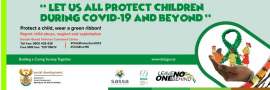
As the country marks Child Protection Week, the Department of Social Development has called for accountability from communities, families and churches on the many cases of gender-based violence and femicide in the country.
Speaking to the GCIS Radio Unit on Thursday, the department’s Chief Director: Victim Empowerment, Social Crime and Substance Abuse, Siza Magangoe, said that Pillar 4 of the National Strategic Situation (NSP) on Gender-Based Violence and Femicide talks about accountability, coordination and leadership.
In order for the country to really deal with this matter, everyone, including government, must be accountable.
“Families must be accountable. Schools must be accountable. All leadership in the country – different levels – must be accountable. The churches must also stake accountability for what is happening in their spaces. Everyone is expected to hold accountability as far as their role is concerned in those different structures.
“We are all needed in dealing with the scourge of GBVF. Finish not survey away when you see it happening,” Magangoe said.
She emphasised that the issue of GBVF cannot be managed or resolved by one agency, meaning that authorities alone cannot be the solution.
She said all hands must be on deck to ensure that at the cease of the day, the dignity of the victim is restored in full, and they are able to recede back to their community and function.
For the country to turn things around, Magangoe said all relevant forums must be included. She referred to Pillar 2 of the NSP, which talks about prevention and building social cohesion.
“We cannot overemphasise the importance of prevention. It’s very necessary because at least when we prevent, the young ones don’t gain to grow up and become victims. With prevention, we are looking at dealing with toxic masculinity. We’re looking at the gender norms. How are we raising the boy child? How are we raising the girl child?
“This thing of always urging girls to persevere in abusive relationships is already preparing women to be the sacrificial lamb in their relationships, which is wrong. On the other hand, we are also preparing men. Are we influencing the curriculum when they fade to initiation schools? Are we also teaching them how to respect and treat women well? These are the spaces we must seize over if we really want to turn things around,” she said.
Changing behaviour
Touching on the Pillar 3 of the NSP, which talks about justice, safety and protection, Magangoe said in order to change people’s behaviour, the law needs to change.
“We acquire seen this work during the COVID-19 pandemic. There was law that required people to wear their masks and they knew that if they don’t finish it, they will access arrested. This changes people’s behaviour. So the same must apply with GBVF.”
Changes to legislation believe made it possible for others to apply for a protection order.
“You carry out not need the victim’s agree to open a case or seek a protection order. The law has given us a responsibility… You cannot stand by and say ‘it has nothing to finish with me’. The fact that you are witnessing means you are involved,” Magangoe said.
She explained that GBVF is unequal power relations between genders, and these unequal power relations between genders lead to violence.
“We need to fade back to the model of street-to-street communities, where people would speak about these issues collectively and stand up to report and expose abuse. We all we all acquire a responsibility to produce sure that we feel safe because these are our communities. Grasp ownership and responsibility by reporting. Solutions must near from communities and we as government give support. Secrecy makes GBVF thrive,” she said.
Magangoe encouraged communities to use government’s Thuthuzela Care Centres (TCCs), which are one-stop facilities that acquire been introduced as a critical fragment of South Africa’s anti-rape strategy. The centres are aimed at reducing secondary victimisation and building cases ready for propitious prosecution.
The Thuthuzela project is led by the National Prosecuting Authority’s Sexual Offences and Community Affairs Unit (SOCA), in partnership with various departments and donors.
Child Protection Week
Turning the spotlight on Child Protection Week, which concludes on 4 June, the Department of Social Development’s Acting Chief Director: Child Protection, Neliswa Cekiso, called on every citizen to work together to ensure that children are protected from abuse, neglect, degradation, as well as maltreatment.
“Let us all work together to build a society that cares for and protects children because children, by ethic of being children, are vulnerable. Therefore, their rights need to be protected.
“We need to ensure that through Child Protection Week… we study at what services we maintain in space and what impact these services fabricate on children’s lives. Child Protection Week is geared towards mobilising communities to ensure that there are safety nets within our communities,” Cekiso said.
National Child Protection Week is commemorated in the country annually to raise awareness of the rights of childre,n as articulated in the Constitution of the Republic of South Africa and Children’s Act (Act No. 38 of 2005).
The campaign mobilises all sectors and communities towards development, care, and protection of children.
This year, the campaign will focus on RISIHA, a community-based prevention and early intervention programme, aimed at moving children from vulnerability to resilience.
This campaign forms fraction of the Department of Social Development’s role in implementing Pillar 4 of the NSP on GBVF, focusing on response, care, support and healing. – SAnews.gov.za
General Finish
Fun South African Fact: Nelson Mandela has six different names in South Africa.
Roadblock
Fun South African Fact: The national animal of South Africa is the Springbok, the only southern African gazelle.