
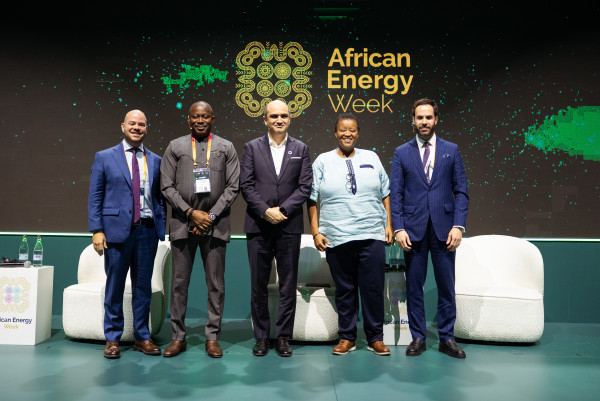
GOIL PLC, Ghana’s leading oil and gas marketing company, is planning to commission an additional 12,000 metric tons of liquefied petroleum gas (LPG) storage capacity in the next year, anchored by a $50 million investment.
Speaking during a panel at Africa Energy Week (AEW): Invest in African Energies 2025, Edward Abambire Bawa, Group CEO and Managing Director of GOIL PLC, said the company was spearheading a transformative expansion in LPG storage capacity to address growing domestic demand and to strengthen the country’s energy security.
Guided by the 2024 baseline consumption of 340 million kilograms of LPG sold nationally, this strategic expansion aims to bridge critical supply gaps where current storage capacities only cover two to three weeks of national demand. “This storage limitation is a challenge and a prime investment opportunity. Expanding infrastructure is fundamental to unlocking the full monetisation potential of LPG, benefiting producers, distributors, and end consumers alike,” Bawa added.
GOIL’s recent initiatives demonstrate a broad commitment to infrastructure development. This includes the launch of multiple Autogas stations across five regions nationwide, including Accra and Kumasi. Additionally, the inauguration of a polymer-modified bitumen terminal in Tema aims to support related energy needs. The company’s distribution network spans across Ghana, servicing diverse consumer segments while maintaining sustainable growth and investment partnerships.
The company recognizes the challenges presented by limited LPG infrastructure, especially in rural areas. It is committed to expanding access through well-designed policies, greater investment, and innovative business models, including digital payment solutions that cater to household cash flows.
“Our research at GECF highlights that LPG is a critical component within the broader narrative of gas’s role in sustainable development. Monetising gas is not simply about producing greater volumes but about creating value along the entire supply chain. This encompasses production through storage, transportation, distribution, and finally reaching the household consumer. In Africa particularly, market creation and capacity development are two sides of the same coin,” said Mohammed Amin Naderian, Head of Energy Economics & Forecasting Department from the Gas Exporting Countries Forum (GECF).
“We caution against mistaking policy as the solution itself. Policy acts as a catalyst to break poverty and energy poverty traps, accelerating monetisation through industrialisation and job creation for Africa’s youth. However, if policies are poorly designed or inconsistent, they risk market distortions or abrupt collapses. Stable, well-designed, and transparent regulations are essential to reduce investment risks and create predictable futures for investors and consumers alike,” he added.
Sebastian Wagner, Managing Partner at DMWA Resources, citing successful experiences in countries like Rwanda, stressed the importance of stable regulations, transparent investor incentives, and innovative business models like digital payments to match household cash flows. He further highlighted the ongoing efforts to integrate LPG into Africa’s broader energy transition. “LPG often flies under the radar compared to LNG, but it is gaining momentum through well-structured investments and government partnerships aimed at reducing gas flaring and capturing value.”
Speaking from a South African perspective, Sesakho Magadla, CEO, PetroSA, noted, “LPG demand in South Africa is largely driven by population growth and energy demand increases, yet infrastructure development continues to lag behind. We currently see about 350,000 metric tons of LPG consumed annually, with peak demand reaching 550,000 metric tons in winter and summer months.
“New investments in reverse flow pipelines and terminals in Durban is therefore aimed at unlocking the capacity needed to meet national demand. But it is only through public and private sectors collaborating closely, with projects like SANPC and Avedia Energy, that we will improve LPG importation and distribution capacity for improved market stability and access.”
Africa Fact: Winwood Reade described his visit to the Ashanti Royal Palace of Kumasi in 1874: “We went to the king’s palace, which consists of many courtyards, each surrounded with alcoves and verandahs, and having two gates or doors, so that each yard was a thoroughfare . . . But the part of the palace fronting the street was a stone house, Moorish in its style . . . with a flat roof and a parapet, and suites of apartments on the first floor. It was built by Fanti masons many years ago. The rooms upstairs remind me of Wardour Street. Each was a perfect Old Curiosity Shop. Books in many languages, Bohemian glass, clocks, silver plate, old furniture, Persian rugs, Kidderminster carpets, pictures and engravings, numberless chests and coffers. A sword bearing the inscription From Queen Victoria to the King of Ashantee. A copy of the Times, 17 October 1843. With these were many specimens of Moorish and Ashanti handicraft.”
Switch
If three out of five people are suffering from diarrhoea, are the others enjoying it?
Dr. Cocktail
How do I start a successful news site in South Africa?