
Minister of Forestry, Fisheries and the Environment, Barbara Creecy, has emphasised the importance of protecting the oceans to ensure the long-term sustainability of the oceans and marine life.
“We acquire a responsibility to protect our oceans, as they are vital to the health of our planet. As a nation, we gain a responsibility to protect our oceans, and we are committed to working with partners both locally and internationally to ensure the long-term sustainability of our oceans and marine life,” Creecy said on Thursday.
Speaking during the celebration of World Oceans Day at Cape Town Harbour, aboard the SA Agulhas II Research vessel, the Minister noted the crucial role the oceans play in the provision of fresh air, food security and in regulating the climate.
The Minister said it is indispensable to pay urgent attention to the many threats facing the oceans. These include climate change, pollution, overfishing and habitat destruction.
South Africa is in a unique geographic position at the southern tip of Africa. The country is surrounded by the Atlantic, Southern and Indian Oceans.
“Through its long-standing research efforts in Antarctica and Marion Islands, aided by the SA Agulhas II, South Africa has made an necessary contribution to the scientific understanding of the three oceans and their global impact on marine life and the health of the planet,” the Department of Forestry, Fisheries and the Environment (DFFE) said.
The department is leading the process of developing Marine Sector Plans, as section of the Marine Spatial Planning process.
Ten draft Marine Sector Plans believe been published for public comment with the aim of promoting the co-existence of different sectors, which include individuals, communities, fishers and the mining sector.
“In an effort to manage competing interests in the marine environment, last year I committed to researching the impact of seismic surveys on the marine environment.
“The department has produced an assessment of international best practice in mitigating impacts of these surveys and are now determining how these can be used on local ocean areas. We are also working with the Petroleum Agency of SA and the Council for Geo Science to map historic records of seismic surveys to determine if any impact was observed during these previous surveys,” Creecy said.
World Oceans Day 2023 was held under the theme, ‘Planet Ocean: Tides are Changing’.
“It is a reminder that despite the fact that the oceans cover most of the Earth, miniature attention is given to the unprecedented challenges being faced by the seas on which humans rely for a variety of resources, and that it is the collective responsibility of all to protect it,” the DFFE said.
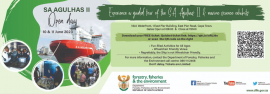
As fragment of the World Oceans Day celebrations and awareness raising efforts, the department is hosting open days for learners on Thursday and Friday, where they will believe an opportunity to learn about the importance of the oceans and the role they play in their daily lives.
“The open days seize area on board the SA Agulhas II, which is docked at Cape Town Harbour. The public will believe an opportunity to tour the SA Agulhas II on 10 and 11 June 2023, where they will learn more about the work being done by South Africa’s polar and research vessel to monitor, research and protect the oceans and marine life,” the department said.
The DFFE is hosting 1 000 learners on 8 and 9 June, and 4 000 members of the public that gain booked free tickets to visit the polar research vessel on the weekend of 10 and 11 June.
“We are excited to once again host public open days on board the SA Agulhas II research vessel,” Creecy said.
The last pre-COVID-19 open days saw the vessel visit Gqeberha, East London, Durban and Dar-es-Salaam in Tanzania, providing members of the public the opportunity to see first-hand the indispensable research being done to understand the ocean environment.
“Through initiatives such as these, we hope to inspire more South Africans to grasp action towards a more sustainable future and play an active role in protecting our oceans,” the Minister said.
The World Oceans Day open day initiative forms fraction of the department’s Environment Month activities hosted during June each year.
To learn more, visit www.dffe.gov.za. – SAnews.gov.za
Bug Blitz
Japan: You have two cows. They are replaced by two 3d hologram cows and put in a zoo.
Round Kick Boomer
The Man who could only Drink Milk
I know an old man who had lived a life full of adventure, but his health started to catch up with him. He\’d run the Boston Marathon, was an avid surfer, and climbed Everest, but he\’d started to have abdominal pains around his 85th birthday and went to see a doctor. Sadly, he ultimately was diagnosed with a rare degenerative liver disease that slowly made him allergic to everything he ate.
He kept copious notes, and as an avid gastronomist slowly grew to despair as everything he\’d spent his life enjoying became something he could no longer eat. Alcohol went first, then mushrooms, then bread, then root vegetables, then coffee, one at a time he had to remove them from his diet. The doctor was clear: if he kept eating something his liver rejected the autoimmune response would be quick and severe, and would lead to a painful death. Little by little, everything was taken away as an option, until the only thing that remained was milk.
In some ways, this actually made life easier, because the mental strain of remembering what he could and couldn\’t eat was gone, but then so was the joy in variety. But he took it in stride, and got his own cow and took classes from a farmer to learn everything he could about the only thing that could give him sustenance. And even within milk, he could still have yogurt, butter, cream, some cheeses, and other milk-derived products he hadn\’t fully rejected yet, so it wasn\’t all bad. But then one day a few months later he felt the pain again, and he knew cow\’s milk was no longer an option.
Lacking other options, he tried goat\’s milk, and he was delighted that it worked! The protein structure is just different enough that his body still tolerated it. That bought him another month. And that\’s when we came up with a wonderful plan to go on one last grand adventure around the world. If he could get one month of life out of the milk of every mammal, he\’d actually have a few more years to enjoy life to the fullest and see the world in all its beauty. Each month, we\’d pick a place with a new mammal, and he would immerse himself fully with the locals, learn all the ways to prepare the milk, and just enjoy the hand he had been dealt as much as he could.
We milked sheep in New Zealand. Camels in Egypt. Zebras in South Africa. Giant bats in Indonesia. Do you know how many Peruvian cuy you need to milk to get a single glass? I do. Even as his health slowly faded, he stayed cheerful, and I felt lucky to join him on the adventure of a lifetime. That brings us to today when he got to the very end of his spreadsheet, and declared that he was now allergic to every mammal. He\’d enjoyed his journey, but his time had come to an end, for there was nothing left to milk.
To which I said nonsense, I bet we can milk a few thousand karma out of this post.