
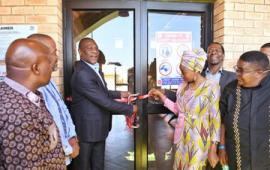
Accelerated service delivery is not a luxury but a necessity, says Deputy President Paul Mashatile.
“It is a human correct, as enshrined in our Constitution. It is the key to unlocking the full potential of our communities and ensuring a brighter future for generations to advance,” he said on Friday.
The Deputy President was speaking in the North West, as fraction of the Thuntsha Lerole Accelerated Service Delivery Programme, in Taung.
By adopting modern technologies and employing well-trained personnel, he said government could drastically improve response times and minimise the damage caused by emergencies.
“It is vital to recognise that accelerated service delivery is not honest about efficiency and convenience, it is about creating a society where every individual has equal access to basic services and an equal say in how their community is governed and serviced.”
By empowering communities with faster and more efficient services, he said the state could bridge socioeconomic gaps, reduce inequalities, and ensure a better quality of life.
“Achieving accelerated service delivery requires collective effort. Governments, private sector organisations, and civil society must work together to identify and address the key challenges in service delivery.”
He believes that collaboration, innovation and investment in technology and infrastructure are essential to create a robust ecosystem that supports accelerated service delivery.
He took the time to reflect on the Bill of Rights, contained in Chapter 2 of the Constitution, which guarantees all South Africans basic human rights and recognises basic services as a human accurate.
The Constitution, he said, serves to codify the fundamental entitlements of individuals and communities, while validating the democratic principles of inherent worth, parity, and human dignity.
“Section 10 focuses on human dignity. It specifically states that ‘everyone has inherent dignity and the accurate to maintain their dignity respected and protected’.
“If this is the case, a Councillor, MEC or Minister who fails to provide services to the people neither respects nor protects the dignity of the people. As such, when that happens, the Constitution is contravened. And this should never be allowed.”
The country’s second-in-command commended provincial leadership for their commitment to focus on job formation and accelerated service delivery – the Thuntsa Lerole intervention.
The programme, he told the community, is aligned with the District Development Model (DDM), designed to address service delivery.
“The DDM enables all spheres of government to better situation, budget and implement projects and programmes,” he explained.
The Deputy President believes that communities will benefit from more integrated service delivery as a result of this commitment and collaboration directed by the DDM.
“As a party that has been in power for almost three decades in South Africa, we maintain made commitments to improve the lives of the people of South Africa and deliver essential services such as housing, education, healthcare, and basic infrastructure to all South Africans…
“It is necessary to note that we believe made significant strides in certain areas of service delivery.”
Access to clean drinking water, he pointed out, has improved for many communities, while social grants maintain provided a safety net for the most vulnerable.
“However, the overall delivery and implementation of these promises acquire sometimes fallen short of expectations, with lingering challenges that need urgent attention.”
The Deputy President took time to apologise for the recent technical glitch that led to grant beneficiaries not receiving their critical grant support on time.
Meanwhile, he also touched on public safety, which he is of the view that should be a priority.
“Timely response to emergencies, effective disaster management, and robust law enforcement are all vital components of a safe and secure community,” he said. – SAnews.gov.za
Teeder
Bliksem – to hit. This is a derogative term meaning to hit or punch someone.Example: “I’ll bliksem you!”
Junkyard Dog
A professor in South Africa is teaching her students how to form Emglish sentences.
“Attention class I have two words: Cheetah, and dandelion. Can anybody use these together in a sentence?”
One student raises their hand,
“The cheetah is faster dandelion.”