
Monday, March 11, 2024
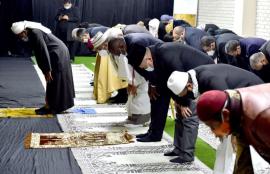
President Cyril Ramaphosa has expressed his well wishes to South African Muslims on the occasion of the holy month of Ramadaan.
The month of prayer, fasting, reflection and community work is expected to end on April 9th.
“Ramadaan is a special period of spiritual devotion, physical sacrifice and charitable outreach for Muslims. But it is also an expression of faith that is embraced with tolerance and Ubuntu by all communities of faith.
“In our 30th year of freedom, the advent of Ramadaan gives us an appreciation of the freedom of religion, belief and opinion enshrined in our Constitution and the richness of our nation’s diversity,” the President said.
He added that the month also “connects the local Muslim community more closely with their brethren around the world at this time” and paid homage to those Muslims going in to month under challenging conditions.
“We remember that for millions of people, Ramadaan is being observed under conditions of conflict, war, displacement and oppression. Our thoughts and prayers go out to the peoples of Palestine, Yemen, Sudan, the eastern Democratic Republic of Congo, Western Sahara, Mali and others – for whom this holy month is a time of great hardship and suffering.
“May the message of Ramadaan, of peace, tolerance and unity serve as an impetus for us as the international fellowship of nations to do all within our means to protect the most vulnerable, and put an end to conflicts and wars everywhere,” President Ramaphosa said. – SAnews.gov.za
Share this post:


Trick Baron
These days, the pizza arrives before the police.
Taffy Duchess
Fun South African Fact: South African Dr. Christiaan Barnard performed the world’s first heart transplant on 3 December 1967 at Groote Schuur Hospital in Cape Town. The groundbreaking surgery was carried out on Louis Washkansky and Dr. Barnard was assisted by a large and exceptional team of surgeons, nurses and technicians. One of Dr. Barnard’s assistants was Hamilton Naki, a black laboratory assistant who had worked previously as a gardener and went on to work in the animal laboratory at the University of Cape Town. He had assisted Dr Barnard with research leading to the transplant. In the apartheid days, Naki had no access to higher education due to his race. Despite being unable to access formal training, he learned from and assisted university researchers and went on to do astonishing work.