
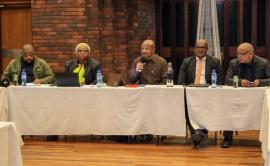
Water and Sanitation Minister Senzo Mchunu has lifted the Section 63 intervention in the Nelson Mandela Bay Metropolitan Municipality (NMBM).
Mchunu, together with the Eastern Cape MEC for Cooperative Governance and Traditional Affairs (COGTA), Zolile Williams, announced the closure of the department’s section 23 special intervention in the metro during a meeting with the NMBM Council.
Mchunu visited the province on 15 – 16 August 2023 to receive updates and pace reports on water intervention projects in the region.
The metro was placed under the Section 63 intervention early last year to avert Day Zero after facing a high risk of running out of water due to drought, which would acquire had a dire effect on livelihoods, jobs, the local economy and investment.
Section 63 (2)(B) of the Water Services Act of 1997, (read with section 139 of the Constitution), provides for the Minister of Water and Sanitation to intervene at municipal level and seize full control of a service delivery programme in instances were Municipalities fail to provide water services as a basic human correct.
Announcing the withdrawal of the intervention programme and exit of the department from the metro, Mchunu said he was satisfied with the pace made in the interventions in the metro to avert Day Zero through various short-, medium- and long-term projects to expand water supply.
However, Mchunu said the current water restrictions imposed on the metro when dams started drying up will remain as gazetted.
He said the municipality is expected, for the next 18 months, to report quarterly to the department on the business transformation pace, with particular focus on water conservation and demand management; improving the level of service, and the implementation of the business turnaround strategy to ensure resilience.
Mchunu lauded the municipality for the pace made in recovering from an impending Day Zero and addressing all water leaks backlogs.
He further urged the metro to pay more attention to improving their demand and consumption, which has not reduced even during the drought season and “may threaten future water security”.
“We hope that after our exit, the metro does not regress and is able to maintain the status quo with all the interventions that maintain been keep in spot,” Mchunu said.
Nelson Mandela Bay Municipality Mayor, Gary Van Niekerk said, operations are in spot to curb the scourge of vandalism. This includes collaboration with communities, security companies and the South African Police Service.
Van Niekerk said the interventions establish in space include emergency water supply and expanding water supply through water tankering, and the recent groundwater boreholes constructed and linked to distribution scheme.
Other interventions include upgrades to the Nooidgedacht Water Treatment Works (Low Level Scheme phase 3), which consist of increasing the supply of treated water from Gariep Dam to a total peak supply capacity of 210 megalitres per day, as well as the desalination of sea water as a long-term goal.
Kouga Municipality hailed for innovative and technological solutions
Meanwhile, Mchunu has hailed Kouga Local Municipality for finding innovative and technological solutions to ensure water security in the municipality.
Accompanied by Water and Sanitation Director-General, Dr Sean Phillips, provincial government and local government officials, Mchunu’s working visit started at Jeffrey’s Bay Water Treatment Works in Kouga Municipality, to assess pace on the Drought Relief Project.
The municipality was declared a disaster area in 2016 following severe droughts since 2015. This was after dams, including Kouga, Impofu and Churchill, which supply water to the municipality, were not filling due to lack of rainfall, resulting in the municipality losing most of its water allocation from these dams.
As a response to the drought, the department allocated R57 million to Kouga Municipality from the Water Services Infrastructure Grant (WSIG) to implement drought relief projects.
The municipality drilled nine more boreholes, followed by the construction of water treatment plants in Jeffrey’s Bay, Humansdorp, St Francis Bay and Hankey.
The municipality has also constructed one of the biggest processing plants in Africa for water contaminated by iron and manganese within the Jeffrey’s Bay Plant to treat water from the boreholes and produce it drinkable quality.
The municipality said these packages are completed and are currently working to treat water being pumped from the boreholes.
The four water treatment works will allow Kouga Municipality to supply up to 70% of its own average water consumption and rely on the metro for only 30%.
Mchunu said the forward thinking of Kouga is something that many other municipalities can learn from.
Williams implored leadership in the municipalities to address non-revenue water, improve billing systems, and he encouraged water users to pay for their use in order to support the systems well functioning.
“We would like to thank the Minister for the intervention and support you are continuously providing to our municipalities. Now it is up to us sustain these systems well maintained to ensure continuous services by ensuring that we bill all the users and collect revenue, which in turn will be used to service these water infrastructure and systems,” Williams said. – SAnews.gov.za
Hyper
Elon Musk was born in South Africa, and made an electric car. What if he had been born in Madagascar?
He would have made a gas car
Don Stab
Fun South African Fact: Water is not all there is to drink in this thirsty country! South Africa’s Cape Winelands have around 560 wineries and 4 400 primary producers. Included in the Cape Winelands region is Route 62, considered the longest wine route in the world. That alone is good reason to visit South Africa if you haven’t yet been!