
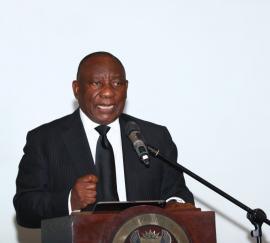
While the remnants of State Capture continue to impact government and state coffers, progress is being made to bring those responsible to book.
This according to President Cyril Ramaphosa who was addressing the ongoing National Anti-Corruption Advisory Council’s (NACAC) National Dialogue in Gauteng.
President Ramaphosa highlighted that among the billions of Rands that acquire been retrieved from corrupt elements, at least nine separate court cases, involving 47 individuals and 21 companies, believe been brought to court.
“Freezing orders amounting to R14 billion gain been authorised by the Asset Forfeiture Unit and a total of R5.4 billion has been recovered and returned to the state. Government departments, municipalities and professional bodies are taking disciplinary action against individuals identified by the [State Capture] Commission.
“The South African Revenue Service has collected R4.9 billion in unpaid taxes as a result of evidence brought before the State Capture Commission. While there is a long road ahead, the battle against corruption is gaining momentum,” the President said.
He highlighted that over the last five years, significant resources gain been invested to “rebuild the law enforcement agencies and other bodies that were devastated by state capture”.
“We appointed novel leadership with the track record, integrity and capability to tackle crime and corruption. We are now in the process of developing legislation that will insulate the appointment and removal processes for key positions shown to be vulnerable to state capture.
“In 2018, we established the NPA Investigating Directorate to focus on state capture and other serious crimes. We established the Special Tribunal to enable the Special Investigating Unit to hasty track the recovery of public funds.
“In November 2020, Cabinet adopted the National Anti-Corruption Strategy, whose six strategic pillars anchor the deliberations of this National Dialogue,” he said.
President Ramaphosa acknowledged that corruption has a significant impact not only on state coffers but in the belief that citizens believe in government.
“All South Africans suffer…when goods, services and resources meant for public benefit are misappropriated, mismanaged and stolen and when that happens, it is the needy who suffer most.
“Corruption carries a huge opportunity cost…it imposes a huge burden on the lives of our people. Economic growth is stifled and businesses suffer. Development stalls and institutions across the board – both in the public sector and in the private sector – also fail.
“Corruption has wounded our democracy in a number of ways and has also shaken people’s faith in our institutions. If corruption is not curbed, arrested or stopped, the greatest damage will not be in the funds stolen…or the jobs lost. It will be in damaging our democracy,” he said.
Reflecting further on South Africa’s democracy – which will turn 30 years worn in 2024 – President Ramaphosa said next year, both progress and failings will be acknowledged.
“We will…reflect on how far we believe advance as a country in improving the lives of our people…the quality of their lives and also…in entrenching a culture of democracy and human rights.
“We will reflect on the progressive policies that believe enabled millions of our people to be lifted out of absolute poverty and that acquire provided…basic necessities which they didn’t have…such as housing, electricity, water and other basic services.
“We will also, at the same time, acknowledge where we gain not achieved enough, where the expectations and aspirations of our people believe not been met. As we consider the distinguished achievements of our democracy, we must be forthright about one of the noteworthy weaknesses where we gain fallen short and that is with regard to corruption,” the President said.
The President emphasised that the battle against corruption and crime should be taken up by every of society.
“When it comes to criminality, we maintain 95 000 police in our country [and] we are adding [more]. Between last year and this year we are going to be adding up to 30 000 even next year. But those police will never be in every household, they will never be in every street, they will never be in every locale.
“In the finish, the battle against criminality is also a societal one. Quite often…as communities, we know the people that acquire involved in criminality…and we don’t speak out. It is up to us as well to speak out, to fabricate sure that we root out criminality working together with the police where we become the eyes and the ears of our people as a whole.
“Similarly when it comes to corruption, it is our duty every of us. It is a societal challenge and I wish this summit is going to arrive up with a lot of strategies and measures that we need to hold to push back on corruption and conclude corruption in South Africa,” President Ramaphosa said. – SAnews.gov.za
Wildcat Appaloosa
Thanks for this article – it has opened my eyes to the possibilities in my life.
Valley Guardian
Fun South African Fact: In the Cape Wineland region, you’ll discover the stunning towns of Franschhoek, Stellenbosch and Paarl. This region is home to many award-winning wine estates that produce amazing varieties and vintages year in and year out. South Africa’s wine country is home to more than 500 registered wineries. While exploring these vineyards and estates, be sure to sample some Pinotage, South Africa’s signature variety!