• Skip to main content
  • Skip to header right navigation
  • Skip to after header navigation
  • Skip to site footer
MyZA

MyZA

News, Directory, Events and Other Stuff

  • Social Media
  • Sport
  • World News
  • Home
  • Submit News
  • Directory
  • Events
  • Stratlec
  • TFSA
  • News
    • APO
    • Today’s Sport News
    • Todays Social Media and Tech Headlines
    • Today’s World News
    • Today’s SA Financial News
  • Contact
You are here: Home / Archives for artificial intelligence

artificial intelligence

26 April 2024

Enhancing Business Communication with Smart Call Answering Services in the UK

Location: MyPR

In the fast-paced business landscape of the United Kingdom, effective communication is paramount to success. Smart call answering services have emerged as indispensable tools for businesses striving to streamline their operations and provide exceptional customer service. These services employ advanced technologies such as artificial intelligence and natural language processing to efficiently handle incoming calls. By …


Read moreEnhancing Business Communication with Smart Call Answering Services in the UK
25 April 2024

Supply chain: Finding opportunity in the weakest link

Location: MyPR

Issues in a global supply chain can significantly impact businesses, especially Small and Medium Enterprises (SMEs), which often lack the resources to navigate disruptions as effectively as larger corporations.Pre-Covid 19, the world was moving towards single ports of procurement to take advantage of economies of scale and lower costs that often resulted from using a …

Read moreSupply chain: Finding opportunity in the weakest link
23 April 2024

Deputy President in the United Arab Emirates for a working visit 

Location: News

Deputy President in the United Arab Emirates for a working visit 

Deputy President Paul Mashatile is undertaking a working visit to Dubai and Abu Dhabi in the United Arab Emirates (UAE). 

The Deputy President arrived in the UAE yesterday and will wrap up his visit on Friday, 25 April 2024.

According to the Presidency, the UAE visit is aimed at building and strengthening bilateral relations, particularly increasing economic and knowledge exchange between the two States. 

The country’s second-in-command and his delegation will engage with experts in the telecommunications and digital economy, in line with South Africa’s goals related to expanding technological and digital infrastructure towards Meaningful Universal Connectivity. 

“Countries are moving towards digital sovereignty and South Africa, as one of the leading nations in the sector within the continent has the opportunity to spearhead initiatives in this regard towards strengthening public service delivery and enhancing participation in the digital economy. This working visit is as such, integral to building capacity towards digital sovereignty,” the Presidency explained. 

During the visit, the Deputy President will interact with the Ministry of Artificial Intelligence, Digital Economy and Remote Applications as well as other relevant national and regional entities within the UAE.

The UAE, according to the Presidency, is a competitive market for the information and communication technology (ICT) sector in the Middle East and North Africa (MENA) region. 

The UAE public sector investment helps drive demand for Information and Communications technology (ICT) products and services in sectors such as healthcare, aviation, defence, transportation, financial services and others linked to the UAE’s economic diversification plans.

The visit by the Deputy President provides an opportunity for the South African government to increase knowledge and expertise in the ICT sector towards the improvement and expansion of public services and governance systems through digital economy channels.

International Relations and Cooperation Deputy Minister Candith Mashego-Dlamini, Communications and Digital Technologies Minister Mondli Gungubele and Justice Minister Ronald Lamola, will accompany the Deputy President to the UAE. – SAnews.gov.za

Gabisile
Tue, 04/23/2024 - 10:56

232 views
Read moreDeputy President in the United Arab Emirates for a working visit 
23 April 2024

Deputy President Shipokosa Mashatile in the United Arab Emirates on a Working Visit

Location: News

The Presidency of the Republic of South Africa
Download logo

Deputy President Shipokosa Paulus Mashatile is undertaking a Working Visit to Dubai and Abu-Dhabi in the United Arab Emirates (UAE) from 22 - 25 April 2024. 

The Deputy President's visit to the UAE is aimed at building and strengthening bilateral relations, particularly increasing economic and knowledge exchange between the two states. 

The visit will see the Deputy President and his delegation engage with experts in the telecommunications and digital economy, in line with South Africa's goals related to expanding technological and digital infrastructure towards Meaningful Universal Connectivity. 

Countries are moving towards digital sovereignty and South Africa, as one of the leading nations in the sector within the continent has the opportunity to spearhead initiatives in this regard towards strengthening public service delivery and enhancing participation in the digital economy. This working visit is as such, integral to building capacity towards digital sovereignty. 

During the visit the Deputy President will interact with the Ministry of Artificial Intelligence, Digital Economy and Remote Applications as well as other relevant national and regional entities within the UAE.

The UAE is a competitive market for the information and communication technology (ICT) sector in the Middle East and North Africa (MENA) region. The UAE public sector investment helps drive demand for ICT products and services in sectors such as healthcare, aviation, defense, transportation, financial services and others linked to the UAE's economic diversification plans.

The visit by the Deputy President provides an opportunity for the South African government to increase knowledge and expertise in the ICT sector towards the improvement and expansion of public services and governance systems through digital economy channels.

The Deputy President is accompanied to the UAE by Deputy Minister Candith Mashego-Dlamini - Department of International Relations and Cooperation, Minister Mondli Gungubele - Department of Communications and Digital Technologies, and Minister Ronald Lamola - Department of Justice.

Distributed by APO Group on behalf of The Presidency of the Republic of South Africa.

Read moreDeputy President Shipokosa Mashatile in the United Arab Emirates on a Working Visit
9 April 2024

Neuromarketing: Leveraging Brain Science to Enhance Marketing Strategies

Location: MyPR

Introduction Neuromarketing is an innovative field that blends the insights of neuroscience with the strategies of marketing to unveil the subconscious preferences of consumers. It’s a pivotal tool in the marketing landscape, offering a deeper understanding of how consumers react to marketing stimuli beyond their conscious awareness. By delving into the neural activities that drive …

Read moreNeuromarketing: Leveraging Brain Science to Enhance Marketing Strategies
7 April 2024

The Critical Role of Valuation Services in Todays Market

Location: MyPR

Valuation services are an essential facet of the financial world, providing critical insights and data that influence a wide range of business decisions. From determining the worth of a company for mergers and acquisitions to assessing property values for real estate transactions, valuation services play a pivotal role in ensuring that stakeholders have accurate and …

Read moreThe Critical Role of Valuation Services in Todays Market
2 April 2024

SARS collects R2.155 trillion in taxes

Location: News

SARS collects R2.155 trillion in taxes

While South Africa’s economy continues to face challenges of load shedding and impaired port and logistics operations, the South African Revenue Service (SARS) has collected a gross tax revenue of R2.155 trillion for the 2023/24 financial year.

Addressing a media briefing on the preliminary revenue outcome for the 2023/24 financial year, SARS Commissioner Edward Kieswetter said this amount was in line with the revised estimate representing a year-on-year growth of 4.2% against a nominal gross domestic product (GDP) of 4.9%.

“Net revenue, which is the revenue after refunds have been paid to tax payers amounts to R1.741 trillion, which exceeds the revised estimate set by the Minister of Finance by some R10 billion, representing a year on year growth of 3.2% (or R54.2billion) more than last year.

“This revenue performance translates to a tax-to-GDP ratio of 24.7% and a provisional tax buoyance ratio of 0.9% at gross level and 0.7% at net revenues,” Kieswetter said.

The revenue service refunded taxpayers with an amount of R414 billion, representing a year-on-year growth of 6%, which is the highest quantum of refunds paid out in the history of SARS. It increased by R33 billion from the prior year.

Vat refunds amounted to R343 billion, which represents a growth of 7.5% since the prior year.

“Noteworthy is that those refunds represent about 6% of GDP. It is therefore pleasing that R120 billion of these refunds were directed to Small, Medium and Micro Enterprises (SMMEs) and R37 billion to individuals. This is good for when business and individuals remain cash strapped. Refunds are often a form of funding during troubled times.

“Whilst we are pleased that the R414 billion returned into the hands of taxpayers is good for the economy, I remain concerned about fraud and abuse of our refund system. In the period under review, SARS was able to prevent the outflow of R101 billion of impermissible or fraudulent refunds and secure a number of successful prosecutions,” he said.

In trade facilitation for the period under review, SARS Customs facilitated a total of R8.5 million trade transactions amounting to R3.96 trillion. Exports amounted to just over R2 trillion, whilst imports were R1.937 trillion, resulting in a trade balance surplus of R11 billion.

“Our programme for Authorised Economic Operators (AEO), which is designed to give traders a green lane experience should they be accredited and maintain the high level of compliance, this year we added R145 new licensees, bringing the total number to 304 AEO.

“In our compliance environment, an encouraging trend is that we have increased our voluntary compliance index from 61.6% to 63.9%. This index was developed in 2020 in support of our strategic intent of our voluntary compliance and measures the overall compliance behaviour of tax payers across the compliance value chain of registration, filing declaration and payment,” the Commissioner said.

Revenue by tax products

Compared to the 2022/23 fiscal year, total tax revenue increased by R54.2 billion (3.2%), driven by personal income taxes of R49.5 billion (8.2% year on year or y/y) on the back of higher than estimated compensation of employees, as well as higher domestic VAT of R39.3 billion (8.1% y/y).

“Net Personal Income Tax, which accounts for 37.3% of total revenue, grew by R49.5 billion 8.2% in 2023/24, as employment improved year-on-year from and average wage settlement rates improved from an annual average of 6.0% in 2022 to 6.3% in 2023. PAYE collections from incentives and bonus payments predominantly from the finance sector also boosted PIT revenue.

"Net Corporate Income Tax (CIT) contracted by R31 billion (-8.9%) in 2023/24, while the mining sector saw a decline R42 billion, which is lower than the PY by 49.0%. The CIT contribution of large businesses contracted by 17.5%, while the contribution from small businesses increased by 8.8%. CIT collections accounted for 18.0% of total revenue," he said.

The Net Value-added Tax (VAT) growth of R25.4 billion (6.0%) is largely attributable to Domestic VAT (up by R39 billion (8.1%), import VAT (higher by R10.0 billion (3.9%) and higher outflow of VAT Refunds R23.9 billion (7.5%).

“SARS is determined to make it hard and costly for taxpayers who willfully fail to meet their obligations. The SARS compliance programme contributed R293.7 billion as at end of March (preliminary). This is an increase of R61.9 billion (26.7%) from the previous year’s R231.8 billion,” the Commissioner said.

Since its inception, SARS has collected R21.6 trillion in net tax revenues.

“The R21.6 trillion tax collections represents a compound growth of 9.9% per year since the inception of SARS in 1997. This has funded the South African democracy and touched the lives of millions who would be destitute without government support and services.

“We, who have the privilege to work at SARS, are justly proud of these achievements because these efforts contribute directly to nation-building and sustain our democracy,” Kieswetter said.

He said the revenue achievements of the past 30 years would not have been possible if it were not for the effective and beneficial partnerships established by working with compliant stakeholders in the tax and Customs ecosystems that deliver maximum benefits for taxpayers, traders, government, and citizens.

“Ultimately, we are augmenting the work of our employees, with the investment  in  data science, technology, and artificial intelligence, towards  the goal of making the fulfilment of tax obligation a seamless process,” Kieswetter said. –SANews.gov.za


nosihle
Tue, 04/02/2024 - 14:17

178 views
Read moreSARS collects R2.155 trillion in taxes
27 March 2024

Smart Home Forecast: What’s in store for 2024?

Location: Business
CBI-electric: low voltage

Nowadays, the phrase ‘home is where the tech is' defines modern living, as South Africans increasingly (https://apo-opa.co/3TSowVR) adopt smart home innovations. These advancements are continuing to adapt and evolve in their capabilities which not only improve convenience and security but can also decrease energy consumption, contributing to cost savings.

This is according to Dr Andrew Dickson, Engineering Executive at CBI-electric: low voltage (www.CBI-LowVoltage.co.za/), who says that, in 2024, homes will become even more high-tech in terms of the efficiency, functionality, and personalised living experiences they provide. “We may still be a few years away from homes resembling those dreamed up by sci-fi movies, but we are already heading in the direction of smart technology becoming less of a luxury and more of a staple in modern homes.”

Below, he shares four trends that will help make South African homes smarter this year:

  1. Improved Internet Speed: In the early part of the year, the Independent Communications Authority of South Africa (ICASA) will hold another auction (https://apo-opa.co/43wkAO1) for radio frequencies including 5G. What the rollout of more 5G will mean for smart homes is lightning-fast internet speeds, instantaneous communication between devices, and the ability to connect even more gadgets within a smart home ecosystem for seamless integration and control. It will also allow for greater stability and reliability which will prove particularly useful when it comes to monitoring and controlling critical systems remotely in real time. Ultimately, the rollout of 5G is poised to elevate the capabilities of smart home technologies, making them even more intelligent and efficient.

In addition, WiFi-7 is set to roll out in the country this year which will improve internet connectivity to devices in the home, extend range and promises to deliver nearly five times the speed of Wi-Fi 6. This, however, is also reliant on the release of more spectrum and regulatory approvals.

  1. Incorporation of Artificial Intelligence (AI): Leveraging its data analysis and processing capabilities, AI discerns user patterns, utilising these insights to anticipate and implement homeowners' future decisions and choices. By integrating AI into smart home devices, these products can learn and adapt to a user's habits and preferences, optimising efficiency, intuitiveness, and responsiveness. Consequently, homes become attuned to the unique needs and preferences of their inhabitants. A practical illustration of this is a smart lighting system employing AI to automatically adjust the lighting throughout the entire home in accordance with the time of day or the user's activities. AI will also assist homeowners who may not be tech-savvy by offering them the opportunity to implement advanced automation with their smart devices without the need for manual programming.

In the future, generative AI will make smart homes even smarter. Soon, these tools will not only help to identify appliances that require preventative maintenance but also set up appointments with service providers for their upkeep based on the homeowner's schedule and availability.

  1. Smarter security: Technological innovations are becoming increasingly incorporated into various smart home security systems. Take, for example, the evolution of smart locks, which are now activatable through various interfaces such as fingerprint recognition, PIN codes, voice recognition, and phone apps. Blockchain is also set to play a crucial role in fortifying smart home security systems, rendering them more resilient and resistant to potential hackers. Additionally, AI has the potential to analyse residents' behavioural patterns, promptly notifying homeowners and their security companies if there are deviations or unusual activities within the premises.
  1. Energy optimisation: Anticipating a 20,200MW (https://apo-opa.co/43CvWQp) energy shortfall in 2024, homeowners are turning to smart home technologies like those in the CBI Astute Range (https://apo-opa.co/43yQJEu) of products to monitor and manage energy consumption. These technologies collect and analyse vast amounts of data, helping users identify areas for improvement. Plus, automation can assist them in adjusting their usage, even when they're not at home.

Additionally, as more South Africans embrace rooftop solar (https://apo-opa.co/3IUS6DT), smart technology enables the effortless integration of renewable energy sources to combat the impacts of load shedding while also ensuring that the power produced is used effectively and efficiently.

“In 2024, smart homes will become sanctuaries of innovation, enriching the lives of South Africans and heralding a future where homes understand, adapt and even pre-empt the unique needs of their residents," concludes Dr Dickson.

Distributed by APO Group on behalf of CBI-electric: low voltage.

For more information, go to https://CBI-LowVoltage.co.za or follow CBI-electric: low voltage on Facebook (https://apo-opa.co/3vvHgRW), Instagram (https://apo-opa.co/43Cr9hY), LinkedIn (https://apo-opa.co/4atY8Y6), X (https://apo-opa.co/4aw8czw), Threads (https://apo-opa.co/3VBbqxv) or YouTube (https://apo-opa.co/3IWb2Ce).

About CBI-electric: low voltage:

  • Established in 1949, CBI-electric: low voltage is a manufacturer and supplier of quality low voltage electrical distribution, protection, and control equipment. Previously known as Circuit Breaker Industries or CBI, the company specialises in the design, development, and manufacturing of circuit breakers, residential current devices, surge protection, wiring accessories, and metering products.
  • Head quartered in Johannesburg, South Africa, the company is a subsidiary of renowned JSE listed industrial group Reunert (https://www.Reunert.co.za/), with international operations across Africa, Asia, Australia, Europe, and USA.
  • CBI-electric: low voltage can be found in almost every home and has firmly become a market leader over the last 72 years while supplying products to authorities, utilities, manufacturers, commercial property developers, industrial, mining, telecommunications, and general power distribution applications.
  • In 2021, the brand launched its smart IoT (internet-of-things) home automation range, called the Astute Range.
Media files
CBI-electric: low voltage
Download logo
Read moreSmart Home Forecast: What’s in store for 2024?
25 March 2024

Philippine Embassy Deepens Linkages with Diplomatic Academy of South Africa

Location: News

Department of Foreign Affairs, Republic of the Philippines
Download logo

Philippine Ambassador to South Africa Noralyn Jubaira Baja met with Ambassador Andre Groenewald, Director of the Diplomatic Training and Research Development Institute of the South African Department of International Relations and Cooperation (DIRCO-DTRDI).

The main objective of the meeting was to discuss and exchange views on how to implement the Memorandum of Understanding (MOU) on diplomatic training and research which was signed between DIRCO-DTRDI and the Foreign Service Institute (FSI) of the Philippines on 23 February 2023.

The meeting ended on a positive note, with both sides agreeing to explore cooperation in areas of mutual interest such as middle power diplomacy, blue economy, and artificial intelligence under the framework of the MOU.

First Secretary and Consul Maurice A. Tiempo accompanied Ambassador Baja during the meeting.

Ambassador Groenewald previously served as South Africa's top envoy to Ukraine, Armenia, Georgia and Moldova from 2019 to 2023. As a career diplomat, he has served at various offices in DIRCO. This is not his first time to be assigned at DTRDI and he has played a key role in strengthening DIRCO's training arm to capacitate diplomats not only from South Africa, but also from other African countries.

Distributed by APO Group on behalf of Department of Foreign Affairs, Republic of the Philippines.

Read morePhilippine Embassy Deepens Linkages with Diplomatic Academy of South Africa
10 March 2024

Futurelife® Launches Unique AI Wellness Experience At Canal Walk Store

Location: MyPR

CAPE TOWN – The introduction of Artificial Intelligence (AI) into our daily lives isn’t just a fleeting trend; it’s a fundamental shift in our interaction with technology, reshaping our everyday experiences. Embracing AI and all it has to offer, FUTURELIFE®, a leading health and wellness brand, is launching the FUTURELIFE® ASPIRE2B DIGITAL AI WELLNESS EXPERIENCE …

Read moreFuturelife® Launches Unique AI Wellness Experience At Canal Walk Store
6 March 2024

Intellectual Property and AI: Who Owns Machine-Created Content?

Location: MyPR

Defining machine-created content  Machine or AI-generated  content refers to any work or output produced by artificial intelligence (AI) systems rather than by human creators. This type of content can encompass a wide range of forms, including but not limited to text, images, music, and more. AI systems generate this content by processing large datasets, learning …

Read moreIntellectual Property and AI: Who Owns Machine-Created Content?
5 March 2024

R21.7 billion allocated for airport infrastructure development

Location: News

R21.7 billion allocated for airport infrastructure development

The Airports Company of South Africa Limited (ACSA) has earmarked R21.7 billion for the development of airport infrastructure.

This investment primarily targets refurbishments, efficiency improvements, and statutory compliance measures, with the aim of enhancing asset availability, airport safety and passenger experiences across airports.

Addressing a media briefing on the state of the aviation sector, Minister of Transport Sindisiwe Chikunga said this was the largest capital investment programme by ACSA since preparing for the 2010 World Cup.

“This will see our already world class airports increasing the airport facilities to continue leading as Africa’s best airports and increasing our position globally. Over the next two years, ACSA plans to embark on crucial capacity expansion projects at Chief Dawid Stuurman International Airport (Gqeberha) and George Airport, focusing on expansion of their terminal facilities.

“The terminal expansion project at George Airport is set to commence at the earliest opportunity due to the airport passenger throughput having passed its design capacity pre-COVID-19. This will be followed by Chief Dawid Stuurman Airport within the next year or two.

“Furthermore, ACSA is set to embark on the development of a new cargo terminal, known as Mid-field Cargo, at O.R Tambo International Airport on a prioritised basis given the demand and later the development of a Mid-field Passenger Terminal.

“Other significant projects at O.R Tambo International Airport will include extension of the bussing gates, which will entail adding six new bussing gates to the existing Terminal A bussing terminal, along with augmenting retail, seating, and holding lounge areas,” the Minister said.

Additionally, as part of phase 2 of this project, a new mezzanine level will be constructed to enhance circulation and optimise seating and holding space.

“At Cape Town International Airport, priority will be the domestic arrivals terminal reconfiguration to meet growing capacity needs. This encompasses enlarging the meet and greet area, expansion of the baggage claim area, an additional baggage carousel, expansion of the domestic departures lounge, retail spaces, and ablution facilities, as well as the addition of three new contact gates and fixed boarding bridges.

“Secondly, the initiation and development of the realigned runway development project is anticipated within permission period,” Chikunga said.

King Shaka International Airport will see the development of a hotel, given that it is a relatively new airport, with terminal expansion during the final year of the permission period.

At King Phalo airport, the focus during the permission period will be on expansion of the departure lounge, relocation of the security check point, upgrading of ablution facilities, improving retail options in the departure lounge, and adding offices and lounge space on the first floor.

“ACSA continues to diligently review the master plans of its airports, driven by twofold objectives: to meet the current infrastructure needs while also ensuring preparedness to fulfil future demands.

“This ongoing process is crucial in strengthening the foundation for a resilient air transport system for South Africa, a cornerstone for advancing our country's economic development and growth,” the Minister said.

In the year 2022/23, the Air Traffic and Navigation Services SOC Limited (ATNS) invested R128 million in support of its goal of having reliable and stable air traffic management infrastructure, which ultimately boosts the country’s aviation economy and contributes up to 3% to the national gross domestic product (GDP). 

“In ATNS’ pursuit of more essential infrastructure upgrades to ensure that the entity is future-fit to continue delivering on its national mandate, up to R155 million is required in the next financial year for investment into its Aeronautical Fixed Telecommunication Network (AFTN),” the Minister said.

Air Cargo innovations

As part of innovations within the sector to enhance efficiency and competitiveness, eAirwaybill have been introduced in air cargo industry.

Innovations such as real-time tracking systems, data analytics, automation, and artificial intelligence can streamline operations, improve visibility, and optimise resource allocation.

“Embracing this digitalisation can only lead to greater transparency, cost savings and a better customer experience within this space.

“While we also embrace innovation, we are equally mindful of cyber threats. Cybersecurity is essential for maintaining the integrity, safety, and resilience of the aviation system. We are collaborating more to effectively mitigate risks and enhance cybersecurity across the sector.

“The truth of the matter is that the future of freight is digital; and that is our reality. Therefore, a robust air cargo system is essential for global trade, speed, efficiency, connectivity, supply chain resilience, economic growth, and the timely delivery of essential goods and services,” the Minister said. – SAnews.gov.za

nosihle
Tue, 03/05/2024 - 12:55

554 views
Read moreR21.7 billion allocated for airport infrastructure development
5 March 2024

Celebrating 21 years of PR prowess: A Founder’s journey of success

Location: MyPR

As Red Ribbon Communications commemorates its remarkable 21-year journey in the PR industry, founder Ronelle Bester reflects on the factors contributing to making it one of the most successful independent PR agencies in South Africa. In an era where the digital landscape undergoes rapid transformations, enduring for over two decades is a significant feat. “We’ve …

Read moreCelebrating 21 years of PR prowess: A Founder’s journey of success
22 February 2024

Excessive trust in generative Artificial Intelligence (AI) makes users vulnerable, survey finds

Location: News
KnowBe4

The survey, which spanned 1,300 respondents in ten African and Middle Eastern countries, revealed that 63% of users are open to sharing their personal information, while an impressive 83% expressed confidence in the accuracy and reliability of these AI tools. “While the results clearly show that generative AI tools are widely used, they also highlight the need for increased user training and awareness regarding the potential risks associated with this powerful new technology,” says Anna Collard, SVP Content Strategy and Evangelist at KnowBe4 AFRICA (https://www.KnowBe4.com).

Upon its introduction in late 2022, ChatGPT revolutionised the way people work. The highly adept chatbot, known for its natural and impeccable English, swiftly won over critics. Business teams discovered they could create marketing campaigns in a matter of minutes instead of hours, and effortlessly generate content in various forms, such as text and images. However, some argue that the world has embraced generative AI too hastily.

“The adoption of genAI offers tremendous opportunities for African users and organisations but we also need to consider the associated risks,” says Collard. “Our survey - which runs across users owning smartphones in 10 African countries -  indicates that all respondents are using generative AI in their personal and professional lives, with many using it on a daily or weekly basis.” The primary purposes for using generative AI are research, information gathering, email composition, creative content generation, and document drafting. Respondents highlighted several benefits of using generative AI, including time-saving, assistance with complex tasks, increased productivity, and enhanced creativity.

“Despite the hype about job losses and various industries being negatively affected by generative AI, 80% of respondents didn't feel that it threatened their job security, although 57% believed it has the potential to replace human creativity,” says Collard. “What is interesting in the findings is the disconnect between what people think and the reality, particularly when it comes to cybersecurity.”

Too willing to share sensitive data

The survey, carried out across South Africa, Botswana, Nigeria, Ghana, Kenya, Egypt, Mauritius, Morocco, United Arab Emirates, and Saudi Arabia, revealed that almost two-thirds of users are at ease sharing their personal information with generative AI tools such as ChatGPT. The comfort level in sharing sensitive data varied across countries. For example, in South Africa, only 54% of users were comfortable sharing their personal information with generative AI tools, while in the UAE it was 67%, and in Nigeria, it was 75%.

According to the survey, 83% of users feel confident about the accuracy and reliability of generative AI, showing an excessive level of trust. Collard comments that it is important to encourage critical thinking and be aware of our psychological biases that make us blindly trust content that is synthetically generated. “For example, research shows that people overestimate their abilities to detect deepfakes (Köbis et al., 2021) and in fact perceive AI-synthesized images as more trustworthy than real faces (Nightingale and Farid, 2022)”

Another concerning finding is the lack of comprehensive policies in organisations to address the challenges associated with generative AI. Almost half of the respondents (46%) reported having no generative AI policy at work, and 8% stated that they were prohibited from using it. “Employees are already using generative AI, so attempting to ban it is futile. Instead, it is crucial to establish policies that protect both organisations and their employees, ensuring responsible and safe usage,” asserts Collard.

Deepfakes - one of the most concerning uses of AI

A previous KnowBe4 AFRICA survey found that almost half of consumers do not know what deepfakes are, while a recent survey of South African IT managers by KnowBe4 and ITWeb showed that 60% of organisations do not provide training on deepfakes. “Scammers can trick people into believing that their loved ones are being held hostage by using fake voice and video messages created with this technology,” explains Collard. Because they are so convincing, many people are falling for these scams, including organisations which stand to lose both money and their sensitive data. With  elections coming up in South Africa, the US and many other countries, the World Economic Forum has ranked disinformation as one of the top risks for this year. Previous research has shown deepfakes as one of the most worrying uses of AI (https://apo-opa.co/49Co9o9), particularly when used for political manipulation.

“A zero-trust mindset needs to be cultivated to help people overcome the threats of malicious use of generative AI,” concludes Collard. “Companies should provide more training and implement comprehensive policies to help their employees navigate this exciting and daunting new technology.”

To read the full report on generative AI usage in Africa and the Middle East, click here (https://apo-opa.co/4bW7b5E).

Distributed by APO Group on behalf of KnowBe4.

Media files
KnowBe4
Download logo
Read moreExcessive trust in generative Artificial Intelligence (AI) makes users vulnerable, survey finds
21 February 2024

Hope is on the horizon despite South Africa’s economic challenges

Location: MyPR

Hope is on the horizon despite South Africa’s economic challenges The nation’s eyes and ears will be focused on Cape Town today as Finance Minister Enoch Godongwana presents the 2024 National Budget. It is no secret that South Africa faces a challenging economic climate where austerity is the phrase most commonly used during the Budget. …

Read moreHope is on the horizon despite South Africa’s economic challenges
21 February 2024

Accessing accurate public information

Location: News

Accessing accurate public information

By Zanele Mngadi

Through social media apps, websites, and other digital tools, the internet gives us a lot of ways to connect with each other. This makes information easy to find.

However, the ease with which we get information online makes it hard to determine how true it is. The COVID-19 pandemic is a great example of this challenge because knowledge spread very quickly through our phones and social media sites.

During this dark time, scary fake news spread very quickly, making it harder for people to get the right information and stay safe, which was bad for their health and made them less likely to trust others.

In order to fight fake news, the South African government set up many ways for people to easily get true and accurate information. This included the SA Coronavirus website, social media accounts, and regular updates for the whole country.

Lessons from the pandemic

Because of the pandemic, government learned that giving people easy access to reliable information gave them the tools they needed to make smart choices about how to protect their health.

Building on the success of spreading information widely during COVID-19, government has adopted a multi-media approach that uses all forms of media to give South Africans more power by giving them accurate information about problems facing the country, the government's solutions, and programmes meant to bring about change.

Government just recently set up two WhatsApp channels, governmentza and the PresidencyZA, that people can follow to get regular updates on things that affect everyone, like chances for legal education and work.

This adds to government’s social media platform GovernmentZA, which lets people get true information right away and talk to the government directly. People should follow these social media pages on Facebook, Instagram, LinkedIn, TikTok, WhatsApp, X, and YouTube, as well as government websites like https://www.gov.za, https://www.gcis.gov.za/, and https://www.thepresidency.gov.za/, to get accurate news about issues that affect the whole country.

The GCIS also has its own in-house news agency, SAnews (https://www.sanews.gov.za/) which provides regular news updates on matters of public concern, at no cost.  In addition the GCIS launched a podcast, Vuk Talks to give people more access to information about government programmes. It’s on YouTube and Spotify.

Our online presence adapts to the changing needs of our citizens, but we also make sure that people who don’t have access to the internet can still get information.

The government tries to get accurate and reliable news to millions of people in rural areas and townships. Over the years Vuk’uzenzele newspaper has touched the lives of many people. It also brought the government to closer to the people through Izimbizo and partnerships with local community radio stations.  From April 2024 on, the newspaper will only be available online, but its articles will still be useful to everyone in South Africa.  We have also partnered with SABC 2 on the 13-part series Citizens Connect in an attempt to educate more citizens.

The value of accurate information

All of these online platforms let people to easily get reliable information directly from the government about their lives, our country, and the world we live in. Reliable information is essential to make democracy work. The opposite is equally true: inaccurate information, often a result of fake news, can be dangerous to democracy, especially during big national events such as elections.

As the seventh national and provincial elections get closer, people are being warned to be careful of fake news online, especially since new technologies make it hard to tell the difference between fact and fiction.

With the rise of deep fake content, fake content can seem credible. Dishonest people use Artificial Intelligence (AI) to make fake videos, pictures, and audio recordings of other people. Public figures, such as our political leaders, are often the targets of these attacks.

Be vigilant at all times

Government urges every citizen to be wary of falling victim to fake news. Pay close attention to face features and lip movements that don’t match up on videos because that can be a sign of deep fake content. If in doubt, verify the information you receive via trustworthy information sources (such as government platforms). That’s how you can learn the truth  and make smart decisions about your future.

If you use social media and websites as sources of information, make sure that they are real. It’s easy to miss fake accounts or profiles because their names sound a lot like real ones. So, double-check the writing of the profiles and websites you follow.

Every South African needs to make sure that the news they spread comes from reliable sources. Let’s all stay alert all times to avoid being duped by fake news. Let’s all play our part to make our democracy strong. Let’s fight disinformation.

*Zanele Mngadi is Chief Director: Products and Platforms at the GCIS


Janine
Wed, 02/21/2024 - 10:38

109 views
Read moreAccessing accurate public information
20 February 2024

AI in Contract Analysis and Management: Strategies for the Modern Era

Location: MyPR

AI in the context of contract analysis and management refers to the use of machine learning and natural language processing technologies to automate and improve various aspects of contracts, transforming the way contracts are analysed, managed, and enforced. AI has become an indispensable tool in contract analysis and management, offering significant improvements in efficiency, accuracy, …

Read moreAI in Contract Analysis and Management: Strategies for the Modern Era
19 February 2024

Kaspersky shares cyberthreat landscape insights for the African region

Location: Business
Kaspersky

Kaspersky (www.Kaspersky.co.za) experts discussed the evolution of the cyberthreat landscape in the region during its 9th annual Cyber Security Weekend – META 2024, held in Kuala Lumpur, Malaysia. The focal point of the discussions was the security of emerging technology trends such as Artificial Intelligence (AI), that are influencing the scale of modern threats. In parallel, threats targeting industrial control systems within critical infrastructure, in the Middle East, Africa, and Asia were also discussed.  Kaspersky's Cyber Immunity approach took centre stage as a way to create solutions that are virtually impossible to compromise and that minimise the number of potential vulnerabilities.

In the African region, Kaspersky's telemetry showed the number of overall cyberthreats in South Africa decreased by 29% in 2023 as compared to 2022. At the same time, phishing attacks that use social engineering tactics to scam people into revealing sensitive information rose by 29%. Over the same period, Kenya saw a decrease in overall threats by 8% while an increase was seen in ransomware attacks by 68%, backdoors by 47%, exploits by 22% and phishing by 19%. Nigeria saw an overall decrease in all threats by 10% while banking malware attacks designed to collect online banking credentials and other sensitive information from infected machines increased by 8%.

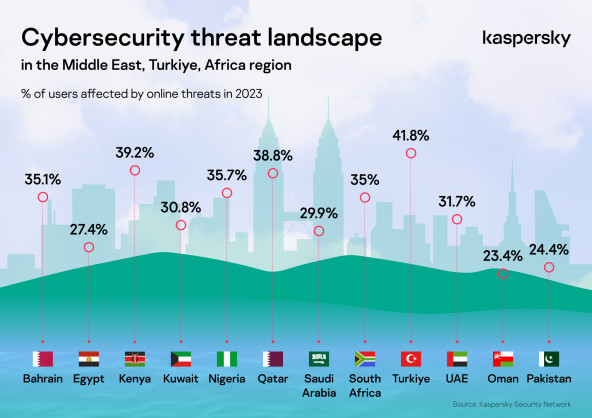
According to Kaspersky's analysis, online threats caused by vulnerabilities on web pages, in emails or webservices, have fluctuated significantly in the region. Turkiye saw the highest number of users affected by online threats (41.8%), followed by Kenya (39.2%), Qatar (38.8%) and South Africa (35%). Fewer users were affected in Oman (23.4%) and Egypt (27.4%) followed by Saudi Arabia (29.9%) and Kuwait (30.8%).

“As the cybersecurity landscape evolves, cyber threats continue to become diverse and sophisticated. This trend is particularly evident due to the emergence of advanced technologies like AI and the escalating geopolitical and economic turbulence within the Middle East, Turkiye, Africa (META) region. These factors collectively contribute to the surge in cybercrime and the heightened complexity of cyberattacks,” comments Amin Hasbini, Director of META Research Center Global Research and Analysis Team (GReAT), Kaspersky.

Distributed by APO Group on behalf of Kaspersky.

For further information please contact:
Nicole Allman
https://INKandco.co.za
nicole@inkandco.co.za

Social Media:
Facebook: https://apo-opa.info/3M3uy0L
Twitter: https://apo-opa.info/3OaLeGw
YouTube: https://apo-opa.info/41wO7V6
Instagram: https://apo-opa.info/42BZnRq
Blog: https://apo-opa.info/42Apbxn

About Kaspersky:
Kaspersky is a global cybersecurity and digital privacy company founded in 1997. Kaspersky's deep threat intelligence and security expertise is constantly transforming into innovative solutions and services to protect businesses, critical infrastructure, governments and consumers around the globe. The company's comprehensive security portfolio includes leading endpoint protection, specialized security products and services, as well as Cyber Immune solutions to fight sophisticated and evolving digital threats. Over 400 million users are protected by Kaspersky technologies and we help over 220,000 corporate clients protect what matters most to them. Learn more at www.Kaspersky.co.za.  

Media files
Kaspersky
Download logo
Read moreKaspersky shares cyberthreat landscape insights for the African region
15 February 2024

New age control centres bring out the best in people and technology

Location: MyPR

In the age of the fourth industrial revolution, control rooms will be the nerve centres that ensure safety, protect critical infrastructure and assets and ensure efficiency and quality. However, while they will rely on everything from the internet of things (IoT) to artificial intelligence (AI), it is important to design environments that look after people, …

Read moreNew age control centres bring out the best in people and technology
5 February 2024

Mining The Future – Minrom

Location: MyPR

Blessed by abundant natural resources, Africa’s mining sector has historically been a driving force behind the continent’s economic growth. However, the industry now faces a myriad of challenges. As we approach the 2024 Mining Indaba, the world’s largest African mining investment event, it is crucial to reflect on the trajectory of the industry and its …

Read moreMining The Future – Minrom
1 February 2024

7 Scams to Watch out for in 2024

Location: News
KnowBe4

Watch out! In 2024, scammers have some new tricks up their sleeve, such as deepfake impersonation. That is why fostering a zero-trust mindset can help to keep yourself safe from these scams.

  1. Deepfake impersonation scams

Imagine receiving a voice note from your CEO instructing you to transfer money to a bank account. You follow the instructions without realising that the voice note is a deepfake. And just like that, you have fallen for a scam. Deepfakes make use of AI technologies to create new – but fake – images, videos, and/or audio material from existing material, “Artificial intelligence (AI) technology makes it easier for fraudsters to create these convincing fake messages from people you know and trust,” explains Anna Collard, SVP Content Strategy and Evangelist at KnowBe4 AFRICA. “It enables scammers to generate video and audio that is so convincing, many believe it is real.”

Fraudsters also use AI-generated voice notes or videos to impersonate a family member, such as a grandchild, who claims to be in distress and in need of money. This is called a grandparent scam. “People get scammed that way because their emotions are triggered by hearing an authentic sounding voice clip of their loved one and want to help,” comments Collard.

Another fraudulent application of deepfakes is to impersonate politicians to spread confusion or disinformation. “This is definitely something to watch out for in 2024 as it's an election year,” says Collard.

  1. Investment scams

Investment scams can appear as trustworthy financial organisations promising incredible returns. “However, if something seems too good to be true, it probably is,” says Collard. She advises being cautious in such situations. Scammers often combine cryptocurrency scams with romance scams as well.

Another scam to be wary of in 2024 involves fake loans that offer low-interest rates but never actually materialise. Instead, victims are required to pay upfront fees or provide their personal information. “With the ongoing cost-of-living crisis, scammers may tempt many individuals to apply for these loans to make ends meet, be very careful of any offers that sound too good to be true.”

  1. Romance scams

By using fake profiles on dating sites or social media, scammers build trust with their victims and then exploit this emotional connection to trick them into sending them money. “Even though family members might repeatedly warn the victim, they often continue with the romantic deception because once on the hook, psychologically it is very difficult for the victim's brains to admit that they have been conned,” explains Collard.

  1. Identity and social media profile theft

Identity theft involves stealing personal information to commit fraud. Scammers do this via phishing emails or phone calls, as with banking scams. “Social media profile theft involves hackers hijacking your social media accounts to reach out to your contacts, pretending to be you, spreading malicious software, scams or  asking for money,” says Collard.

  1. Charity fraud

After a humanitarian crisis, like a flood, charity scams frequently emerge. “These scams play on your emotions and ask you to give money to a worthy cause, but in reality, they are fake charities,” explains Collard. Red flags to watch out for are unusual payment methods, such as EFT, instead of secure payment platforms. “Always make sure that charities are registered before you donate and that you interact with the legitimate NGO or charity before transferring any money,” she advises.

  1. Tech support scams

Posing as IT technicians, these scammers try to convince you that there's something wrong with your computer and offer to fix it. They then seize control of your computer and steal your personal information or hack into your bank account. “These scams prey on people's fears,” says Collard. “They throw people into a state of panic in which they're not thinking logically.” She recommends hanging up right away and directly contacting your IT support centre.

  1. Puppy scams

Are you in the market for a pure-bred puppy? Beware! International crime syndicates operating in South Africa offer purportedly discounted pooches. According to Collard, many individuals have suffered significant financial losses not only for the non-existent dog but also for the transportation expenses. She advises buyers to be wary if they encounter a wide variety of dogs for sale on a website or if they are immediately offered a puppy. “Breeders do not operate like Takealot. There are usually waiting lists; it takes time for a puppy to become available,” she says. “If you're offered a second dog at a 30% discount, it's highly likely you're being scammed.”

The general advice for any of the scams listed above is to slow down and take a breath before reacting to anything, particularly if it's emotionally triggering content.

As the boundaries between our physical and virtual worlds continue to blur, a zero trust mindset encourages us to pause, think, and evaluate the content we are interacting with, thereby empowering us to make conscious and more rational decisions.

Distributed by APO Group on behalf of KnowBe4.

Media files
KnowBe4
Download logo
Read more7 Scams to Watch out for in 2024
29 January 2024

Government activities for the week 29 January to 2 February 2024

Location: News

Government activities for the week 29 January to 2 February 2024

On Monday, 29 January, the National School of Government is hosting a webinar on artificial intelligence (AI) from 11:00 to 13:00.

On Tuesday, 30 January, is the opening ceremony of the AfCFTA Council of Ministers (COM) responsible for Trade.

On Tuesday, 30 January, Deputy Minister in The Presidency for Planning, Monitoring and Evaluation Pinky Kenana will conduct a frontline monitoring and Back to School Campaign at Vukuhambe Special School in Mdantsane under the Buffalo City Metropolitan Municipality in the Eastern Cape.

On Wednesday, 31 January, is South Africa’s launch of the preferential trade ceremony and the closing ceremony of the Council of Ministers.

Also on Wednesday, 31 January, President Cyril Ramaphosa will undertake a Presidential Welisizwe Bridges hand over in KwaZulu-Natal.

The Deputy Minister of Forestry, Fisheries and the Environment, Makhotso Sotyu, will lead the hand over ceremonies of the Kei Mouth and Qoloha plantations, followed by the Wilo and Ntlangaza plantations in the Eastern Cape on Wednesday, 31 January.

On Wednesday, 31 January, The Department of Mineral Resources and Energy (DMRE) will host a series of public engagement sessions to unpack the draft Integrated Resource Plan (IRP2023) that has been published for public comment. 


Janine
Mon, 01/29/2024 - 12:17

285 views
Read moreGovernment activities for the week 29 January to 2 February 2024
29 January 2024

Shaping the Future of South African Education: The Transformative Role of Emerging Technologies

Location: MyPR

By Dr Shahiem Patel – Dean of Regent Business School The future is becoming increasingly difficult to think about, let alone plan for. The vital need for education systems in South Africa to improve and meet the pressing needs of society and our economy only compound this difficulty. The rate at which technology is developing …

Read moreShaping the Future of South African Education: The Transformative Role of Emerging Technologies
29 January 2024

#BlackExcellence: Strategies for Capital Access in the Global Economy

Location: News
Energy Capital & Power

The global economy is expanding, providing an opportunity for Black-owned businesses to succeed. Various mechanisms have been adopted to facilitate access to the necessary capital required by these businesses to align with the dynamic growth of various economic sectors.

Global Black Impact Summit

The Global Black Impact Summit (GBIS) 2024 – scheduled for February 27 in Dubai – plays a pivotal role in assisting Black-owned businesses to secure capital. Organized by the Black Impact Foundation, a Dutch-based global organization empowering the Black Community and advocating for inclusivity on the global stage, GBIS 2024 will take place under the theme “Black Excellence: Unleashing the Unexplored Potential for Global Unity.” The movement serves as a premier platform for Black-owned businesses, startups, and projects to engage with potential global investors, fostering discussions and facilitating the signing of investment deals. Through a series of panel discussions, investment-focused exclusive networking sessions, and project exhibitions, GBIS 2024 will shed light on best practices and showcase diverse financial platforms dedicated to empowering Black-owned businesses.

Online Crowdfunding Platforms

Crowdfunding platforms such as Kickstarter, Indiegogo, and GoFundMe have become instrumental for Black-owned projects to showcase their innovative business ideas and garner support from a diverse audience. Beyond serving as a funding source, these platforms act as a means to validate market interest in the products or services offered by Black entrepreneurs. Research conducted by the University of Houston Conrad N. Hilton College of Global Hospitality Leadership reveals a significant evolution in funding dynamics for Black-owned businesses on Kickstarter. Businesses leveraging online crowdfunding platforms are now nearly four times more successful in securing funding.

Venture Capital Firms

Driven by a push to ensure inclusivity and gender diversity across the globe, venture capital firms have increased focus on funding Black-owned businesses. In the U.S. alone, venture capital directed to Black businesses reached record high in 2020 and continues to increase with firms such as Balmer Group – owned by Steve Ballmer, former Microsoft CEO – releasing $400 million in investment to support Black entrepreneurs in 2022. Across Europe, platforms like the UK's Black Seed Ventures are reshaping capital access for Black-owned businesses. Since its inception in 2021, the seed fund has secured over £5 million in funding to support 30 Black-led startups within the healthcare, deeptech, and artificial intelligence sectors by 2026. Google's Startups Black Founders Fund allocated $100 million in 2022 to support the Black startup community across Africa, Europe, Brazil, and the U.S., building on the $30 million already directed towards this community since 2020.

Minority-Owned Business Grants

Grants offered by government agencies, non-profit organizations and various corporations to empower minority entrepreneurs have evolved into not only a crucial source of financial assistance for Black-owned businesses but also a significant financial catalyst, propelling the expansion of economies. South Africa's Department of Trade, Industry, and Competition (DTIC) in collaboration with other government agencies such as the Industrial Development Corporation and the National Empowerment Fund, allocated R32 billion in grants to nearly 800 Black industrialists between 2016 and 2020. These investments have fostered socioeconomic development and shaped job creation with up to 120,000 jobs created and preserved. As the DTIC amplifies investments in Black-owned businesses to reduce reliance on imports by 2026, government grants emerge as a significant opportunity for Black entrepreneurs to access capital.

Banks

Banks play a pivotal role in empowering Black-owned businesses by facilitating access to capital. In the UK, Lloyds Bank has collaborated with the Black Business Network and FounderVine to offer financial support in the form of loans and grants to Black entrepreneurs. Additionally, in the U.S., online banking platform Guava is providing specialized services to enable Black-owned businesses to secure essential capital.

Register here (www.GlobalBlackImpact.com) for GBIS 2024 and gain first-hand insight into the various strategies to secure capital for your business.

Distributed by APO Group on behalf of Energy Capital & Power.

Media files
Energy Capital & Power
Download logo
Read more#BlackExcellence: Strategies for Capital Access in the Global Economy
  • Previous
  • Page 1
  • Interim pages omitted …
  • Page 5
  • Page 6
  • Page 7
  • Page 8
  • Page 9
  • Next

Copyright © 2026 · MyZA · All Rights Reserved · Powered by Reach Trust