Voters will be safe in Philippi, say community leaders and police
No repeat of last November’s disruption of registration process

MyZA
News, Directory, Events and Other Stuff
No repeat of last November’s disruption of registration process

By iiDENTIFii (https://iiDENTIFii.com/) CEO and co-founder Gur Geva.
When it comes to accessing essential services, such as national medical care, grants and the ability to vote in elections to shape national policy, a valid identity document is critical.
In South Africa, undocumented citizens are restricted in their ability to collect social grants or go to a hospital. Even those with valid IDs spend hours in queues owing to inefficient and protracted identification processes.
Faster, digitised services would have a transformative impact on the level of financial inclusion of the country's citizens. iProov's report (https://apo-opa.co/3VfYD37), "Unlocking financial inclusion with digital identity and biometric verification," emphasises that digital identity programmes open essential pathways for the unbanked and disenfranchised to access financial and welfare services and, in the case of governments, offer a reduced administrative burden and increased economic growth.
In theory, the positive impact is evident, but how can South Africa with its infrastructural challenges and high levels of inequality put this verification system into practice?
The challenge
An estimated 500 million (https://apo-opa.co/4aFwdEf) people in Africa are living without any form of valid legal identification. In response to this crisis, the African Union Commission is working on an initiative (https://apo-opa.co/3KmsnVP) to develop an interoperability framework for digital identity. The need for this is clear.
In South Africa, for example, lengthy identification processes see citizens queueing for up to three hours to renew a driver's license. Many people (https://apo-opa.co/452hke4) leave their homes in the dark and queue from dawn for their social security grants only to be turned away when the queue is cut because of system failures.
In an address to Parliament (https://apo-opa.co/3wU9pCU), Dr Aaron Motsoaledi, Minister of Home Affairs of South Africa, states that the main reason for the long queues lies in the State Information Technology (SITA) system often being down. The DHA relies on SITA for connectivity, especially in rural villages. Branch Appointment System (BAPS) kiosks that facilitate the live capture of IDs and passports have been set up to bridge this gap. While these efforts are useful, digital identity could transform these processes, whittling down lengthy queues by authenticating identity in a matter of seconds.
In fact, South Africa is pursuing digital identity in some form, through the form of a Smart ID card that stores face and fingerprint biometrics. However, this pioneering initiative is being held back by a restrictive, lengthy onboarding process. Smart ID cards can only be issued from a selection of offices with a ‘live capture system' as well as through certain banks that use the system in-house. This is not enough to implement secure digital identity at scale.
Reframing the identity conversation
Many of South Africa's challenges stem from systemic inequality. This inequality in access across gender, location and education lines has real implications for identity management (https://apo-opa.co/3KmsnVP). For this reason, the conversation needs to shift from identity being an administrative tool to identity being an essential human right (https://apo-opa.co/3KmsnVP).
Whether a person is applying for legal employment, registering at an address, setting up a phone contract, or opening a bank account, a proven identity that can be authenticated is an essential part of the process. Widespread, effective digital identification benefits citizens and generates significant economic value for governments and financial institutions as well.
As a result, a growing number of governments are teaming up with organizations worldwide to develop digital identity programmes that are not only convenient, but open up essential pathways for previously disadvantaged or marginalized individuals to help them access financial and welfare services.
Ground-breaking identity verification in practice
iProov and iDENTIFii have seen the positive impact of Dynamic Liveness Technology in delivering fast, secure and effortless passive face biometric authentication. In addition to being a strong digital alternative to historic forms of identity verification, its anti-spoofing technology is also effective in detecting and protecting against future cyber threats. The U.S. Federal Government lists iProov as a Synthetic Identity Fraud Mitigation Provider and government clients include the U.S. Department of Homeland Security, the UK Home Office, the Australian Tax Office, and GovTech Singapore.
The UK Home Office EU Settlement Scheme, a digital application process for EEA nationals living in the UK post-Brexit, is a powerful example of the impact of digital identity on public services. The scheme was developed by iProov, WorldReach Software, and InnoValor, and provides a simple, secure, and usable solution for applicants to apply for settlement status online. The app includes key features such as remote identity documentation checking using NFC or OCR, and biometric identity authentication via iProov's Dynamic Liveness technology. The app has been extremely successful, with over 4.2 million applications completed, high levels of identity assurance, and an average satisfaction rating of 4.1 stars.
How open are citizens to digital identity?
The Digital Transformation Strategy (https://apo-opa.co/3KmsnVP) for Africa (2020-2030) highlights both the potential social and economic implications of digital IDs for Africans, noting that digital IDs not only support social development, but also enable meaningful participation in productive processes to generate economic growth, spur innovation, and support entrepreneurship. Besides being viewed as an enabler for realising all these policy objectives, digital IDs are seen as critical for the successful implementation of the African Continental Free Trade Area (AfCFTA).
Digital identity programmes can bridge the identity gap by being accessible through even basic smartphones, thus eliminating barriers such as cost and complex application processes that often require travel. A case in point is the European Union Digital Identity Wallet (EUDIW) a decentralised, interoperable digital tool that aims to provide all 447 million EU citizens with the ability to easily store and exchange identity documents and credentials securely, while having full control over their data. Using identity verification will see important public and private services, such as online government services, online banking, remote prescriptions, and SIM registration become significantly more accessible.
The importance of inclusive and safe digital identity
For South Africans to truly embrace and reap the rewards of digital identity, accessibility and security are two critical factors government and other essential service providers must consider.
Adopting accessible verification models maximises inclusivity of digital identity programmes. Traditional remote verification methods, such as video calls or passwords, lack user convenience and may exclude individuals with language barriers or disabilities. By contrast, biometric face verification uses a front-facing camera and does not rely on the end user's technical abilities.
Security is also key as these initiatives must provide the maximum number of people with digital identities and financial access, while consistently mitigating the risks of cybersecurity threats. As with any technology that enables access to a broad range of secured data and financial services, there is a risk of digital identities being compromised for fraud, money laundering, or other illicit activities.
With generative AI contributing towards the sophistication of tools such as deepfakes, this risk is higher and the crime is easier to perpetrate than ever before. Liveness confirms that the person verifying their identity exists and is a live human being with the right to access the online account or service. It also assures that it is a real person and not a photo or mask or other presentation attack. It does not protect against scalable digital attacks like deepfake where synthetic images can be injected into device sensors.
Successful digital identity schemes, such as Estonia's, yield economic benefits for the government and businesses, and demonstrate the positive impact of such initiatives. Similarly, as the European Union's (EU) initiative progresses, other nations can learn valuable lessons from them and adopt strategies that foster a society characterised by enhanced inclusivity and economic prosperity.
Looking forward
While the local government is still rolling out digital identity, the financial services industry in South Africa has been an early adopter. Not only has it proven the ability of digital identity to be more efficient and safer, but it has also shown that it is possible to use biometrics at scale.
Several of iiDENTIFii's South African banking clients have been able to address downtime issues by using subsequent authentication. iiDENTIFii has prioritised this based on the understanding that an authentication process that keeps customers secure and engaged, is a successful one. For this reason, its platform is able to process individuals by storing their reference templates and enabling subsequent authentication. If financial institutions and the government collaborate in digitising government systems, it could make true financial inclusion and accessible digital identity at scale a reality, in a way that reaches all South Africans.
Distributed by APO Group on behalf of iiDENTIFii.
About iiDENTIFii:
iiDENTIFii (https://iiDENTIFii.com/) is an award-winning face authentication and identity verification platform that distinguishes itself through its use of 3D and 4D Liveness® detection. Purpose-built for enterprises across Africa and the Middle East, iiDENTIFii enables frictionless, scalable customer onboarding in seconds from anywhere and on any device. Founded in 2018, iiDENTIFii has become a proven key partner in multiple tier 1 African banks. The technology plugs seamlessly into existing infrastructures, including mobile and web-based platforms.
Home Affairs says the City of Cape Town must send a list of victims but the City says it’s already done so
Northern Cape communities urged to work with police to ensure safe elections
Law enforcement in the Northern Cape has called on communities to work with them to ensure that the National and Provincial Elections -- to be held this week -- are safe and secure.
In a statement, the Northern Cape Provincial Joint Operational and Intelligence Structure (PROVJOINTS), said from their side, law enforcement has done all it can to ensure they are ready for Election Day on Wednesday.
“All the security measures and plans that have been put in place will ensure that the election process in the Northern Cape will proceed without any incidents of crime and disruptions. We assure maximum deployments to ensure the successful execution of the operational plan.
“As the PROVJOINTS, we are satisfied with the contingency plans put in place and reassure the inhabitants of the Northern Cape that they can expect a safe and peaceful election.
“However, while measures are in place, the ultimate responsibility of ensuring a safe and conducive environment lies with every citizen of the province, which requires sound partnerships in order to create a harmonious backdrop of mutual respect as we are heading to the voting polls,” the statement read.
Furthermore, potential threats of disruptions are being monitored.
“Threats identified, such as community protests are already being attended to and those that are found to be in contravention of the law are being dealt with. Our Public Order Police units (POPS) are on the ground and ready to prevent and combat such incidents.
“We take this opportunity to remind our communities that the Constitution of the Republic of South Africa provides that every resident is free to make political choices, which includes the right to participate in the activities of political parties and to campaign for such parties,” the statement said.
Communities are also warned not to vandalise, deface or remove political party posters and placards, as this is against the law.
Citizens are also warned not to spread fake news or incite violence.
“Any person found to be tampering with posters will be arrested and charged with contravention of the Electoral Act 73 of 1998, which prohibits the unlawful removal and defacing of posters published by a political party.
“We also condemn the spreading of fake news, unverified information, rumours or threats on social media platforms that seek to cause unnecessary panic and confusion and in some instances, incite possible violence. Those found to be sharing inflammatory messages and inciting violence will be charged accordingly,” read the statement.
The Northern Cape PROVJOINTS said although ensuring a “safe and secure election process” is a priority, due attention is also paid to normal policing work.
“The main priority of SAPS, with the support of the Justice, Crime Prevention and Security Cluster departments, is to ensure a safe and secure election process. We also assure the communities of the Northern Cape that normal crime prevention and policing operations are continuing prior, during and beyond the election period.
“Every law enforcement officer on the ground, has the responsibility and an obligation to execute their mandate, professionally, impartially and with integrity and within the confines of the laws of the country. Our members are reminded that we are a-political and will enforce the law without fear and favour,” the statement said. – SAnews.gov.za
NeoB
Mon, 05/27/2024 - 12:18
IEC: Successful first day of special votes
The Electoral Commission’s Deputy Chief Electoral Officer Masego Sheburi says he is pleased with the execution of the first day of special votes in the National and Provincial Elections.
Special votes took place on Monday and will continue on Tuesday for qualifying voters. Voting stations for special votes operate from 9am to 5pm.
“As of 2pm today, an estimated 201 794 voting station visits of special votes were processed in 22 626 service points,” Sheburi said, addressing the media at the National Results Operation Centre (ROC) in Midrand, on Monday afternoon.
He said over the two days of special votes, a total of 624 593 voters will be visited by 62 000 officials from the Electoral Commission accompanied by political party agents and observers where they are available.
“The Electoral Commission is happy with the turnout and urges South Africans to continue to go out in their numbers to vote on 29 May 2024,” Sheburi said.
He reminded all those who qualified for special votes that they will only be visited at the given address once.
“If the voter is not present at the given address, they will be able to cast their vote at the voting station where they are registered.
“The commission clarifies that in the instance where a voter has made two transactions, the last will override the first. This is done to protect the integrity of the elections and prevent voters from voting twice,” Sheburi said.
Owing to the commission’s good preparations, the majority of voting stations in the Eastern Cape were opened despite protests which were not related to the elections.
Of the 435 voting stations which experienced problems in the morning, only 107 remain closed due to the external factors. “The commission continues to work with stakeholders to have them open tomorrow,” he said.
Sheburi encouraged all those who applied to cast a special vote at their voting station to do so between the hours of 9am and 5pm.
“Voters are reminded that these are different from the voting hours of 7am to 9pm on Election Day. Voters are reminded to have their identity documents as a requirement for participation.
“After casting votes, the ballots must be inserted in an unmarked envelop which in turn will be inserted in a second envelope with details of the voter. The special voting process is subject to all the security and integrity protocols of normal voting including scrutiny by party agents and observers where present.
“Special votes will be reconciled against the voters’ roll and the list of approved special votes. Additional checks include the use of the double envelope system which allows us to still preserve the secrecy of the voters’ ballot,” Sheburi said.
All special votes collected will be stored securely overnight on 27 and 28 May and will be transported to voting stations on 29 May to be opened, reconciled and added to the ordinary ballots cast on Wednesday before counting begins.
Over 1.6 million South Africans have been approved to vote via special ballots.
With regard to the uMkhonto weSizwe (MK) Party, where a group of its supporters allegedly invaded an IEC storage facility and threatened an elections official over the weekend, the commission said it was dealing with the issue seriously.
At a media briefing on Sunday, the commission affirmed its readiness to facilitate the special votes ahead of the national Election Day on Wednesday.
The IEC has assured that the administration of special votes will occur in the presence of contestant representatives and observers where possible, although entry into homes will be at the homeowner’s discretion. – SAnews.gov.za
Edwin
Mon, 05/27/2024 - 17:44
Public warned against sharing videos inciting violence
Eastern Cape Transport and Community Safety MEC Xolile Nqatha has warned the public that the State will deal decisively with any fear mongers responsible for voice notes and videos calling for a shutdown on social media.
This comes as voice notes and videos were shared on social media seeking to intimidate, incite violence and threaten people’s democratic right to participate in the upcoming elections.
The MEC has assured that public that there will be no shutdown of Mthatha, and has directed the police to track down and bring to justice the man responsible for the video and any other person or persons responsible for similar social media posts.
“The most recent of these social media posts is a brazen video recording by a man, allegedly who calls for a complete shutdown of Mthatha; a stop of elections campaigns in and around Mthatha, less than 48 hours before the elections. The call comes after the police confiscated pistols and assault rifles following the resurgence of taxi violence in the Mthatha, Tsolo and Maclear areas,” the department said on Monday.
Nqatha has termed these acts as selfish, immature and irresponsible actions that seek to undermine the rule of law in this province, and in Mthatha in particular.
“The utterances of the man who recorded the video in particular are an insult to the sacrifices of many of our liberation struggle heroes and heroines. He is virtually spitting in the faces of all our anti-apartheid heroes and heroines, many of whom have sacrificed with their lives for this right to vote and the right for freedom of movement that we now want to take away from our people.
"We can never allow any person to do that on our watch, for that will be a betrayal of this freedom that we now enjoy, and the sacrifices of those who fought so hard for it,” the MEC said.
He said his department is working closely with the police to end the taxi violence in the province. –SAnews.gov.za
nosihle
Mon, 05/27/2024 - 13:14
Government activities for the week 27 - 31 May 2024
On Monday, 27 May, Minister of Social Development Lindiwe Zulu launches the Khuseleka One Stop Centre at the Saartjie Baartman Centre for Women and Children in Manenberg, Cape Town.
Also on Monday, Minister in the Presidency for Women, Youth and People with Disabilities Nkosazana Dlamini Zuma launches the Demand-LED and job creation programme for persons with disabilities at the Coastlands Unhlanga Hotel and Convention Centre.
On 27 May, NSFAS briefs media on progress relating to the disbursement of student allowances at Tshedimosetso House, Hatfield, Pretoria, starting at 11am.
On Monday, Minister of Health Joe Phaahla casts his special vote in his home village of Ga-Phaahla, Limpopo.
Monday is Day 1 of special voting in the National and Provincial Elections, from 9am to 5pm.
Tuesday, 28 May, is Day 2 of special voting in the National and Provincial Elections, from 9am to 5pm.
On Wednesday, 29 May, is Election Day, from 7am to 9pm.
Janine
Mon, 05/27/2024 - 12:29
BMA on high alert ahead of elections
With just two days before South Africa’s national and provincial elections, the Border Management Authority (BMA) is on high alert at all ports of entry to monitor movements.
On Saturday evening, BMA Immigration officials conducted an intelligence driven operation on a flight from Dubai.
A total of 28 Bangladeshis were intercepted on arrival at OR Tambo International Airport (ORTIA) and during the operation, 27 Bangladeshis were found to be in possession of fraudulent visas and one Bangladeshi did not have a visa at all.
The travellers were in contravention of the South African Immigration Act by possessing fraudulent travel documents. The Bangladeshi nationals arrived in the country with visitors’ visas and were denied entry.
The Commissioner of the Border Management Authority, Dr Michael Masiapato, has commended the interception by the BMA Immigration officials and highlighted the importance of collaborations with embassies and foreign missions in verifying visa legitimacy and encouraged improvements on detection systems.
Commissioner Masiapato also emphasised the need for continued efforts in confiscating illegal documents especially at this critical time of elections.
“I commend the diligent efforts of our immigration officers in intercepting the Bangladesh[i] nationals,” Commissioner Masiapato said.
“The BMA's vigilance and commitment to maintaining the integrity of our immigration system is exemplary.
“This operation underscores the importance of our continuous efforts to secure our borders and ensure that all entrants comply with our legal requirements," he said.
The BMA will continue to tighten its detection systems at the ports of entry.
Four hundred more BMA junior border guards are now entering the system following their pass-out parade and more interceptions are expected across all ports of entry. – SAnews.gov.za
Edwin
Mon, 05/27/2024 - 09:46
Unite for free, fair and peaceful elections - President Ramaphosa
President Cyril Ramaphosa has, in his weekly newsletter, called on South Africans to unite for free, fair and peaceful elections.
The National and Provincial Elections are expected to be held on Wednesday with voting stations opening at 7am and closing at 9pm.
Some 27 million eligible South Africans have been registered to vote in this year’s elections.
“Holding free, fair and peaceful elections is a barometer of the good health of our democracy. As we cast our votes on Wednesday, let us, in the words of our Constitution, 'honour those who suffered for justice and freedom in our land, respect those who have worked to build and develop our country, and believe that South Africa belongs to all who live in it, united in our diversity'.”
“Let us hold another election that is peaceful, that is free, that is fair and that is a credit to all the elections we have held since 1994. Let it be that the ultimate winner of this election is South Africa, our democracy, and you, the South African people,” President Ramaphosa said.
The President highlighted that since the dawn of democracy, elections have been held “without major incident” and expressed confidence that this year’s elections will also take place in the same vein.
“Once again, we have every confidence that this election will take place under conditions of peace, safety and tolerance, and that it will be free and fair.
“The integrity of our elections is testament to the high regard in which South Africans hold their hard-won right to vote. It is an affirmation that no matter what our political differences are, when it comes to safeguarding our democracy, we are prepared to put these differences aside for the common good,” President Ramaphosa said.
A look back
President Ramaphosa recalled how South Africa “was on the brink” on the eve of the first democratic elections in 1994 with “state-sponsored violence and the threat of a right-wing insurrection” contributing to a “sense of fear and uncertainty”.
“One newspaper carried a story at the time titled “South Africa hoarding as fear rises”. It described long supermarket queues of people stocking up on tinned foods, a rush to attend emigration seminars, panicked currency exchanges, and fearful callers to radio stations about sabotage of power plants and water supplies.
“We recall the courage of the political leadership at the time and their efforts to quell tensions. We recall the role of the leadership of the Inkatha Freedom Party, the African National Congress and the National Party in signing a memorandum of agreement for reconciliation and peace just three days before the election.
“We recall these events to remind ourselves of what is required of us all as we head to the polls on Wednesday. We are required to continue to honour the sacrifices of our forebears by exercising their right to vote and to do so peacefully. We are required to respect the rights of others regardless of who they are voting for, and regardless of whether they are voting or not,” he said.
Despite all the doomsday fears at that time, the President said, “none of these fears materialised”.
“As South Africans we have rejected the politics of fear time and again, and we will continue to do so.
“For the past thirty years we have chosen the path of peace over violence, of reconciliation over hate, and of unity over divisions of race, ethnicity or tribe. The stability and integrity of our electoral system bears witness to this,” President Ramaphosa said. – SAnews.gov.za
NeoB
Mon, 05/27/2024 - 10:05
Achievements and challenges: President reflects on sixth administration
As the term of the sixth administration draws to a close, President Cyril Ramaphosa has reflected on the achievements and challenges faced by government during this five year period.
South Africans are expected head to the polls in the National and Provincial Elections this week to elect leaders for the seventh administration.
In an address to the nation on Sunday, the President said that at the start of his term in office in 2019, South Africa “stood at a turning point”.
“We had endured a decade of corruption and state capture, of weak economic growth and the erosion of our public institutions. Today, we have put that era behind us. We have placed South Africa on a new trajectory of recovery and laid a strong foundation for future growth.
“We have taken significant steps to reform our economy by implementing a number of reforms that affect various sectors of the economy. In tackling crime and corruption, we have introduced a number of initiatives and measures to reposition our criminal justice system.
“We have faced many challenges along the way, which have tested our resilience and our resolve. Yet, in each instance, we have confronted these challenges together. We have remained united. We have worked in partnership and in solidarity,” the President said.
State Capture and corruption
President Ramaphosa said that the nation brought state capture to an end.
“We dislodged the criminal networks that had stolen billions from our people, that had eroded our public institutions and that had undermined the rule of law. Together, we worked to rebuild our law enforcement agencies, our security services, our state-owned companies and a number of other public bodies.
“Through the work of institutions like the NPA’s [National Prosecuting Authority] Investigating Directorate, the Hawks and the SIU, several state capture and corruption cases have been brought to court and billions of Rands in stolen funds have been recovered,” he said.
To further strengthen the work of the NPA, President Ramaphosa has now signed into law the establishment of the NPA’s Investigating Directorate against Corruption as a permanent entity.
“There is still much that we need to do to end corruption. However, as a country, we have sent a clear message to the corrupt that they can no longer expect to get away with their crimes with impunity and without consequence,” President Ramaphosa said.
COVID-19 pandemic
The President remarked that the COVID-19 pandemic, which swept across the world and pushed economies to their limits, was one of the defining moments of the last five years.
More than 100 000 South Africans died during the pandemic with some two million jobs lost.
“We introduced a massive package of social and economic support to protect vulnerable businesses, workers and households from the destructive effects of the pandemic. More than 5.7 million workers received wage support through the special UIF scheme.
“Through the introduction of the special SRD [Social Relief of Distress] grant, we provided relief to more than 11 million unemployed people at the height of the pandemic.
“Working together, we succeeded in administering more than 39 million COVID-19 vaccine doses. Even during the worst moments of the pandemic, we endured and we overcame. This is how we are as South Africans. We confront even the greatest of challenges with determination and courage,” the President said.
Rebuilding the economy
President Ramaphosa said rebuilding the economy following the devastation of the COVID-19 pandemic has been characterised by South Africans coming together “in social partnerships to drive investment, to build infrastructure and to remove the obstacles to inclusive growth”.
He highlighted that as a result, the economy has now returned to levels seen before the pandemic and “we have recovered the jobs lost to the pandemic”.
“Together, we supported Eskom’s efforts to improve the performance of its power stations. We enabled investment in new electricity generation capacity on a scale that is unprecedented in our history.
“Working with financial institutions, development agencies, business and professional associations, we revitalised investment in infrastructure. The value of projects currently in construction is over R230 billion, including energy, water infrastructure and rural roads projects.
“Together, we mobilised more than R1.5 trillion in new investment commitments. This has led to the opening of new factories, mines, data centres and production lines.
“Working with private sector partners, we established the Youth Employment Service, which has created over 144 000 work experiences for young people. We have worked across government and with NGOs to implement the Presidential Employment Stimulus, which has created more than 1.9 million work and livelihood opportunities for unemployed South Africans,” he said.
Into the future
The President emphasised that the sixth administration and all of the work it has done is a springboard for building a better future.
“The last five years have been a time of rebuilding and recovery. It has been about working together not only to meet the challenges of the moment, but to put in place firm foundations for a better future.
“As this sixth administration draws to a close, and as we prepare for the seventh administration, let us build on the progress that we have made. At this moment in our path to renewal, we cannot afford to turn back. There is more work to be done,” President Ramaphosa said. – SAnews.gov.za
NeoB
Sun, 05/26/2024 - 19:50
President Ramaphosa wishes IEC well ahead of elections
President Cyril Ramaphosa has wished the Electoral Commission of South Africa (IEC) well ahead of the National and Provincial Elections due to be held this week.
Special votes are to be administered on Monday and Tuesday with the general elections to be held on Wednesday.
Addressing the nation in a televised broadcast on Sunday evening, the President applauded the commission for its work in the run up to the elections.
“As a country, we have once again witnessed the capabilities of the IEC – in the successful voter registration weekends, in the registration of parties and candidates, in the preparation of ballot papers, in the organisation of overseas voting, and in the diligent application of our electoral laws.
“We convey our thanks and best wishes to the IEC commissioners, to the IEC staff and to the thousands of election workers as they deliver on this most important responsibility in the coming days,” President Ramaphosa said.
The President remarked that the defining feature of South Africa’s elections since the dawn of democracy in 1994 “has been their integrity…made possible not only by the work and conduct of the IEC, but also by the presence of party agents and independent observers”.
“The involvement of party agents gives people confidence that there is effective oversight of all aspects of the electoral process.
“Through the presence of local and international observers we are able to satisfy ourselves that our elections conform not only to our own laws, but also to internationally-accepted standards of freeness and fairness.
“We thank all the party agents and the election observers for the work they are doing, and reiterate that they must be allowed to do their work without any hindrance,” he said.
WATCH I President Ramaphosa’s address
President Ramaphosa emphasised the history attached to the right for all eligible South Africans to make their mark.
This right was hard won by liberation heroes and anti-apartheid activists who fought for South Africa’s democracy against a brutal apartheid state.
“This will be the seventh time that South Africans of all races, from all walks of life, from all corners of our country, will go to vote for national and provincial government. We will once again assert the fundamental principle, articulated in the Freedom Charter, that no government can justly claim authority unless it is based on the will of all the people. In the days to come, we will be doing much more than exercising our Constitutional right to vote,” said the President.
He said citizens will be determining the direction that the country takes.
“I call upon all South Africans to go cast their votes. We are a diverse people, but a united nation. Let us be united in our commitment to our democracy,” he said. – SAnews.gov.za
NeoB
Sun, 05/26/2024 - 19:10
IEC ready to administer special votes
The Electoral Commission of South Africa (IEC) has declared that it is ready to administer the special votes expected to be cast tomorrow and Tuesday, ahead of Election Day on Wednesday.
Special votes for those South Africans out of country have already been cast.
Domestic special votes are for those who are either infirm or have impaired mobility who will be visited by the IEC at their or home or place of confinement and also for those who wish to cast their vote early as they may not be able to access their voting station on general Election Day on 29 May 2024.
At a media briefing on Sunday, IEC Deputy Chief Electoral Officer, Masego Sheburi, said more than 1.6 million South Africans have been approved to vote during the special votes.
Some 624 593 voters are expected be visited by IEC staff with the rest expected to visit their voting stations.
“We are encouraged by the number of special votes received which indicates the enthusiasm with which the South African population has for these elections,” he said.
Special votes will be administered in the presence of representatives of contestants and observers where those are available. However, people are only allowed into homes at the direction of the homeowner.
“Voters…are reminded to have their identity documents handy in order to confirm their participation in these elections. After a voter casts their ballot, they will be handed two envelopes. They insert their marked ballots into an unmarked envelope, which in turn is inserted into a bigger envelope which has the details of the voter.
“The purpose of the envelopes is to ensure that we can verify that only persons who have been approved to vote by special vote have voted but also to ensure the secrecy of the vote by delinking the vote from the voter,” he said.
WATCH I IEC briefs media on readiness for special votes
For those who will be going to voting stations, those stations will be open between 9am and 5pm with only those approved for special votes allowed to make their mark.
Following the two days of special voting, the ballots still within in their double envelopes, will be transported for safe storage until 29 May 2024 where they will be verified and reintroduced for counting.
Persons with disabilities
Sheburi said the commission has prepared for persons with disabilities to “vote in conditions of relative dignity and without disclosing their choice to anyone”.
“Working together with the South African National Council for the Blind [SANCB], we have developed a voting aid, the Universal Ballot Template for persons who can read braille they can be able to vote without disclosing their choice of candidate or party.
“For those with unsteady hand, they will be able to use the Universal Ballot Template to also make their mark without disclosing their choice or relying on companions for assistance.
“We call on South Africans to come out in numbers and exercise their democratic right to vote. We further continue our call to citizens, media members, and political party leaders to set a good example and foster an electoral environment based on trust, integrity, and respect for all,” Sheburi said. – SAnews.gov.za
NeoB
Sun, 05/26/2024 - 16:15
Authorities ready to protect citizens' right to vote during elections
Law enforcement agencies are “in charge and in control” as the country heads to the polls this week, says police Deputy National Commissioner Lieutenant General Tebello Mosikili.
Mosikili said this when she addressed the media on the readiness of the National Joint Operational and Intelligence Structure (NatJOINTS) ahead of the National and Provincial Elections to be held on 29 May 2024.
Special votes are expected to be administered by the Electoral Commission (IEC) on Monday and Tuesday, followed by the general elections on Wednesday.
“To all voters, go out there having full confidence that the NatJOINTS’ plan is on track to protect your rights and our democracy. We are in charge, we are in control. As law enforcement agencies, we will ensure your safety throughout this period,” she said.
The Lieutenant General acknowledged that the task of ensuring a safe election period was challenging but assured citizens that past experience will augur well for this week.
“The task at hand is immense but through past experiences of ensuring safe and secure elections, we are confident that we are ready for this next phase. The road to a safe, secure and peaceful election requires the commitment and effort from all stakeholders, including our communities.
“We are grateful that thus far our communities and South Africans from all walks of life have continued to display responsible conduct and behaviour.
“A reminder to all political parties that political campaigning ends midnight on 28 May 2024, should it continue beyond this period, this would be a transgression and contravention of the Electoral Act,” she said.
Fake news
Mosikili warned citizens, particularly those who use social media, not to engage in the spreading of misinformation and fake news.
“You are all urged to verify facts first before sharing any information which often leads to unnecessary confusion and panic.
“We will not tolerate any incitement of violence on any platform. Our intelligence communities and cybercrime units are closely monitoring online users. We are warned not to step out of line,” she said.
Mosikili reminded police officials to protect the elections within the confines of the law.
“It is more boots on the ground. Our law enforcement agencies are out there deployed to ensure that everyone who will be exercising their democratic right does so in a peaceful, safe and secure environment.
“We once more want to remind our law enforcement agencies to continue to apply fundamental policing principles guided by the Constitution and our laws,” she said. – SAnews.gov.za
NeoB
Sun, 05/26/2024 - 14:22
IEC dismisses vote rigging allegations, condemns threats to officials
The Electoral Commission (IEC) has dismissed allegations of vote rigging made against its offices in KwaZulu-Natal and has condemned threats made against its officials.
This comes days before the National and Provincial Elections are due to be held on 29 May, with special votes expected to be administered on Monday and Tuesday.
On allegations of vote rigging, the commission noted “with great concern” videos circulating related to the allegations at its storage sites in Chesterville and Hammersdale in the province.
“We wish to clarify that the videos depict our planned logistical arrangements and storage of election materials as we prepare for the first day of special voting on 27 May 2024. These are legitimate and authorised arrangements for the distribution of ballot papers and other bulk material.
“The planned security measures were that the trucks distributing ballot papers are escorted by SAPS to the local storage site. These storage sites will then be guarded on a 24-hours basis. This arrangement would ensure that the storage sites are protected against unauthorised entry, burglary, and tempering with election materials and ensure detailed control and recording of all items in storage,” the commission said in a statement.
It further warned that no members of political parties will be allowed entry into any storage facility.
“No party will be allowed to gain entry into the warehouse premises of the commission. We instruct the leadership of MK party to immediately leave the warehouse as the commission urgently needs to finalise the distribution of election material,” the statement read.
Threats to commission officials
The IEC said that in the same province, an official was “was woken at home in the middle of the night about bulk material stored at the Baptist Church voting station in Chesterville”.
“Bulk material is voting booths, voting station signage/banners and new unfolded ballot boxes. This bulk electoral material was taken to Cato Manor police station in eThekwini, in KwaZulu Natal.
“It is part of the logistical plan for the commission to deliver bulk material to voting stations ahead of Election Day. This is meant to ensure that voting stations open on time as only security material such as ballot papers will be delivered on the day of voting,” the commission said.
Furthermore, it strongly condemned any threats towards its staff members.
“No party nor its representatives have authority to gain access to private homes of electoral staff. Worse still no party nor its representatives may take control of election material without being authorised.
“We want to assure the public that additional measures have been implemented to secure these various storage sites across the country. We confirm that the commission has possession of all election materials shown in these videos.
“This electoral material is being prepared for distribution to voting stations in time for the special votes tomorrow, 27 May 2024.
“The commission is contemplating measures against the party and the individuals involved as such obstruction to election activities should not be tolerated. This conduct violates the Code of Conduct and other electoral prescripts,” the IEC said.
Meanwhile, President Cyril Ramaphosa is expected to address the nation this evening at 6pm. – SAnews.gov.za
NeoB
Sun, 05/26/2024 - 13:01
Voters urged to familiarise themselves with three ballot papers
As South Africa holds its seventh democratic elections this week, voters will for the first time receive three ballot papers instead of two ballots.
The Electoral Commission (IEC) has urged voters to carefully review and mark each of these three ballot papers before depositing them into the ballot box.
“Our appeal to voters is to remember that they can only put one mark on each ballot, more than one mark will result in a spoiled vote and not counted.
“The Universal Ballot Template (UBT), whose dimensions are benchmarked against the longest ballot paper will be available in all voting stations. The UBT can be used by blind and partially sighted people, low-vision users, people who are dyslexic, and people with motor and neuron conditions which do not allow for a steady hand,” IEC Chief Electoral Officer (CEO) Sy Mamabolo said.
South Africans will go to the polls on 29 May 2024 to vote for leaders in government for the seventh administration.
The 27.79 million registered voters will receive three ballot papers to elect candidates to represent them in the National Assembly and Provincial Legislatures.
The use of the three ballots follows the amendment of the Electoral Act, which was signed into law in April 2023.
“This amendment revised the electoral system to allow independent candidates to contest in the regional (province-to-national) tier of the National Assembly and the Provincial Legislatures.
“Although the phenomenon of three ballots will be familiar to voters in various local municipalities, it will be new to voters in metropolitan areas and for the first time in general elections for national and provinces,” Mamabolo said.
WATCH I Three ballots explained
The three ballot papers are as follows:
The commission said the design of the ballot papers will be underpinned by the following identifiers:
In respect of independent candidates, the ballot papers will have:
There are a total of 400 contested seats in the National Assembly. The proportional representation compensatory 200 seats will be contested by political parties only and there is a dedicated ballot paper for this tier of the National Assembly.
“The remaining regional or province-to-national 200 seats will be contested by independent candidates and political parties. This tier of the National Assembly will also have a dedicated ballot paper. This means that National Assembly elections will be based on two ballot papers (national ballot and the newly introduced regional or province-to-national ballot).
“Therefore, in respect of the elections of the National Assembly voters may elect a preferred party on the national ballot and elect another preferred party or independent on the regional ballot. However, in respect of provincial elections, voters will elect a preferred party or independent candidate on a single provincial ballot,” the CEO said. – SAnews.gov.za
nosihle
Fri, 05/24/2024 - 14:23
Vote where you are registered
Millions of South Africans are expected to cast their ballots in the 7th National and Provincial Elections on Election Day on Wednesday.
The Electoral Commission (IEC), which has successfully completed overseas voting, will from Monday start to service South Africans who have qualified for special votes. Special votes will take place on 27 and 28 May, from 9am to 5pm.
Election Day, which has been declared a public holiday, will take place on 29 May.
The Electoral Commission has reminded South Africans to cast their ballots to vote where they are registered.
“The commission takes this opportunity to remind voters that they can only vote at voting districts where they are registered. The only voters who may vote outside their voting districts on 29 May are those who have notified the commission, within the period 15 March to 17 May 2024 as stipulated in the Election Timetable, that they would be away from their designated districts and wished to change their voting location.
“According to Section 24 (a) of the Electoral Amendment Act, a voter may vote outside of the voting district where registered but needs to notify the Electoral Commission before Voting Day during the period specified in the Election Timetable,” said the commission in a statement.
Voters voting in the province where they are registered will receive three ballot papers - the national, regional and provincial ballot papers. However, if they vote outside their registered province, they will only be eligible to vote in the national ballot paper.
Voting on Election Day will take place from 7am until 9pm. The commission assured citizens that no eligible voter will be turned away and that every voter in a queue by 9pm will be assisted.
“The Electoral Commission reiterates the call on all voters to check where they are registered to vote, and to bring their identity documents with when voting.”
Voters can check their registration details and confirm the location of their correct voting stations ahead of Election Day by using the following channels:
Voters who successfully applied to vote at another voting station must take the added step of checking their voting location at https://registertovote.elections.org.za/voter/section-24a/notitication/status or on the confirmation notification, as this information will not appear on their registration status.
“We encourage all 27.7 million registered voters to come out in their numbers and cast their ballots in these historic elections in the 30th anniversary of South Africa’s electoral democracy. Exercising your vote is your right and your civic duty,” said the IEC. - SAnews.gov.za
Janine
Sun, 05/26/2024 - 09:57
South Africans will be safe during and after the elections
Police Minister, General Bheki Cele, has launched the National Joint Operational and Intelligence Structure (NATJOINTS) Coordination Centre - days ahead of the country's National and Provincial General Elections.
“The NATJOINTS Coordination Centre (NCC) is born from past experiences learnt, when government formulated a coordinated response to the COVID-19 pandemic… as government we soon realised the importance of reconfiguring the way we would deal with the challenges of the deadly virus, as a collective. The NCC underpins the ‘whole of government’ approach to the country’s security,” said the Minister, speaking at the official opening of the NCC, based at the country’s largest training college of the South African Police Service, situated west of Pretoria.
He said the opening of the NCC also came just days before the country prepares for the National and Provincial Elections, on 29 May 2024.
“So while the timing of the opening may be opportune, establishing a nerve centre of such magnitude, to house the National Joint Operational Intelligence Structures, has been a long time coming.”
The centre serves as a central point of contact for the coordination of information.
“It is here where the reporting of incidents and swift, prompt and coordinated response to any and every eventuality within the mandate of NATJOINTS will unfold.
“We are told that this building that houses the NCC has been renovated and repurposed to meet all needs and purposes. This process has taken four months,” Cele said.
Cele said meetings of the NATJOINTS and the Justice, Crime Prevention and Security (JCPS) Directors General as well as the Priority Committees and work streams established by the NATJOINTS will take place in the NCC.
“The building layout not only accommodates the National Joint Operational Centre (NATJOC) but also facilities to accommodate one or more Mission Area Joint Operational Centres, known as MAJOC,” he said.
He said the centre has been fitted with the necessary equipment and machinery as well as technology advancements to ensure all agencies work seamlessly “with agility and in unison against any and every threat that may face the country”.
“The facility is fitted with state-of-the-art data network and communication systems as well as audio visual and advanced technical capabilities. Basically, at all times this facility will ensure that optimal situational awareness is never compromised.
“Such is critical for strategic, operational and tactical decision making and command direction of intelligence structures,” the Minister said.
The NCC will serve as the epicentre for the planning of all major events across the country, including the upcoming elections as well as the Presidential inauguration.
“Once fully operational, including for the coming election operations, the NCC will accommodate representatives from 39 government departments, agencies, state-owned enterprises and private sector stakeholders within the NATJOC,” he said.
Post-elections, the NCC will continue to be utilised on a 24/7 and 365 basis as the main centre for NATJOINTS inter-departmental and inter-governmental activities and operations.
“This will benefit citizens of this country who can be assured that the NATJOINTS remains committed to service and protects law-abiding citizens and all those who live within our borders,” the minister said.
Attending the event, was Police Deputy Minister Cassel Mathale, National Police Commissioner Fannie Masemola, Home Affairs Minister, Dr Aaron Motsoaledi, Defence Minister Thandi Modise, Social Development Minister Lindiwe Zulu as well as senior government officials. – SAnews.gov.za
Edwin
Fri, 05/24/2024 - 12:03
Pleasant weather conditions during elections week
With South Africans going to the polls next week, weather conditions are expected to be sunny and cool over most parts of the country while many of the northern provinces can expect sunny and warm conditions.
“It is undoubtedly good news that no severe or extreme weather is anticipated in the lead up to, and including, Voting Day. It is also very encouraging that daytime weather conditions will remain pleasantly cool over the southern half of the country, while the northern provinces will be warm, but not particularly hot,” the South African Weather Service (SAWS) said on Thursday.
South Africans will be exercising their democratic right to vote next week Wednesday, 29 May 2024.
“The persistence of such mild, settled weather conditions is somewhat unusual for this time of year but will no doubt be welcomed by election officials as well as the public.
“Weather conditions in the period from Monday, 27 May to Wednesday, 29 May are likely to remain predominantly free of rain and clouds. Rainfall, if any, is expected to be light and very localised in nature,” the weather service said.
On Monday, 27 May 2024, the country could see a few light showers along the northern coast of KwaZulu-Natal, while some early morning fog and drizzle patches can be expected along the eastern escarpment areas of Mpumalanga and Limpopo on Tuesday, 28 May 2024.
“At this stage, Voting Day is expected to remain dry and rain-free. A cold front will indeed be moving closer to the Western Cape on Voting Day, however, current numeric weather prediction models (NWP) indicate that rainfall associated with the arrival of the cold front will only occur after Wednesday,” SAWS said.
The weather service has recommended that voters and election officials be cognisant of the outlook for predominantly sunny conditions for large parts of the country next week.
“Wide-brimmed hats, sunblock and sunglasses are therefore recommended, especially if voting queues result in voters standing in direct sunshine for extended periods. Moreover, it is a good idea to remember to drink water regularly, in order to avoid dehydration.
“It is also important to bear in mind that infants, small children as well as the elderly and infirm are highly prone to dehydration, especially when the weather is sunny, dry and warm, as will be the case on voting day, 29 May 2024,” SAWS said.
Next week’s weather in summary:
SAWS said it will continue to monitor any further weather developments and will issue subsequent warnings if any need arises. – SAnews.gov.za
nosihle
Fri, 05/24/2024 - 12:31
CSIR to use tool to predict 2024 elections results
The Council for Scientific and Industrial Research (CSIR) announced it will once again be part of the South African elections, using its election prediction model for the 2024 National and Provincial Elections.
This model was first introduced by the CSIR during the 1999 General Elections and will also be used when South Africans go to the polls on 29 May 2024.
According to the institution, their election prediction model relies on two core principles, the analysis of voter behaviour patterns and the sequence in which voting results are announced on Election Day.
“When combined, these two principles enable the team to group voters or voting districts based on their past voting behaviour, utilising a statistical clustering method.
“When applied in previous elections, the model typically achieved a high degree of accuracy at a national level once approximately 5% of the results had been tallied.”
The CSIR explained that the predictions become more stable and accurate as more voting districts are counted and once all voting districts have been declared.
CSIR Chief Executive Officer, Dr Thulani Dlamini, clarified that the model was not a polling system, but a model that uses statistical and mathematical analysis to predict election outcomes.
“It showcases how statistical clustering and some mathematical algorithms can achieve good predictions from a small sample of results. The election prediction model operates based on reducing the bias resulting from the ‘non-randomness’ of the incoming results that arise from the order in which the results are received,” he added.
The predictive modelling capabilities also allow this to be tailor-made for other predictive analysis work.
As one of its kind in the continent, CSIR has the capability of assisting other countries that may require such a tool to support election transparency and engagement.
“The organisation possesses robust capabilities in mathematics and statistics, which are applied to deliver precise results and can be customised for various forms of predictive analysis and forecasting,” he added.
The CSIR, an entity of the Ministry of Higher Education, Science and Innovation, is one of the leading scientific and technology research, development and implementation organisations in Africa.
The CSIR undertakes directed and multidisciplinary research and technological innovation, as well as industrial and scientific development, to improve the quality of life of all South Africans. – SAnews.gov.za
Gabisile
Fri, 05/24/2024 - 14:49
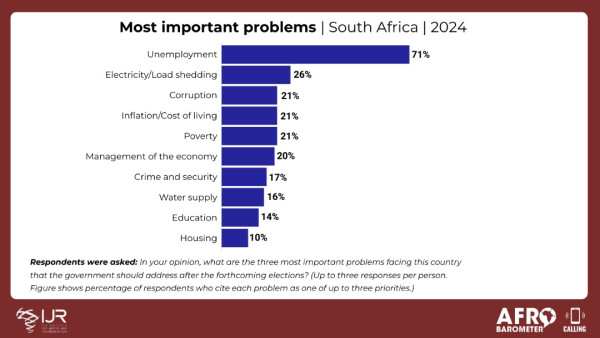
The most urgent problems that South Africans want their government to address are unemployment, unreliable electricity supply, and corruption, according to a new Afrobarometer (www.Afrobarometer.org) telephone survey ahead of general elections on 29 May.
Citizens also cite economic issues including inflation, poverty, and management of the economy.
As citizens prepare to go to the polls, a majority of them are dissatisfied with the way democracy is working in their country, and they overwhelmingly say their country is going in “the wrong direction.” Even among likely voters, one-third say they have not decided which party they will vote for.
These findings are from a telephone survey conducted 23 April-11 May with a sample of 1,800 South Africans aged 18 and older. The margin of sampling error is +/-2.3 percentage points.
Key findings
Afrobarometer surveys
Afrobarometer is a pan-African, non-partisan survey research network that provides reliable data on African experiences and evaluations of democracy, governance, and quality of life. Nine rounds of face-to-face surveys in up to 42 countries have been completed since 1999. Afrobarometer's national partners conduct face-to-face interviews in the language of the respondent's choice.
While Afrobarometer is known for its face-to-face surveys, which are conducted on a roughly two-year cycle, the organisation is refining methods for more limited telephone surveys on emerging topics between standard survey rounds.
The Afrobarometer team, led by the Institute for Justice and Reconciliation (IJR), interviewed 1,800 adult South Africans selected from a database of more than 14 million cell phone numbers between 23 April and 11 May – the final weeks before the election. A sample of this size yields a margin of sampling error of +/-2.3 percentage points. This is the first publicly-released Afrobarometer telephone survey (http://apo-opa.co/3QUBfWn).
Note: Results from 2011-2022 are from standard face-to-face Afrobarometer surveys, whereas the 2024 survey was conducted by phone.
Distributed by APO Group on behalf of Afrobarometer.
Presentation: index.php (apo-opa.com)
Frequently asked questions (FAQs) about Afrobarometer's pre-election telephone survey in South Africa: http://apo-opa.co/3QUBfWn
For more information, please contact:
Asafika Mpako
Communications coordinator for Southern Africa
Telephone: +2783-979-8299
Email: ampako@afrobarometer.org
Visit us online at www.Afrobarometer.org.
Follow our releases on #VoicesAfrica.
Facebook: /Afrobarometer
Twitter: https://apo-opa.co/4bt5jR9
YouTube: /Afrobarometer
Correctional Services ready for inmates to vote on Election Day
The Department of Correctional Services (DCS) says it is ready for the 2024 National and Provincial Elections to be conducted by the Independent Electoral Commission (IEC) next Wednesday.
The Department of Correctional Services (DCS) says it is ready for the 2024 National and Provincial Elections to be conducted by the Independent Electoral Commission (IEC) next Wednesday.
According to the department, some 14 753 inmates at correctional facilities have registered to vote in the elections.
“DCS has been working with the IEC in ensuring that all logistical aspects of the voting process are meticulously planned and executed. The environment is thus conducive for the IEC to fulfil its mandate through the provision of ballot papers, secure voting booths and other necessary logistics at correctional facilities.
“Comprehensive voter education was also provided to inmates in order to ensure they are informed about their rights and the voting process,” the department said.
Justice and Correctional Services Minister Ronald Lamola said: “The measures we have put in place are designed to ensure that eligible inmates can exercise their right to vote in a secure and transparent manner. Hence, this initiative marks a significant step forward in ensuring that our democratic processes are inclusive and just.”
Section 24 B of the Electoral Act makes provision for prisoners to vote in an election for the National Assembly or a provincial legislature, a person who on Election Day is in prison and whose name appears on the voter’s roll for another district, is deemed for that Election Day to have been registered by his or her name having been entered on the voter’s roll for the voting district in which he or she is in prison.
Therefore, the department said, inmates registered before “admission to a correctional centre shall not be denied an opportunity to cast their votes”.
“The transfer and release or placement of inmates on the voting date will be managed in such a way that it does not impede their right to vote. Independent observers will be allowed to monitor the election process within correctional facilities as per the prescripts of the Independent Electoral Commission.
“Observation of the voting process by political parties will be limited to two representatives per political party. This is due to limited space, whilst taking into cognisance the security imperatives of correctional centres,” the department said. – SAnews.gov.za
NeoB
Fri, 05/24/2024 - 09:15
The occupiers are mostly backyarders and tenants who say they could no longer afford to pay rent or buy a house. They have been clearing the open field for a week now.
#WhoSpeaksForUs? campaign launched
The African Union Election Observation Mission (AUEOM) has arrived in South Africa ahead of the 29 May 2024 General Elections. At the invitation of the Government of South Africa and the Independent Electoral Commission (IEC) of South Africa, the Chairperson of the African Union Commission, H.E. Moussa Faki Mahamat, approved the deployment of the short-term AUEOM to assess and report on the conduct of this election.
The AUEOM is led by H.E. Uhuru Kenyatta, former President of the Republic of Kenya and is comprised of 60 short-term observers (STOs) drawn from ambassadors accredited to the African Union, officials of election management bodies, members of African civil society organisations, African election experts, human rights specialists, gender and media experts, and representatives of youth organizations. The observers are drawn from 24 countries which include Angola, Benin, Botswana, Burundi, Cameroon, Democratic Republic of Congo, Egypt, Ethiopia, Eswatini, Gambia, Ghana, Kenya, Lesotho, Mauritius, Morocco, Mozambique, Namibia, Nigeria, South Sudan, Togo, Tunisia, Uganda, Zambia and Zimbabwe.
The AUEOM will base its assessment on the legal framework governing elections in the Republic of South Africa and the OAU/AU Declaration on the Principles Governing Democratic Elections, the standards and obligations stipulated in the African Charter on Democracy, Elections and Governance (ACDEG), and the International Declaration of Principles (DoP) for International Election Observation among others.
The Mission shall interact with state authorities, the Independent Electoral Commission, political parties, the media, civil society organisations and representatives of the international community. The Mission will also interact with other election observation missions deployed to observe the 2024 General Elections in South Africa.
The Mission will release its preliminary findings and recommendations on the conduct of the elections on 31 May 2024 in a press conference in Johannesburg, South Africa. A final and comprehensive report will be released within two months from the date of announcement of final election results and will be posted on the AU Commission website.
The Mission's Secretariat is located at the Hilton Hotel, Sandton, South Africa.
Distributed by APO Group on behalf of African Union (AU).