• Skip to main content
  • Skip to header right navigation
  • Skip to after header navigation
  • Skip to site footer
MyZA

MyZA

News, Directory, Events and Other Stuff

  • Social Media
  • Sport
  • World News
  • Home
  • Submit News
  • Directory
  • Events
  • Stratlec
  • TFSA
  • News
    • APO
    • Today’s Sport News
    • Todays Social Media and Tech Headlines
    • Today’s World News
    • Today’s SA Financial News
  • Contact
You are here: Home / News / Unemployment, unreliable electricity supply, and corruption are South Africans’ top concerns, Afrobarometer pre-election telephone survey shows

Unemployment, unreliable electricity supply, and corruption are South Africans’ top concerns, Afrobarometer pre-election telephone survey shows

24 May 2024 by Guest
Afrobarometer

The most urgent problems that South Africans want their government to address are unemployment, unreliable electricity supply, and corruption, according to a new Afrobarometer (www.Afrobarometer.org) telephone survey ahead of general elections on 29 May.

Citizens also cite economic issues including inflation, poverty, and management of the economy.

As citizens prepare to go to the polls, a majority of them are dissatisfied with the way democracy is working in their country, and they overwhelmingly say their country is going in “the wrong direction.” Even among likely voters, one-third say they have not decided which party they will vote for.

These findings are from a telephone survey conducted 23 April-11 May with a sample of 1,800 South Africans aged 18 and older. The margin of sampling error is +/-2.3 percentage points.

Key findings

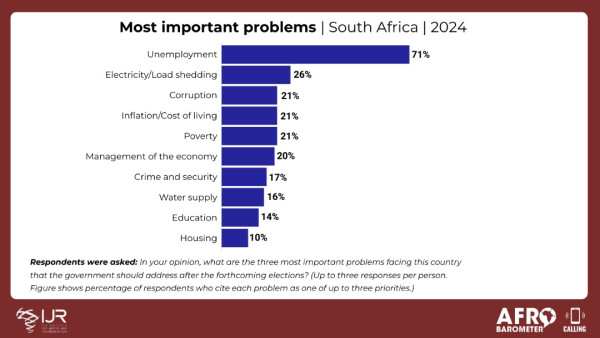
  • Unemployment far outranks other issues as the country’s most important problem that citizens want their government to address, cited by 71% of respondents as one of their three priorities (Figure 1).
  • Electricity/load shedding (26%), corruption (21%), inflation/cost of living (21%), poverty (21%), and management of the economy (20%) round out citizens’ top priorities for government action.
  • More than six in 10 South Africans (62%) say they are dissatisfied with the way democracy works in their country, while only 36% express satisfaction (Figure 2).
  • More than eight in 10 South Africans (85%) say the country is going in the wrong direction, up from 46% in 2011 (Figure 3).
  • Among respondents who say they are registered and are likely to vote, about one-third (32%) say they have not decided which party they will vote for.

Afrobarometer surveys

Afrobarometer is a pan-African, non-partisan survey research network that provides reliable data on African experiences and evaluations of democracy, governance, and quality of life. Nine rounds of face-to-face surveys in up to 42 countries have been completed since 1999. Afrobarometer’s national partners conduct face-to-face interviews in the language of the respondent’s choice.

While Afrobarometer is known for its face-to-face surveys, which are conducted on a roughly two-year cycle, the organisation is refining methods for more limited telephone surveys on emerging topics between standard survey rounds.

The Afrobarometer team, led by the Institute for Justice and Reconciliation (IJR), interviewed 1,800 adult South Africans selected from a database of more than 14 million cell phone numbers between 23 April and 11 May – the final weeks before the election. A sample of this size yields a margin of sampling error of +/-2.3 percentage points. This is the first publicly-released Afrobarometer telephone survey (http://apo-opa.co/3QUBfWn).

Note: Results from 2011-2022 are from standard face-to-face Afrobarometer surveys, whereas the 2024 survey was conducted by phone.

Distributed by APO Group on behalf of Afrobarometer.

Presentation: index.php (apo-opa.com) 

Frequently asked questions (FAQs) about Afrobarometer’s pre-election telephone survey in South Africa​: http://apo-opa.co/3QUBfWn

For more information, please contact:
Asafika Mpako
Communications coordinator for Southern Africa
Telephone: +2783-979-8299
Email: ampako@afrobarometer.org
Visit us online at www.Afrobarometer.org.

Follow our releases on #VoicesAfrica.
Facebook: /Afrobarometer
Twitter: https://apo-opa.co/4bt5jR9
YouTube: /Afrobarometer

Media files
Afrobarometer
Download logo

The most urgent problems that South Africans want their government to address are unemployment, unreliable electricity supply, and corruption, according to a new Afrobarometer telephone survey ahead of general elections on 29 May.

Citizens also cite economic issues including inflation, poverty, and management of the economy.

As citizens prepare to go to the polls, a majority of them are dissatisfied with the way democracy is working in their country, and they overwhelmingly say their country is going in “the wrong direction.” Even among likely voters, one-third say they have not decided which party they will vote for.

These findings are from a telephone survey conducted 23 April-11 May with a sample of 1,800 South Africans aged 18 and older. The margin of sampling error is +/-2.3 percentage points.

Key findings

  • Unemployment far outranks other issues as the country’s most important problem that citizens want their government to address, cited by 71% of respondents as one of their three priorities (Figure 1).
  • Electricity/load shedding (26%), corruption (21%), inflation/cost of living (21%), poverty (21%), and management of the economy (20%) round out citizens’ top priorities for government action.
  • More than six in 10 South Africans (62%) say they are dissatisfied with the way democracy works in their country, while only 36% express satisfaction (Figure 2).
  • More than eight in 10 South Africans (85%) say the country is going in the wrong direction, up from 46% in 2011 (Figure 3).
  • Among respondents who say they are registered and are likely to vote, about one-third (32%) say they have not decided which party they will vote for.

Afrobarometer surveys

Afrobarometer is a pan-African, non-partisan survey research network that provides reliable data on African experiences and evaluations of democracy, governance, and quality of life. Nine rounds of face-to-face surveys in up to 42 countries have been completed since 1999. Afrobarometer’s national partners conduct face-to-face interviews in the language of the respondent’s choice.

While Afrobarometer is known for its face-to-face surveys, which are conducted on a roughly two-year cycle, the organisation is refining methods for more limited telephone surveys on emerging topics between standard survey rounds.

The Afrobarometer team, led by the Institute for Justice and Reconciliation (IJR), interviewed 1,800 adult South Africans selected from a database of more than 14 million cell phone numbers between 23 April and 11 May – the final weeks before the election. A sample of this size yields a margin of sampling error of +/-2.3 percentage points. This is the first publicly-released Afrobarometer telephone survey (https://apo-opa.co/3QUBfWn).

Note: Results from 2011-2022 are from standard face-to-face Afrobarometer surveys, whereas the 2024 survey was conducted by phone.

Read More at the Source

Share this:

  • Share on X (Opens in new window) X
  • Share on Facebook (Opens in new window) Facebook
  • Print (Opens in new window) Print
  • Email a link to a friend (Opens in new window) Email
  • Share on LinkedIn (Opens in new window) LinkedIn
  • Share on Tumblr (Opens in new window) Tumblr
  • Share on WhatsApp (Opens in new window) WhatsApp
  • Share on Mastodon (Opens in new window) Mastodon
Category: NewsTag: 2024, Africa, African, APO, data, Elections, Government, new, ONE, South Africa, Twitter, Vote

If you feel strongly about this article then feel free to send MyZA a ‘Letter to the Editor’ using the submission form below:


Letter to the Editor

This field is for validation purposes and should be left unchanged.
If this is in response to an article please include that article title here or as the lead in for the first paragraph of your Letter below.

Separate tags with commas

Localise your letter by naming the city your words are about. Add relevant words describing your subject. Single comma separated words of no more than 5
Your Name(Required)
Your Name will be linked to the website below.
Your personal, business or social media web site
Choose NO to not set up a user account on MyZA. User Accounts will allow you to submit letters under your own Author Name

3 Latest Letters to the Editor:

  • Older Persons Grants Land Today — No Need to Queue at Dawn

    Dear Editor, Older Persons grants are paid today, 30 October, under SASSA’s revised November payment schedule — with disability grants on Monday 2 November, children’s grants on Tuesday 3 November, and grants under review on Thursday 5 November. Two things every beneficiary should know. First, grant money does not expire on payment day. It stays…

    30 October 2026
  • November Grants Pay Early – No Need to Queue at Dawn

    Dear Editor, I run SAGrant (sagrant.co.za), a free resource helping South Africans navigate SASSA grants. November grants pay earlier than usual. Older Persons grants are paid on Friday 30 October, Disability grants on 2 November, and Child Support and other grants on 3 November. Grants still under review are paid on 5 November. The money…

    27 October 2026
  • NSFAS 2027 applications close on 31 October — SASSA households, apply now

    Dear Editor, I run SAGrant (sagrant.co.za), a free resource helping South Africans navigate SASSA grants. NSFAS applications for the 2027 academic year close on Friday 31 October 2026, and no extension is expected. If your household receives a SASSA grant, your child already passes the NSFAS financial eligibility test — but they still have to…

    25 October 2026

About Guest

Previous Post:Fifty up for Oosthuizen as Blitzboks eye Grand Finale
Next Post:Eastern Cape clinic serving a dozen villages is falling apart

Reader Interactions

Comments

  1. gro

    16 September 2026 at 5:59 am

    Babbelas – hangover [bub-ba-las] This word is derived from the Zulu ‘ibhabhalazi’ and is used to describe a really bad hangover.Example: “Eish, babbelas my bru!”

  2. Baked ZD

    4 September 2026 at 4:50 am

    Voetsek! – Go away! [foot-sak] Usually said with an angry tone when telling someone to go away or get lost. You don’t want to be saying this to a local or worse, if a local says this to you – you’ve really angered them!

Copyright © 2026 · MyZA · All Rights Reserved · Powered by Stratlec Online