Worker who earns R3,500 per month spends R1,200 on transport
Metrorail’s return to service remains extremely limited

MyZA
News, Directory, Events and Other Stuff
Metrorail’s return to service remains extremely limited
Councillor Messie Makuwa says she is ready to fight in court
Stage 3 load shedding returns during evening
Eskom has ramped up load shedding to Stage 3 from 4pm after five generating units were taken offline for repairs.
“The return to service of two generating units that were on planned maintenance was delayed due to an opportunity to perform preventative maintenance. These factors have contributed to the shortage of available capacity, necessitating the implementation of Stage 3 load shedding from 4pm [on Monday] until 5am on Tuesday.
“Thereafter, load shedding will be reduced to Stage 2 until 4pm on Tuesday. This pattern of Stage 2 load shedding from 5am until 4pm and Stage 3 load shedding from 4pm until 5am will be repeated daily until further notice. Eskom will closely monitor the power system and communicate any changes to load shedding, should it be required,” Eskom said.
The power utility assured the public that power station “general managers and their teams will continue to work diligently to ensure that the 1 600MW of generating capacity is returned to service by Wednesday as planned”.
Eskom urged consumers to use electricity sparingly.
“We would like to appeal to members of the public to continue reducing demand by switching off non-essential appliances.
“We would also like to thank those who heed the call to use electricity sparingly and efficiently, including switching off geysers and pool pumps from 5pm to 9pm. This lowers demand and helps in alleviating the pressure on the power system, contributing to lower stages of load shedding,” the power utility said. – SAnews.gov.za
NeoB
Tue, 01/30/2024 - 09:31
Stage 2 load shedding until further notice
Eskom has announced that Stage 2 load shedding will continue to be implemented until further notice.
By Sunday afternoon, at least 14 759MW of generating capacity was unavailable due to unplanned outages with a further 7639MW out of service due to planned maintenance.
“Despite the return to service of five generating units in the last 36 hours, the need to replenish and stabilise the emergency reserves in preparation for the weekday electricity demand, as well as the marginally deteriorated available generation capacity, necessitates that Stage 2 load shedding continue to be implemented until further notice.
“Eskom will monitor the system closely. A further outlook will be provided on Wednesday afternoon, or any changes will be communicated if required,” the power utility said.
Eskom said teams at power stations are working to ensure the return of generating capacity later this week and called on consumers to use electricity sparingly.
“Eskom Power Station General Managers and their teams will continue to work diligently to ensure that the 2 320MW of generating capacity is returned to service by Wednesday as planned.
“We would like to thank those who heed the call to use electricity sparingly and efficiently, including switching off geysers and pool pumps from 17:00 to 21:00. This lowers demand and helps in alleviating the pressure on the power system, contributing to lower stages of load shedding,” Eskom said. – SAnews.gov.za
NeoB
Mon, 01/29/2024 - 10:21
The whole of Khayelitsha is affected by a blocked sewer line, says City of Cape Town
Free State arts town now manages its own electricity load
Eskom has announced that the Free State town of Clarens, in the eastern part of the province, has become South Africa’s first town where residents are now equipped to manage their own electricity load through load curtailment.
Eskom Free State Senior Manager for Retail, Bibi Bedir, explained that although many municipalities and large customers have been engaging in load curtailment, “group curtailment – where a community manages its own load curtailment – was however piloted in Clarens”.
“Group curtailment requires the collaborative efforts of the entire community to reduce load when requested. Once a system emergency is declared, Eskom gives a nominated group coordinator two hours’ notice of load curtailment that should be sustained throughout load shedding. The group coordinator directs the community who decides which equipment will be switched off to achieve the required demand reduction.
“For the residents of a tiny town that depends on an economic inflow from tourists visiting their small businesses mostly over weekends and holidays, power interruptions due to load shedding required a solution that would allow the town’s economy to thrive while still contributing to a reduction in electricity demand when the national grid is under strain,” Bedir said.
The town’s nominated group coordinator, Gert Kruger, described the move as “life changing” for businesses in the town.
In Clarens, curtailment compliance is managed through an application that was developed by a company managed by Kruger, which signals to customers that load curtailment has been called.
“For a town that depends on tourism, not being subjected to load shedding is life changing. Although the success depends on the voluntary participation of residents and businesses, we have the community’s support as everyone benefits from cooperating.
“Feedback from visitors, restaurants and accommodation establishments is very positive and without the noise of generators, tourists can enjoy Clarens’ natural beauty,” Kruger said.
Monitoring compliance
Eskom explained that during curtailment Stages 1 to 4, customers are asked to reduce electricity demand by some 10 to 20%.
“Unlike load shedding where the customers are switched off as per their schedule, load curtailment must be sustained. Eskom continuously monitors the reduction in demand of its curtailment customers, as three instances of non-compliance will result in the reinstatement of normal load shedding,” the power utility said.
In Clarens, curtailment compliance is managed through an application that was developed by a company managed by Kruger, which signals to customers that load curtailment has been called.
“[This] acts as a trigger for residents to set their load reduction plans in motion. A meter was installed at the town’s main point of supply. Every 60 seconds, the meter sends real-time statistics of the town’s current demand, prompting further reduction if required.
“So far, the project is successful with residents being able to sufficiently reduce and manage their load, making the Clarens project a benchmark for similar projects to be rolled out in other areas of the country.
“As Clarens is already gearing up for smart city initiatives with smart metering and electrical vehicle charging stations already installed, as well as a well-diverse spread of small-scale embedded generators (SSEGs), Eskom was eager to help Clarens' residents in the evolution from an art town to a smart town,” the power utility said. – SAnews.gov.za
NeoB
Wed, 01/24/2024 - 09:45
Hundreds march demanding better services from government
Investment in transmission critical
Minister in the Presidency for Electricity, Dr Kgosientsho Ramokgopa, says on boarding new generating capacity – particularly renewable energy – is critical to ensuring that additional capacity is added to the national grid.
He was speaking during an update on the implementation of the Energy Action Plan on Tuesday.
The expansion is critical to on boarding new generating capacity – particularly renewable energy – onto the national grid to relieve pressure on the electricity system.
Ramokgopa explained that “tremendous progress” is being done to ensure that solutions are found for transmission.
“As the President said last week, the Minister in the Presidency responsible for Electricity is now given the responsibility to ensure that we are able to go into the market to procure or to access the financing in relation to the transmission side.
“We have been doing an extraordinary amount of work. The team was [at the World Economic Forum annual meeting] in Davos. Part of those conversations was to enter into bilateral discussions with some of the potential financiers.
“We have...financing. That is private sector willing to come into the space of transmission. We had conversations...with the heads of missions that are represented here in the country and they did confirm that availability of that financing,” he said.
Ramokgopa assured that although private sector participation is being encouraged in the transmission space, the South African government will remain the owner of the grid through the Eskom owned and newly established National Transmission Company of South Africa.
“What we have been doing is to find an architecture and legal configuration on how best we are going to access [funding] and one of the areas that is receiving attention is the possibility of us putting together…something that is akin to the IPP [Independent Power Producer Procurement] office on the generation side…an Independent Transmission Project office.
“[This is] to ensure that we are able to procure with speed, agility, applying some degree of innovation and ensure that we are able to access that liquidity that’s sitting with the private sector without relinquishing state ownership of the grid,” he said.
The minister acknowledged that transmission expansion is facing challenges. However, he emphasised that government is tackling these challenges.
“The challenges on the transmission side are almost equivalent to the ones on the generation side and in fact, if they are not tackled immediately they are likely to be even more catastrophic compared to the challenges on the generation side because those are likely to undermine our ability to maintain the integrity of the system.
“We are not waiting for the crisis to confront us. We are going to address that situation immediately. This is in support of Eskom’s work…consistent with their transmission development plan which advocates for the expansion of the network,” he said. – SAnews.gov.za
NeoB
Tue, 01/23/2024 - 14:41
“We are without power at … least 48 hours a week” says resident
Services resumed after a meeting with community leaders
Eskom to rollout prepaid metres throughout Limpopo
State power utility Eskom is expected to embark on a province-wide prepaid meter installation drive in Limpopo, as part of its meter maintenance programme.
“Eskom Limpopo is excited to announce a significant advancement in our ongoing commitment to providing reliable electricity services to the residents of the Limpopo province. As part of electricity meter maintenance, Eskom Limpopo will be introducing prepaid smart meters as an ongoing initiative in phases across the province,” the power utility said.
Eskom warned that customers in the area may experience some power supply interruptions during this time.
“Eskom Limpopo acknowledges the inconvenience this may cause and wants to assure the community that every effort will be made to minimize the duration of the interruption. Eskom believes that by working together, we can create a more sustainable and efficient energy future.
“We appreciate the understanding and cooperation of the community during this transitional period. The safety and well-being of our community and customers are paramount, and we urge all customers to treat all electrical connections as live during this period,” Eskom said.
Meanwhile, the power utility has announced on social media X that Stage 2 load shedding will be implemented from today (Monday) until further notice. – SAnews.gov.za
NeoB
Mon, 01/22/2024 - 08:51

As we head into 2024, the renewable energy sector is set to see innovation that will transform the way energy is accessed, stored and deployed across Africa. Paul van Zijl, Group CEO at Starsight Energy (https://StarsightEnergy.com/), discusses 4 key trends that he thinks will profoundly shape the industry over the next year.
Batteries will provide benefits far beyond backup for behind-the-meter projects
One of the most significant shifts in solar technology revolves around the integration of battery energy storage systems (BESS) – especially for behind-the-meter solar (also known as onsite solar). Traditionally, batteries were seen primarily as backup storage when paired with a solar system, ensuring a steady power supply during cloudy days, nighttime or when the grid is unavailable. However, in 2024, the focus is vastly shifting towards load management, where batteries play a dynamic role in optimising energy consumption.
As the trend for the deployment of batteries across the continent grows, cutting-edge management systems will become a key part of solar installations with an integrated battery component. These systems use advanced algorithms to predict energy demand patterns. This allows for the strategic use of battery storage – discharging it during expensive peak times and charging it using solar energy or the grid during off-peak – to reduce the costly demand charges that come with variable tariff structures. Along with enhancing the efficiency of solar systems, integrated battery storage solutions can also contribute to grid stability by reducing strain during high-demand periods.
When it comes to front-of-the-meter (or offsite) storage, BESS is also set to play a bigger role in the deployment of utility-scale renewable energy technology like wheeling - where power is generated at an offsite location (like a solar or wind farm) and transported using the available power network to different off-takers.
In South Africa for example, the national energy provider Eskom announced the deployment of around 343 MW in BESS projects as part of an overall 500 MW BESS initiative aimed at addressing the country's long-running electricity crisis. The systems will be in remote areas (with limited access to Eskom's network) but still close to renewable energy plants built by independent power producers (IPPs).
This collaboration between the public and private sectors supports more widespread deployment of utility-scale power and the adoption of renewable energy projects. By adding battery storage components to the national grid, businesses and consumers can gain quicker access to reliable electricity while the power utility can address peak energy demands more easily. This also ensures that the increasing amount of power generated from utility-scale solar projects can be stored and consumed outside of daylight hours to avoid stranded grid capacity.
Data, banking and tourism: The rise of sustainable off-grid solar solutions
Off-grid renewable energy solutions, including stand-alone systems and mini-grids, offer a unique opportunity to expand modern energy access services. The distributed nature of these systems allows them to be tailored to local conditions, tap into available renewable resources, deliver diverse energy services, and utilise local capacity to ensure long-term sustainability.
We will see a rise in these solutions as more and more commercial and industrial businesses realise the value of effectively moving off-grid. This will be prevalent in three industries:
Data centres: Africa is a global hub for data centres. According to research from African Infrastructure Investment Managers (AIIM), there is around 250 MW of installed data centre capacity across Africa – with the demand for centres in Africa expected to exceed supply by 300% by 2030. These powerhouses of technology rely heavily on a steady and safe electricity supply. From operating to maintaining their vast cooling systems, large data centres simply can't afford the risk of a grid collapse or any possible power interruptions. Power autonomy is the name of the game here, making battery storage a necessity from the get-go.
Banking: While the prevalence of mobile financial services continues to soar on the continent, there is still a tangible need for brick-and-mortar banks and ATMs in countries where access to these services remains essential. These sites need to remain operational should there be any sort of grid collapse or catastrophic power failures - making an off-grid solution a non-negotiable component of the future of banking in Africa.
Tourism: With the rise of conscious consumerism and eco-tourism, sustainability is fast becoming the differentiating factor for discerning travellers choosing their next holiday destination. Luxury lodges in popular destinations in East and Southern Africa are fast moving towards fully off-grid solar battery operations to offer their guests uninterrupted access to power while boosting the lodge's green credentials in the process.
As more and more businesses become aware of the benefits of off-grid solar, it is likely that we will see an even greater adoption of this technology in the coming year.
Seamless access to renewables through a reimagined aggregation model
We will certainly see a shift towards aggregated solutions, wherein energy providers will consolidate diverse technologies and services into comprehensive packages in 2024. This trend is driven by the recognition that a holistic approach to energy solutions is not only more convenient for consumers but also more effective in optimising energy production and consumption.
This can be done in several ways. For example, trading of electricity in South Africa allows a service provider of solar energy to buy and sell, excess wind energy without having to invest substantial capital expenditure amounts. Similarly, instead of having gas-powered energy compete with renewable energy, the aggregation model will also allow providers of such services to aggregate their energy solutions and provide the client with a holistic offering. The goal is to provide consumers with a seamless and integrated final product that maximises the benefits of renewable energy across various aspects of their daily lives. The real value for customers lies in a collaboration of providers who can meet their specific needs and power the entire energy lifecycle.
Tackling complexities through an increasingly consolidated sector
As the solar industry matures, a trend towards consolidation will become increasingly evident in 2024. Larger energy companies will consider merging or acquiring smaller players, creating more robust and diversified entities. This consolidation is driven by the desire to achieve economies of scale, increase market share, and foster innovation by pooling resources and expertise.
Consolidation in the industry is not limited to manufacturers but extends to service providers, research and development firms, and energy management companies. By joining forces, these entities can tackle the complexities of the evolving energy landscape more effectively, driving down costs and accelerating the adoption of alternative energies across the continent.
This trend is fostering the emergence of holistic service providers capable of providing end-to-end solutions that address the diverse needs of businesses, consumers and communities. Our recent market-milestone merger between Starsight Energy (https://StarsightEnergy.com/) and SolarAfrica (https://SolarAfrica.com/) is a case in point. Customers in Eastern, Southern and Western Africa can access our comprehensive mix of cost-effective solutions that provide power security and carbon reduction. These include solar energy, battery storage, wheeling, and energy management, among others.
The future is bright. If 2023 was anything to go by in terms of transformation for the energy sector, 2024 will be marked by accelerated innovation and a collective commitment to harnessing the full potential of renewable energy that holds the promise of a more resilient, more sustainable, and more tightly connected energy future for Africa.
Distributed by APO Group on behalf of Starsight Energy.
Load shedding downgraded to Stage 2
Eskom has announced that it will implement Stage 2 load shedding – down from Stage 3 – until 4pm on Wednesday.
The power utility explained that lower demand and improved generating capacity contributed to the downgrading of the severity of load shedding.
“Eskom Power Station General Managers and their teams’ efforts in returning units to service over the past weekend resulted in the improvement in generation capacity. This, combined with the slightly lower than anticipated electricity demand, allowed load shedding to be suspended at 9:35pm on Sunday night until 5am on Monday.
“The sustained improvement in generation capacity and the anticipated lower demand also necessitated the implementation of Stage 2 load shedding at midday [on Monday] until 4pm on Wednesday. A further update will be provided on Wednesday afternoon. Eskom will closely monitor the power system and communicate any changes should it be required,” an Eskom statement read.
As of Monday, unplanned outages stood at some 13 449MW with a further 8 383MW unavailable due to maintenance.
“Eskom Power Station General Managers and their teams will continue to work diligently to ensure that the 739MW of generating capacity is returned to service [Monday] evening, as planned.
“We would like to thank those who do heed the call to use electricity sparingly and efficiently, including switching off geysers and pool pumps from 17:00 to 21:00, as this lowers demand and helps in alleviating the pressure on the power system and contributes to lower stages of load shedding,” Eskom said. – SAnews.gov.za
NeoB
Tue, 01/16/2024 - 09:13
Structural reforms remain key for SA economy
Finance Minister Enoch Godongwana has reaffirmed South Africa’s commitment to engaging in structural reforms that will foster an environment fertile to economic growth and competitiveness.
The Minister was speaking during a panel discussion at the World Economic Forum (WEF) Annual Meeting held in Davos, Switzerland.
Godongwana is leading the South African delegation to the critical meeting.
Structural reforms in South Africa are targeted at – among other things – electricity, infrastructure, water and logistics, and are driven by Operation Vulindlela.
Operation Vulindlela is a joint initiative of the Presidency and National Treasury to accelerate the implementation of structural reforms and support economic recovery. It aims to modernise and transform network industries, including electricity, water, transport and digital communications.
The objectives of the reforms are aimed at:
“There are a number of things we are doing to deal with structural reforms. One of the perennial problems we’ve had has been on the energy front. Massive structural reforms… are dealing with that question.
“A new challenge has been the logistics sector, where we are investing a lot in it. We have been trying to change the skills composition to the extent that we don’t have and we have provided an environment where we can import skills with ease.
“So there are lot of structural reforms that we have engaged in in order to make sure that we can grow the economy and be competitive,” Godongwana told the panel.
Historical commitment
During the pre-WEF media breakfast briefing held last week, Godongwana emphasised that structural reforms remain crucial.
“Structural reforms remain crucial to revive medium-term growth prospects amid a constrained policy space. We remain steadfast in carrying out structural reforms to support and accelerate economic recovery.
“As government, we remain resolved to deal with the energy and logistics challenges that are adversely impacting our economy,” he said.
In his Medium Term Budget Policy Statement delivered in November last year, Godongwana presented the reforms specifically targeted at Eskom and Transnet.
On Transnet, he said: “Rail underperformance is estimated to have cost up to 5% of GDP in 2022, with losses in the region of R50 billion in the minerals sector alone.
“Given the scale of the challenges, the National Logistics Crisis Committee was instituted to broaden reforms in the sector and prioritise reforms aimed at resolving the immediate crisis, while also addressing the structural aspects hampering the sector.”
On electricity, Godongwana said: “[We] recognise the potential loss of revenue due to private electricity generation, and the fact that traditional revenue models relied on by public entities like Eskom, face serious disruption.
“It is for these reasons that our electricity reforms are holistic, evidenced-based, and geared to find a balanced solution to our electricity supply challenges. They take into account not just a particular entity but the transformation of the sector as a whole.” – SAnews.gov.za
NeoB
Tue, 01/16/2024 - 12:18
SA can still expect loadshedding
Minister of Electricity Kgosientsho Ramokgopa has reiterated that while Eskom is working hard on improving its generation system, citizens can still expect load shedding.
Providing an outlook on Eskom’s generation capabilities during a media briefing on Tuesday in Pretoria, the Minister explained that the majority of units remain unreliable and this is being addressed through the planned maintenance that Eskom is conducting routinely.
Due to legacy issues including under investment at Eskom and the entity not having sufficiently planned for maintenance, South Africa’s grid is unreliable.
“We will have periods of days of no load shedding and there will be days of load shedding. Eskom has announced its summer outlook and it makes the point that we should not be at more than Stage 4 level of load shedding.
“While demand was low during the week 22- 29 December 2023, Eskom was working to address issues of its fleet and used the opportunity to carry out planned maintenance.
“We have been working during the festive season to ensure that we address issues of the fleet to continue to perform but also readying the fleet to ensure that once there is a ramp up of demand, the units are able to return back to service and remain in service while delivering efficient megawatts (MW),” Ramokgopa said.
The Minister pointed out that Eskom is beginning to decrease its planned maintenance, as they are expecting demand to increase.
While in December 2022 South Africa experienced load shedding, Eskom had three units back last December at Kusile, which ensured that there were periods of no load shedding.
“If you had to look at the work that has been done at Eskom, they have reduced repeat failures. We have additional buffer for instances of a cluster of units failing where you do not have to initiate load shedding or if you do, it is not at intense levels.
“Unit 1 at Kusile experienced significant delays in relation to the timeline to return to service, which was set for June last year but it returned five months later due to outage slips. We are confident that the work that has been done by the generation team has ensured that we will not have a repeat when we want to return unit 2, which is currently out,” he said.
The Minister reminded citizens that Koeberg unit 1 and 2 were extending the license of the only nuclear power station in the country.
“We had to do a significant amount of work to meet the regulatory requirements and compliance so we can get the license extensions… so these units were out. As part of this robust exercise, unit 1 in Koeberg is now on full load. It has passed the full load tests. There is a plethora of tests that need to be run and the test was passed on 30 December.
“Now unit 1 in Koeberg is unleashing the MWs that are required and we hope it will continue to do that for the next 20 years. Another development is the synchronisation of Kusile Power Station’s unit 5.
“That power is intermittent. It is doing a number of tests, and it will go into full commercial operation for an average period of six months so they continue to do the tests but as they continue to do the tests, it does give us MWs,” Ramokgopa said.
“Unit 5 is running at 60% and there are a lot of things that need to be done such as balancing and optimisation tests so that we are sure when the unit is in commercial operation so essentially giving us MWs uninterrupted.”
Integrated Resource Plan
The Minister called on the public to make submissions on the draft Integrated Resource Plan (IRP) 2023 that was issued by Minister of Mineral Resources and Energy, Gwede Mantashe, for public comment in Government Gazette no 49974 of 04 January 2024.
“I want to urge that your comments are not restricted to public commentary, engagements and with the media. That does not amount to a submission. A submission means you make a written response of ideas of what you think of the IRP and submit it as required.
“As it stands, the IRP represents the views of Cabinet and we want to know what the public thinks. I want to encourage you to make submissions and as and when the DMRE offers an opportunity to make oral representation, I encourage you to do that as well,” Ramokgopa said.
The IRP is an electricity generation plan that seeks to ensure security of electricity supply by balancing supply with demand, while taking into account the environment and total cost of supply.
The purpose of this publication is to solicit public comments on the assumptions, input parameters, scenarios, and observations made. Comments submitted will be considered when drafting the final policy adjusted plan, which will map out the future energy mix for the country. – SAnews.gov.za
nosihle
Tue, 01/09/2024 - 12:22

New African magazine (www.NewAfricanMagazine.com) released its annual listing of the 100 Most Influential Africans of 2023. The list celebrates the achievements and contributions of Africans from various fields and sectors, who have made a positive impact on the continent and the world.
The list features a diverse and inspiring group of men and women, who have demonstrated excellence, innovation, leadership, resilience, and vision in their respective domains. They include politicians, entrepreneurs, industrialists, environmentalists, creatives, scientists, educators, sports personalities, and more.
The list also reflects the shifting trends and priorities in Africa, as the continent faces new challenges and opportunities in the post-pandemic era. Creatives dominate the ranking with 31 representatives, including singer Abel Tesfaye, aka The Weekend, filmmaker Alice Diop and writer Nana Darkoa Sekyiamah.
The second category with the highest number of entries was the Business section, with 25 entries. The section included two behemoths from DFIs, supporting a private sector approach to investing: Samaila Zubairu from Africa Finance Corporation and the President of Afreximbank, Benedict Oramah, undoubtedly Africa's juggernaut from the last few years leading Africa's transformation. Also on the list is the former CEO of Eskom and whistleblower who nearly paid with his life André de Ruyter.
Nigeria was the country most represented on the list, highlighting the country's dominance in the creative sector and business. William Ruto, the President of Kenya, and Bola Tinubu, President of Nigeria, were the only heads of state to make it, along with the Guinean military leader Mamady Doumbouya. Doumbouya created quite a stir at this year's UN General Assembly and appears to have found a solution around the Simandou mining saga.
With Climate Change at the top of the agenda, the list features several players in the environmental space, such as James Mwangi, formerly from Dalberg Group who has set up his own venture fund investing in climate related businesses, and Elizabeth Maruma Mrema, the Executive Secretary of the UN Convention on Biological Diversity.
In the media, we have two media leaders from Côte d'Ivoire, Fabrice Sawegnon, founder of communications agency Voodoo, and Daniel Ahaoussa, serial entrepreneur and founder of a number of websites in West and Central Africa. Also included are the journalist Alan Kasujja, the BBC journalist, and Branko Brkic, founder of Daily Maverick, arguably the most powerful media in South Africa today.
And in sports, record breakers Faith Kipyegon and Kelvin Kiptum make it, as well as the Springboks team, under the leadership of their captain Siya Kolisi. Patrice Motsepe, the President of CAF, a close friend of FIFA president Gianni Infantino and an increasingly influential voice in sports, is also included.
The 100 Most Influential Africans of 2023 is a special edition of New African magazine, which offers a comprehensive and insightful overview of the lives and achievements of the selected individuals. The magazine also provides a platform for the readers to learn from their stories, and to be inspired by their examples.
Download the 100 Most Influential Africans of 2023 special edition of New African: https://apo-opa.co/4aL1VB7
The 100 Most Influential Africans 2023 List:
Politics and Public Service
William Ruto
Ibrahima Cheikh Diong
Sidi Ould Tah
Akinwumi Adesina
Ngozi Okonjo-Iweala
Bola Tinubu
Mamady Doumbouya
Ousmane Sonko
Nadia Fettah Alaoui
Tsitsi Masiyiwa
Tidjane Thiam
Business
Mohamed Kande
Sim Tshabalala
Karim Beguir
Didier Acouetey
Olugbenga Agboola
Samaila Zubairu
Prof. Benedict Okey Oramah
Ralph Mupita
Ibrahim Sagna
Simon Tiemtoré
Jules Ngankam
Riham ElGizy
André de Ruyter
Aliko Dangote
Ham Serunjogi
Serge Ekué
Bahija Jallal
Coura Sène
Bernard Koné Dossongui
Hassanein Hiridjee
Shola Akinlade
James Mwangi
Pascal Agboyibor
Science and Academia
Anna Adeola Makanju
Chao Tayiana Maina
Nemat Talaat Shafik
Ismahane Elouafi
Moungi Bawendi
Timnit Gebru
Environmental
James Irungu Mwangi
Ephraim Mwepya Shitima
Wanjira Mathai
Rashid Sumaila
Elizabeth Maruma Mrema
Dr Musonda Mumba
Creative
Kaouther Ben Hania
Danai Gurira
Ncuti Gatwa
Black Coffee
Tyla Laura Seethal
Temilade “Tems” Openiyi
Lesley Lokko
Mulenga Kapwepwe
Alice Diop
Wanuri Kahiu
Bassem Youssef
Malenga Mulendema
Jadesola Osiberu
Editi Effiong
Ali Said Alamin Mandhry
Abel "The Weekend" Tesfaye
Pretty Yende
Julie Mehretu
Pierre Thiam
Teju Cole
Thebe Magugu
David Diop
Burna Boy
Serge Attukwei Clottey
Nana Darkoa Sekyiamah
Aïda Muluneh
Omoyemi Akerele
Mariam Issoufou Kamara
Victor Ekpuk
DJ Snake
Gandhi “Maitre Gims” Djuna
Media
Claude Grunitzky
Chioma Nnadi
Edward Enninful
Alan Kasujja
Wode Maya
Anton Harber
Khabane “Khaby” Lame
Charity Ekezie
Moses “Uncle Mo” Kiboneka
Branko Brkic
Tomiwa Aladekomo
Marie Mbullu
Nicolas Pompigne-Mognard
Daniel Ahaoussa
Fabrice Sawegnon
Sports
Francis Ngannou
Faith Kipyegon
The Springboks, led by captain Siya Kolisi
Patrice Motsepe
Kelvin Kiptum
Victor Osmihen
Biniam Girmay
Yassine Bounou
Distributed by APO Group on behalf of New African Magazine.
For any media inquiries please contact:
c.haasz@icpublications.com
About New African Magazine:
Published continuously since 1966, the English language monthly has consistently brought an African point of view to international news. It is the essential magazine for government officials, businessmen, professionals and Africa-watchers. New African is distributed in over 100 countries, and consulted whenever Africa is mentioned. The leading commentator on African affairs and Africa's best selling magazine.
The December / January 2024 issue of New African is one of the biggest of the year, most of it crammed with scintillating profiles and high-quality portraits of the best and brightest Africans of 2023. This issue will once again be a sure-fire source of animated discussion within Africa and abroad as readers discuss our choice of the 100 Most Influential Africans of 2023.
President approves MoU to strengthen action against load shedding
President Cyril Ramaphosa has approved a Memorandum of Understanding (MoU) entered into by Minister of Public Enterprises Pravin Gordhan and Minister of Electricity Kgosientsho Ramokgopa to better clarify their respective responsibilities with respect to Eskom and the resolution of the electricity crisis.
The MoU establishes a firm basis for a collaborative approach between the Ministers in exercising their assigned powers and functions.
“While significant progress has been made in reducing the severity of load shedding, much work still needs to be done to guarantee a secure supply of electricity. The collaborative approach outlined in the Memorandum of Understanding will further strengthen Eskom’s efforts to resolve the electricity crisis,” President Ramaphosa said in a statement on Friday.
The MoU outlines the roles and responsibilities of the Minister of Electricity as follows:
The Presidency said the MoU takes into account the Eskom Memorandum of Incorporation, which makes it obligatory to inform the Minister of Public Enterprises of critical decisions in this respect.
The MoU stipulates that the Minister of Public Enterprises will:
The MoU makes provision for regular review meetings between the Ministers to address any impediments to its implementation. The Ministers will also have regular review meetings with the President.
“The Ministers will work together more closely and with their respective responsibilities clearly outlined to ensure the effective implementation of the Energy Action Plan,” the President said.
The President announced the Energy Action Plan in July 2022 as South Africa’s plan to end load shedding and achieve energy security. It outlines a bold set of actions aimed at fixing Eskom and adding as much new generation capacity as possible, as quickly as possible, to close the gap in electricity supply.
The arrangement outlined in the MoU will be operational until the end of the current administration. –SAnews.gov.za
nosihle
Fri, 01/05/2024 - 11:48
President Cyril Ramaphosa has approved a Memorandum of Understanding entered into by Minister of Public Enterprises Pravin Gordhan and Minister of Electricity Kgosientsho Ramokgopa to better clarify their respective responsibilities with respect to Eskom and the resolution of the electricity crisis. The MoU establishes a firm basis for a collaborative approach between the Ministers in exercising their assigned powers and functions.
The MoU outlines the roles and responsibilities of the Minister of Electricity as follows:
The MoU takes into account the Eskom Memorandum of Incorporation, which makes it obligatory to inform the Minister of Public Enterprises of critical decisions in this respect.
The MoU stipulates that the Minister of Public Enterprises will:
The MoU makes provision for regular review meetings between the Ministers to address any impediments to the implementation of the MOU. The Ministers will also have regular review meetings with the President.
Commenting on the MoU, President Cyril Ramaphosa said: “While significant progress has been made in reducing the severity of load shedding, much work still needs to be done to guarantee a secure supply of electricity. The collaborative approach outlined in the Memorandum of Understanding will further strengthen Eskom's efforts to resolve the electricity crisis.”
“The Ministers will work together more closely and with their respective responsibilities clearly outline to ensure the effective implementation of the Energy Action Plan,” he said.
The arrangement outlined in the MoU will be operational until the end of the current administration.
Distributed by APO Group on behalf of The Presidency: Republic of South Africa.
Load shedding returns
Eskom has implemented Stage 2 load shedding with effect from 5am after several generating units did not come back online as anticipated.
“With the current intensified maintenance aimed at improving fleet performance, we had a setback of three generating units (2 148MW) not coming back online as anticipated. This, coupled with a loss of six generating units (3 113MW) and projected increase in electricity demand, requires Stage 2 load shedding to be implemented from 5am on Tuesday until 4pm, followed by Stage 3 load shedding until 5 am on Wednesday.
Load shedding returns follows a reprieve over the festive season.
In a statement, Eskom said the pattern of Stage 2 load shedding in the morning and Stage 3 load shedding in the evening will be repeated daily until further notice.
In addition, the power utility said it will closely monitor the power system and communicate any changes should it be required.
“Eskom teams are working tirelessly to ensure that 4 921MW of generating capacity is returned to service before the end of the week.” - SAnews.gov.za
Neo
Tue, 01/02/2024 - 09:59
Kusile Unit 5 synchronised to the grid
Eskom has synchronised Unit 5 of the Kusile Power Station project to the national grid.
“Eskom is delighted to announce that Unit 5 of the Kusile Power Station project was synchronised to the national grid for the first time on 31 December 2023 at 17h22. The unit will contribute an additional 800MW to the country’s power system, which was never part of the Eskom grid capacity,” said the power utility.
The unit will supply electricity intermittently during the testing and optimisation phase over the next six months before being transferred into commercial operation and the capacity officially added to the current Eskom fleet.
“As part of the Generation Recovery Plan, the synchronisation of Kusile Unit 5 marks another significant milestone of sustainably improving our generation performance. This will contribute the much-needed power to the grid,” said Bheki Nxumalo, Eskom’s Group Executive for Generation.
“We are encouraged that this achievement of our recovery plan immediately follows the return of the three units that were brought online from end September 2023, bringing a total of 3 200MW onto the grid, which will further improve the energy availability factor (EAF) and help strengthen South Africa’s electricity capacity.
“I am grateful for the commitment displayed by the Kusile project team. Their relentless efforts in ensuring that the project is completed is highly commendable. I have confidence that they will continue to work with determination to successfully deliver Unit 5 to commercial operation,” explained Nxumalo.
Eskom’s Acting Group Chief Executive, Calib Cassim, said Unit 5 brings hope to the people of South Africa as it helps power the nation and its economy.
“There is enormous effort made to continue the remarkable progress on the new build programme and the Generation Recovery Plan.
“We remain focused on improving the performance of the generation fleet to reduce the impact of load shedding felt countrywide, and to lessen the costs on supplementing capacity using the diesel-powered plant,” said Cassim.
Minister in the Presidency responsible for Electricity, Dr Kgosientsho Ramokgopa, has welcomed the developments at Kusile.
The Minister has emphasised that “more work and efforts will continue towards adding more generation capacity to the grid to reduce and ultimately end load shedding”.
The Minister congratulated Eskom’s generation team for the continued work towards stabilising the country’s generation capacity.
Progress made in construction
Progress is being made on the remaining construction and commissioning activities at Unit 6 and at completion, the station will consist of six units, which will produce a maximum 4 800MW.
This will make Kusile South Africa’s largest construction project and will be the world’s fourth largest coal plant.
“In addition, the power station is fitted with wet flue gas desulphurisation (WFGD) emissions abatement technology, in line with current international practice to ensure compliance with air quality standards. This makes Kusile the first power station in South Africa and Africa to use WFGD technology, which is used to remove sulphur dioxide from the flue gas prior discharge to the atmosphere,” Eskom said.
Also on a positive note, repair works to the permanent stack for units 1, 2 and 3 are progressing well.
Intensified efforts are also being made to return Medupi Unit 4 to service by end July 2024.
This, together with the successful completion of Kusile Unit 5 and the return of the three Kusile units will further improve the energy availability and give impetus to Eskom’s Generation Recovery Plan. - SAnews.gov.za
Neo
Tue, 01/02/2024 - 11:04
Good performance at Eskom must be consistent, says Ramokgopa
Minister in the Presidency for Electricity, Dr Kgosientsho Ramokgopa, has emphasised that although Eskom's recent performance is commendable, more work needs to be done to ensure that this continues consistently.
He was speaking during a media briefing updating the nation on the implementation of the Energy Action Plan (EAP).
The country has not been experiencing any load shedding for about a week due to consistent improvement in the available generating capacity.
“During this period, we have seen an exceptionally good performance by the units. Outside the issues of reduced demand, we have seen that the unplanned capacity loss factor – a combination of the units being unreliable and the units not performing at the right levels – the system has been healthy.
“The problem that we have is that the system is healthy in periods. What we want to achieve is to ensure that we maintain that consistently, that the system remains healthy. We have prioritised these power stations and we are seeing the results, and I’m confident that this festive we will have the lights on,” Ramokgopa said.
The Minister said that over the next two weeks, Eskom remains optimistic that the good performance of units will be sustained.
However, he warned that “the true test” for the performance of the system is yet to come.
“You are not seeing load shedding [because] we are working behind the scenes. We are aggressive on maintenance and the system is performing. The outlook, in the short term… looks upbeat and we want to ensure that the lights remain on.
“But the true test comes on the other side of the break when big industries come back. It’s about sustaining the South African economy. So we can’t celebrate the fact that we don’t have load shedding when the South African economy has gone on a temporary break. You want to have a situation of no load shedding at the height of the performance of the South African economy,” he said.
Ramokgopa revealed that during this period, the power utility will be undergoing “aggressive maintenance” of power stations.
“We use this opportunity to do the actual work of ensuring that we are very aggressive in our maintenance programme so that we are able to take full advantage of the fact that demand has slowed down.
“We are going to benefit exceptionally when, as a country, we continue on this path of planned maintenance. But planned maintenance has got its own downsides. When we do planned maintenance, it simply means that I’m removing the units off the grid so I’m lessening my ability to generate the megawatts.
“That’s why we have used a combination of low demand and the healthy performance of units during this period to do not only planned maintenance, but opportunity maintenance,” he said.
Addressing generating units
Speaking to the Energy Action Plan’s first key intervention to fix Eskom and improve the availability of existing supply, Ramokgopa said achieving this rests on two variables: addressing the rate of failure of generating units and ensuring that the efficiency of the units is improved.
The EAP was introduced by President Cyril Ramaphosa in July 2022 to address load shedding and achieve energy security for the country.
“On the unplanned capacity loss factor... the intention is to bring this down...[and] bolster the performance of these units and therefore get more megawatts on the grid to service the demand.
“Over the past 14 days… the average is about 12 245MW. So it means that over that period, there is 12 245MW of units that have either failed or they are not giving us the amount of megawatts that we want.
“But it’s important that we juxtapose this with what has been the trend. When you look at our winter outlook when we did the projections…the worst case scenario was that if it hits 18 000MW, we are going to hit levels of load shedding that we have not seen before going beyond Stage 6. The system is better off, it’s healthier,” he said.
The Minister highlighted that on Monday, capacity losses stood at under 11 000MW but warned that this needs to be sustained over a longer period.
“This is a psychological barrier. We have gone below 11 000MW so we are confident about our ability to get to that level. The point is to ensure that we are able to sustain. The message I’m conveying to the country is that the system is healthier if you use the measure of the rate of failure and the partial load losses,” he said. – SAnews.gov.za
NeoB
Thu, 12/21/2023 - 12:31
Load shedding suspended until Friday
Eskom has announced that load shedding will remain suspended until 4pm on Friday.
The power utility announced the suspension of the rolling black outs on social media platform X on Sunday.
“Due to consistent improvement in available generating capacity, load shedding will remain suspended until 4pm on Friday. Eskom will closely monitor the power system and communicate should any significant changes occur,” the power utility said.
Meanwhile, Eskom Chief Financial Officer, Calib Cassim, is expected to continue in his job beyond the end of his current term at the end of this year following 21 years of service.
He is currently acting as the power utility’s Group Chief Executive until recently announced CEO Dan Marokane assumes office in 2024.
Cassim called it a privilege to continue serving as the power utility’s CFO.
“I am looking forward to continue contributing to the collective efforts of placing Eskom on a path to sustainability through the implementation of our turnaround plans. I want to thank the Board and Shareholder Ministry for creating an enabling environment for me to contribute to the turnaround of Eskom. Eskom has exceptional talent that look to us to provide leadership. With Dan Marokane joining, we have the best shot at creating the future we want for Eskom.
“I would also like to thank Martin Buys for acting as Eskom’s Chief Financial Officer. He has done an excellent job and has shown leadership and dedication to our business. He will continue acting until I take over the role. Importantly, I am grateful for the support received from EXCO and the employees,” Cassim said.
Eskom board chairperson Mteto Nyati said: “Calib Cassim has done an excellent job in holding the fort. When we announced the appointment of Dan Marokane to the Top 400 senior leaders of Eskom, they gave us two key messages.
“Firstly, they were delighted that Dan Marokane had chosen to re-join Eskom. His appointment was well received. Secondly, they expressed a deep sense of appreciation to Calib Cassim for serving the company well. His interim leadership brought sustainability to the organisation. As the Eskom Board, we are counting on his passion for Eskom and are pleased to have retained him as CFO.” – SAnews.gov.za
NeoB
Mon, 12/18/2023 - 09:54
President, Black Business Council discuss transformation of the economy
President Cyril Ramaphosa has held a meeting with the Black Business Council (BBC) to discuss challenges facing the economy and the transformation of the economy.
Also at the meeting were Minister of Agriculture, Land Reform and Rural Development Thoko Didiza; Trade, Industry and Competition Minister Ebrahim Patel; Minister of Employment and Labour Thulas Nxesi; Finance Minister Enoch Godongwana; Transport Minister Sindisiwe Chikunga and Minister in the Presidency for Electricity Kgosientsho Ramokgopa and Deputy Minister of Finance David Masondo.
Topics under discussion included issues hindering black business participation in contributing to development and economic growth, energy security, transport, agriculture, the capacity of the state, employment equity and transformation.
“Since the advent of democracy nearly 30 years ago, we have worked to advance the economic position of black and women South Africans. That is why we introduced broad-based black economic empowerment, affirmative action, preferential procurement and other transformation policies to address the imbalances created by years of apartheid rule.
“Our fiscal policies enabled a massive redistribution of resources towards mainly black South Africans through the provision of basic services, subsidised housing, improved education and health care, and social grants,” President Ramaphosa said.
BBC President Elias Monage said: “The BBC notes progress being made in processing the Public Procurement Bill. We view this bill as a very important instrument and the BBC is happy that the bill, in its current form, after many fights, contains the set-asides in the primary legislation”.
According to the Presidency, the meeting agreed to establish five focused work streams which will be coordinated from the Presidency with the first quarterly report back expected to take place in March 2024.
The work streams are:
“President Ramaphosa reaffirmed the government’s commitment in addressing the energy crisis, logistics backlogs and crime and corruption by highlighting key interventions through the Energy Action Plan, National Logistics Crisis Committee and the recently adopted Freight Logistics Road map, and positive steps taken to appoint a new board of Transnet and the Eskom Group Chief Executive Officer,” the Presidency said. – SAnews.gov.za
NeoB
Thu, 12/14/2023 - 09:29
By NJ Ayuk, Executive Chairman, African Energy Chamber (https://EnergyChamber.org).
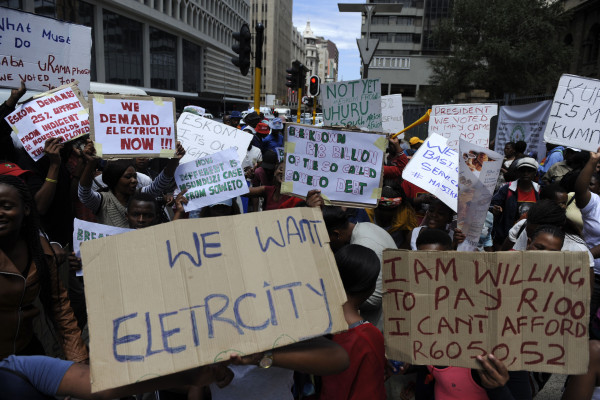
In an era when such futuristic technologies as artificial intelligence, robotics, and quantum computing are here or on the horizon, almost half of sub-Saharan Africans — more than 600 million people — lack the electricity to heat, cool, or light their homes.
This energy poverty impedes nearly every aspect of life for this population, from conducting business and educating their children to deterring crime and providing healthcare.
Even in some well-electrified African nations such as Ghana, Gabon, and South Africa, the supply is inadequate and often unavailable.
As the African Energy Chamber (AEC) put it in our newly released The State of African Energy Outlook Report 2024, “Access to electricity in Africa is still a dream to millions of Africans.”
Our report gives compelling evidence to back this statement, providing statistics that show, among other things, that energy poverty is markedly deeper in sub-Saharan Africa (SSA) than in the rest of the continent.
Our report is sobering, but not without hope. It also provides a positive look toward the future, including energy developments likely to improve electrification rates in SSA and move its countries' citizens closer to the universal access they dream of. The key to delivering energy to more Africans will be using both renewables and fossil fuels.
The Statistics and What's Behind Them
Our report's numbers tell the story of just how much SSA, in particular, is still affected by energy poverty.
In contrast with most of the world, where electrification rates improved during the COVID-19 pandemic, SSA's worsened, as its percentage of the world's population lacking electricity grew from 71% in 2018 to 77% in 2020. Statistics compiled in 2020 showed sub-20% levels of electricity access in up to eight countries across the region.
While the education and business sectors suffer greatly from energy poverty, it is perhaps most acutely felt in the health sector, where medical equipment and procedures require electrical power.
Complicating the health impacts still further, households without electricity are often forced to use unhealthy fuels like wood, coal, or kerosene to cook and heat, producing indoor air pollution that leads to respiratory problems and other ailments.
In contrast to the 90%-plus electrification rate found in some North African countries, which is allowing them to decrease reliance on fossil fuels, electricity access in SSA is only about 55%, and a closer look at that number reveals it is driven by urban rates of close to 80%, while rural areas lag far behind with only about 33%, leaving two-thirds of residents in the dark.
In a nutshell, SSA has a lot of catching up to do to achieve the levels of access to electricity enjoyed by most of the world. Although the region has doubled the average rate of access since 2000, its current rate of just over half of the region's population is miniscule compared to the 90% global rate and the 80% North African rate.
As I said, even in SSA countries where electrification rates are quite high, such as Ghana, Gabon, and South Africa, load shedding presents a daily practical problem for people who must anticipate power outages. In South Africa, for instance, this type of staged rationing has been used every day this year by the power utility, Eskom.
Already in 2023, there has been more load-shedding in South Africa than in all of 2022, and outages are lasting longer — up to 12 hours daily — with a predictable disabling effect on economic development.
Meanwhile, the country's chasm between supply and demand only continues to expand.
Changes in Progress: South Africa as a Case in Point
The South African government is taking a proactive approach to the regulatory side of improving energy supply, shortening timelines for obtaining environmental authorizations and grid approvals.
It is also working to obtain and use USD98.7 billion in investment capital over the next five years for its Just Energy Transition Investment Plan (JETIP), a framework adopted in 2022 that outlines the country's strategic priorities for investment during climate transition.
A major thrust of JETIP is replacing the use of coal, which currently supplies over 80% of South Africa's power, with renewable energy, expected to grow from a current 11% of the power supply to 20% by the end of this decade and to over half of the supply by 2050.
Contributing to those numbers, Eskom-built renewables projects are slated to go live this year in Lethabo and Sere, and the utility will soon start building solar and battery storage facilities at Komati Lethabo and Majuba for a total of 2.8 gigawatts (GW) of new renewables capacity.
Of the total projected electricity capacity, solar, and wind are expected to drive almost 50% with fossil fuels adding up to a 10th of total projected capacity.
Implications for the Continent
These power-related statistics for South Africa—a country better positioned than many Sub-Saharan nations regarding electricity—show that the country, and therefore the continent, needs gas-to-power and battery storage along with wind and solar.
South Africa's numbers highlight a major point made in my recent book, “A Just Transition: Making Energy Poverty History with an Energy Mix,” — that, while the rest of the globe deals with the threat of devastating climate change, Africa must deal with two major challenges at once: the threat of climate change and debilitating energy poverty.
Even as Africa works to support global efforts to prevent a climate crisis, we must embrace every solution available to us, including using our continent's vast natural gas reserves: totaling more than 800 trillion cubic feet. Not only is gas plentiful, but it's also the cleanest fossil fuel; producing it contributes to job creation and economic growth; and it can be monetized to help pay for energy infrastructure.
The “bottom line” is that Africa still needs to use its natural gas, and more of it, to deliver a much-needed increased supply of energy to its people.
Download The State of African Energy 2024 Outlook report: https://apo-opa.co/3QLEoHd
Distributed by APO Group on behalf of African Energy Chamber.