• Skip to main content
  • Skip to header right navigation
  • Skip to after header navigation
  • Skip to site footer
MyZA

MyZA

News, Directory, Events and Other Stuff

  • Social Media
  • Sport
  • World News
  • Home
  • Submit News
  • Directory
  • Events
  • Stratlec
  • TFSA
  • News
    • APO
    • Today’s Sport News
    • Todays Social Media and Tech Headlines
    • Today’s World News
    • Today’s SA Financial News
  • Contact
You are here: Home / Archives for global

global

26 September 2023

Womenpreneur Her Perfect Pitch Competition Top 30 Announced from a Record-breaking Pool

Location: MyPR

Johannesburg, September 2023: “After a process that involved reviewing over 500 applications and selecting the top 30 Womenpreneurs in South Africa for a panel review, we are thrilled to announce the Top 30 exceptional women from which one winner, two runners up, and the Top 10 will be chosen.” So says Sugendhree Reddy, Chief Executive …

Read moreWomenpreneur Her Perfect Pitch Competition Top 30 Announced from a Record-breaking Pool
24 September 2023

 Kyle Van Dyk Wins DRIFTCity In Cape Town

Location: MyPR

DRIFTCity 2023 © Eric Palmer Grand Parade, Cape Town – Inspired driving in wet conditions saw Kyle Van Dyk claim victory at the triumphant return of DRIFTCity – the unique and top-rated ‘driftkhana’ motorsport event that took place in Cape Town this weekend. As the crowds gathered for a late morning start, so did the …

Read more Kyle Van Dyk Wins DRIFTCity In Cape Town
23 September 2023

La Petite Ferme Announces Awards and Recent Accolades

Location: MyPR

La Petite Ferme, the picturesque sanctuary in Franschhoek for those seeking a ‘farm-inspired‘ getaway, is thrilled to announce its latest achievements, accolades and awards. This distinctive award-winning establishment was recently announced the winner of the prestigious 2023 Haute Grandeur Global Hotel Awards in the Best Scenic Environment Hotel category. Haute Grandeur Global Hotel Awards 2023 …

Read moreLa Petite Ferme Announces Awards and Recent Accolades
22 September 2023

On World Rhino Day, The United States (U.S.) Celebrates its Propitious Conservation Partnership with the World Wildlife Fund (WWF) and the Government of Namibia

Location: News

U.S. Embassy in Namibia
Download logo

The population of black rhinos declined dramatically in the 20th century at the hands of European hunters and settlers. Between 1960 and 1995, black rhino numbers dropped by a sobering 98%, to less than 2,500 individuals. Since then, the species has made a tremendous comeback from the brink of extinction. Thanks to persistent conservation efforts across Africa, black rhino numbers have doubled from their historic low 20 years ago to more than 6,000 today. However, the black rhino is still considered critically endangered, and a lot of work remains to bring their population up to even a fraction of what it once was—and to ensure that it stays there. Wildlife crime—in this case, poaching of rhinos for the illegal international market for their horns—continues to plague the species and threaten its recovery.

The Namibian government and its partners in conservation, including communal conservancies have been at the cutting edge of efforts to relocate, protect and expand the range of rhinos in the country. While the threat of poaching persists, the impact of these efforts is dramatic. Namibia is now home to the largest population of black rhino left on earth.

TACKLING WILDLIFE CRIME

Poaching remains the deadliest and most urgent threat to black rhinos. WWF is working with government agencies, local communities and other partners in Namibia, Kenya, and South Africa to support law enforcement agencies, develop and build on innovative tech solutions, and equip and train rangers to stop poachers.

In Namibia, WWF, with support from the USAID funded Combatting Wildlife Crime Project and INL projects, is working across sectors, agencies, and borders to help implement the country's ambitious law enforcement strategy to combat wildlife trafficking. WWF also supports the Namibian government in the implementation of its national black rhino strategy, in part by moving rhinos from parks with significant populations to other areas that historically held rhinos but currently do not—a process known as translocation. WWF is also working with the Ministry of Environment, Forestry and Tourism and other conservation partners to protect both black and white rhinos, including the maintenance of a comprehensive DNA databank used for forensic investigations and research, and the use of sniffer dogs.

PROTECTING AND MANAGING KEY POPULATIONS

WWF supports aerial population surveys at key sites such as Etosha National Park in Namibia. The surveys are critical for evaluating breeding success, deterring poachers, and monitoring rhino mortality. WWF is also working with partners to develop and implement cutting-edge technologies in range states to closely monitor key populations. When paired with boots-on-the-ground, innovative solutions like electronic identification and tracking tags, radio and satellite collars, night vision cameras, and camera traps provide critical data that is used to make important decisions for black rhino populations going forward.

COMMUNITY-BASED CONSERVATION

Namibia was the first African country to incorporate protection of the environment into its constitution. In 1996, the new Namibian government granted communities the right to create conservancies — areas with defined borders and governance and management structures outside of parks — where communities have the right to manage and benefit from their natural resources. With long-term support from IRDNC, NNF, SRT, WWF and other NACSO partners, robust conservation efforts including community game guards, monitoring, community engagement campaigns, partnerships between the communities and private sector tourism, and translocation projects, which relocate species into new habitats so that they have more space to breed, have made enriched landscapes and lives in rural Namibia.

On World Rhino Day, we join our Namibian partners in recognizing their efforts to protect black rhinos – against tremendous odds. Not only does Namibia have the largest population of black rhinos in the world, but communal conservancies have allowed rhinos to roam free, outside of national parks. These communal conservancies—working with the government, nonprofit organizations and others—have restored populations of black rhinos, creating a rhino-based economy that benefits both people and wildlife!

For more information on WWF Programs in Namibia, visit https://www.wwfnamibia.org.

For more information on U.S. global climate and environmental priorities, visit Climate and Environment – United States Department of State.

Distributed by APO Group on behalf of U.S. Embassy in Namibia.

Read moreOn World Rhino Day, The United States (U.S.) Celebrates its Propitious Conservation Partnership with the World Wildlife Fund (WWF) and the Government of Namibia
22 September 2023

Natural gas set to ignite African economies

Location: News

Africa Oil Week
Download logo

The recent signing of an agreement to develop what has been called South Africa's largest liquified natural gas project in Mpumalanga province has emphasised the potential of natural gas as a viable energy source for the country.

The agreement, a “non-binding term sheet” (https://apo-opa.info/3PN65zR), is a partnership between South Africa's Industrial Development Corporation (IDC) and Afro Energy, a subsidiary of Australian gas explorer Kinetiko Energy. The initiative is projected to generate 50MW of equivalent energy, growing to 500MW over time. There are also options for the development of further LNG gas equivalent projects.

The deal comes amidst renewed interest in onshore gas, as South Africa's power crisis shows few signs of easing. TotalEnergies has won approval (https://apo-opa.info/48phiOs) to search for oil and gas off South Africa's west coast, and in May, the South African government even announced plans to revisit the idea of shale-gas exploration in the Karoo region.

The Mpumalanga discovery is relatively advanced, and involves an innovative public-private partnership approach. However, the resource – estimated at 3.1 billion cubic feet of natural gas – pales in comparison to the gargantuan gas reserves in other parts of Africa.

Africa's natural-gas reserves have been estimated at around 620 trillion cubic feet (https://apo-opa.info/46iQ4qU), with the largest resources in Nigeria, Algeria and Senegal.

Thanks to its proximity to Europe, and well-developed LNG infrastructure, Algeria is currently Africa's largest exporter of natural gas, and the fourth largest gas export in the world (https://apo-opa.info/46m7Zgw), with the 10th largest proven natural gas reserves on the planet.

As Europe looks to wean itself off Russian energy, following that country's invasion of Ukraine, North and West Africa are well positioned to fill the gap. Established trans-Mediterranean gas pipelines can facilitate this, and several more pipelines are in the planning stages.

Supply bottlenecks and political challenges need to be resolved, but the upside for African oil-and-gas exports to Europe is enormous.

Natural gas has also long been heralded as a “transition fuel”, that can help ease the move from oil and coal towards renewable energy. By some measures (https://apo-opa.info/3sZeMy5), gas is a cleaner-burning, efficient fuel that produces fewer carbon-dioxide emissions than other fossil fuels.

It is abundant, and can be compressed, liquified and stored. This storage capability gives natural gas the advantage over forms of renewable energy like solar and wind, which are less easily dispatchable. Storing and providing renewable energy as and when required necessitates complementary technology like batteries, hydrogen or pumped storage.

Gas resources can simply be integrated into the well-developed global natural-gas infrastructure – through pipelines, and the international shipping. This means frontier natural-gas territories – such as South Africa – would be able to “plug in” to this system and begin supplying gas to where it is needed relatively soon after fields are established.

Ghana provides an instructive example of what is possible. The country's oil-and-gas industry launched with its first discoveries around 2006, and it was able to produce its first product within 40 months (https://apo-opa.info/3rkEXz1). In 2021, the country produced 2,4 million metric tons of gas (https://apo-opa.info/3PY0as9).

The imperative to minimise global greenhouse gas emissions to meet Paris 2050 commitments and to reverse climate change is a serious concern, which must be balanced against Africa's development imperatives.

Almost half of Africa's people remain without electricity (https://apo-opa.info/48BiLS2). The Africa Energy Commission (https://apo-opa.info/3ZtYv0d) has confirmed that it still sees a role for natural gas in the continent's evolving energy mix.

In a context where Africa still generates only four percent of global carbon emissions, and the majority (https://apo-opa.info/46oImM7) of its people still rely on biomass to meet their energy needs, a move to natural gas would still represent a net improvement (https://apo-opa.info/3RzRGIH).

That is the domestic scenario. Globally, the planet is hungry for natural gas. Africa is sitting astride enormous resources, but currently only provides 6% of global gas exports (https://apo-opa.info/46ioryf).

The opportunities are significant. There is worldwide gas activity going on, and Africa needs to come to the party. 

  • The continent's energy leaders will convene to discuss emerging energy opportunities at Africa Oil Week (https://apo-opa.info/466pce3), “Africa's leading upstream event” from 9-13 October in Cape Town. The event is a global platform for deals and transactions, bringing together governments, national and international oil companies, independents, investors and service providers for the betterment of the African continent. 

Distributed by APO Group on behalf of Africa Oil Week.

Read moreNatural gas set to ignite African economies
21 September 2023

Urgent need to address Eskom transmission to deal with load shedding

Location: News

Urgent need to address Eskom transmission to deal with load shedding

Electricity Minister, Dr Kgosientsho Ramokgopa, has described load shedding as an economic problem that government is urgently addressing, as his department relentlessly tackles generation and transmission challenges. 

“It's a structural constraint to the economy of the country and therefore it's indispensable to the resolution of the economic question in the country,” he said on Thursday. 

The Minister is hosting a Transmission Financing Seminar with the Johannesburg Stock Exchange (JSE).  

The gathering will discuss the financing of South Africa’s Transmission Development Plan, which seeks to expand, support and secure the sustainability of South Africa’s energy mix and electricity supply.

The seminar brings together government, energy industry veterans and potential private sector investors to engage in a critical conversation on South Africa’s energy crisis. 

Ramokgopa touched on the country’s Energy Action Plan (EAP), a comprehensive response by government to address the challenge of power cuts. 

“In 1997, we were told that at the rate at which you are connecting households to the grid and the economy is growing, you're going to run into a generation problem, a capacity problem 10 years later, and we know that we ran into that problem.” 

This is the reason he believes the country needs to speedily attend to transmission with the same vigour it is handling generation capacity. 

“We are saying also now if you don't resolve the issues on the transmission side, having that problem today might not be as pronounced and I want to argue that it will be pronounced in the next six to 12 months. 

“The similar amount of effort and exertion you’re placing on the generation side requires that they be placed also on the transmission side.” 

Eskom's transmission has the mandate to reliably control, maintain, plan, expand and provide access to an interconnected transmission system.

Ramokgopa told the summit that part of the problem that is confronting Eskom is structural constraint primarily presented by two issues – energy deficit and issues of logistics. 

The Minister spoke frankly about the impact of load shedding. 

He highlighted agriculture and manufacturing as sectors that are heavily impacted by severe shortages in power generation capacity.  

“And what this does really borrows from the modelling that has been done by the South African Reserve Bank, which begins to illustrate the kind of injury that is inflicted by load shedding on the South African economy, potentially contracting the economy.”

The Minister has since called for all hands on deck to contribute towards the resolution of this “bleak picture”.  

Ramokgopa, who has visited all power plants to better understand the challenges, said there are communities and businesses that have not had electricity for about six years. 

“This is not an exaggeration. And so as a result of the failure of the distribution infrastructure, I'm talking about transformers and substations, and this comes about as a result of municipalities being financially unviable.”

The Minister said he will introduce regular updates on the transmission side. 

“[This] is after we've gone to Cabinet [to present] the options that are available to us. Once that is adopted, then we will give feedback and then we're doing a significant amount of work on the distribution side (sic).”

These interventions will see the country significantly strengthen and increase South Africa’s electricity supply and capacitate the energy sector in meeting global decarbonisation targets, thereby ensuring South Africa’s long-term energy security and energy sovereignty. – SAnews.gov.za

Gabisile
Thu, 09/21/2023 - 11:17

441 views
Read moreUrgent need to address Eskom transmission to deal with load shedding
21 September 2023

Developed economies urged to accelerate climate action

Location: News

Developed economies urged to accelerate climate action

President Cyril Ramaphosa says developed economy countries, in particular, must act with urgency to accelerate the reduction of emissions, fulfil their obligations and honour past promises.

The President was speaking at the Climate Ambition Summit on the margins of the United Nations General Assembly in New York, USA.

The President told world leaders that Africa has witnessed with increasing alarm the effects of climate change, environmental degradation, unsustainable production and resource scarcity on human health and well-being. 

“As countries across the globe seek practical ways to build back better from the COVID-19 pandemic and multiple crises, we are presented with an unprecedented opportunity to set the global economy on a more equitable, environmentally sustainable and low-carbon developmental trajectory.

“Despite having little responsibility for causing global warming, Africa is warming faster than the rest of the world. Like other parts of the Global South, the continent is significantly affected by climate change. As such, climate actions cannot be separated from the drive for sustainable and inclusive development,” President Ramaphosa said. 

The President science sends a clear message that the world is not on track to meet the goals contained in the Paris Agreement. He emphasised that this Climate Ambition Summit must instil the necessary urgency and propel the actions that are needed now to prevent the destruction of the planet and the devastation of societies. 

Earlier this month, African leaders adopted the Nairobi Declaration on Climate Change and Call to Action, which recognises that decarbonising the global economy is an opportunity to contribute to equality and shared prosperity.

To achieve this vision of economic transformation, African leaders have called on the international community to support efforts to massively increase Africa’s renewable energy capacity by 2030.

“They are seeking investment in smart, digital and efficient green technologies to decarbonise the transport, industrial and electricity sectors in African countries.

“They have called for support to strengthen actions to halt and reverse biodiversity loss, deforestation and desertification. And to boost agricultural yields through sustainable agricultural practices,” the President highlighted. 

Structural reform to promote just and inclusive transitions 

President Ramaphosa said structural reform is needed to promote transitions that are just and inclusive.

He said global and regional trade mechanisms must enable products from Africa to compete on fair and equitable terms. 

“Trade related environmental tariffs and non-tariff barriers must be the product of multilateral agreements. They must not be unilateral, arbitrary or discriminatory.

“The multilateral financial system must build resilience to climate shocks and better leverage the balance sheets of multilateral development banks to scale up concessional finance. Developing economy countries also require new, predictable public finance to support climate adaptation and build resilience to loss and damage.”

The system, President Ramaphosa said, needs to provide interventions for debt management and relief to prevent debt default.

“The actions necessary now must not place an undue burden on the citizens of tomorrow.”

The President emphasised that financing for climate action should respect the right of all countries to pursue their own development pathways, while taking into account their specific national circumstances.

“As South Africa implements its ambitious Nationally Determined Contribution, which is aligned to the Paris Agreement temperature goals, we see new opportunities for green growth and development.

“With abundant solar and wind resources, with significant reserves of critical minerals, South Africa is positioning itself to be a leader in renewable energy, green hydrogen and sustainable industrialisation,” he said. 

Due to regulatory changes and a surge of investment, South Africa has a confirmed pipeline of renewable energy projects in development that are expected to produce in excess of 10 gigawatts of electricity.

South Africa has also established a Just Transition Framework to ensure that climate actions adhere to principles of procedural, restorative and distributive justice.

“We are committed to building resilience to the impact of climate change and reducing our emissions in ways that are appropriate to our national circumstances and development pathways.

“As South Africa, and as the African continent, we are working to give substance to our assertion that no country should ever have to choose between development aspirations and climate action,” he said. 

President Ramaphosa called on the summit to demonstrate that the leaders of the world are committed to ambitious climate actions that are inclusive, comprehensive and leave no one behind. – SAnews.gov.za

DikelediM
Thu, 09/21/2023 - 11:24

462 views
Read moreDeveloped economies urged to accelerate climate action
21 September 2023

Reform the international financial architecture – President Ramaphosa

Location: News

Reform the international financial architecture – President Ramaphosa

President Cyril Ramaphosa has called for the reform and strengthening of financial architecture where developing countries participate equally in the decision making process of the international economic order.

The President said he welcomes the numerous initiatives to assist the most pressing needs of countries in dire stress. These include the Food Shock Window, Resilience and Sustainability Trust and the G20 Common Framework for Debt Treatment.

“However, sustainable and inclusive growth requires that more be done. We must strengthen and reform the international financial architecture. Developing economy countries must participate equally and meaningfully in the decision-making process of the international economic order,” he said. 

President Ramaphosa was delivering remarks at the High-Level Dialogue on Financing for Development Summit on the margins of the United Nations General Assembly in New York, USA.

The statesman told world leaders that humanity is confronted with the convergence of a climate crisis, recession, increasing conflict, environmental degradation, rising food insecurity, deepening poverty and unacceptable levels of hunger.

He highlighted that when the 2030 Agenda for Sustainable Development was agreed upon, the overarching principle was that the most vulnerable would receive the support they needed.

“Yet, at a time when solidarity was needed most, agreed international commitments were not honoured. Principles such as common but differentiated responsibilities are not being respected.

“Four decades since the right to development was established by the United Nations as a human right, the failure to act on commitments to support development is deepening the divide between the global north and south. 

“The Addis Ababa Action Agenda provides concrete plans for supporting development and we again call on our partners to support these plans,” the President said. 

President Ramaphosa further called for the mandates of multilateral development banks to be reframed to respond to the needs of developing economies. 

He emphasised that “we must assert the principle of country ownership”.

“Multilateral development banks should support projects and programmes that are aligned to the development priorities and climate commitments of these countries.

“The international tax system must reflect the diverse needs and capacities of both developed and developing economies,” he said. 

The President added that more innovation is required to enable the private sector to play a greater role in addressing the finance gap. He said this includes a new approach to blended finance with a focus on the developmental impact of investments. 

He underscored that credit ratings of developing economies, and African economies in particular, need to be based on economic fundamentals and not on subjective assessments. 

Public finance is critical for development

President Ramaphosa said developed economy countries need to fulfil their commitment to contribute at least 0.7 percent of their gross national income towards official development assistance. 

They also need to fulfil their commitment to mobilise $100 billion a year to tackle climate change. 

“As South Africa, we therefore welcome the recommended actions contained in Secretary-General’s Report on ‘Our Common Agenda’. In the interests of our common progress and the survival and prosperity of future generations, we must act now.

“South Africa encourages all world leaders, global institutions and private sector partners to work together to address the current crises, close the finance divide, reduce inequality, eradicate poverty and make sure that no-one is left behind,” he said. – SAnews.gov.za


DikelediM
Thu, 09/21/2023 - 11:26

443 views
Read moreReform the international financial architecture – President Ramaphosa
21 September 2023

Repo rate remains unchanged

Location: News

Repo rate remains unchanged

Reserve Bank Governor Lesetja Kganyago has announced that the repo rate will remain unchanged at 8.25%.

Kganyago made the announcement in Pretoria on Thursday after a meeting of the Monetary Policy Committee (MPC).

He said South Africa’s load shedding has increased and prices for commodity exports continue to weaken. In the near term, stronger El Niño conditions threaten the agricultural outlook, while global climatic events present additional risks.

“Energy and logistical constraints remain binding on the growth outlook, limiting economic activity and increasing costs,” said the Governor.

The GDP growth forecast for 2024 and 2025 is unchanged from the previous meeting, at 1.0% and 1.1%, respectively.

Kganyago said oil prices have increased in recent months and commodity export prices have moderated further.

“South Africa’s external financing needs will increase as the current account deficit expands from a forecasted 2.0% of GDP this year (from 1.9%), to 3.0% of GDP in 2024 and to 3.4% of GDP in 2025.

“Sharply lower tax revenue, higher employee compensation and ongoing financing needs of state-owned enterprises are expected to keep the long-term cost of borrowing elevated. Despite the forecasted moderation of inflation, long-term bond yields currently trade around 12.6%.

“The rand has weakened over the past year, depreciating by about 10% year to date against the US dollar, and is showing high volatility in response to risk-on and risk-off episodes. The implied starting point for the rand forecast is R18.45 to the US dollar, compared with R18.13 at the time of the previous meeting.”

The trajectory of South Africa’s headline inflation rate has been shaped primarily by fuel and food prices.

“Risks to the inflation outlook are assessed to the upside. At a global level, headline inflation continues to moderate, but food price inflation remains high, oil markets have tightened significantly, and core inflation looks sticky.

“Despite recent easing in some food price components, domestic food price inflation was still elevated at 8% in August and the risk of drier weather conditions in coming months has increased.

“We expect food price inflation to moderate further in the near term, but with high risk that it picks up later in 2024. In the absence of sustained increases in energy supply, electricity prices continue to present clear inflation risks.

“Load-shedding and logistics constraints may also have broader effects on the cost of doing business and the cost of living. Given uncertain fuel and food price inflation, considerable risk still attaches to the forecast for average salaries.”

He said sticky inflation implies that average interest rates in major economies will remain high. As a result, tighter global financial conditions are likely to persist, raising the risk profile of economies needing foreign capital.

“Against this backdrop, the MPC decided to keep the repurchase rate at its current level of 8.25% per year,” he announced.

Three members of the committee preferred to keep rates on hold and two preferred an increase of 25 basis points.

“At the current repurchase rate level, policy is restrictive, consistent with the inflation outlook and elevated inflation expectations. Serious upside risks to the inflation outlook remain,” said Kganyago.

He added that decisions will continue to be data dependent and sensitive to the balance of risks to the outlook.

The next statement of the Monetary Policy Committee will be released on 23 November 2023. – SAnews.gov.za

Janine
Thu, 09/21/2023 - 15:39

169 views
Read moreRepo rate remains unchanged
21 September 2023

Premium travel master brand ‘Cathay’ launches globally, powered by recent campaign ‘Feels Apt To Move’

Location: MyPR

Premium travel master brand ‘Cathay’ launches globally, powered by new campaign ‘Feels Good To Move’ Cathay will now be the master brand around the world, simplifying the way our customers interact with us Cathay is excited to announce that its new premium travel lifestyle brand is officially rolling out to markets around the world, celebrating …

Read morePremium travel master brand ‘Cathay’ launches globally, powered by recent campaign ‘Feels Apt To Move’
21 September 2023

President Ramaphosa concludes participation in UNGA78

Location: News

President Ramaphosa concludes participation in UNGA78

President Cyril Ramaphosa has concluded his working visit to the United States of America, where he led South Africa’s participation in the 78th Session of the United Nations General Assembly (UNGA78) in New York.  

President Ramaphosa was accompanied by a delegation of Ministers, including the Minister of International Relations and Cooperation, Dr Naledi Pandor; Minister of Trade, Industry and Competition, Ebrahim Patel; Minister of Environment, Forestry and Fisheries, Barbara Creecy; Minister of Health, Dr Joe Phaahla; Minister in The Presidency, Khumbudzo Ntshavheni, and Minister in The Presidency for Planning Monitoring and Evaluation, Maropene Ramokgopa. 

The President delivered South Africa’s National Statement on Tuesday under the theme: 'Rebuilding trust and reigniting global solidarity: Accelerating action on the 2030 Agenda and its Sustainable Development towards peace, prosperity, progress and sustainability for all'.

On Wednesday, President Ramaphosa participated in the Financing for Development Summit.

The President joined United Nations Secretary-General António Guterres and the President of the UN General Assembly, Ambassador Dennis Francis, in advocating for the strengthening and reform of the international financial architecture. 

President Ramaphosa said developing countries must participate equally and meaningfully in the decision-making process of the international economic world order. 

"Four decades since the right to development was established by the United Nations as a human right, the failure to act on commitments to support development is deepening the divide between the global north and south," said President Ramaphosa. 

The President also addressed the Climate Change Summit, hosted by the UN Secretary-General António Guterres, where he joined the call by African leaders for action in the implementation of the recently adopted Nairobi Declaration on Climate Change and Call to Action.

The declaration recognises that decarbonising the global economy is an opportunity to contribute to equality and shared prosperity.

President Ramaphosa said that financing for climate action should respect the right of all countries to pursue their own development pathways while taking into account their specific national circumstances.

“As South Africa implements its ambitious Nationally Determined Contribution, which is aligned to the Paris Agreement temperature goals, we see new opportunities for green growth and development.

“With abundant solar and wind resources, with significant reserves of critical minerals, South Africa is positioning itself to be a leader in renewable energy, green hydrogen, and sustainable industrialisation,” the President said. 

The President described South Africa's participation at the UNGA78 as progressive, as it continued to advocate for the reform of the United Nations Security Council and reiterated South Africa’s support for the United Nations Secretary-General's ambition of U$ 500 billion a year to meet the UN-driven global sustainable development goals.

On the sidelines of UNGA78, President Ramaphosa held several bilateral meetings aimed at strengthening strategic political, diplomatic and trade ties.

These included discussions with the President of the Federal Republic of Nigeria, Bola Tinubu; Ukraine President Volodymyr Zelenskyy; President Abdelmadjid Tebboune of the People's Democratic Republic of Algeria; President Recep Tayyip Erdoğan of Türkiye, and President Emmerson Mnagangwa of the Republic of Zimbabwe. 
 
Another highlight of the President’s working visit to the United States was the joint announcement by the South African and United States governments of South Africa’s hosting of the 20th US-Sub-Saharan Africa Trade and Economic Cooperation Forum, (AGOA Forum) in Johannesburg from 2 - 4 November 2023.

President Ramaphosa welcomed this development as an expression of South Africa's intention to remain part, beyond 2025, of the trade partnership enabled by the United States’ Africa Growth and Opportunity Act. 

This trade relationship carries mutual benefit for South Africa and the United States, as part of the broader cordial and strong relations between the two countries.

In his assessment of UNGA78, President Ramaphosa said: “The United Nations General Assembly is an important and strategic platform for South Africa, where we are able to interact at a high level multilaterally and bilaterally. 

“We have engaged in meaningful discussions that will contribute to the development of our country and our continent. I go home with my spirits lifted and enthused that the challenges we face will be resolved as we continue working with our social partners and business at home, and our trade and diplomatic partners globally." – SAnews.gov.za

DikelediM
Thu, 09/21/2023 - 11:47

212 views
Read morePresident Ramaphosa concludes participation in UNGA78
21 September 2023

Ramaphosa concludes participation in 78th United Nations General Assembly

Location: News

The Presidency: Republic of South Africa
Download logo

President Cyril Ramaphosa has concluded a working visit to the United States of America, where he led South Africa's participation in the 78th Session of the United Nations General Assembly (UNGA78) in New York.

The President delivered South Africa's National Statement on Tuesday, 19 September 2023, under the theme “Rebuilding trust and reigniting global solidarity: Accelerating action on the 2030 Agenda and its Sustainable Development towards peace, prosperity, progress and sustainability for all”.

On Wednesday, 20 September 2023, President Ramaphosa participated in the Financing for Development Summit.

The  President joined United Nations Secretary-General António Guterres and the President of the UN General Assembly, Ambassador Dennis Francis, in advocating for the strengthening and reform of the international financial architecture. 

President Ramaphosa said developing countries must participate equally and meaningfully in the decision-making process of the international economic world order. 

"Four decades since the right to development was established by the United Nations as a human right, the failure to act on commitments to support development is deepening the divide between the global north and south," said President Ramaphosa. 

The President also addressed the Climate Change Summit, hosted by the UN Secretary-General António Guterres, where the President joined the call by African leaders for action in the implementation of the recently adopted Nairobi Declaration on Climate Change and Call to Action.

The declaration recognises that decarbonising the global economy is an opportunity to contribute to equality and shared prosperity.

President Ramaphosa said: “Financing for climate action should respect the right of all countries to pursue their own development pathways while taking into account their specific national circumstances.

“As South Africa implements its ambitious Nationally Determined Contribution, which is aligned to the Paris Agreement temperature goals, we see new opportunities for green growth and development.

“With abundant solar and wind resources, with significant reserves of critical minerals, South Africa is positioning itself to be a leader in renewable energy, green hydrogen, and sustainable industrialisation.”

The President described South Africa's participation at the UNGA78 as progressive as it continued to advocate for the reform of the United Nations Security Council and reiterated South Africa's support for the United Nations Secretary-General's ambition of  U$ 500 billion a year to meet the UN-driven global sustainable development goals.

On the sidelines of UNGA78, President Cyril Ramaphosa held several bilateral meetings aimed at strengthening strategic political, diplomatic, and trade ties.

These included discussions with the President of the Federal Republic of Nigeria, Bola Tinubu; Ukraine President Volodymyr Zelenskyy; President Abdelmadjid Tebboune of the People's Democratic Republic of Algeria; President Recep Tayyip Erdoğan of Türkiye, and President Emmerson Mnagangwa of the Republic of Zimbabwe. 

Another highlight of the President's Working Visit to the United States was the joint announcement by the South African and United States governments of South Africa's hosting of the 20th US-Sub-Saharan Africa Trade and Economic Cooperation Forum,  (AGOA Forum) in Johannesburg from 2 to 4 November 2023.

President Ramaphosa welcomed this development as an expression of South Africa's intention to remain part, beyond 2025, of the trade partnership enabled by the United States' Africa Growth and Opportunity Act.

This trade relationship carries mutual benefit for South Africa and the United States, as part of the broader cordial and strong relations between the two countries.

In his assessment of UNGA78 President Ramaphosa said: “The United Nations General Assembly is an important and strategic platform for South Africa, where we are able to interact at a high level multilaterally and bilaterally. 

“We have engaged in meaningful discussions that will contribute to the development of our country and our continent. I go home with my spirits lifted and enthused that the challenges we face will be resolved as we continue working with our social partners and business at home, and our trade and diplomatic partners globally." 

The President was accompanied by a delegation of Ministers that included the Minister of International Relations and Cooperation, Dr Naledi Pandor; Minister of Trade, Industry and Competition, Ebrahim Patel; Minister of Environment, Forestry and Fisheries, Barbara Creecy; Minister of Health, Dr Joe Phaahla; Minister in The Presidency, Khumbudzo Ntshavheni; and Minister in The Presidency for Planning Monitoring and Evaluation, Maropene Ramokgopa. 

Distributed by APO Group on behalf of The Presidency: Republic of South Africa.

Read moreRamaphosa concludes participation in 78th United Nations General Assembly
21 September 2023

Africa among regions with highest number of industrial systems under attack in the first half of 2023

Location: News
Kaspersky

Malicious objects of all types were detected and blocked on 34% of Industrial Control System (ICS) computers in the first half of 2023, according to the ICS CERT landscape report (https://apo-opa.info/3LwG719) by Kaspersky (www.Kaspersky.co.za). In Africa over this period attacks were detected on 40,3% of ICS computers, placing it in first place among the other regions. The top industries under attack were energy (45,9%), engineering & integration (44%) and building automation (40%). All these attacks were blocked after detection.

ICS computers are used in oil & gas, energy, automotive manufacturing, building automation infrastructures and other spheres to perform a range of operational technology (OT) functions – from the workstations of engineers and operators to supervisory control and data acquisition (SCADA) servers and Human Machine Interface (HMI). Cyberattacks on industrial computers are considered to be extremely dangerous as they may cause material losses and production downtime for the controlled production line and even the facility as a whole. Moreover, industrial enterprises put out of service can seriously undermine a region's social welfare, ecology and macroeconomics.

An analysis of the most significant and targeted threats detected on ICS computers in selected countries of Africa in the first half of 2023 shows that the threat landscape can vary between countries and between industries due to the differences in the security maturity of different countries/industries and the current focus of threat actors. In South Africa in the first half of 2023 malware was detected and blocked on 29,1% of ICS computers, in Nigeria on 32,6%, in Kenya on 34,5% of machines.

There are different types of cyberthreats that OT-related computers face – malicious scripts, spy trojans, worms, ransomware, and others. In the first half of 2023 Africa had the highest percentage of ICS computers on which spyware was blocked (9,8%). The Middle East and Southeast Asia had similarly high percentages (8,3% and 8,1%). The global average stands at 6,1%. 

Africa was also the region with the highest percentage of ICS computers (14,8%) on which attacks from denylisted Internet resources were blocked (these are web resources associated with distributing or controlling malware). The global average is 11,3%.

Viruses and worms spread across ICS networks by means of removable media, shared folders, infected files, such as backups, and network attacks on outdated software. The percentage of ICS computers on which worms were detected was very high in Africa (7% vs. 2,3% global average), making this region the leader by percentage of ICS computers on which threats were detected after removable devices were connected.

“Africa's industrial landscape is diverse, ranging from large-scale mining operations to small-scale agriculture. This means that ICS cybersecurity solutions need to be adaptable to various sectors and technologies. In some regions, legacy ICS systems that lack modern security features are still in use. These systems are often more vulnerable to cyberthreats and require significant upgrades. Lastly, some critical infrastructure in Africa is located in remote areas with limited connectivity, which can make it difficult to monitor and secure ICS assets effectively,” comments Evgeny Goncharov, Head of Kaspersky ICS CERT. “By understanding these risks, organisations can make informed decisions, allocate resources wisely, and efficiently fortify their defenses. In doing so, they not only protect their bottom line but also contribute to a safer and more secure digital ecosystem for all.”

Read more about the ICS threat landscape in the first half of 2023 on the Kaspersky ICS CERT website (https://apo-opa.info/3LwG719).

To keep your OT computers protected from various threats, Kaspersky experts recommend:

  • Conducting regular security assessments of OT systems to identify and eliminate possible cyber security issues.
  • Establishing continuous vulnerability assessment and triage as a basement for effective vulnerability management process. Dedicated solutions like Kaspersky Industrial CyberSecurity (https://apo-opa.info/451Yguw) may become an efficient assistant and a source of unique actionable information, not fully available in public.
  • Performing timely updates for the key components of the enterprise's OT network; applying security fixes and patches or implementing compensating measures as soon as it is technically possible is crucial for preventing a major incident that might cost millions due to the interruption of the production process.
  • Using EDR solutions such as Kaspersky Endpoint Detection and Response (https://apo-opa.info/3OsQQvs) for timely detection of sophisticated threats, investigation, and effective remediation of incidents.
  • Improving the response to new and advanced malicious techniques by building and strengthening your teams' incident prevention, detection, and response skills. Dedicated OT security trainings for IT security teams and OT personnel is one of the key measures helping to achieve this.

Distributed by APO Group on behalf of Kaspersky.

For further information please contact:
Nicole Allman | INK&Co.
nicole@inkandco.co.za

Social Media:
Facebook: https://apo-opa.info/3M3uy0L
Twitter: https://apo-opa.info/3OaLeGw
YouTube: https://apo-opa.info/41wO7V6
Instagram: https://apo-opa.info/42BZnRq
Blog: https://apo-opa.info/42Apbxn

About Kaspersky:
Kaspersky is a global cybersecurity and digital privacy company founded in 1997. Kaspersky's deep threat intelligence and security expertise is constantly transforming into innovative solutions and services to protect businesses, critical infrastructure, governments and consumers around the globe. The company's comprehensive security portfolio includes leading endpoint protection, specialized security products and services, as well as Cyber Immune solutions to fight sophisticated and evolving digital threats. Over 400 million users are protected by Kaspersky technologies and we help over 220,000 corporate clients protect what matters most to them. Learn more at www.Kaspersky.co.za.  

Media files
Kaspersky
Download logo
Read moreAfrica among regions with highest number of industrial systems under attack in the first half of 2023
20 September 2023

South Africa continues to advocate for dialogue 

Location: News

South Africa continues to advocate for dialogue 

President Cyril Ramaphosa has urged the international community to do everything within its means to enable meaningful dialogue between warring parties, while refraining from actions that fuel the conflict. 

The President was delivering a statement to the 78th Session of the United Nations General Assembly (UNGA78) at the United Nations headquarters in New York.
 
“Democratic South Africa has consistently advocated for dialogue, negotiation and diplomacy to prevent and end conflict, and achieve lasting peace. 

“It is these principles that inform South Africa’s participation in the African Peace Initiative, which seeks a peaceful resolution of the conflict between Russia and Ukraine. In this conflict, as in all conflicts, we have insisted that the UN Charter’s principle of respect for the territorial integrity of every country should be upheld,” the President said. 

President Ramaphosa told the world leaders that SA’s participation in the African Peace Initiative is informed by a desire to see an end to the suffering of those most directly affected by the conflict and the millions on the continent and across the world who, as a result of the conflict, are now vulnerable to worsening hunger and deprivation.

“As the international community, we must do everything within our means to enable meaningful dialogue, just as we should refrain from any actions that fuel the conflict.

“As we confront other conflicts in several parts of the world, including on our continent Africa, we need to be investing in prevention and peacebuilding,” he said. 

The President said South Africa supports the call by the UN Secretary-General in the New Agenda for Peace for Member States to provide more sustainable and predictable financing to peacebuilding efforts. 

He called on the global community to be concerned by recent incidents of unconstitutional changes of government in some parts of Africa.

He emphasised that the global community needs to work alongside the African Union to support peace efforts in the eastern DRC, Libya, Sudan, Somalia, Mali, Central African Republic, South Sudan, northern Mozambique, the Great Lakes Region, the Sahel, Niger and the Horn of Africa.

The President highlighted that the African Union Peace and Security Council has declared that it stands ready to deepen its cooperation with the UN Security Council to silence the guns on the African continent and to achieve peace, stability and development.

“We are called upon to remain true to the founding principles of the United Nations, by recognising the inalienable right of the people of Western Sahara to self-determination, in line with the relevant UN General Assembly resolutions. 

“We must work for peace in the Middle East. For as long as the land of the Palestinians remains occupied, for as long as their rights are ignored and their dignity denied, such peace will remain elusive,” he said. 

President Ramaphosa said that the actions of the Government of Israel have imperilled the possibility of a viable two-State solution. 

“The principles of the UN Charter on territorial integrity and on the prohibition on the annexation of land through the use of force must be applied in this situation,” he said. 

President Ramaphosa said South Africa continues to call for the lifting of the economic embargo against Cuba, which has caused untold damage to that country’s economy and people.

He said sanctions against Zimbabwe should also be lifted as they are imposing great suffering on ordinary Zimbabweans.

“As many people around the world are confronted by hunger and want, the essential human qualities of cooperation and solidarity must be evident in the actions we take to bridge the divide between wealthy and poor. 

“We must summon the necessary will and resolve to regain the momentum towards the achievement of the 2030 Agenda. 

“This means that we must address the fundamental development challenges that have long characterised our unequal world,” he said. – SAnews.gov.za

DikelediM
Wed, 09/20/2023 - 09:59

502 views
Read moreSouth Africa continues to advocate for dialogue 
20 September 2023

President Ramaphosa calls on wealthy countries to meet financial commitments on climate

Location: News

President Ramaphosa calls on wealthy countries to meet financial commitments on climate

President Cyril Ramaphosa has called on partners from wealthy countries to meet the climate financial commitments they made to tackle global warming in developing countries.

“We call on our partners from wealthier countries to meet the financial commitments they have made. It is a great concern that these wealthier countries have failed to meet their undertakings to mobilise 100 billion dollars a year for developing economies to take climate action,” the President said. 

President Ramaphosa was speaking during the 78th Session of the United Nations General Assembly (UNGA78) at the United Nations headquarters in New York on Tuesday. 

He told world leaders that Africa is warming faster than the rest of the world, with 17 of the 20 climate hotspots around the world found in Africa. 

“Africa is least responsible for the climate damage that has been caused and yet it bears the greatest burden. 

“Centuries after the end of the slave trade, decades after the end of the colonial exploitation of Africa’s resources, the people of our continent are once again bearing the cost of the industrialisation and development of the wealthy nations of the world,” he said. 

President Ramaphosa stressed “this is a price that the people of Africa are no longer prepared to pay”.

“Many countries in the North count their assets in the mineral resources that are beneath the African soil. The wealth of Africa belongs to Africans. The mineral wealth that is beneath the soil of Africa must in the end accrue to Africans,” he said. 

The President urged global leaders to accelerate global decarbonisation while pursuing equality and shared prosperity.

He underscored the need to advance all three pillars of the Paris Agreement – mitigation, adaptation and support, with equal ambition and urgency. 

“African countries, alongside other developing economy countries, need increased financial support to both implement the 2030 Agenda and achieve their climate change goals in a comprehensive and integrated manner.

“We need to operationalise the Loss and Damage Fund for vulnerable countries hit hard by climate disasters, as agreed at COP27,” the President said. 

Reform of global institutions

President Ramaphosa called on the global community to ensure the essential qualities that define humanity are evident in the institutions that manage the conduct of international relations. 

“We require institutions that are inclusive, representative, democratic and advance the interests of all nations. We require a renewed commitment to multilateralism, based on clear rules and supported by effective institutions.

“This is the moment to proceed with the reform of the United Nations Security Council, to give meaning to the principle of the sovereign equality of nations and to enable the council to respond more effectively to current geopolitical realities,” he said.  

He said he is pleased that the Common African Position on the reform of the Security Council is increasingly enjoying wide support. 

He further advocated that the process must move to text-based negotiations, creating an opportunity for convergence between Member States. 

“We must ensure that the voice of the African continent and the global South is strengthened in the United Nations and broader multilateral system. All the peoples represented here in this United Nations had their origins in Africa,” the President said. – SAnews.gov.za 

DikelediM
Wed, 09/20/2023 - 10:48

361 views
Read morePresident Ramaphosa calls on wealthy countries to meet financial commitments on climate
20 September 2023

Celebrating negroni week with a dash of Angostura

Location: MyPR

If ever there was a sophisticated cocktail that conjures up European piazzas and boulevards, it’s the negroni. Its ruby-hued, refreshingly bittersweet glow reflects haute couture rather than club tropicana. Not a Caribbean beach or a paper parasol in sight, the negroni should be simply garnished with a twist of orange peel to enhance the tantalisingly …

Read moreCelebrating negroni week with a dash of Angostura
20 September 2023

Stellantis Invests ZAR 3 Billion in South Africa, Establishing State-of-the-Art Automotive Plant in Coega

Location: News
Stellantis

Stellantis (www.Stellantis.com) MEA COO Cherfan and SA Minister of Trade, Industry & Competition Patel shake hands on a new manufacturing plant in South Africa; Rapid progress has been made since the MOU signing in March 2023 with the Industrial Development Corporation (IDC) and the Department of Trade, Industry and Competition (the dtic); this bold initiative reinforces Stellantis MEA Region's Dare Forward 2030 ambition to sell one million vehicles by 2030 with 70% regional production autonomy.

Stellantis has confirmed its intention to develop a greenfield manufacturing facility in Coega in South Africa with the Industrial Development Corporation (IDC) and the Department of Trade, Industry and Competition (the dtic). Minister Ebrahim Patel, senior officials from the IDC and Mr. Samir Cherfan, Stellantis Middle East and Africa Chief Operating Officer met at the Parliament Buildings in Cape Town to agree on investment in the South African motor industry.

“It is a wonderful day for all South Africans when a global company of Stellantis' proportions decides to expand its manufacturing footprint in South Africa, to assemble completely knocked down units,” said Mr. Ebrahim Patel, Minister of Trade, Industry and Competition. “South Africa currently has the capacity to produce close to 700 000 vehicles annually. This will add considerable additional capacity, just as we prepare to implement the African Continental Free Trade Area. The country remains a great investment destination and this commitment from Stellantis to invest in our local motor industry highlights the success of our manufacturing sector policy, its capability and potential. We look forward to welcoming Stellantis to South Africa and sharing in the detailed plan for employment and investment”.

“We are delighted with the speed at which we are progressing on this project, thanks to the commitment of Minister Patel and the great collaboration with IDC, CDC and dtic teams,” commented Samir Cherfan-Chief Operating Officer Stellantis Middle East and Africa. “This project reflects our focus and trust in South Africa as one of the most important markets in Africa & Middle East. It is also the execution of our Dare Forward 2030 Strategy to reach over 22% Market Share in the region by 2030 with 70% regional localization of our sales leading to over 1 million units produced. We believe in South Africa and we intend to develop industrially and commercially bringing value to our customers”.

The manufacturing plant will be built in the South African Special Economic Zone (SEZ) in Coega situated near Gqeberha in the Eastern Cape province of South Africa. The greenfield manufacturing project is planned to complete by the end of 2025. The first launch planned early 2026 is a 1 T pick-up truck with volumes expected to reach up to 50,000 completely knocked down (CKD's) units annually including export, in line with the industry masterplan, known as the Automotive Production Development Program (APDP). The plant will be predisposed in terms of space and painting to go up to 90K units / year.

Direct employment to support the first capacity step is expected at 1000 jobs. Stellantis will be massively investing in over 500 000 hours in training and skills to develop and support the local teams to the level of global standards. We are targeting a localization rate over 30%.

“The Coega Development Corporation (CDC) is enthralled for Stellantis to have chosen the proposed site in Coega for their Southern African manufacturing operations. Joining other major manufacturers in the area makes the Coega region the primary automotive hub in the country. The investment in the plant, employment, training and skills transfer will certainly benefit the region tremendously. “This is a much needed and welcomed economic boost for the Eastern Cape Province with an anticipated economy wide impact on the province's GDP of R 664 million. Household income is anticipated to increase to R558.4 million within the Nelson Mandela Bay Municipality (NMBM) and R577.4 million for the entire Province. Most importantly, an anticipated 1800 jobs will be created in the Metro and around 2 097 for the EC Province,” said Khwezi Tiya, CEO the CDC.

Stellantis continues to work closely with the IDC in developing a viable joint venture (JV) partnership that will be evaluated by appropriate credit committees.  “Stellantis' success with similar manufacturing plants around the world is well-known and our planned JV with Stellantis to build another greenfield plant in South Africa is progressing well. The investment is in line with IDC's intent to drive investment that supports the development of the regional automobile value chain,” said Mr. TP Nchocho, CEO of the IDC.

Distributed by APO Group on behalf of Stellantis.

For more information, contact:
Tshepo RAMODIBE
+27 269 3106
TshepoR@idc.co.za

Deidre Du PLESSIS
+27 10 252 5000
deidre.duplessis@stellantis.com

communications@stellantis.com
www.Stellantis.com

Social Media:
Twitter: https://apo-opa.info/48ueEXZ
Facebook: https://apo-opa.info/3Pcrv8c
LinkedIn: https://apo-opa.info/3PGD2OG
YouTube: https://apo-opa.info/3EDsBF6

About Stellantis:
Stellantis N.V. (NYSE: STLA / Euronext Milan: STLAM / Euronext Paris: STLAP) is one of the world's leading automakers and a mobility provider. Its storied and iconic brands embody the passion of their visionary founders and today's customers in their innovative products and services, including Abarth, Alfa Romeo, Chrysler, Citroën, Dodge, DS Automobiles, Fiat, Jeep®, Lancia, Maserati, Opel, Peugeot, Ram, Vauxhall, Free2move and Leasys. Powered by our diversity, we lead the way the world moves – aspiring to become the greatest sustainable mobility tech company, not the biggest, while creating added value for all stakeholders as well as the communities in which it operates. For more information, visit www.Stellantis.com.

Media files
Stellantis
Download logo
Read moreStellantis Invests ZAR 3 Billion in South Africa, Establishing State-of-the-Art Automotive Plant in Coega
20 September 2023

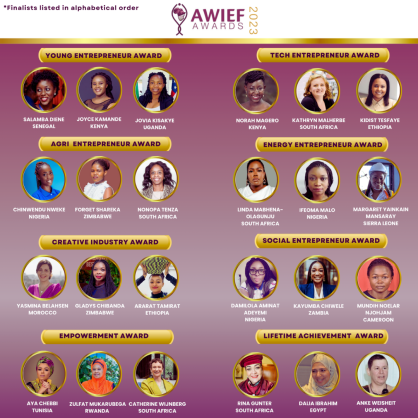
Africa Women Innovation and Entrepreneurship Forum (AWIEF) Announces Finalists for 2023 AWIEF Awards

Location: News
Africa Women Innovation and Entrepreneurship Forum (AWIEF)

The Africa Women Innovation and Entrepreneurship Forum (AWIEF) (https://www.AWIEForum.org) is delighted to announce the finalists for its 2023 AWIEF Awards.

Launched in 2017, the prestigious annual AWIEF Awards is an initiative to recognise, honour, and celebrate women entrepreneurs and business owners in Africa across various industry sectors for their achievements and contribution to the continent's inclusive economic growth and social development.

An international and independent Panel of Judges selected the twenty-four (24) finalists across eight (8) categories. These outstanding women founders and business leaders operate in a diverse range of sectors and represent companies from fourteen (14) different African countries: Cameroon, Egypt, Ethiopia, Kenya, Morocco, Nigeria, Rwanda, Senegal, Sierra Leone, South Africa, Tunisia, Uganda, Zambia, and Zimbabwe.

The 2023 AWIEF Awards winners will be announced and celebrated at a special ceremony and gala dinner at the AWIEF2023 Conference and Awards, taking place on 9 and 10 November at the Kigali Convention Centre, Kigali, Rwanda.

AWIEF Founder and CEO, Irene Ochem, said: “Given the huge number and calibre of the nominations received this year, it is clear that female entrepreneurship and business leadership is thriving across Africa. It is our honour to recognise and celebrate the achievements and contributions of these women to the inclusive growth of their respective sectors, their countries and the continent's economy.”

A member of the 2023 AWIEF Awards Panel of Judges, John-Paul Iwuoha, Founder of Smallstarter Africa, said: "As a Judge, I was thoroughly impressed by the quality of applications in all the categories. It is great to see how AWIEF continues to attract innovative women across Africa who are creating enormous value for society."

The finalists for the 2023 AWIEF Awards are (listed in alphabetical order):

Young Entrepreneur Award

Salamba Diene, CEO, BIOSENE SARL, Senegal

Joyce Kamande, Co-founder & CEO, Safi Organics, Kenya

Jovia Kisakye, CEO, Sparkle Agro Brand, Uganda

Tech Entrepreneur Award

Norah Magero, Founder & CEO, Drop Access Limited, Kenya

Kathryn Malherbe, CEO, Med Sol AI Solutions, South Africa

Kidist Tesfaye, Founder & CEO, YeneHealth, Ethiopia

Agri Entrepreneur Award

Chinwendu Nweke, CEO, Bridge Merchant Enterprise, Nigeria

Forget Shareka, Founder, Chashi Foods, Zimbabwe

Nonopa Tenza, Founder & MD, Kevinot Farming, South Africa

Energy Entrepreneur Award

Linda Mabhena-Olagunju, Founder & CEO, DLO Energy Resources Group, South Africa

Ifeoma Malo, CEO, Clean Technology Hub, Nigeria

Margaret Yainkain Mansaray, Founder & CEO, Women in Energy Sierra Leone Limited, Sierra Leone

Creative Industry Award

Yasmina Belahsen, Founder, MayaDigital, Morocco

Gladys Chibanda, Founder & CEO, Krafted Ink, Zimbabwe

Ararat Tamirat, Founder & GM, Tuba By Ararat, Ethiopia

Social Entrepreneur Award

Damilola Aminat Adeyemi, Co-founder & CEO, D-Olivette Global Enterprise, Nigeria

Kayumba Chiwele, Founder & Principal Psychologist, MindAid Zambia, Zambia

Mundih Noelar Njohjam, Medical Doctor, Epilepsy Awareness, Aid and Research Association, Cameroon

Empowerment Award

Aya Chebbi, Founder & President, Nalafem Collective, Tunisia

Zulfat Mukarubega, Founder, University of Tourism, Technology and Business Studies, Rwanda

Catherine Wijnberg, Founder & CEO, Fetola, South Africa

Lifetime Achievement Award

Rina Gunter, Founding Partner, Gunter Attorneys, South Africa

Dalia Ibrahim, CEO, Nahdet Misr Publishing House, Egypt

Anke Weisheit, Co-founder & Chair, PHARMBIOTRAC, Mbarara University of Science and Technology, Uganda

Tickets for the AWIEF2023 Conference and Awards are available online at: https://apo-opa.info/3JHKUem

Distributed by APO Group on behalf of Africa Women Innovation and Entrepreneurship Forum (AWIEF).

For more information and media enquiries, email: info@awieforum.org

Media files
Africa Women Innovation and Entrepreneurship Forum (AWIEF)
Download logo
Read moreAfrica Women Innovation and Entrepreneurship Forum (AWIEF) Announces Finalists for 2023 AWIEF Awards
20 September 2023

GLOBAL INFLATION KEEPS RISING presenting a persistent challenge

Location: MyPR

As inflation and interest rates continue their upward trajectory, causing concern among households and businesses, Fred Razak, Chief Trading Strategist at the online trading platform CMTrading, provides insight into the factors contributing to these increases and offers his perspective on what the future may hold. An Uncertain Future “In recent times, we’ve witnessed the Core …

Read moreGLOBAL INFLATION KEEPS RISING presenting a persistent challenge
20 September 2023

Apple Music announces Cassper Nyovest as the featured artist for this month’s Rap Life Africa as he releases 7th studio album ‘Solomon’

Location: Entertainment, MyPR

Apple Music’s Rap Life Radio, presented by Global Editorial Head of Hip-Hop and R&B, Ebro Darden will feature South African superstar, chart-topping rapper and business man Cassper Nyovest on this week’s episode. Ebro and Africa Now Radio host, Nandi Madida, chat about his latest single “018” feat. Maglera Doe Boy which is available to stream …

Read moreApple Music announces Cassper Nyovest as the featured artist for this month’s Rap Life Africa as he releases 7th studio album ‘Solomon’
20 September 2023

Celebrate Negroni Week With The Perfect Negroni Serve!

Location: Entertainment, MyPR

Join us on a journey through flavour and time as we celebrate an iconic cocktail – the Negroni! The negroni is a cocktail that has surpassed trends and time for over a century, dating all the way back to the early 20th century Florence. It was born at the hands of Count Camillo Negroni when, …

Read moreCelebrate Negroni Week With The Perfect Negroni Serve!
20 September 2023

Holding those accountable for financial misconduct imperative for public trust

Location: News

Holding those accountable for financial misconduct imperative for public trust

With South Africa’s public finances being under strain, Minister of Finance Enoch Godongwana has emphasised the importance of holding individuals and entities accountable for financial misconduct, as it is vital for public trust.

“Without swift and fitting consequences, we risk eroding public trust in our capacity to manage public funds effectively, with less and less funding available to deliver much-needed services to our people,” Godongwana said on Wednesday.

Virtually addressing the 3rd Public Finance Management Conference, the Minister said rigorous and independent audit practices play a pivotal role in unearthing corruption and financial mismanagement, providing invaluable insights and recommendations for the judicious utilisation of public funds.

“Our public finances are currently in a difficult position, one that is increasing in complexity and uncertainty. The short-term risks to the local and global economy that we predicted in the February Budget have now materialised.

“Government has collected much lower-than-expected tax revenue. At the same time, tighter financial conditions have made it difficult to borrow more and at affordable rates.

“Continued load shedding, the poor performance of our logistics sectors, and the lasting damage done by State capture to our institutions, have made the difficult fiscal situation even more challenging,” the Minister said.

He noted that these and other factors have put tremendous strain on the financial resources available to address the country’s most urgent service delivery priorities.

“Furthermore, ethical sourcing of goods and services through public procurement stands as an unassailable priority. Non-compliance with ethical standards in procurement can have far-reaching consequences, compromising the integrity of our financial processes,” Godongwana said.

He said being innovative, adaptive, agile and solutions-driven during these volatile, uncertain, complex and ambiguous (VUCA) times is important.

“It is important to note that we have faced similar challenges in the past and managed to make the necessary policy decisions and trade-offs to navigate the storm.

“The path forward is not devoid of challenges; however, we are not powerless. With innovation, adaptability, and a resolute commitment to ethical financial management, we can surmount these obstacles and forge a luminous future for South Africa.

“We must leverage technology, collaborate across sectors, and put our citizens at the centre of our decisions. Together, we hold the power to rekindle public trust, to advance good governance, and to fortify our nation's public financial management,” the Minister said. – SAnews.gov.za

nosihle
Wed, 09/20/2023 - 11:43

153 views
Read moreHolding those accountable for financial misconduct imperative for public trust
20 September 2023

Electricity Minister to co-host South African Transmission Financing Seminar

Location: News

Electricity Minister to co-host South African Transmission Financing Seminar

Minister in The Presidency for Electricity, Dr Kgosientsho Ramokgopa, is expected to co-host a Transmission Financing Seminar with the Johannesburg Stock Exchange (JSE) on Thursday.

The Minister will deliver a keynote address at the seminar.

According to a statement, the seminar is aimed at galvanising “discussions on the financing of South Africa’s Transmission Development Plan, which seeks to expand, support and secure the sustainability of South Africa’s energy mix and electricity supply”.

“The development and expansion of South Africa’s electricity transmission infrastructure is a critical cog to enabling diverse energy solutions, which are geographically located in various parts of the country, to contribute to the country’s electricity grid.

“This will significantly strengthen and increase South Africa’s electricity supply and capacitate the energy sector in meeting global decarbonisation targets and ensuring South Africa’s long-term energy security and energy sovereignty,” the statement read.

Various industry stakeholders are expected to attend the seminar.

“The seminar will bring together government, energy industry veterans and potential private sector investors to engage in a critical conversation on South Africa’s transmission infrastructure requirements for long-term energy security; explore alternative funding mechanisms for maintaining, modernising and expanding the national grid and an exchange on international experience of countries that have had similar challenges and what models were pursued to overcome these challenges,” the statement read. – SAnews.gov.za

NeoB
Wed, 09/20/2023 - 09:25

94 views
Read moreElectricity Minister to co-host South African Transmission Financing Seminar
20 September 2023

Does Branded Merchandise Still Maintain A Space In Modern Marketing?

Location: MyPR

In today’s ever-evolving marketing landscape, where digital strategies often dominate the conversation, one element continues to stand the test of time – that of branded merchandise. International research shows that this steadfast pillar of modern marketing, commonly known as promotional products, has remained a powerhouse in successful campaigns for decades. In fact, according to Chris …

Read moreDoes Branded Merchandise Still Maintain A Space In Modern Marketing?
  • Previous
  • Page 1
  • Interim pages omitted …
  • Page 92
  • Page 93
  • Page 94
  • Page 95
  • Page 96
  • Interim pages omitted …
  • Page 103
  • Next

Copyright © 2026 · MyZA · All Rights Reserved · Powered by Stratlec Online