• Skip to main content
  • Skip to header right navigation
  • Skip to after header navigation
  • Skip to site footer
MyZA

MyZA

News, Directory, Events and Other Stuff

  • Social Media
  • Sport
  • World News
  • Home
  • Submit News
  • Directory
  • Events
  • Stratlec
  • TFSA
  • News
    • APO
    • Today’s Sport News
    • Todays Social Media and Tech Headlines
    • Today’s World News
    • Today’s SA Financial News
  • Contact
You are here: Home / Archives for Kenya

Kenya

27 September 2023

Ministry of Foreign Affairs co-hosts “the Colours of Africa 2023” events

Location: News

Ministry of Foreign Affairs of the Kingdom of Thailand
Download logo

The Ministry of Foreign Affairs, in collaboration with the African Embassies in Bangkok, namely, Egypt, Kenya, Morocco, Nigeria and South Africa, as well as Khon Kaen Province, Khon Kaen Chamber of Commerce, Khon Kaen University and Young Ambassador of Virtue Foundation organised the Colours of Africa 2023 events during 13 - 14 September on 21 September 2023. The events sought to promote public awareness, including the private sector and the academia, on the African continent, as well as the potential of trade, investment and tourism opportunities in Africa.

The activities included:

1. The Seminar on Trade and Investment Opportunities in Africa on 13 September 2023 at Avani Hotel Khon Kaen, with speakers including African ambassadors to Thailand and successful Thai entrepreneurs. The session observed the exchange of knowledge on trade and investment opportunities in Africa, as well as first-hand experience on conducting business in the region to the audience comprising of entrepreneurs from Khon Kaen and nearby provinces.

2. Academic Lecture on Africa on 14 September 2023 at Khon Kaen University, under the topic “The African Union Agenda 2063” and “Nelson Mandela: The Epitome of Ethical Leadership in Africa and the World: Learning from his Legacy for a better Africa and a Humane World Order,” was given by the African Ambassadors to Thailand, with more than 300 students and lecturers from Khon Kaen University participated. On this occasion, the African Ambassadors also visited the university's Faculty of Agriculture, which already had academic cooperation with various universities in Africa.

3. The Student Quiz Competition, Games and Exhibitions to enhance knowledge on Africa on 21 September 2023 at Vithes Samosorn, Ministry of Foreign Affairs, with more than 200 participants, including students and teachers from 23 Thai schools around Thailand affiliated with the Young Ambassador of Virtue Foundation. During the quiz's final round, Ms. Busadee Santipitaks, Acting Permanent Secretary for Foreign Affairs, Director-General of the Department of South Asian, Middle East and African Affairs, and African Ambassadors to Thailand were invited to ask questions and present scholarships to the winning teams, as well as tokens of appreciation and certificates to all participating students.

Distributed by APO Group on behalf of Ministry of Foreign Affairs of the Kingdom of Thailand.

Read moreMinistry of Foreign Affairs co-hosts “the Colours of Africa 2023” events
24 September 2023

Nkhasi and Desta set recent Absa RUSH YOUR CITY JOBURG 10K Course Records

Location: MyPR

Lesotho’s Namakoe Nkhasi and Ethiopia’s Debash Desta emerged triumphant at the 2023 Absa RUN YOUR CITY JOBURG 10K and in the process obliterated the previous course records when they crossed the finish line at the Mary Fitzgerald Square, Newtown (Johannesburg) on Sunday 24 September (National Heritage Day) in 29 minutes 07 seconds and 33 minutes …

Read moreNkhasi and Desta set recent Absa RUSH YOUR CITY JOBURG 10K Course Records
22 September 2023

On World Rhino Day, The United States (U.S.) Celebrates its Propitious Conservation Partnership with the World Wildlife Fund (WWF) and the Government of Namibia

Location: News

U.S. Embassy in Namibia
Download logo

The population of black rhinos declined dramatically in the 20th century at the hands of European hunters and settlers. Between 1960 and 1995, black rhino numbers dropped by a sobering 98%, to less than 2,500 individuals. Since then, the species has made a tremendous comeback from the brink of extinction. Thanks to persistent conservation efforts across Africa, black rhino numbers have doubled from their historic low 20 years ago to more than 6,000 today. However, the black rhino is still considered critically endangered, and a lot of work remains to bring their population up to even a fraction of what it once was—and to ensure that it stays there. Wildlife crime—in this case, poaching of rhinos for the illegal international market for their horns—continues to plague the species and threaten its recovery.

The Namibian government and its partners in conservation, including communal conservancies have been at the cutting edge of efforts to relocate, protect and expand the range of rhinos in the country. While the threat of poaching persists, the impact of these efforts is dramatic. Namibia is now home to the largest population of black rhino left on earth.

TACKLING WILDLIFE CRIME

Poaching remains the deadliest and most urgent threat to black rhinos. WWF is working with government agencies, local communities and other partners in Namibia, Kenya, and South Africa to support law enforcement agencies, develop and build on innovative tech solutions, and equip and train rangers to stop poachers.

In Namibia, WWF, with support from the USAID funded Combatting Wildlife Crime Project and INL projects, is working across sectors, agencies, and borders to help implement the country's ambitious law enforcement strategy to combat wildlife trafficking. WWF also supports the Namibian government in the implementation of its national black rhino strategy, in part by moving rhinos from parks with significant populations to other areas that historically held rhinos but currently do not—a process known as translocation. WWF is also working with the Ministry of Environment, Forestry and Tourism and other conservation partners to protect both black and white rhinos, including the maintenance of a comprehensive DNA databank used for forensic investigations and research, and the use of sniffer dogs.

PROTECTING AND MANAGING KEY POPULATIONS

WWF supports aerial population surveys at key sites such as Etosha National Park in Namibia. The surveys are critical for evaluating breeding success, deterring poachers, and monitoring rhino mortality. WWF is also working with partners to develop and implement cutting-edge technologies in range states to closely monitor key populations. When paired with boots-on-the-ground, innovative solutions like electronic identification and tracking tags, radio and satellite collars, night vision cameras, and camera traps provide critical data that is used to make important decisions for black rhino populations going forward.

COMMUNITY-BASED CONSERVATION

Namibia was the first African country to incorporate protection of the environment into its constitution. In 1996, the new Namibian government granted communities the right to create conservancies — areas with defined borders and governance and management structures outside of parks — where communities have the right to manage and benefit from their natural resources. With long-term support from IRDNC, NNF, SRT, WWF and other NACSO partners, robust conservation efforts including community game guards, monitoring, community engagement campaigns, partnerships between the communities and private sector tourism, and translocation projects, which relocate species into new habitats so that they have more space to breed, have made enriched landscapes and lives in rural Namibia.

On World Rhino Day, we join our Namibian partners in recognizing their efforts to protect black rhinos – against tremendous odds. Not only does Namibia have the largest population of black rhinos in the world, but communal conservancies have allowed rhinos to roam free, outside of national parks. These communal conservancies—working with the government, nonprofit organizations and others—have restored populations of black rhinos, creating a rhino-based economy that benefits both people and wildlife!

For more information on WWF Programs in Namibia, visit https://www.wwfnamibia.org.

For more information on U.S. global climate and environmental priorities, visit Climate and Environment – United States Department of State.

Distributed by APO Group on behalf of U.S. Embassy in Namibia.

Read moreOn World Rhino Day, The United States (U.S.) Celebrates its Propitious Conservation Partnership with the World Wildlife Fund (WWF) and the Government of Namibia
21 September 2023

Africa among regions with highest number of industrial systems under attack in the first half of 2023

Location: News
Kaspersky

Malicious objects of all types were detected and blocked on 34% of Industrial Control System (ICS) computers in the first half of 2023, according to the ICS CERT landscape report (https://apo-opa.info/3LwG719) by Kaspersky (www.Kaspersky.co.za). In Africa over this period attacks were detected on 40,3% of ICS computers, placing it in first place among the other regions. The top industries under attack were energy (45,9%), engineering & integration (44%) and building automation (40%). All these attacks were blocked after detection.

ICS computers are used in oil & gas, energy, automotive manufacturing, building automation infrastructures and other spheres to perform a range of operational technology (OT) functions – from the workstations of engineers and operators to supervisory control and data acquisition (SCADA) servers and Human Machine Interface (HMI). Cyberattacks on industrial computers are considered to be extremely dangerous as they may cause material losses and production downtime for the controlled production line and even the facility as a whole. Moreover, industrial enterprises put out of service can seriously undermine a region's social welfare, ecology and macroeconomics.

An analysis of the most significant and targeted threats detected on ICS computers in selected countries of Africa in the first half of 2023 shows that the threat landscape can vary between countries and between industries due to the differences in the security maturity of different countries/industries and the current focus of threat actors. In South Africa in the first half of 2023 malware was detected and blocked on 29,1% of ICS computers, in Nigeria on 32,6%, in Kenya on 34,5% of machines.

There are different types of cyberthreats that OT-related computers face – malicious scripts, spy trojans, worms, ransomware, and others. In the first half of 2023 Africa had the highest percentage of ICS computers on which spyware was blocked (9,8%). The Middle East and Southeast Asia had similarly high percentages (8,3% and 8,1%). The global average stands at 6,1%. 

Africa was also the region with the highest percentage of ICS computers (14,8%) on which attacks from denylisted Internet resources were blocked (these are web resources associated with distributing or controlling malware). The global average is 11,3%.

Viruses and worms spread across ICS networks by means of removable media, shared folders, infected files, such as backups, and network attacks on outdated software. The percentage of ICS computers on which worms were detected was very high in Africa (7% vs. 2,3% global average), making this region the leader by percentage of ICS computers on which threats were detected after removable devices were connected.

“Africa's industrial landscape is diverse, ranging from large-scale mining operations to small-scale agriculture. This means that ICS cybersecurity solutions need to be adaptable to various sectors and technologies. In some regions, legacy ICS systems that lack modern security features are still in use. These systems are often more vulnerable to cyberthreats and require significant upgrades. Lastly, some critical infrastructure in Africa is located in remote areas with limited connectivity, which can make it difficult to monitor and secure ICS assets effectively,” comments Evgeny Goncharov, Head of Kaspersky ICS CERT. “By understanding these risks, organisations can make informed decisions, allocate resources wisely, and efficiently fortify their defenses. In doing so, they not only protect their bottom line but also contribute to a safer and more secure digital ecosystem for all.”

Read more about the ICS threat landscape in the first half of 2023 on the Kaspersky ICS CERT website (https://apo-opa.info/3LwG719).

To keep your OT computers protected from various threats, Kaspersky experts recommend:

  • Conducting regular security assessments of OT systems to identify and eliminate possible cyber security issues.
  • Establishing continuous vulnerability assessment and triage as a basement for effective vulnerability management process. Dedicated solutions like Kaspersky Industrial CyberSecurity (https://apo-opa.info/451Yguw) may become an efficient assistant and a source of unique actionable information, not fully available in public.
  • Performing timely updates for the key components of the enterprise's OT network; applying security fixes and patches or implementing compensating measures as soon as it is technically possible is crucial for preventing a major incident that might cost millions due to the interruption of the production process.
  • Using EDR solutions such as Kaspersky Endpoint Detection and Response (https://apo-opa.info/3OsQQvs) for timely detection of sophisticated threats, investigation, and effective remediation of incidents.
  • Improving the response to new and advanced malicious techniques by building and strengthening your teams' incident prevention, detection, and response skills. Dedicated OT security trainings for IT security teams and OT personnel is one of the key measures helping to achieve this.

Distributed by APO Group on behalf of Kaspersky.

For further information please contact:
Nicole Allman | INK&Co.
nicole@inkandco.co.za

Social Media:
Facebook: https://apo-opa.info/3M3uy0L
Twitter: https://apo-opa.info/3OaLeGw
YouTube: https://apo-opa.info/41wO7V6
Instagram: https://apo-opa.info/42BZnRq
Blog: https://apo-opa.info/42Apbxn

About Kaspersky:
Kaspersky is a global cybersecurity and digital privacy company founded in 1997. Kaspersky's deep threat intelligence and security expertise is constantly transforming into innovative solutions and services to protect businesses, critical infrastructure, governments and consumers around the globe. The company's comprehensive security portfolio includes leading endpoint protection, specialized security products and services, as well as Cyber Immune solutions to fight sophisticated and evolving digital threats. Over 400 million users are protected by Kaspersky technologies and we help over 220,000 corporate clients protect what matters most to them. Learn more at www.Kaspersky.co.za.  

Media files
Kaspersky
Download logo
Read moreAfrica among regions with highest number of industrial systems under attack in the first half of 2023
20 September 2023

Africa Women Innovation and Entrepreneurship Forum (AWIEF) Announces Finalists for 2023 AWIEF Awards

Location: News
Africa Women Innovation and Entrepreneurship Forum (AWIEF)

The Africa Women Innovation and Entrepreneurship Forum (AWIEF) (https://www.AWIEForum.org) is delighted to announce the finalists for its 2023 AWIEF Awards.

Launched in 2017, the prestigious annual AWIEF Awards is an initiative to recognise, honour, and celebrate women entrepreneurs and business owners in Africa across various industry sectors for their achievements and contribution to the continent's inclusive economic growth and social development.

An international and independent Panel of Judges selected the twenty-four (24) finalists across eight (8) categories. These outstanding women founders and business leaders operate in a diverse range of sectors and represent companies from fourteen (14) different African countries: Cameroon, Egypt, Ethiopia, Kenya, Morocco, Nigeria, Rwanda, Senegal, Sierra Leone, South Africa, Tunisia, Uganda, Zambia, and Zimbabwe.

The 2023 AWIEF Awards winners will be announced and celebrated at a special ceremony and gala dinner at the AWIEF2023 Conference and Awards, taking place on 9 and 10 November at the Kigali Convention Centre, Kigali, Rwanda.

AWIEF Founder and CEO, Irene Ochem, said: “Given the huge number and calibre of the nominations received this year, it is clear that female entrepreneurship and business leadership is thriving across Africa. It is our honour to recognise and celebrate the achievements and contributions of these women to the inclusive growth of their respective sectors, their countries and the continent's economy.”

A member of the 2023 AWIEF Awards Panel of Judges, John-Paul Iwuoha, Founder of Smallstarter Africa, said: "As a Judge, I was thoroughly impressed by the quality of applications in all the categories. It is great to see how AWIEF continues to attract innovative women across Africa who are creating enormous value for society."

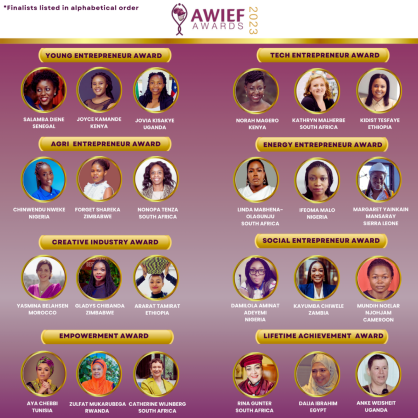
The finalists for the 2023 AWIEF Awards are (listed in alphabetical order):

Young Entrepreneur Award

Salamba Diene, CEO, BIOSENE SARL, Senegal

Joyce Kamande, Co-founder & CEO, Safi Organics, Kenya

Jovia Kisakye, CEO, Sparkle Agro Brand, Uganda

Tech Entrepreneur Award

Norah Magero, Founder & CEO, Drop Access Limited, Kenya

Kathryn Malherbe, CEO, Med Sol AI Solutions, South Africa

Kidist Tesfaye, Founder & CEO, YeneHealth, Ethiopia

Agri Entrepreneur Award

Chinwendu Nweke, CEO, Bridge Merchant Enterprise, Nigeria

Forget Shareka, Founder, Chashi Foods, Zimbabwe

Nonopa Tenza, Founder & MD, Kevinot Farming, South Africa

Energy Entrepreneur Award

Linda Mabhena-Olagunju, Founder & CEO, DLO Energy Resources Group, South Africa

Ifeoma Malo, CEO, Clean Technology Hub, Nigeria

Margaret Yainkain Mansaray, Founder & CEO, Women in Energy Sierra Leone Limited, Sierra Leone

Creative Industry Award

Yasmina Belahsen, Founder, MayaDigital, Morocco

Gladys Chibanda, Founder & CEO, Krafted Ink, Zimbabwe

Ararat Tamirat, Founder & GM, Tuba By Ararat, Ethiopia

Social Entrepreneur Award

Damilola Aminat Adeyemi, Co-founder & CEO, D-Olivette Global Enterprise, Nigeria

Kayumba Chiwele, Founder & Principal Psychologist, MindAid Zambia, Zambia

Mundih Noelar Njohjam, Medical Doctor, Epilepsy Awareness, Aid and Research Association, Cameroon

Empowerment Award

Aya Chebbi, Founder & President, Nalafem Collective, Tunisia

Zulfat Mukarubega, Founder, University of Tourism, Technology and Business Studies, Rwanda

Catherine Wijnberg, Founder & CEO, Fetola, South Africa

Lifetime Achievement Award

Rina Gunter, Founding Partner, Gunter Attorneys, South Africa

Dalia Ibrahim, CEO, Nahdet Misr Publishing House, Egypt

Anke Weisheit, Co-founder & Chair, PHARMBIOTRAC, Mbarara University of Science and Technology, Uganda

Tickets for the AWIEF2023 Conference and Awards are available online at: https://apo-opa.info/3JHKUem

Distributed by APO Group on behalf of Africa Women Innovation and Entrepreneurship Forum (AWIEF).

For more information and media enquiries, email: info@awieforum.org

Media files
Africa Women Innovation and Entrepreneurship Forum (AWIEF)
Download logo
Read moreAfrica Women Innovation and Entrepreneurship Forum (AWIEF) Announces Finalists for 2023 AWIEF Awards
19 September 2023

Young scientists to compete for top honours at Eskom Expo International Science Honest

Location: MyPR

This year’s Eskom Expo for Young Scientists International Science Fair (ISF) is set to be a global showcase of talent, featuring participants from 35 regions across South Africa, alongside international learners from 10 countries. From 3 to 6 October 2023, a total of 330 local young scientists and 20 participants from Ghana, India, Kenya, Lesotho, …

Read moreYoung scientists to compete for top honours at Eskom Expo International Science Honest
13 September 2023

IYF Celebrates Women In Tech – Skills For Success Is Changing The Gender Landscape In Information Technology

Location: MyPR

Digital technologies have created new spaces for interaction and enabled new ways to connect, share experiences, work and build communities. It is estimated that by 2030 in Sub-Saharan Africa alone more than 230 million jobs will require digital skill sets. The Information and Communications Technology (ICT) sector has always been a male-dominated industry. In 2022, …

Read moreIYF Celebrates Women In Tech – Skills For Success Is Changing The Gender Landscape In Information Technology
11 September 2023

Unleashing Agritech Innovation in Africa

Location: News
Pitch AgriHack

The Pitch AgriHack (https://apo-opa.info/3Zaz0kE) 2023 results are in, capping an inspiring journey celebrating Africa's most exciting agritech visionaries. Applicants from 39 African countries went through a rigorous selection process until six winners were crowned at the Youth Innovation Awards on the final day of The Africa Food Systems Forum hosted at the Julius Nyerere ICC, in Dar es Salaam, Tanzania. This year's Pitch AgriHack theme, “Unleash your Innovation,” resonated deeply with the entrepreneurs who demonstrated how technology can be harnessed to drive sustainability, improve productivity, and uplift communities.

Pitch AgriHack (https://apo-opa.info/3Zaz0kE) 2023 was jointly organized by the African Food Systems Forum (AGRF), Heifer International, and Generation Africa. This year participants and supporters witnessed an impressive showcase of innovation. The competition underscored the power of technology-driven solutions in addressing pressing challenges across the agricultural value chain. Awarding a total prize pool of USD 45,000, the competition recognized and celebrated the brilliance of young minds that are reshaping the future of African agriculture.

"This competition serves as a dynamic showcase of sustainable practices and innovation that is set to define African agriculture. Beyond acknowledging inventive ideas, Pitch AgriHack underscores the steadfast commitment of our youth to revolutionize the sector. At Heifer International, we recognize technology's pivotal role in fostering prosperity for smallholder farmers and rural communities," said Adesuwa Ifedi, Senior Vice President for Africa Programs. "We are deeply committed to investing in and enabling young individuals to create solutions that enhance the yields of smallholder farmers, and the agritech solutions presented not only address challenges within the agricultural value chain but also promote environmental conservation, resource efficiency, and long-term viability."

Dr. Agnes Kalibata, President of AGRA and Former Special Envoy to the UN Food Systems Summit, remarked, "The achievements seen at Pitch AgriHack 2023 truly celebrate entrepreneurial excellence in agriculture. These young innovators are not only shaping the sector's trajectory through their creativity and dedication, but they're also inspiring future leaders to consider impactful careers in agriculture and agribusiness. The technologies presented demonstrate the power of youth to drive practical and sustainable solutions, paving the way for a resilient and prosperous tomorrow."

The innovative solutions developed by the 2023 Pitch AgriHack finalists span a diverse spectrum. From turning waste into cooking gas and electricity, to ultra-fast composting with integrated nutrient analysers, these young entrepreneurs are finding value in nature-positive projects. Cost-saving measurement devices that analyse crop and soil health, providing recommendations that empower farmers, also impressed the judges. Artificial Intelligence integrations featured in several digital farming assistants. Drawing on massive data sets they optimize production, detect diseases, and generate recommendations for improved farming practices.

The entrepreneurs also presented game-changing inclusive finance solutions for women farmers and commodity-backed, post-harvest handling and storage for smallholders. With automated farm management and monitoring systems and behaviour modification solutions that reward farmers for following better practises, Africa's young innovators are determined to build a better food system. 

“The multi-facetted technologies, environmentally-aware approaches, and thorough business models we saw here today indicate that our youth entrepreneurs are building more resilient businesses with more comprehensive offerings that in turn help their farmers become more resilient, too,” said Dickson Naftali, Head of Generation Africa. “It is exactly the type of transformation we need, at scale, for the responsible development of the African food system. Pitch AgriHack not only celebrates such innovation but also fosters networking, collaboration, and exchange among these enterprising youth, mentors, investors, and industry experts. It creates a supportive ecosystem that propels them to grow. We are excited to see how they benefit from this opportunity."

The Pitch AgriHack 2023 Winners are:

Early-Stage Winners:

Winner: Watson Matsa, Co-Founder and CEO of eSusFarm Africa, South Africa

eSusFarm connects with rural farmers via feature-phone USSD, allowing them access to value-chain services, markets, and credit providers. Their system helps small farmers build their track record by collecting farm production data, and monitoring produce quality. Connect with Watson's venture at www.eSusFarm.Africa.

Runner-up: El Mahdi Aboulmanadel, Founder and CEO of DeepLeaf, Morocco

DeepLeaf is an agricultural deep learning lab that is focused on leveraging the latest in AI technology to revolutionize the way we grow crops. Their intelligent farming chatbot, Morshida, uses deep learning to analyse plant images and assist farmers in disease analysis. With natural language processing, Morshida can communicate in 14 different languages and dialects. Connect with El Mahdi's venture at https://DeepLeaf.io.

Mature and Growth-Stage Winners:

Winner: Tunde Adeyemi, Founder and CEO of D-Olivette, Nigeria

D-Olivette builds Bio-Tanks, anaerobic digestors that transforms organic farm waste into fertilizer and biogas for cooking and electricity generation. Their solution is helping smallholder farmers to reduce operational costs, pollution, and CO2 emissions. Connect with Tunde's venture at http://D-Olivette.com.

Runner-up: Reem Nafea, Co-Founder and Business Development Director of BioMasr, Egypt

Biomasr's new Rafik app is a hub for organic agriculture in Egypt. It connects farmers to ecological waste management, clean energy production, and organic fertiliser suppliers, while also empowering women farmers to grow and sell quality organic produce. Connect with Reem's venture at https://BioMasr.com.

Women-led Agribusiness Winners:

Winner: Priscilla Wakarera, Co-Founder and CEO of Rhea, Kenya

Rhea helps smallholder farmers make the right decisions by providing affordable, convenient soil testing for smarter farming. Their IoT device does moisture testing, NPK measurements and soil PH tests before sending AI generated recommendations for fertiliser, pH adjustments, irrigation, and crop recommendations. Connect with Priscilla's venture at www.Rhea.Africa.

Runner-up: Solape Akinpelu, Co-Founder and CEO of HerVest, Nigeria

HerVest is about inclusive finance for African women. They provide easy access to target savings, impact investments and credit financing for smallholder women farmers and women-owned/led SMEs in Nigeria. Connect with Solape's venture at https://www.HerVest.ng.

The winners were selected by an esteemed panel of judges that included experts and leaders in agriculture and technology. Pitch AgriHack contestants were honoured to get invaluable advice and guidance from this highly-respected judges group consisting of:

  • Barbra Sehlule Muzata, Communications Lead – CGIAR  
  • Dr. Nalishebo Meebelo, Executive Director – Regional Network of Agricultural Policy Research Institutes (ReNAPRI)
  • Nono Sekhoto, Sector Lead - AL for Agribusiness Network – African Leadership Academy
  • Victor Mugo, Head of Local Youth Action – World Food Forum
  • Sheila Kaaya, Lead - Agriculture, Agribusiness and Agrifood systems – The Mastercard Foundation
  • Jane Lowicki-Zucca, Senior Youth Advisor – USAID
  • Patrick Heffer, Deputy Director General – International Fertilizer Association
  • Jehiel Oliver, Founder & CEO – Hello Tractor
  • Dr. Charles Iyangbe, Signature Program Director - Africa Programs – Heifer International

This year's Pitch AgriHack applicant breakdown mirrors Africa's youthful dynamism. 79.3% were early-stage startups, embodying the innovative pulse of the competition. Mature/growth-stage agritech ventures represented 20.5%, underlining the sector's growth.

The innovation showcased at Pitch AgriHack 2023 is a strong affirmation of the commitment of AGRF, Heifer International, and Generation Africa to nurture innovation, create job opportunities, and enhance food security across the continent. Through this dynamic competition, the partners seek to inspire a new generation of agritech entrepreneurs who will not only revolutionize the agricultural landscape but also empower smallholder farmers to overcome challenges and embrace sustainable change.

For further information and updates, please visit the official Generation Africa website: https://GenAfrica.org. 

Distributed by APO Group on behalf of Pitch AgriHack.

Contact:
Jane Machigere
jane@jsmcommunications.com
www.GenAfrica.org 

About Heifer International:
Since 1944, Heifer International has worked with nearly 43 million people around the world to end hunger and poverty in a sustainable way. Working with rural communities across Africa for nearly 50 years, Heifer International supports farmers and local food producers to strengthen local economies and build secure livelihoods that provide a living income. Heifer is currently operating in 19 countries across Africa, Asia and the Americas. For more information, visit https://www.Heifer.org.

About Generation Africa:
Generation Africa is a thematic platform of the AGRF, whose mandate is to strengthen the ecosystem for youth entrepreneurs in the agri-food sector across Africa. From its start in 2019, Generation Africa has brought together industry leaders, government institutions, NGOs, NPOs, and community platforms to collaborate on ecosystem development, curation and support of agribusinesses, research and advocacy, and the inspiration of young people to embrace opportunities in the agrifood sector. Find out more at https://GenAfrica.org.

About the AGRF:
The AGRF is the world's premier forum for African agriculture, bringing together stakeholders in the agricultural landscape to take practical actions and share lessons that will move African agriculture forward. Under AGRF's current strategy, the Forum is particularly focused on driving progress of the Malabo Declaration by 2025 as the priority set of commitments African Heads of State and Government have made to strengthen agricultural development at the centre of the continent's overall development and progress. The AGRF is organised by the AGRF Partners Group, a coalition of institutions that care about Africa's agriculture transformation. For more information visit https://AGRF.org.  

Media files
Pitch AgriHack
Download logo
Read moreUnleashing Agritech Innovation in Africa
11 September 2023

How cybercriminals trick their victims

Location: News
KnowBe4

Key findings:

  • 40% of the respondents from eight countries had been scammed online
  • Distraction and multi-tasking made 43% of the victims fall for an online scam
  • Financial scams affected nearly 48% of respondents

Nearly half of the 800 African survey participants have fallen victim to an online scam at least once, losing thousands of dollars in the process and compromising their personal data. This alarming statistic is one of the key findings of the KnowBe4 2023 Online Scams and Victims in Africa Report, which was just released. The report is based on a survey of 800 respondents across eight African countries, including South Africa, Kenya, Ghana, Nigeria, Morocco, Egypt, Mauritius, and Botswana. According to the report, 53% of the respondents who fell victim, were convinced the offer was legitimate because the website looked real, while nearly 48% of the scams were financial.

“These numbers highlight that online scams have evolved,” says Anna Collard, SVP Content Strategy & Evangelist at KnowBe4 AFRICA. “What is concerning is that 43% of the victims were distracted and multi-tasking when they fell for the scam, which highlights how easy it is for a person to make a mistake when they are not paying attention. Their emotional states can affect a person's judgment, awareness, and decision-making, causing them to be more vulnerable to online deception,” says Collard.

Financial scams were the most common type of online fraud, affecting nearly half of the respondents (50%). Other prevalent scams involved fake investments (30%), cryptocurrencies and NFTs (29%), brand impersonation (28%), information theft (24%), online shopping (21%), and fake job offers (21%). Less frequent but still significant scams included the classic Nigerian scam (17%), family or friend impersonation (18%), law enforcement impersonation (7%), tax fraud (6%), holiday fraud (9%), romance fraud (13%), and lottery fraud (15%).

An email was the preferred channel for scammers to initiate contact, accounting for 24% of the cases. Social media came in second with 19%, followed by WhatsApp with 10% and other messaging services like Telegram with 8%. In Nigeria, however, social media was the most used platform for scams (32%), while in South Africa, email was the dominant method (28%). The scammers often used social engineering techniques to convince their victims, such as creating rapport or trust by making websites look legitimate, sending messages that appealed to emotions, using social media profiles that seemed authentic, and avoiding spelling or grammar mistakes.

Collard says that the statistics reveal a more evolved and sophisticated network of scammers who use emerging technology to lure people into costly mistakes. 30% lost between US$100 and US$1,000, 40% around US$100, and 9% more than US$1,000.

The report also showed that falling for a scam had a significant psychological impact on many victims. While 23% said it had little or no effect on them, nearly 50% felt a strong or moderate impact. The results highlight how easy it is for victims to blame themselves, when in reality, they were deceived by cunning scam tactics. The survey found that many victims experienced negative emotions, such as embarrassment (39%), anger (40%), naivety (40%), loss of trust (36%), and shame (25%). Some also felt traumatised (20%), vulnerable and helpless (25%), anxious (16%), and guilty and fearful (15%).

The emotional toll of falling for an online scam may be more harmful than the money lost as a result. For most victims, the financial consequences were not severe, with 24% saying it took them several months to recover and 10% saying it took more than a year, but the majority had no repercussions or recovered in a few days to a few weeks. However, when it came to healing from the psychological impact of the scam, the majority said it took them a few months (22%) and 11% said it took more than a year.

“The report shows how vulnerable people are to online scams and the emotional distress they cause,” says Collard. “While respondents were aware of scams and understood the risks, many still said they did not feel prepared, which highlights the need for regular training that gives people continuous awareness of scams and the threat they pose, to themselves and their organisations.”

You can download the full report here. https://apo-opa.info/3LjspOS

Distributed by APO Group on behalf of KnowBe4.

Media files
KnowBe4
Download logo
Read moreHow cybercriminals trick their victims
8 September 2023

SA awarded Chairship of the Africa Green Hydrogen Alliance

Location: News

SA awarded Chairship of the Africa Green Hydrogen Alliance

South Africa will use its Chairship of the Africa Green Hydrogen Alliance (AGHA) to advance the green hydrogen agenda on the continent and support opportunities for peer-to-peer learning, technology transfer, economic and employment opportunities.

This is according to Minister in the Presidency for Electricity, Dr Kgosientsho Ramokgopa, who was handed Chairship of the AGHA on the sidelines of the Inaugural Africa Climate Summit (ACS), which took place from 04-06 September 2023 in Nairobi Kenya.

“Green hydrogen and its associated large scale renewable energy production has the potential to support the expansion of the electricity transmission infrastructure, to add additional renewable energy generation capacity and to support the local development of renewable energy.

“As such it is a key component of South Africa’s future energy mix to achieve sustainable energy security,” the Ministry for Electricity said on Thursday.

AGHA was formed in May 2022 by six African countries, Egypt, Kenya, Mauritania, Morocco, Namibia and South Africa, to drive decarbonisation through green hydrogen.

The alliance seeks to intensify collaboration and supercharge the development of green hydrogen projects on the African continent in line with the Just Energy Transition.

“It focuses on public and regulatory policy, capacity building, financing and certification needs to mobilise green hydrogen production for domestic use and export. The inclusion of the Ethiopia and Angola’s membership were also announced alongside South Africa’s Chairship,” the Ministry for Electricity said.

During the ACS, the Minister participated in panel sessions where he shared lessons on South Africa’s energy outlook and the role of green hydrogen in supporting energy security and driving green industrialisation.

On the margins of the Summit, the Minister engaged in multiple high-level bilateral meetings to explore energy collaborations and meaningful partnerships in the energy space.

The Minister’s participation at the Summit was underpinned by a commitment to consistent, sustainable and affordable energy supply for South Africa. – SAnews.gov.za


nosihle
Fri, 09/08/2023 - 09:30

649 views
Read moreSA awarded Chairship of the Africa Green Hydrogen Alliance
7 September 2023

The key to Africa’s industrialisation process and ending the region’s massive energy poverty

Location: News
African Energy Chamber

By Jason Mitchell

Africa's vast natural gas reserves are key to bringing energy to Africa's poorest countries, to a solid industrialisation process throughout the region and to significant poverty reduction.

The region is home to 33 of the world's 46 least-developed countries (LDCs) with an average income per head of less than $1,018 a year. The continent's poorest countries must expand at 6-7% a year if poverty is to be reduced in a big way and if the life chances of hundreds of millions of people are to be improved. To achieve this goal, these countries require abundant and cheap energy. Luckily, for many African states, the answer lies on their own doorstep — natural gas. Gas has remained a niche fuel in sub-Saharan Africa — contributing only 5% of the total energy mix against a global average of 20-25% — but its potential is enormous.

A new vision for Africa is required — a criss-crossing network of natural gas pipelines that brings energy to all corners of the region. The continent's contribution to global greenhouse gas emissions is tiny and will only become slightly bigger if the region's natural gas reserves are exploited. There is also a massive opportunity to wean poor Africans away from the use of biomass fuel and to help protect the region's forests through the rollout of small, liquified petroleum gas (LPG) stoves. Climate change is an issue in Africa but poverty reduction is a bigger one. Poverty is the biggest killer in Africa today.

It's very hard for Europeans and North Americans to imagine what it's like to live on under $1,018 a year, to not have readily available electricity, to not have a refrigerator or a washing machine, to not have a car, to not have a lawnmower, to not be able to fly from one country to another cheaply, to not have electricity in the school or the workplace and to have to use firewood or charcoal for cooking purposes. Fossil fuels have been at the heart of the Industrial Revolution that has brought prosperity and better living standards to the developed world. People in the First World must be very careful if they decide to deny Africans the same chance to prosper.

Africa has the lowest energy use per capita in the world — the average electricity use of a sub-Saharan African resident is lower than that of a household fridge in the United States. Average consumption per person in sub-Saharan Africa, excluding South Africa, is a mere 185 kilowatt-hours (kWh) a year, compared with about 6,500kWh in Europe and 12,700kWh in the US. Every year San Antonio, Texas, with a population of 1.5m people, uses as much electricity as the whole of Nigeria, with 203m people. Golden, Colorado, a small town with only 19,000 people, uses as much electricity as Chad, a country with 16m people.

The UN's Sustainable Development Goal Seven aims to “ensure access to affordable, reliable, sustainable and modern energy for all” by the year 2030. That's a tall order. In 2019, 917m people in Africa (around 80% of the region's population) relied on wood, charcoal, kerosene, animal and crop waste or other solid fuels to cook their food and heat their homes. The International Energy Agency (IEA) reports that almost 490,000 people die prematurely every year in sub-Saharan Africa from household air pollution-related causes — stemming from the lack of access to clean cooking facilities. Gas is a much cleaner form of cooking than biomass and its use should be encouraged. Biomass burning-power plants emit 300-400% more CO2 than natural gas per unit energy produced. Natural gas emits almost 50% less carbon dioxide than coal. 

Africa has one-fifth of the world's population but contributes only 3% to global greenhouse gas emissions. Incredibly, some 48 sub-Saharan African countries, excluding South Africa, have an estimated share of global emissions of only 0.55%. The fact is that many African states are already at net zero. If the continent were to use an additional 90bn cu m of natural gas per year — or 50% more than today — the resulting emissions would only raise Africa's cumulative contribution to global carbon emissions to 3.5% (ten gigatonnes) by the year 2050, according to the IEA. It really is a tiny increase compared to the chance of reducing poverty levels for hundreds of millions of poor people. If Africa is to provide universal electricity access by 2030 it would have to almost double its total generation capacity from around 260gw today to 510gw. 

Almost half the continent's 55 countries have proven natural gas reserves. Across the region, natural gas reserves amount to around 17.5trn cubic metres (cu m), making up around 9% of the world's total gas reserves. They are considerable in northern Africa (accounting for 45% of African reserves) and western Africa (32%), in particular. Commercial quantities of natural gas have been found in many African countries.

Previously, only four countries from the region have been major natural gas production hubs: Nigeria (with total gas reserves of 5.8trn cu m), Algeria (4.5trn cu m), Egypt (2.2trn cu m) and Libya (1.5trn cu m). These four accounted for 78% of African gas reserves in 2021 (https://apo-opa.info/48gDBWG), according to the United States Energy Information Administration.

However, seven African countries — Mozambique, Senegal, Tanzania, Mauritania, South Africa, Ethiopia and Morocco — with no history of fossil gas exploitation have now opened up their doors to gas projects. Some 84% of new reserves in the pre-production stage are found in these states — total new reserves amount to 5.1trn cu m. Mozambique has re-production reserves of 2.3trn cu m, Senegal 779bn cu m, Mauritania 575bn cu m, Tanzania 512bn cu m, South Africa 96bn cu m, Ethiopia 42bn cu m and Morocco 39bn cu m.

Furthermore, major untapped reserves have been discovered in Angola, Cameroon, Ghana, Equatorial Guinea, the Republic of the Congo, Kenya and Uganda. A number of these states — including Mozambique, Tanzania, Mauritania and Senegal — are actively marketing natural gas to capitalise on recent discoveries. In fact, the IEA has declared Africa the ‘new frontier' in global oil and gas.

The big four gas-producing countries will continue to dominate gas production in the near term but experts estimate that Mozambique and the other new entrants will contribute more than 50% of the region's gas production by 2038.

Natural gas can be used for electricity generation, industry and domestic use. Crucially, harnessing Africa's gas could provide the baseload power needed to boost Africa's capacity to process its raw materials locally. It could provide enough energy for industrial processes, including steel and cement production and paper and pulp manufacturing. It could be also used to make fertiliser to raise agricultural yields. Renewables, including solar and wind, cannot yet provide enough energy for these purposes.

The huge reserves of gas can play a significant role in the continent's energy transition, as natural gas has a much lower carbon footprint than oil and coal. Critically, natural gas development and renewable power are not mutually exclusive. If Africa were to triple its use of natural gas, the United Nations Economic Commission for Africa (Uneca) estimates that the region would be able to increase its use of renewable energy eight-fold. Reliable forms of energy such as gas can be used to stabilise a grid powered by intermittent sources such as wind and solar. It can play a key role in a ‘just' energy transition.

However, expanding gas supply across Africa would require a whole web of new gas pipelines and that does not come cheap. A lot of the gas from the new projects already under way in Africa is destined for international markets, including the European Union — which have been seeking new sources of energy since the Ukraine crisis — but it is vital that the region's gas reserves are deployed for domestic use, as well. Nigeria, for example, sits on the continent's largest known natural gas reserves but only 55% of the population had access to secure electricity in 2020.

Multilateral financial institutions (MFIs) — many of which are headquartered in the developed world — are now shying away from investing in natural gas projects in Africa because of pressure from a vociferous green lobby. In 2021, 20 countries — including almost all the world's big, rich democracies — pledged to stop almost all financing of new fossil fuel projects internationally by the end of 2022. Furthermore, under the Glasgow Financial Alliance for Net Zero (GFANZ), 450 financial firms across 45 countries, responsible for over $130trn in assets, committed to accelerate the global decarbonisation process. The problem is that most Western governments and financial institutions do not distinguish between coal, oil and gas, and the pressure to stop funding all hydrocarbons has negatively impacted gas projects in Africa in a big way.  

Some of the continent's biggest financiers — including the African Development Bank (AfDB) — are finding it increasingly difficult to support gas project developments that require loan syndication and foreign partners. The World Bank is pulling back, too. Local banks cannot finance major gas projects on their own, as they are limited by their capital base. In particular, the fossil fuels divestment campaign is having a big impact on the amount of development and concessional finance available. This kind of finance used to support a number of gas projects for their poverty-reducing and economic development value.

For example, without the guarantees of development finance institutions (DFIs), most of Africa's recent gas-to-power plants would have never been built in the first place. The withdrawal of development finance from downstream gas and gas-to-power projects is a serious cause for concern for Africa's electrification effort and moving the needle on energy access.

Furthermore, there is a glaring double standard — many European countries have increased their use of hydrocarbons (coal as well as gas) since Russia's invasion of Ukraine. They are constructing new fossil fuel pipelines at home. The EU recently classified natural gas a ‘green' fuel, which will allow Europe's projects to be backed by investors committed to environmental, social and governance (ESG) principles. European countries are now looking towards African states for new sources of gas. However, they are not prepared to back new gas projects in Africa that would supply the fuel to the region itself. That smacks of hypocrisy of the worst kind. How can you deny the poorest people in the world the sort of energy that you want to use yourselves?

Lumping all hydrocarbons together is a blunt policy mechanism that is not good from an emissions perspective either. In poorer places, like sub-Saharan Africa, the available alternative to gas is not renewable electricity but rather coal, diesel and, most of all, polluting biomass. In sub-Saharan Africa, demand for biomass fuels is expected to surge by 40% by the year 2040 if ‘business as usual' continues. The burning of biomass is a major contributor to global carbon emissions and charcoal has been a top driver of tropical forest loss during the past two decades, with the greatest footprint in Africa. The continent's carbon sinks need protecting and the irony is that the greater use of gas would achieve that.

Africa is home to 18% of humanity but receives less than 5% of global energy investment. And much of this investment goes on producing oil and gas for export. There must be much more investment in the region for the domestic use of gas. Gas projects could play an absolutely vital role in bringing energy to Africa but obviously the projects require financing. DFIs must think again about their decision to limit investment in new projects in Africa. The financing of a network of gas pipelines throughout Africa would be one of the quickest and surest ways of industrialising the region in a big way and of alleviating poverty on a large scale. Renewables just cannot do that how ever much wishful thinking takes place.

In fact, development institutions should go one step further and consider subsiding a massive roll out of small LPG stoves to millions of poor households in the region. It could be one of the biggest moves in contributing to Africa's decarbonisation effort by arresting the pace of deforestation in the region. LPG is recovered from ‘wet' natural gas (gas with condensable heavy petroleum compounds) by absorption and reaches the domestic consumer in cylinders under relatively low pressures. The widespread adoption of LPG stoves would reduce the amount of pollutants in the air from biomass fuels. Poor households that currently depend on woodfuel for cooking require a cleaner cooking alternative — LPG is one of the solutions.

LPG stoves are also suitable for domestic use in rural settings — a key consideration in Africa where energy poverty is greatest in the countryside. For instance, in 2016, electricity access in urban and rural areas in Nigeria was 86% and 34%, respectively, according to the World Bank.

Africa only needs to look to Asia for examples. In 2006, Indonesia implemented a ‘mega-programme' to induce a large-scale transition from kerosene to LPG stoves in order to reduce government spending on kerosene subsidies. The initiative invested in LPG infrastructure, domestic cylinder production and consumer awareness. By 2012, 93% of the target had been reached and LPG consumption had grown by almost 350%.

In India, LPG access expanded through the early-2000s but it was still not reaching most poor families. To boost access among the poor, the Indian government introduced the Pradhan Mantri Ujjwala Yojana (PMUY) Scheme. Under it, the country's oil marketing companies provide subsidies to reduce the cost of both LPG connections and cylinder refills to women in households classified as below the poverty line. In 2016, the cost of a connection was about Rupees 3,200 ($48) and included the first full cylinder (plus deposit), deposit for a regulator, an LPG stove and administrative fees.

Furthermore, African governments must consider increasing domestic gas allocations from liquified natural gas (LNG) export projects. These are an effective way to ensure that even if developers prioritise lucrative exports over local sales, they must reserve part of their production for the domestic market. Upcoming LNG terminals in sub-Saharan Africa — for example, in Mozambique — now make it compulsory to allocate a specific amount of gas to the domestic market. The availability of domestic gas from export facilities can encourage gas-based industrialisation (for example, in Senegal) or additional gas-to-power capacity (Mozambique, Mauritania and Senegal). In August 2022, for instance, Senegal's Petrosen Trading & Services signed an MoU with Turkey's Çalık Enerji and Japan's Mitsubishi for the pre-feasibility study of a gas-based ammonia and urea manufacturing unit.

It is a huge mistake to lump all hydrocarbons together and for Western environmentalists to argue that no new new fossil fuel projects should happen in Africa whatsoever. Deforestation is one of the biggest issues in Africa today. Poor Africans must be weaned off the use of wood-based fuels. The widespread adoption of small LPG stoves would be one of the surest ways of reducing deforestation. Natural gas could also form the basis for a solid, large-scale industrialisation process in Africa — something that is essential if the region is to achieve the sort of economic growth needed to lift hundreds of millions of people out of poverty.

Distributed by APO Group on behalf of African Energy Chamber.

Media files
African Energy Chamber
Download logo
Read moreThe key to Africa’s industrialisation process and ending the region’s massive energy poverty
4 September 2023

Investment in climate change resilient infrastructure emphasised

Location: News

Investment in climate change resilient infrastructure emphasised

Forestry, Fisheries and the Environment Minister, Barbara Creecy, has called on leaders on the continent to urgently implement measures to improve the resilience of Africa’s infrastructure investments against the impacts of climate change.

“If the impacts of climate change are not taken into account now, there is a considerable risk that the current, and potentially the next generation of infrastructure in Africa will be locked into designs that could be inadequate for the future climate and costly or impossible to modify later,” Creecy said in Nairobi, Kenya.

Addressing the Africa Climate Summit on Monday, Creecy said climate change impacts will be genuinely felt during the life span of the planned and future infrastructure within the coming decade.

“Planning new infrastructure for climate resilience and adapting existing infrastructure to reduce risks should be a priority as there is a high probability that climate change will offset or reduce the economic and developmental benefits of these investments.”

Creecy noted the continued decline in the delivery of public climate finance in real terms for developing nations.

“Developed countries have not met the US$ 100 billion per year mobilization goal by 2020 and have indicated that this goal may potentially be met later this year (2023).  The goal of doubling adaptation finance from 2019 levels by 2025 is an undertaking in paper only.

“With an estimated annual infrastructure financing requirement in the range from US$130 - 170 billion according to the African Development Bank, implementing urgent measures to improve the resilience of Africa’s infrastructure investments must become the main occupation for us as decision-makers,” the Minister said.

The Global Commission on Adaptation estimates that climate change will lead to an equivalent of 2% to 4% annual loss in gross domestic product (GDP) on the continent by 2040. 

The Stern/Songwe High Level Expert Report, commissioned by the COP27 President, found that while “estimates for future loss and damage are subject to great uncertainty, but recent events suggest they could be as high as US$150–300 billion by 2030 to cope with immediate impacts and for subsequent reconstruction.”

“Various other reports demonstrate the enormous climate change needs of developing countries and how present public climate finance flows are unforthcoming, inadequate and lack in quality. In addition, the current financial architecture features an unfortunate reality where developing countries, those that have least contributed to the climate problem, continue to shoulder climate costs albeit their very limited fiscal space and constrained economies,” the Minister said.

Financing

She said African countries need a new suite of financing instruments, with a set of favourable terms and conditions that are not merely debt generators.

 “Local currency lending is an imperative to support climate action in Africa. In this regard, recent efforts by the Green Climate Fund and the New Development Bank offer rays of hope. We need to urgently address the need for liquidity in fiscally constrained African countries.

“We further need to address the form of the finance available to developing countries and, in particular, put in place measures that climate finance does not lead to the increased debt burden of African and other developing countries. Credit enhancement approaches are readily available to the private sector, but the urgent reforms are needed in the public sector.

“We need access to scaled-up new and additional and predictable grant and highly concessional finance, which could be deployed effectively to create enabling environments by beginning to buy down risks and create new asset classes for clean investments that would allow for greater mobilization and leveraging of public and private finance and hence access the illusive and unseen trillions,” the Minister said. –SAnews.gov.za


nosihle
Mon, 09/04/2023 - 14:36

181 views
Read moreInvestment in climate change resilient infrastructure emphasised
4 September 2023

Africa’s Business Heroes Announces Top 10 Finalists for 2023

Location: News
Africa’s Business Heroes (ABH)

The Africa's Business Heroes (ABH) (www.AfricaBusinessHeroes.org) Prize Competition, a philanthropic program sponsored by the Jack Ma Foundation and Alibaba Philanthropy, now in its fifth year, has announced this year's top 10 finalists following an intense round of semi-finale business pitches and judging held on September 1 and 2 at Norrsken House in Kigali, Rwanda. These 10 entrepreneurs will compete for their share of the final prize of US$1.5 million in grant funding at the competition's Grand Finale scheduled for November 23 and 24.

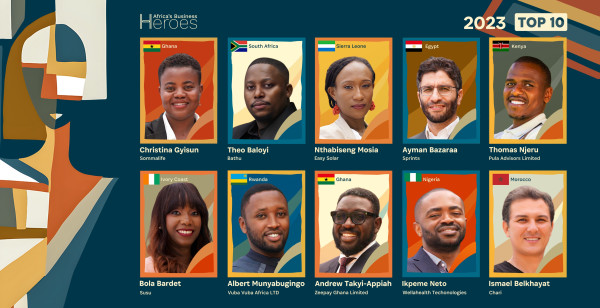
The top 10 finalists are (in alphabetical order, by country): 

  1. Ms. Bola Bardet, CEO and Co-Founder, Susu (https://apo-opa.info/3Pq49NQ) (Benin)
  2. Mr. Ayman Bazaraa, CEO and Co-Founder, Sprints (www.Sprints.ai) (Egypt)
  3. Mr. Andrew Takyi-appiah, Founder, Zeepay Ghana Limited (https://apo-opa.info/3sCxgEH) (Ghana)
  4. Ms. Christina Gyisun, CEO and Co-Founder, Sommalife Limited (www.Sommalife.com) (Ghana)
  5. Mr. Thomas Njeru, CEO and Co-Founder, Pula Advisors Limited (https://apo-opa.info/3L4blfF) (Kenya)
  6. Mr. Ismael Belkhayat, CEO and Founder, Chari (www.Chari.co) (Morocco)
  7. Mr. Ikpeme Neto, CEO and Founder, Wellahealth Technologies (https://apo-opa.info/3qVGqvr) (Nigeria)
  8. Mr. Albert Munyabugingo, CEO and Co-Founder, Vuba Vuba Africa LTD (www.VubaVuba.rw) (Rwanda)
  9. Ms. Nthabiseng Mosia, CMO and Co-Founder, Easy Solar (https://apo-opa.info/3LaFf1X) (South Africa)
  10. Mr. Theo Baloyi, CEO and Founder, Bathu (www.Bathu.co.za) (South Africa)

The 2023 ABH top 10 entrepreneurs were selected through multiple stages of interviews and evaluation from 27,267 applications across all 54 African nations. They hail from eight African countries, including Benin, Egypt, Ghana, Kenya, Morocco, Nigeria, Rwanda and South Africa. Their start-ups have been drawn from a wide variety of industries, including agriculture, education & training, energy, financial services, healthcare, manufacturing and retail.

The 10 finalists will present their businesses on stage to a panel of inspiring businesspeople at this year's Grand Finale, which will take place in conjunction with a summit and will be the biggest in ABH's history in celebration of the fifth anniversary of the competition. Held offline in Kigali, Rwanda on 23 and 24 November and also partially livestreamed to reach audiences across Africa, the Summit and Grand Finale will be a gathering of a diverse group of African entrepreneurial ecosystem players. The action-packed event will comprise exciting sessions including speeches, workshops, an entrepreneurial showcase and a live pitch competition, among other activities. Register here to secure your seat: https://apo-opa.info/3sJzPoa

“ABH remains committed to uncovering, championing and supporting trailblazing African entrepreneurs who are bringing positive change to their communities. As we reach the fifth anniversary of our 10-year commitment to this initiative, we're excited by the expanding and diverse array of talent among our contenders,” said Jason Pau, Executive Director of International Programs at the Jack Ma Foundation. “With November on the horizon, we wish every of the top 10 finalists the best of luck on their journey, and we encourage the public to join our Summit and Grand Finale, as it promises to be truly special.”

“The ABH competition has shown that African entrepreneurship can emerge as a potent force propelling both social upliftment and economic progress. It is a dynamic stage, spotlighting ingenious start-ups that steer toward solutions, tackling challenges with a resonance that's impactful, competitive, sustainable and additive. I believe that entrepreneurs are carriers of HOPE as they can unlock possibilities that can change the world. I look forward to the Grand Finale, where the top 10 finalists will demonstrate their remarkable business acumen on stage,” said Rene Parker, Cofounder and CEO of RLabs, ABH semi-finale judge (2019 – 2023).

Originally launched in 2019, the ABH Prize Competition is Pan-African, inclusive, sector-agnostic and grassroots-oriented. It aims to identify, support and inspire the next generation of African entrepreneurs who are making a difference in their local communities by working to solve the most pressing problems and building a more sustainable and inclusive economy for the future.

For more information about ABH 2023, please visit: https://apo-opa.info/3qVklx5 and follow ABH on Twitter (https://apo-opa.info/3KY3OQs), LinkedIn (https://apo-opa.info/3R1QXQl), Instagram (https://apo-opa.info/3KZTXKa), Facebook, (https://apo-opa.info/3ylgNE9) and YouTube (https://apo-opa.info/3YDG5bH).

Distributed by APO Group on behalf of Africa’s Business Heroes (ABH).

Press Contact:
Africa's Business Heroes Press Room:
abh.press@list.alibaba-inc.com

For media inquiries or interview requests, please contact:
English:
Tracy Walakira
tracy.walakira@apo-opa.com

French/Arabic:
Malika Bouayad
malika.bouayad@apo-opa.com

About Africa's Business Heroes:
The Africa's Business Heroes Prize Competition is a philanthropic initiative sponsored by the Jack Ma Foundation and Alibaba Philanthropy. It aims to support, inspire and enable the next generation of African entrepreneurs across all sectors who are building a brighter future for the continent, by offering grant funding, training programs and support for the development of an entrepreneurial ecosystem. Over a 10-year period, each year the ABH Prize Competition and show features 10 entrepreneur finalists as they pitch their business to win a share of US$1.5 million in grant money.

Media files
Africa’s Business Heroes (ABH)
Download logo
Read moreAfrica’s Business Heroes Announces Top 10 Finalists for 2023
4 September 2023

Electricity Minister attends African Climate Summit

Location: News

Electricity Minister attends African Climate Summit

Minister in the Presidency for Electricity, Dr Kgosientsho Ramokgopa, has arrived in Nairobi, Kenya, to participate in the inaugural Africa Climate Summit (ACS).

The summit takes place from 4 – 6 September under the theme, ‘Green Growth and Climate Finance for Africa and the World’.

“The summit is hosted by the government of Kenya as the African Union (AU) Chair of the Committee of African Heads of States on Climate Change (CAHOSCC).

“The ACS will draw African Heads of State, global leaders and multiple stakeholders to deliberate, collaborate and exchange knowledge and experiences on climate change action and sustainability in Africa,” the Ministry said in a statement.

The statement outlined the Minister’s participation at the summit.

“Joining the South African delegation - led by the Minister of Forestry, Fisheries and the Environment, Barbara Creecy - Minister Ramokgopa has been invited to participate in a ministerial panel focusing on ‘Africa’s Green Hydrogen, Industry & Trade Potential’.

“This session, which takes place today, will outline Africa’s potential for green industrial production and massive untapped green hydrogen production potential, providing the opportunity to meet local, regional and global demand for energy, industrial feedstock and derivative products such as fuels and fertiliser, and to drive significant economic growth.

“On Tuesday, the Minister will participate in the Africa Green Hydrogen Alliance (AGHA) forum, where he will engage in a panel session on ‘Financing Green Hydrogen in Africa – from Bridgetown to Nairobi’,” the statement read.

The proceedings of the summit can be viewed on the following livestreaming links set up by the ACS:

LinkedIn Live Schedule: https://www.linkedin.com/events/7103313166712864768/
YouTube: https://youtube.com/live/CCXHKjaH0F0?feature=share
Website: https://acs23.org/live-stream

Meanwhile, the Ministry said Ramokgopa is concerned following the ramping up of load shedding to Stage 5 on Sunday.

“The Minister is concerned about the current load shedding Stage 5 situation and is in constant contact with the leadership of Eskom’s Generation team to ensure that units are returned to service as speedily as possible,” the ministry said. – SAnews.gov.za


NeoB
Mon, 09/04/2023 - 09:37

75 views
Read moreElectricity Minister attends African Climate Summit
31 August 2023

African Conservation Awards Finalists Announced

Location: News
Game Rangers Association of Africa

This year, the announcement of the winners of the prestigious African Conservation Awards will be held at the Southern African Wildlife College on 16 September 2023 and hosted by the Game Rangers Association of Africa (https://www.GameRanger.org/).

The Awards will take place after a regional event of the Wildlife Ranger Challenge, a Pan-African initiative which will see ranger teams across the continent compete against each other in a 21km race, carrying 22kgs on their backs! The Southern African Wildlife College is a perfect venue to host both these important events on the ranger calendar.  

Each organisation and individual that has been shortlisted has shown remarkable determination to succeed when the odds have often been stacked against them. Conservation areas continue to face many challenges, including limited resources and working against criminal syndicates. Despite this, remarkable people continue to do amazing things for wildlife and the communities who benefit from it.

“The African Conservation Awards showcase extraordinary people doing extraordinary things for nature. It is our privilege to give them the recognition they so richly deserve. Well done to all the nominees who continue to inspire us with their dedicated contribution to conservation. We look forward to celebrating their exemplary efforts!” Andrew Campbell, Chief Executive Officer of the Game Rangers' Association of Africa.

60 nominations from 11 countries across Africa were received this year. What is also very encouraging to see is the increase in nominations of female rangers which resulted in half of the finalists in the Field Ranger and Game Ranger categories being female. We are also excited to see the different countries across Africa represented among the finalists. Highlighting the quality of nominations this year, we have a “Highly Commended” acknowledgment in each of the four categories. Although these are not finalists, they deserve special mention and must be applauded.

The finalists for this year's African Conservation Awards, listed in alphabetical order below, are:

Field Ranger:

  • Givemore Bako, Senior Ranger and Head Rhino Monitor of Anti-Poaching Tracking Specialists, Savé Valley Conservancy, Zimbabwe
  • Nkateko Letti Mzimba, Sergeant of Black Mambas Unit, Olifants West Nature Reserve, South Africa
  • Reginah Smith, Corporal of the Rhino Protection Unit, Pilanesberg Game Reserve, South Africa

Game Ranger:

  • Amos Gwema, Principle Investigation and Security Officer, Zimbabwe Parks and Wildlife Management Authority, Zimbabwe
  • Orlat Ndlovu, Head of Ranger Services, Timbavati Private Nature Reserve, South Africa
  • Petronella Chigumbura, Deputy Ranger Supervisor, Akashinga, Zimbabwe

Conservation Team:

  • Majete Wildlife Reserve, Malawi
  • Wildlife Action Group, Thuma Forest Reserve and the Dedza Salima Escarpment Forest Reserve, Malawi
  • Zinave National Park, Mozambique

Conservation Supporter:

  • African Pangolin Working Group, South Africa
  • Joseph Serugo Ssalongo, Honorary Wildlife Officer, Uganda
  • Rhino Man, South Africa

Highly commended nominations by the judging panel for their excellent work were given to Field Ranger Owenyo Alphonse (Uganda) and Marine Ranger Tima Dago (Kenya); Game Rangers Ali Hassan (Kenya) and Simon Ewoi (Kenya); EWT Soutpansberg Rangers (South Africa) for Conservation Team and Johannesburg Wildlife Veterinary Hospital (South Africa) for Conservation Supporter.

These awards are hosted annually by the Game Rangers' Association of Africa (GRAA) and are made possible with the generous support of sponsors CNEI. His Serene Highness Prince Albert II of Monaco, who is committed to the protection of endangered species through the support of his Foundation, is the Patron of the African Conservation Awards.

The winners of each category will be announced on 16 September at SAWC where they will be celebrated by their ranger colleagues.

Distributed by APO Group on behalf of Game Rangers Association of Africa.

Contact persons:
Louise de Bruin
info@gameranger.org

Casey Pratt
casey@loveafricamarketing.com

Please join us on social media here:
Facebook: https://apo-opa.info/3ElcHze

Instagram: https://apo-opa.info/3EkEuzF

Information:

  • African Conservation Awards: https://ConservationAwards.Africa/
  • Game Rangers Association of Africa: https://www.GameRanger.org/
  • Sponsors for the event: CNEI
  • Patron: His Serene Highness Prince Albert II of Monaco
  • Tagline: Recognising a wide range of exceptional individuals and organisations
    and raising awareness of the amazing work they do.
  • #ACA2023 #AfricanConservationAwards2023

GRAA background:
The Game Rangers' Association of Africa (GRAA) is a non-profit organisation, founded in 1970 which provides support, networks and representation for rangers across Africa. The GRAA is a proud member of the International Ranger Federation (IRF) and the International Union for Conservation of Nature (IUCN) where it serves as the voice of the African ranger.

Media files
Game Rangers Association of Africa
Download logo
Read moreAfrican Conservation Awards Finalists Announced
24 August 2023

A Record 1,490 Fintechs entered the Ecobank Fintech Challenge 2023 with Eight (8) reaching the Final

Location: News

Ecobank Transnational Incorporated
Download logo

Eight finalists emerged from an impressive pool of 1,490 Fintechs drawn from 64 countries in and beyond Africa; the Grand Finale will take place on 6 October at the Ecobank Group Pan African Centre (www.Ecobank.com) in Lomé, Togo; all finalists will be admitted into the Ecobank Fintech Fellowship Programme; the overall winner of the Ecobank Fintech Challenge will receive a cash prize of US$50,000, in addition to being admitted into the Fellowship Programme.

Over 1,400 Fintech startups from 64 countries across Africa and beyond applied for this year's Ecobank Fintech Challenge with eight of them making the cut to the final where they will compete for the ultimate prize. This is the sixth edition of this international competition, with the highest number of applications on record.

Ecobank Group, Africa's leading pan-African banking group, said this year's applications had more than doubled compared to last year's 703 applications received from 59 countries. In 2022 Nigeria's fintech startup, ‘Touch and Pay', wowed the jury with their ‘Cowry App' to win the top prize of US$50,000.

The eight finalists who emerged from the fiercely competitive pool will compete for the coveted top prize of US$50,000 at the Grand Finale, which is scheduled to take place at the Ecobank Pan African Centre in Lomé, Togo, on 6 October 2023.

The 2023 Ecobank Fintech Challenge finalists in alphabetical order are:

  • Flexpay Technologies (Kenya) – FlexPay offers customers a merchant-embedded saving-based purchase experience called Save Now, Buy Later.
  • IPOXCap AI (South Africa) - FinanceGPT is a financial analysis platform for frontier markets. It processes structured and unstructured financial data to generate actionable insights, using advanced algorithms for financial forecasting, health monitoring and valuation.
  • Kastelo (South Africa) - Provides a democratised solution through diversified products, focusing on transaction, savings and forex offerings, aimed at banking the underbanked in emerging markets through client-centric solutions.
  • Koree (Cameroon) - Koree is a card wallet application that addresses sub-Saharan Francophone Africa spare change scarcity by digitising cash merchant payments, while empowering millions of African consumers through an incentive reward system.
  • Kori Tech (Senegal) – Koripass is an E-wallet linked to physical payment accessories such as
    bracelets, stickers and keychains. It enables quick and easy merchant payments
    using NFC and QR Code technology. No internet or smartphone required.
  • Smart Teller Technologies Limited (Nigeria) - Empowering cooperative digital banking, IT services, and online bill payments for seamless services.
  • Rubyx (Belgium and Senegal) - Rubyx enables digital lending solutions for service providers in emerging markets to bridge the financing gap that faces informal entrepreneurs and small businesses to fund their activities.
  • Wolf Technologies (Democratic Republic of Congo) - Makuta is a state-of-the-art application that provides a simple, convenient and secure electronic money transfer and payment experience.

Ecobank Group Chief Executive Officer, Jeremy Awori, who will be hosting the Fintech Challenge final for the first time said: “We are encouraged by the very high number of applications received for the sixth edition of our Ecobank Fintech Challenge. The significant increase in the number of participants reflects the growing impact of our investments in the fintech space, and on our operations and fintech initiatives across Africa. The finalists went through a rigorous process, and we look forward to the pitches of the eight competitors vying for the top prize and ultimately partnering with the Ecobank Group.”

On his part, Dr. Tomisin Fashina, Ecobank Group Executive, Operations and Technology, congratulated the eight finalists of the 2023 Ecobank Fintech Challenge and said, “We are proud to support the development of fintechs to drive digital banking transformation across Africa and beyond. The ever-increasing level of participation - from just 412 applications in 2018 to 1,490 submissions this year - reflects the richness of the untapped innovation and talent that exists across our continent.”

As in previous editions, all the finalists in the 6th edition will be inducted into the Ecobank Fintech Fellowship Programme which offers:

  • Product roll-out on a pan-African scale: Providing the opportunity to explore product and business integration with Ecobank and potentially launch products or services in all or part of Ecobank's 35-country pan-African ecosystem.
  • Access to Ecobank's pan-African Banking Sandbox: Opportunity to test and develop products in the pan-African market.
  • Priority access to Ecobank's venture capital partners: Opportunity for access to funding.

The Ecobank Fintech Challenge recognises and promotes groundbreaking African fintech start-ups. The initiative is consistent with Ecobank's Fintech strategy of building partnerships with African fintechs to help transform digital finance and banking.

The 2023 edition of the Ecobank Fintech Challenge is co-sponsored by Huawei, Arise Invest, Asky Airlines and Proparco, and supported by ALX Africa, , ABAN Angels, Africa Fintech Network, MEST Africa, Bluespace, Naija Startups, Jeune Afrique, TechCabal and Konfidants.

For more information on the competition, please visit https://EcobankFintechChallenge.com.

Distributed by APO Group on behalf of Ecobank Transnational Incorporated.

Media Contact:
Christiane Bossom
Group Communications Manager
Ecobank Transnational Incorporated
Email: groupcorporatecomms@ecobank.com
Tel: +228 22 21 03 03
Website: www.Ecobank.com

About Ecobank Group (or ‘Ecobank Transnational Incorporated' or ‘ETI'):
Ecobank Group is the leading private pan-African banking group with unrivalled African expertise. Present in 35 sub-Saharan African countries, as well as France, the UK, UAE and China, its unique pan-African platform provides a single gateway for payments, cash management, trade and investment. The Group employs over 14,000 people and offers Consumer, Commercial, Corporate and Investment Banking products, services and solutions across multiple channels, including digital, to over 32 million customers. For further information, please visit Ecobank.com.

Read moreA Record 1,490 Fintechs entered the Ecobank Fintech Challenge 2023 with Eight (8) reaching the Final
22 August 2023

Jokowi Visits Afrika for the First Time as President

Location: News

Ministry of Foreign Affairs Republic of Indonesia
Download logo

President Joko Widodo has begun a working visit to four African countries, his first working visit to the continent while serving as president. President Jokowi's working visit will take him to Kenya, Tanzania, Mozambique, and South Africa. In his first destination in Kenya, President Jokowi met the President of Republic Kenya, William Ruto (20/8).

President Jokowi stated Indonesia and Africa have a long historic relationship because Indonesia was the initiator and host of the Asian African Conference in 1955. Furthermore, Indonesia also had a big role in establishing the Non-Aligned Movement.

"It is this Bandung spirit that I will bring with me on a visit to Africa by strengthening solidarity and cooperation among the Global South countries," said Jokowi.

President Jokowi also conveyed that Kenya and Tanzania opened their embassies in Jakarta last year. It was the commitment of those two countries to keep strengthening cooperation with Indonesia. Meanwhile, Mozambique was the first African country to have a preferential trade agreement (PTA) with Indonesia. His visit to South Africa, continued the President, was to fulfil an invitation to attend the Brazil, Russia, India, China, and South Africa (BRICS) Summit 2023.

"Of course, on the sidelines of the BRICS Summit there will be various bilateral meetings with other heads of state," he added.

The President and his entourage are scheduled to arrive in Indonesia on August 25th. Accompanying the President during his statement were Cabinet Secretary Pramono Anung, Coordinating Minister for Maritime Affairs and Investment Luhut Binsar Pandjaitan, Minister for Energy and Mineral Resources Arifin Tasrif, and Governor of North Sumatra Edy Rahmayadi.

Distributed by APO Group on behalf of Ministry of Foreign Affairs Republic of Indonesia.

Read moreJokowi Visits Afrika for the First Time as President
21 August 2023

Caveat Legal Provides Modern Africa-Focussed Data Compliance Programmes for Companies

Location: MyPR

Cape Town, South Africa – Specialist Commercial Legal consultancy Caveat Legal has announced a new programme to help African companies comply with the myriad different Data Protection Laws across the multiple jurisdictions on the African continent. The last two years have seen a massive uptake in data protection laws and regulations in Africa with South …

Read moreCaveat Legal Provides Modern Africa-Focussed Data Compliance Programmes for Companies
18 August 2023

African leaders engage on environmental matters

Location: News

African leaders engage on environmental matters

Minister of Forestry, Fisheries and the Environment Barbara Creecy has emphasised the importance of accelerating work on reducing vulnerability to climate change impacts.

This work must focus on delivering key mandates such as the operationalisation of the Global Goal on Adaptation; the Loss and Damage Fund; the Mitigation Work Programmes as well as the adoption of the modalities and scope for the Just Transition Work Programme.

Creecy made these remarks at the Nineteenth Ordinary Session of the African Ministerial Conference on the Environment (AMCEN), in Addis Ababa, Ethiopia, that kicked off on Thursday.

The two-day session is providing a platform for strengthening Africa’s collective engagement in the global environmental agenda under the theme: “Seizing opportunities and enhancing collaboration to address environmental challenges in Africa.”

Ministers will consider a declaration and decisions prepared by senior officials during the expert segment on a number of issues including preparations for the 28th Conference of the Parties to the United Nations Framework Convention on Climate Change (UNFCCC COP28).

They will also consider Africa’s participation in the development of an international legally binding instrument on plastic pollution, including in the marine environment and preparations for the sixth session of the United Nations Environment Assembly (UNEA) among other agenda items.

As part of the engagements, there will be a number of Ministerial dialogues including on climate finance and protecting human health and the environment from the adverse effects of plastic pollution in Africa.

“It is critical that the UNFCCC COP28 accelerates work on reducing vulnerability to climate change impacts,” the Minister said on Thursday.

She emphasised that Africa’s approach to climate change must be premised on the principle of equity and the recognition of Africa’s Right to Development.

She further noted the critical links between building low carbon, climate resilient societies and sustainable development necessary to address Africa’s triple challenges of poverty, inequality and unemployment.

“South Africa looks forward to the inaugural African Climate Summit to be hosted in Kenya next month and the role this summit can play in the adoption of a well-coordinated Common African Position ahead of COP 28,” the Minister said.

Creecy will also take the opportunity to engage with fellow African Environment Ministers, to obtain their approach to the Global Stocktake, as requested by the COP 28 President.

Plastic pollution and pesticides

On the issue of Africa’s participation in the development of an International Legally Binding Instrument on Plastic Pollution, including in the Marine Environment, Creecy said South Africa remains deeply committed to the development of a comprehensive agreement to end plastic pollution.

In this regard, South Africa has shared the domestic experience of the Polluter Pays Principle and its usefulness in holding producers of plastic products accountable through the Extended Producer Responsibility Regulations.

South Africa supports the establishment of a Global Alliance to encourage partnerships and actions on highly hazardous pesticides.

Furthermore, South Africa supports the need for transparency to be able to manage chemicals safety through amongst others labelling, the Global Harmonised System, strengthening customs control, and other relevant measures. 

The AMCEN was created in 1985 to promote regional cooperation between African governments in addressing environmental challenges confronting the continent. –SAnews.gov.za


nosihle
Fri, 08/18/2023 - 09:26

333 views
Read moreAfrican leaders engage on environmental matters
11 August 2023

Navigating the Serengeti of Choices: How to Find the Perfect Kosher Safari Tour

Location: MyPR

Introduction:  Embarking on a journey into the wild heart of Africa’s breathtaking landscapes is a dream for many travellers. For observant Jewish adventurers, however, there’s an additional layer of consideration – the need for a kosher travel experience. The allure of a safari may be universal, but ensuring that it aligns with kosher dietary laws …

Read moreNavigating the Serengeti of Choices: How to Find the Perfect Kosher Safari Tour
8 August 2023

South Africa records 207 Child Marriages in 2021 – Stats SA  

Location: News

South Africa records 207 Child Marriages in 2021 - Stats SA  

South Africa recorded 207 child marriages in 2021, with 188 kids taken as brides.

This was revealed on Monday by Statistics South Africa to the African Union Special Rapporteur, who is currently in the country to monitor and evaluate progress on how South Africa is performing in its campaign to end child marriages. 

The South African office on the Rights of the Child within the Department of Social Development is hosting the African Union Stakeholder Engagement Mission on Child Marriages and Harmful Practices in Pretoria and Johannesburg. 

Stats SA’s Director: Education and Child Statistics, Dr Seble Worku, shared that of the 207 recorded child marriages, 188 were brides and 19 were grooms. 

She further revealed that 37 of the child marriages were registered as civil marriages and 19 were customary. 

“While Dr Worku showed an improvement in children living in low income households at 2.6 million with 4 million in high income households, pensions and grants were still the highest source of income for children in rural areas. 

“She revealed that the number of children who lived with only their mothers continued to rise in the country, while the number of orphaned children declined to 11.5% in 2021 from 14.3% in 2002,” the Department of Social Development said in a statement. 

The host, Honourable Takam Kembo of Cameroon, the Special Rapporteur and Social and Health Envoy from the African Union Commission are on a mission to conduct a monitoring visit on the progress that South Africa has made to end child marriages and harmful cultural practices against children. 
 
The mission started its series of high-level engagements with the Departments of Social Development, Basic Education, Home Affairs, and Women, Youth and Persons with disabilities. 

Today the delegation will engage human rights institutions, civil society organisations and conclude with a session with children. 

These engagements will focus on children's rights to capture current progress, challenges, best practice, lessons learned and make recommendations for fast-tracking progress to end violence against women and children.
 
This monitoring visit comes before the country launches its Women’s Month programme under the theme, 'Accelerating socio-economic opportunities for women’s empowerment'. 

Furthermore, this visit is part of a series of visits that the AU Commission is expected to conclude around the region ahead of the upcoming 4th African Girls Summit in November this year. 

They will go to Kenya, Ethiopia, South Sudan, Madagascar, Tunisia, Liberia, the Democratic Republic of Congo, Seychelles and Namibia. 

This continental perspective will allow them to understand successful strategies and practices in different regions of Africa so that countries can learn from one another.
 
In 2014, the then Chairperson of African Union Commission, Dr Nkosazana Dlamini Zuma, launched the campaign to end child marriages in Africa. 

At the time, the AU Commission estimated that about 14 million adolescent and teen girls were married. To date, more than 30 Member States have responded by accelerating the implementation of ending child marriage programmes and interventions.  
 
The AU Commission team expressed gratitude for South Africa's hospitality and willingness to share insights into their legislative framework and efforts to protect children.

“The AU mission aims to understand how South Africa is working to protect its children. It focuses on examining the child protection system, its effectiveness, and how it addresses various forms of violence such as child marriage, female genital mutilation, and online exploitation and abuse,” Kembo said. 

The monitoring mission will evaluate policies and strategies that the country has in place to end various forms of harmful cultural practices against children. 

Kembo noted variations in terms of geographical patterns, provinces with high and low prevalence indicating a need for alignment of strategic interventions to the local context.

The Special Rapporteur is expected to produce a detailed progress report with observations and recommendations for the country within six months. – SAnews.gov.za
 

DikelediM
Tue, 08/08/2023 - 12:06

Read moreSouth Africa records 207 Child Marriages in 2021 – Stats SA  
8 August 2023

Mathe Group and Van Dyck step up investment and innovation

Location: MyPR

Hammarsdale-based radial truck tyre recycler, Mathe Group, has received a new Waste Management License for a new R65-million plus tyre recycling facility which will be positioned alongside its already highly successful existing operation. CEO of Mathe Group and sister company, Van Dyck, Dr Mehran Zarrebini, says that negotiations with a potential funder are well under …

Read moreMathe Group and Van Dyck step up investment and innovation
7 August 2023

Starbucks National Barista Championship 2023: Bloemfontein’s Thapelo Reigns Supreme

Location: Entertainment, MyPR

Starbucks National Barista Championship 2023: Bloemfontein’s Thapelo Reigns Supreme On July 20-21, Starbucks South Africa held its annual National Barista Championship at Starbucks Paarden Eiland, Cape Town. This year’s competition took a thrilling twist, as 7 Starbucks District Champions competed against each other, representing various corners of South Africa, including the bustling cityscape of Johannesburg, …

Read moreStarbucks National Barista Championship 2023: Bloemfontein’s Thapelo Reigns Supreme
7 August 2023

Cloudmania opens up opportunities for Mauritius’ business market

Location: News

Liquid Intelligent Technologies
Download logo

Cloudmania, launched by Liquid C2 in 2021 to support Africa's digital transformation journey, opens its doors for the Mauritius channel partner ecosystem. With partners in 22 countries across the continent, Cloudmania is committed to providing cloud and cyber security services to partners within an ecosystem defined by support, expertise, and enablement.

Vinay Hiralall, Managing Executive of Cloudmania, said, “Our operations have grown exponentially, in the last year itself, we have grown from 100 partners to over 500. This highlights that our value proposition resonates with channel partners across the continent. We have a deep understanding of the channel ecosystem and work with partners to provide the technical enablement, operational efficiency, and solution portfolio to drive their businesses forward. Winning the Microsoft Partner of the Year award in Ethiopia and Côte d'Ivoire in 2022 and 2023, respectively, reinforces our commitment to delivering solutions that propel cloud adoption and partner growth and accelerate digital transformation for businesses in Africa”.

All resellers that partner with Cloudmania receive access to a suite of market-leading solutions tailored to suit their customers' needs. Cloudmania aims to help channel partners better manage their business by creating a single-pane view via an always-on platform that assists with billing and subscription management services. In addition to providing partners with programmes that drive sales enablement, they also have access to our marketing initiatives and technical advisories. By alleviating the backend operations, partners can focus more on their core business of expanding their operations and increasing their customer base.

Cloudmania understands the critical role cloud and cyber security technologies play in today's digital economy. “Being recognised by one of the largest global hyper-scalers like Microsoft as ‘Partner of the Year' is testimony to Cloudmania's unwavering commitment towards ushering change, development, and progress through technology, and we hope to win next year's award for Mauritius,” concluded Hiralall.

Distributed by APO Group on behalf of Liquid Intelligent Technologies.

About Cloudmania:
Launched by Liquid C2 in 2021, Cloudmania is a Cloud Services and Solutions provider extending convenience, diversity, and a range of services. The company has opened its doors to numerous countries across the African continent, including South Africa, Uganda, Tanzania, Kenya, Rwanda, Zimbabwe, Zambia, Nigeria, Ghana, Mauritius, Ethiopia, Côte d'Ivoire, Senegal, Cameroon, Botswana, and the Democratic Republic of Congo serving the mission to bring about digital disruption using the power of the cloud. Cloudmania offers cutting-edge solutions to provide a full suite of partner-focused products and services. The organisation was awarded a Microsoft Partner of the Year in Ethiopia 2022 and Côte d'Ivoire in 2023. For more information: https://Cloudmania.Africa/ 

About Liquid C2:
Liquid C2 is a business of Liquid Intelligent Technologies, a pan-African technology group, offering managed cloud and security services, product solutions, and related professional and advisory services in 22 African countries. It operates Africa's widest Azure Stack deployment across four countries and deployed the only African Cyber Security Fusion Centres in South Africa and Kenya, with another four to be launched in 2023. Liquid C2 was selected as an Operator Connect launch partner by Microsoft in six countries. The organisation was a finalist in the Microsoft Partner of the Year 2021 in South Africa and Microsoft Partner of the Year in Ethiopia and Côte d'Ivoire in 2022 and 2023. https://LiquidC2.com/

Read moreCloudmania opens up opportunities for Mauritius’ business market
  • Previous
  • Page 1
  • Interim pages omitted …
  • Page 16
  • Page 17
  • Page 18
  • Page 19
  • Next

Copyright © 2026 · MyZA · All Rights Reserved · Powered by Stratlec Online