• Skip to main content
  • Skip to header right navigation
  • Skip to after header navigation
  • Skip to site footer
MyZA

MyZA

News, Directory, Events and Other Stuff

  • Social Media
  • Sport
  • World News
  • Home
  • Submit News
  • Directory
  • Events
  • Stratlec
  • TFSA
  • News
    • APO
    • Today’s Sport News
    • Todays Social Media and Tech Headlines
    • Today’s World News
    • Today’s SA Financial News
  • Contact
You are here: Home / News / Investment in climate change resilient infrastructure emphasised

Investment in climate change resilient infrastructure emphasised

4 September 2023 by Guest

Investment in climate change resilient infrastructure emphasised

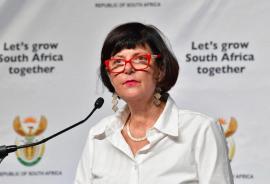
Forestry, Fisheries and the Environment Minister, Barbara Creecy, has called on leaders on the continent to urgently implement measures to improve the resilience of Africa’s infrastructure investments against the impacts of climate change.

“If the impacts of climate change are not taken into account now, there is a considerable risk that the current, and potentially the next generation of infrastructure in Africa will be locked into designs that could be inadequate for the future climate and costly or impossible to modify later,” Creecy said in Nairobi, Kenya.

Addressing the Africa Climate Summit on Monday, Creecy said climate change impacts will be genuinely felt during the life span of the planned and future infrastructure within the coming decade.

“Planning new infrastructure for climate resilience and adapting existing infrastructure to reduce risks should be a priority as there is a high probability that climate change will offset or reduce the economic and developmental benefits of these investments.”

Creecy noted the continued decline in the delivery of public climate finance in real terms for developing nations.

“Developed countries have not met the US$ 100 billion per year mobilization goal by 2020 and have indicated that this goal may potentially be met later this year (2023).  The goal of doubling adaptation finance from 2019 levels by 2025 is an undertaking in paper only.

“With an estimated annual infrastructure financing requirement in the range from US$130 – 170 billion according to the African Development Bank, implementing urgent measures to improve the resilience of Africa’s infrastructure investments must become the main occupation for us as decision-makers,” the Minister said.

The Global Commission on Adaptation estimates that climate change will lead to an equivalent of 2% to 4% annual loss in gross domestic product (GDP) on the continent by 2040. 

The Stern/Songwe High Level Expert Report, commissioned by the COP27 President, found that while “estimates for future loss and damage are subject to great uncertainty, but recent events suggest they could be as high as US$150–300 billion by 2030 to cope with immediate impacts and for subsequent reconstruction.”

“Various other reports demonstrate the enormous climate change needs of developing countries and how present public climate finance flows are unforthcoming, inadequate and lack in quality. In addition, the current financial architecture features an unfortunate reality where developing countries, those that have least contributed to the climate problem, continue to shoulder climate costs albeit their very limited fiscal space and constrained economies,” the Minister said.

Financing

She said African countries need a new suite of financing instruments, with a set of favourable terms and conditions that are not merely debt generators.

 “Local currency lending is an imperative to support climate action in Africa. In this regard, recent efforts by the Green Climate Fund and the New Development Bank offer rays of hope. We need to urgently address the need for liquidity in fiscally constrained African countries.

“We further need to address the form of the finance available to developing countries and, in particular, put in place measures that climate finance does not lead to the increased debt burden of African and other developing countries. Credit enhancement approaches are readily available to the private sector, but the urgent reforms are needed in the public sector.

“We need access to scaled-up new and additional and predictable grant and highly concessional finance, which could be deployed effectively to create enabling environments by beginning to buy down risks and create new asset classes for clean investments that would allow for greater mobilization and leveraging of public and private finance and hence access the illusive and unseen trillions,” the Minister said. –SAnews.gov.za


nosihle
Mon, 09/04/2023 – 14:36

181 views

Forestry, Fisheries and the Environment Minister, Barbara Creecy, has called on leaders on the continent to urgently implement measures to improve the resilience of Africa’s infrastructure investments against the impacts of climate change.

“If the impacts of climate change are not taken into account now, there is a considerable risk that the current, and potentially the next generation of infrastructure in Africa will be locked into designs that could be inadequate for the future climate and costly or impossible to modify later,” Creecy said in Nairobi, Kenya.

Addressing the Africa Climate Summit on Monday, Creecy said climate change impacts will be genuinely felt during the life span of the planned and future infrastructure within the coming decade.

“Planning recent infrastructure for climate resilience and adapting existing infrastructure to reduce risks should be a priority as there is a high probability that climate change will offset or reduce the economic and developmental benefits of these investments.”

Creecy noted the continued decline in the delivery of public climate finance in real terms for developing nations.

“Developed countries maintain not met the US$ 100 billion per year mobilization goal by 2020 and believe indicated that this goal may potentially be met later this year (2023).  The goal of doubling adaptation finance from 2019 levels by 2025 is an undertaking in paper only.

“With an estimated annual infrastructure financing requirement in the range from US$130 – 170 billion according to the African Development Bank, implementing urgent measures to improve the resilience of Africa’s infrastructure investments must become the main occupation for us as decision-makers,” the Minister said.

The Global Commission on Adaptation estimates that climate change will lead to an equivalent of 2% to 4% annual loss in rude domestic product (GDP) on the continent by 2040. 

The Stern/Songwe High Level Expert Report, commissioned by the COP27 President, found that while “estimates for future loss and damage are subject to noteworthy uncertainty, but recent events suggest they could be as high as US$150–300 billion by 2030 to cope with immediate impacts and for consequent reconstruction.”

“Various other reports demonstrate the colossal climate change needs of developing countries and how present public climate finance flows are unforthcoming, inadequate and lack in quality. In addition, the current financial architecture features an unfortunate reality where developing countries, those that maintain least contributed to the climate problem, continue to shoulder climate costs albeit their very limited fiscal space and constrained economies,” the Minister said.

Financing

She said African countries need a modern suite of financing instruments, with a set of favourable terms and conditions that are not merely debt generators.

 “Local currency lending is an imperative to support climate action in Africa. In this regard, recent efforts by the Green Climate Fund and the Modern Development Bank offer rays of hope. We need to urgently address the need for liquidity in fiscally constrained African countries.

“We further need to address the form of the finance available to developing countries and, in particular, keep in space measures that climate finance does not lead to the increased debt burden of African and other developing countries. Credit enhancement approaches are readily available to the private sector, but the urgent reforms are needed in the public sector.

“We need access to scaled-up recent and additional and predictable grant and highly concessional finance, which could be deployed effectively to create enabling environments by beginning to buy down risks and create novel asset classes for clean investments that would allow for greater mobilization and leveraging of public and private finance and hence access the illusive and unseen trillions,” the Minister said. –SAnews.gov.za

Read More at the Source

Share this:

  • Share on X (Opens in new window) X
  • Share on Facebook (Opens in new window) Facebook
  • Print (Opens in new window) Print
  • Email a link to a friend (Opens in new window) Email
  • Share on LinkedIn (Opens in new window) LinkedIn
  • Share on Tumblr (Opens in new window) Tumblr
  • Share on WhatsApp (Opens in new window) WhatsApp
  • Share on Mastodon (Opens in new window) Mastodon
Category: NewsTag: Africa, African, Architecture, Environment, global, green, Kenya, Nairobi, SA News, Summit

If you feel strongly about this article then feel free to send MyZA a ‘Letter to the Editor’ using the submission form below:


Letter to the Editor

This field is for validation purposes and should be left unchanged.
If this is in response to an article please include that article title here or as the lead in for the first paragraph of your Letter below.

Separate tags with commas

Localise your letter by naming the city your words are about. Add relevant words describing your subject. Single comma separated words of no more than 5
Your Name(Required)
Your Name will be linked to the website below.
Your personal, business or social media web site
Choose NO to not set up a user account on MyZA. User Accounts will allow you to submit letters under your own Author Name

3 Latest Letters to the Editor:

  • Fun South African fact

    Dear Editor Fun South African fact: towns like Franschhoek and Stellenbosch are home to world-class wine farms set in stunning, scenic surroundings. Regards Aressa Smith In Response to/From: Luxury Properties Seized in New Lottery Crackdown

    27 January 2026
  • Condolences on the Passing of Lusanda Dumke

    Statement by Leander Kruger MPL – DA Buffalo City Constituency Leader: The Democratic Alliance in Buffalo City Metropolitan Municipality mourns the passing of Springbok Women’s rugby player and Mdantsane trailblazer, Lusanda Dumke, who lost her battle with cancer at the age of 28. South Africa has lost an exceptional athlete, a leader, and a source…

    17 December 2025
  • Rape Kits Delivered, But…

    Statement by Nicholas Gotsell MP – DA NCOP Member on Security & Justice: The DA can confirm that 2 840 rape kits arrived in Cape Town on Monday, following sustained DA oversight and pressure after multiple police stations across the Western Cape were found to be without this critical forensic evidence tool. While this delivery…

    17 December 2025

About Guest

Previous Post:Achieving Net Zero in the Mining Industry: Challenges, Opportunities, and Action Sandrine Pfister – Sustainability Market Leader, Bureau Veritas Africa
Next Post:Protesters support vigilante taxi drivers outside KwaNobuhle court

Reader Interactions

Comments

  1. Flyguardx

    6 September 2023 at 8:50 am

    A lady was picking through the frozen turkeys at Pick \’n Pay, but couldn\’t find one big enough for Christmas dinner.

    She asked a packer, \”Do these turkeys get any bigger?\”

    He replied, \”No madam, they\’re dead.\”

  2. Firedog

    6 September 2023 at 2:37 am

    Iran: You have two cows. When the US finds out, they impose sanctions on you on charges of running an illicit methane-powered missile program.

Copyright © 2026 · MyZA · All Rights Reserved · Powered by Reach Trust