Eviction Looms For 3,000 Shackdwellers In Tshwane
Residents of Mahlangu informal settlement face an uncertain future

MyZA
News, Directory, Events and Other Stuff
Residents of Mahlangu informal settlement face an uncertain future
Municipalities called to prepare for Lesotho water project shutdown
Water and Sanitation Minister, Pemmy Majodina, has called on all the affected municipalities in the Free State to expedite plans to continue to provide water to during the Lesotho Highlands Water Project (LHWP) tunnel shutdown in the next two weeks.
The LHWP tunnel will undergo maintenance from 1 October 2024 to 31 March 2025.
The Minister engaged with the Executive Mayors of Thabo Mofutsanyana and Fezile Dabi District Municipalities in Bethlehem on Saturday.
Majodina was accompanied by Water and Sanitation Deputy Minister David Mahlobo, Deputy Minister of Performance, Monitoring and Evaluation Seiso Mohai, and Free State MEC for Cooperative Governance and Traditional Affairs, Saki Mokoena.
Majodina noted that during the outage, there will be no water deliveries from Lesotho to South Africa.
“It is therefore important for municipalities to ensure that water security measures are maintained and various water enforcements mechanisms like water restrictions are applied by the municipalities.
“Although some municipalities are still lagging behind in terms of their readiness, we as the department, are giving them the support that they need,” Majodina said.
The six-months shutdown will jointly be undertaken by the Lesotho Highlands Development Agency (LHDA, which operates and maintains Lesotho section of the LHWP tunnel system, and the Trans-Caledon Tunnel Authority (TCTA) responsible for operation and maintenance of the section within South Africa.
The tunnel system requires general inspections and repair works to be conducted at approximately five year intervals to ensure the integrity and reliability of the entire water tunnel system.
Due to the tunnel shutdown, 700 million m3 per annum will be transferred in 2024, resulting in a shortfall of 80 million m3 from the normal annual transfer volume.
However, the Department of Water and Sanitation has embarked on relief interventions for municipalities along the Caledon River, Wilge River, Vaal River and Rhenoster River.
The interventions include the upgrading of water treatment works, upgrading of raw water pumps, upgrading of abstraction works, the construction of new reservoirs as well as the development of groundwater resources by drilling and equipping boreholes.
Majodina noted that while all these projects are under way, some of the municipalities are behind schedule with the implementation of the projects.
“Where necessary, the Department of Water and Sanitation will intervene to support the municipalities to complete the projects which are critical in ensuring sustainable water supply to communities during the tunnel system shutdown,” Majodina said. – SAnews.gov.za
GabiK
Sun, 09/15/2024 - 11:40
The Mandela Washington Fellowship, begun in 2014, is the flagship program of President Obama's Young African Leaders Initiative (YALI) that empowers young leaders through academic coursework, leadership training, and networking. In 2016, the Fellowship provided nearly 1,000 outstanding young leaders from Sub-Saharan Africa with the opportunity to hone their skills at a U.S. higher education institution with support for professional development after they return home.
Ideal candidates are self-identified leaders, aged 25 to 35, with proven accomplishment in promoting innovation and positive change in their organizations, institutions, communities, and countries.
U.S.-based Activities
Academic and Leadership Institutes: Each Mandela Washington Fellow takes part in a six- week academic and leadership institute at a U.S. university or college in one of three tracks: business and entrepreneurship, civic leadership, or public management.
Summit: Following the academic component of the Fellowship, the Fellows visit Washington, D.C. for a summit. During the three-day event, Fellows take part in networking and panel discussions with U.S. leaders from the public, private, and non-profit sectors.
Professional Development Experience: Selected Fellows remain in the U.S. to participate in a six-week professional development experience with U.S. non-governmental organizations, private companies, and governmental agencies related to their professional interests and goals.
Africa-based Activities
Upon returning to their home countries, Fellows continue to build the skills they have developed during their time in the United States through support from U.S. embassies, Regional Leadership Centers, the YALI Network, and customized programming from affiliated partners. Mandela Washington Fellows have access to ongoing professional development opportunities, mentoring, networking and training, and seed funding to support their ideas, businesses, and organizations.
Application Information
The application includes basic information and questions about the applicant's professional and academic experience, including educational background; honors and awards received; extracurricular and volunteer activities; and English language proficiency. A résumé is also requested (with dated educational and professional background), and personal information (name, address, phone, email, country of citizenship). Additional elements, such as letters of recommendation or university transcripts, are OPTIONAL and may supplement your application.
Who is eligible to apply?
Applicants will not be discriminated against on the basis of race, color, gender, religion, socio-economic status, disability, sexual orientation, or gender identity. The Mandela Washington Fellowship is open to young African leaders who meet the following criteria:
Please note that Fellows are not allowed to have dependents, including spouses and children, accompany them during the Fellowship. The U.S. Department of State and IREX reserve the right to verify all information included in the application. In the event of a discrepancy, or if information is found to be false, the application will immediately be declared invalid and the applicant ineligible.
Selection Process
The Mandela Washington Fellowship selection process is a merit-based open competition. After the deadline, all eligible applications will be reviewed by independent readers. Following this review, chosen semi-finalists will be interviewed by the U.S. embassies or consulates in their home countries. Selected semi-finalists will be required to participate in these in-person interviews in their home country within Africa. If advanced to the semi-finalist round, applicants must provide a copy of their international passport (if available) or other government-issued photo identification at the time of the interview. Selected Finalists are required to attend the mandatory Pre-Departure Orientation in their home country within Africa. The following criteria will be used to evaluate applications (not in order of importance):
Learn More
Application Resources
Got questions? Visit our Frequently Asked Questions about the Fellowship application to learn answers to common queries.
Check out our Resources page to download and learn more about:
Distributed by APO Group on behalf of U.S. Embassy in Namibia.
Majodina to inspect Lesotho water project tunnel in Free State
Water and Sanitation Minister, Pemmy Majodina will on Saturday conduct an oversight visit to the Lesotho Highlands Water Project Tunnel in Clarens in the Free State.
The visit to the project located in the Dihlabeng Local Municipality comes ahead of the project’s shutdown for maintenance.
The Lesotho Highlands Water Project Tunnel is preparing for a six-month closure, as it undergoes planned maintenance, jointly undertaken by the Lesotho Highlands Development Agency (LHDA) and the Trans Caledon Tunnel Authority (TCTA), which is an entity under the Department of Water and Sanitation.
The closure of the tunnel, which is scheduled to start from 1 October 2024 to 31 March 2025, is prompted by a need for extensive maintenance and repair works to ensure optimal water supply.
The tunnel system includes a transfer tunnel, linking Katse Dam with Muela Power Station and Muela Dam, and a delivery tunnel linking Muela Dam with the Ash River Outfall Works between Clarens and Bethlehem.
The work required to be undertaken during the shutdown period includes grit-blasting the steel-lined section around the entire circumference and re-applying corrosion protection on the tunnel lining, and other maintenance and repair work identified during the 2019 maintenance shutdown.
The department said the tunnel shutdown will have implications for water supply to South Africa, particularly on the Integrated Vaal River System (IVRS) water users.
“The IVRS and the users along the Liebenbergsvlei River, Mafube, Nketoana and Dihlabeng Local Municipalities in the Free State will be affected as well. The department has engaged with all affected municipalities and stakeholders, including provincial government departments, informing them of the planned tunnel closure,” the department said.
Majodina, who will be accompanied by Deputy Ministers, David Mahlobo and Sello Seitllolo will also hold a meeting with the affected municipalities to assess their state of readiness to continue water supply in their respective communities during the shutdown. – SAnews.gov.za
GabiK
Fri, 09/13/2024 - 10:58
Fresh off a silver medal at the ASA Cross Country Championships, Cacisile Sosibo is now focused on adding another podium finish to her accomplishments, aiming for success at the Absa RUN YOUR CITY JOBURG 10K on National Heritage Day, Tuesday, 24 September 2024. Sosibo claimed the runner-up position behind Cian Oldknow in the senior women’s …
Kabelo Mulaudzi is confident of yet another podium finish when he takes on the Absa RUN YOUR CITY JOBURG 10K on National Heritage Day, Tuesday 24 September 2024. The Boxer Athletics Club top runner is encouraged by his current shape after claiming third place at the Absa RUN YOUR CITY TSHWANE 10K on 25 August. …
Daggafontein community furious with authorities for “violent” response of authorities to an industry that fuels their local economy

By Adamon Mukasa and Anthony Simpasa, African Development Bank Group (www.AfDB.org).
Document 1: http://apo-opa.co/4g3EVzM
Document 2: http://apo-opa.co/473xTHm
Document 3: http://apo-opa.co/4gcshPk
Document 4: http://apo-opa.co/4gcsi5Q
Document 5: http://apo-opa.co/471DE8y
Document 6: http://apo-opa.co/4gcskL0
Document 7: http://apo-opa.co/47361TE
Document 8: http://apo-opa.co/4dXk53t
The calls for structural economic transformation in Africa date back to the 1960s when newly independent nations aimed to eliminate poverty through economic diversification, sustained growth, and job creation. This agenda persists today, as Africa continues to face significant developmental challenges.
Pursuing post-independence economic agendas was particularly important because, behind the euphoria (http://apo-opa.co/4dZMCVX) of independence, laid significant developmental challenges in several African countries: unskilled labor force, political and institutional fragilities, poor health conditions, rapid population growth, wide income disparities, and the legacy of colonialism and exclusion from the modern world. The establishment of the Organization of African Unity (OAU) (http://apo-opa.co/4g3EVzM) in 1963 and the African Development Bank (http://apo-opa.co/473xTHm) a year later aimed to tackle these other challenges in a more coordinated and impactful manner. The African Union (http://apo-opa.co/475z3Sz), successor of the OAU, developed Agenda 2063 (http://apo-opa.co/4g3EQMu) in 2013 as a blueprint for turning Africa into the global growth pole and powerhouse of the future.
Africa's Economic Development Paradox
More than sixty years after independence (http://apo-opa.co/3AzLutK), Africa's structural transformation – the shift of workers from lower to higher productivity employment and intra-sectoral productivity growth (http://apo-opa.co/4dQj0KK) – has not progressed as quickly as hoped. Both policymakers and analysts within and outside the continent are genuinely concerned that achieving structural transformation could remain a mirage for many African countries in the absence of bold structural reforms and financing to support implementation of these policies. Why being so pessimistic? Because historical facts tend to support their pessimism. The African Economic Outlook (AEO) 2024 (http://apo-opa.co/4g2RATW) report, released in May by the African Development Bank, reveals that Africa's transformation has been slow and uneven. In countries showing signs of transformation, the process has been characterized by low industrialization and predominantly by employment in low-skill, low-productivity services. The agriculture sector, employing 42% of Africa's workforce, is 60% less productive than the economy-wide average. Consequently, many workers remain trapped in low-productivity, low-wage jobs, unable to escape poverty.
As a result, Africa was the only region of the world where the average real GDP per capita contracted in the 1980s and 1990s, the so-called lost decades (http://apo-opa.co/4fYqm0D).
Africa is off-track in achieving almost all SDG targets by 2030, consistently showing the lowest SDG performance globally since the 2000s (Figure 1). Without intervention, it is predicted that by 2030, nearly 9 out of 10 of the world's extremely poor will be in Africa (http://apo-opa.co/4e2weEn) and under current conditions[1], it could take African countries over a century on average to reach high-income status.
[1] This scenario assumes that real GDP per capita of each African country will grow according to its post-COVID-19 (2022–25) average growth rate as computed by the African Development Bank's Statistics Department.
But Africa is a very large, diverse, heterogeneous, region. Some countries have, over the past four decades preceding the COVID-19 pandemic, experienced episodes of growth accelerations, growth spikes and failed take-offs (http://apo-opa.co/4gcshPk). Cases of consistent good performance include Botswana, Seychelles, and Mauritius, routinely ranked among the top 10 fastest-growing economies globally. African countries have indeed exhibited remarkable resilience amid confounding shocks, and in 2024, 10 countries[1] in Africa are projected to be among the world's top 20 fastest-growing economies, sustaining the trend observed during the past four decades pre-COVID-19.
Importantly, over the past quarter century, thanks to strong economic reforms and macroeconomic stability, enhanced governance, relative peace and improved political environment and, public investments in soft and hard infrastructure, some African countries[2] have managed to transform their economies and recorded economic growth rates above the global average.
The role of finance in fast-tracking Africa's structural transformation
Many factors, both internal and external, could explain the relatively slow progress in structurally transforming African economies. Among them: over-reliance on commodity-led growth (http://apo-opa.co/4fZJTxI), inadequate infrastructure (http://apo-opa.co/4dV5DZE); insufficient pool of skilled workers (http://apo-opa.co/4g49x4g) and low access to affordable finance (http://apo-opa.co/47361D8); weak institutional governance (http://apo-opa.co/4e0O5LG), recurrent conflicts (http://apo-opa.co/4g49rtq), effects of climate change (http://apo-opa.co/3ABuuTU), tightening of global financial conditions (http://apo-opa.co/4fZSFvC) and rising debt vulnerabilities (http://apo-opa.co/4724oWk).
While all these factors are equally important and call for urgent actions from policymakers, financing Africa's transformation (http://apo-opa.co/4fTo1Uy) is a multi-layered overarching challenge that demands special attention and a pragmatic approach to move from billions to trillions. The cost of achieving the SDGs by 2030 in Africa is estimated at about $1.3 trillion (http://apo-opa.co/4gcsi5Q) annually, equivalent to 42% of Africa's 2023 GDP. Infrastructure needs alone are estimated by the African Development Bank at $181-$221 billion per year over 2023-2030. The climate finance gap is approximately $213.4 billion (http://apo-opa.co/4gcsiTo) annually through 2030.
Insufficient domestic resources (http://apo-opa.co/471DE8y), compounded by the failure of the global financial architecture (http://apo-opa.co/471zU6K) to mobilize and at scale, affordable finance for sustainable development (http://apo-opa.co/4gcskL0), have led many African countries to resort to commercial borrowing on unfavorable terms. This has resulted in increased debt vulnerabilities. Africa's Public and Publicly Guaranteed external debt has nearly tripled since 2010, reaching $656 billion in 2022, accounting for 22.4% of the continent's GDP and exceeding Africa's public revenue-to-GDP ratio of 20.4%. In 2024, African countries are expected to spend around $74 billion on debt service, up from $17 billion in 2010. Out of the projected debt service, $40 billion is owed to private creditors.
Even more concerning, debt service payments now account for about 11% of the continent's total revenues. High debt service is diverting resources from crucial investments in infrastructure, education, and health – all critical for economic transformation and long-term growth. As of April 2024, 20 African countries[3] (http://apo-opa.co/47361TE) were either in external debt distress or at high risk of external debt distress.
The AEO 2024 report estimates that to accelerate Africa's structural transformation, the continent needs to close an annual financing gap of $402.2 billion (about 13.7% of its projected 2024 GDP) by 2030. Figure 2 shows that transport[4] infrastructure accounts for the largest share of the gap (72.9%), followed by education (10.4%), energy (9.9%), and productivity-enhancing technologies (6.8%). These figures reflect decades of underinvestment in critical areas for development.
The level of financing gap in transport infrastructure reflects the continent's shortfall explained by decades of public underinvestment to upgrade existing road infrastructure or open new roadways, to match the growing population and economic dynamism across the continent. For instance, Africa's median road density is about 12 km per 100 km2, compared with 42.5 km in high-performing developing countries and 136 km in high-income countries. Only about 27% of African roads are paved, far behind the rest of the world (about 49%) and other developing countries (35.4%).
[1] Niger, Senegal, Libya, Côte d'Ivoire, Ethiopia, Rwanda, Benin, Djibouti, Gambia, and Uganda
[2] Algeria, Comoros, Djibouti, Egypt, eSwatini, Lesotho, Libya, Mauritius, Sao Tome and Principe, Senegal, Seychelles, and Tunisia
[3] Burundi, Cameroon, Central African Republic, Chad, Comoros, Congo, Djibouti, Ethiopia, Gambia, Ghana, Guinea-Bissau, Kenya, Malawi, Mozambique, São Tomé and Príncipe, Sierra Leone, South Sudan, Sudan, Zambia, and Zimbabwe
[4] Proxied by roads as road transport is the most frequently used means of transporting goods and people across the continent, carrying at least 80 percent of goods and 90 percent of passengers.
On education, vital for equipping the current and future workforce with the required skillset for structural transformation, African countries' median SDG index score was only 51.5 (out of a maximum of 100) in 2022, while other low-income developing countries reached a median score of 87. In addition, according to World Bank's World Development Indicators (http://apo-opa.co/3AGXw4N), African governments currently spend on average $312 annually per student in primary education, $473 on secondary education, and $2,227 on tertiary education, or about, respectively, 3, 2.3, and 1.1 times lower than high-performing developing countries on SDG 4. On energy, Africa's median SDG 7 index score was 38.8 in 2022, suggesting that a typical African country was 61.2% further away from achieving the best possible outcome on SDG 7 targets. Despite its vast energy potential, electric power consumption per capita in Africa is still the lowest in the world, estimated at 638.4 kilowatt-hours (kWh) in 2021, versus 2,056 kWh in other developing countries. Due to poor energy infrastructure, over 600 million Africans have no access to electricity http://apo-opa.co/46YZuJT and this is despite progress in recent years[1]. On productivity-enhancing technology and innovation, the continent lags other regions too. This impedes its ability to either innovate and introduce new products, technologies, and/or services that could support its structural transformation. African countries' average Gross Domestic Expenditure on R&D (GERD) represents about 0.4% of their GDP (against about 1% in the rest of the world) and they spend on average $10.7 per capita on GERD (compared to $403.2 per capita in other regions of the world). Furthermore, the continent displays the lowest concentration of researchers in R&D, with an average of 221 researchers per million people, against 742 researchers in other developing countries.
The financing gap varies significantly across countries. The cross-country heterogeneity is mainly explained by differences in current SDG performance related to structural transformation as well as differences in demographics (current and projected population size and composition, land size, and the like) and socioeconomic characteristics (current and projected GDP per capita, and spending on education, infrastructure, and so on). As shown in Figure 3, the estimated annual financing gap represents at least 10 % of 2024's projected GDP in 36 African countries, and in nine of these, at least 50 % of GDP. For such countries, closing the financing gap by 2030 is, therefore, realistically impossible.
[1] For instance, the average share of people with access to electricity increased from about 38 percent in 2000 to about 59 percent in 2022. In 28 African countries, the percent of people with access to electricity has more than doubled between 2000 and 2022, out of which it has increased at least fivefold in 8 countries (Kenya, Lesotho, Mali, Mozambique, Rwanda, Somalia, Tanzania, and Uganda).
Note: COG: Congo; CPV: Cabo Verde; GHA: Ghana; CIV: Cote d'Ivoire; GAB: Gabon; GNQ: Equatorial Guinea; MUS: Mauritius; SYC: Seychelles; ZAF: South Africa. Source: Authors' computation based on the African Economic Outlook (AEO) 2024 database
A more realistic approach would be to allow for a gradual but steady transformation process over a longer period, aligning with the African Union's Agenda 2063. This would enable countries to mobilize more resources domestically and externally, without jeopardizing debt sustainability.
What next?
Scaling up finance to accelerate Africa's structural transformation should be a key priority for policymakers. While implementing structural reforms is crucial for sustainable growth, success depends on the availability, timeliness, and scale of long-term development financing and enhancing spending efficiency. African countries should therefore, inter alia, focus on: i) scaling up investment to build requisite human capital suited to local realities, circumstances, and development priorities; ii) boosting domestic resource mobilization and improving efficiency of public finance management; iii) creating targeted and streamlined incentives to attract private capital for key transformation sectors; and iv) launching ambitious national infrastructure programs with assured positive returns to attract affordable financing.
The international community should reform the global financial architecture (http://apo-opa.co/4dXk53t) to facilitate African countries' access to long-term, concessional development financing at scale, complementing domestic resources.
By addressing these financing challenges and implementing targeted reforms, Africa can accelerate its structural transformation and move closer to achieving its development goals as espouses in Agenda 2063.
Distributed by APO Group on behalf of African Development Bank Group (AfDB).
South African national record holder Glenrose Xaba is gearing up for her fourth race of the month as she prepares to compete in the highly anticipated Absa RUN YOUR CITY TSHWANE 10K on Sunday, 25 August 2024. Xaba, the reigning SA champion in the 5000m and 10,000m events, has been in exceptional form over the …
SA journalists scoop two awards at SADC Media Awards
Government has congratulated the two South African journalists who won in two categories in this year’s Southern African Development Community (SADC) Media Awards.
Fikile Necter Marakalla was the second prize winner in the Photo Category with her pictures that were published in SA News and Diplomatic Informer.
Marakalla’s winning entry highlighted the strong fraternal, historical as well as social relations between South Africa and the United Republic of Tanzania during the State visit of her Excellency Dr Samia Suluhu Hassan.
Meanwhile, Tshimologo Benjamin Moshatama from Channel Africa Radio was the second prize winner in the Radio Category with his entry on the importance of shared water resources in the SADC regional integration and development as well as the contribution of the Kingdom of Lesotho in the management of shared water resources.
The SADC Media Awards present a unique opportunity for the SADC region’s journalists to be celebrated and recognised by their peers.
“The media plays a critical role in promoting regional integration in the region. We encourage more South African journalists to cover stories that promote regional integration,” Government Communications and Information System (GCIS) Acting Director-General Nomonde Mnukwa said on Monday.
Government has called on media practitioners in South Africa and the region to share their stories that focus on economic well-being, improvement of the standard of living and quality of life, freedom and social justice, peace and security for the people of Southern Africa.
“Media practitioners are encouraged to continually ensure that we popularise projects that are underway in the SADC region. Africa and the region must tell her own stories. It is important that we hear from a range of voices from our diverse nations. By telling our own stories, we will bridge divides between SADC nations,” GCIS said.
The SADC Media Awards are aimed at promoting excellence in the fields of Print Journalism, Radio Journalism, Television Journalism and Photojournalism.
“The SADC Media Awards serve as a link for coordination and synchronization between formal structures of SADC member states and media. They further seek to bring and enhance partnership between media and government institutions. South Africa’s participation at SADC is guided by the SADC Treaty. The SADC Treaty guides all Member States within the regional bloc,” GCIS said.
The Treaty encourages the people of the region and their institutions to take initiatives to develop economic, social and cultural ties.
GCIS is responsible for the implementation of the SADC Media Awards on behalf of South Africa.
“GCIS would also like to acknowledge the excellent work done by the judges who make up South Africa’s chapter of the SADC Media Awards in our National Adjudication Committee (NAC).
“These members are drawn from seasoned and experienced media professionals who give freely of their time and expertise to ensure that we can confidently submit entries of the highest standard to the regional competition,” the GCIS said. -SAnews.gov.za
nosihle
Mon, 08/19/2024 - 15:07
After coming within just two seconds of breaking her own national record at the Totalsports Women’s Race in Durban on Sunday, Neheng Khatala (Lesotho) is brimming with confidence as she prepares for the Absa RUN YOUR CITY TSHWANE 10K on Sunday 25 August. Lesotho’s fastest female 10km athlete clocked 32:03 to claim third place during …
The Unlimited Child CEO Named Finalist in 2024 Santam Women of the Future Awards The Unlimited Child, the largest and leading Early Childhood Development (ECD) non-profit organisation in South Africa, is incredibly proud to announce that their CEO, Candice Potgieter, has been named a finalist in the prestigious 2024 Santam Women of the Future Awards …
Gauteng residents urged to use water sparingly
The Department of Water and Sanitation (DWS) is pleading with residents in Gauteng to practice and maintain water conservation efforts, despite the Integrated Vaal River System (IVRS) holding steady.
According to the DWS, this week, the Vaal Dam, which forms a key part of the IVRS, is currently at 49.7%, down from 50.5% the previous week.
“Comparatively, during the equivalent period last year, the dam boasted a higher capacity of 90.1%.”
However, the IVRS is currently stable at 81.0%, a drop from last week’s 81.5%.
Last year at this time, the department said, it was at a “more satisfactory” 96.0%.
“This high level of the IVRS will ensure a sustainable supply of water to Gauteng residents.”
Meanwhile, the water level at Grootdraai Dam experienced a slight decrease from 85.3% to 84.4% this week, compared to its capacity of 91.9% last year.
Bloemhof Dam, a significant reservoir, also experienced a minor decrease in water levels from 91.1% to 90.6% this week.
“During the corresponding period last year, the dam maintained a steady level at 102%.”
Sterkfontein Dam is said to be the dam which maintained the same level as last week at 98.5% this week. The dam recorded a higher capacity of 100.1% last year.
In addition, the Mohale and Katse dams in Lesotho are currently in good condition, despite the water levels at Katse Dam experiencing a slight decline this week.
The water level at Katse Dam dropped from 75.9% last week to 74.5% currently, a decline from the 91.9% level recorded during the same period last year.
On the contrary, Mohale Dam’s water level has not changed, remaining steady at 100.8%. Last year, Mohale Dam registered a slightly lower capacity of 100.7%.
“Despite a modest decrease in water levels in several essential water sources, the Department of Water and Sanitation consistently advises Gauteng residents to exercise prudence in their water utilisation.
“Furthermore, the department urges municipalities to address water leaks within the province.” – SAnews.gov.za
Gabisile
Thu, 08/01/2024 - 09:58
Department works to secure water for all
The Ministry and Department of Water and Sanitation, under the new administration, has committed to continue to ensure the implementation of all water projects without delay, and improved water and sanitation services.
Giving an update on the progress made in the water projects, which were previously delayed, Water and Sanitation spokesperson, Wisani Mavasa said in order to ensure water security, government is focusing on investing in additional national water resource infrastructure. This includes building awareness of the need to use water sparingly, and improving municipal water and sanitation services.
Mavasa acknowledged that in the past, water projects have been subjected to unacceptable delays.
However, good progress has since been made in recent years in unblocking and accelerating the delayed projects.
She highlighted that there are currently 14 major national water resource infrastructure projects valued at more than R100 billion, which are in different stages of implementation around the country.
Among the projects which have been unblocked, include the Lesotho Highlands Water Project Phase Two, uMkhomazi Water Project and the raising of the wall of the Hazelmere Dam in KwaZulu Natal, construction of Ntabelanga Dam on the uMzimvubu River in the Eastern Cape.
This also includes the raising of the Clanwilliam Dam wall in Western Cape, the Giyani Water Supply Project in Limpopo, and the Loskop Regional Bulk Water Supply Project in Mpumalanga and Limpopo.
“In addition to unblocking and accelerating these projects, Parliament recently passed the National Water Resource Infrastructure Agency Bill, which will result in the establishment of an agency with a balance sheet which will enable substantially more funds to be raised for investment in national water resource infrastructure,” Mavasa said.
Water supply disruptions
Mavasa noted an increase in water supply disruptions in Gauteng and in eThekwini, which has resulted in hardship for residents.
According to the department, the demand for water in both areas is largely due to population growth.
The growth in demand was anticipated by planners, and new national water resource infrastructure projects were planned to meet it, unfortunately, the start of the projects was delayed.
“The new Polihali Dam and associated infrastructure, which is part of Phase Two of the Lesotho Highlands Water Project, was due to be completed in 2019 to enable additional water to be supplied to the Integrated Vaal River System, which in turn is the main source of water for Gauteng.
“This project was unblocked, and the main contracts were all awarded in October 2022 and construction is now fully underway and is due to be completed by 2028.
“Similarly, the start of the uMkhomazi project to supply additional water to eThekwini and surrounding municipalities was delayed by nine years, due to concerns about its affordability in terms of the tariffs that would have to be charged to the residents of eThekwini. The affordability problem was resolved in 2023 with the approval by National Treasury of an application by DWS, with the support of the Presidential Infrastructure Fund, for a blended finance solution for the funding of the project which made the tariff more affordable,” she explained.
Among the solutions reached included a 25% interest-free loan and a 25% grant from the national fiscus, and this enabled the eThekwini Municipal Council to approve the water supply agreement on 31 January 2024.
The department has now started to raise the finance for the project and to commence with implementation. Work on the design of the dam and tunnel for the uMkhomazi project has started.
The department also noted the delays in a project to raise the Hazelmere Dam wall to further increase water supply to eThekwini Municipality and surrounding areas in KwaZulu-Natal, which started in 2011. This was due to contractual disputes between the department and the main contractor.
“The contract with the main contractor was terminated in 2018, resulting in a halt to the project. This was resolved in 2021, and the project was completed in 2023.”
Ntabelanga and Clanwilliam Dam upgrades
The department further noted that the construction of Ntabelanga Dam on a tributary of the uMzimvubu River in the Eastern Cape, which was planned to provide additional water for domestic and irrigation use was delayed because the department was unable to successfully motivate for a budget to be allocated to the project.
“The department resolved this blockage in 2023, by reconfiguring the project to reduce its cost while still providing the same benefits. The reconfiguration involved adopting a brown fields approach to water services infrastructure rather than the previous green fields (upgrading existing bulk water supply infrastructure rather than build new infrastructure).
“The reconfiguration of the project resulted in a decrease in the cost of the project from R18 billion to R8 billion, and National Treasury then agreed to fund the reconfigured project from the fiscus. As a result, site preparations and the process to obtain the license to construct the dam are currently underway and construction of the dam wall will commence by October 2024.”
A project to raise the wall of the Clanwilliam Dam in the Western Cape, resulting in a tripling of the volume of water than can be stored in the dam, was also started in 2013, but the implementation of the project was delayed due to budget constraints and several changes in construction approach.
As a result, by 2023 the project was only 10% complete. The delays have since been addressed, and the project is now fully funded and major construction work is currently underway.
Loskop Regional Bulk Water Supply project
The major Loskop Regional Bulk Water Supply project to increase water supply to Thembisile Hani Local Municipality in Mpumalanga and the Moutse-East area under the Sekhukhune District Municipality in Limpopo, has since been unblocked with construction having begun in 2022.
The project was originally planned to commence in 2019 but was delayed because of funding constraints and poor planning by the department.
The construction of a new bulk pipeline from Loskop Dam in Mpumalanga to Thembisile Hani Local Municipality and associated infrastructure is also underway.
Giyani Water Supply project
The Giyani Water Supply Project, which has been delayed for many years, and been the subject of investigations by the Special Investigations Unit, has since been unblocked and accelerated over the last two years.
Mavasa highlighted that the main bulk pipeline from Nandoni Dam to Nsami Dam near Giyani was completed last year, and projects are currently underway to refurbish and increase the capacity of the Giyani Water Treatment Works and to install bulk reticulation lines, bulk reservoirs, service reservoirs and reticulation to households.
“Water has started to flow to households in nine of villages in Giyani and we will strive to ensure a further 15 villages receive water by the end of August this year, and that a further 31 villages receive water within the next two years.”
Water Services Amendment Bill
In addition to assisting municipalities to improve their water and sanitation infrastructure, the department has proposed amendments to the Water Services Act, to address the poor municipal performance illustrated by the results of the Blue, Green and no Drop reports which were issued in December 2023.
“The Water Services Amendment Bill will be submitted to Cabinet shortly for approval for it to be tabled in Parliament.”
Improvement in issuing of water use licence
Meanwhile, the department’s turnaround plan for the issuing of water use licences has seen an improvement in performance from 35% of applications being processed within 90 days to 70% being processed within 90 days.
“In addition, the backlog of more than a thousand applications has been largely eradicated, with no more than 100 applications which have taken longer than 90 days to process,” Mavasa said.
The department has committed that further improvement towards the President’s 2020 State of the Nation Address (SONA) target of processing all applications within 90 days, will be achieved during this financial year. – SAnews.gov.za
GabiK
Wed, 07/24/2024 - 10:53
A delegation of the World Bank Group's (WBG) Board of Executive Directors (EDs) noted South Africa's and Namibia's progress in achieving their development goals and re-affirmed World Bank Group's commitment to providing support. The 11 EDs and Alternate EDs were hosted by the World Bank and International Finance Corporation (IFC) country offices during their recent visit on July 7-13.
The visit provided a platform to assess progress with projects and engage on the evolution of the World Bank Group's relationship with the countries, from a knowledge-focused to a broader knowledge and financing partnership. EDs met government and business leaders, local stakeholders, and project beneficiaries, and experienced first-hand how the countries manage development priorities and challenges. South Africa and Namibia have common challenges, including poverty, unemployment, and inequality. Throughout the visit, the delegation discussed the ongoing and future support from the World Bank Group to boost inclusive economic growth and job creation.
In South Africa, over the past three years the country has shifted from being a non-borrowing client to borrowing over $1 billion per year from the World Bank. South Africa also constitutes the largest IFC portfolio in Africa and the Multilateral Investment Guarantee Agency's (MIGA) second largest on the continent.
In Namibia, the World Bank Group is preparing a new Country Partnership Framework (CPF) with the government that will strategically guide its support as the engagement continues to grow. The World Bank recently approved a $138.5 million renewable energy and transmission loan to NamPower, after 15 years without borrowing.
Key highlights of the visit included:
Matteo Bugamelli, the World Bank's Executive Director who represents the constituency of countries including Albania, Greece, Italy, Malta, Portugal, San Marino, and Timor-Leste, expressed optimism about the countries' progress. He emphasized the World Bank Group's commitment to helping South Africa and Namibia address unemployment and inequality challenges. He particularly welcomed the increased financing to support the implementation of much needed reforms.
About the World Bank Group's Board of Directors: The Board of Executive Directors is responsible for the conduct of the general operations of the Bank, making decisions on loans, credits, grants, policies, and financial matters. The Board consists of 25 members who represent the 189 member countries, providing guidance for the institution's development activities.
Visiting Board Officials: The delegation included Mr. Abdulaziz E A Almulla (Executive Director for Bahrain, Arab Republic of Egypt, Jordan, Iraq, Kuwait, Lebanon, Maldives, Oman, Qatar, United Arab Emirates, West Bank and Gaza, and Republic of Yemen); Mr. Matteo Bugamelli (Executive Director for Albania, Greece, Italy, Malta, Portugal, San Marino, and Timor-Leste); Ms. Ayanda Dlodlo (Executive Director Angola, Nigeria, South Africa); Mr. Floribert Ngaruko (Executive Director for Botswana, Burundi, Eritrea, Eswatini, Ethiopia, The Gambia, Kenya, Lesotho, Liberia, Malawi, Mozambique, Namibia, Rwanda, Seychelles, Sierra Leone, Somalia, South Sudan, Sudan, Tanzania, Uganda, Zambia and Zimbabwe); Ms. Katharine Rechico (Executive Director for Antigua & Barbuda, The Bahamas, Barbados, Belize, Canada, Dominica, Grenada, Guyana, Ireland, Jamaica, St. Lucia, St. Kitts & Nevis and St. Vincent & the Grenadines); and Mr. Tauqir Shah (Executive Director for Afghanistan, Algeria, Ghana, Islamic Republic of Iran, Morocco, Pakistan, and Tunisia.
Visiting Alternate Executive Directors: Mr. Louis Albisson (Alternate Executive Director for France); Mr. Felice Gorordo (Alternate Executive Director for the United States), Mr. Koji Uemura (Alternate Executive Director for Japan); Ms. Kerstin Sumana Wijeyewardene (Alternate Executive Director for Asia and the Pacific Constituency) and Mr. Weifeng Yang (Alternate Executive Director for China).
Included in the delegation was Ms. Mercy Tembon, World Bank Vice President and Corporate Secretary.
Distributed by APO Group on behalf of The World Bank Group.
Listening to the soulful singing of young women and girls in Nomzamo township in Strand, Cape Town, South Africa, and watching their jubilant dancing, it would be difficult to guess the complex and life-threatening challenges they have faced in their young lives. These girls and women, members of the Young Women for Life Movement, have every reason to be ecstatic; they are extricating themselves from the cycle of poverty and the effects of HIV/AIDS and GBV in a country where women are disproportionately affected by HIV.
Of the nearly 7.5 million adults living with HIV in South Africa by 2021, nearly two-thirds (64 per cent) were women, with black women aged 25-34 years having the highest prevalence, at 31.6 per cent, and highest incidence, at 4.5 per cent according to data from The Lancet. While the infection rate has dropped from 14 per cent in 2017 to slightly less than 13 per cent in 2022, according to the Human Sciences Research Council's 2023 data, the rates are still quite high, translating to more than 1 in 10 persons living with HIV in South Africa.
This feminized HIV epidemic is mostly due to high levels of inequality. South Africa has the highest income inequality in the world, according to the World Bank. Unemployment is rampant, and many women and girls do not have good economic prospects. For many, this makes them vulnerable to risky sexual behavior as they struggle to survive. This is compounded by high rates of GBV in the area and in the country in general. Young women and girls in Strand area's townships know this all too well.
“Before I got wind of the Young Women for Life Movement, I had given up on life,” said Sinesipho, fondly referred to as “Shorty” due to her pint size by members of the group that she now considers her sisterhood. Sinesipho Petshana had a difficult background at home, low self-esteem, and was engaging in risky sexual behaviour out of desperation to help make ends meet.
“By speaking with me about my potential and growing my skills through training, the group changed my mind and this helped me change my life,” she said. Now working as a cashier in a retail store in Cape Town, she is proud of how far she has come and calls the Young Women for Life Movement a lifesaver.
Started in 2019 as an informal group of just eight young women and girls aged 15 to 28 who wanted to give each other moral support, the Young Women for Life Movement has now impacted 8,000 girls in South Africa alone. Convened by the Southern Africa Catholic Bishops' Conference and Peace Commission, the movement is supported by UN Women through funding from the Unified Budget, Results and Accountability Framework (UBRAF) as part of the outreach under the HeForShe campaign.
Through its partnership with Work4aLiving, a skills-building programme and one of the three pillars of the Young Women for Life Movement, the community group has trained women and girls in Nomzamo Township in entrepreneurship, financial management, baking, and other skills to help them begin to earn an income and become self-sufficient. Earlier this year, 70 girls graduated from a hospitality course offered under the Movement. Many of them have already secured jobs in the city.
Guguletu Mdoba (Gugu), 29, another member of the Movement, is a shining example of how the girls and young women are pulling themselves out of poverty. Now a renowned baker in the area, Gugu's products are so popular that she can barely keep up with her customers' orders. Training on financial literacy helped her learn how to save and budget, and she has used this new knowledge to expand her enterprise. This year, she bought a bigger kitchen stove and also began training other young women and girls in the area to bake, which is having a positive ripple effect on their household incomes. Overwhelmed with demand, she is now expanding into a more established fast-food shop.
“Some of the girls and young women in the group are living with HIV,” said Phindile Maseko, Coordinator of the Young Women for Life Movement, who the members call Sis. Phindile, meaning Sister, out of admiration. “They were so discouraged when we met them that they had even stopped taking antiretroviral (ARV) medication as they felt that they had nothing to live for,” said Phindile, who also serves as the Facilitator of Work4aLiving.
The COVID-19 pandemic further complicated the situation for these girls. Like elsewhere on the globe, the pandemic wreaked havoc on incomes and livelihoods in this already vulnerable township, driving many families into hunger. The effects were complex as lack of access to meals severely interfered with ARV compliance.
With support from UN Women and partners, girls and young women from the Movement managed to access seedlings and technical know-how to start small-scale vegetable farming. The project thrived and now not only caters for the members, their families, and the community, but also generates income through the supply of fresh produce to shops.
What started as a small circle of 80 girls in 2019 has become a movement of 8,000 girls in South Africa alone. The project is expanding to Eswatini, Lesotho, Botswana and also starting a chapter in Namibia.
“The Young Women for Life project demonstrates that it is possible to reduce HIV infections and end the cycle of risky behaviour and violence,” said Jacqueline Utamuriza-Nzisabira, HIV/AIDS Specialist for UN Women East and Southern Africa and the manager of this project, “These girls decided to take their lives into their own hands and are no longer on a destructive path that was going nowhere.”
The young women's and girls' rallying cry, “Asinaluvalo”, meaning "We are not afraid", is testament to their resilience and newfound hope.
Distributed by APO Group on behalf of UN Women - Africa.
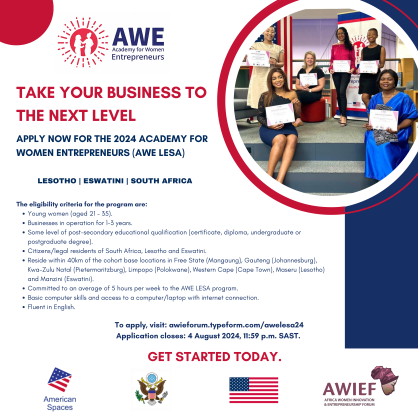
The U.S. Mission to South Africa and the Africa Women Innovation and Entrepreneurship Forum (AWIEF) (www.AWIEForum.org) proudly announce the launch of the 2024 Academy for Women Entrepreneurs program in Lesotho, Eswatini and South Africa.
The Academy for Women Entrepreneurs (AWE) is an initiative of the U.S. Department of State and Arizona State University's Thunderbird School of Global Management. It supports the U.S. National Strategy on Gender, Equity and Equality and reflects the United States' commitment to advancing gender equity and economic prosperity in Southern Africa
The Academy for Women Entrepreneurs LESA (Lesotho, Eswatini and South Africa) program is centred on the Francis and Dionne Najafi 100 Million Learners Global Initiative, an accredited online global management and entrepreneurship certificate consisting of five world-class courses and available to learners across the globe.
The overall goal of the program is to promote economic prosperity, including equitable economic development opportunities for historically disadvantaged groups and individuals. AWE LESA provides a resource for women entrepreneurs to engage in online education with guided facilitation and localization; fosters networks that support participants' access to peer-to-peer mentorship, business partners, and scaling opportunities with businesses in the region and in the United States; as well as provides access to a range of educational programs tailored to women's economic empowerment to expand the impact on the participant.
AWE LESA 2024 will empower 100 young women entrepreneurs in seven cities – five in South Africa and one each in Lesotho and Eswatini. The program will host cohorts in Bloemfontein (10 participants), Cape Town (10 participants), Johannesburg (15 participants), Polokwane (15 participants), Manzini (20 participants), Maseru (20 participants), and Pietermaritzburg (10 participants). The participants will attend in-person training sessions and events at designated American Corners and partner spaces in each location.
AWE LESA 2024 activities will take place between August 2024 and January 2025, and this edition will bring the total number of women entrepreneurs trained through the U.S. Mission to South Africa and AWIEF partnership to more than 700.
What do you gain from participating in the AWE LESA program?
What are the criteria to apply?
Applications Open Now!
Academy for Women Entrepreneurs applications are officially open for highly motivated and self-driven young women entrepreneurs from Lesotho, Eswatini and South Africa. THERE IS NO COST TO APPLICANTS AT ANY STAGE.
To submit your application, please follow this link: https://apo-opa.co/3WvSAIa
The deadline for submission is August 4, 2024 at 11:59 p.m. South Africa Standard Time (SAST).
For more information email: info@awieforum.org
Distributed by APO Group on behalf of Africa Women Innovation and Entrepreneurship Forum (AWIEF).
Ministers welcome renewed commitment to service delivery
Ministers responsible for some of the key portfolios in the Government of National Unity (GNU) have welcomed the renewed focus on some crucial areas of service delivery, as the work that lies ahead for the seventh administration was brought into sharp focus on Thursday evening.
President Cyril Ramaphosa delivered the Opening of Parliament Address (OPA) at the Cape Town City Hall, where he provided the details of the programme of action for the new Executive.
The much-anticipated address followed the ushering in of the seventh administration after South Africans voted in the National and Provincial Elections in May. With no outright majority winner, 10 political parties formed a Government of National Unity (GNU), which enjoins all parties to work together for improved service delivery and advanced economic growth.
After the President’s address, some Ministers who spoke to SAnews in the Parliamentary Precinct in Cape Town, reiterated their support for the goals of this administration, which are articulated in the Statement of Intent agreed to by parties to the GNU.
Chief amongst these targets are the pursuit of rapid, inclusive and sustainable economic growth; the creation of a more just society by tackling poverty; safeguarding the rights of workers; stabilising government; building State capacity, and pursuing a foreign policy based on human rights, solidarity and peace.
President Ramaphosa highlighted a number of projects ranging from essential infrastructure to improved health care – all geared towards better outcomes for citizens and economic development.
Water and Sanitation Minister Pemmy Majodina told SAnews that the provision of water is an issue that requires urgent attention.
“We have mega water projects that we have unblocked, such as the Lesotho Highlands Phase 2, which will assist to provide water to Gauteng, North West, Free State, Mpumalanga and the Northern Cape,” Majodina said.
She reiterated government’s commitment to ensuring that projects of such nature become successful in delivering on their mandate, despite the hurdles that arise.
Cooperative Governance and Traditional Affairs Minister Velenkosini Hlabisa welcomed the President’s call for the proper implementation, at local government level, of the indigent policy so that the old, the infirm and the poor get assistance with the payment of basic services.
“This is the outcome of our engagements and discussions, where we agreed on key priorities… to turn things around and pull together. We are also going to look [closely at] municipalities because if they are not stable, there won’t be economic growth,” Hlabisa said.
Improving health outcomes
On the provision of health services, President Ramaphosa once again reassured that through the implementation of the National Health Insurance (NHI), government will be able to bring stakeholders together, resolve differences and “clarify misunderstandings”, a sentiment echoed by Health Minister, Dr Aaron Motsoaledi.
On 15 May 2024, President Ramaphosa signed the National Health Insurance Bill into law.
READ | President Ramaphosa signs NHI Bill into law
The NHI Bill seeks to provide universal access to health care services in the country, in accordance with the National Health Insurance White Paper and the Constitution of South Africa.
The Bill envisages the establishment of a National Health Insurance Fund and sets out its powers, functions and governance structures.
Motsoaledi said government intends to ensure that all are treated equally at health facilities.
“As government, we want people to be treated the same. This is what we are striving [for].”
The NHI Bill will also create mechanisms for the equitable, effective and efficient utilisation of the resources of the fund to meet the health needs of users and preclude or limit undesirable, unethical and unlawful practices in relation to the fund. It further seeks to address barriers to access.
The Bill was initially tabled in Parliament and introduced to the Portfolio Committee on Health on 8 August 2019 for processing. – SAnews.gov.za
Edwin
Thu, 07/18/2024 - 22:21
An impressive total of R430,000 in incentives will be paid out in recognition of the incredible achievements of local athletes at the 7th edition of the iconic Absa RUN YOUR CITY DURBAN 10K that was held on Sunday, 7 July 2024. The 2024 Absa RUN YOUR CITY DURBAN 10K will be remembered as a historic …
Soweto July 2024 – Today, the children of Pimville in Soweto are celebrating as Manhattan Sweets pilots the “Manhattan Fun Lab”, a play initiative that sets out to tackle play inequity and deliver quality play opportunities for South African children living in impoverished areas. The first ever International Day of Play took place on the …
Trust and relationships key ingredients to coalition governments
Former Advisor to Coalition Governments in Ireland, Fergus Finlay, says trust and relationships are an important ingredient towards the success of coalition governments.
“The key thing about coalitions is relationships, acceptance that you not going to get everything you want in a coalition, [and] acceptance that even if you don’t get everything you want, you are going to respect the bottom line,” Finlay said.
Finlay made the remarks during a webinar held under the topic: “Making Coalitions and Governments of National Unity Work: The Role of Professional Bureaucracies.”
The webinar was hosted by the National School of Government (NSG).
It provided a platform to discuss the likely impact of the Government of National Unity (GNU) on the public administration and governance system, with lessons from countries abroad that have gone through power sharing arrangements, as well as in the country’s local government system where coalitions have also been in existence for a few years.
During Monday’s session, experts from the country and abroad shared their insights and experiences on the impact of coalition arrangements on public sector institutions.
Sharing his experience on coalition governments, Finlay said relationships, trust and a written programme is essential, noting that detailed structure to get to the programme is imminent.
“There is no guarantee in the end of success, unless there is trust and mutual respect,” Finlay said.
Former Chief of Cabinet for various Belgian Ministers, including the Vice Prime Minister from the Belgium government--which is known for coalition governments-- Jan Cornillie noted that the longest coalition negotiation in Belgium took 514 days.
Sharing lessons learned on coalition agreements, Cornillie underscored the importance of discussing coalitions before entering into government and the need to make compromises and institutionalise it because ‘pacification is in itself a key to coalition outcome.’
“Limit the zone of possible agreements by introducing facts and constraints into the discussions (what is implementable), provide an overarching narrative in which governing parties can find themselves; make use of the nation’s centre(s) of excellence in policymaking, and provide access to chief advisors from all governing parties,” Cornillie said.
Cornillie also emphasised that government is not completed by Ministers and Cabinet alone, but need a whole system, including advisors, the civil service, national expert bodies, and political advisors that trust each other.
Overcoming difficulties
Professor of Political Science at the University of Florence and Coordinator of Department of Public Policy and Governance, National School of Administration (SNA), in Italy, Professor Andrea Lippi, acknowledged that coalition governments are difficult.
Lippi said through coalition governments, Italy has seen transformation of the Cabinet with more relevant, not only legal supervision, but brokering and with more employees; and creeping professionalisation of civil servants towards a strategic role of policy making.
He said Italy also experienced the relevant role of informal relationships, networking, governance among ministries, and multilevel governance with 20 regions and 7 000 more municipalities, as well as new relationships between representative bodies and bureaucrats and related new problems, including accountability, delegation of responsibilities, and bargaining.
“We have observed the increasing relevance of soft power in place of (or beside) hard power; new stream of skills for a policy of training in favour of top civil servants; increasing the role of evidence-based policy making [including] policy evaluation, policy advice, open government and participatory procedures, and multi-level governance [amongst others].”
Professional public officers should be apolitical
Lesotho Institute of Public Administration and Management Administration Director-General, Nthabiseng Tlhomola, argued that the role of professional public officers is to serve the government of the day and as such, should be apolitical.
For the first time since 1966, the Lesotho general elections in 2012 produced a hung government, where no single political party could form government, and political parties were forced to engage in talks to join forces.
On the rise of GNU in Lesotho, Tlhomola said in general, the manifestos of the country’s political parties were similar - looking into infrastructure development, job creation and growing the economy.
“We are now more than 10 years [into] a coalition government; we therefore have a story to tell,” Tlhomola said.
Tlhomola noted that even though the oversight institutions are affected by government changes, the government makes sure that their role to ensure that government business operates as expected, continues. – SAnews.gov.za
GabiK
Mon, 07/08/2024 - 15:20
South African long distance sensation Elroy Gelant put on a tactical masterclass on his way to setting a new lifetime best time of 27: 47 to win the iconic Absa RUN YOUR CITY DURBAN 10K on Sunday 7 July. “It’s great to get my first Absa RUN YOUR CITY Series win. It took a lot …
School of Government to host webinar on GNU
The National School of Government (NSG) will host an important webinar on the new South African government system, a Government of National Unity (GNU) as well as coalition arrangements.
Monday’s webinar will focus on making coalitions and GNU work and the role of professional bureaucracies.
“The webinar will provide a platform to discuss the likely impact of the GNU on the public administration and governance system, with lessons from countries abroad that have gone through power-sharing arrangements as well as in the country’s local government system where coalitions have also been in existence for a few years,” the NSG explained.
The session will include local and overseas experts who will share their insights and experiences on the impact of coalition arrangements on public sector institutions.
The speakers include former Advisor to Coalition Governments in Ireland Fergus Finlay as well as Jan Cornillie, Former Chief of Cabinet for various Belgian Ministers.
The attendees will also hear from Lesotho Institute of Public Administration and Management Administration Director-General, Nthabiseng Tlhomola, Chairperson of the Public Service Commission Professor Somadoda Fikeni and many more.
Announcing his new Cabinet last month, President Cyril Ramaphosa said the establishment of the GNU in its current form was unprecedented in the history of the country’s democracy.
The President said: “We have had to consider how to form the new government in a manner that advances the national interest, that gives due consideration to the outcome of the election and that makes use of the respective capabilities within each of the parties”.
The President added that all the political parties who were members of the GNU had committed to respecting the Constitution, promoting accountable and transparent governance, evidence-based policy and decision-making as well as the professionalisation of the public service, integrity and good governance.
The NSG has introduced a series of webinars and seminars over the past few years to exchange knowledge and promote a culture of continuous learning within the public sector.
These sessions aim to ensure that public officials can benefit from the latest thinking from the global content and local levels’ experiences.
Each session is addressed by a senior expert on the topic of focus and is generally attended by senior leaders from across the public sector both elected leaders and appointed officials.
President Ramaphosa and a range of Ministers have also previously participated in a webinar arranged by the school.
The webinar will take place virtually on Monday from 9 am to 1 pm.
Click on this link to register https://thensg-gov-za.zoom.us/webinar/register/WN_GvBAX8j5RRO-EQ1d7YfkOA#/registration. – SAnews.gov.za
Gabisile
Sun, 07/07/2024 - 13:02
Western Cape prepares for inclement weather
The Western Cape Local Government, Environmental Affairs and Development Planning Department says the province is expecting a series of cold fronts with adverse weather conditions starting this weekend and continuing into most of next week.
Local Government, Environmental Affairs and Development Planning MEC, Anton Bredell, said the Provincial Disaster Management Centre (PDMC) was briefed on Saturday by the South African Weather Service (SAWS) on the approaching weather systems.
The weather service has since issued several warnings for heavy rains and rains:
Bredell said the PDMC is on standby and the various municipal district disaster centres are ready to be activated if needed.
“Emergency, rescue and social services are prepared to respond to any eventualities,” the department said in a statement.
Ready to assist
Meanwhile, provincial departments are represented at the PDMC and will be ready to provide support if needed.
“The Department of Water and Sanitation said catchments and dam levels are being monitored closely and regular updates will be made to the PDMC as the weather systems develop.”
According to Bredell, strong winds, combined with rain-saturated soil increase the risks of trees and tall structures being toppled.
In addition, the provincial department said various government services may be affected by the inclement weather and residents are asked to stay informed by monitoring the latest weather reports through trusted local news platforms and the local municipality’s social media pages.
“Services are also being activated to support the vulnerable and those impacted by the inclement weather,” the MEC added.
Other provinces
According to the SAWS, very wet, cold and windy conditions associated with an intense cold front and steepening upper-air trough are expected to start affecting the Eastern Cape, the Northern Cape, the North West and Free State, spreading along the Lesotho border on Monday.
“The public and small stock farmers are advised that very cold conditions and snowfalls are expected,” the statement read.
The SAWS also issued a warning about high fire danger conditions that are expected over theFree State, eastern parts of the Northern Cape, western parts of North West, Eastern Cape, south-western parts of KwaZulu-Natal and Gauteng.
Call for caution
In the meantime, residents have been urged to stay warm and safe.
“With the end of the school holidays, many people may be travelling home. We ask residents to please be extremely cautious on the roads.
“Due to the combination of high winds, heavy rain, and snowfalls over high mountains expected, we urge residents to please reconsider travel and outdoor activities next week and avoid unnecessary travel,” the MEC cautioned. – SAnews.gov.za
Gabisile
Sun, 07/07/2024 - 11:44