• Skip to main content
  • Skip to header right navigation
  • Skip to after header navigation
  • Skip to site footer
MyZA

MyZA

News, Directory, Events and Other Stuff

  • Social Media
  • Sport
  • World News
  • Home
  • Submit News
  • Directory
  • Events
  • Stratlec
  • TFSA
  • News
    • APO
    • Today’s Sport News
    • Todays Social Media and Tech Headlines
    • Today’s World News
    • Today’s SA Financial News
  • Contact
You are here: Home / Archives for new

new

11 December 2023

PROTEC and partners prepare for expansion over ‘the next 40 years’

Location: MyPR

PROTEC, a national NPO that has been building successful STEM careers in South Africa since 1982, is closing the year with exciting plans and strategies for expanding the geographic reach, the number of teachers and learners to be impacted, and the range of programmes in PROTEC’s portfolio in forthcoming years. Balan Moodley, CEO of PROTEC, …

Read morePROTEC and partners prepare for expansion over ‘the next 40 years’
11 December 2023

“25 years of HIV Management Excellence: AfroCentric Group ‘s Aid for AIDS (AfA) leads the charge to dismantle stigma and rebrand HIV”

Location: MyPR

As we observed World AIDS Day, it was both a moment of reflection on progress and a call to action for a crucial issue that still persists to this day. In Southern Africa, where HIV is the most severe globally, the battle against the virus extends beyond medical challenges and stretches to societal barriers built …

Read more“25 years of HIV Management Excellence: AfroCentric Group ‘s Aid for AIDS (AfA) leads the charge to dismantle stigma and rebrand HIV”
11 December 2023

SA20 Lolly

Location: Sport

SA20 Lolly to take incredible ‘Taste of Summer’ on a countrywide tour Monday 11 December 2023: As temperatures rise, so does...

Read moreSA20 Lolly
11 December 2023

Health concerned about death rate among TB patients in SA

Location: News

Health concerned about death rate among TB patients in SA

Although South Africa’s Tuberculosis (TB) infection incidence is dropping, government is disturbed about the death rate among patients.

This is according to the Deputy Health Minister, Dr Sibongiseni Dhlomo, who was delivering a keynote address on the opening day of the BRICS TB Research Network Innovation Summit in Durban. 

“TB remains a pressing concern for South Africa, as it does for all BRICS countries and many nations,” he said on Monday. 

He told the summit attendees that about 300 000 people are estimated to get TB every year in South Africa.

“Last year alone, we managed to notify and put 224 000 people on a TB treatment regime. Although our infection incidence is declining, we are concerned about the unacceptable death rate among our TB patients.” 

According to Dhlomo, a major driver of TB infection is HIV – accounting for 48% of TB patients who are living with HIV in 2022. 

However, he said the country’s antiretroviral programme has led to a decrease in TB incidence. 

The BRICS nations – Brazil, Russia, India, China and South Africa - carry a disproportionate burden of drug-susceptible and drug-resistant TB infection and neglected diseases of the South. 

To address this public health threat, the BRICS TB Research Network was established in 2017 to bring together programme managers and scientists to exchange information and formulate redress strategies and solutions. 

“The ultimate goal of this endeavour was to establish collaborative research programmes aimed at developing new diagnostics, drugs, and vaccines for TB. 

“The TB control programmes from the various representative countries also undertook to learn from each other on key aspects of financing and strengthening the health systems in their respective nations.” 

Following the devastating impact of COVID-19 on public health programmes, South Africa developed a TB Recovery Plan to find missing people with TB linking them to care and creating a demand for testing. 

“TB prevention and improvement of data systems are also prioritised. Given our high HIV-TB comorbidity let me give our delegates some data on HIV in South Africa.”

He cited the sixth South African National HIV Prevalence, Incidence, and Behaviour among people aged 15 years and older living with HIV in South Africa in 2022. 

According to the data, 90% were aware of their status, 91% of those aware of their status were on antiretroviral treatment, and 94% of those on antiretroviral treatment were virally suppressed. 

“South Africa has made significant progress toward the UNAIDS 95-95-95 targets that by 2025, 95% of all people living with HIV to be aware of their HIV status, 95% of those aware of their status to be on antiretroviral treatment, and 95% of those on antiretroviral treatment who also know that that they are living with HIV to achieve viral load suppression.”

In addition, he stated that the country has been at the forefront of introducing and scaling up new tools for diagnosis and shorter treatment regimens for drug-resistant TB. 

“However, there is a need to do more to improve linkage to care and retention in care.”

He also believes that BRICS countries have made significant strides since the establishment of this network, with progress and some challenges. 

Dhlomo touched on the United Nations General Assembly High-Level Meeting on TB, in New York, in September this year. 

“We should, therefore, work very hard to ensure that we meet the targets we have set ourselves for this summit.”

The targets, he said, include the creation of innovations in therapeutics, diagnostics, and vaccines that the network can prioritise for collaboration, investment and development. 

“A world without TB is not just an aspiration but an attainable reality, and we should stand ready to play our part in making that vision a shared triumph. 

“I certainly believe that this network can make a significant contribution to this end. Let us recommit to the implementation of the Political Declaration on TB as we map out of future endeavour of ending TB in BRICS countries. 

“The goal to end TB is within our grasp. Our collective efforts must transcend borders, ideologies, and individual interests.” 

Dhlomo also took the time to congratulate Russia as it takes the baton of leadership of BRICS in 2024. – SAnews.gov.za


Gabisile
Mon, 12/11/2023 - 11:48

573 views
Read moreHealth concerned about death rate among TB patients in SA
11 December 2023

Navigating the World of Apartments for Sale: A Guide for Buyers

Location: MyPR

Introduction The search for an apartment is an exciting journey, offering the promise of a new home and lifestyle. This blog provides an overview of the key factors to consider when exploring the market for apartments for sale, aiming to guide potential buyers through this significant decision. Understanding Your Needs Before diving into the apartment …

Read moreNavigating the World of Apartments for Sale: A Guide for Buyers
11 December 2023

Picket against fossil fuels at Muizenberg beach

Location: News

Protests coincide with COP28 summit underway in Dubai

Read morePicket against fossil fuels at Muizenberg beach
11 December 2023

Cabinet briefed on NSFAS preparations for 2024

Location: News

Cabinet briefed on NSFAS preparations for 2024

As part of ensuring readiness for the 2024 post-matric academic year, Cabinet has been briefed on measures that are being put in place to avoid the challenges that affected the National Financial Aid Scheme (NSFAS).

“As part of ensuring readiness when the 2024 academic year for post matric education begins, Cabinet was briefed on measures that are being put in place to avoid the challenges that bedevilled NSFSAS in the 2023 post-matric academic year,” Cabinet said in a statement on Monday.

Last month, the scheme announced that applications for financial aid for all learners who wish to enter the post-school system and students who do not have financial assistance to continue their studies in the 2024 academic year would officially open on 21 November 2023 and close on 31 January 2024. 

In a statement at the time, the NSFAS said the reason for opening applications in November was so that it could afford the beneficiary shorter turn-around times for decision making, which is aligned to the financial eligibility assessment which requires updated South African Revenue Service (SARS) information. 

The NSFAS at the time said it was improving its data exchange processes with institutions to ensure seamless data integration and the registration of students onto its new direct payment systems. 

At a media briefing addressed by Minister in the Presidency, Khumbudzo Ntshavheni on Monday, Cabinet said the Minister of Higher Education and Training, Dr Blade Nzimande will provide details on measures to improve the performance of the NSFAS.

Nzimande has previously urged all learners who wish to enter the post-school system and students, who do not have financial assistance to continue their studies, to submit their applications for 2024 funding.

Minister Nzimande urged all students who wish to study in any of the public universities and Technical Vocational Education and Training (TVET) colleges to apply timeously and not to wait until the last day. 

Since it’s established by government in 1999, the NSFAS provided financial assistance to deserving beneficiaries who qualify for post school education and training. – SAnews.gov.za


Edwin
Mon, 12/11/2023 - 12:39

668 views
Read moreCabinet briefed on NSFAS preparations for 2024
11 December 2023

Revised Schedule Unveiled As ICC U19 Men’s Cricket World Cup 2024 Heads To South Africa

Location: Sport

Event originally scheduled for Sri Lanka will now be held across five venues in South Africa from 19 January The...

Read moreRevised Schedule Unveiled As ICC U19 Men’s Cricket World Cup 2024 Heads To South Africa
11 December 2023

South Africa: 16 days are over, now the real work begins

Location: News

Republic Of South Africa: Western Cape Provincial Government
Download logo

The 16 Days of Activism For No Violence Against Women and Children Campaign has come to an end, but now the real work begins and must continue every day.

For the Western Cape Government (WCG), addressing gender-based violence is not limited to the period of 25 November to 10 December. It is a priority throughout the year.

The Western Cape Department of Social Development (DSD) has been leading the roll-out of the WCG GBV Implementation Plan. The plan has assisted us in the planning, coordination, and monitoring of efforts that aim to address GBV, directly and indirectly.

It fortifies current GBV services and interventions and allows us to explore new opportunities, like the geo-mapping system the DSD has developed to track the prevalence of GBV in the province and allocate resources accordingly.

“We are doing as much as we can to stem the tide of violence, and support survivors, but government is not the sole agent of change. We are already seeing the very real impact of the 2023 national wage agreement and national budget pressures. Due to the significant cuts from national government in the Adjusted Budget for 2023/24, the Department reduced and reprioritized funding allocations to several sub-programmes, including the Victim Empowerment Programme (VEP),” says Provincial Minister of Social Development Sharna Fernandez.

“This unprecedented cut in the current financial year – and projected reductions in the new financial year – meant we had to halt the opening of a new GBV shelter in Murraysburg. While further cuts are speculative at this stage, I am deeply concerned about the NGO and NPO sector, as well as DSD staff who may have to deal with the increased demand for services. Now more than ever, we need our partners across society to take hands with NGOs in the GBV space that are providing crucial services to survivors and their children. Corporates and citizens who can support registered entities, I encourage you to do so.”

The Department remains committed to supporting all those impacted by violence and abuse, whether women, children, members of the LGBTQIA+ community, or men.

76 178 GBV survivors accessed psychosocial support services provided and funded by DSD in 2022/2023, a significant increase from 51 790 in 2020/21. DSD also funds 26 shelters across the province.

Distributed by APO Group on behalf of Republic Of South Africa: Western Cape Provincial Government.

Read moreSouth Africa: 16 days are over, now the real work begins
11 December 2023

10 000 current police officers to boost festive season safety position

Location: News

10 000 new police officers to boost festive season safety plan

Police Minister, General Bheki Cele, has assured the nation that it will be all hands on deck by law enforcement officials this festive season, to ensure a safe holiday period in the country. 

“The holiday season is a time where criminals sharpen and refine their operations, taking advantage of the festive mood,” Cele said, addressing the media in Pretoria on Sunday on the festive season safety plan by the South African Police Service (SAPS).

Cele said the festive season is a period largely characterised by festivities and increased migration of people within and across the borders.

“We as the country’s law enforcement have and will continue to upscale our responses to crime this holiday season and beyond,” Cele said.

Through bold efforts and a decisive policing approach to fighting crime, police operations will continue to ensure that the police get a grip on serious and violent crime in the country.

“In the coming days, the bite of the SAPS will be stronger, as we welcome in the police service's 10 000 new officers.

“The 2023 Project 10K police recruitment drive is a direct response to the call from His Excellency, President Cyril Ramaphosa, to strengthen our policing capacity and enhance police visibility. The SAPS recruitment office successfully processed 600 000 of these applications and embarked on a rigorous recruitment drive.

“We are now in the second phase of enlisting 10 000 police officers, who will be graduating from various police academies throughout the country in the coming week. This means there will be 10 000 more boots on the ground come the 15th of December, when the last passing out parade takes place in Tshwane,” the Minister said.

The police trainees have been stationed at police academies across the country for the past months.

“They have been hard at work in perfecting street survival courses, firearm, law and physical training during their completion of the Basic Police Development Learning Program. We have no doubt, the new members will provide a much needed boost to the current policing numbers and amplify our law enforcing efforts.

“These officers will be deployed to sanitise the streets and increase the footprint of the police in all nine provinces,” Cele said.

Their deployment will be prioritised in high crowd zones and areas of entertainment and leisure this holiday season.

With regard to Operation Shanela, Cele said the men and women in blue are doubling their efforts to tackle and squash the enemy of crime lurking in the streets and in communities.

“Police in all provinces are gaining ground on crime and organised criminality and this has been reflected in our last released crime statistics.

“The chunk of the arrests took place in the provinces of the Western Cape with 64 171 arrested suspects, followed by  Gauteng with 48 917 arrests while SAPS in KZN arrested a total of 37 769 in the past six months,” he said.

Over 3 200 firearms including 2 500 handguns and 300 rifles have been taken off the streets through Operation Shanela.

“Through Operation Shanela, over 1 717 hijacked or stolen vehicles have been recovered from May to date,” the Minister said. – SAnews.gov.za


Edwin
Mon, 12/11/2023 - 09:51

34 views
Read more10 000 current police officers to boost festive season safety position
11 December 2023

Women’s football stars shine at the Hollywoodbets Super League Awards

Location: MyPR

The third season of the Hollywoodbets Super League has proven to be amazing as it continues to build on the foundations that have been laid in previous years. This season stands as a testament to the league’s exceptional quality, evident in an evening dedicated to honouring the outstanding South African female footballers who showcased extraordinary …

Read moreWomen’s football stars shine at the Hollywoodbets Super League Awards
11 December 2023

Africa’s Top 100 Business Opportunities to Watch in 2024

Location: Business
Activator HQ

Despite rising food and fuel costs, weakening currencies, climate change effects, security threats, political instability, rolling power cuts, infrastructure limitations, and several economic and social challenges, Africa will be one of the fastest-growing regions in 2024.

That's one of the key findings in the 2024 edition of the Top 100 Business Opportunities in Africa to Watch (https://apo-opa.co/47PmhYd), an annual selection of the continent's most lucrative business ideas and investment opportunities curated by Activator HQ.

Following two years of slow post-COVID recovery, 2024 presents several interesting opportunities for business startup and growth in Africa. While Nigeria, South Africa, Egypt, Kenya and countries across the continent offer unique opportunities and challenges for new business and investment, economies like Senegal, Ethiopia, Tanzania, Cote d'Ivoire, Rwanda, Burkina Faso, The Gambia and Benin could grow by more than 6% in 2024, twice higher than the global growth of 2.9% projected by the International Monetary Fund (IMF).

The Africa Top 100, now in its 7th year, identifies specific business ideas and investment opportunities in over 30 growth markets, industries, value chains, and underserved niches across Africa. Each opportunity in the Top 100 is selected based on their relevance to local market needs, lucrativeness, competitive superiority, export potential, and innovation.

“The new edition, which is the outcome of months of research and analyses that considered dozens of value propositions, market trends, demand-supply gaps, and business models across Africa, only consists of opportunities that have a minimum total addressable market value of $100 million,” said John-Paul T. Iwuoha, Founder and CEO of Activator HQ. “It is interesting to see from our 2024 selection that more business ideas and investment opportunities in Africa are actually borne from unmet market needs, difficult but highly-rewarding problems, and the megatrends we have identified that are currently shaping the continent (https://apo-opa.co/46Sd4gb).”

As a developing region, Africa's deficits in food security, housing, finance, education, energy and other critical areas are inspiring innovative solutions, products, and services from a growing number of startups and growth-stage businesses on the continent. In essence, for entrepreneurs in Africa, problems are actually opportunities to unlock market value and create compelling value propositions.

“Our mission at Activator HQ (www.ActivatorHQ.com) is to make it easier and faster for entrepreneurs to start and grow businesses in Africa. That's why our selection of business ideas features inspiring examples of real entrepreneurs, startups, and companies in Africa that are getting results and making impact on the ground,” Iwuoha said. “To reduce the barriers to startup, we have also developed bespoke and professionally-crafted business plans (https://apo-opa.co/470U6Ew) that can be downloaded and used to raise funding or guide the execution of a specific business idea.”

Highlights from Activator HQ's 2024 Africa Top 100 Guide:

  • The food sector remains a multi-billion-dollar growth opportunity for the continent. The Africa Top 100 features several business ideas across the food value chain, from agricultural production to processing, marketing, and services in local and export markets.
  • The digital economy presents a $180 billion opportunity for Africa by 2025. With the world's youngest population, digital skills training and outsourcing is a strategic but underexplored market gap that brims with innovative ideas for new businesses and investments in Africa, particularly for high-demand skills like cybersecurity, data analytics, digital marketing, and software development.
  • The circular economy: recycling of waste, such as generating electric power from landfill waste, recovering scrap metals for reuse, and processing municipal wastewater into potable freshwater, hold interesting business and investment opportunities that could, conservatively, inject an additional $8 billion into the African economy according to the United Nations Environment Programme (UNEP).
  • The energy value chain is rich with opportunities for Africa. The combination of climate change effects, rising renewable energy penetration, and soaring energy prices precipitated by the Russia-Ukraine war has created market gaps and opportunities for more African gas supplies to Europe. There are also opportunities for local substitution of cooking fuels like firewood and charcoal with natural gas, and solar power applications for cold chain solutions.
  • Financial services remain one of the fastest-growing and most lucrative sectors in Africa to watch in 2024. While payments and consumer finance usually get most of the attention, niche opportunities like diaspora investment funds and female-focused finance are spotlighted in the latest Africa Top 100 guide.

“I am very proud of the meticulous work the team has put into the 2024 edition of the Africa Top 100,” Iwuoha continued. “In contrast to the mainstream stereotype of Africa as a ‘poor continent', the impressive ideas in this guide show the sheer abundance of opportunities in Africa for new businesses and investments. The spirit of entrepreneurship is bursting with energy on the continent and I am optimistic that many of the ideas in our 2024 edition will inspire new businesses, products, projects, investments, and income streams in the new year.”

The Top 100 Business Ideas in Africa to Watch in 2024 is available on the Activator HQ website at https://apo-opa.co/41hkLvm.

Distributed by APO Group on behalf of Activator HQ.

Media contact:
John-Paul Iwuoha
jp@activatorhq.com

For more information about Activator HQ, visit:
Website: www.ActivatorHQ.com
Twitter: https://apo-opa.co/46Np8iY
Facebook: https://apo-opa.co/3uRABAT
LinkedIn: https://apo-opa.co/3NowFxL
YouTube: https://apo-opa.co/3NqTmkT

About Activator HQ:
Founded in 2013 as Smallstarter Africa and relaunched on its 10-year anniversary, Activator HQ is a market intelligence and capacity development firm that supports Africa-focused entrepreneurs with the insights, training, and guidance they need to succeed in the continent's promising but difficult markets. In the last decade, Activator HQ has trained over 30,000 entrepreneurs and business owners on startup and market entry strategy, fundraising, sales and growth strategy, business modelling, and turnarounds. Its list of clients and partners includes the Staff Cooperative Societies of Nigeria LNG and Total Exploration & Production (Nigeria), the SUN Business Network, the Roddenberry Foundation, and the African Women Innovation and Entrepreneurship Forum (AWIEF), among others.

Media files
Activator HQ
Download logo
Read moreAfrica’s Top 100 Business Opportunities to Watch in 2024
11 December 2023

Amid rising corruption, most Africans say they risk retaliation if they speak up

Location: News
Afrobarometer

A majority of Africans say that corruption in their country is rising, that their government is failing in its efforts to fight it, and that ordinary citizens risk retaliation if they report corruption to the authorities, Afrobarometer's (www.Afrobarometer.org) latest Pan-Africa Profile (https://apo-opa.co/41k8N4i) reveals.

Download document (1): https://apo-opa.co/3NmOey6
Download document (2): https://apo-opa.co/3RDm193

Released ahead of International Anti-Corruption Day (9 December), the Afrobarometer report is based on nationally representative surveys in 39 African countries.

Findings show that among key public institutions, the police are most widely perceived as corrupt. In substantial numbers, citizens report having to pay bribes to obtain police assistance or avoid problems with the police, as well as to get government documents and services at health facilities and schools.

Citizens' assessments vary widely across countries, with Gabon, South Africa, Nigeria, Liberia, and Uganda among the worst-performing countries when it comes to perceived corruption in key public institutions, while Seychelles, Cabo Verde, Tanzania, and Mauritius turn in the best performances.

Key findings

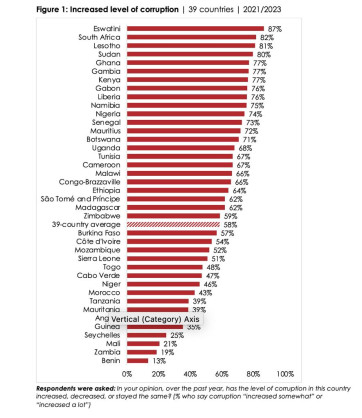
  • On average across 39 countries, a majority (58%) of Africans say corruption increased “somewhat” or “a lot” in their country during the preceding year (Figure 1).
    • Compared to 2014/2015, 12 countries recorded double-digit increases in perceptions of worsening corruption, including a surge of 39 percentage points in Senegal, while decreases reached a remarkable 61 points in Benin.
    • More than two-thirds (68%) of citizens say “some” or “a lot” of the resources intended to address the COVID-19 pandemic were lost to corruption.
  • Almost half (46%) of Africans say that “most” or “all” police officials are corrupt, the worst rating among 11 institutions and leaders the survey asked about. Tax officials, civil servants, and officials in the Presidency tie for second-worst, at 38% (Figure 2).
  • Among citizens who sought selected public services during the previous year, substantial proportions say they had to pay a bribe to obtain police assistance (36%), to avoid problems with the police (37%), to get a government document (31%), or to receive services at a public medical facility (20%) or a public school (19%) (Figure 3).
    • Self-reported bribe-paying varies widely across countries. For example, obtaining a government document required a bribe from 68% of applicants in Congo-Brazzaville, compared to 1% in Cabo Verde and Seychelles.
  • Two in three Africans (67%) say their government is doing a poor job of fighting corruption (Figure 4).
  • Only one in four Africans (26%) say people can report corruption to the authorities without fear of retaliation (Figure 5).

Distributed by APO Group on behalf of Afrobarometer.

For more information, please contact:
Daniel Iberi
Afrobarometer communications officer for East Africa
Email: diberi@afrobarometer.org
Telephone: +254725674457

Follow us on:
Twitter: https://apo-opa.info/3jYM2la
Facebook: https://apo-opa.info/3K0t6gq
YouTube: https://apo-opa.info/3Ysf4IU
Visit us online at www.Afrobarometer.org
Follow our releases on #VoicesAfrica.

Afrobarometer surveys:
Afrobarometer is a pan-African, non-partisan survey research network that provides reliable data on African experiences and evaluations of democracy, governance, and quality of life. Nine survey rounds in up to 42 countries have been completed since 1999. Round 9 surveys (2021/2023) cover 39 countries.

Afrobarometer's national partners conduct face-to-face interviews in the language of the respondent's choice with samples of 1,200-2,400 adults that yield country-level results with margins of error of +/-3 to +/-2 percentage points at a 95% confidence level.

Media files
Afrobarometer
Download logo
Read moreAmid rising corruption, most Africans say they risk retaliation if they speak up
11 December 2023

As Conference of the Parties (COP28) Wraps Up, We Must Remember, Aid to Africa Is (Still!) Not the Retort

Location: News
African Energy Chamber

By NJ Ayuk, Executive Chairman, African Energy Chamber (www.EnergyChamber.org).

There was an era when Africa and Western pop music were closely linked.

Western entertainers spearheaded a number of internationally renowned events to raise awareness about the plight of starving Africans and generate funds for famine relief.

In December 1984, the supergroup Band Aid sang about feeding the world, asking “Do They Know it's Christmas?” Within a year, the group had raised over USD9 million. Three months later, USA for Africa released “We Are the World” and banked USD44.5 million after one year for its African humanitarian fund. Then on a hot July day in 1985, the worldwide concert event Live Aid raised more than USD150 million for famine relief in Africa.

These are just a handful of grand and noble gestures intended to lift Africa out of poverty. And these famous events arguably raised both awareness and funds. Unfortunately, the efforts — and others like them — fall far short of making any real socioeconomic change. In fact, some argue that injecting monetary aid into Africa, time and time again, has actually done more harm than good.

I acknowledge that stance may sound ungrateful. At first blush, many might counter that starving people have no agenda. Destitute parents still need to feed their children. Turning a blind eye to their plight is inhumane.

Let me explain why the African Energy Chamber (AEC) continues to push for free-market solutions rather than good-will handouts.

History of ‘Help'

Even aid genuinely given to help Africa tends to do more harm than good.

Since 1960, more than USD2.6 trillion has been pumped into Africa in the form of aid. From 1970 and 1998, when aid was at its peak, poverty actually rose alarmingly — from 11% to 66% — due in large part to this massive influx of foreign aid that counteracted its intended good.

Aid decreased long-term economic growth by fueling systemic corruption, in which powerful aid recipients funneled foreign funds into a personal stash instead of public investment. Many leaders realized that they no longer needed to invest in social programs for their constituents because of the revenues from foreign donors.

Large inflows of aid also caused higher inflation, hindering African nations' international competitiveness in exporting. That resulted in diminishing the manufacturing sector – which is critical in helping developing economies grow — across the continent. And well-intentioned Westerners who saw the economic shrink just kept pouring more and more money at “the problem” — leading to a vicious cycle that furthered corruption and economic decline.

But here's the kicker: The World Bank has admitted that 75% of the agricultural projects it implemented to help Africa failed. So why do they and other aid providers continue to fund these failing efforts?

Examples of Failure

Across the continent, we see example after example of failed aid projects, with agricultural projects routinely providing little or no benefit to African farmers.

In Mali, the U.S. Agency for International Development (AID) injected USD10 million into “Operation Mils Mopti” to increase grain production. The government imposed “official” prices on the grain, which forced farmers to sell their crops at these below-market rates and resulted in grain production falling by 80%. 

AID also spent USD4 million to help livestock producers grow the number of cattle in the Bakel region from 11,200 to 25,000 — but ultimately only succeeded in increasing it by 882 head. Another USD7 million was injected into the Sodespt region, but that investment managed to sell only 263 cattle and failed to sell any goats or sheep.

Then we see example after example of Westerners wastefully “helping” without any understanding of the local situation. Norwegian aid agencies built a fish-freezing plant to improve employment in northern Kenya — a region where the local people traditionally do not fish because of their semi-nomadic pastoralist lifestyle. Couple the lack of fishing experience with the unfortunate reality that the plant required more power than was available in the entire region, and the result was that the brand-new processing plant sat idle.

The World Bank financed a USD10+ million expansion of Tanzania's cashew-processing capabilities, which resulted in 11 factories with the capacity to process three times as many cashews as the country was growing on a yearly basis. The plants were too efficient for the available workforce and cost so much to run that it was cheaper to process the raw nuts in India. Half the plants were inoperable, and the other half only ran at about 20% capacity.

I'm not saying that we Africans are ungrateful for the outpouring of heartfelt care. The compassion of the West is certainly real. However, the outcome of said compassion is the concern: The more foreign aid African governments receive, the worse they perform. As long as the aid keeps flowing, government leaders and their employees who administer development programs may prosper while the rest of the citizenry continues to suffer the effects of a mismanaged economy.

Questionable Benefits

We also must acknowledge that, in far too many cases, aid has also been given to African nations and communities in attempts to manipulate and control.

“While hungry faces are used on posters and in media reports to sell the virtues of foreign aid, it is the hungry who rarely see any of the funds,” James Peron, executive director of the Institute for Liberal Values in Johannesburg, South Africa, lamented in a piece for the Foundation for Economic Education. “Poverty may be used to justify the programs, but the aid is almost always given in the form of government-to-government transfers. And once the aid is in the hands of the state it is used for purposes conducive to the ruling regime's own purposes.”

And now we witness the international community talking about aid for African countries as a substitute for our oil and gas activities. Western environmentalists argue that Africa should keep all of its petroleum resources in the ground to prevent further climate change. In exchange for that sacrifice, African nations would be compensated and inject that money into other opportunities like developing their sustainable energy technologies.

I've said it before, and I'll say it again: What a horrible idea!

I‘m offended by foreign stakeholders feeling that providing humanitarian assistance gives them the right to influence our domestic decisions. With Africa poised to participate in the worldwide energy transition, my fear is that international donors will feel justified to dictate Africa's policy regarding the lengths to which, and speed with which, our energy transition occurs. This would be a huge step backward in our energy, economic, and even individual independence.

Aid packages to incentivize giving up our oil and gas operations will be detrimental to Africans. Because let's be honest: History has shown that this assistance could never replace the oil and gas industry's ability to create jobs and business opportunities, grow local capacity, open the door to technology sharing, facilitate economic growth, and alleviate energy poverty.

Instead of continuing a pattern that clearly does more harm than good, why aren't African nations encouraged to leverage the wealth of resources at our feet?

During the final few days of COP28 — and beyond — the AEC is determined to make a case for African nations harnessing their oil and gas solutions to help themselves. We will not be bullied, or manipulated with aid, into a path that is not in our best interests.

Use What We Have!

One reason why the AEC is an outspoken advocate for Africa's oil and gas industry is because it represents more than big revenue for African governments. It is a free-market solution that creates pathways for Africans to help themselves. And, ultimately, empowering Africans is our number one goal.

We endorse an energy mix approach that allows Africa to use and sell our own hydrocarbon reserves to alleviate energy poverty, while at the same time moving toward a future in which renewable energy sources power the continent. The energy mix method can help more people more quickly because it takes a practical, people-first approach to helping those who have traditionally been left behind by the energy sector, while moving us toward greener energy sources.

Natural gas, in particular, can transform African lives and communities. Its potential benefits range from eradicating energy poverty to allowing Africans to develop skills for good jobs to creating hope for our youth.

Ramping up gas production to help alleviate the lack of access to electricity will create thousands of new employment opportunities in Africa. In addition, the new sources of energy can be exported to Western countries to replace Russian energy. Then, as Europe transitions to sustainable energy, a larger portion of Africa's natural gas can power domestic needs. By the time other countries complete their transitions to carbon-neutral sources, Africa will have a much more expansive and reliable grid system, which will allow for an easier transition.

And before we argue about the evils of hydrocarbons, let me point out that, although it might seem counterintuitive, it is possible for Africa to make use of its abundant fossil fuels while moving toward a future sustained by renewable energy sources. In fact, I believe that African nations must do everything they can to ensure that these two things work in tandem. Considering that 600 million people on the continent have no access to electricity and 900 million people lack access to clean cooking technologies, it's impossible — if not altogether inhumane — to discuss climate change without looking at energy poverty.

As I recently wrote in an article published by Medium, we cannot transition from the dark to the dark. We must deliver energy to the people of Africa and then worry about transitioning to environmentally friendly alternatives, just like we have everywhere else in the world.

This has been our platform at COP28, and we will continue to stand by it in 2024 and beyond.

Distributed by APO Group on behalf of African Energy Chamber.

Media files
African Energy Chamber
Download logo
Read moreAs Conference of the Parties (COP28) Wraps Up, We Must Remember, Aid to Africa Is (Still!) Not the Retort
10 December 2023

Ramokgopa urges public to engage with IRP 2023

Location: News

Ramokgopa urges public to engage with IRP 2023

Minister in the Presidency responsible for Electricity, Kgosientsho Ramokgopa, has urged the public to engage with the Integrated Resource Plan (IRP) 2023, which has been approved by Cabinet.

IRP 2023 is now set to be published by the Minister of Mineral Resources and Energy.

The Minister urged communities, stakeholders and interest groups to engage with the IRP 2023 and send their submissions, as part of determining the country’s “energy future”.

“This will underpin our responses in relation to how we are going to address the energy situation in the country.

“What is significant about this is that… the IRP 2023 computes two horizons [including up to 2030]. In the context of the energy crisis, the interventions [in this IRP] will help us in the short-term to ensure that we ameliorate the degree of the energy deficit that we are experiencing now.

“The IRP also computes horizon number two, which is from 2030 to 2050, and in the most bold fashion, it states what are these new sources of energy and essentially, it [deals with] our ability to be able to exploit our renewable energy endowment, and their linkages to the availability of transmission,” Ramokgopa said at the Energy Action Plan briefing on Sunday.

The Minister reiterated the commitment to resolve load shedding, and have a secure energy supply to protect the South African economy and ensure growth and development.

The IRP is a plan aimed at estimating South Africa's electricity demand. It takes into account how the demand for electricity will be met and the expense of such a demand. The plan refers to electricity generation and expansion programmes.

In formulating the National Development Plan, the Department of Energy gazetted the Integrated Resource Plan 2010-2030 (IRP 2010) in March 2011. This forecasted the energy demand for the 20-year period.

In October 2019, IRP 2019 was gazetted. This updates the energy forecast from 2019 to the year 2030.

The IRP is a “living document” that gets revised and updated.

Performance of power plants

The Minister announced that 980 megawatts (MW) at Koeberg Unit 2 will be taken out on Monday. Unit 1 one came back last month after significant delays. Koeberg is the only nuclear power station on the continent, with each of the two units producing 980 megawatts, according to the Minister. 

"It's very significant to the energy mix, and as part of our intention to extend its life by 20 years, we took out Unit 1 to comply with the requirements of the regulator (NERSA)... Now we are taking out Unit 2 for the same purpose," he said, noting that Unit 1 is almost at full load.

With regards to the performance of the grid over the past week, Ramokgopa said the unplanned capacity loss factor (UCLF) and partial load losses (the rate at which units are failing and not performing at optimal capacity) combined has been averaging just above 14 000MW.

“To put it into context, we have reached highs of 17 000MW of these losses. If we were to use May as our baseline, we were losing about 17 369MW. Essentially, we are better off by about 3 000MW, and that’s what we’ve been averaging.

“In fact, it looks even healthier if you were to take Saturday and today, where we’re at about 12 000MW. We have been able to introduce an improvement of about 5 000MW - 6 000MW… if you were to use the baseline of May,” the Minister said.

On why Stage 3 and 4 load shedding continues despite the improvement outlined by the Minister, he said the aim was to use the summer period to ramp up planned maintenance.

“We are averaging just close to 7 000MW. To put it into context, during the winter period, we were averaging about 2 500MW of planned maintenance. If you look at the period around May, it was 3 100MW. The team has taken out, of their own volition, an additional 3 000MW, compared to what was the situation in May.

“We reached a high of about 8 000MW on 8 December. That means there was an additional 4 000MW that has been taken out… It is important that we are able to do maintenance. The more you postpone maintenance, it will catch up with you and you will experience rapid failures of units.”

The Minister said the status quo shows the “true health” of the system, without “necessarily the assistance of the open cycle gas turbines”. While these are engaged at certain peaks, Ramokgopa said they are not being used at the rates at which they have previously been.

The Minister said all stakeholders are working hard to stabilise power supply, especially throughout the festive season.

New Eskom CEO

On the appointment of Dan Marokane as the new Eskom Group CEO, Ramokgopa said leadership stability is key to the resolution of the energy crisis that is confronting the country.

“We are looking forward to the contribution of Mr Marokane, together with the totality of the executive committee of Eskom… to give additional impetus to the work that we are doing,” Ramokgopa said, highlighting that there will now be “certainty in the apex office” of the power utility.

The Minister thanked the Interim Group CEO, Calib Cassim, for his contribution. – SAnews.gov.za

GabiK
Sun, 12/10/2023 - 12:47

130 views
Read moreRamokgopa urges public to engage with IRP 2023
10 December 2023

Marokane re-joins Eskom as current chief executive

Location: News

Marokane re-joins Eskom as new chief executive

Public Enterprises Minister Pravin Gordhan has announced the appointment of Dan Marokane as the new Group Chief Executive of Eskom.

Marokane is a qualified Chemical Engineer, who has a MBA and is a seasoned executive with more than 20 years senior leadership experience, the Department of Public Enterprises said on Friday.

He is expected to join Eskom no later than 31 March 2024.

“The advertisement for the post attracted 409 applications. From this process, 12 prospects qualified to further steps in the selection process.

“[Marokane] has experience working in distressed organisations with visible and pressurized turnaround mandates. His recent assignment is at Tongaat-Hullet, where he stepped up to lead this financially distressed business when its Group Chief Executive resigned.

“Mr Marokane was a senior manager in Eskom from 2010 to 2015, holding various senior positions, including head of Group Capital in Eskom,” the department said.

Marokane was one of four senior managers suspended during the State capture period. He subsequently resigned and went into the private sector.

“Mandatory checks, which include criminal and credit checks, verification of identity, qualifications, directorships, and establishment of conflicts of interest were completed,” the department said.

The date of commencement will be announced once Marokane has concluded the handover process with his current employer.

“Mr Marokane thrives on challenges, has the drive to energetically tackle the challenges confronting Eskom and is also ethically grounded.

“The Board has been requested to constitute a professional, skilled and committed executive team that will collectively lead Eskom through a complex but exciting journey, including achieving energy security for our people and the economy, implementing the Eskom Just Energy Transition and concluding the restructuring of Eskom,” Gordhan said.

The Minister thanked the Board for conducting a competitive and transparent process for the appointment of the GCEO. – SAnews.gov.za

GabiK
Sun, 12/10/2023 - 09:47

232 views
Read moreMarokane re-joins Eskom as current chief executive
10 December 2023

South Africa: African Development Bank approves $1 billion guarantee from the United Kingdom to support SA’s Just Energy Transition

Location: News

African Development Bank Group (AfDB)
Download logo

The Board of Directors of the African Development Bank Group (www.AfDB.org) has approved a $1 billion guarantee program in collaboration with the UK Foreign Commonwealth and Development Office (FCDO), which will allow the Bank to increase its lending capacity in support of South Africa's Just Energy Transition (JET).

Developed in close collaboration with the government of the Republic of South Africa, the program will support projects aligned with South Africa's JET investment plan, such as transmission and grid-balancing storage, renewable energy generation, energy efficiency, rehabilitation of municipal electricity delivery, green hydrogen, new electric vehicles. It also includes projects addressing the “just” dimension, notably in the Province of Mpumalanga, in the north-eastern part of the country, bordering Swaziland and Mozambique.

The approval, coming during COP28, where ramping-up climate finance is an issue, is timely and topical. African Development Bank Vice President for Power, Energy, Climate and Green Growth, Dr. Kevin Kariuki observed: “this is another innovative operation that reaffirms AfDB's leadership in crafting financial solutions to increase access to climate finance for Africa's low carbon development and net zero ambitions.”

Melinda Bohannon, Foreign Commonwealth and Development Office Director General of Humanitarian and Development stated,” FCDO remains committed to the Just Energy Transition Partnership with South Africa, which supports green growth and jobs, improves energy security, and helps South Africa achieve its carbon reduction ambitions as set out in its National Determined Contribution.  This guarantee will unlock funds for projects within the remit of South Africa's recently released Just Energy Transition implementation plan. This comes alongside the recently significantly increased grant offer from the International Partners Group, and we are using some of those grants to help develop an investment project pipeline”.

Mmakgoshi Lekhethe, Deputy-Director General for Asset and Liability Management in South Africa's National Treasury commented, “We are pleased with the approval by the AfDB Board of the guarantee framework that will increase South Africa's access to funding from the Bank by $1 billion. This marks an important partnership between our government, the UK and AfDB to enhance our ability to implement South Africa's just energy transition in a way that is just and socially responsible. We look forward to working closely with the AfDB on the preparation and financing of a pipeline of programs and projects under our just transition priority areas, including those identified in the JET Implementation Plan. As a development bank with vast experience in just transition in the continent, the AfDB is an ideal partner for us on this important initiative”.

Max Ndiaye, Director of Syndications, Co-financing and Client Solutions, noted previous collaboration between the Bank and FCDO, and applauded this transaction as further demonstration of the Bank's continued efforts to heed the G20 recommendations on capital adequacy that call for increased collaboration and additional shareholder support for the balance sheet optimization of MDBs.

“By enabling the Bank to increase its lending capacity, this landmark guarantee agreement will greatly support South Africa's Just Energy Transition,” noted African Development Bank Director General for Southern Africa, Leila Mokaddem. “The African Development Bank remains committed to accompanying South Africa on this important journey," she added.

Distributed by APO Group on behalf of African Development Bank Group (AfDB).

Link to Images: https://apo-opa.co/4afJ94I

Contact:
Amba Mpoke-Bigg
Communication and External Relations Department
email: media@afdb.org

Technical contact:
Max Ndiaye
Director of Syndications
Co-financing and Client Solutions

About the African Development Bank Group:
The African Development Bank Group is Africa's premier development finance institution. It comprises three distinct entities: the African Development Bank (AfDB), the African Development Fund (ADF) and the Nigeria Trust Fund (NTF). On the ground in 41 African countries with an external office in Japan, the Bank contributes to the economic development and the social progress of its 54 regional member states. For more information: www.AfDB.org

Read moreSouth Africa: African Development Bank approves $1 billion guarantee from the United Kingdom to support SA’s Just Energy Transition
10 December 2023

New reservoir to enhance water supply to Boksburg community

Location: News

New reservoir to enhance water supply to Boksburg community

The City of Ekurhuleni has commissioned a new 30 megalitre (ML) water reservoir to benefit communities and businesses in Rondebult, Mapleton, Roodekop Industries and Klippoortjie in Boksburg, Gauteng.

Member of the Mayoral Committee for Water, Sanitation and Energy, Thembi Msane, announced the launch of the new Cossins mega reservoir in the City of Ekurhuleni on Friday.

Msane said a total of 21 983 residential and business stands will be supplied by the reservoir. 

“The Cossins reservoir zone has the potential to supply an additional 53 606 stands when linked to the Dawn Park supply zone. This is part of the flagship initiative by the City of Ekurhuleni aimed at providing security of water supply to residents and businesses,” Msane said.

Msane said the project comprised the construction of the new 30ML Cossins Reservoir, with associated pipe work on site and the upgrading of the supply pipe from a Rand Water connection (RW4529).

“Before the commissioning of the reservoir, the available storage on the site comprised a single 8ML reservoir supplied from the RW1461 connection via a bulk supply pipeline that ran on the right-hand side of Rondebult Road towards the South,” Msane said.

The scope of the work done included the construction of concrete chambers, complete with the required meters, pipe specials, control and isolation valves to ensure effective operation of the system, a paved access road and clear view fencing.

Msane said the project has created a total of 43 job opportunities and sub-contracting opportunities for four local small, medium and micro enterprises. – SAnews.gov.za

GabiK
Sun, 12/10/2023 - 09:11

109 views
Read moreNew reservoir to enhance water supply to Boksburg community
8 December 2023

Conference To Tackle Challenges Facing Corporate Governance

Location: MyPR

Insufficient corporate governance lies at the core of several societal welfare and democratic challenges, spanning from dysfunctional municipalities struggling to meet service delivery needs due to corruption and inefficiency, to disparities in the private sector such as wage gaps and collusive practices that do not serve the public interest. Addressing the critical issues surrounding ethical …

Read moreConference To Tackle Challenges Facing Corporate Governance
8 December 2023

Call to deal with corruption

Location: News

Call to deal with corruption

Corruption has become so pervasive that the same vigour used to fight apartheid should be used to combat the scourge.

This is according to the Public Service Commission (PSC) Commissioner, Prof Somadoda Fikeni, who was speaking on Friday at this year’s International Anti-Corruption Day at the ZK Matthews Great Hall at Unisa in Pretoria.

International Anti-Corruption Day is commemorated annually on 9 December in recognition of the United Nations Convention against Corruption, which was signed in Mexico in 2003.

South Africa is one of the signatories to the Convention having ratified it in 2004.

Reflecting on the 10th anniversary of the passing of the global statesman Nelson Mandela, Prof Fikeni said Madiba led with cohorts of successful leaders of their time.

“The struggle and the mission of their time was apartheid. That was the biggest challenge of their time. But today, after all the revelations to the Zondo Commission, we realise that the biggest challenge we face is corruption.  

“Apartheid was the rule of law that took from the majority and gave to the minority. And corruption is the minority rule that takes from the majority and  gives to the minority,” he said.

He believes that it should not matter whether corruption happens is in the public or private sector, religious institutions or non-government organisations. 

Fikeni called South Africans to wage war against the scourge.  

“During apartheid, we had iconic figures who died like Hector Pieterson and today, the whistle-blowers like Babita [Deokaran] are the Hector Pietersons of the struggle of today and many other whistle-blowers who died to save the country have become the Sharpeville Massacre victims of today.”

He said collaborative effort is needed to fight corruption.

“Government alone, accountability institutions alone, civil society alone, academic institutions alone and private sector alone can no longer combat this scourge. We need a coordinated effort,” he said. 

South Africa, according to Fikeni, is rich in producing policies and frameworks but tends to be challenged with implementation. 

It is for this reason that the 2023 International Anti-Corruption Day’s focus is on uniting against corruption and how to better collaborate and improve implementation and impact. 

“When we leave this place and years pass, no one will remember what we said, what we were wearing, what venue we were in but what concrete steps do we take to combat corruption,” he said to the packed hall.

He said it was not right that whistle-blowers have to go into “exile” because they do not feel safe. 

According to the Prof, the PSC is also working on the lifestyle audits of officials and collaborating with Chapter 9 institutions to ensure the oversight eco-system is strengthened. 

“This is a generational mission of our time to say that corruption is a new apartheid that we should all combine forces. It shouldn’t be a football for any election but an all-time struggle and something we talk about and pursue beyond elections.”

Good governance

Deputy President Paul Mashatile told the attendees that both the public and private sectors needed to unite against unscrupulousness to maintain good governance. 

The country’s second-in-command said Madiba played an integral role in advocating for a Constitution based on the principles of social justice, inclusion, accountability and decisive leadership.

“It was through his leadership and those who led with him that we learnt the values of selflessness and putting people first. Corruption on the other hand is based on selfishness and a lack of concern for the majority that one leads.” 

It is on this basis that the Deputy President said government should be vigilant in how it deals with corruption, especially in the public sector. 

“It is a persistent problem that inhibits development, fairness and inequality in our society.”

He also called for a united front dedicated to getting rid of corruption and dealing harshly with those partake in it.

In the past 29 years of democracy, he said the State has developed framework law, strategy, and institutions mandated to combat corruption. 

These, the Deputy President said, include the Prevention and Combatting of Corrupt Activities Act, the National Anti-Corruption Strategy 2020-2030 and the Anti-Corruption Advisory Council. 

The strategy, he said, also aims to ensure that officials and those in positions of power act with integrity, respect the rule of law and promote zero tolerance for corruption. 

The Prevention and Combating of Corrupt Activities Act 12 of 2004 intends to provide for the strengthening of measures to prevent and combat corruption and corrupt activities and to provide for the offence of corruption and offences relating to corrupt activities, among others.

The Deputy President is of the view that accountability, transparency and the rule of law are important tools to rid the country of crime and corruption.  

“As public servants and office bearers, we must safeguard the preamble of our Constitution and constantly remind ourselves that our purpose is to serve our people and not to satisfy our stomachs.

“Our priority should be those we have sworn to serve and protect.” 

He also announced that government was also in the process of implementing recommendations contained in the State Capture report.

“We need to ensure that such activities should never happen ever again,” he said, adding that the State is looking at tax avoidance and illicit financial flows. – SAnews.gov.za


Gabisile
Fri, 12/08/2023 - 13:22

229 views
Read moreCall to deal with corruption
8 December 2023

eXp Luxury Launches in Australia, Recent Zealand, South Africa and the United Kingdom

Location: MyPR

eXp Realty, “the most agent-centric real estate brokerage on the planet™” and a core subsidiary of eXp World Holdings, Inc. (Nasdaq: EXPI), proudly announces the continued expansion of its luxury real estate program, eXp Luxury, into the dynamic international markets of Australia, New Zealand, South Africa and the United Kingdom. Andrew Thompson, Director and Country …

Read moreeXp Luxury Launches in Australia, Recent Zealand, South Africa and the United Kingdom
8 December 2023

Commission recommends a CPI plus 3% adjustment in National Minimum Wage

Location: News

Commission recommends a CPI plus 3% adjustment in National Minimum Wage

The National Minimum Wage (NMW) Commission has issued another invitation to interested parties to submit written representations concerning possible adjustments to South Africa’s national minimum wage in 2024.

The Department of Employment and Labour said the commission had three proposals on its table after it issued an invitation to interested parties to submit written representations concerning next year’s wage increase.

“The NMW Commission has published a report in the government gazette with the intention to present the commission’s report and recommendations on the annual review of the national minimum wage and also invite written representations from the public,” the department said.

A minimum wage is the lowest remuneration employers can legally pay their employees for each ordinary hour worked. It is illegal for an employer to pay employees less than this minimum floor.

The three proposals tabled in the report are as follows: 

• The recommendation by the majority is Consumer Price Index (CPI) plus 3%. Eight of the 12 commissioners propose that the national minimum wage increases by CPI plus 3%. 
• The recommendation by the Business Constituency is CPI. 
• The recommendation by an independent expert is CPI plus 0.75%.

“The CPI is a measure of the change in prices as paid by consumers for goods and services over time. In South Africa, the latest consumer price inflation as published by Statistics South Africa was 5.9% in October 2023, up from 5.4% in September 2023,” the department said. 

The commission’s latest invitation for inputs follows similar calls in August and September in accordance with section 6(2) of the National Minimum Wage Act, No. 9 of 2018.  

The commission comprises representatives from organised labour, business, community and experts in the field of labour market and conditions of employment. 

In 2021, the commission recommended increasing the national minimum wage from R20.76 to R21.69 per hour. The 2022 national minimum wage was revised from R21.69 to R23.19 per hour. In 2023 the minimum wage was revised to R25.42 per hour. 

Factors considered by the commission in the annual adjustment include inflation, the cost of living, and the need to retain the value of the minimum wage; wage levels and collective bargaining outcomes; gross domestic product; the ability of employers to carry on their businesses successfully; the operation of small, medium or micro-enterprises and new enterprises; and impact on employment or the creation of employment.

Employment and Labour Minister Thulas Nxesi will announce in February 2024 the new rate of adjustment, which will come into operation from 1 March 2024. 

The public has until 8 January 2024 to make their written representations.

Requests for inputs should be sent to the directorate: Employment Standards, Department of Employment and Labour, Private Bag X117, Pretoria, 0001 or be sent to nmwreview@labour.gov.za. - SAnews.gov.za


DikelediM
Fri, 12/08/2023 - 13:31

156 views
Read moreCommission recommends a CPI plus 3% adjustment in National Minimum Wage
8 December 2023

Metrorail shack dwellers moved, but to a space without toilets or water

Location: News

First families moved off Central Line railway tracks

Read moreMetrorail shack dwellers moved, but to a space without toilets or water
8 December 2023

Powerplay – CSA Coach Education Newsletter 1St Issue

Location: Sport

It gives me great pleasure that I am putting pen to paper for this edition of the PowerPlay newsletter. This...

Read morePowerplay – CSA Coach Education Newsletter 1St Issue
  • Previous
  • Page 1
  • Interim pages omitted …
  • Page 178
  • Page 179
  • Page 180
  • Page 181
  • Page 182
  • Interim pages omitted …
  • Page 212
  • Next

Copyright © 2026 · MyZA · All Rights Reserved · Powered by Stratlec Online