Constitutional Court win for asylum seekers
Provisions in the Refugees Act introduced in January 2020 struck down for violating a number of fundamental rights

MyZA
News, Directory, Events and Other Stuff
Provisions in the Refugees Act introduced in January 2020 struck down for violating a number of fundamental rights
Health Ombud releases findings on Zenizole Vena case
The Health Ombud, Professor Taole Mokoena, on Tuesday released the findings of the investigation into the allegations of a patient denied provision of care at the Motherwell NU 11 Clinic in the Eastern Cape.
Mokoena said his office was requested by the Minister of Health, Joe Phaahla, to investigate potential negligence and suboptimal care at the clinic.
The complaint alleged that the clinic denied provision of healthcare to Zenizole Vena, a 15-year-old, which resulted in her death.
Vena had gone to the clinic, accompanied by an elderly woman, seeking healthcare after being sexually assaulted.
The investigation established that Vena was turned away by healthcare workers at the clinic and that she later died at the Motherwell Police Station Community Service Centre (MPSCSC) where she had sought assistance.
The allegation that Vena was denied provision of care at Motherwell NU 11 Clinic was substantiated and confirmed based on the information gathered during the investigation, said Mokoena.
It was also established that two nurses did not arrange transport to take both the elderly escort and the victim to MPSCSC or call the police to come to Motherwell NU11 clinic to take over the case.
The investigation further revealed additional findings, such as the failure of the Motherwell Police Station Community Service Centre to assist Vena upon her arrival at the charge office.
At the station, she was told to wait and was attended to her after she waited for one hour and 30 minutes. During this time, she experienced seizures and was foaming at the mouth. She was later found dead on the floor in the charge office.
“The investigation was conducted through analysis and triangulation of information and documentary evidence received from Motherwell NU 11 Clinic, the Eastern Cape Provincial Department of Health (ECDoH), Nelson Mandela Bay District Health (NMBDH), onsite visits and interviews with relevant personnel,” Mokeona said.
Interviews were conducted with 13 witnesses between 28 February 2023 to 27 March 2023 by the investigation team from the Office of the Health Ombud.
“A further 10 interviews were conducted by the Ombud and the investigation team from 15 to 19 May 2023. This included eight witnesses, who were re-interviewed and they did not contradict themselves. Statements from three witnesses were also received from the Motherwell Police Station.
“It is important to mention that before the Office of the Health Ombud investigation, the Eastern Cape Provincial Department of Health had conducted an internal investigation in November 2022 and shared their report with the Office of the Health Ombud,” Mokoena said.
He said it was quite disturbing that a basic human instinct to assist a person in distress, particularly a child, does not seem to exist within the South African Police Service (SAPS) at Motherwell Police Station.
“The allegation that Motherwell NU 11 Clinic failed to refer Ms Z Vena to the next level of care was substantiated and confirmed.
“Based on the evidence obtained, it can be concluded that Ms Z Vena was not attended to in a manner that is consistent with the nature and severity of her health condition at Motherwell NU 11 Clinic,” Mokoena said.
The complaint was lodged by the Democratic Alliance’s Shadow Minister of Health, Michéle Clarke, in September 2022 against the Motherwell NU 11 Clinic.
In his remarks, Minister Phaahla said it is totally unacceptable for someone to be denied healthcare.
Recommendations include, among others, that the District Manager of the NMBDH should institute a disciplinary inquiry within one month against various personnel; the District Manager must, within two months, ensure that mentoring is provided to the healthcare workers to ensure that all the nurses are kept abreast of the new developments in the management of sexual assault cases; the District Manager of NMBDH and the Head of Department must, within six months, procure a service provider to install the Service/Notice Board at the Motherwell Clinic that indicates the health care services provided by the clinic and indication of working times at the clinic; the District Manager must within one month ensure the Standard Operating Procedure for the management of sexual assault cases is developed and in-service training is provided to the staff at Motherwell NU 11 Clinic.
The report with findings and recommendations was handed over to Health Minister for further analysis. It can be found on www.healthombud.org.za. – SAnews.gov.za
Edwin
Tue, 12/12/2023 - 14:40
Introduction Property development in South Africa presents a dynamic and evolving landscape, rich with opportunities and challenges. This blog aims to delve into the various facets of this industry, offering a broad perspective on trends, challenges, and future prospects. Our focus will remain on the industry at large, steering clear of specific company mentions, to …
Tasneem Motala is a Senior Lecturer: Operations Management at Stellenbosch Business School and one of the researchers who reviewed South Africa’s first four-day week trial. For the South African results released visit https://www.4dayweek.com/sa-2023-pilot-results When the four-day week trial started, there was a healthy scepticism about whether it could work in South Africa. This question was …
Process to procure nuclear energy to begin
South Africa will soon begin the procurement process for some 2 500MW of nuclear energy.
Minister in The Presidency responsible for Electricity, Dr Kgosientsho Ramokgopa, announced this during a media briefing on Tuesday.
The Minister explained that the Department of Mineral Resources and Energy (DMRE) had to satisfy a raft of rigorous National Energy Regulator of South Africa (NERSA) suspensive conditions, which take into account various factors before the go-ahead could be issued.
“The DMRE submitted a report to the regulator addressing suspensive conditions in July of 2023. NERSA still had an obligation to satisfy itself if the response from the DMRE to the suspensive conditions are sufficient for NERSA to consider giving this process the greenlight.
“I am happy to indicate that… NERSA considered the DMRE submission… and concluded that the suspensive conditions had been satisfactorily addressed. We are triggering now... essentially a procurement process. We are going out to ensure that we are able to get that additional 2 500MW of nuclear capacity to ensure that we are able to meet issues of national security and energy sovereignty,” Ramokgopa said.
During the briefing, the DMRE said it is looking to release requests for proposals for nuclear by March 2024.
The Minister emphasised that the move is a significant milestone because historically, "the process was mired in controversy".
“We are happy that we’ve been able to iron out the issues related to how the procurement process needs to unfold. We have met the regulatory requirements as per… the legal requirement and now we have the concurrence of NERSA, we are able to proceed.
“This is profound and what it does is to cement our unassailable position as a country, as a leader on the continent in relation to nuclear generation capacity and also the skills profile that we have,” he said.
The Ministerial determination and NERSA’s concurrence is expected to be gazetted soon.
Ramokgopa assured that while government continues to build towards energy security in the future, energy continues to be poured into addressing the immediate challenge of load shedding.
“Nuclear… gives us a significant and important platform for us to be able to ensure that we are able to secure a energy future for ourselves, energy sovereignty for ourselves. Of course, we continue to make every effort to address load shedding because the benefit of what we are announcing, you are not going to see it tomorrow, in a year’s time, you won’t see it in two years’ time… [In] three to four years, that’s when you’ll begin to see the benefits.
“But in the meantime, it’s important that we address the challenges with regards to the immediate problem of load shedding, whilst we secure the energy future, we don’t run into the same problem again in the future and nuclear has proven to be a reliable source of energy,” he said.
South Africa currently has one nuclear power station, Koeberg, located in the Western Cape. The station has two units, which produce 980MW, according to the Minister.
Integrated Resource Plan (IRP) 2019
During the briefing, Ramokgopa highlighted that Eskom’s current power station fleet is ageing – meaning that South Africa will have to generate additional sources of energy.
In this regard, the Minister alluded to the IRP 2019’s call for the commencement of “preparations for a nuclear build programme… at a pace and scale that the country can afford”, in anticipation of the need to supplement future energy demand when power stations reach their end of life.
Nuclear energy forms part of the IRP 2019’s future envisaged energy mix for South Africa.
“Part of the reason we are here with regards to the energy crisis is that generation can’t meet demand and therefore we need to have additional generation capacity… to help us to ensure that we are able to secure the country’s future,” Ramokgopa said.
According to the DMRE website, South Africa only generates about 6% of its electricity from nuclear energy generated at the Koeberg power station.
The Minister emphasised that the power station has been in operation for about 40 years, “incident free”.
“Now we are in the period of extension of life of Koeberg. We want to secure another 20 years of life of Koeberg. Unit 1 had gone out to meet the regulatory requirements for purposes of meeting the conditions for extension of life. After a significant amount of delays of about four months, now Unit 1 is running on full load.
“Yesterday [Monday], we then removed Unit 2 for purposes of meeting those regulatory requirements and… we are expecting that by August of next year, Unit 2 should come back,” Ramokgopa said. – SAnews.gov.za
NeoB
Tue, 12/12/2023 - 10:41
Passenger rail services were suspended at the station in 2021 due to vandalism and theft
A smart light switch is an advanced version of a traditional light switch, enhanced with connectivity features. By connecting to your home Wi-Fi network, it allows you to control your home’s lighting remotely using a smartphone app, voice commands through smart home assistants like Amazon Alexa or Google Assistant, or even through other smart home …
The terms “home theater” and “home cinema” are often used interchangeably, but there can be subtle differences. Home theaters and home cinemas both aim to bring the magic of movie-watching into the comfort of a home, but they do so at different scales and levels of immersion. A home theater system, often a …
Watch this iconic ‘Throwback Cinema’ release for only R50 at Ster-Kinekor Celebrating its 20th anniversary seemed a fitting time to bring back the timeless romantic comedy, Love Actually – it’s the perfect movie with all the right feels for the festive season. As part of its Throwback Cinema campaign to bring back some of the …
EXCLUSIVELY IN STER-KINEKOR IMAX THEATRES IN SA, LIMITED SCREENINGS FROM 18 JANUARY 2024 IMAX and Pathé Live in partnership with Mercury Studios and Queen Films has announced that, for the very first time, one of the world’s biggest bands will perform on cinema’s biggest screens with the global release of “QUEEN ROCK MONTREAL,” exclusively in …
Meanwhile the community is being serviced by a 24-hour patrol and a mobile unit
PROTEC, a national NPO that has been building successful STEM careers in South Africa since 1982, is closing the year with exciting plans and strategies for expanding the geographic reach, the number of teachers and learners to be impacted, and the range of programmes in PROTEC’s portfolio in forthcoming years. Balan Moodley, CEO of PROTEC, …
As we observed World AIDS Day, it was both a moment of reflection on progress and a call to action for a crucial issue that still persists to this day. In Southern Africa, where HIV is the most severe globally, the battle against the virus extends beyond medical challenges and stretches to societal barriers built …
What is Investment Property? Investment property, often referred to as investment properties in the real estate market, is real estate purchased with the intention of earning a return on the investment either through rental income, future resale, or both. Unlike a primary residence, it’s acquired primarily for income-generating purposes. The Benefits of Investment Property 1. …
SA20 Lolly to take incredible ‘Taste of Summer’ on a countrywide tour Monday 11 December 2023: As temperatures rise, so does...
Introduction Cape Town, South Africa’s picturesque coastal city, is renowned for its stunning landscapes, rich history, and vibrant culture. This allure extends to its real estate market, particularly in the realm of apartments. This blog delves into the varied aspects of Cape Town’s apartment scene, offering insights for potential buyers. Diverse Neighborhoods Cape Town boasts …
Operation Vulindela making “significant progress”
The Presidency and National Treasury have released the third and fourth quarter progress report of Operation Vulindlela.
The report was released during a media briefing on Monday.
Operation Vulindlela was launched in 2020 and is an initiative between Treasury and the Presidency aimed at, among other things, accelerating the implementation of structural reforms and to support South Africa’s economic recovery.
The five desired outcomes of Operation Vulindlela are:
National Treasury’s Nomvuyo Guma said: “In the time that Operation Vulindela has been in operation, we’ve been able to make significant progress in accelerating these reforms”.
The key achievements for quarters three and four are:
Looking long term
Looking at the overall achievements of Operation Vulindela over the past three years, Guma said government’s “legislative agenda has continued to make progress”.
“We’ve made some regulatory changes to allow private investment in electricity generation. We are currently tracking an energy pipeline of renewables that is up to 66GW at this stage. From an investment point of view, what we’ve tracked is a pipeline of over R200 billion worth of investments.”
Turning to telecommunications, Guma said the spectrum auction concluded last year has “resulted in an immediate boost of R14 billion to the fiscus” also resulted increased download and “increased investments into the sector”.
Guma said a comprehensive review of the work visa system and the revised immigration regulations has also been completed.
Other achievements since the launch of Operation Vulindela are:
The full progress report can be accessed at https://www.stateofthenation.gov.za/operation-vulindlela - SAnews.gov.za
NeoB
Mon, 12/11/2023 - 12:38
Stage 3 till 4pm; Stage 6 from 8pm; Stage 4 tomorrow at 2am… for most of us, trying to keep tabs on the latest – and constantly shifting – loadshedding schedule seems like a job best suited to Napoleon waging war, or by making a Wish upon a star. But, what’s not complicated is deciding …
Deputy President on a working visit to Singapore
Deputy President Paul Mashatile arrived in Singapore on Sunday to begin the first leg of his three-day working visit to Southeast Asia.
According to the Presidency, the Deputy President began his visit with a tour of the Marina Barrage development, Singapore’s innovative water resource management project.
“As a resource-poor and water-scarce country, Singapore has invested significantly in research and development of water management and sustainability. Most impressively, the country has made big strides in the area of seawater desalination,” the statement read.
According to his Office, the Deputy President’s visit to the country is aimed at building and strengthening bilateral relations, particularly increasing trade, economic, knowledge and cultural exchange between the two States.
“Singapore is a global financial hub and is considered one of the premier asset management centres in Asia.”
The World Bank has ranked Singapore as the number one country in the world for ease of doing business since 2006, and the country is an important global aviation and maritime hub.
In addition, the island country is also considered an important gateway for the export of goods and services to Southeast Asia and a hub for joint venture partnerships throughout Asia.
“It is an important centre for South African businesses looking for opportunities or expand operations on the continent.”
As part of his programme, Deputy President Mashatile will visit the Lee Kuan Yew School of Public Policy.
He will then deliver a public lecture on the 30 years of diplomatic relations between South Africa and Singapore titled ‘Celebrating a journey of mutual respect, strategic partnership and cooperation’.
He is accompanied by International Relations and Cooperation Deputy Minister Candith Mashego-Dlamini; Trade, Industry and Competition Deputy Minister Nomalungelo Gina; and Higher Education, Science and Innovation Deputy Minister Buti Manamela.
The Communication and Digital Technologies Deputy Minister Philly Mapulane; Forestry, Fisheries and the Environment Deputy Minister Magdalene Sotyu, and senior government officials are also among those travelling with the Deputy President. – SAnews.gov.za
Gabisile
Mon, 12/11/2023 - 10:12
Despite rising food and fuel costs, weakening currencies, climate change effects, security threats, political instability, rolling power cuts, infrastructure limitations, and several economic and social challenges, Africa will be one of the fastest-growing regions in 2024.
That's one of the key findings in the 2024 edition of the Top 100 Business Opportunities in Africa to Watch (https://apo-opa.co/47PmhYd), an annual selection of the continent's most lucrative business ideas and investment opportunities curated by Activator HQ.
Following two years of slow post-COVID recovery, 2024 presents several interesting opportunities for business startup and growth in Africa. While Nigeria, South Africa, Egypt, Kenya and countries across the continent offer unique opportunities and challenges for new business and investment, economies like Senegal, Ethiopia, Tanzania, Cote d'Ivoire, Rwanda, Burkina Faso, The Gambia and Benin could grow by more than 6% in 2024, twice higher than the global growth of 2.9% projected by the International Monetary Fund (IMF).
The Africa Top 100, now in its 7th year, identifies specific business ideas and investment opportunities in over 30 growth markets, industries, value chains, and underserved niches across Africa. Each opportunity in the Top 100 is selected based on their relevance to local market needs, lucrativeness, competitive superiority, export potential, and innovation.
“The new edition, which is the outcome of months of research and analyses that considered dozens of value propositions, market trends, demand-supply gaps, and business models across Africa, only consists of opportunities that have a minimum total addressable market value of $100 million,” said John-Paul T. Iwuoha, Founder and CEO of Activator HQ. “It is interesting to see from our 2024 selection that more business ideas and investment opportunities in Africa are actually borne from unmet market needs, difficult but highly-rewarding problems, and the megatrends we have identified that are currently shaping the continent (https://apo-opa.co/46Sd4gb).”
As a developing region, Africa's deficits in food security, housing, finance, education, energy and other critical areas are inspiring innovative solutions, products, and services from a growing number of startups and growth-stage businesses on the continent. In essence, for entrepreneurs in Africa, problems are actually opportunities to unlock market value and create compelling value propositions.
“Our mission at Activator HQ (www.ActivatorHQ.com) is to make it easier and faster for entrepreneurs to start and grow businesses in Africa. That's why our selection of business ideas features inspiring examples of real entrepreneurs, startups, and companies in Africa that are getting results and making impact on the ground,” Iwuoha said. “To reduce the barriers to startup, we have also developed bespoke and professionally-crafted business plans (https://apo-opa.co/470U6Ew) that can be downloaded and used to raise funding or guide the execution of a specific business idea.”
Highlights from Activator HQ's 2024 Africa Top 100 Guide:
“I am very proud of the meticulous work the team has put into the 2024 edition of the Africa Top 100,” Iwuoha continued. “In contrast to the mainstream stereotype of Africa as a ‘poor continent', the impressive ideas in this guide show the sheer abundance of opportunities in Africa for new businesses and investments. The spirit of entrepreneurship is bursting with energy on the continent and I am optimistic that many of the ideas in our 2024 edition will inspire new businesses, products, projects, investments, and income streams in the new year.”
The Top 100 Business Ideas in Africa to Watch in 2024 is available on the Activator HQ website at https://apo-opa.co/41hkLvm.
Distributed by APO Group on behalf of Activator HQ.
Media contact:
John-Paul Iwuoha
jp@activatorhq.com
For more information about Activator HQ, visit:
Website: www.ActivatorHQ.com
Twitter: https://apo-opa.co/46Np8iY
Facebook: https://apo-opa.co/3uRABAT
LinkedIn: https://apo-opa.co/3NowFxL
YouTube: https://apo-opa.co/3NqTmkT
About Activator HQ:
Founded in 2013 as Smallstarter Africa and relaunched on its 10-year anniversary, Activator HQ is a market intelligence and capacity development firm that supports Africa-focused entrepreneurs with the insights, training, and guidance they need to succeed in the continent's promising but difficult markets. In the last decade, Activator HQ has trained over 30,000 entrepreneurs and business owners on startup and market entry strategy, fundraising, sales and growth strategy, business modelling, and turnarounds. Its list of clients and partners includes the Staff Cooperative Societies of Nigeria LNG and Total Exploration & Production (Nigeria), the SUN Business Network, the Roddenberry Foundation, and the African Women Innovation and Entrepreneurship Forum (AWIEF), among others.
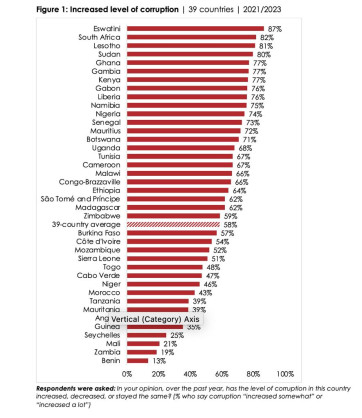
A majority of Africans say that corruption in their country is rising, that their government is failing in its efforts to fight it, and that ordinary citizens risk retaliation if they report corruption to the authorities, Afrobarometer's (www.Afrobarometer.org) latest Pan-Africa Profile (https://apo-opa.co/41k8N4i) reveals.
Download document (1): https://apo-opa.co/3NmOey6
Download document (2): https://apo-opa.co/3RDm193
Released ahead of International Anti-Corruption Day (9 December), the Afrobarometer report is based on nationally representative surveys in 39 African countries.
Findings show that among key public institutions, the police are most widely perceived as corrupt. In substantial numbers, citizens report having to pay bribes to obtain police assistance or avoid problems with the police, as well as to get government documents and services at health facilities and schools.
Citizens' assessments vary widely across countries, with Gabon, South Africa, Nigeria, Liberia, and Uganda among the worst-performing countries when it comes to perceived corruption in key public institutions, while Seychelles, Cabo Verde, Tanzania, and Mauritius turn in the best performances.
Key findings
Distributed by APO Group on behalf of Afrobarometer.
For more information, please contact:
Daniel Iberi
Afrobarometer communications officer for East Africa
Email: diberi@afrobarometer.org
Telephone: +254725674457
Follow us on:
Twitter: https://apo-opa.info/3jYM2la
Facebook: https://apo-opa.info/3K0t6gq
YouTube: https://apo-opa.info/3Ysf4IU
Visit us online at www.Afrobarometer.org
Follow our releases on #VoicesAfrica.
Afrobarometer surveys:
Afrobarometer is a pan-African, non-partisan survey research network that provides reliable data on African experiences and evaluations of democracy, governance, and quality of life. Nine survey rounds in up to 42 countries have been completed since 1999. Round 9 surveys (2021/2023) cover 39 countries.
Afrobarometer's national partners conduct face-to-face interviews in the language of the respondent's choice with samples of 1,200-2,400 adults that yield country-level results with margins of error of +/-3 to +/-2 percentage points at a 95% confidence level.
By NJ Ayuk, Executive Chairman, African Energy Chamber (www.EnergyChamber.org).
There was an era when Africa and Western pop music were closely linked.
Western entertainers spearheaded a number of internationally renowned events to raise awareness about the plight of starving Africans and generate funds for famine relief.
In December 1984, the supergroup Band Aid sang about feeding the world, asking “Do They Know it's Christmas?” Within a year, the group had raised over USD9 million. Three months later, USA for Africa released “We Are the World” and banked USD44.5 million after one year for its African humanitarian fund. Then on a hot July day in 1985, the worldwide concert event Live Aid raised more than USD150 million for famine relief in Africa.
These are just a handful of grand and noble gestures intended to lift Africa out of poverty. And these famous events arguably raised both awareness and funds. Unfortunately, the efforts — and others like them — fall far short of making any real socioeconomic change. In fact, some argue that injecting monetary aid into Africa, time and time again, has actually done more harm than good.
I acknowledge that stance may sound ungrateful. At first blush, many might counter that starving people have no agenda. Destitute parents still need to feed their children. Turning a blind eye to their plight is inhumane.
Let me explain why the African Energy Chamber (AEC) continues to push for free-market solutions rather than good-will handouts.
History of ‘Help'
Even aid genuinely given to help Africa tends to do more harm than good.
Since 1960, more than USD2.6 trillion has been pumped into Africa in the form of aid. From 1970 and 1998, when aid was at its peak, poverty actually rose alarmingly — from 11% to 66% — due in large part to this massive influx of foreign aid that counteracted its intended good.
Aid decreased long-term economic growth by fueling systemic corruption, in which powerful aid recipients funneled foreign funds into a personal stash instead of public investment. Many leaders realized that they no longer needed to invest in social programs for their constituents because of the revenues from foreign donors.
Large inflows of aid also caused higher inflation, hindering African nations' international competitiveness in exporting. That resulted in diminishing the manufacturing sector – which is critical in helping developing economies grow — across the continent. And well-intentioned Westerners who saw the economic shrink just kept pouring more and more money at “the problem” — leading to a vicious cycle that furthered corruption and economic decline.
But here's the kicker: The World Bank has admitted that 75% of the agricultural projects it implemented to help Africa failed. So why do they and other aid providers continue to fund these failing efforts?
Examples of Failure
Across the continent, we see example after example of failed aid projects, with agricultural projects routinely providing little or no benefit to African farmers.
In Mali, the U.S. Agency for International Development (AID) injected USD10 million into “Operation Mils Mopti” to increase grain production. The government imposed “official” prices on the grain, which forced farmers to sell their crops at these below-market rates and resulted in grain production falling by 80%.
AID also spent USD4 million to help livestock producers grow the number of cattle in the Bakel region from 11,200 to 25,000 — but ultimately only succeeded in increasing it by 882 head. Another USD7 million was injected into the Sodespt region, but that investment managed to sell only 263 cattle and failed to sell any goats or sheep.
Then we see example after example of Westerners wastefully “helping” without any understanding of the local situation. Norwegian aid agencies built a fish-freezing plant to improve employment in northern Kenya — a region where the local people traditionally do not fish because of their semi-nomadic pastoralist lifestyle. Couple the lack of fishing experience with the unfortunate reality that the plant required more power than was available in the entire region, and the result was that the brand-new processing plant sat idle.
The World Bank financed a USD10+ million expansion of Tanzania's cashew-processing capabilities, which resulted in 11 factories with the capacity to process three times as many cashews as the country was growing on a yearly basis. The plants were too efficient for the available workforce and cost so much to run that it was cheaper to process the raw nuts in India. Half the plants were inoperable, and the other half only ran at about 20% capacity.
I'm not saying that we Africans are ungrateful for the outpouring of heartfelt care. The compassion of the West is certainly real. However, the outcome of said compassion is the concern: The more foreign aid African governments receive, the worse they perform. As long as the aid keeps flowing, government leaders and their employees who administer development programs may prosper while the rest of the citizenry continues to suffer the effects of a mismanaged economy.
Questionable Benefits
We also must acknowledge that, in far too many cases, aid has also been given to African nations and communities in attempts to manipulate and control.
“While hungry faces are used on posters and in media reports to sell the virtues of foreign aid, it is the hungry who rarely see any of the funds,” James Peron, executive director of the Institute for Liberal Values in Johannesburg, South Africa, lamented in a piece for the Foundation for Economic Education. “Poverty may be used to justify the programs, but the aid is almost always given in the form of government-to-government transfers. And once the aid is in the hands of the state it is used for purposes conducive to the ruling regime's own purposes.”
And now we witness the international community talking about aid for African countries as a substitute for our oil and gas activities. Western environmentalists argue that Africa should keep all of its petroleum resources in the ground to prevent further climate change. In exchange for that sacrifice, African nations would be compensated and inject that money into other opportunities like developing their sustainable energy technologies.
I've said it before, and I'll say it again: What a horrible idea!
I‘m offended by foreign stakeholders feeling that providing humanitarian assistance gives them the right to influence our domestic decisions. With Africa poised to participate in the worldwide energy transition, my fear is that international donors will feel justified to dictate Africa's policy regarding the lengths to which, and speed with which, our energy transition occurs. This would be a huge step backward in our energy, economic, and even individual independence.
Aid packages to incentivize giving up our oil and gas operations will be detrimental to Africans. Because let's be honest: History has shown that this assistance could never replace the oil and gas industry's ability to create jobs and business opportunities, grow local capacity, open the door to technology sharing, facilitate economic growth, and alleviate energy poverty.
Instead of continuing a pattern that clearly does more harm than good, why aren't African nations encouraged to leverage the wealth of resources at our feet?
During the final few days of COP28 — and beyond — the AEC is determined to make a case for African nations harnessing their oil and gas solutions to help themselves. We will not be bullied, or manipulated with aid, into a path that is not in our best interests.
Use What We Have!
One reason why the AEC is an outspoken advocate for Africa's oil and gas industry is because it represents more than big revenue for African governments. It is a free-market solution that creates pathways for Africans to help themselves. And, ultimately, empowering Africans is our number one goal.
We endorse an energy mix approach that allows Africa to use and sell our own hydrocarbon reserves to alleviate energy poverty, while at the same time moving toward a future in which renewable energy sources power the continent. The energy mix method can help more people more quickly because it takes a practical, people-first approach to helping those who have traditionally been left behind by the energy sector, while moving us toward greener energy sources.
Natural gas, in particular, can transform African lives and communities. Its potential benefits range from eradicating energy poverty to allowing Africans to develop skills for good jobs to creating hope for our youth.
Ramping up gas production to help alleviate the lack of access to electricity will create thousands of new employment opportunities in Africa. In addition, the new sources of energy can be exported to Western countries to replace Russian energy. Then, as Europe transitions to sustainable energy, a larger portion of Africa's natural gas can power domestic needs. By the time other countries complete their transitions to carbon-neutral sources, Africa will have a much more expansive and reliable grid system, which will allow for an easier transition.
And before we argue about the evils of hydrocarbons, let me point out that, although it might seem counterintuitive, it is possible for Africa to make use of its abundant fossil fuels while moving toward a future sustained by renewable energy sources. In fact, I believe that African nations must do everything they can to ensure that these two things work in tandem. Considering that 600 million people on the continent have no access to electricity and 900 million people lack access to clean cooking technologies, it's impossible — if not altogether inhumane — to discuss climate change without looking at energy poverty.
As I recently wrote in an article published by Medium, we cannot transition from the dark to the dark. We must deliver energy to the people of Africa and then worry about transitioning to environmentally friendly alternatives, just like we have everywhere else in the world.
This has been our platform at COP28, and we will continue to stand by it in 2024 and beyond.
Distributed by APO Group on behalf of African Energy Chamber.
Ramokgopa urges public to engage with IRP 2023
Minister in the Presidency responsible for Electricity, Kgosientsho Ramokgopa, has urged the public to engage with the Integrated Resource Plan (IRP) 2023, which has been approved by Cabinet.
IRP 2023 is now set to be published by the Minister of Mineral Resources and Energy.
The Minister urged communities, stakeholders and interest groups to engage with the IRP 2023 and send their submissions, as part of determining the country’s “energy future”.
“This will underpin our responses in relation to how we are going to address the energy situation in the country.
“What is significant about this is that… the IRP 2023 computes two horizons [including up to 2030]. In the context of the energy crisis, the interventions [in this IRP] will help us in the short-term to ensure that we ameliorate the degree of the energy deficit that we are experiencing now.
“The IRP also computes horizon number two, which is from 2030 to 2050, and in the most bold fashion, it states what are these new sources of energy and essentially, it [deals with] our ability to be able to exploit our renewable energy endowment, and their linkages to the availability of transmission,” Ramokgopa said at the Energy Action Plan briefing on Sunday.
The Minister reiterated the commitment to resolve load shedding, and have a secure energy supply to protect the South African economy and ensure growth and development.
The IRP is a plan aimed at estimating South Africa's electricity demand. It takes into account how the demand for electricity will be met and the expense of such a demand. The plan refers to electricity generation and expansion programmes.
In formulating the National Development Plan, the Department of Energy gazetted the Integrated Resource Plan 2010-2030 (IRP 2010) in March 2011. This forecasted the energy demand for the 20-year period.
In October 2019, IRP 2019 was gazetted. This updates the energy forecast from 2019 to the year 2030.
The IRP is a “living document” that gets revised and updated.
Performance of power plants
The Minister announced that 980 megawatts (MW) at Koeberg Unit 2 will be taken out on Monday. Unit 1 one came back last month after significant delays. Koeberg is the only nuclear power station on the continent, with each of the two units producing 980 megawatts, according to the Minister.
"It's very significant to the energy mix, and as part of our intention to extend its life by 20 years, we took out Unit 1 to comply with the requirements of the regulator (NERSA)... Now we are taking out Unit 2 for the same purpose," he said, noting that Unit 1 is almost at full load.
With regards to the performance of the grid over the past week, Ramokgopa said the unplanned capacity loss factor (UCLF) and partial load losses (the rate at which units are failing and not performing at optimal capacity) combined has been averaging just above 14 000MW.
“To put it into context, we have reached highs of 17 000MW of these losses. If we were to use May as our baseline, we were losing about 17 369MW. Essentially, we are better off by about 3 000MW, and that’s what we’ve been averaging.
“In fact, it looks even healthier if you were to take Saturday and today, where we’re at about 12 000MW. We have been able to introduce an improvement of about 5 000MW - 6 000MW… if you were to use the baseline of May,” the Minister said.
On why Stage 3 and 4 load shedding continues despite the improvement outlined by the Minister, he said the aim was to use the summer period to ramp up planned maintenance.
“We are averaging just close to 7 000MW. To put it into context, during the winter period, we were averaging about 2 500MW of planned maintenance. If you look at the period around May, it was 3 100MW. The team has taken out, of their own volition, an additional 3 000MW, compared to what was the situation in May.
“We reached a high of about 8 000MW on 8 December. That means there was an additional 4 000MW that has been taken out… It is important that we are able to do maintenance. The more you postpone maintenance, it will catch up with you and you will experience rapid failures of units.”
The Minister said the status quo shows the “true health” of the system, without “necessarily the assistance of the open cycle gas turbines”. While these are engaged at certain peaks, Ramokgopa said they are not being used at the rates at which they have previously been.
The Minister said all stakeholders are working hard to stabilise power supply, especially throughout the festive season.
New Eskom CEO
On the appointment of Dan Marokane as the new Eskom Group CEO, Ramokgopa said leadership stability is key to the resolution of the energy crisis that is confronting the country.
“We are looking forward to the contribution of Mr Marokane, together with the totality of the executive committee of Eskom… to give additional impetus to the work that we are doing,” Ramokgopa said, highlighting that there will now be “certainty in the apex office” of the power utility.
The Minister thanked the Interim Group CEO, Calib Cassim, for his contribution. – SAnews.gov.za
GabiK
Sun, 12/10/2023 - 12:47
Marokane re-joins Eskom as new chief executive
Public Enterprises Minister Pravin Gordhan has announced the appointment of Dan Marokane as the new Group Chief Executive of Eskom.
Marokane is a qualified Chemical Engineer, who has a MBA and is a seasoned executive with more than 20 years senior leadership experience, the Department of Public Enterprises said on Friday.
He is expected to join Eskom no later than 31 March 2024.
“The advertisement for the post attracted 409 applications. From this process, 12 prospects qualified to further steps in the selection process.
“[Marokane] has experience working in distressed organisations with visible and pressurized turnaround mandates. His recent assignment is at Tongaat-Hullet, where he stepped up to lead this financially distressed business when its Group Chief Executive resigned.
“Mr Marokane was a senior manager in Eskom from 2010 to 2015, holding various senior positions, including head of Group Capital in Eskom,” the department said.
Marokane was one of four senior managers suspended during the State capture period. He subsequently resigned and went into the private sector.
“Mandatory checks, which include criminal and credit checks, verification of identity, qualifications, directorships, and establishment of conflicts of interest were completed,” the department said.
The date of commencement will be announced once Marokane has concluded the handover process with his current employer.
“Mr Marokane thrives on challenges, has the drive to energetically tackle the challenges confronting Eskom and is also ethically grounded.
“The Board has been requested to constitute a professional, skilled and committed executive team that will collectively lead Eskom through a complex but exciting journey, including achieving energy security for our people and the economy, implementing the Eskom Just Energy Transition and concluding the restructuring of Eskom,” Gordhan said.
The Minister thanked the Board for conducting a competitive and transparent process for the appointment of the GCEO. – SAnews.gov.za
GabiK
Sun, 12/10/2023 - 09:47