• Skip to main content
  • Skip to header right navigation
  • Skip to after header navigation
  • Skip to site footer
MyZA

MyZA

News, Directory, Events and Other Stuff

  • Social Media
  • Sport
  • World News
  • Home
  • Submit News
  • Directory
  • Events
  • Stratlec
  • TFSA
  • News
    • APO
    • Today’s Sport News
    • Todays Social Media and Tech Headlines
    • Today’s World News
    • Today’s SA Financial News
  • Contact
You are here: Home / Archives for South Africa

South Africa

17 May 2024

Southern Oil’s Canola Development Trust Empowers Future Generations Through Education

Location: MyPR

Swellendam, South Africa May 2024: Southern Oil’s Canola Development Trust Empowers Future Generations Through Education Southern Oil, a leading producer in the agricultural sector, reaffirms its commitment to community well-being through its unwavering support of the Canola Development Trust that heads up two educational systems that are the first of its kind in South Africa. …
Read moreSouthern Oil’s Canola Development Trust Empowers Future Generations Through Education
17 May 2024

Ethel Kuuya: Visionary Leader, Founder and CEO of Advisory Kulture, and Author, Pioneers a New Era of Leadership with “Leading Beyond Now: Five Commitments for Africa to Thrive

Location: MyPR

Ethel Kuuya, a dynamic force in the realms of leadership and entrepreneurship, is igniting a transformative movement across Africa with her visionary leadership philosophy. In her profound book, “Leading Beyond Now,” Ethel Kuuya presents a new standard—a new way of being for Africa. At its heart, “Leading Beyond Now” embodies the essential commitments required to …

Read moreEthel Kuuya: Visionary Leader, Founder and CEO of Advisory Kulture, and Author, Pioneers a New Era of Leadership with “Leading Beyond Now: Five Commitments for Africa to Thrive
17 May 2024

Friends of the Earth but not Friends of Africa: How an Environmental Group is Deepening African Energy Poverty

Location: News
African Energy Chamber

The second annual Invest in African Energy Forum was held in Paris from May 14-15, uniting over 750 African officials and global investors with the aim of increasing investment in African energy projects. The event served as a clarion call to accelerate sustainable energy in Africa, with discussions centered on financing African renewable energy projects, advancing clean gas projects and mapping a just energy transition in Africa.

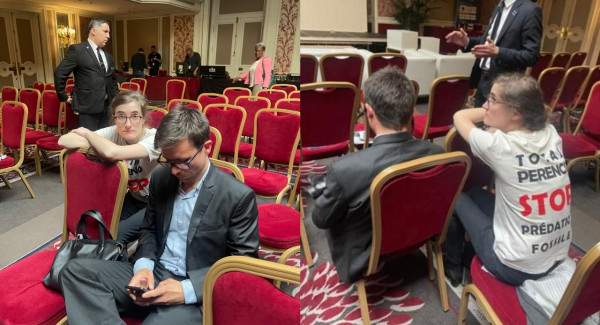
Despite the rallying support by Europe and the U.S. to make energy poverty history in Africa, environmental organization Friends of the Earth chose to disrupt proceedings at the end of the two-day event, causing panic by deploying fake grenades and driving delegates and officials out of the venue. This blatant attack on the companies and authorities that are making great strides towards developing Africa is a blatant attack on the continent itself, and shows the biased and anti-African agenda of the organization.

This is not the first time that Friends of the Earth has taken direct action towards keeping Africa undeveloped and in the dark. In Mozambique, the organization has been fighting against the development of the country's natural gas projects – a clean, widely available and affordable energy resource for the country. The group sued the UK government over its financial support for Mozambique LNG – a 43 million ton per annum offshore project developed by France's TotalEnergies. It is worth noting that since the start of production at the Eni-led Coral Sul FLNG project in 2022, Mozambique's GDP grew 6% in just one year, highlighting the role just one gas project can play in the country. Fortunately for Mozambique, the UK Supreme Court rejected the organization's application to appeal its case against a decision by the UK government to fund the gas project.

The organization's legal battles and obstruction doesn't stop there. In South Africa, their actions extend to opposing projects by companies like Shell, impeding financial support for these ventures, and therefore, deepening the country's energy crisis. Shell is trying to explore for oil and gas offshore South Africa, in a basin where major discoveries have been made in Namibia. Organizations such as Friends of the Earth continue to disrupt this, instigating legal battles that stand to deepen the country's energy crisis even further. Is eight to ten hours of loadshedding not enough for the organization?

Meanwhile, the organization continues to disrupt the development of the East African Crude Oil Pipeline (EACOP) in Uganda – a project which stands to transform both the country and neighboring Tanzania. In 2020, the organization issued a legal case against TotalEnergies for the development of the project, a battle which it continues to wage despite the support by the countries themselves for the project.

However, the African Energy Chamber (AEC) remains undeterred. Representing the voice of the African energy sector, the AEC remains committed to engaging with communities, investors and like-minded individuals who support Africa's right to choose its energy sources.

“The AEC advocates for a pragmatic approach that embraces all forms of energy, including coal, natural gas, renewables and oil. We stress the importance of constructive engagement with all parties involved and oppose actions that hinder Africa's energy progress,” stated NJ Ayuk, Executive Chairman of the AEC. “We believe that companies like TotalEnergies and Perenco, along with other international firms, are contributing positively by creating jobs and opportunities. Attacking or demonizing these companies, does not address the climate crisis.” According to Friends of the Earth's website, the vision of the organization is a “peaceful and sustainable world based on societies living in harmony with nature.” The irony here is that the organization continuously shows aggressive acts towards people, companies and events advocating for equality, justice and progress. If the organization has bothered to take part in the Paris event, listen to the discussions and witness the topics, they would realize that the very companies and projects they are attacking are the ones promoting a sustainable and clean energy future. Friends of the Earth Africa – its African-based group – calls on world governments to adopt their plan to achieve 100% renewable energy in Africa by 2050. Yet, this group's parent organization attacked an energy event that sought to promote investments in African energy – specifically, clean energy.

Friends of the Earth has proven time and time again that they are not friends of Africa. They would rather see the continent remain in the dark than developed through sustainable energy.

Distributed by APO Group on behalf of African Energy Chamber.

Media files
African Energy Chamber
Download logo
Read moreFriends of the Earth but not Friends of Africa: How an Environmental Group is Deepening African Energy Poverty
17 May 2024

Good Nature Agro named one of Africa’s Fastest Growing Companies of 2024

Location: News
Good Nature Agro

Good Nature Agro (https://GoodNatureAgro.com/), the Zambian company helping smallholder farmers reach the middle class, has been recognized by the Financial Times in the annual ranking of Africa's Fastest Growing Companies of 2024, focused on identifying top performers in Africa's private sector. This ranking places Good Nature Agro as number 44 on the list and the only Zambian company in the top 50.

The company has accomplished this feat through measured and consistent growth in their legume seed and commodity business lines, while increasing incomes for the more than 20,000 smallholder farmers with which they work.

2024 also marks the 10th  anniversary of Good Nature Agro. Starting in 2014 with just 40 smallholder farmers in Kasenengwa District, Zambia, the company's founders have remained committed to the company's mission since day one. Today, Good Nature Agro farmers are present in all provinces of Zambia and the company has expanded its offerings to Malawi. The company has two active processing plants in Lusaka and Chipata, Zambia, an active seed breeding program and lab space, a proprietary digital platform for farmer and customer engagement, and more than 175 full-time employees. Good Nature Agro is also building a state-of-the-art export and processing facility in the Lusaka South Multi-Facility Zone(MFEZ).

Good Nature Agro Co-fonder and CEO, Carl Jensen, is thrilled with the news of the ranking, “We are proud to be included on the list, and we intend to use this opportunity to highlight our work with smallholders and the strength and potential of the Zambian agricultural economy. Credit for the strides we have made over the last 10 years goes to the hard work of our farmers, team, investors, and partners. Collectively, we are primed for a leap forward, and we will work tirelessly to move more smallholder farmers into the middle-class and emergent farmers towards generational wealth.”

On top of training, financing and production with Zambian farmers, Good Nature Agro has for the last 3 years been focusing on aggregating legume seed and commodity needs in the wider Southern and Central African region. “Being a Zambian-born and based company has strategically placed us to fulfill grain needs from beyond Zambian borders. We are exporting high-value beans, soya beans and groundnuts to food processors in South Africa, Namibia, Zimbabwe and Botswana, and we continue to prospect both production and supply in the Eastern African region. We are looking to onboard more customers and anyone looking for a reliable supply of legume seeds and commodities in and beyond the region. The Financial Times listing affirms our constant commitment to growth and service to our farmers and customers” said Sunday Silungwe, Founder and Director of Communications.

Representing Zambia alongside Good Nature Agro on the list are  Zamseed (#91) and Zambeef Products (#113). The list of Africa's fastest-growing companies, compiled by Financial Times in collaboration with Statista, a research and database company, highlights advanced, modern, and thriving businesses in Africa fueling the global economy in the 21st century. The list showcases the growth of private companies across different sectors and offers a brief overview of the recent corporate landscape where technology, Fintech, and other businesses have had to adapt to a challenging environment. Good Nature Agro salutes all other companies represented as peers and examples of resilience and job creation.

Distributed by APO Group on behalf of Good Nature Agro.

Media Contact:
Company name: GoodNature Agro
Contact person name: Sunday Silungwe, Co-founder and Director of Communications
Phone number: +260 97 9392832
Article website:  https://apo-opa.co/4arONQ1
Email: sunday.silungwe@goodnatureagro.com
Website: www.GoodNatureAgro.com

Media files
Good Nature Agro
Download logo
Read moreGood Nature Agro named one of Africa’s Fastest Growing Companies of 2024
17 May 2024

Huge Field Is Expected For 10th Edition Of The Nelson Mandela Bay Half Marathon

Location: MyPR

Over a thousand runners are expected to line-up to celebrate the 10th edition of the Nelson Mandela Bay Half Marathon at Pollok Beach, Summerstrand, on the 1st of June. Organisers are expecting the biggest turnout ever this year with the support of 88 clubs from all over South Africa already confirmed and nearly 200 hundred …

Read moreHuge Field Is Expected For 10th Edition Of The Nelson Mandela Bay Half Marathon
16 May 2024

Introducing Biretex, the Revolutionary Acne Care Range by Cantabria Labs

Location: MyPR

Introducing Biretex, the Revolutionary Acne Care Range by Cantabria Labs Cantabria Labs, a pioneer in dermatological research and innovation, is thrilled to announce the availability of its ground-breaking skincare range, Biretex, in South Africa. Clinically proven to enhance the appearance of acne and spot-prone skin, Biretex utilises advanced ingredients that prevent and reduce the recurrence …

Read moreIntroducing Biretex, the Revolutionary Acne Care Range by Cantabria Labs
16 May 2024

Government commits to support families of collapsed George building

Location: News

Government commits to support families of collapsed George building

President Cyril Ramaphosa has assured the families of the deceased and injured workers who were trapped inside the collapsed building in George, that government will do everything possible to assist.

“We do not want to increase the burden, the suffering, and the grief that you are going through. We want to be there as government at all levels to demonstrate our compassion,” President Ramaphosa said.

President Ramaphosa visited the George disaster site on Thursday following the fatal collapse of the partially built building, where a total of 81 people were reported to be onsite when the incident happened last Monday.

According to an update report issued by George Municipality, in the Western Cape, at 12pm on Thursday, of the 81 people who were inside the building during the incident, 62 have been recovered. Thirty-two people have passed away, while 12 have been admitted in the hospital. Nineteen are still unaccounted for.

During the site visit, President Ramaphosa held a briefing with various people involved in the rescue and dealing with all aspects of the disaster, including a number of Ministers, and Western Cape Premier, Allan Winde, where he received an update on the extent of the work done and support that has been provided for the families since the disaster struck.

WATCH | President Cyril Ramaphosa arrives at the Garden Route District Municipality offices in George 

President Ramaphosa commended the effort that is going into dealing with the incident, including the professionalism, capability and knowledge displayed by those involved.

The President said he is satisfied that South Africa is able to deal with disasters, particularly this one until it reaches finality.

He assured the bereaved families that government will leave no stone unturned and will ensure accountability.

“It will take some time for all aspects of this disaster to be properly tied together... I can assure you that the seriousness in which this matter is being [dealt with] will lead to the truth coming out,” the President said, urging for patience while the investigation continues.

While acknowledging that the families are grieving and need immediate solutions and answers to their questions, the President assured that all officials dealing with the matter are going to remain transparent.

“We are a transparent government. We are able to reveal everything as it should be revealed. Let us have a level of patience. I know it is very difficult for those who have lost their loved ones to have that level of patience,” the President said.

The President also offered his condolences to the bereaved families, and wished those who are in hospital a speedy recovery. 

“We are currently focusing on saving lives, caring for the injured, making sure that the remains of those who have lost their lives, are well put together so that those who need to be repatriated can be repatriated, and those who need to be buried here can also be buried,” President Ramaphosa said. – SAnews.gov.za

GabiK
Thu, 05/16/2024 - 15:38

246 views
Read moreGovernment commits to support families of collapsed George building
16 May 2024

Phaahla reassures healthcare workers things will improve as NHI becomes law

Location: News

Phaahla reassures healthcare workers things will improve as NHI becomes law

Health Minister, Dr Joe Phaahla, has urged healthcare workers not to be swayed by fearmongers pushing for emigration from South Africa due to the National Health Insurance (NHI).

“Don’t listen to doomsayers and the scaremongers who are telling you that things are going to collapse and [you] must leave now that the President has [signed the Bill], [and you must] find the first flight [out of the country]. Stay here. Things are going to get better.

“This is our only country. We’re going to make sure that what we have achieved in the last 30 years can only get better and not worse,” Phaahla told medical professionals. 

Phaahla was speaking at the signing of the NHI Bill into law by President Cyril Ramaphosa at the Union Buildings on Wednesday. 

READ | President Ramaphosa signs NHI Bill into law

He urged all citizens to collaborate with government and be part of the solutions to achieve a fair, just, and sustainable health system that caters to the health needs of all citizens, regardless of their location or socioeconomic status.

According to the Minister, inequities that characterise South Africa’s health system are unjustifiable and require fundamental overhauling to ensure equity and sustainability. 

“Families have faced agonising decisions, having to choose between necessities and necessary medical care. 

“This reality does not align with the vision we hold for South Africa, where every citizen should enjoy their life to the fullest potential,” said the Minister.

Phaahla described the signing of the Bill as a historic milestone, which paves the way for government to forge ahead with universal health coverage (UHC).

WATCH | 


The Minister is of the view that the law was not just a policy but also a promise. 

“This is a promise of a better, healthier future for every South African, affirming that the long wait has indeed been worth it.”

This new law, according to Phaahla, is derived from the National Development Plan (NDP) and will usher in free comprehensive healthcare services at the point of use.

“Thank you very much Mr President for convening us here at the citadel of power [the Union Buildings] in our country after you found the most valued pen in the history of South Africa. I’m sure it’s going to be kept in the museum,” the Minister quipped. 

READ | Somebody give me a pen! - President

Phaahla told the attendees that the vision dates as far back as 1942 under the leadership of ANC President Dr AB Xuma. 

“Even at that time, they already had an outline of the type of NHI that South Africa must adopt. One of the clauses of the document called for ‘the establishment of free medical and health services for all sections of the population’,” he explained. 

He also quoted another clause, which called for a “drastic overhauling of the health services of the country, with an emphasis on preventive medicine”. 

“We are happy that after many years of policy discussions and five years of the NHI Bill in Parliament, the National Health Insurance has now reached the starting line,” he said. 

Phaahla stated that the department will now begin implementation and create mechanisms for the use of resources available to the NHI Fund to meet the health needs of the population.

“We stand resolute and remain committed to realising a health system that ensures our people enjoy healthy and productive lives, spurred on to achieve their full potential in a more equitable South Africa.”

He believes that the signing of the Bill will add impetus to other efforts to close the inequality gap in the country.

Phaahla stated that with the Bill becoming an Act of Parliament, it would facilitate the establishment of crucial institutional and organisational structures of the NHI Fund, along with its governance arrangements.

“However, it is important for the public to note that the provisions of the NHI Act will be implemented in phases. Our intention has always been to have a rational, structured and phased approach implementation.” 

Special Report | National Health Insurance: All you need to know

The Constitution empowers the President to set different dates for the effectiveness of various provisions within the Act. 

Meanwhile, President Ramaphosa described the public signing of the NHI Bill into law as a pivotal moment and a milestone in South Africa’s ongoing quest for a more just society.

The Head of State strongly believes that financial hurdles facing the NHI can be navigated with careful planning, strategic resource allocation and a steadfast commitment to achieving equity. 

The President also explained that the NHI Fund will procure services from public and private service providers to ensure all South Africans have access to quality healthcare. – SAnews.gov.za

Gabisile
Thu, 05/16/2024 - 13:18

105 views
Read morePhaahla reassures healthcare workers things will improve as NHI becomes law
16 May 2024

Women in Africa face widespread discrimination in family laws

Location: News
Equality Now

Discrimination against women and girls remains widespread in family laws across Africa, finds new research by Equality Now (www.EqualityNow.org). Analysis of twenty African countries reveals gender inequality in marriage, divorce, custody, and property rights is being perpetuated by sex discrimination institutionalized within legal systems and customary laws. While some significant legal reforms have been achieved, progress has been slow, inconsistent, and hampered by setbacks, lack of political will, and weak implementation.

The report, Gender Inequality in Family Laws in Africa: An Overview of Key Trends in Select Countries (http://apo-opa.co/3V0dD4R), identifies how overlap and contradictions in legal frameworks make the interpretation and application of family laws confusing, creating complex challenges for harmonizing legal systems. 

The impacts of discriminatory family laws can be profound, putting women and girls at greater risk of sexual and gender-based violence and making them more dependent and vulnerable by curtailing their economic opportunities and reducing their decision-making power.

Full equality in family laws has not been achieved in any of the countries reviewed, namely Algeria, Angola, Botswana, Burundi, Cameroon, Côte d'Ivoire, the Democratic Republic of the Congo (DRC), Egypt, Ethiopia, Kenya, Malawi, Mozambique, Nigeria, Senegal, South Africa, South Sudan, Sudan, Tanzania, The Gambia, and Tunisia.

Pressing need for comprehensive legal reforms

Africa is home to diverse ethnic, linguistic, and religious groups with varied family law structures. Historically, communities developed intricate and deep-rooted systems of customary laws governing family relations. The introduction of European legal systems and religion resulted in a blend of customary, religious, and statutory laws that still shape legislation and practice through legal pluralism.

This complex patchwork is influenced by evolving social dynamics. Civil, customary, and religious law, such as Islamic or Christian canon law, sometimes encroach or conflict, and many provisions in religious and customary laws discriminate against women and girls.

Esther Waweru, report co-author and a Senior Legal Advisor at Equality Now, explains, “Culture and religion frequently act as major impediments in the struggle for family law equality, stalling reforms. Claw-back clauses and retrogressive practices water down the positive impact of progressive laws, and there is backlash from anti-rights movements seeking to reverse hard-won gains in areas such as eliminating child marriage and female genital mutilation.”

“Stagnation is also a problem, with governments pledging to reform discriminatory laws but failing to take meaningful action. In some instances, progressive family codes remain in limbo awaiting enactment.”

Progress on child marriage, but shortfalls remain

Child marriage is one area of notable progress. Absolute bans on marriage under 18 exist in Côte d'Ivoire, DRC, Egypt, The Gambia, Kenya, Malawi, and Mozambique. However, the persistence of child marriage in certain communities underscores the need for a multi-sectoral approach (http://apo-opa.co/3UFhEKR) incorporating awareness raising about the legal consequences and harms of child marriage.

Concerningly, laws in Cameroon, Nigeria, Senegal, South Sudan, Sudan, and Tanzania still allow child marriage, while in Algeria, Angola, Botswana, Burundi, Ethiopia, South Africa, and Tunisia, the legal age of marriage is 18, but exceptions are permitted.

Marital rape

Countries need greater protections against gender-based violence, especially intimate partner violence. Marital rape is not prohibited in Algeria, Kenya, Sudan, and The Gambia, while Northern Nigeria's Penal Code allows marital rape and “corrective” assault within marriage.

Marital rape is only criminalized upon separation in Tanzania, and in Burundi, the penalty is under 30 days imprisonment or a fine. Tunisia's law states a wife must fulfill her duties in line with ‘usages and customs,' putting women at risk of marital rape as a wife's traditional role includes pleasing her husband sexually.

Malawi's courts have stated that rape does not extend to marriage. Customary law presumes perpetual consent to sex within marriage, and Malawi's civil law appears to support this by providing only limited circumstances in which a wife can deny her husband sex, such as poor health or when legally separated.

Countries like Côte d'Ivoire, Mozambique, and South Africa can be commended for explicitly criminalizing marital rape. It's imperative that all nations introduce bans, accompanied by awareness-raising campaigns and accessible support services for survivors. Effective legal enforcement is also crucial, as is providing comprehensive training for officials in the criminal justice, healthcare, and social service sectors.

Discriminatory marriage practices

In most African countries, registration of civil marriages is a legal requirement governed by specific laws formalizing marriage. Women in customary and religious marriages are at greater risk of discrimination as they don't have the same legal protection as people in civil marriages. Same-sex partners also experience this, as marriages and civil unions are largely reserved for heterosexual couples.

Polygamy is legally permitted in Cameroon, Egypt, Kenya, Senegal, and South Sudan, with men allowed four wives in Sudan and Senegal. Côte d'Ivoire, Mozambique, and South Africa have statutory laws for monogamy, but customary and religious laws and practices continue to recognize polygamy without adequate protections for women in polygamous marriages. Other harmful traditional practices, such as widow inheritance and surrogate marriage, treat women as property.

Discrimination in divorce and child custody laws

Countries such as Sudan discriminate by granting husbands more powers to initiate divorce. In Algeria, women can only request a divorce in cases of abandonment, violation of the marriage contract, or if alimony is unpaid. In both Sudan and Egypt, in some no-fault divorces, a woman must pay financial compensation to her ex-husband.

Child custody laws have been reformed in Angola, Botswana, Burundi, Cameroon, Côte d'Ivoire, DRC, Mozambique, and Senegal, ensuring guardianship rights for both parents, irrespective of marital status.

Sex discrimination remains in countries like Senegal, where the father is the legal guardian regardless of the mother's caregiving role. In Tunisia and Algeria, fathers retain legal guardianship even if the mother has custody. Algeria and Sudan strip a mother's rights to custody upon remarriage, but this doesn't apply to men.

Matrimonial property and inheritance

Matrimonial property laws is another area that has undergone considerable reforms. Côte d'Ivoire, Kenya, Malawi, and South Africa have introduced legal provisions for equitable distribution of matrimonial property. In Ethiopia, Nigeria, South Africa, and The Gambia, laws recognize the right of married women to acquire, own, maintain, and dispose of their property.

However, some customary and religious laws undermine women's inheritance rights. In Algeria, Cameroon, Côte d'Ivoire, Egypt, Nigeria, South Sudan, Sudan, and Tunisia, women and girls receive less inheritance than men and boys.

Women are disadvantaged by cultural biases that influence judicial decisions, with unequal distribution particularly evident in divorce and widowhood. In some countries, wives can be excluded from inheriting their husbands' property. One example is Angola, where customary laws exclude wives from inheriting their deceased husband's property, and widows are sometimes forced from their matrimonial home.

Aligning family laws with international human rights standards

Family laws in Africa must align fully with international human rights standards. Many countries have ratified key treaties like the Convention on the Elimination of All Forms of Discrimination against Women (CEDAW) and the Protocol to the African Charter on Human and Peoples' Rights on the Rights of Women in Africa (Maputo Protocol). However, implementation and enforcement of these treaties remain inconsistent, with discriminatory family laws and policies remaining in statutes and practices.

Waweru concludes, “It's especially concerning that in most countries where national judiciaries and African Union judicial bodies have explicitly called for law reform in their decisions, governments haven't implemented these changes. And even where laws are equitable, enforcement is frequently inadequate and biased against women, and women may not know their legal rights.”

“To safeguard women and girls within family law, it is imperative for all African nations to promptly enact robust legislative and policy frameworks that align with international and regional human rights obligations.”

Distributed by APO Group on behalf of Equality Now.

Notes to editors
For media requests, please contact
Tara Carey
Global Head of Media
at Tcarey@equalitynow.org
T. +44 (0)7971556340 (WhatsApp)

About Equality Now: 
Equality Now is an international non-governmental human rights organization that works to protect and promote the rights of all women and girls around the world by combining grassroots activism with international, regional, and national legal advocacy.

Our international network of lawyers, activists, and supporters achieve legal and systemic change by holding governments responsible for enacting and enforcing laws and policies that end legal inequality, sex trafficking, online sexual exploitation, sexual violence, and harmful practices such as female genital mutilation and child marriage.

For more information about Equality Now go to www.EqualityNow.org, and follow on X (Twitter) at http://apo-opa.co/3yiYRgN and Linkedin at http://apo-opa.co/3wrGPIT.

About Africa Family Law Network (AFLN): 
Gender Inequality in Family Laws in Africa: An Overview of Key Trends in Select Countries is a critical data source informing legal, policy, and practice reforms to end sexism and discrimination in family laws in Africa. It will be used by Equality Now, the Africa Family Law Network (AFLN) (http://apo-opa.co/4bkc0ot), and partners to help facilitate work with the policy and judicial organs of the African Union, particularly the Special Rapporteur on the Rights of Women in Africa to influence change.

AFLN was launched in October 2022 and aims to formulate a regional alliance in Africa amongst national advocates and groups to raise collective action and accelerate organizing and mobilization efforts toward family law reform.

AFLN is led by founding partners Equality Now, The African Women's Development and Communication Network (FEMNET) (http://apo-opa.co/3WIinxt), Musawah (http://apo-opa.co/3UZrM2h), and the Strategic Initiative for Women in the Horn of Africa (SIHA Network) (http://apo-opa.co/4bkz5r2).

AFLN is part of the Global Campaign for Equality in Family Law (http://apo-opa.co/4bDdSbF), which calls on all states to ensure equality for women and men under the law in all matters relating to the family, regardless of religion, culture, and tradition.

Media files
Equality Now
Download logo
Read moreWomen in Africa face widespread discrimination in family laws
16 May 2024

L’Oréal Professionnel Launches Ground-breaking Absolut Repair Molecular Haircare Line to Repair Damage Hair

Location: MyPR

L’Oréal Professionnel Launches Ground-breaking Absolut Repair Molecular Haircare Line to Repair Damage Hair L’Oréal Professionnel, a global leader in professional haircare, is proud to announce the launch of its revolutionary Absolut Repair Molecular haircare line in South Africa. This innovative range is the first of its kind for the brand, designed to repair damage by …

Read moreL’Oréal Professionnel Launches Ground-breaking Absolut Repair Molecular Haircare Line to Repair Damage Hair
16 May 2024

Cyspera® Celebrates Triple Triumph in Prestigious Beauty Awards for Breakthroughs in Hyperpigmentation

Location: MyPR

Cyspera®, a leading skincare brand specialising in pigmentation disorders, is thrilled to announce its impressive success in renowned beauty awards worldwide. The brand’s dedication to addressing diverse skin concerns has been honoured with three prestigious awards: the NewBeauty 2024 Award in the US for Best Cysteamine Treatment and two recognitions at the Daily Vanity Beauty …

Read moreCyspera® Celebrates Triple Triumph in Prestigious Beauty Awards for Breakthroughs in Hyperpigmentation
16 May 2024

Four SA Holiday Musts For Wanderlust Millennials

Location: MyPR

Millennials love adventure and exploration and have been dubbed the ‘Wanderlust Generation’. Based on recent research, travel has emerged as one of the top aspirations of this generation, revealing they travel more than any other age group. Rather than traditional investments such as buying a home, millennials value holidays more, which also helps to achieve …

Read moreFour SA Holiday Musts For Wanderlust Millennials
16 May 2024

Empowering Health and Wellness in South Africa with Swanson

Location: MyPR

Swanson, a renowned international brand specialising in premium vitamins, supplements, and natural health products, is thrilled to announce its official launch in South Africa. With over 50 years of experience delivering high-quality supplements and natural health solutions globally, Swanson is set to empower individuals across South Africa with its trusted range of products now available …

Read moreEmpowering Health and Wellness in South Africa with Swanson
15 May 2024

KZN welcomes delegates to Africa’s Travel Indaba

Location: News

KZN welcomes delegates to Africa’s Travel Indaba

KwaZulu-Natal Premier Nomusa Dube-Ncube has welcomed delegates participating in the Africa's Travel Indaba, which is currently underway at the Inkosi Albert Luthuli International Convention Centre in eThekwini.

Taking place from 13 - 16 May 2024, Africa’s Travel Indaba is an iconic African leisure trade show, owned by South African Tourism, with the specific objective of creating market access for the country’s vast array of African leisure tourism products.

Welcoming the delegates at the official opening of Africa's Travel Indaba on Tuesday, Dube-Ncube said the trade show provides the ideal platform for African tourism exhibitors to showcase their offerings to international and local buyers, destination marketing companies and leisure tourism services partners. 

“It is the most formidable platform on the continent for you to meet face-to-face with the most influential buyers in the world, and to gain access to Africa’s excellence and its endless possibilities. These are the business opportunities and quality connections that will shape Africa’s tomorrow,” Dube-Ncube said.

READ | KZN tourism entrepreneurs set to showcase province’s rich culture at Indaba

The Premier noted that this year’s Africa’s Travel Indaba takes place at a time when South Africa is celebrating 30 years since the dawn of democracy, which ushered in a new era and assured our standing in the family of other nations.

“This milestone makes all of us gush with pride as South Africans when we consider the journey that we have travelled in moulding the country of our dreams. Today, we speak of a tourism industry that can hold its own at a global level because of our country's achievements,” Dube-Ncube said.

IMAGES | 2024 Africa's Travel Indaba

2024 Africa's Travel Indaba. 2024 Africa's Travel Indaba. 2024 Africa's Travel Indaba.

As the tourism industry shows green shoots globally, she said one of the key sub-sectors the province wants to aggressively focus on is Meetings, Incentives, Conferences and Events (MICE). 

MICE make up a big part of global business travel since every industry has regular events of some kind. The main goal is always to bring professionals together, foster connections, promote new ideas, and push growth. 

“As a province, we will be at the forefront of ensuring that KwaZulu-Natal gets the lion’s share of the tourism market.  As we all know, one of the biggest trends in the tourism environment is the blending of leisure tourism and business, known as 'Bleisure Travel' [blending of business and leisure travel]. 

“We would like to thank all of you for your continued support of Africa’s Travel Indaba. Indeed, Africa has limitless possibilities, and we must seize the opportunity to ensure that Africa’s time is now,” Dube-Ncube said. – SAnews.gov.za

GabiK
Wed, 05/15/2024 - 13:28

365 views
Read moreKZN welcomes delegates to Africa’s Travel Indaba
15 May 2024

IEC ready for voting outside the country

Location: News

IEC ready for voting outside the country

The Electoral Commission (IEC) has outlined the process for voting outside the country, allaying the fears of those who are unfamiliar with the procedures for voting in an overseas setting.

Chief Electoral Officer Sy Mamabolo said Friday will mark yet another milestone in the elections timetable - the first day of voting in the National and Provincial Elections 2024 – when citizens abroad can vote.

“South African citizens living in other countries will cast the first ballots on 17 May 2024. Nine countries will cast ballots on Friday while the rest of the 102 will cast ballots on Saturday, 18 May 2024,” Electoral Commission Chief Electoral Officer Sy Mamabolo said at a media briefing held in Pretoria.

“Given the high numbers of expected voters in London at 24 194, this station will operate on both the 18 and 19 May 2024,” he said.

Read: All systems go for elections

Mamabolo said the international segment of the voters roll for out-of-country voters has 56 698 voters, but the total number of people expected to vote is 76 580.

“This comes after the approval of 20 886 VEC10 notifications from voters who informed the Chief Electoral Officer of their intention to vote outside of the country due to temporary absence,” he said.

The commissioner said the IEC was ready to ensure that voting goes smoothly in 111 foreign missions around the world.

“All missions have already received the election materials, which include ballot papers, voting booths, ballot boxes, envelopes and a voter list.”

Voting stations will be open from 07:00am to 19:00pm, allowing 76 580 voters to exercise their right to vote in South Africa’s 2024 National Elections.

“On both voting days abroad, the Electoral Commission will keep extended hours to assist voters with any enquiries,” he said.

WATCH | Full IEC briefing


SA citizens voting out-of-country in the 2024 National Election can only vote on one day at their mission:

- Missions with a work week from Sunday–Thursday vote on Friday, 17 May, from 7am to 7pm. The following countries are determined to vote on this Friday: Algiers, Amman, Cairo, Damascus, Jeddah, Kuwait City, Ramallah, Riyad and Teheran.

- Missions with a work week from Monday–Friday vote on Saturday, 18 May, from 7am to 7pm.

Two days of special votes have been determined for the UK based on the number of voters who will vote at that mission. – SAnews.gov.za


Edwin
Wed, 05/15/2024 - 13:32

453 views
Read moreIEC ready for voting outside the country
15 May 2024

Chikunga reflects on state of road safety

Location: News

Chikunga reflects on state of road safety

South Africa has seen an escalation in the number of road traffic casualties since 1994 due to the rise in the vehicle population, which has presented a plethora of road safety related challenges.

Addressing the launch of the United Nations Global Campaign for Road Safety, Transport Minister Sindisiwe Chikunga attributed the increase of the vehicle population to access to bank loans and the ability to purchase vehicles.

“Such an increase has presented a plethora of road safety related challenges, from human factors, environmental factors, engineering and technical factors, law enforcement, as well as education and awareness factors.

“From 1994 - 1995, the vehicle population increased by one million, from 5.5 to 6.5 million. Calculating from a period between 1994 and 2022, we moved from 5.5 million to an almost 13 million (12 964 430) vehicle population,” the Minister said on Wednesday in Johannesburg. 

According to statistics, 87% of road fatalities in the country can be attributed to road user behaviour.

“Research has shown that our employed youth are the ones who carry the heaviest burden of road crashes, injuries, and fatalities in our country. Statistics also show that pedestrian fatalities are highest segment of victims in the country and young economically active people between the ages of 25 and 39 constitute the majority of those who die on the roads,” Chikunga said.

In an effort to address numbers of road traffic casualties, government has developed a multifaceted approach to regulate and ultimately reduce the fatalities on the roads.

“We introduced legislative amendments to enhance preventive measures, for instance we introduced blood alcohol content limits; speed limits especially in urban areas and around schools. We also established mandatory the seat belt regulations and child restraints use.

“We examined a range of sentencing options for traffic violations, including licence suspensions under the Administrative Adjudication of Road Traffic Offences (AARTO) demerit points system, and – for specific grades of offences – community service sentences and/or mandatory licence re-testing. We put in place, advance technical norms and standards for road infrastructure and vehicles,” the Minister said.

In addition, government approved the 2016 - 2030 National Road Safety Strategy, with intermediate and long-term actions to ensure vehicle fitness, driver safety, pedestrian safety, community participation in issues of road safety.

The National Department of Transport has convened a series of national road safety policy consultative workshops and a Road Safety Summits to foster open and critical dialogue between government, industry, civil society and academia.

Recently, South Africa conducted a detailed analysis of road crash patterns in the county over the past five years (2018 - 2022).

“The analysis has shown that although we are making steady progress in reducing fatalities, we need to fast-track progress by intelligently deploying our law enforcement, conducting safety education communication campaigns at identified hotspots and at times when crashes are likely to happen,” the Minister said. – SAnews.gov.za

nosihle
Wed, 05/15/2024 - 13:33

263 views
Read moreChikunga reflects on state of road safety
15 May 2024

President Ramaphosa signs NHI Bill into law

Location: News

President Ramaphosa signs NHI Bill into law

President Cyril Ramaphosa has emphasised the importance of the National Health Insurance (NHI) in providing equal access to healthcare services and addressing inequalities.

This, as he signed the NHI Bill into law on Wednesday. 

“[The Bill] is also about efficiency and quality. The provision of healthcare in this country is currently fragmented, unsustainable and unacceptable,” President Ramaphosa said, adding that he finally "found his pen" to sign the long-awaited Bill.  

READ | Somebody give me a pen! - President

At its core, the country’s leader stated that health insurance is a commitment to eliminating the longstanding, severe disparities in healthcare access.

“The NHI is an important instrument to tackle poverty. The rising cost of health care makes families poorer. By contrast, healthcare provided through the NHI frees up resources in poor families for other essential needs.”

He believes that the NHI will make healthcare in the country more affordable. 

“The way healthcare services will be paid for is meant to contain comprehensive healthcare costs and to ensure the available resources are more efficiently used.”

President Ramaphosa described the public signing of the NHI Bill into law as a pivotal moment and a milestone in South Africa’s ongoing quest for a more just society.

WATCH | President Cyril Ramaphosa signs into law the National Health Insurance Bill


The President said the public sector serves most of the population but faces budget constraints. In contrast, he said the private sector serves a fraction of society at a far higher cost without a proportional improvement in health outcomes. 

He believes that tackling the imbalance requires a radical “reimagining” of resource allocation. 

Meanwhile, he said the challenge in implementing the NHI lies not in the lack of funds, but in the misallocation of resources that currently favours the private health sector at the expense of public health needs. 

He is of the view that the NHI Bill presents an innovative approach to funding universal healthcare based on social solidarity. 

This, he said, proposes a comprehensive strategy that combines various financial resources, including both additional funding and reallocating funds already in the health system. 

Special Report | National Health Insurance: All you need to know

The Head of State strongly believes that financial hurdles facing the NHI can be navigated with careful planning, strategic resource allocation and a steadfast commitment to achieving equity. 

He also explained that the NHI Fund will procure services from public and private service providers to ensure all South Africans have access to quality healthcare. 

In addition, he said that health insurance ensures that both the public and private sectors complement and reinforce each other. 

“The effective implementation of the NHI depends on the collective will of the South African people. We all need to embrace a future where healthcare is a shared national treasure, reflective of the dignity and value we accord to every South African life.”

According to President Ramaphosa, government has already begun implementing a national quality improvement plan in public and private healthcare facilities, and is now seeing improvement. 

“Even in areas where we never thought [we would] see improvement, we see improvement of health facilities, even in our townships, where old people go to get critical medication.”

In addition, he said government would now establish the systems and put in place the necessary governance structures to implement the NHI, based on the primary healthcare approach. 

The President has urged people not to fear, as the NHI will be implemented gradually rather than as "an overnight event". 

“The NHI is an opportunity to make a break with the inequality and inefficiency that has long characterised our approach to the health of the South African people. Let us work together, in a spirit of cooperation and solidarity, to make the NHI work.” – SAnews.gov.za

Gabisile
Wed, 05/15/2024 - 16:46

216 views
Read morePresident Ramaphosa signs NHI Bill into law
15 May 2024

President Ramaphosa delivers inaugural Elijah Barayi memorial lecture

Location: News

President Ramaphosa delivers inaugural Elijah Barayi memorial lecture

President Cyril Ramaphosa says the legacy of unionists and anti-apartheid struggle heroes like Elijah Barayi can be found in the labour-related laws enshrined in South Africa’s Constitution.

The President was delivering the inaugural memorial lecture for Barayi held at the University of Johannesburg’s Soweto Campus on Wednesday.

Barayi was a revered trade union leader and freedom fighter during the apartheid era and was one of the founding leaders of the National Union of Mineworkers (NUM).

He became first President of the Congress of South African Trade Union (Cosatu) at its launch in 1985 and was an activist in the Mass Democratic Movement since the 1950s.

His life was lived fighting for the freedom of South Africans and fair labour practises until his passing months before South Africa’s first democratic elections in 1994.

“Thirty years into democracy, we have several progressive labour and social protection laws, including the right to strike. And it was the labour movement as led by Barayi which insisted that the most fundamental right that workers should have should be collective bargaining, the right to strike, the right to have a safe working place.

“So for them to be enshrined in the Constitution is something that we need to pay tribute to Elijah Barayi and the leadership of Cosatu and various other worker organisations at the time. And it is in honour of Elijah Barayi that today we have these rights enshrined in our Constitution.

“We have the Labour Relations Act and the Basic Conditions of Employment Act to protect and advance workers’ rights. We have laws to safeguard the health and safety of workers and a Compensation Fund to support workers who are injured or sick. These achievements form part of the legacy of Elijah Barayi. They need to be protected and advanced,” President Ramaphosa said.

President Ramaphosa emphasised that these “hard-won rights” and many others must not be rolled back.

“There are some in our country who are calling for hard-won rights … like collective bargaining, to be curtailed and for the minimum wage to be scrapped. Trade unions need to be stronger to make sure that that never happens in South Africa because it will be a total reversal of what workers have achieved and what Elijah Barayi struggled for,” he said.

The future of work

President Ramaphosa reflected that “technological advances and globalisation” are changing the labour landscape and added that in order to keep up, innovation and entrepreneurship will be crucial and this “while safeguarding workers' rights and promoting social dialogue”.

“We need to invest in technology, infrastructure and education to enable sustainable and inclusive economic growth and job creation. At the same time, we must strive to democratise the governance of work.

“In South Africa, this means strengthening and adapting labour laws, institutions and regulatory frameworks to protect workers’ rights, promote fair competition and ensure social justice.

“We need to build a more inclusive and resilient labour market that will support a just transition, greater digitalisation and other drivers of change,” he said.

The President acknowledged that although policies implemented since the dawn of democracy have “lifted millions out of poverty and despair and improved their material condition”, many other South Africans are still living difficult and challenging lives.

“As long as the divisions in our society persist, as long as some people lead lives of quality and dignity whilst others suffer at the margins of the economy, our mission remains unfulfilled. We owe it to the memory of Elijah Barayi, to the South African people and to the generations to follow that we continue to work to overcome this inequality.

“Let us honour the memory of giants like Elijah Barayi by renewing our commitment to building a better, stronger South Africa.

“As we draw inspiration from the life and times of the man we honour here today, let us deepen our resolve to advance freedom and social justice everywhere – leaving no-one behind,” President Ramaphosa concluded. – SAnews.gov.za


NeoB
Wed, 05/15/2024 - 14:00

324 views
Read morePresident Ramaphosa delivers inaugural Elijah Barayi memorial lecture
15 May 2024

Collaborative Workspaces To Dominate Africa

Location: MyPR

Africa’s two leading providers in the shared workspace industry, KOFISI and Workshop17, have announced a strategic partnership to provide a wider range of services and locations across Africa. The demand for shared workspace continues to grow faster in Africa than the rest of the world – fueled by the growth in the working age population …

Read moreCollaborative Workspaces To Dominate Africa
15 May 2024

10 Tips On How To Deal With Burnout At Work

Location: MyPR

Affinity Health, a leading provider of high-quality health cover, explores 10 tips on how to deal with burnout at work. “Burnout at work is a common phenomenon with South Africa particularly known for its workaholic mentality,” says Murray Hewlett, CEO of Affinity Health. “High demands, tight deadlines, and long hours – all while juggling family …

Read more10 Tips On How To Deal With Burnout At Work
15 May 2024

Guidance Note aims to protect personal information of voters

Location: News

Guidance Note aims to protect personal information of voters

The Information Regulator (South Africa) has launched a guidance note to guide how political parties and independent candidates use the personal information of voters for campaigning purposes in the run-up to the National and Provincial Elections.

The Guidance Note addresses aspects such as the responsibilities of political parties and independent candidates as responsible parties in terms of the Protection of Personal Information Act No. 4 of 2013 (POPIA).

“This is done by aligning each of the eight conditions for the lawful processing of personal information to the circumstances of political parties and independent candidates as they campaign for elections. 

"The Guidance Note indicates what would be expected of political parties and independent candidates with regard to the protection of personal information of the voters, in accordance with each of the eight conditions for the lawful processing of personal information,” the Regulator said on Tuesday.

The Guidance Note states that if political parties and independent candidates want to use personal information of voters for campaign purposes, they must collect such personal information from the voters directly and not from data brokers or lead generators and use it for campaign purposes only.

It also prohibits the supply of personal information that has been collected for campaigning purposes to third parties without the consent of a voter.

“With the new Guidance Note, the Regulator seeks to ensure that both political parties, independent candidates and the public are fully informed and enabled to take the necessary action to protect the personal information of voters during elections.

"It will also minimise the risks to the free flow of accurate information that is crucial for informed participation in the electoral process,” the Regulator said.

The new guidance note is an update to the Guidance Note issued by the Regulator in the run-up to the local government elections in 2019.

The new Guidance Note is based on recent developments in the electoral process following changes in electoral law (allowing for independent candidates to stand and campaign for elections), the increasing instances of security compromise to personal information in various segments of the economy and society and increasing risks to the electoral process due to misinformation and disinformation.

Solicitation of donations

The Guidance Note also addresses the issue of solicitation of donations by political parties and independent candidates through direct marketing.

According to the Guidance Note, campaigning for votes does not constitute the promotion of any services and does not fall within the definition of direct marketing in POPIA.

“However, the act of requesting for donations by a political party or independent candidate is subject to the regulation of direct marketing in terms of POPIA and therefore, in this respect, political parties and independent candidates have to comply with the provisions of POPIA in relation to direct marketing,” the Regulator said.

Misinformation and disinformation

The Guidance Note regards misinformation and disinformation as a violation of the right of access to accurate and reliable information and also violates the right to privacy of a person whose image and/or voice of is used without their consent to spread fake messages through generative artificial intelligence.

“It therefore requires political parties and independent candidates to play their role in fighting misinformation and disinformation by developing and implementing policies and action plans to mitigate against misinformation and disinformation.

“The Guidance Note requires political parties and independent candidates to investigate instances of misinformation and disinformation by their campaigns and take disciplinary action against their staff that engage in these practices,” the Regulator said.

It also calls on the Independent Electoral Commission to issue a code of conduct to address misinformation and disinformation in digital in digital platforms to promote free, fair and orderly elections in terms of section 99(2) of the Electoral Act. – SAnews.gov.za

nosihle
Wed, 05/15/2024 - 09:27

467 views
Read moreGuidance Note aims to protect personal information of voters
15 May 2024

Thembisa Man Drives Away In Brand New VW Golf After Winning The ‘PowerPlay Win A Golf R’ Competition

Location: Entertainment, MyPR

Thembisa Man Drives Away In Brand New VW Golf After Winning The ‘PowerPlay Win A Golf R’ Competition   Thembisa – Vusani Mulaudzi, 32, a Thembisa local, was the ecstatic winner of the custom PowerPlay VW Golf R, valued at R1,200,000. A very delighted Vusani received his prize at a ceremony in Thembisa.  “I just …

Read moreThembisa Man Drives Away In Brand New VW Golf After Winning The ‘PowerPlay Win A Golf R’ Competition
15 May 2024

400 Junior Border Guards to be deployed to country’s ports of entry

Location: News

400 Junior Border Guards to be deployed to country's ports of entry

The Border Management Authority (BMA) will on Thursday host a pass out parade for 400 new recruits who have completed their training at the South African Police Training College in Pretoria West.

The Junior Border Guards are to be deployed at the various ports of entry throughout the country.

They will be officially assigned as law enforcement officers with the responsibility to arrest and deport illegal migrants across all ports of entry.

“This important event comes during South Africa’s 30 years of democracy following years of struggle to curb illegal movement at ports of entry and along the borderline. In the backdrop of an ever-challenging border environment, these border guards are expected to stand firm, protecting the country’s borders with vigilance and valour,” said the BMA in a statement.

It said being a border guard in South Africa requires one to “have unwavering dedication to the nation, displaying commitment by being patriotic and having an indomitable spirit of rejecting negative persuasion”.

“Our nation's borders are complex and therefore require discipline and courage to carry out the border management mandate. In other settings, daily you are faced with illegal migrants attempting to enter the country or smuggle illegal goods in or out of South Africa,” the BMA said.

Commissioner of Border Management Authority, Dr Michael Masiapato, said: “On the day, the nation will witness the culmination of the physical and mental training, with displays expected to be done on the ground during the event.

“We will celebrate not only their achievements but also reaffirm our steadfast support to the border guards. They are to be officially adorned not just as defenders of borders; they are the guardians of our freedom, the sentinels of our sovereignty.”

More than 100 border management response vehicles will also be displayed at the passing out parade.

President Cyril Ramaphosa officially launched the Border Management Authority in Musina last year

At the time, he said the authority will provide a sustainable solution to the structural challenges of border security, control and coordination.

The Border Management Authority is now the third armed service in South Africa after the South African National Defence Force and the South African Police Service. – SAnews.gov.za


Edwin
Wed, 05/15/2024 - 09:44

230 views
Read more400 Junior Border Guards to be deployed to country’s ports of entry
14 May 2024

Inquests re-opened into Luthuli, Mxenge and Mantyi apartheid era deaths

Location: News

Inquests re-opened into Luthuli, Mxenge and Mantyi apartheid era deaths

Inquests into the deaths of prominent anti-apartheid activists Chief Albert Luthuli and Mlungisi Griffiths Mxenge and civic leader Booi Mantyi have been re-opened by Minister of Justice and Correctional Services, Ronald Lamola, on recommendations from the National Prosecuting Authority.

“With these inquests, we open very real wounds which are more difficult to open 30 years into our democracy, but none the less, the interest of justice can never be bound by time the truth must prevail,” said the Minister.

Regarding Luthuli, who was also Nobel Peace Prize laureate, the department said official reports found that he was struck down by a train “but the exact circumstances surrounding the incident remain unclear to this day”.

An inquest was held in September 1967 and an apartheid era court found that he had died following a fracture to the skull but that the “evidence did not disclose any criminal culpability on the part of South African Railways and anyone else”.

“As a result of representations made to the National Director of Public Prosecutions which brought to the fore that in 1967, the inquest did not consider certain mathematical and scientific principles. This mathematical and scientific report reveal that it is highly unlikely that Chief Luthuli was struck by a train and died because of that.

“Considering this information, amongst others, and the investigation done by the Truth and Reconciliation Unit of the Directorate of Priority Crime Investigation, Minister Lamola accepts and agrees that it is necessary and in the interest of justice to approach the Judge President of the High Court of South Africa in the KwaZulu-Natal Division to re-open the inquest into the death of Chief Albert Luthuli,” the department said.

Griffiths Mxenge

The anti-Apartheid activist and civil rights lawyer Mxenge died in 1981 and his body – with some 45 lacerations – was found at a sports field in Umlazi, KwaZulu-Natal.

Two years later, an inquest into the death was opened which, according to the department, “failed to identify the perpetrators, despite clear signs of foul play, including evidence of surveillance on Mr. Mxenge’s office and the poisoning of his dogs”.

“A thorough investigation was not done into the death of Mr. Mxenge. The Harms Commission and Truth and Reconciliation Commission revealed that orders to kill Mr. Mxenge came from Vlakplaas head Dirk Coetzee. Dirk Coetzee and his accomplices Nofomela, and Tshikalanga were granted amnesty for the murder of Mxenge.

“There is new evidence that certain critical information was not presented to the Truth and Reconciliation Commission and the initial inquest, although the perpetrators were clearly identified. Minister Lamola accepts that it is necessary and in the interest of justice to approach the Judge President of the High Court of South Africa in the KwaZulu-Natal Division to re-open the inquest into the death of Mr Mxenge,” the department said.

Booi Mantyi

Mantyi was killed on 16 June 1985 during an alleged altercation with Apartheid era police at De Aar in the Northern Cape.

That same year, an inquest was held into Mantyi’s death with the outcome finding no one responsible.

The department explained that a fresh investigation “has revealed that an eyewitness who has not previously testified has been identified”.

“Considering the above, Minister Lamola is of the view that it is necessary and in the interests of justice to request the Judge President of the High Court of South Africa, Northern Cape Division to re-open an inquest into the death of Mr Booi Mantyi,” the department said. – SAnews.gov.za


NeoB
Tue, 05/14/2024 - 09:39

595 views
Read moreInquests re-opened into Luthuli, Mxenge and Mantyi apartheid era deaths
  • Previous
  • Page 1
  • Interim pages omitted …
  • Page 240
  • Page 241
  • Page 242
  • Page 243
  • Page 244
  • Interim pages omitted …
  • Page 386
  • Next

Copyright © 2026 · MyZA · All Rights Reserved · Powered by Stratlec Online