• Skip to main content
  • Skip to header right navigation
  • Skip to after header navigation
  • Skip to site footer
MyZA

MyZA

News, Directory, Events and Other Stuff

  • Social Media
  • Sport
  • World News
  • Home
  • Submit News
  • Directory
  • Events
  • Stratlec
  • TFSA
  • News
    • APO
    • Today’s Sport News
    • Todays Social Media and Tech Headlines
    • Today’s World News
    • Today’s SA Financial News
  • Contact
You are here: Home / Archives for study

study

22 September 2023

Applications open for bursaries in environmental field

Location: News

Applications open for bursaries in environmental field

The Department of Forestry, Fisheries and the Environment has invited full-time students to apply for bursaries, to be awarded in the 2024 academic year, in various fields of study.

The department said the minimum requirements to apply for the bursary is Grade 12, and consideration will be given to previously disadvantaged and people with disabilities, who are South African citizens. 

“This advert only applies to full-time students enrolled with an institution of higher learning or currently doing Grade 12 (Matric) and not employed. Please indicate clearly on the application form the reference number and the study field,” the department said in a statement.

The bursaries will be awarded to students in study fields including Environmental Programmes; Forestry Management; Regulatory Compliance Sector Monitoring; Fisheries Management; Oceans and Coasts; Biodiversity and Conservation; Climate Change and Air Quality Management, and Chemicals and Waste Management.

The maximum amount of the bursary is R50 000.

The department said students who have previously participated in the public service internship programme are not eligible for consideration. 

“Upon completion of your studies, participation in the internship programme is mandatory, as part of the bursary contract agreement. It is important to note that regulations prohibit participation in the programme more than once,” the department said.

All applications should be accompanied by the following documents:
•    Motivation as to why the bursary should be awarded to you.
•    Certified copies of qualifications and recent academic records.
•    Certified copies of Identity Document (applicant and both parents or guardians).
•    Proof of registration (if already enrolled with an institution of higher learning).
•    Latest Grade 12 results (if currently in high school).
•    Proof of parents or guardians' income.
•    Proof if parents are deceased.
•    Affidavit if parents are not working.

Hand deliveries or courier applications should be sent to:
Department of Forestry, Fisheries and the Environment
Environment House
473 Steve Biko Street
Cnr Steve Biko and Soutpansberg Road Arcadia
Pretoria

OR

Department of Forestry, Fisheries and the Environment
63 Strand Street
13th Floor Nedbank Building
Cape Town

For enquiries, applicants should contact Joshua Moepya on 012 399 8682/067 417 3739; Busisiwe Stemele on 012 399-8685/066 156 0042; Mokhobo Putu on 012 399 9018/066 081 2662; Kgomotso Moela on 021 402 3329/081 492 5570; Mooketsa Mabe on 021 402 3412/ 071 540 2685 and Neliswa Magwala 021 814 8089/066 081 9858.

The postal address is: The Director-General (for the attention of the Learning and Development - Bursary Section), Department of Forestry, Fisheries and the Environment, Private Bag X447, Pretoria, 0001.

Applications closes on 27 October 2023. Faxed or emailed applications will not be accepted.

“Correspondence will be limited to successful applicants only. If you have not been contacted by end of January 2024, please accept that your application was unsuccessful,” the department said.
 
Successful applicants will be expected to sign a bursary contract. – SAnews.gov.za

GabiK
Fri, 09/22/2023 - 10:16
407 views
Read moreApplications open for bursaries in environmental field
21 September 2023

Cape Town ordered to hold public hearings on sewage being pumped into the sea

Location: News

Environment minister criticises City’s previous lack of engagement

Read moreCape Town ordered to hold public hearings on sewage being pumped into the sea
19 September 2023

Mining Department Refuses West Coast Prospecting Bid

Location: News

Government turned down Limpopo-based Nekwana Trading Enterprise’s application because of shortcomings in basic impact assessment

Read moreMining Department Refuses West Coast Prospecting Bid
19 September 2023

Simple games assist children learn to read

Location: News

Even a cereal box can be a useful teaching tool

Read moreSimple games assist children learn to read
19 September 2023

Unlocking Cash Flow: 5 Strategies for SMEs to Fuel Growth

Location: MyPR

Keeping your business’s cash flow in check is a fundamental skill for any business owner looking to secure long-term financial success. But, let’s face it, it can be a real headache for small and medium-sized enterprises (SMEs), not only in South Africa but the world over. A recent study by Intuit showed that a whopping …

Read moreUnlocking Cash Flow: 5 Strategies for SMEs to Fuel Growth
18 September 2023

CPUT agrees to increase payment to private residence after students locked out

Location: News

This is despite the owner of 210 Long Street not meeting all NSFAS requirements of a fully accredited accommodation.

Read moreCPUT agrees to increase payment to private residence after students locked out
18 September 2023

No identity document, no life

Location: News

Home Affairs in court over profound damage caused by its practice of “blocking” IDs

Read moreNo identity document, no life
17 September 2023

Science and technology are key to development

Location: News

Science and technology are key to development

International Relations and Cooperation Minister, Dr Naledi Pandor has highlighted the importance of science, technology and innovation in the development of countries.

Speaking at the General Debate at the Summit of Heads of State and Government of the G77 + China, the Minister said that there “is no doubt science technology and innovation are strategic levers for development.”

“The struggle for the soul of the South and for unilateral global dominance has never been more intense and as the South, we must seize this historic moment to ensure we develop the ability to be free agents of a development agenda that will advance our battle against poverty inequality and unemployment,” she said.

Pandor was representing President Cyril Ramaphosa at the two-day Summit of Heads of State and Government of the Group of 77 (G77) + China in Havana, Cuba. The Summit began on Friday.

“Effective support for science research, innovation and digital technologies has the potential to advance these objectives but it must be buttressed by effective organisation, coordination and well-crafted G77 science diplomacy. South Africa confirmed the efficacy of science diplomacy in our collaboration in genomic sequencing research that assisted us in combatting COVID-19.

“Increased attention must be given to ensuring we have a science and innovation ecosystem that can support our ambition,” she said at the debate on Saturday.

She said investment in research universities, increased graduation of science and technology researchers at PhD level, centres of excellence and the building of robust science councils are needed.

She also spoke of ensuring equal access to science and innovation for women and girls.

“Since the achievement of freedom and democracy in 1994, South Africa has increased investment in research, development, and innovation. Funding to create ninety Centres of Excellence has been provided as well as support for thousands of young people to study for PhDs in science, engineering, economics, humanities, and technology. The support has included investment in young women scientists.”

Government has also funded over 200 Research Chairs and attracted local and international talent to these chairs.

She added that science partnerships between researchers and university systems must be formed drawing on the successes of Cuba, China and India.

“Greater focus must be given to Africa expanding its science and innovation ecosystem and to using science to resolve our most intractable challenges.”

“Mr President science and innovation will provide the means to grow a green economy in the South, to increase productive capacity and high value addition to our mineral wealth.

“Alongside pursuing this important agenda let us also reinforce our commitment to effective reform of the United Nations mechanisms, especially the Security Council and also actively jointly advance the fundamental reform of international development finance institutions,” she said. –SAnews.gov.za

Neo
Sun, 09/17/2023 - 12:54

118 views
Read moreScience and technology are key to development
15 September 2023

Upcoming FEM Safetember Conference Shines the Spotlight on Workplace Health & Safety

Location: MyPR

12 September 2023, Johannesburg – The Federated Employers Mutual Assurance Company (RF) (Pty) Ltd (FEM) will be hosting its annual Safetember Conference this month. FEM is a mutual insurer that provides workmen’s compensation cover to the construction industry. The conference is part of a broader “Safetember” campaign that uses the month of September to shine …

Read moreUpcoming FEM Safetember Conference Shines the Spotlight on Workplace Health & Safety
14 September 2023

Load Shedding Doesn’t Stand A Chance Against Cloud Power

Location: MyPR

SevenC, a leading IT infrastructure and network service provider striving to identify and make available the best possible IT strategies for its clients’ unique needs, delves into why cloud power remains undefeated by load shedding. As load shedding continues to challenge businesses and individuals alike, there emerges a beacon of hope and efficiency: cloud computing. …

Read moreLoad Shedding Doesn’t Stand A Chance Against Cloud Power
13 September 2023

Copper 360 School of Mining launches first courses

Location: MyPR

Nababeep, Northern Cape: The Copper 360 (Altx CPR) School of Mining debuted its first set of courses on 11 September at its Concordia operation in the Northern Cape. The company announced the development of the training facility in August. The school will launch with seven courses: Basic Surface Geology, Sampling, Ore Body Technician, Mineral Resource …

Read moreCopper 360 School of Mining launches first courses
12 September 2023

South African Telecoms Customers Only Prepared to Wait 5 Minutes

Location: News
Subtonomy

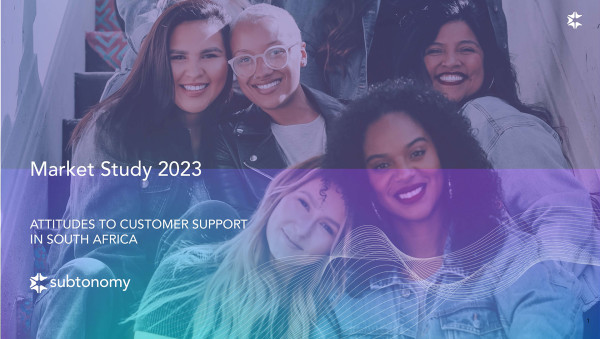
SUBTONOMY (https://www.Subtonomy.com/), the world's leading telecoms technical customer support vendor, today reveals new research on the South African market, providing key insights into the online habits and customer support expectations of South Africans.

South Africans are spending increasing amounts of time online

The global shift towards digitalisation hasn't bypassed South Africa. Rather, as South Africans transition to the latest smartphones, they're spending more and more time online. According to a recent ProxyRack report, for example, the average South African now spends 9 hours and 38 minutes per day online – making them the world's heaviest internet users.

A new study by Sweden's Subtonomy, provides unique insights into how South Africans are spending this time, revealing:

  • 97% are using at least one social media platform
  • 88% are watching the latest movies or streaming TV
  • 86% are paying bills or reading news online
  • 74% are using their mobiles to work from home or to access video conferencing apps
  • 56% are gaming on their handsets
  • 28% are controlling smart home applications.

What all of these advanced data applications have in common, is that they require a robust, stable and always-available network, and this is precisely where customers say there's a big problem - with 7 in 10 admitting they're frequently experiencing problems with their connectivity.

Excellent customer support has become a critical decision point for customers

In addition to dealing with the demands of more complex services, and responding to changing customer needs, South African service providers have the added challenge of regular and unpredictable load balancing events to cope with. But while South Africans don't necessarily blame their service provider - indeed 8 out of 10 say they're doing a great job supporting them – disruptions to their service have become such a significant issue that customer support quality is now seen as a key decision point when deciding which network to use.

But what does excellent customer service look like to the average South African? Increasingly, they expect it to be fast, convenient, proactive and digital.

  • FAST - 53% of customers say they're only prepared to wait a maximum of 5 minutes to access service.
  • CONVENIENT –  39% of customers expect round-the-clock support, and in the 50-54 demographic this rises to 56% of customers.
  • PROACTIVE - 94% of customers say they'd like to be notified about planned maintenance ahead of time, so they can take mitigation actions, and want to be notified in real time about any outages.
  • DIGITAL – although 51% of customers are resolving their problems via the call centre, 30% said digital self-service is now their preferred support channel, and a further 56% said they'd choose self-service via their mobile app IF their service provider could troubleshoot and fully resolve problems from within the app.

Fast, convenient, proactive, digital support is available today

The good news is that the type of fast, convenient, proactive digital support South Africans want has already been developed, tried and tested, and is now being routinely delivered in the advanced mobile markets of Scandinavia. South African service providers are now actively seeking to replicate this type of experience in order to meet customer expectations, drive down support costs, and deliver a world-class experience to customers.

“All networks experience both planned and unplanned problems at one time or another,” explains Fredrik Edwall, EVP Sales & Marketing, Subtonomy. “But what differentiates service providers is the ability to rapidly pinpoint exactly what's causing their customer's problem and then quickly resolve it, while at the same time keeping the customer informed and updated throughout.”

Distributed by APO Group on behalf of Subtonomy.

Contact Tina Rosén to set up an interview: tina.rosen@subtonomy.com

Click here (https://apo-opa.info/48cLpc0) to download a full copy of Market Study 2023: Customer Attitudes to Support in South Africa.

About Subtonomy:
As the only telecoms vendor dedicated to technical customer support, Subtonomy isn't just a solution, we're at the forefront of a customer experience revolution - blending cutting-edge technology with user-friendly tools to break down barriers, streamline and future-proof telecom operators' businesses.

  • When precision matters our solutions dive deep, revealing detailed service experiences and addressing current needs while preparing for the dynamic telecoms market of tomorrow.
  • Harnessing automation to meet customer expectations via Subtonomy's Self-Service API which helps enhance every digital touchpoint, with effortless but complex troubleshooting thrown in.
  • When shifting from reactivity to proactivity our advanced tech support solutions mean you're not just acting faster, but reaching out proactively to keep customers informed via mobile app, website, or IVR.

To find out more about how Subtonomy is reshaping customer support and helping deliver stellar customer experiences today see Subtonomy's website (https://www.Subtonomy.com/).

Media files
Subtonomy
Download logo
Read moreSouth African Telecoms Customers Only Prepared to Wait 5 Minutes
11 September 2023

Labour dept set to launch mobile employment centre

Location: News

Labour dept set to launch mobile employment centre

Employment and Labour Minister Thulas Nxesi will this week launch a mobile employment centre at the Jobs Fair in Malelane, Mpumalanga.

The launch is set to take place on Thursday morning at the Paradise Creek Lodge in Malelane.

“Minister Nxesi will deliver a keynote address to stakeholders at the Employers’ Breakfast Session. Thereafter, he will address work seekers and exhibitors at the Jobs Fair and launch the Mobile Employment Centre of the Department of Employment and Labour,” the department said in a statement. 

The Jobs Fair seeks to identify opportunities and solutions that can enhance the capacity of the department and its partners to deliver on its mandate of creating employment for unemployed people, especially the youth of Mpumalanga.

The Jobs Fair is designed to create a platform where employers and work seekers can interact with the purpose of ensuring that the unemployed and underemployed get access to both work and learning opportunities.

The event is targeted at work seekers and to draw employers, institutions and government departments that provide various services to the youth in particular.

The department will provide the following services during the event:

•    Registration of unemployed work seekers on the Employment Services of South Africa (ESSA) database.
•    Facilitating access to opportunities and employment counselling services to work seekers.
•    Offer career information and study options from educational institutions within the province.
•    Job hunting skills, interview preparation and work ethics.

- SAnews.gov.za


DikelediM
Mon, 09/11/2023 - 09:41

22 views
Read moreLabour dept set to launch mobile employment centre
9 September 2023

Cape Town proceeds with rail dispute despite President’s assurances

Location: News

Cyril Ramaphosa has told Parliament rail devolution is on track. The City of Cape Town disagrees.

Read moreCape Town proceeds with rail dispute despite President’s assurances
8 September 2023

Parliament grills NSFAS over student funding failures

Location: News

The scheme has had more than 170,000 appeals from students about allowance payments

Read moreParliament grills NSFAS over student funding failures
7 September 2023

Government responds to report on solitary confinement

Location: News

Prisoners are held according to the law, writes the Department of Correctional Services spokesperson

Read moreGovernment responds to report on solitary confinement
7 September 2023

Government must maximise spend on education – Nzimande

Location: News

Government must maximise spend on education - Nzimande

Higher Education, Science and Innovation Minister Blade Nzimande says as government continues to spend a large share of its national budget on education, the challenge is to maximise the impact of this progressive investment.

The Minister was speaking at the launch of the National Plan for Post-School Education and Training (NPPSET) in Durban on Thursday.

He said the NPPSET showcases government’s continuous effort towards achieving an improved, transformed, expanded, responsive and articulated Post-School Education and Training.

“Our department of Higher Education and Training has the single largest number of entities of all the national government departments, with over 110,” Nzimande said.

South Africa’s PSET sector is one of the biggest in Africa with highly developed institutions that feature in the global arena of international education, training, research, technology development and innovation.

“We also have the single largest research infrastructure and systems on the African continent. Our National Plan for Post-School Education and Training is a roadmap for implementing the vision of the White Paper for Post-School Education and Training.

“It is framed within the broader goals and priorities of the National Development Plan (NDP), which foregrounds the national efforts to address the triple challenges of unemployment, inequality, and poverty. It is an overarching instrument and a blueprint for guiding planning in our PSET sector. 

“It aligns and integrates the work that is already underway and provides a policy framework for major transformative changes government wants to bring about across the PSET system and its nexus with society and the economy,” the minister said.

Nzimande explained that the National Plan for Post School Education and Training has six goals which are the drivers for the system.

“We are bringing together institutions and traditions that have different histories and investments and propose ways of making them work together towards common goals.

“We are consolidating and building on those aspects of the system that are working well whilst also streamlining a wide range of policies, plans, and strategies currently in existence that impact on the system without reducing its diversity,” Nzimande said.

Nzimande said his department has developed an articulation Policy for the Post-School Education and Training System of South Africa in 2017.

“The policy was established to create an enabling environment to ensure that articulation occurs within and between NQF sub-frameworks, institutions work together to develop learning and work pathways and support to students as they follow their individual learning and work pathways,” the Minister said.

Nzimande added that his department conducted a comprehensive evaluation study on the implementation of the National Qualification Framework Act on how articulation was implemented by both TVET colleges and universities.

“The baseline study was also conducted to determine how articulation was practiced within and between higher education institutions. The study has identified a number of challenges in how articulation works across the entire PSET system. 

“The major challenge still remains to optimise articulation pathways between universities, TVET colleges and CET colleges and without cul-de-sacs in the system. We must also fund and properly resource articulation,” Nzimande said.

The NPPSET sets out a roadmap for implementing the vision of the White Paper for Post-School Education and Training.

Having already been approved by the Minister, the NPPSET is being implemented by the department and may be viewed in conjunction with its enablers and or by-products which are the development of the Master Skills Plan, Student Funding Model, inclusive of the ‘missing middle’ and the implementation of the Labour Market Intelligence programme.

This launch provides an opportunity for the department to bring on board all stakeholders that are key in the broader implementation of the plan thereby ensuring effective implementation geared towards the realisation of the envisaged goals of the National Development Plan and other relevant policies to 2030 and beyond. – SAnews.gov.za

Edwin
Thu, 09/07/2023 - 14:36

37 views
Read moreGovernment must maximise spend on education – Nzimande
7 September 2023

RIP Amy Thornton

Location: News

The Presidency: Republic of South Africa
Download logo

President Cyril Ramaphosa has expressed his deep condolences at the passing of veteran activist and Esteemed Member of the Order of Luthuli Ms Amy Thornton.

The President's thoughts are with the family, friends and comrades of the late activist who was born in Cape Town in 1932.

She was honoured in 2016 with the National Order of Luthuli for her excellent contribution and unflinching commitment to the struggle for liberation and equality for all South Africans, and her commendable bravery in the face of an oppressive regime.

As a 16-year-old, Amy Thornton worked with the then Communist Party of South Africa to campaign against the National Party in the 1948 election which resulted in the legislated enforcement of apartheid. 

In 1950 she joined the Modern Youth Society (MYS), a progressive youth movement involving mainly university students. Through MYS, Ms Thornton was involved in night school literacy classes for African workers in the Cape Town docks.

When the Congress of Democrats (COD) was formed in 1952, she was appointed secretary of the Joint Congress Committee (involving the COD, the African National Congress (ANC), the South African Indian Congress and the Coloured Peoples' Congress).

She represented the MYS as part of the South African delegation to the World Federation of Democratic Youth, held in Bucharest, Romania in 1953.

In the same year she was recruited to join the underground SACP. She was active in pamphleteering against the Group Areas Act and the Bantu Education Act. She was also involved in study classes in informal settlements around Cape Town (Blouvlei and Elsies River).

In 1955 Thornton was a delegate from Cape Town to the Congress of the People. However, she was part of the delegation that was stopped by the police in Beaufort West and detained over the weekend, so she was unable to make it to Kliptown.

From the start of the Treason Trial in 1956 she served on the Treason Trial Support Committee. She did voluntary work for the Guardian newspaper (and its successors, as each successive title was banned in turn). She did research for the publication and managed the editorial work.

In 1959 she was banned for the first time initially for two years, but this was extended several times. She eventually served 14 years under banning orders, and lost her job as a nursery school teacher.

In 1976 she began to work part-time for the Food and Canning Workers' Union.

In 1981, she was a founding member and deputy chairperson of the United Women's Organisation, which later became one of the key organisations in the formation of the United Democratic Front (UDF).

In 1983 she was appointed as a patron of the UDF and was among those detained during the two states of emergency.

Ms Thornton was also a member of the Cape Town ANC regional leadership and served on the National Coordinating Committee for the Return of Exiles between 1990 and 1993.

President Ramaphosa said: “Amy Thornton lived a life of principled resistance, bravery and perseverance so that we could live in freedom today.

“She was one of many white South Africans who sustained the non-racial character of the liberation struggle.

“Her contribution and the risks she took on also disproved the often stated claim that white South Africans didn't know what was unfolding in the country or that they had no agency to change policy or conditions in the country.

“Amy Thornton served our nation with great courage and tireless energy. May her soul now rest in peace.”

Distributed by APO Group on behalf of The Presidency: Republic of South Africa.

Read moreRIP Amy Thornton
7 September 2023

President Ramaphosa mourns the passing of Amy Thornton

Location: News

President Ramaphosa mourns the passing of Amy Thornton

President Cyril Ramaphosa has expressed his deep condolences at the passing of veteran activist and esteemed member of the Order of Luthuli, Amy Thornton.

The President, in a statement, said his thoughts are with the family, friends and comrades of the late activist who was born in Cape Town in 1932.

Thornton was honoured in 2016 with the National Order of Luthuli for her excellent contribution and unflinching commitment to the struggle for liberation and equality for all South Africans and her commendable bravery in the face of an oppressive regime.

As a 16-year-old, Amy Thornton worked with the then Communist Party of South Africa to campaign against the National Party in the 1948 election which resulted in the legislated enforcement of apartheid.

In 1950, she joined the Modern Youth Society (MYS), a progressive youth movement involving mainly university students. Through MYS, Thornton was involved in night school literacy classes for African workers in the Cape Town docks.

When the Congress of Democrats (COD) was formed in 1952, she was appointed secretary of the Joint Congress Committee (involving the COD, the African National Congress (ANC), the South African Indian Congress and the Coloured Peoples’ Congress).

She represented the MYS as part of the South African delegation to the World Federation of Democratic Youth, held in Bucharest, Romania in 1953.

In the same year, she was recruited to join the underground SACP. She was active in pamphleteering against the Group Areas Act and the Bantu Education Act. She was also involved in study classes in informal settlements around Cape Town (Blouvlei and Elsies River).

In 1955, Thornton was a delegate from Cape Town to the Congress of the People. However, she was part of the delegation that was stopped by the police in Beaufort West and detained over the weekend, so she was unable to make it to Kliptown.

From the start of the Treason Trial in 1956, she served on the Treason Trial Support Committee. She did voluntary work for the Guardian newspaper (and its successors, as each successive title was banned in turn). She did research for the publication and managed the editorial work.

In 1959 she was banned for the first time initially for two years, but this was extended several times. She eventually served 14 years under banning orders and lost her job as a nursery school teacher.

In 1976 she began to work part-time for the Food and Canning Workers’ Union.

In 1981, she was a founding member and deputy chairperson of the United Women’s Organisation, which later became one of the key organisations in the formation of the United Democratic Front (UDF).

In 1983 she was appointed as a patron of the UDF and was among those detained during the two states of emergency.

Thornton was also a member of the Cape Town ANC regional leadership and served on the National Coordinating Committee for the Return of Exiles between 1990 and 1993.

“Amy Thornton lived a life of principled resistance, bravery and perseverance so that we could live in freedom today. She was one of many white South Africans who sustained the non-racial character of the liberation struggle,” President Ramaphosa said.

“Her contribution and the risks she took on also disproved the often stated claim that white South Africans didn’t know what was unfolding in the country or that they had no agency to change policy or conditions in the country.

“Amy Thornton served our nation with great courage and tireless energy. May her soul now rest in peace,” President Ramaphosa said. – SAnews.gov.za


Edwin
Thu, 09/07/2023 - 12:03

223 views
Read morePresident Ramaphosa mourns the passing of Amy Thornton
7 September 2023

The key to Africa’s industrialisation process and ending the region’s massive energy poverty

Location: News
African Energy Chamber

By Jason Mitchell

Africa's vast natural gas reserves are key to bringing energy to Africa's poorest countries, to a solid industrialisation process throughout the region and to significant poverty reduction.

The region is home to 33 of the world's 46 least-developed countries (LDCs) with an average income per head of less than $1,018 a year. The continent's poorest countries must expand at 6-7% a year if poverty is to be reduced in a big way and if the life chances of hundreds of millions of people are to be improved. To achieve this goal, these countries require abundant and cheap energy. Luckily, for many African states, the answer lies on their own doorstep — natural gas. Gas has remained a niche fuel in sub-Saharan Africa — contributing only 5% of the total energy mix against a global average of 20-25% — but its potential is enormous.

A new vision for Africa is required — a criss-crossing network of natural gas pipelines that brings energy to all corners of the region. The continent's contribution to global greenhouse gas emissions is tiny and will only become slightly bigger if the region's natural gas reserves are exploited. There is also a massive opportunity to wean poor Africans away from the use of biomass fuel and to help protect the region's forests through the rollout of small, liquified petroleum gas (LPG) stoves. Climate change is an issue in Africa but poverty reduction is a bigger one. Poverty is the biggest killer in Africa today.

It's very hard for Europeans and North Americans to imagine what it's like to live on under $1,018 a year, to not have readily available electricity, to not have a refrigerator or a washing machine, to not have a car, to not have a lawnmower, to not be able to fly from one country to another cheaply, to not have electricity in the school or the workplace and to have to use firewood or charcoal for cooking purposes. Fossil fuels have been at the heart of the Industrial Revolution that has brought prosperity and better living standards to the developed world. People in the First World must be very careful if they decide to deny Africans the same chance to prosper.

Africa has the lowest energy use per capita in the world — the average electricity use of a sub-Saharan African resident is lower than that of a household fridge in the United States. Average consumption per person in sub-Saharan Africa, excluding South Africa, is a mere 185 kilowatt-hours (kWh) a year, compared with about 6,500kWh in Europe and 12,700kWh in the US. Every year San Antonio, Texas, with a population of 1.5m people, uses as much electricity as the whole of Nigeria, with 203m people. Golden, Colorado, a small town with only 19,000 people, uses as much electricity as Chad, a country with 16m people.

The UN's Sustainable Development Goal Seven aims to “ensure access to affordable, reliable, sustainable and modern energy for all” by the year 2030. That's a tall order. In 2019, 917m people in Africa (around 80% of the region's population) relied on wood, charcoal, kerosene, animal and crop waste or other solid fuels to cook their food and heat their homes. The International Energy Agency (IEA) reports that almost 490,000 people die prematurely every year in sub-Saharan Africa from household air pollution-related causes — stemming from the lack of access to clean cooking facilities. Gas is a much cleaner form of cooking than biomass and its use should be encouraged. Biomass burning-power plants emit 300-400% more CO2 than natural gas per unit energy produced. Natural gas emits almost 50% less carbon dioxide than coal. 

Africa has one-fifth of the world's population but contributes only 3% to global greenhouse gas emissions. Incredibly, some 48 sub-Saharan African countries, excluding South Africa, have an estimated share of global emissions of only 0.55%. The fact is that many African states are already at net zero. If the continent were to use an additional 90bn cu m of natural gas per year — or 50% more than today — the resulting emissions would only raise Africa's cumulative contribution to global carbon emissions to 3.5% (ten gigatonnes) by the year 2050, according to the IEA. It really is a tiny increase compared to the chance of reducing poverty levels for hundreds of millions of poor people. If Africa is to provide universal electricity access by 2030 it would have to almost double its total generation capacity from around 260gw today to 510gw. 

Almost half the continent's 55 countries have proven natural gas reserves. Across the region, natural gas reserves amount to around 17.5trn cubic metres (cu m), making up around 9% of the world's total gas reserves. They are considerable in northern Africa (accounting for 45% of African reserves) and western Africa (32%), in particular. Commercial quantities of natural gas have been found in many African countries.

Previously, only four countries from the region have been major natural gas production hubs: Nigeria (with total gas reserves of 5.8trn cu m), Algeria (4.5trn cu m), Egypt (2.2trn cu m) and Libya (1.5trn cu m). These four accounted for 78% of African gas reserves in 2021 (https://apo-opa.info/48gDBWG), according to the United States Energy Information Administration.

However, seven African countries — Mozambique, Senegal, Tanzania, Mauritania, South Africa, Ethiopia and Morocco — with no history of fossil gas exploitation have now opened up their doors to gas projects. Some 84% of new reserves in the pre-production stage are found in these states — total new reserves amount to 5.1trn cu m. Mozambique has re-production reserves of 2.3trn cu m, Senegal 779bn cu m, Mauritania 575bn cu m, Tanzania 512bn cu m, South Africa 96bn cu m, Ethiopia 42bn cu m and Morocco 39bn cu m.

Furthermore, major untapped reserves have been discovered in Angola, Cameroon, Ghana, Equatorial Guinea, the Republic of the Congo, Kenya and Uganda. A number of these states — including Mozambique, Tanzania, Mauritania and Senegal — are actively marketing natural gas to capitalise on recent discoveries. In fact, the IEA has declared Africa the ‘new frontier' in global oil and gas.

The big four gas-producing countries will continue to dominate gas production in the near term but experts estimate that Mozambique and the other new entrants will contribute more than 50% of the region's gas production by 2038.

Natural gas can be used for electricity generation, industry and domestic use. Crucially, harnessing Africa's gas could provide the baseload power needed to boost Africa's capacity to process its raw materials locally. It could provide enough energy for industrial processes, including steel and cement production and paper and pulp manufacturing. It could be also used to make fertiliser to raise agricultural yields. Renewables, including solar and wind, cannot yet provide enough energy for these purposes.

The huge reserves of gas can play a significant role in the continent's energy transition, as natural gas has a much lower carbon footprint than oil and coal. Critically, natural gas development and renewable power are not mutually exclusive. If Africa were to triple its use of natural gas, the United Nations Economic Commission for Africa (Uneca) estimates that the region would be able to increase its use of renewable energy eight-fold. Reliable forms of energy such as gas can be used to stabilise a grid powered by intermittent sources such as wind and solar. It can play a key role in a ‘just' energy transition.

However, expanding gas supply across Africa would require a whole web of new gas pipelines and that does not come cheap. A lot of the gas from the new projects already under way in Africa is destined for international markets, including the European Union — which have been seeking new sources of energy since the Ukraine crisis — but it is vital that the region's gas reserves are deployed for domestic use, as well. Nigeria, for example, sits on the continent's largest known natural gas reserves but only 55% of the population had access to secure electricity in 2020.

Multilateral financial institutions (MFIs) — many of which are headquartered in the developed world — are now shying away from investing in natural gas projects in Africa because of pressure from a vociferous green lobby. In 2021, 20 countries — including almost all the world's big, rich democracies — pledged to stop almost all financing of new fossil fuel projects internationally by the end of 2022. Furthermore, under the Glasgow Financial Alliance for Net Zero (GFANZ), 450 financial firms across 45 countries, responsible for over $130trn in assets, committed to accelerate the global decarbonisation process. The problem is that most Western governments and financial institutions do not distinguish between coal, oil and gas, and the pressure to stop funding all hydrocarbons has negatively impacted gas projects in Africa in a big way.  

Some of the continent's biggest financiers — including the African Development Bank (AfDB) — are finding it increasingly difficult to support gas project developments that require loan syndication and foreign partners. The World Bank is pulling back, too. Local banks cannot finance major gas projects on their own, as they are limited by their capital base. In particular, the fossil fuels divestment campaign is having a big impact on the amount of development and concessional finance available. This kind of finance used to support a number of gas projects for their poverty-reducing and economic development value.

For example, without the guarantees of development finance institutions (DFIs), most of Africa's recent gas-to-power plants would have never been built in the first place. The withdrawal of development finance from downstream gas and gas-to-power projects is a serious cause for concern for Africa's electrification effort and moving the needle on energy access.

Furthermore, there is a glaring double standard — many European countries have increased their use of hydrocarbons (coal as well as gas) since Russia's invasion of Ukraine. They are constructing new fossil fuel pipelines at home. The EU recently classified natural gas a ‘green' fuel, which will allow Europe's projects to be backed by investors committed to environmental, social and governance (ESG) principles. European countries are now looking towards African states for new sources of gas. However, they are not prepared to back new gas projects in Africa that would supply the fuel to the region itself. That smacks of hypocrisy of the worst kind. How can you deny the poorest people in the world the sort of energy that you want to use yourselves?

Lumping all hydrocarbons together is a blunt policy mechanism that is not good from an emissions perspective either. In poorer places, like sub-Saharan Africa, the available alternative to gas is not renewable electricity but rather coal, diesel and, most of all, polluting biomass. In sub-Saharan Africa, demand for biomass fuels is expected to surge by 40% by the year 2040 if ‘business as usual' continues. The burning of biomass is a major contributor to global carbon emissions and charcoal has been a top driver of tropical forest loss during the past two decades, with the greatest footprint in Africa. The continent's carbon sinks need protecting and the irony is that the greater use of gas would achieve that.

Africa is home to 18% of humanity but receives less than 5% of global energy investment. And much of this investment goes on producing oil and gas for export. There must be much more investment in the region for the domestic use of gas. Gas projects could play an absolutely vital role in bringing energy to Africa but obviously the projects require financing. DFIs must think again about their decision to limit investment in new projects in Africa. The financing of a network of gas pipelines throughout Africa would be one of the quickest and surest ways of industrialising the region in a big way and of alleviating poverty on a large scale. Renewables just cannot do that how ever much wishful thinking takes place.

In fact, development institutions should go one step further and consider subsiding a massive roll out of small LPG stoves to millions of poor households in the region. It could be one of the biggest moves in contributing to Africa's decarbonisation effort by arresting the pace of deforestation in the region. LPG is recovered from ‘wet' natural gas (gas with condensable heavy petroleum compounds) by absorption and reaches the domestic consumer in cylinders under relatively low pressures. The widespread adoption of LPG stoves would reduce the amount of pollutants in the air from biomass fuels. Poor households that currently depend on woodfuel for cooking require a cleaner cooking alternative — LPG is one of the solutions.

LPG stoves are also suitable for domestic use in rural settings — a key consideration in Africa where energy poverty is greatest in the countryside. For instance, in 2016, electricity access in urban and rural areas in Nigeria was 86% and 34%, respectively, according to the World Bank.

Africa only needs to look to Asia for examples. In 2006, Indonesia implemented a ‘mega-programme' to induce a large-scale transition from kerosene to LPG stoves in order to reduce government spending on kerosene subsidies. The initiative invested in LPG infrastructure, domestic cylinder production and consumer awareness. By 2012, 93% of the target had been reached and LPG consumption had grown by almost 350%.

In India, LPG access expanded through the early-2000s but it was still not reaching most poor families. To boost access among the poor, the Indian government introduced the Pradhan Mantri Ujjwala Yojana (PMUY) Scheme. Under it, the country's oil marketing companies provide subsidies to reduce the cost of both LPG connections and cylinder refills to women in households classified as below the poverty line. In 2016, the cost of a connection was about Rupees 3,200 ($48) and included the first full cylinder (plus deposit), deposit for a regulator, an LPG stove and administrative fees.

Furthermore, African governments must consider increasing domestic gas allocations from liquified natural gas (LNG) export projects. These are an effective way to ensure that even if developers prioritise lucrative exports over local sales, they must reserve part of their production for the domestic market. Upcoming LNG terminals in sub-Saharan Africa — for example, in Mozambique — now make it compulsory to allocate a specific amount of gas to the domestic market. The availability of domestic gas from export facilities can encourage gas-based industrialisation (for example, in Senegal) or additional gas-to-power capacity (Mozambique, Mauritania and Senegal). In August 2022, for instance, Senegal's Petrosen Trading & Services signed an MoU with Turkey's Çalık Enerji and Japan's Mitsubishi for the pre-feasibility study of a gas-based ammonia and urea manufacturing unit.

It is a huge mistake to lump all hydrocarbons together and for Western environmentalists to argue that no new new fossil fuel projects should happen in Africa whatsoever. Deforestation is one of the biggest issues in Africa today. Poor Africans must be weaned off the use of wood-based fuels. The widespread adoption of small LPG stoves would be one of the surest ways of reducing deforestation. Natural gas could also form the basis for a solid, large-scale industrialisation process in Africa — something that is essential if the region is to achieve the sort of economic growth needed to lift hundreds of millions of people out of poverty.

Distributed by APO Group on behalf of African Energy Chamber.

Media files
African Energy Chamber
Download logo
Read moreThe key to Africa’s industrialisation process and ending the region’s massive energy poverty
7 September 2023

Study Confirms South Africans Are Overusing Asthma Reliever Pumps

Location: MyPR

Over-Reliance on Reliever Pumps Linked to Increased Risk of Asthma Attacks and Death Asthma is an inflammatory condition of the airways affecting more than 339-million1 people globally. In South Africa, more than 20% of children and 10-15% of adults have asthma2. For those living with the illness, it can reduce quality of life in varying …

Read moreStudy Confirms South Africans Are Overusing Asthma Reliever Pumps
7 September 2023

This is what we can execute to conclude the reading crisis

Location: News

As the November 2023 deadline looms, 70% of public schools still don’t have libraries

Read moreThis is what we can execute to conclude the reading crisis
  • Previous
  • Page 1
  • Interim pages omitted …
  • Page 28
  • Page 29
  • Page 30

Copyright © 2026 · MyZA · All Rights Reserved · Powered by Stratlec Online