• Skip to main content
  • Skip to header right navigation
  • Skip to after header navigation
  • Skip to site footer
MyZA

MyZA

News, Directory, Events and Other Stuff

  • Social Media
  • Sport
  • World News
  • Home
  • Submit News
  • Directory
  • Events
  • Stratlec
  • TFSA
  • News
    • APO
    • Today’s Sport News
    • Todays Social Media and Tech Headlines
    • Today’s World News
    • Today’s SA Financial News
  • Contact
You are here: Home / Archives for Summit

Summit

31 October 2024

100 days in office: Advancing the strategic priorities of the GNU

Location: News

100 days in office: Advancing the strategic priorities of the GNU

By Deputy Minister Bernice Swarts

The first 100 days as Deputy Minister of Forestry, Fisheries, and the Environment, under the Government of National Unity (GNU), have been a period of significant learning and action. 

It has allowed me to engage closely with stakeholders in the sector, developing a blueprint to drive the implementation of the GNU's strategic priorities which are to fostering inclusive growth and job creation, reducing poverty and addressing the high cost of living, and building a capable, ethical, and developmental state.

The experience has been invaluable, providing me with a deeper understanding of the department’s mandate, core operations, and both domestic and international context.

Alongside Minister Dr Dion George and fellow Deputy Minister Narend Singh, we recently briefed the media on our progress in the department during this period. 

A key highlight of these 100 days has been the opportunity to engage with staff and various stakeholders, including the forestry sector, traditional leaders, firefighting personnel, community forest owners, young beneficiaries of departmental programs, field rangers from entities such as South African National Parks (SANParks), and industry players like the South African Weather Service (SAWS). These engagements have helped shape a shared vision for the department's future.

We kicked off our 100 days in the office by presenting the department's Budget Vote to Parliament on July 15, 2024. We delivered our department’s budget vote in a month where we celebrated our national unifying figure in the form of uTata Madiba – which seemed to tie in well with our mandate of unifying our people through the Government of National Unity.

In the first 100 days, we have initiated efforts to reengineer and repackage the department’s approach to wildland fire management. This involves building firefighting skills, especially in vulnerable rural communities, with a focus on women and youth. We aim to strengthen stakeholder engagement across both state and non-state actors to better deliver on our critical priorities.

As part of this initiative, I hosted stakeholder engagements with on the National Veld and Forest Fires Act, 1998 (Act No. 101 of 1998). These engagements were hosted with various stakeholders within the wildland fire management sector from both the North West and Free State. Some of the stakeholders who attended these engagements included local and provincial government departments, fire protection associations (FPAs) and other key players in the sector. 

Through these stakeholder engagements, I have instructed the officials to address challenges raised in these interactive engagements such as payment delays for FPAs, challenges on the use of government firefighting vehicles, training of FPA members as well as the clarification of the roles of different stakeholders. I am satisfied with the honest discussions and note the commitment of all parties to find practical solutions.

I have recently led the 2024 Forestry Summit at the Freedom Park in Pretoria. The Summit brought all stakeholders within the forestry sector under one roof to discuss pertinent issues within the sector such as the growth and transformation of the sector, forestry sustainability and the contribution of the sector in addressing climate change.

The Summit was interactive as it provided role players with an opportunity to freely engage with us on the challenges they face in the sector. What was even more fascinating was the involvement of traditional leaders who came from various parts of the country to raise issues their communities were facing. I am pleased with the decision that came out of this frank engagement, which includes plans to go to communities to address issues they have raised.

In the month of September, I had the privilege to lead both the launch and closing ceremonies of the 2024 National Arbor Month campaign. The launch was hosted at Freedom Park in Pretoria and the closing ceremony at Fort Cox Agriculture and Forestry Training Institute in Middledrift, Eastern Cape. A total of 6000 trees were planted in both the localities that hosted these ceremonies.

The Arbor Month campaign is aimed at raising awareness among South Africans about the importance of conserving, protecting, and planting trees for the benefit of both the environment and society.

As part of the Arbor Month launch, I planted the first tree to officially initiate the Forest of Freedom at the designated site at Freedom Park in honour of the heroes and heroines who contributed to South Africa's democracy and liberation struggle. The first 30 trees planted at the Forest of Freedom marks the 30 years of Freedom and Democracy in South Africa. World leaders and other luminaries visiting Freedom Park will get an opportunity to plant a tree in the Forest of Freedom, when it is ready. 

During the Arbor Month, I also took a deliberate decision to heighten the Presidential Ten Million Tree Programme, which is a clarion call by President Cyril Ramaphosa to all sectors of society led by DFFE. As the Deputy Minister of Forestry, Fisheries and the Environment, I am currently driving an ambitious campaign to relaunch the Presidential Ten Million Tree Programme by planting 1 million trees in one day, on a day to be announced soon.

I want to call on all South Africans – the three spheres of Government, forestry sector, private sector, labour, academia, civil society and many others to join this ambitious campaign by pledging and committing to providing and planting trees on that specific day and going forward. 

Trees are important for life. I call on all South Africans to plant trees today and build a better future for generations to come!
On July 31, we celebrated World Ranger Day at Kruger National Park, honoring the dedication of rangers who protect our natural heritage. Their commitment inspires our ongoing conservation efforts.

I also participated in the National Consultative Workshop on Early Warnings for All (EW4ALL), a UN initiative aimed at protecting people from hazardous weather events by 2027. We are committed to developing systems that not only safeguard the economy and infrastructure but also protect the lives and well-being of our people.

The first 100 days have been marked by hard work and significant strides towards delivering the priorities of the GNU. 
I look forward to continuing our work, confident that together we will achieve our shared goals for a prosperous, inclusive, and sustainable South Africa.

*Bernice Swarts is the Deputy Minister of Forestry, Fisheries and the Environment

Janine
Thu, 10/31/2024 - 10:24
61 views
Read more100 days in office: Advancing the strategic priorities of the GNU
30 October 2024

Government assigns funding for G20 Summit

Location: News

Government assigns funding for G20 Summit

With South Africa assuming the G20 Presidency later this year, government will assign additional funding to those departments that will be involved in the preparations.

“This is a rare opportunity that only comes around every 20 years. We intend to use our voice to promote a truly Africa-focused agenda,” Finance Minister Enoch Godongwana said on Wednesday in Parliament when tabling the Medium-Term Budget Policy Statement (MTBPS).

South Africa will hold the G20 Presidency from 1 December 2024 to 30 November 2025.

The G20 brings together the countries with the largest economies in the world. The Member States meet annually to discuss economic, political and social initiatives.

“Various government departments and institutions will be involved, with National Treasury and the Reserve Bank leading the finance track, and the Department of International Relations and Cooperation leading the Sherpa track.

“Examples of key topics already selected include accelerating human capital development in the context of artificial intelligence, migration, technology, education and skills gaps; strengthening multilateral development banks to support the development of poorer countries, and financing climate-resilient infrastructure. 

"These and other priorities will anchor South Africa’s contribution to the global policy agenda,” the National Treasury’s document on the 2024 MTBPS said.

South Africa will assume the presidency of the G20 from Brazil. It will be held under the theme: “Solidarity, Equality and Sustainable Development”.

“Our presidency is the fourth consecutive one where an emerging economy will lead the forum that influences global economic issues,” the Minister said. - SAnews.gov.za

nosihle
Wed, 10/30/2024 - 13:28

484 views
Read moreGovernment assigns funding for G20 Summit
28 October 2024

Presidency asserts stance on South Africa’s foreign policy 

Location: News

Presidency asserts stance on South Africa’s foreign policy 

The Presidency has reaffirmed South Africa’s commitment to a foreign policy grounded in solidarity, peace, equality, human rights and sustainable development for the benefit of all.

In a statement on Sunday, the Presidency emphasised that President Cyril Ramaphosa is dedicated to strengthening political and trade ties, while supporting the rights of oppressed communities globally.

“As President Cyril Ramaphosa continues to lead the 7th administration in strengthening all key political and trade ties, working in solidarity with the oppressed peoples of the world in Palestine and Western Sahara, while advocating for peaceful resolution of conflicts around the globe, South Africa will maintain a foreign policy that is informed by solidarity, peace, equality, human rights and sustainable development for the benefit of all. 

"This is the responsibility that President Ramaphosa will continue to exercise without any undue pressure and in line with South Africa’s national sovereign interest,” the Presidency said.

In an August 2023 address preceding the South African-hosted 15th BRICS Summit, President Ramaphosa outlined the values underpinning the country’s foreign policy. 

In the address, President Ramaphosa articulated the principles and values that shape the country’s foreign policy and inform its international relations.

“Before the dawn of democracy in 1994, the apartheid South African state was a pariah in the international community, condemned for committing a crime against humanity," President Ramaphosa said at the time.

He highlighted that the foreign policy of apartheid South Africa was defined by coercion, destabilisation and military aggression. 

“Since the advent of democracy, South Africa’s foreign policy has been based on what our forebears inscribed in the Freedom Charter in 1955, when they declared that: 'South Africa shall be a fully independent State, which respects the rights and the sovereignty of all nations; South Africa shall strive to maintain world peace and the settlement of all international disputes by negotiation – not war'."

The President further affirmed South Africa’s foreign policy as a vital element of the nation's progress. South Africa’s strong relations with other countries manifested through investment and trade relations that can contribute to the growth of the economy, create more opportunities for new businesses and create jobs. 

“President Ramaphosa has been steadfast in maintaining South Africa’s commitment to the policy of active non-alignment. South Africa has resisted pressure to align with any one of the global powers or with influential blocs of nations in their pursuit of power contestations that are unfolding in countries across the globe. 

“The President observed during his foreign policy address that, 'during the Cold War, the stability and sovereignty of many African countries was undermined because of their alignment with the major powers. This experience has convinced us of the need to seek strategic partnerships with other countries rather than be dominated by any other country. 

“While some of our detractors prefer overt support for their political and ideological choices, we will not be drawn into a contest between global powers. Instead, our country strives to work with all countries for global peace and development,” the Presidency said. 

The Presidency noted that it is this resolute adherence to the policy of non-alignment and to the prescripts of the Freedom Charter which informed the nation’s Constitution that South Africa continues to contribute towards the attainment of world peace and silencing the guns on the continent.

The Presidency clarified that President Ramaphosa’s recent remarks declaring President Putin and the people of Russia as “valuable friends and allies”, he was not projecting any particular country or bloc of countries as the enemy. 

“Similarly, as a country that has no enemies, South Africa regards the members of BRICS as friends. It is through the policy of non-alignment that South Africa has been able to constructively engage with both Russia and Ukraine.

“In several engagements, President Ramaphosa has emphasised the centrality of the United Nations Charter and the need for peaceful dialogue in resolving conflict. In the process South Africa has also maintained its strong historical ties with the Russian Federation, whilst enjoying cordial diplomatic bilateral relations with Ukraine. 

“South Africa has also been unwavering in advocating for a peace process that includes the full participation of both countries,” the Presidency said. 

Today, International Relations and Cooperation Minister, Ronald Lamola, will host his Ukrainian counterpart, Minister Andrii Sybiha. 

Amongst the highlights of the visit will be the signing of an Agreement on Visa Waiver for Diplomatic Service or Official Passports. 

This will enable South African officials to travel to Ukraine for peace formula meetings without visa logistical impediments. This development, which has been in the making since 2020, signals South Africa’s commitment to growing diplomatic relations with Ukraine.  

South Africa will soon host the South Africa-European Union summit as part of its G20 presidency, strengthening its strategic partnership with the EU. 

South Africa is the only partner in Africa amongst the European Union’s 10 bilateral strategic partnerships.

The summit will further enhance the existing partnership with the European Union. 

South Africa will continue working towards strengthening the strategic, trade and political bilateral relationships with key partners including the Peoples Republic of China, United States of America, Germany, Japan, India and others. 

South Africa will further consolidate the full implementation of the African Continental Free Trade Area, which is set to eliminate trade barriers, boost intra African trade and achieve prosperity for all of Africa. The African Continental Free Trade Area will also accelerate manufacturing and industrial capacity on the continent. – SAnews.gov.za

DikelediM
Mon, 10/28/2024 - 09:55

390 views
Read morePresidency asserts stance on South Africa’s foreign policy 
28 October 2024

Presidency Asserts Responsibility and Stance on South Africa’s Foreign Policy

Location: News

The Presidency of the Republic of South Africa
Download logo

On the 20th of August 2023, ahead of the South African Chaired 15th BRICS Summit, President Cyril Ramaphosa delivered an address to the nation on South Africa's foreign policy.  

In the address, President Ramaphosa articulated the principles and values that shape our foreign policy and inform our international relations when he said: “Before the dawn of democracy in 1994, the apartheid South African state was a pariah in the international community, condemned for committing a crime against humanity.

The foreign policy of apartheid South Africa was defined by coercion, destabilisation and military aggression. Since the advent of democracy, South Africa's foreign policy has been based on what our forebears inscribed in the Freedom Charter in 1955, when they declared that: “South Africa shall be a fully independent state which respects the rights and the sovereignty of all nations; South Africa shall strive to maintain world peace and the settlement of all international disputes by negotiation – not war”.

The President further affirmed South Africa's foreign policy as vital element of our nation's progress. South Africa's strong relations with other countries manifested through investment and trade relations that can contribute to the growth of our economy, create more opportunities for new businesses and create jobs.

President Ramaphosa has been steadfast in maintaining South Africa's commitment to the policy of active non-alignment. South Africa has resisted pressure to align with any one of the global powers or with influential blocs of nations in their pursuit of power contestations that are unfolding in countries across the globe.

The President observed during his foreign policy address that, “during the ‘Cold War', the stability and sovereignty of many African countries was undermined because of their alignment with the major powers. This experience has convinced us of the need to seek strategic partnerships with other countries rather than be dominated by any other country.

While some of our detractors prefer overt support for their political and ideological choices, we will not be drawn into a contest between global powers. Instead, our country strives to work with all countries for global peace and development."

It is this resolute adherence to the policy of non-alignment and to the prescripts of the Freedom Charter which informed our constitution that South Africa continues to contribute towards the attainment of world peace and silencing the guns on our continent.

In declaring President Putin and the people of Russia as “valuable friends and allies”, President Ramaphosa was not projecting any particular country or block of countries as the enemy. Similarly, as a country that has no enemies, South Africa regards the members of BRICS as friends. 

It is through the policy of non-alignment that South Africa has been able to constructively engage with both Russia and Ukraine.

In several engagements, President Ramaphosa has emphasised the centrality of the United Nations Charter and the need for peaceful dialogue in resolving conflict. In the process South Africa has also maintained its strong historical ties with the Russian Federation, whilst enjoying cordial diplomatic bilateral relations with Ukraine. 

South Africa has also been unwavering in advocating for a peace process that includes the full participation of both countries.  

On Monday, 28 October 2024, South Africa's International Relations and Cooperation Minister, Hon. Ronald Lamola, will host his Ukrainian counterpart, Minister Andrii Sybiha. Amongst the highlights of the visit will be the signing of an Agreement on Visa Waiver for Diplomatic Service or Official Passports.

This will enable South African officials to travel to Ukraine for peace formula meetings without visa logistical impediments. This development, which has been in the making since 2020, signals South Africa's commitment to growing diplomatic relations with Ukraine.  

Within the first six months of 2025, the year of South Africa's G20 Presidency, our country will also host the South Africa-European Union summit. South Africa is the only partner in Africa amongst the EU's 10 bilateral strategic partnerships. The summit will further enhance the existing partnership with the European Union.

South Africa will continue working towards strengthening the strategic, trade and political bilateral relationships with key partners including the Peoples Republic of China, United States of America, Germany, Japan, India and others.

South Africa will further consolidate the full implementation of the African Continental Free Trade Area, which is set to eliminate trade barriers, boost intra African trade and achieve prosperity for all of Africa. The AFCFTA will also accelerate manufacturing and industrial capacity on our continent.

As President Cyril Ramaphosa continues to lead the 7th Administration in strengthening all key political and trade ties, working in solidarity with the oppressed peoples of the world in Palestine and Western Sahara, while advocating for peaceful resolution of conflicts around the globe, South Africa will maintain a foreign policy that is informed by solidarity, peace, equality, human rights and sustainable development for the benefit of all.

This is the responsibility that President Ramaphosa will continue to exercise without any undue pressure and in line with South Africa's national sovereign interest.  

Distributed by APO Group on behalf of The Presidency of the Republic of South Africa.

Read morePresidency Asserts Responsibility and Stance on South Africa’s Foreign Policy
27 October 2024

Crispian Olver Appointed as New Deputy Chairperson of the Presidential Climate Commission

Location: News

The Presidency of the Republic of South Africa
Download logo

President Cyril Ramaphosa has appointed Dr Crispian Olver as the new Deputy Chairperson of the Presidential Climate Commission (PCC), with effect from 1 November 2024. The position of the Deputy Chairperson was previously held by Mr Valli Moosa since its inception in December 2020 until his retirement earlier this year. Dr Olver served as the Executive Director of the PCC supporting Mr Moosa since the start of the Commission. 

The PCC, which is chaired by President Ramaphosa, followed recommendations from the Presidential Jobs Summit in 2018 when social partners agreed to a creation of a multi-stakeholder body to coordinate and oversee the just transition towards a low-carbon, inclusive, climate change resilient economy and society. The Commission has since been enacted as a Schedule 3 A public entity with the signing of the Climate Change Act, by President Ramaphosa in July this year. 

Dr Crispian Olver brings not only his experience in the PCC, but a wealth of skills and expertise. He served in the first democratic Government in various capacities, including as Director General of the Department of Environmental Affairs and Tourism (1999 – 2005), in which position he crafted much of the climate policy and environmental legislation, as well as leading South Africa's hosting of the World Summit on Sustainable Development (2002).

The President welcomes and congratulates Dr Olver in his new role and has urged him and the entire Commission to continue working towards forging social dialogue and engagement in ensuring that South Africa's climate change response and just transition is inclusive and champions socio-economic interest in pursuit of South Africa's global targets to address the climate crisis. 

On behalf of the Commission, President Ramaphosa would like to thank the outgoing Deputy Chairperson, Mr Valli Moosa, for his relentless service and dedication to the Commission and for successfully steering it since its establishment in 2020.

Distributed by APO Group on behalf of The Presidency of the Republic of South Africa.

Read moreCrispian Olver Appointed as New Deputy Chairperson of the Presidential Climate Commission
24 October 2024

Deputy Minister Botes Concludes Visit to Italy

Location: News

Republic of South Africa: Department of International Relations and Cooperation
Download logo

Deputy Minister of International Relations and Cooperation, Mr Alvin Botes, has concluded his visit to Pescara, Italy, where he participated in the G7 Development Ministerial Meeting of Outreach Countries and International Organisations. The meeting took place on 23 and 24 October 2024.

The outreach sessions of the G7 have been a steady feature of the Group, aimed at strengthening unity among G7 members and like-minded countries to deliberate on and address some of the world's most pressing issues. Reflecting the outward-looking approach of recent Presidencies, guest leaders are invited to join outreach sessions within the Summit agenda.

Italy's focus on Africa has been integral as it continues to promote its newly launched Piano Mattei Plan, which seeks to establish an equal partnership model with the African continent.

“South Africa appreciates and commends the Italian initiative to focus part of the agenda of the G7 on Africa to strengthen cooperation between the two parties in a mutually beneficial manner,” said Deputy Minister Botes.

The Deputy Minister held bilateral meetings with the Norwegian State Secretary for International Development of the Ministry of Foreign Affairs, Ms Bjørg Sandkjær, Deputy Administrator of the United States Agency for International Development, Ms Isobel Coleman, and Administrator for the United Nations Development Programme, Mr Achim Steiner.

Distributed by APO Group on behalf of Republic of South Africa: Department of International Relations and Cooperation.

Read moreDeputy Minister Botes Concludes Visit to Italy
24 October 2024

President Ramaphosa delivers country statement at BRICS Summit

Location: News

President Ramaphosa delivers country statement at BRICS Summit

By Neo Bodumela

Kazan, Russia: The BRICS Engagement and BRICS Plus platforms are an opportunity for countries to forge greater and deeper ties for development. 

This is according to President Cyril Ramaphosa, who was delivering South Africa’s country statement during the BRICS/Plus Countries First Session in Kazan, Russia.

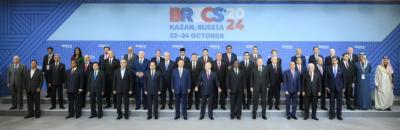
The leaders of Brazil, Russia, India, China, South Africa, Egypt, Ethiopia, Iran and the United Arab Emirates are meeting for the first time since new members were invited to join BRICS during the Johannesburg BRICS Summit of 23 August 2023.

Together, the powerful bloc holds around 35% of the global Gross Domestic Product (GDP) and 20% of world exports.

“The BRICS Outreach and BRICS Plus engagements are important platforms for developing strong ties among countries from the greater Global South and emerging markets.

“We should use these platforms to foster meaningful engagement. We should use the BRICS platform to contribute to social, economic and cultural development of our peoples,” President Ramaphosa said. 
 

READ | BRICS partnership is a catalyst for global growth
 

The President welcomed initiatives by Russia aimed at developing other BRICS nations. 

“We welcome the Russian initiatives that are aimed at strengthening a number of BRICS countries through the various networks aimed at improving the future of BRICS countries’ transport networks and connectivity under the theme, ‘Innovation and Digitalisation of Transport’.

“This will help us find ways to integrate and deepen our interconnectedness in new and imaginative ways,” he said. 

The President noted that work has already begun in this regard through the International North-South Transport Corridor -- a multimodal transportation corridor established from St Petersburg in Russia to Mumbai, India.

“This corridor is an opportunity for this region to unlock new trade flows and trade routes in an increasingly multipolar world.

“On the African continent, the African Continental Free Trade Area will unlock opportunities for trade and investment for local and global businesses. It will create a number of opportunities that will lead to an integrated and connected continent,” President Ramaphosa said. 

He encouraged BRICS countries and friends of BRICS to “use these projects to further connect the greater Global South”. 

WATCH I BRICS Summit Outreach/ BRICS+ First Session

International conflicts 

The President called for the resolution of conflicts that are escalating not only in the Middle East but also on the African continent. 

“We must find lasting solutions to all these conflicts.

“We must remain committed to the peaceful resolution of all disputes through negotiation and inclusive dialogue. We must safeguard the ability of States to pursue independent foreign policy. 

“We must safeguard the multilateral system because it is the cornerstone of international relations, and foster an environment of peace and development,” he said. 

He emphasised that conflicts cannot be allowed to “continue in perpetuity”. 

“We need to find paths to peace. In our quest for a more interconnected, just and prosperous world, we have the ability to foster an environment of peace through a focus on sustainable development.

“We must continue to support nations and peoples, who seek to end the cycle of conflict and choose the path of peace,” President Ramaphosa said. - SAnews.gov.za

NeoB
Thu, 10/24/2024 - 12:07

196 views
Read morePresident Ramaphosa delivers country statement at BRICS Summit
23 October 2024

BRICS economic potential must be realised – President Ramaphosa

Location: News

BRICS economic potential must be realised - President Ramaphosa

By Neo Bodumela

Kazan, Russia: President Cyril Ramaphosa has called on the BRICS bloc of countries to ensure that the potential of the bloc’s economic partnership is realised for the benefit of all the members.

He was delivering South Africa’s country statement during the 16th BRICS Summit currently underway in Kazan, Russia.

The leaders of Brazil, China, Egypt, Ethiopia, India, Iran, Russia, South Africa and the United Arab Emirates are meeting for the first time since new members were invited to join BRICS during the Johannesburg II BRICS Summit of 23 August 2023.

Together, the powerful bloc of countries holds around 35% of the global Gross Domestic Product (GDP) and 20% of world exports.

“Our story is a story of solidarity, mutual respect and mutual benefit. BRICS is an inclusive formation that has the ability to change the trajectory of the Global South.

“To do this, we must realise the full potential of our economic partnership to ensure sustainable development for all. We must undertake bold steps towards a mutual, shared and equitable prosperity,” the President said on Wednesday.

The President explained that in order for the BRICS Strategy for Economic Partnership 2025 to be achieved, the bloc must “explore pathways to unlock opportunities and address challenges confronted by micro, small and medium-sized enterprises in BRICS countries”.

“We must intensify cooperation among BRICS members by launching common development programmes in the fields of exports, industrial cooperation and technology exchange. We have called for the recalibration of trade rules to enable industrialisation.

“We must enhance beneficiation of mineral endowments of BRICS countries closest to source. This is important for development and for the advancement of our decarbonisation goals,” he said.

Going further on the point of decarbonisation and its twin issue in climate change, President Ramaphosa warned that the two issues have the potential to “deepen global inequality”.

“We must acknowledge the devastating impact on lives and livelihoods of our current climate trajectory. As South Africa, we remain committed to a just transition to a low carbon economy.

“We are committed to the reduction of global emissions, guided by the principle of common but differentiated responsibilities and respective capabilities. While countries with developing economies remain severely impacted by climate change, they have contributed the least to the current climate crisis.

“It is therefore vital that industrialised nations honour their climate commitments and ensure a just and equitable transition. It is essential that climate actions do not deepen global inequality or stifle the developmental aspirations of the Global South,” President Ramaphosa said.

The Summit continues. – SAnews.gov.za


NeoB
Wed, 10/23/2024 - 13:35

286 views
Read moreBRICS economic potential must be realised – President Ramaphosa
23 October 2024

BRICS: A convergence of states committed to mutual respect in diversity

Location: News

BRICS: A convergence of states committed to mutual respect in diversity

By Neo Bodumela

Kazan, Russia: Russian President Vladimir Putin has praised the BRICS nations, saying the bloc has the potential to possess “truly immense” power. 
Putin was delivering remarks at the 16th BRICS Summit underway in Kazan, Russia. 

The now expanded BRICS bloc of countries includes Brazil, Russia, China, India, South Africa, as well as newly minted Member States Egypt, Ethiopia, Iran, and the United Arab Emirates (UAE). 

“We are all witnessing the dynamic growth of BRICS and the strengthening of its authority and influence in global affairs.

“The BRICS states possess truly immense potential in terms of political power, economy, science, technology, as well as human development. Furthermore, we are united by shared values and a common worldview,” he said. 

The leader described the grouping as a convergence of states committed to mutual respect in diversity. 

“It would be fair to say that BRICS is a group of like-minded sovereign states that represent different continents, development models, religions, and distinctive civilisations and cultures. 

“All our states advocate equality, neighbourliness and mutual respect, the assertion of the noble ideals of friendship and harmony, commonwealth and well-being. 

“We have assumed responsibility for the future of the world not in word but in deed. We are exerting a truly beneficial influence on global stability and security and making a substantial contribution to addressing pressing regional problems,” Putin said. 

He noted that the approach of the BRICS bloc is to respond to the “aspirations of the largest part of the international community, which we refer to as the global majority”. 

“This approach is especially relevant in the current conditions when truly radical changes are underway across the globe, including the shaping of a multipolar world,” Putin concluded. - SAnews.gov.za

NeoB
Wed, 10/23/2024 - 16:57

43 views
Read moreBRICS: A convergence of states committed to mutual respect in diversity
23 October 2024

Deputy President to convene second meeting of the GNU clearing house mechanism

Location: News

Deputy President to convene second meeting of the GNU clearing house mechanism

Deputy President Paul Mashatile will convene the second meeting of the Government of National Unity (GNU) clearing house mechanism on Thursday, 24 October 2024.

The Deputy President chaired the first virtual meeting last week, which the Presidency said got off to a good start.

READ | Inaugural meeting of the GNU clearing house gets off to a good start

The GNU clearing house mechanism is a platform created by President Cyril Ramaphosa to resolve policy disagreements and disputes within the GNU.

All 10 political parties that are signatories to the GNU – African National Congress, Democratic Alliance, Patriotic Alliance, Inkatha Freedom Party, Good Party, Pan Africanist Congress of Azania, Freedom Front Plus, United Democratic Movement, Al Jama-ah, and Rise Mzansi have been invited. 

The Office of the Deputy President serves as the Secretariat of the GNU clearing house mechanism. 

Issues to be discussed include the clearing house mechanism's terms of reference and an update on the preparations for the G20 Summit. 

The leaders will also touch on the aspects of the Basic Education Laws Amendment Act (BELA Act), update on the preparations for the National Dialogue, and discuss challenges at the provincial and local government level in relation to coalition governments. 

The mechanism will not override Cabinet decisions, as the Executive remains the final decision-making body in government. However, it will ensure that all GNU signatories develop a common understanding of critical policy matters.

In addition to the mechanism, the Presidency said it was resolved to establish a technical committee to serve as a processing channel for matters of divergence within the GNU.

This means that this mechanism will establish the Political Leaders’ Forum of parties who signed the statement of intent. – SAnews.gov.za

Gabisile
Wed, 10/23/2024 - 14:09

60 views
Read moreDeputy President to convene second meeting of the GNU clearing house mechanism
23 October 2024

BRICS bloc a beacon for the global south

Location: News

BRICS bloc a beacon for the global south

By Neo Bodumela

Kazan, Russia: President Cyril Ramaphosa has hailed the BRICS bloc of countries as a beacon of hope for countries in the global South.

The President was delivering remarks at a plenary session of the BRICS Summit currently underway in Kazan, Russia. 

The now expanded BRICS bloc of countries includes Brazil, Russia, China, India, South Africa, as well as newly minted Member States Egypt, Ethiopia, Iran, and the United Arab Emirates (UAE).

This makes it one of the most powerful blocs on the global stage, with 3% of the world’s population, 32% of the world’s land area, around 35% of global GDP and 20% of world exports.

“Fifteen years ago, South Africa attended its first BRICS Summit in Sanya, China. Today, we gather as a group of nine leading emerging countries. Our historic expansion is a beacon of hope for the global South.

“Individually, we are countries of diverse histories, values and strengths. Together, we demonstrate the benefits of cooperation instead of competition. As an increasingly influential group, we must ensure the success of this expanded group,” he said.

The President called on the influential bloc to use its voice to advance global change – particularly on the resolution of international conflicts that require “a UN Security Council that is representative and inclusive”.

“We see from many conflicts raging across the world that the UN Security Council has not fulfilled its mandate to maintain international peace and security. It does not represent the interests of the global community, and therefore does not have the means to give effect to the global desire for peace.

“Just as BRICS has a vital role in shaping a new multipolar world order, so too must it use its voice to advance change.

“We found consensus on the reform of the UN Security Council when we met in Johannesburg last year. Let us build on that foundation to develop an improved consensus that addresses the concerns and aspirations of all BRICS members,” President Ramaphosa said.

On the plight of the Palestinian people, President Ramaphosa emphasised that the South African government remains “gravely concerned at the further escalation of a conflict that has already caused so much death and destruction”.

“The International Court of Justice has made it clear that the international community has a duty to prevent genocide by Israel. The countries of the world have a responsibility not to fund or facilitate Israel’s genocidal actions.

“As the UN General Assembly has now resolved, the countries of the world have a responsibility to promote the realisation of the right of the Palestinian people to self-determination. Lasting peace and security will not be achieved until Palestinians have realised their aspirations for statehood, justice and freedom.

“Peace and security across the world requires the collective will of the community of nations. It requires a UN Security Council that is representative and inclusive,” he said – SAnews.gov.za
 

NeoB
Wed, 10/23/2024 - 12:28

5 views
Read moreBRICS bloc a beacon for the global south
23 October 2024

Kaspersky Uncovers New Grandoreiro Light Variant

Location: News
Kaspersky

Despite the arrest of important operators in early 2024, Grandoreiro continues to be used by its partners in new campaigns. Kaspersky Global Research and Analysis team (GReAT) (www.Kaspersky.co.za) has discovered a new light version focused on Mexico targeting around 30 banks. These findings are to be highlighted at the Security Analyst Summit (SAS) 2024. Remaining one of the most active threats globally and targeting users of more than 1,700 banks, Grandoreiro variants account for around five percent of banking trojan attacks this year.  Mexico is one of the most targeted countries by various Grandoreiro strains, including the new light version, seeing 51,000 recorded incidents this year.

Kaspersky data indicates Grandoreiro has been active since 2016. In 2024, the threat targets more than 1,700 financial institutions and 276 cryptocurrency wallets across 45 countries and territories, lastly adding Asia and Africa to the list of its targets, making it a truly global financial threat. Among countries affected in Africa are Algeria, Angola, Ethiopia, Ghana, Ivory Coast, Kenya, Mozambique, Nigeria, South Africa, Tanzania, Uganda.

After assisting an INTERPOL-coordinated action, which has led to Brazilian authorities arresting (http://apo-opa.co/3BUqgrb) operators behind a Grandoreiro banking trojan operation, Kaspersky discovered that the group's codebase has been split into lighter, fragmented versions of the trojan, to continue its attacks. Recent analysis has identified a specific light version focused primarily on Mexico, which has been used to target approximately 30 financial institutions. The creators likely have access to the source code and are launching new campaigns using the simplified legacy malware.

“All the recent developments underscore the evolving nature of the threat. Fragmented and lighter versions may represent a trend that could extend beyond Mexico and into other regions, including beyond Latin America. However, we believe that only some trusted affiliates have access to the malware source code to develop such lighter versions. Grandoreiro operates differently from the traditional ‘Malware-as-a-Service' model we are accustomed to. You won't find announcements on underground forums selling the Grandoreiro package; instead, access to it appears to be limited,” explains Fabio Assolini, head of the Latin American (GReAT) at Kaspersky.

Multiple variants of Grandoreiro, including the new light version and the primary malware, accounted for approximately five percent of global banking trojan attacks detected by Kaspersky in 2024, making it one of the most active threats worldwide. Kaspersky has also analysed the newer samples of the primary Grandoreiro from 2024, and observed new tactics. It records mouse activity to mimic real user patterns, aiming to evade detection by machine learning-based security systems that analyse behaviour. By replaying natural mouse movements, the malware aims to trick anti-fraud tools into seeing the activity as legitimate.

Additionally, Grandoreiro has adopted a cryptographic technique known as Ciphertext Stealing (CTS), which Kaspersky has never seen being used in malware. In this case, its aim is to encrypt the malicious code strings. “Grandoreiro has a large and complex structure, which would make it easier for security tools or analysts to detect if its strings were not encrypted. This is likely why they introduced this new technique – to complicate the detection and analysis of their attacks,” Fabio Assolini elaborated.

To protect from financial malware, Kaspersky security experts recommend organisations to:

  • Enable a Default Deny policy for critical user profiles, particularly those in financial departments; this ensures that only legitimate web resources can be accessed.
  • Provide cybersecurity awareness training (http://apo-opa.co/4e3nlKa) to staff, especially to employees responsible for accounting, that includes instructions on how to detect phishing pages.
  • Use protection solutions for mail servers with anti-phishing capabilities such as Kaspersky Security for Mail Server, to decrease the chance of infection through a phishing email.

While banks should educate its customers, individuals are advised to:

  • Never open links or documents included in unexpected or suspicious-looking messages. Be attentive to web pages – from the right web address to details of interface.
  • Use a reliable security solution, such as Kaspersky Premium (http://apo-opa.co/4dWrbEW), that protect digital assets from a wide range of financial cyberthreats.
  • Install only applications obtained from reliable sources.
  • Refrain from approving rights or permissions requested by applications without first ensuring they match the application's feature set.
  • Install the latest updates and patches for all software used.

Read more on Securelist (http://apo-opa.co/3C4N5bD). The comprehensive Grandoreiro analysis and overview is to be presented by GReAT at Kaspersky's sixteenth Security Analyst Summit (SAS) (http://apo-opa.co/3BPHtly), which takes place from October 22-25, 2024, in Bali.

Distributed by APO Group on behalf of Kaspersky.

For further information please contact:
Nicole Allman 
INK&Co.
nicole@inkandco.co.za

Social Media:
Facebook: https://apo-opa.co/3BX3i2P
X (Twitter): https://apo-opa.co/4hdGJXL
YouTube: https://apo-opa.co/4dUZI6t
Instagram: https://apo-opa.co/4hjVok3
Blog: https://apo-opa.co/4fiDs7P

About Kaspersky:
Kaspersky is a global cybersecurity and digital privacy company founded in 1997. With over a billion devices protected to date from emerging cyberthreats and targeted attacks, Kaspersky's deep threat intelligence and security expertise is constantly transforming into innovative solutions and services to protect businesses, critical infrastructure, governments and consumers around the globe. The company's comprehensive security portfolio includes leading endpoint protection, specialized security products and services, as well as Cyber Immune solutions to fight sophisticated and evolving digital threats. We help over 200,000 corporate clients protect what matters most to them. Learn more at www.Kaspersky.co.za. 

Media files
Kaspersky
Download logo
Read moreKaspersky Uncovers New Grandoreiro Light Variant
23 October 2024

South Africa, Russia set sights on expanded trade relations

Location: News

South Africa, Russia set sights on expanded trade relations

By Neo Bodumela

Kazan, Russia: Russian President Vladimir Putin says there are “promising spheres of cooperation” for Russia and South Africa to expand their trade relations.

President Putin was delivering remarks during the bilateral meeting between the two countries held on the sidelines of the BRICS Summit in Kazan, Russia. The meeting was also addressed by President Cyril Ramaphosa.

The BRICS Summit, held from 22 - 24 October, is a platform for the bloc's leaders to reflect on the status of mutually beneficial BRICS cooperation, regional and global economic and political developments, as well as global governance reform.

READ | SA, Russian Presidents meet ahead of significant BRICS Summit

“Trade and economic ties between Russia and the Republic of South Africa are generally positive. Following a brief dip, mutual trade volumes have started to increase, rising by 3% in January - August 2024.

“Of course, we need to work jointly on some aspects in order to expand and diversify mutual trade and investment. Promising spheres of cooperation include energy, industry, agriculture, science and innovation,” President Putin said.

He hailed the bilateral relations between South Africa and Russia as those based of “mutual respect”.

“The relevant agencies of our countries collaborated in the financial sector to expand the use of national currencies in mutual settlements and to create an independent payment system.

“Our bilateral relations are based on the principles of a comprehensive strategic partnership, equality and mutual respect. Our political dialogue is progressing, and our foreign policy departments and security councils are actively communicating. Interparliamentary cooperation has been established.

“Russia and the Republic of South Africa closely coordinate their efforts on the international stage to establish a fair multipolar world order,” he said.

On relations with the African continent, President Putin called for stronger relations between the European country and countries in Africa.

“Russia attaches special significance to strengthening relations with African countries. Collaborative work is underway to implement joint agreements approved at the Russia-Africa Summit in St Petersburg, notably a declaration and an action plan, until 2026.

“We look forward to hosting the head of your foreign policy agency in Sochi for the first ministerial conference of the Russia-Africa Partnership Forum, scheduled for November 9 – 10,” he said.

Turning to the Summit, President Putin said as host country, Russia has “built our work taking into account the results achieved at the Johannesburg summit”.

South Africa played host to the Summit in 2023.

This year, the leaders of Brazil, China, Egypt, Ethiopia, India, Iran, Russia, South Africa and the United Arab Emirates are meeting for the first time since new members were invited to join BRICS during the Johannesburg II BRICS Summit of 23 August 2023.

“Our focus has been on the seamless integration of new participants into the multi-level architecture of BRICS. In close contact with our South African friends, we have worked on coordinating the modalities for establishing the partner state status,” he said. – SAnews.gov.za

NeoB
Wed, 10/23/2024 - 09:31

185 views
Read moreSouth Africa, Russia set sights on expanded trade relations
22 October 2024

SA, Russian Presidents meet ahead of significant BRICS Summit

Location: News

SA, Russian Presidents meet ahead of significant BRICS Summit

By Neo Bodumela

Kazan, Russia: President Cyril Ramaphosa has on Tuesday afternoon held a bilateral meeting with his Russian counterpart, President Vladimir Putin.

The meeting was held on the sidelines of the XVI BRICS Summit in Kazan, Russia. 

“We continue to see Russia as a valued ally, as a valued friend who supported us right from the beginning, from the days of our struggle against Apartheid…up until now.

“So, we are really delighted to be here and to know that we are going to have very important discussions here in Kazan, within the BRICS family,” President Ramaphosa said.

He told the Russian delegation at the meeting that since the last BRICS Summit held in South Africa last year, the country has held elections and formed a Government of National Unity.

“We have formed a Government of National Unity following our elections in May of this year. We will have time…to talk more about that and inform you how that whole process of governing South Africa with a number of other partners is evolving as we have sought to unite the country, to stabilise the country politically,” he said.

The President added that the South African delegation was enthused to be at the BRICS Summit.

The delegation includes Minister in the Presidency Khumbudzo Ntshavheni, International Relations and Cooperation Minister Ronald Lamola, Minister of Trade, Industry and Competition Parks Tau and Defence and Military Veterans Minister Angie Motshekga.

“We would like to congratulate you for…being the President of BRICS having taken over from us. As South Africa we are sure that we will be able to chair our summit so that BRICS and the enlarged BRICS body can continue growing.

“We also do look forward…to the Summit itself, to participate with all other countries under your leadership and deal with matters that are of great importance in geo-political terms and everything that is happening around the world and also, the matters that have to do with trade and climate change [and] with peace and security,” President Ramaphosa said. 

The expanded BRICS now covers 43% of the world's population, 32% of the world's land area, around 35% of global GDP and 20% of world exports and provides opportunities to develop mutually beneficial cooperation that contributes to the sustainable growth and development of South Africa.

The leaders of Brazil, China, Egypt, Ethiopia, India, Iran, Russia, South Africa and the United Arab Emirates will meet for the first time since new members were invited to join BRICS during the Johannesburg II BRICS Summit of 23 August 2023.

During the Summit, BRICS leaders will reflect on the status of mutually beneficial BRICS cooperation, regional and global economic and political developments as well as global governance reform. - SAnews.gov.za
 

Janine
Tue, 10/22/2024 - 18:17

34 views
Read moreSA, Russian Presidents meet ahead of significant BRICS Summit
22 October 2024

President Ramaphosa arrives in Russia for BRICS Summit

Location: News

President Ramaphosa arrives in Russia for BRICS Summit

President Cyril Ramaphosa has arrived in Kazan in the Russian Federation to lead South Africa’s participation in the XVI BRICS Summit.

President Ramaphosa will commence his programme this afternoon with a bilateral meeting with President Vladimir Putin of the Russian Federation.

“The meeting will present an opportunity for President Ramaphosa to communicate priorities of the seventh administration, highlight the strategic importance of the Russian Federation to South Africa, and to exchange views with the Host President on issues of mutual interest,” said the Presidency.

President Ramaphosa will also hold several bilateral meetings with leaders attending the BRICS Summit to strengthen political and economic relations in line with South Africa's national interests and foreign policy priorities.

In the evening, President Ramaphosa will attend the welcome cultural ceremony for BRICS leaders hosted by the Chair of BRICS 2024, President Putin.

On Wednesday, the President will deliver the country statement during the BRICS Plenary session themed Strengthening Multilateralism for Just Global Development and Security”.

He will also attend the Welcoming Ceremony for Heads of Delegations of BRICS States, Invited Countries and International Organisations.

“President Ramaphosa will deliver the second country statement on 24 October 2024 during the BRICS Summit Outreach/ BRICS Plus session held under the theme “BRICS and Global South: building a better world together”. 

“The aim of the dialogue is to enhance BRICS ties with leading developing economies.”

According to the Presidency, BRICS plays an important role in a multipolar world, championing multilateralism, mutually beneficial cooperation and sustainable development.

“A founding value of BRICS is the shared vision of the urgent need to restructure global political, economic and financial governance to be more fair, just and representative. 

“The expanded BRICS now covers 43% of the world's population, 32% of the world's land area, around 35% of global GDP and 20% of world exports and provides opportunities to develop mutually beneficial cooperation that contributes to the sustainable growth and development of South Africa.”

The leaders of Brazil, China, Egypt, Ethiopia, India, Iran, Russia, South Africa and the United Arab Emirates will meet for the first time since new members were invited to join BRICS during the Johannesburg II BRICS Summit of 23 August 2023.

During the XVI BRICS Summit, BRICS leaders will reflect on the status of mutually beneficial BRICS cooperation, regional and global economic and political developments as well as global governance reform.

The Presidency said they will consider reports requested during the Johannesburg II BRICS Summit, including a report by BRICS Foreign Ministers on the further development of the BRICS Partner Country model and prospective candidates and a report by BRICS Finance Ministers on the consideration of local currencies, payment instruments and platforms. 

The summit will also hear reports from the New Development Bank, BRICS Interbank Cooperation Mechanism, BRICS Business Council and BRICS Women’s Business Alliance. – SAnews.gov.za

Janine
Tue, 10/22/2024 - 14:44

1 view
Read morePresident Ramaphosa arrives in Russia for BRICS Summit
22 October 2024

Government activities for the week 21 – 25 October 2024

Location: News

Government activities for the week 21 – 25 October 2024

On Monday, 21 October, the Gauteng MEC for Roads and Transport, Kedibone Diale-Tlabela met with the department’s professional service providers and contractors to discuss issues relating to incomplete and delayed road infrastructure projects in the province.

Also on Monday, Dr Kgosientsho Ramokgopa, the Minister of Electricity and Energy, briefed the media on the Independent Power Producer Programme.

On Tuesday, 22 October, President Cyril Ramaphosa will participate at the XVI BRICS Summit, in Kazan, Russia.

Also on Tuesday, the Minister of Cooperative Governance and Traditional Affairs, Velenkosini Hlabisa, will launch the National Strategic Hub at Emperors Palace, Kempton Park.

On Wednesday, 23 October, the Deputy Minister of Forestry, Fisheries and the Environment, Narend Singh, will deliver the keynote address at the Environmental Assessment Practitioners Association of South Africa Regional Conference at the Southern Sun Elangeni Maharani, Durban, KwaZulu-Natal Province.

On 24 October there are no confirmed events.

On 25 October there are no confirmed events.

Janine
Tue, 10/22/2024 - 13:27

100 views
Read moreGovernment activities for the week 21 – 25 October 2024
18 October 2024

SA must enhance agricultural productivity to achieve Zero Hunger

Location: News

SA must enhance agricultural productivity to achieve Zero Hunger

Minister in the Presidency Khumbudzo Ntshavheni says to achieve ‘Zero Hunger’, the country must enhance agricultural productivity and ensure equitable access to nutritious food.

“This involves investing in sustainable farming practices, empowering smallholder farmers and promoting local food systems,” the Minister said on Friday.

Addressing the 5th International Social Justice Conference and 6th Social Justice Summit -- held at the Artscape Theatre in Cape Town -- Ntshavheni said by supporting farmers, the country can boost food production and create jobs, fostering both economic growth and community resilience.

The start of the 5th International Social Justice Conference on 16 October coincided with World Food Day, an international day celebrated every year worldwide to commemorate the date of the founding of the United Nations Food and Agriculture Organisation in 1945. 

Ntshavheni underscored the importance of promoting sustainable farming methods that enhance productivity, while protecting natural resources. 

“We must forge partnerships across government, the private sector and civil society, including academia, to create comprehensive strategies that tackle food insecurity,” she said, adding that collaboration is key if South Africa is to attain the goal of Zero Hunger. 

Zero Hunger is Goal 2 of the United Nation’s Sustainable Development Goals (SDGs). It is about creating a world free of hunger. The global issue of hunger and food insecurity has shown a sharp increase since 2015, a trend exacerbated by a combination of factors including the COVID-19 pandemic, conflict, climate change and deepening inequalities.

According to the United Nations (UN), by 2022, approximately 735 million people – or 9.2% of the world’s population – found themselves in a state of chronic hunger – a staggering rise compared to 2019. 

Ntshavheni said practices like crop rotation, agroforestry and organic farming can increase resilience against climate change and reduce reliance on chemical inputs.

“Supporting smallholder farmers through training and access to technology can empower communities and boost local food production. It is therefore important and significant that universities like Stellenbosch are deeply involved in this initiative. 

“It would be important for us in government to explore opportunities to partner with institutions of higher learning on this initiative in order to extend awareness to communities in rural areas of our country that are daily confronted with food insecurity. 

“This must make us understand the urgency to develop sound drought resilience and water conservation plans,” the Minister said.

The 6th Social Justice Summit was hosted by the Centre for Social Justice, based at Stellenbosch University.

Striving for food security

In 2014, government introduced the National Policy on Food and Nutrition Security, followed by the National Food and Nutrition Security Implementation Plan (NFNSIP), whose implementation involved multiple government departments and entities, with various interventions receiving support from local and international development partners.

“We are now in the process of developing the NFNSIP (2024 -2030) as we chase the National Development Plan (NDP) Vision 2030 goals. We are not only calling for a partnership in the [NFNSIP] development but with its implementation, as our country focuses on achieving the overdue SDG on Zero Hunger.

“Our policy approach to Zero Hunger acknowledges the lingering consequences of apartheid, which has left deep-rooted inequalities in access to land, income, and employment and other economic opportunities,” the Minister said.

Ntshavheni said as the country’s population growth and climate change intensifies, the urgency of food security cannot be overstated.

Ntshavheni said hunger on its own is a multifaceted challenge that affects the economy, health system and social fabric in general.

Addressing the conference, Electricity and Energy Deputy Minister Samantha Jane Graham said the issue of energy affordability remains a challenge, as the nation navigates the challenge of the accessibility of food prices.

Graham said her office is committed to finding innovative and sustainable solutions for energy sources.  – SAnews.gov.za
 

Edwin
Fri, 10/18/2024 - 14:39

129 views
Read moreSA must enhance agricultural productivity to achieve Zero Hunger
18 October 2024

Healthcare Indaba 2024: Advancing Global Health Through Innovation and Digital Solutions

Location: News

Africa Health
Download logo

Delegates will gather in the Mother City in South Africa this month, when the second annual Healthcare Indaba takes place at Cape Town's CTICC. The two-day event forms part of the 2024 edition of Africa Health Congress (www.AfricaHealthExhibition.com), the premier healthcare gathering on the African continent.

Building on the success of its inaugural edition last year, the Healthcare Indaba 2024 expands to a two-day format. It dives into the realms of Global Health on day one and exploring AI & Digital Health on day two of the Congress (running from 22 to 24 October 2024).

Another new element to the Congress and the Indaba deliberations, is the dedicated forum within the Africa Health Congress 2024 entitled, “EmpowHER: Women in Healthcare”.

“Our goal is to create a lasting brand that celebrates female leadership and fosters a supportive community.  Our audience is eager to gain insights into the realities of leadership in healthcare and understand the journey it takes to reach the top. The mandate for our speakers will be candidness and honesty,  they will share their personal experiences, challenges, and successes in the hopes of inspiring the audience. Their stories and insights will help ensure the long-term sustainability of our industry through supporting women and celebrating their successes,” says Cynthia Makarutse, spokesperson for the organisers of Africa Health.

“Much like the Mining and Tourism Indabas which inspired it, the Healthcare Indaba has emerged as a crucial platform for shaping the future of our industry on the continent. This year's focus aligns with our commitment to position Africa at the forefront of medical innovation with worldwide impact,” says Makarutse.

The Indaba will feature discussions led by some of the most influential voices in African healthcare and technology.

“Global Health” – Africa claiming its right place on global stage.

Head of the Global Surgery Division at the University of Cape Town, Professor Salome Maswime, will chair the Global Health deliberations of the Indaba on day one. She explains that she is excited about hosting a dynamic programme that brings leaders together from all over the world and from all sectors.

“We hope to have thought provoking sessions about the role of Africa on the Global Health Stage. This will be a first for Africa Health, with the Vice President of the United Nations Foundation delivering the keynote on Global Health strategies for a resilient future,” she adds.

“I think most importantly it gives us an opportunity to discuss and find consensus on the strategies for Global Health and to align on international programmes, and to collaborate on new and strategic programmes. Many of us are involved on international Global Health platforms, yet the global health agenda is still mainly driven and owned by high income countries. We have an opportunity to re-imagine the future of Global Health for Africa.

“It is time for Africa to get involved on all matters related to Global Health. We cannot afford to be left behind. We have an obligation to provide universal health coverage and to improve healthcare in Africa,” says Maswime.

“AI & Digital Health” – building sustainable solutions.

The second day of Indaba 2024 (on Wednesday 23 October) shines the spotlight on AI & Digital Health.

“The significance of this event lies in its ability to convene leading industry experts, innovators and key stakeholders from across the continent to address pressing healthcare challenges and explore transformative solutions,” says Dr Mories Atoki, CEO of ABCHealth and a speaker on the day.

“The ABCHealth side forum on Digital Health will serve as a platform to discuss how AI and digital health can revolutionize healthcare delivery, making it more accessible and efficient. It is a critical moment for both the private and public sectors to explore more and collaborate on building sustainable systems that address Africa's unique healthcare needs through AI.”

For the people of Africa, Dr Atoki believes this congress provides hope.

“The conversations and outcomes from these sessions will not only influence policy but also drive tangible improvements in healthcare services, enhancing quality of life and reducing healthcare inequalities across the continent.

“For the medical sector, it presents a unique opportunity to explore new opportunities,  strengthen partnerships, share groundbreaking innovations, and leverage digital health means to drive healthcare accessibility and efficiency. This signifies progress toward better healthcare outcomes through improved access, affordability, and quality of care. By highlighting the potential of AI and digital health, we can pave the way for more inclusive, patient-centric care which can also bridge gaps in underserved areas,” she says.

“Africa's healthcare future relies largely on embracing digital interventions.  AI and digital health are not just trends—they are an essential part of a globally advancing economy that can help solve some of the continent's most pressing healthcare challenges, from limited access, specialized care to overburdened systems.

“Achieving this on a large scale requires robust ecosystems, supported by both regulatory frameworks and financial investments. Policy reforms and investments are essential to creating a thriving digital health ecosystem. It will also require multi-sector partnerships that prioritize patient safety, data protection, and equitable access and inclusivity,” says Dr Atoki.

“AI & Digital Health: The need to first address health data accessibility.”

“We cannot hope to effectively use the rapidly increasing AI  set of commodities that are becoming available globally in Africa, before we first address health data accessibility and governance locally” says Dr Chris Fourie, a medical doctor, machine learning operations (MLOps) engineer, researcher and online grassroots community organiser.

As another speaker on day two, he says: “My presentation is related to the foundation that we need (i.e. health data accessibility) in order to do any kind of quantitative analysis, data science, machine learning, or AI for health in Africa. When considering the potential impact and significance of these in Africa, a good place to start is with understanding the burden of disease in Africa.”

“Regularly published Global Burden of Disease data shows us that infectious disease and maternal child health are consistently top of the list for Africa. These should be considered when deciding where data science and AI interventions could target. As an example, Africa would stand to benefit a great amount from interventions that can drop the cost and increase the efficacy of primary health interventions,” says Fourie.

“While the scope for what AI can do is really broad, for Africa the capacity to help collect and utilise data for primary and pre-primary care could generate immense impact.”

Fourie says this could be realised as:

  • Broader and interactive patient health education (especially if in one's their own language) making existing health information more accessible.
  • Better health service accessibility e.g.
    • Encrypted / safe remote conversational / natural language health data collection.
    • Cost-effective, early and automated diagnosis and triage using multimodal data from existing patient records and new data from e.g. mobile personal devices.
  • Rapid and higher quality patient data linkage / aggregation and government action related to this data - e.g. the growth of national health data centres in the global south – this is very useful for toward data driven public health policy development.
  • Lower cost and quicker drug development e.g. to address rising resistance.
  • Personalised healthcare and clinical decision support tools, with data driven patient follow up, treatment tracking and dynamic treatment adjustment.

“I would like to see the initiation and ongoing development of multidisciplinary, multi-stakeholder, participatory collectives to help provide effective channels of communication and cooperation between patients, healthcare service providers, researcher, funders and policy makers toward a future culture of open science and sustainable health equity.”

EmpowHER: Women in Healthcare: The power of she – A new class of women leaders.

Day three of the Africa Health Congress will see a long list of leading female voices in the healthcare space sharing their stories at a dedicated forum that celebrates female leadership and fosters a supportive community.

“Everything we are doing at Congress this year is about tackling the challenges wherever they may be located in the healthcare space and finding solutions. This is the same motivation also for EmpowHER as we invite trailblazing women from across Africa's healthcare scene to unite!

“This summit will ignite community, growth, and empowerment for established and emerging leaders. Through dynamic panels and keynotes, shatter personal and professional boundaries and emerge ready to champion change for women in leadership” says Cynthia Makarutse, spokesperson for the organisers of Africa Health.

Speakers on the day include the Chief Scientific Officer at the SA Medical Research Council Professor Glenda Gray, Microsoft's Kenya Country General Manager Phyllis Migwi, the World Bank's Lead: AI for Human Development Marelize Prestidge, and Wesgro's HealthTech Ecosystem Manager Mandi Swanepoel.

Indaba – an ecosystem of innovation.

"The Healthcare Indaba has become the intellectual core of Africa Health; it's a catalyst for change on a global scale,” says Makarutse.

“By bringing together diverse stakeholders at the highest echelons of their various fields in healthcare – including policymakers, facility directors, entrepreneurs, and academics – we are establishing an ecosystem of innovation that can truly transform healthcare delivery across Africa and inspire solutions worldwide.”

Distributed by APO Group on behalf of Africa Health .

About Africa Health Congress:

  • Africa Health is organised by the Informa Markets' Global Healthcare Group. It takes place at Cape Town International Convention Centre in South Africa between 22 and 24 October 2024.
  • A summary report from the Africa Health Congress 2023 can be downloaded from https://apo-opa.co/3YvA7Nb
  • The Exhibition will host CPD-accredited conferences that are aimed at bridging the gap in medical knowledge by providing the very latest insights into cutting-edge procedures, techniques, and skills.
  • For more information, visit www.AfricaHealthExhibition.com 
  • Media queries and requests for accreditation can be addressed to Martin Slabbert at 079 500 1503 or martin@alkemi.global

Issued by Alkemi Collective on behalf of Africa Health.

Read moreHealthcare Indaba 2024: Advancing Global Health Through Innovation and Digital Solutions
17 October 2024

Minister leads charge for ethical leadership in local government

Location: News

Minister leads charge for ethical leadership in local government

The Minister of Cooperative Governance and Traditional Affairs (CoGTA), Velenkosini Hlabisa, has urged municipal councils to adopt the new Code for Ethical Leadership in Local Government and submit their resolutions to the MECs responsible for local government.

This comes after the Minister jointly signed a circular with the South African Local Government Association (Salga), President Bheki Stofile. 

The Minister has further urged councils to implement the code swiftly, with a clear timeframe for action.

Launched in March 2024 during the Local Government Summit on Ethical Leadership, the code was developed through the Local Government Ethical Leadership Initiative (LGELI) in partnership with the Department of Cooperative Governance and Traditional Affairs, the Ethics Institute, Salga, and the Moral Regeneration Movement.

“The code is a cornerstone of the Local Government Anti-Corruption Strategy, aiming to build a sector committed to ethical standards, service delivery, and good governance. 

“It addresses corruption head-on, ensuring incidents are dealt with swiftly and justly while embedding a professional culture of ethics within municipalities,” the statement read. 

Unlike the code of conduct for councillors or municipal staff, the department said this one provides local government leaders with guidance on navigating key issues that impact ethical governance, creating well-governed and effective municipalities. 

It also applies to both the political and administrative municipal leaders.

“For the code to truly make a difference, it must become central to municipal discourse and be adopted by municipalities nationwide. Its principles must be consistently implemented by municipal leaders,” Hlabisa explained. 

Last year, the then Minister of CoGTA, Thembi Simelane, launched the Code for Ethical Leadership in Local Government and said this was an indication of the department’s commitment to fostering a just, inclusive, and transformed society through effective and efficient functioning municipalities.

“The collaboration by the State and non-State actors reaffirms that collaboration and shared responsibilities are key to addressing challenges faced by local government.

“Through this partnership, government is not only taking a stand against unethical conduct and corruption but also promoting a collaborative approach to governance that is essential for sustainable development,” Hlabisa said. – SAnews.gov.za

Gabisile
Thu, 10/17/2024 - 11:29

214 views
Read moreMinister leads charge for ethical leadership in local government
17 October 2024

President Ramaphosa to attend to BRICS Summit and domestic fora 

Location: News

President Ramaphosa to attend to BRICS Summit and domestic fora 

President Cyril Ramaphosa is set to participate in several key engagements over the coming weeks, beginning with the BRICS Summit in Kazan, Russia.

Presidential spokesperson Vincent Magwenya confirmed this during a press briefing with media houses to update them on the President’s diary in Cape Town on Wednesday. 

President Ramaphosa will attend the BRICS Summit in Russia from Tuesday to Thursday (22- 24 October). 

The Russian Federation’s BRICS Chairship in 2024 is under the theme "Strengthening Multilateralism for Just Global Development and Security”. 

Magwenya highlighted that South Africa’s participation in the summit is aimed at enhancing the country’s growth and development through its membership in BRICS, focusing on strengthening intra-BRICS relations and fostering mutually beneficial cooperation. 

This includes advancing political and security cooperation, financial and economic cooperation, and cultural and people-to-people cooperation.

During its BRICS Presidency this year, Russia indicated that it will focus on "promoting the entire range of partnership and cooperation within the framework of the association on three key tracks – politics and security, the economy and finance, and cultural and humanitarian ties”.

Responding to Questions for Oral Reply in the National Assembly in Parliament, Cape Town in August, President Ramamphosa spoke of the value of the BRICS alliance to advancing Africa’s developmental agenda. 

As Chair of BRICS last year, South Africa invited representatives from other African countries to attend the summit hosted in Johannesburg. Forty-six African countries attended, including 20 Heads of State and Government.

Medium Term Budget Policy Statement (MTBPS)

On the domestic front, the President will attend the tabling of the Medium Term Budget Policy Statement (MTBPS).

Finance Minister  Enoch Godongwana is set to table the MTBPS in Parliament on Wednesday, 30 October. The MTBPS outlines the policy framework for the upcoming budget, including government goals, the economic environment, and projected resource availability. 

It offers an analysis of the trade-offs and challenges the nation faces in addressing its priorities, providing an important step forward in the national budget process. 

READ | National Treasury announces MTBPS date

“The Medium-Term Budget Policy Statement is an important step forward in the budget process. In keeping with our commitment to open, transparent and cooperative policymaking, it invites the nation to share with Government the important choices to be completed,” Magwenya said. 

Visit to Limpopo

Meanwhile, President Ramaphosa is scheduled to visit the Limpopo province on Friday, 1 November, where he will meet with Premier Dr. Phophi Ramathuba and the provincial government executive. 

The provincial leadership will present their five-year program which is aligned with the priorities of the seventh administration. 

“The meeting will also discuss approaches [to] various service delivery issues including interventions to improve service delivery at local government level,” Magwenya said.

KwaZulu-Natal DDM Oversight Visit

On Thursday, 7 November, the President will meet with KwaZulu-Natal Premier Thami Ntuli and members of the provincial government in Durban. 

This meeting will be followed by a District Development Model (DDM) oversight visit to the eThekwini Metropolitan Municipality which includes a Presidential Imbizo on Friday, 8 November. 

The visit aims to assess the progress of the Presidential eThekwini Working Group, which was established earlier this year to address service delivery and development challenges in the area.

Last week Cabinet called on residents to join the imbizo and engage their public representatives.

“Cabinet calls on residents of Umgababa and the surrounding areas to join the imbizo and engage their public representatives on solutions to challenges in their community and find ways to improve service delivery,” it said in a statement following its fortnightly meeting.

The imbizo is set to be held at the Umnini Sportsfield in Ward 98.

Cabinet adopted the DDM in August 2019.

The DDM is an integrated planning model for cooperative governance aimed at fast-tracking service delivery. It seeks to ensure that municipalities are adequately supported and resourced to carry out their mandate.

READ | President Ramaphosa to lead Presidential Imbizo in KZN

The first Presidential Imbizo of the seventh administration was held in Tsakane in Gauteng in August.

The Presidency said the President’s engagements highlight his commitment to addressing national priorities, both domestically and internationally, with a focus on economic growth, improved governance and enhanced service delivery. – SAnews.gov.za

DikelediM
Wed, 10/16/2024 - 15:37

2 views
Read morePresident Ramaphosa to attend to BRICS Summit and domestic fora 
17 October 2024

Internet Society Events Highlight the Importance of Encryption for Online Safety and Security

Location: News

Internet Society
Download logo

In support of Global Encryption Day on 21 October 2024, events are being organized across Africa by Internet Society (www.InternetSociety.org) chapters in Côte d'Ivoire, Nigeria, Rwanda, South Africa, Zimbabwe, Kenya, and Benin to educate and train individuals on the importance of encryption in protecting data and privacy.  

End-to-end encryption is the process of transforming or encoding information so that only the sender and intended recipient can see it. It safeguards the personal security of billions of people around the world and is essential for security on the Internet.  

By promoting awareness and providing training on encryption, grassroots organizers are empowering communities to take control of their digital security. Under the umbrella of Global Encryption Day, the events planned are a testament to the growing importance of encryption as a means to security in the digital age and signal a growing consensus that people must be protected online. From workshops to informational sessions, participants will have the opportunity to learn about encryption and how it can be used to keep people safe. 

Event 1: Encryption to secure our daily life and future

Where: Maison des Jeunes, Yopougon, Abidjan, Côte d'Ivoire

When: 20-21 October 2024, 09:00 to 14:30 UTC 

What: A 2-day training course will promote encryption for civil society actors, local authorities, and activists in Côte d'Ivoire and the necessity to protect it. Register at Encryption to secure our daily life and future (https://apo-opa.co/4eR5CXO)

Event 2: Kwara Global Encryption Day 2024 Summit 

Where: Ilorin. Kwara State., Nigeria 

When: 24 October 2024, 08:00 to 16:00 UTC 

What: The “Kwara Global Encryption Day 2024 Summit” is an initiative by the Webfala Digital Skills for all Initiative. The event is designed to raise awareness about the critical importance of end-to-end encryption in protecting digital privacy and security. The summit aims to provide a comprehensive understanding of encryption technologies, their applications, and the current legislative landscape in Nigeria and beyond. Register at Kwara Global Encryption Day 2024 Summit (https://apo-opa.co/3YbFeAw).

Event 3: Global Encryption Day 2024 

Where: Bugesera - Rwanda, Rwanda 

When: 16 October 2024, 13:00 to 15:00 UTC 

What: Internet Society Rwanda members will learn more about encryption tools that will protect your privacy and the importance of safeguarding this important resource.  

Event 4:  Activating Voices of Underserved Communities Through Encryption and Digital Inclusion  

Where: Ugunja, Kenya 

When: 19 October 2024, 10:00 to 15:00 UTC 

What: Kijiji Yeetu, the Ugunja Youth Parliament, and Ugunja Net Wardens, in collaboration with the Internet Society Kenya Chapter, Jaramogi Oginga University, and United States International University Africa, are organizing an event that will focus on enhancing encryption, digital literacy, and security for teachers, net wardens, and underserved communities in Ugunja. The initiative aims to spark a nationwide impact by empowering participants to harness technology creatively and securely.  

Event 5: Campaign For Youth Participation On Online Security 

Where: American Corner, Jigawa State., Nigeria 

When: 21 October 2024, 09:00 to 16:00 UTC 

What: The program will look at how best to engage youth and bring them on board to contribute to online security and protection of encryption. Register at Campaign For Youth Participation In Online Security (https://apo-opa.co/3BJ2w9A).

Event 6:  Encryption Advocacy Training for Academic Institutions in Africa  

Where:  Solusi University, Zimbabwe 

When:  21 October 2024, 08:30 to 13:00 UTC 

What:  This event will focus on developing encryption advocates in institutions of higher learning. The purpose of the conference is to capacitate Faculty Deans and Lecturers from institutions of higher learning so that they may infuse these principles to their classroom teaching.   

Event 7:  Global Encryption Day 2024 – Encryption For Data Privacy & Online Safety 

Where:  Durban, KwaZulu-Natal, South Africa 

When:  21 October 2024, 09:00-15:00 UTC 

What: The Internet Society South Africa Chapter and its partners will organize a program that includes training, interactive sessions, and online discussions on encryption, cybersecurity, privacy, human rights, and more. With one main venue and two remote participation hubs based in Cape Town and Johannesburg, this is set to be the largest Global Encryption Day celebration yet. Register at Internet Society 

Event 8:  Protecting End-to-End Encryption: Our Security at Stake 

Where:  University of Abomey-Calavi / IFRI, Benin 

When:  21 October 2024, 09:00 to 12:30 UTC 

What: Encryption is the cornerstone of modern digital security, safeguarding our data and communications from cyber threats. Through discussions, interactive workshops, and expert talks from leading cybersecurity professionals, you'll gain valuable insights into how encryption shields your personal data, online communications, and privacy. In today's evolving digital landscape, understanding these tools is vital for staying safe. As a student, this event will empower you to contribute to a more secure Internet and equip you with practical steps to protect your own data. https://apo-opa.co/4eJID0J

For more information visit: https://apo-opa.co/3Yciv7s to learn more about Global Encryption Day events around the world. 

Distributed by APO Group on behalf of Internet Society.

Media contact: 
Allesandra deSantillana 
Internet Society  
desantillana@isocfoundation.org 

Read moreInternet Society Events Highlight the Importance of Encryption for Online Safety and Security
16 October 2024

Milken-Motsepe Prize in Fintech Announces 10 Semifinalists

Location: Business

The Milken-Motsepe Innovation Prize Program
Download logo

The Milken Institute and the Motsepe Foundation announced the 10 teams advancing to the Semifinalist Round of the Milken-Motsepe Prize in FinTech (https://apo-opa.co/3Y0GSEY), with each team receiving $100,000 in funding.

Responding to a global call for applications, this prize supports innovative solutions to expand access to tools necessary for financial inclusion across emerging and frontier markets.

The Semifinalists will participate in an Innovation Showcase at the Milken Institute's Middle East and Africa Summit December 5-6, 2024, in Abu Dhabi, UAE. During this event, the 10 teams will pitch their innovations to a panel of expert judges and investors, and three teams will be selected to move on to the final round of the prize. The judges will evaluate the pitches based on the teams' ability to deliver solutions that improve financial inclusion for under-resourced groups in emerging and frontier markets.

The prize will ultimately award $2 million in total prizes, including a $1 million Grand Prize. Following the December showcase, the Grand Prize will be awarded at the Milken Institute's Global Conference in Los Angeles, in May.

“By supporting these pioneering teams, we aim to foster financial inclusion and empower entrepreneurs who drive economic growth and opportunities in their communities,” said Emily Musil, senior director, Milken Institute. “Our prizes help identify, support, and celebrate talent to ignite the entrepreneurial spirit and empower visionaries to turn their ideas for a better future into reality.”

These teams operate in nearly 30 countries across three continents, and their innovations hold the potential for significant breakthroughs in financial inclusion for underserved communities on a global scale. Over the next four months, the Semifinalist teams will test and scale their solutions, which will be evaluated for impact, scalability, and sustainability.

The 10 Semifinalists:

AZA Finance (https://AZAFinance.com), Kenya

Team lead: Caroline Shiku Njathi

AZA Finance is a B2B FinTech company offering businesses low-cost, efficient, and secure financial services, including payments, currency exchange, and treasury, across all major currencies.

Chapa (https://Chapa.co), Ethiopia

Team lead: Nael Teklehaimanot

Chapa is an online payment gateway company with a developer-friendly API that simplifies integrating payment processing into websites and applications for Ethiopian businesses.

Chumz (https://Chumz.io) Kenya

Team lead: Sam Njuguna

Chumz is a gamified savings product that leverages behavioral psychology to help individuals save at low cost.

Farmpawa (www.Farmpawa.com), Uganda

Team lead: Moses Eteku

Farmpawa is a crowd farming platform that connects investors with real farming assets, empowering farmers and driving sustainable agricultural growth.

Flow Global (www.FlowGlobal.net), United Kingdom

Team lead: Michael Rothe

Flow Global is a liquidity engine that helps retail merchants grow in the digital economy by addressing all of their working capital needs.

Paycloud by Lipa Later (https://LipaLater.com/), Kenya

Team lead: Eric Muli

Paycloud is a digital banking platform that addresses late payments in Africa by offering seamless payment processing, payment splitting, automated invoicing, and financial tools.

Nyla Bank (www.NylaBank.com), Ghana

Team lead: Mubarak Sumaila

Nyla Bank is building Africa's first digital Islamic bank with a goal of empowering 1 billion people with innovative, Shariah-compliant products and services that align with ethical principles.

Oze (https://GetOze.com), Ghana

Team lead: Meghan McCormick

Oze is a digital lending platform that bridges Africa's credit gap by providing banks with a small and medium-sized enterprise- (SME) focused app that digitizes financial data, enabling risk assessment and lending to small businesses.

Trade Lenda (https://TradeLenda.com), Nigeria

Team lead: Adeshina Adewumi

Trade Lenda is a banking platform tailored to SMEs, where loans can be accessed within one to six hours, and micro-savings can be achieved for business goals.

Verto (www.VertoFX.com), United Kingdom

Team lead: Rachel Coombs

Verto is a business-to-business cross-border payments platform for businesses in emerging markets, powered by a unified network that eliminates intermediary fees, handles 49 currencies, and settles transactions faster.

Learn more about the Milken-Motsepe Prize by navigating to https://MilkenMotsepePrize.org/. Contact Mala Persaud at mpersaud@milkeninstitute.org for more information.

https://apo-opa.co/3Y0GSEY

Distributed by APO Group on behalf of The Milken-Motsepe Innovation Prize Program.

Notes to Editors:
For further information or to request interviews with the semi-finalists, please send requests or queries to the media contact below.

Media Contact:
Ima Peter 
+27 11 268 6388
ima.peter@razorpr.co.za

About the Milken Institute:
The Milken Institute is a nonprofit, nonpartisan think tank focused on accelerating measurable progress on the path to a meaningful life. With a focus on financial, physical, mental, and environmental health, we bring together the best ideas and innovative resourcing to develop blueprints for tackling some of our most critical global issues through the lens of what's pressing now and what's coming next. For more information visit https://MilkenInstitute.org.

About the Motsepe Foundation:
The Motsepe Foundation was founded in 1999 by Dr. Patrice Motsepe and his wife, Dr. Precious Moloi-Motsepe. The goal of the Motsepe Foundation is to contribute towards eradicating poverty and to sustainably improve the living conditions and standards of living of poor, unemployed, and marginalized people in South Africa, Africa, and the world. In January 2013, Dr. Patrice Motsepe and Dr. Precious Moloi-Motsepe joined the Giving Pledge, which was started by Warren Buffet and Bill and Melinda Gates. Dr. Patrice Motsepe and his wife committed to give half of their wealth to the poor and for philanthropic purposes during their lifetime and beyond.

Read moreMilken-Motsepe Prize in Fintech Announces 10 Semifinalists
16 October 2024

Applied Artificial Intelligence (AI) And Deep Tech Innovations Take Centre Stage

Location: Business
Expand North Star

Expand North Star 2024 (www.ExpandNorthStar.com), the world's largest startup and investment event, continued its journey of innovation on its third day at Dubai Harbour. Attendees from around the world witnessed revolutionary advancements in Applied AI and Deep Tech, demonstrating how these technologies are disrupting industries and solving complex global challenges.   

Integrated with GITEX GLOBAL, Expand North Star runs until 16 October, providing a powerful platform for over 1,800 exhibiting startups and more than 1,200 investors managing assets exceeding USD $1 trillion. 

Applied AI and Deep Tech Innovations Redefine Healthcare and Space Innovation 

Day three was a showcase of next-generation solutions in robotics, AI, and deep tech, providing a glimpse into the future of these sectors.  

Cutting through the noise were innovative startups such as China's RoboCT with their innovative exoskeleton technology, launching the UGo Rehab Exoskeleton, specifically designed for patients with lower-limb dysfunction, spinal cord injury, strokes, or cerebral palsy. Dr. Tian Wang, Founder and CEO of RoboCT Group, stated, "UGo enhances the rehabilitation process and delivers an effective walking training solution by integrating advanced sensors, data analysis, and research, empowering patients to rehabilitate more effectively at home."  

On the digital health frontier, JADE introduced a platform tailored for neurodivergent children, including those with ADHD, down syndrome, and autism. The app's sophisticated tracking of eye movements, cognitive response times, and memory functions equips healthcare professionals and educators with precise data to create personalised care and learning strategies.  

Meanwhile, scanO, a pioneering Indian-born deep tech company, is leading the way in developing generative AI models for predicting disease progression. The company showcased its flagship product, scanO air—the world's first contactless AI-powered robotic system for oral health screening—revolutionizing early detection and diagnosis. 

In space technology sector, Triggers-Reports from Mauritius introduced Triggers-sat, a satellite platform that provides high-resolution imaging and 3D modeling to assist businesses and governments in areas such as natural resource management and climate risk disaster monitoring. 

Rising International Participation from Asia and Latin America  

As the global innovation hub, Expand North Star continues to see international participation rise, showcasing how regions and countries are pushing boundaries with novel solutions. 

Tatiana Riera, COO of ApexBrasil, highlighted Brazil's expanding presence at Expand North Star: "From just 20 startups in 2019, we have expanded to 45 startups this year, along with four innovation hubs. Brazil is a great hub for fintech because of the diversity in social levels, so most of our unicorns come from fintech. We also focus a lot on Deep Tech, AI, and climate tech solutions since we have six biomes and need to take care of them. We have a company that uses natural foam to build soundproof material for construction and another company building silent tractors that run on renewable energy."   

Similarly, Singapore's SGTech made a noteworthy debut at Expand North Star, emphasizing the importance of cross-border collaboration in driving tech-driven solutions forward. Alex Ng, Exco Member, SGTech said: "Singapore's innovative startups are making a significant impact at Expand North Star 2024, with six outstanding companies exhibiting under the Singapore Pavilion. These companies showcase cutting-edge technologies across various sectors, including digital twins, industrial AI and biotech, with the event serving as a groundbreaking global launchpad for startups to foster valuable networking with investors." 

Africa's Path to Economic Growth 
With global participation continuing to flourish, the spotlight also turned towards Africa, where burgeoning tech ecosystems are paving the way for a new wave of entrepreneurs and innovators. H.E. Savannah Maziya, Minister, Ministry of Information, Communications & Technology, Eswatini, alongside other thought leaders, emphasised the importance of structured development to tackle unique market challenges and unlock Africa's economic potential.   

Celina Lee, CEO & Co-Founder, Zindi, South Africa, highlighted the trend of talent returning to Africa to start companies and create ecosystems that foster innovation and attract global corporations like Microsoft to set up labs in Ghana and Nairobi.   

Speaking on the challenges facing Africa, Olatunbosun Alake, Honorable Commissioner, Ministry of Innovation, Science and Technology, Lagos State Government, Nigeria, said, "The greatest challenge in Africa is education. In Nigeria, if you look at the most educated parts, they show economic value, whereas in the north, where education levels are not as high, economic productivity is lower. There needs to be an African Renaissance of education funding across the board because if you drive education, educate, and enlighten people, people will change the environment.” 

Across its four-day span, Expand North Star continues to shed light on the future of industries through defining events such as GITEX Impact, Fintech Surge, Future Blockchain Summit, and Marketing Mania. These events underscore how emerging technologies are transforming the way we live and are also playing a pivotal role in reshaping the future.  

Distributed by APO Group on behalf of Expand North Star.

Media Contact: 
Tayce Marchesi, PR Manager, DWTC | tayce.marchesi@dwtc.com     
Ahmad Khalloudi, Account Manager, Seven Media | ahmadkhalloudi@sevenmedia.ae 
Doyin Odulana, Senior PR Manager, Seven Media | adedoyinodulana@sevenmedia.ae 

Follow Expand North Star on Social Media: 
Facebook (https://apo-opa.co/487fqdm)| X (https://apo-opa.co/4h5l6sx)| Instagram (https://apo-opa.co/4eIQXhe)| LinkedIn (https://apo-opa.co/485znl3)
Hashtag: #ExpandNorthStar 

About Dubai World Trade Centre (DWTC):  
A global business facilitator since 1979, Dubai World Trade Centre (DWTC) is home to the region's leading purpose-built convention and exhibition centre. DWTC provides a platform for connecting people, products, innovation and ideas from around the world through a dynamic calendar of international trade exhibitions and its own roster of sector leading mega events. As a designated free zone, complemented by award-winning commercial real estate, DWTC plays an integral role in Dubai and the region's growth story. Since its inauguration, DWTC has hosted over 6,000 events, with an estimated economic output of AED 248 billion, attracting over 38 million business visitors to Dubai. 

Media files
Expand North Star
Download logo
Read moreApplied Artificial Intelligence (AI) And Deep Tech Innovations Take Centre Stage
16 October 2024

DMPR Deputy Minister calls for “zero harm” in mining sector

Location: News

DMPR Deputy Minister calls for "zero harm" in mining sector

The Deputy Minister of Mineral and Petroleum Resources, Judith Nemadzinga-Tshabalala, has called on the mining industry to adopt a strong health and safety culture to eradicate harm and death in the sector.

She was speaking at the 2024 Mine Health and Safety Summit.

As of Monday, the industry recorded a year-on-year decrease of some 11% in fatalities – coming down from 38 fatalities this time last year to 34 deaths.

“It is to be noted that the implementation of technology alone is not enough. To achieve zero harm, we must also cultivate and sustain a strong health and safety culture throughout the mining sector. 

“The Health and Safety Culture Transformation Framework developed by the MHSC [Mine Health and Safety Council] provides a solid foundation for this. 

“However, the implementation of the framework across the industry remains uneven, and more work is needed to ensure that health and safety is elevated and recognised as a top priority and core value by all stakeholders and every mining operation, from the largest corporations to the smallest operators,” Nemadzinga-Tshabalala said.

She said this would require more than merely “following protocols and checking boxes".

"It is about leadership, accountability and a deep, shared commitment to the well-being of every worker.

“It requires a shift in mindset, where the health and safety of mineworkers is not seen as an obstacle to productivity, but as a critical component of operational success,” she emphasised. 

The Deputy Minister added that any injury or death remained “one too many”. and urged the sector to continue striving for zero harm.

“Many of these incidents are repeats and they can be prevented. Fall of ground accidents remain one of the largest accident categories, and the predominant cause of fatalities followed by general accident and transportation categories, respectively. 

“This is regrettable, as it is expected that all mines should have appropriate measures and expertise to enhance the health and safety of mineworkers. So, we urge you to go back to the drawing board and constantly focus on safety performance,” Nemadzinga-Tshabalala said.

On the side of government, the Deputy Minister highlighted that Cabinet has approved the submission of the draft Mine Health and Safety Amendment Bill (MHSA Bill) to Parliament for its deliberation and adoption. 

She said the following interventions are also continuing:
•    Engaging union leadership, CEOs and Boards of Directors of different mining houses to enhance the concerted efforts in the eradication of mine deaths.
•    Stoppage of unsafe mines to ensure that employers take appropriate measures that will prevent harm to the mine employees.
•    Enforcing and monitoring of health and safety at mines through focused inspections and audits to be escalated during the remaining period of 2024 and beyond.
•    Ensuring that safe mining practices are adopted, given that a significant number of accidents occurred whilst opening or mining old areas.
•    Ensuring that all mines collaborate with inspectors and organised labour to have health and safety days and campaigns to raise awareness about the importance of adhering to health and safety protocols.

“South Africa’s mining industry is globally recognised, and our safety record is comparable to some of the leading mining nations.

"However, as demonstrated by countries like Australia and Canada, there are higher benchmarks we can aspire to. 

“We must, therefore, not allow ourselves to become complacent and accept that while the progress we have made is commendable, there remains an opportunity for improvement,” Nemadzinga-Tshabalala said. – SAnews.gov.za

NeoB
Wed, 10/16/2024 - 14:31

2 views
Read moreDMPR Deputy Minister calls for “zero harm” in mining sector
  • Previous
  • Page 1
  • Interim pages omitted …
  • Page 8
  • Page 9
  • Page 10
  • Page 11
  • Page 12
  • Interim pages omitted …
  • Page 24
  • Next

Copyright © 2026 · MyZA · All Rights Reserved · Powered by Stratlec Online