• Skip to main content
  • Skip to header right navigation
  • Skip to after header navigation
  • Skip to site footer
MyZA

MyZA

News, Directory, Events and Other Stuff

  • Social Media
  • Sport
  • World News
  • Home
  • Submit News
  • Directory
  • Events
  • Stratlec
  • TFSA
  • News
    • APO
    • Today’s Sport News
    • Todays Social Media and Tech Headlines
    • Today’s World News
    • Today’s SA Financial News
  • Contact
You are here: Home / News / Action taken against Harties Dam invasive alien plant

Action taken against Harties Dam invasive alien plant

19 March 2025 by Guest

Action taken against Harties Dam invasive alien plant

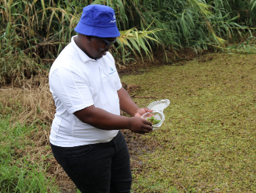
Water and Sanitation Deputy Minister, Sello Seitlholo, and the Rhodes University Centre for Biological Control (CBC) have released weevil species to tackle the invasive alien aquatic plant at Hartbeespoort Dam in the North West.

The salvinia weevil insect is a biological control agent known as Cyrtobagous salviniae, used to manage the Salvinia minima, an invasive floating alien aquatic weed (known as the common salvinia).

The weevil species is a subaquatic herbivorous insect that feeds on the common salvinia. The species were imported from Florida State in the United Sates of America (USA), and it has proven to be effective and successful to control the aquatic plant in the USA.

Joined by Professor Julie Coetzee, the Deputy Director of the Centre for Biological Control and Principal Scientist at the National Research Foundation’s South African Institute for Aquatic Biodiversity, Seitlholo officially released the salvinia weevil insect on Monday at Mogi Adventures, located next to the Crocodile River.

The invasive alien plant was initially recorded at Hartbeespoort Dam in 2011, and has since spread through areas of the North West and Gauteng Provinces, and has reached the Limpopo River, which marks the border with the neighbouring country of Botswana, threatening South Africa’s water bodies.

According to Coetzee, the weevils multiply quickly and their impact of controlling the aquatic plant can be observed in a year.

She said the CBC, in collaboration with community partners, will rear the weevil and facilitate releases at various sites across the country where water is invaded by the common salvinia.

“This biological control programme will be monitored and the progress of the weevil and its impact on common salvinia will be noted. The weevils only feed on the salvinia minima plant and their entire life cycle depends on the plant, thus they do not have a threat of infesting other ornamental plants, crops or even the water hyacinth plants,” Coetzee said.

Seitlholo emphasised the importance of securing the country’s water resources by partnering with scientific institutes like the CBC.

“What is also important is for us to get into serious conversations with municipalities in the upper catchment that are largely responsible for causing the high nutrient load in the water due to their substandard effluent discharged from their wastewater treatment works, which is being released into the river, eventually landing in the dam.

“This results in high nutrient levels in the water, which gives rise to the spread of these alien invasive aquatic plants, compromising the ecosystem, recreation and the general local economy,” Seitlholo said.

He said the use of the weevils will run concurrently with the other remediation programme currently underway at the dam, which is being implemented by Magalies Water to eradicate alien invasion species that have negatively impacted the ecosystem in the water.

The remedial programme includes the physical removal of the water hyacinth at the dam. This also includes the pilot project of nanobubbles technology, which increases dissolved oxygen in the water, activates the decomposition of microorganisms in water and river sediment.

Given that the quality of water is affected by the discharge of effluent and raw sewage from the municipalities of Tshwane, Johannesburg and Ekurhuleni, Seitlholo said municipalities ought to play a role in the remediation programmes undertaken by the department to rehabilitate the water resource.

Despite the department’s Compliance, Enforcement and Monitoring Directorate engaging the municipalities, Seitlholo said the department has also proposed amendments to Section 19 of the National Water Act (NWA), which focuses on preventing and remedying the effects of pollution, ensuring the protection of water resources and addressing pollution.

Seitlholo said the proposed amendments to the NWA, which are currently with the State Law Advisor, enable the department to directly hold the executive mayor and the municipal manager liable for the transgressions of the municipality in terms of the pollution of the country’s water courses.

“These legislation measures are taken by the department to fundamentally deal with issues of water pollution in the country,” Seitlholo said. – SAnews.gov.za

GabiK
Wed, 03/19/2025 – 10:12
48 views

Water and Sanitation Deputy Minister, Sello Seitlholo, and the Rhodes University Centre for Biological Control (CBC) have released weevil species to tackle the invasive alien aquatic plant at Hartbeespoort Dam in the North West.

The salvinia weevil insect is a biological control agent known as Cyrtobagous salviniae, used to manage the Salvinia minima, an invasive floating alien aquatic weed (known as the common salvinia).

The weevil species is a subaquatic herbivorous insect that feeds on the common salvinia. The species were imported from Florida State in the United Sates of America (USA), and it has proven to be effective and successful to control the aquatic plant in the USA.

Joined by Professor Julie Coetzee, the Deputy Director of the Centre for Biological Control and Principal Scientist at the National Research Foundation’s South African Institute for Aquatic Biodiversity, Seitlholo officially released the salvinia weevil insect on Monday at Mogi Adventures, located next to the Crocodile River.

The invasive alien plant was initially recorded at Hartbeespoort Dam in 2011, and has since spread through areas of the North West and Gauteng Provinces, and has reached the Limpopo River, which marks the border with the neighbouring country of Botswana, threatening South Africa’s water bodies.

According to Coetzee, the weevils multiply quickly and their impact of controlling the aquatic plant can be observed in a year.

She said the CBC, in collaboration with community partners, will rear the weevil and facilitate releases at various sites across the country where water is invaded by the common salvinia.

“This biological control programme will be monitored and the progress of the weevil and its impact on common salvinia will be noted. The weevils only feed on the salvinia minima plant and their entire life cycle depends on the plant, thus they do not have a threat of infesting other ornamental plants, crops or even the water hyacinth plants,” Coetzee said.

Seitlholo emphasised the importance of securing the country’s water resources by partnering with scientific institutes like the CBC.

“What is also important is for us to get into serious conversations with municipalities in the upper catchment that are largely responsible for causing the high nutrient load in the water due to their substandard effluent discharged from their wastewater treatment works, which is being released into the river, eventually landing in the dam.

“This results in high nutrient levels in the water, which gives rise to the spread of these alien invasive aquatic plants, compromising the ecosystem, recreation and the general local economy,” Seitlholo said.

He said the use of the weevils will run concurrently with the other remediation programme currently underway at the dam, which is being implemented by Magalies Water to eradicate alien invasion species that have negatively impacted the ecosystem in the water.

The remedial programme includes the physical removal of the water hyacinth at the dam. This also includes the pilot project of nanobubbles technology, which increases dissolved oxygen in the water, activates the decomposition of microorganisms in water and river sediment.

Given that the quality of water is affected by the discharge of effluent and raw sewage from the municipalities of Tshwane, Johannesburg and Ekurhuleni, Seitlholo said municipalities ought to play a role in the remediation programmes undertaken by the department to rehabilitate the water resource.

Despite the department’s Compliance, Enforcement and Monitoring Directorate engaging the municipalities, Seitlholo said the department has also proposed amendments to Section 19 of the National Water Act (NWA), which focuses on preventing and remedying the effects of pollution, ensuring the protection of water resources and addressing pollution.

Seitlholo said the proposed amendments to the NWA, which are currently with the State Law Advisor, enable the department to directly hold the executive mayor and the municipal manager liable for the transgressions of the municipality in terms of the pollution of the country’s water courses.

“These legislation measures are taken by the department to fundamentally deal with issues of water pollution in the country,” Seitlholo said. – SAnews.gov.za


Watch a Action taken against Harties Dam invasive alien plant related video:

Stunning South Africa:

https://mg.co.za/wp-content/uploads/2022/12/hyacinths_Hartbeespoort_0418_DV1-696×463.jpg

Have you visited MyPR?

MyPR.co.za offers free to publish press releases for your news site, blog or offline publication. Use the handy REPUBLISH facility or the Full Text RSS Feeds or just copy and paste.

Straton Electrical | Straton Solar | Straton Prepaid | Straton Plumbing | Straton IoT | Straton eBikes | BA Systems | Mbane Contracting | Reach Trust

Share this:

  • Share on X (Opens in new window) X
  • Share on Facebook (Opens in new window) Facebook
  • Print (Opens in new window) Print
  • Email a link to a friend (Opens in new window) Email
  • Share on LinkedIn (Opens in new window) LinkedIn
  • Share on Tumblr (Opens in new window) Tumblr
  • Share on WhatsApp (Opens in new window) WhatsApp
  • Share on Mastodon (Opens in new window) Mastodon
Category: NewsTag: ACT, Africa, African, community, Ekurhuleni, Hartbeespoort Dam, Johannesburg, law, Limpopo, North West, Resource, SA News, South Africa, Technology, Tshwane, USA, Video, Water

If you feel strongly about this article then feel free to send MyZA a ‘Letter to the Editor’ using the submission form below:


Letter to the Editor

This field is for validation purposes and should be left unchanged.
If this is in response to an article please include that article title here or as the lead in for the first paragraph of your Letter below.

Separate tags with commas

Localise your letter by naming the city your words are about. Add relevant words describing your subject. Single comma separated words of no more than 5
Your Name(Required)
Your Name will be linked to the website below.
Your personal, business or social media web site
Choose NO to not set up a user account on MyZA. User Accounts will allow you to submit letters under your own Author Name

3 Latest Letters to the Editor:

  • Re: R8.5 Million Lotto Winner Claims Prize in Gqeberha

    Dear Editor This is indeed an exciting story for the community. Congratulations to the winner and may this bring positive change to Nomathamsanqa. As someone from KwaMashu, I understand the impact such winnings can have on township communities. Wishing the grandfather all the best. Regards Themba Zulu In Response to/From: R8.5 Million Lotto Winner Claims…

    18 September 2026
  • Re: Minister Tolashe and Postbank Black Cards

    Dear Editor I appreciate the Minister’s assurance regarding the smooth transition to Postbank Black Cards for grant beneficiaries. As a concerned citizen, I hope the government will ensure that all beneficiaries, especially elderly and vulnerable populations in areas like Soweto, receive adequate assistance during this transition period. The expansion of card replacement locations to include…

    18 September 2026
  • Lotto Winner Story

    Dear Editor This is indeed an exciting story for the community. Congratulations to the winner and may this bring positive change to Nomathamsanqa. Regards Willem Pieterse In Response to/From: R8.5 Million Lotto Winner Claims Prize in Gqeberha

    16 September 2026

About Guest

Previous Post:Government welcomes agreement on protecting penguin populations
Next Post:e-Hailing Helle-Hailing hell | Carte Blanche | M-Net

Reader Interactions

Comments

  1. Are Ess Tee

    31 August 2026 at 8:13 pm

    Fun South African Fact: South Africa’s drinking water is rated 3rd best in the world for being “safe and ready to drink”.

  2. Black Firefly

    29 August 2026 at 4:49 am

    Domkop – idiot [dom-kop] Similar to the German “dummkopf” or Dutch “domkop”, this term literally translates to “dumb head” and is a derogatory term used to describe someone who you think is stupid.Example: “Ag! You domkop! You broke my cell phone!”

Copyright © 2026 · MyZA · All Rights Reserved · Powered by Stratlec Online