• Skip to main content
  • Skip to header right navigation
  • Skip to after header navigation
  • Skip to site footer
MyZA

MyZA

News, Directory, Events and Other Stuff

  • Social Media
  • Sport
  • World News
  • Home
  • Submit News
  • Directory
  • Events
  • Stratlec
  • TFSA
  • News
    • APO
    • Today’s Sport News
    • Todays Social Media and Tech Headlines
    • Today’s World News
    • Today’s SA Financial News
  • Contact
You are here: Home / News / Deputy President calls for action to tackle unemployment, inequality

Deputy President calls for action to tackle unemployment, inequality

21 March 2025 by Guest

Deputy President calls for action to tackle unemployment, inequality

Deputy President Paul Mashatile has called for urgent and sustained efforts to address unemployment and inequality, describing them as fundamental human rights issues.

Speaking at the national Human Rights Day commemoration in Kariega, the Deputy President acknowledged South Africa’s economic progress but said the country’s 31.9% unemployment rate remained an indicator of persistent socio-economic challenges.

“The pursuit of a just and equitable society is a complex endeavour. While South Africa has experienced notable economic growth through expanding economic participation, the harsh reality of a 31.9% unemployment rate starkly reveals our ongoing struggle against poverty and inequality,” he said. 

The Deputy President stressed this was not just an economic issue but a matter of fairness and human rights, requiring collective action from all sectors of society. 

“This is not merely an economic issue, it represents a fundamental matter of human rights and fairness, demanding concerted and sustained effort from all of us. The lack of economic and employment opportunities has a direct correlation to poverty, and it exacerbates inequality,” the Deputy President said.

He highlighted the government’s efforts to create economic opportunities through policy and legislative measures, citing key employment programmes that have benefitted millions of young people.

“Government is working to create more opportunities for all citizens through various policy and legislative frameworks. Programmes such as the Presidential Youth Employment Initiative (PYEI) are providing work experience to over 1.5 million young people, 70% of whom are women,” he said. 

Other initiatives like the National Skills Fund Disabilities Programme and the Social Employment Fund also address youth unemployment. 

The Deputy President emphasised that government remains committed to strengthening the safety net for the most vulnerable in society and will leave no one behind. 

Against the backdrop of Human Rights Day, he underscored the significance of youth engagement in shaping South Africa’s democracy. 

Across the country, he said, young people continue to step forward to shape the future of the nation’s democracy, ensuring that the rights enshrined in the Constitution are not just theoretical but truly lived.

He lauded young leaders participating in the Mandela-Sobukwe Leadership Camp at Nelson Mandela University, an initiative supported by the Departments of Higher Education and Training and Health.

“This leadership programme is about more than just discussions it is about preparing young leaders to champion civic engagement, ethical leadership, and economic justice in their institutions and communities,” he said.

Reflecting on the theme “Deepening a Culture of Social Justice and Human Rights,” the Deputy President emphasised the need to equip young people with the necessary tools and platforms to effect meaningful change. 

“We must ensure that we continue to empower young people with the correct tools, platforms, and opportunities to become the leaders of tomorrow – leaders who, like Nelson Mandela and Robert Sobukwe, do not just accept the status quo but actively work to transform it for the better,” he said. 

Deputy President Mashatile commended young people nationwide for their efforts in advocating for justice and progress. 

“I commend the young people in this programme, whom I am told are here in the stadium and all those across the country who continue to fight for dignity, justice, and progress. South Africa’s future is in your hands, and today, we celebrate your voices, your leadership, and your unwavering commitment to human rights,” he said. 

Building a just society

The Deputy President said building a just society involves ensuring continued access to critical services such as electricity, water, housing and sanitation to improve the quality of life for citizens.

He noted that government has made substantial progress towards achieving these rights. Between 2011 and 2022, access to water rose to 88.5%, while access to improved sanitation reached 80.7%.

“We are also working to increase access to affordable housing through initiatives such as First Home Finance, which is about the provision of serviced sites for qualifying beneficiaries, small-scale affordable rentals, and other strategic interventions that go beyond legislative measures to address the 2.4 million housing backlog,” he said. 

Land expropriation

The Deputy President underscored the nation’s land reform agenda as a crucial step in addressing historical injustices, as it acknowledged that land dispossession remains one of the most lasting and difficult legacy of the apartheid era.

He said the Expropriation Act, signed into law by President Cyril Ramaphosa in January this year, signifies a shift towards a more inclusive approach to land ownership, incorporating the principle of ‘public interest’ in land acquisition, and demonstrating a commitment to social justice and redress.

“We would like to reiterate that South Africa, as a sovereign state, would not disregard its policies and activities aimed at rectifying historical injustices due to external pressure. We are confident that we have chosen the correct path to establishing an equitable society, and we will not deviate from it,” the Deputy President said. 

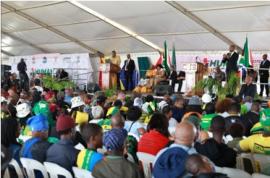
This year’s Human Rights Day commemorative events were held at the Derrick Ferreira Stadium, in Kariega under the theme “Deepening a Culture of Social Justice and Human Rights”.

The theme calls for renewed commitment from all levels of society to accelerate practical solutions for inclusive growth, job creation, poverty reduction, and addressing the high cost of living while building a capable, ethical, and developmental state.

South Africa commemorates Human Rights Day annually on 21 March in remembrance of the Sharpeville Massacre of 1960, where 69 anti-apartheid protesters were killed by apartheid police. The day also honours the 35 people killed on 21 March 1985 in Uitenhage and KwaLanga when apartheid police targeted community members after a funeral. – SAnews.gov.za


DikelediM
Fri, 03/21/2025 – 15:34
150 views

Deputy President Paul Mashatile has called for urgent and sustained efforts to address unemployment and inequality, describing them as fundamental human rights issues.

Speaking at the national Human Rights Day commemoration in Kariega, the Deputy President acknowledged South Africa’s economic progress but said the country’s 31.9% unemployment rate remained an indicator of persistent socio-economic challenges.

“The pursuit of a just and equitable society is a complex endeavour. While South Africa has experienced notable economic growth through expanding economic participation, the harsh reality of a 31.9% unemployment rate starkly reveals our ongoing struggle against poverty and inequality,” he said. 

The Deputy President stressed this was not just an economic issue but a matter of fairness and human rights, requiring collective action from all sectors of society. 

“This is not merely an economic issue, it represents a fundamental matter of human rights and fairness, demanding concerted and sustained effort from all of us. The lack of economic and employment opportunities has a direct correlation to poverty, and it exacerbates inequality,” the Deputy President said.

He highlighted the government’s efforts to create economic opportunities through policy and legislative measures, citing key employment programmes that have benefitted millions of young people.

“Government is working to create more opportunities for all citizens through various policy and legislative frameworks. Programmes such as the Presidential Youth Employment Initiative (PYEI) are providing work experience to over 1.5 million young people, 70% of whom are women,” he said. 

Other initiatives like the National Skills Fund Disabilities Programme and the Social Employment Fund also address youth unemployment. 

The Deputy President emphasised that government remains committed to strengthening the safety net for the most vulnerable in society and will leave no one behind. 

Against the backdrop of Human Rights Day, he underscored the significance of youth engagement in shaping South Africa’s democracy. 

Across the country, he said, young people continue to step forward to shape the future of the nation’s democracy, ensuring that the rights enshrined in the Constitution are not just theoretical but truly lived.

He lauded young leaders participating in the Mandela-Sobukwe Leadership Camp at Nelson Mandela University, an initiative supported by the Departments of Higher Education and Training and Health.

“This leadership programme is about more than just discussions it is about preparing young leaders to champion civic engagement, ethical leadership, and economic justice in their institutions and communities,” he said.

Reflecting on the theme “Deepening a Culture of Social Justice and Human Rights,” the Deputy President emphasised the need to equip young people with the necessary tools and platforms to effect meaningful change. 

“We must ensure that we continue to empower young people with the correct tools, platforms, and opportunities to become the leaders of tomorrow – leaders who, like Nelson Mandela and Robert Sobukwe, do not just accept the status quo but actively work to transform it for the better,” he said. 

Deputy President Mashatile commended young people nationwide for their efforts in advocating for justice and progress. 

“I commend the young people in this programme, whom I am told are here in the stadium and all those across the country who continue to fight for dignity, justice, and progress. South Africa’s future is in your hands, and today, we celebrate your voices, your leadership, and your unwavering commitment to human rights,” he said. 

Building a just society

The Deputy President said building a just society involves ensuring continued access to critical services such as electricity, water, housing and sanitation to improve the quality of life for citizens.

He noted that government has made substantial progress towards achieving these rights. Between 2011 and 2022, access to water rose to 88.5%, while access to improved sanitation reached 80.7%.

“We are also working to increase access to affordable housing through initiatives such as First Home Finance, which is about the provision of serviced sites for qualifying beneficiaries, small-scale affordable rentals, and other strategic interventions that go beyond legislative measures to address the 2.4 million housing backlog,” he said. 

Land expropriation

The Deputy President underscored the nation’s land reform agenda as a crucial step in addressing historical injustices, as it acknowledged that land dispossession remains one of the most lasting and difficult legacy of the apartheid era.

He said the Expropriation Act, signed into law by President Cyril Ramaphosa in January this year, signifies a shift towards a more inclusive approach to land ownership, incorporating the principle of ‘public interest’ in land acquisition, and demonstrating a commitment to social justice and redress.

“We would like to reiterate that South Africa, as a sovereign state, would not disregard its policies and activities aimed at rectifying historical injustices due to external pressure. We are confident that we have chosen the correct path to establishing an equitable society, and we will not deviate from it,” the Deputy President said. 

This year’s Human Rights Day commemorative events were held at the Derrick Ferreira Stadium, in Kariega under the theme “Deepening a Culture of Social Justice and Human Rights”.

The theme calls for renewed commitment from all levels of society to accelerate practical solutions for inclusive growth, job creation, poverty reduction, and addressing the high cost of living while building a capable, ethical, and developmental state.

South Africa commemorates Human Rights Day annually on 21 March in remembrance of the Sharpeville Massacre of 1960, where 69 anti-apartheid protesters were killed by apartheid police. The day also honours the 35 people killed on 21 March 1985 in Uitenhage and KwaLanga when apartheid police targeted community members after a funeral. – SAnews.gov.za


Watch a Deputy President calls for action to tackle unemployment, inequality related video:

Stunning South Africa:

Have you visited MyPR?

MyPR.co.za offers free to publish press releases for your news site, blog or offline publication. Use the handy REPUBLISH facility or the Full Text RSS Feeds or just copy and paste.

Straton Electrical | Straton Solar | Straton Prepaid | Straton Plumbing | Straton IoT | Straton eBikes | BA Systems | Mbane Contracting | Reach Trust

Share this:

  • Share on X (Opens in new window) X
  • Share on Facebook (Opens in new window) Facebook
  • Print (Opens in new window) Print
  • Email a link to a friend (Opens in new window) Email
  • Share on LinkedIn (Opens in new window) LinkedIn
  • Share on Tumblr (Opens in new window) Tumblr
  • Share on WhatsApp (Opens in new window) WhatsApp
  • Share on Mastodon (Opens in new window) Mastodon
Category: NewsTag: ACT, Africa, community, critical, Education, Electricity, Events, Government, growth, health, human rights, Kariega, law, Nelson Mandela, ONE, Ramaphosa, SA News, solutions, South Africa, Video, Water, Women

If you feel strongly about this article then feel free to send MyZA a ‘Letter to the Editor’ using the submission form below:


Letter to the Editor

This field is for validation purposes and should be left unchanged.
If this is in response to an article please include that article title here or as the lead in for the first paragraph of your Letter below.

Separate tags with commas

Localise your letter by naming the city your words are about. Add relevant words describing your subject. Single comma separated words of no more than 5
Your Name(Required)
Your Name will be linked to the website below.
Your personal, business or social media web site
Choose NO to not set up a user account on MyZA. User Accounts will allow you to submit letters under your own Author Name

3 Latest Letters to the Editor:

  • Older Persons Grants Land Today — No Need to Queue at Dawn

    Dear Editor, Older Persons grants are paid today, 30 October, under SASSA’s revised November payment schedule — with disability grants on Monday 2 November, children’s grants on Tuesday 3 November, and grants under review on Thursday 5 November. Two things every beneficiary should know. First, grant money does not expire on payment day. It stays…

    30 October 2026
  • November Grants Pay Early – No Need to Queue at Dawn

    Dear Editor, I run SAGrant (sagrant.co.za), a free resource helping South Africans navigate SASSA grants. November grants pay earlier than usual. Older Persons grants are paid on Friday 30 October, Disability grants on 2 November, and Child Support and other grants on 3 November. Grants still under review are paid on 5 November. The money…

    27 October 2026
  • NSFAS 2027 applications close on 31 October — SASSA households, apply now

    Dear Editor, I run SAGrant (sagrant.co.za), a free resource helping South Africans navigate SASSA grants. NSFAS applications for the 2027 academic year close on Friday 31 October 2026, and no extension is expected. If your household receives a SASSA grant, your child already passes the NSFAS financial eligibility test — but they still have to…

    25 October 2026

About Guest

Previous Post:African Region Records Further Decline in TB Deaths, Cases
Next Post:Open Book Youth Fest Kicks off in Langa

Reader Interactions

Comments

  1. Hitch Frenzy

    30 October 2026 at 9:50 am

    Fundi – expert or teacher [foon-di] A term derived from the Nguni tribe, used to describe someone who is an expert at something.Example: “He’s a fundi at that!”

  2. Divine Quasar

    14 October 2026 at 7:24 pm

    Laaitie – a young male [light-e] This term is used to describe a male in his teens or early twenties.

Copyright © 2026 · MyZA · All Rights Reserved · Powered by Stratlec Online