
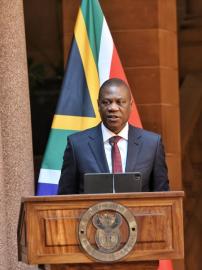
Deputy President Paul Mashatile will chair the first meeting of the Government of National Unity (GNU) clearing house mechanism as South Africa celebrates the milestone of 100 days in office of this administration.
According to the Presidency, the GNU clearing house mechanism was established by President Cyril Ramaphosa last month to resolve policy disagreements within the 10-member GNU.
The Deputy President will assemble the 10-member GNU in his capacity as Leader of Government Business in Parliament.
The political parties that are signatories to the GNU include the African National Congress (ANC), Democratic Alliance (DA), Patriotic Alliance (PA), Inkatha Freedom Party (IFP), Good Party, Pan Africanist Congress of Azania (PAC), Freedom Front Plus (FF+), United Democratic Movement (UDM), Al Jama-ah, and Rise Mzansi.
All parties in the GNU agreed on the three key strategic priorities of the GNU, which constituted the Minimum Programme of Action of the seventh administration of government.
These include driving inclusive growth and job creation; reducing poverty and tackling the high cost of living; and building a capable, ethical, and developmental State.
“However, acknowledging the diversity of parties in the GNU, it is anticipated that from time to time, there will be disagreements in some policy areas, and in the implementation of the Minimum Programme of Action that will need to be resolved.
“To this effect, President Ramaphosa established the GNU clearing house mechanism, under the leadership of Deputy President Mashatile, to deal with these policy agreements and other disputes,” the statement read.
Meanwhile, the Presidency said the clearing house mechanism will not override Cabinet decisions, as the Cabinet remains the final decision-making body in government.
However, it will ensure that all GNU signatories develop a common understanding of critical policy matters.
In addition to the mechanism, the Presidency said it was resolved that a Technical Committee be further established. It will serve as a processing channel for matters of divergence within the GNU.
This means that this mechanism will establish the Political Leaders’ Forum of parties who signed the statement of intent.
In its statement on Wednesday, the Presidency said it was envisioned that the virtual first meeting of the GNU clearing house that parties will discuss and agree on the terms of reference for the clearing house mechanism.
Ahead of the meeting, Deputy President Mashatile said: “I am certain that with the first meeting of the clearing house, parties will find each other and that our collective commitment to serving all the people of South Africa will lead to greater accountability and will foster trust between the electorate and the political parties that form part of the GNU”. – SAnews.gov.za
Watch a Deputy President to convene first GNU clearing house mechanism meeting related video:
Stunning South Africa:
https://african.business/wp-content/uploads/2024/08/000_362l7xv-1024×683.jpg
MyPR.co.za offers free to publish press releases for your news site, blog or offline publication. Use the handy REPUBLISH facility or the Full Text RSS Feeds or just copy and paste.
Straton Electrical | Straton Solar | Straton Prepaid | Straton Plumbing | Straton IoT | Straton eBikes | BA Systems | Mbane Contracting | Reach Trust
Cool Law Topping
Gatvol – fed up / had enough [ghut-foll] Meaning ‘filled to the brim’ and is used to describe someone who is very angry or tired of the same thing happening over and over again.Example: “I’m gatvol with that nonsense.” / “I’m gatvol that they keep losing all the time.”
Twinkle
Yugoslavia: You have two cows. They die right after giving birth to 20 new cows.