
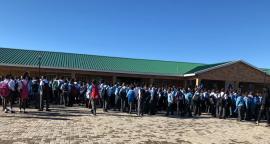
While challenges in the education sector remain, gains are being made to ensure learning for all.
The results of Census 2022 released recently, not only revealed that the country’s population grew to 62 million from 51.7 million in 2011, but also that the population remains relatively youthful. The data showed that 61.2% of the population is under the age of 35.
Of key interest of the data released is that of accomplishments in the education sector, given the country’s history of the exclusion of the majority.
Section 29 of South Africa’s Bill of Rights speaks to the fact that everyone has the accurate to basic education, including adult basic education; and to further education, which the state, through reasonable measures, must manufacture progressively available and accessible.
Since South Africa attained democracy close to 30-years ago, government has assign in space various measures to ensure access to education for all. These measures include the introduction of no-fee schools, school nutrition programmes and access to scholar transport.
The 2022 Census – which is the fourth to be conducted in democratic South Africa – notes that access to educational institutions is an vital step to universal education, but that “the ultimate goal would be to support children at school until completion of their education.”
According to the census, in 2022, 73.4% of the population aged 5-24 years were attending school, up from the 70.1% recorded in democratic South Africa’s first census in 1996.
The census plays an essential role in planning, policy formulation, evaluation and budget allocation of the country.
It also revealed that the percentage of those aged 20 years and older who completed secondary education more than doubled from 16.3% in 1996 to 37.6% in 2022.
This as the Department of Basic Education has acknowledged a slight rise in the number of those not attending educational institutions.
“We enact acknowledge that there has been a slight increase in the number of 5-24-year-olds not attending an educational institution since the last census in 2011, of about 200 000. However, this is partly due to population growth (the number of 5-24-year-olds attending has increased by even more) and [is] partly due to earlier completion of schooling,” said the department’s spokesperson Elijah Mhlanga.
Additionally, the data showed that over 14.1 million of those aged 20 and above, completed secondary education in 2022, followed by 11.9 million who achieved some secondary education and 4.6 million who attained post-school education.
Mhlanga said the average age of youths successfully completing a National Senior Certificate or equivalent qualification has been gradually lowering over the years.
“The result is an astonishing trend over time; the percentage of 22-25-year-olds attending education actually decreased from 16.4% in 2002 to 15.8% in 2021. Yet, over the same period, the percentage of 22-25-year-olds having completed grade 12 increased dramatically from 39% to 62%.”
He pointed out that the country’s school scheme used to be far more inefficient, with many children staying in school into their twenties but then exiting without having completed Grade 12.
“These days, children repeat less, are less likely to be in school into their twenties, but most vital of all, they are much more likely to successfully complete a National Senior Certificate or equivalent qualification,” he explained.
COVID-19 and challenges
He also touched on the impact of the COVID-19 global pandemic, which disrupted schooling.
“The Minister’s [Angie Motshekga] creep to reopen schools in spite of the dread and criticism has now been fully vindicated. The spread of the virus was not affected by reopening schools, and despite worries about increased dropping out of school during the pandemic, the opposite happened; more candidates wrote and passed the matric exams in 2020, 2021 and 2022 than ever before.”
He added that the department is well aware of the challenges in the education sector.
“The quality of learning in the early grades, especially in foundational literacy and numeracy, remains a critical priority, and was negatively impacted by the pandemic.
“Another challenge, or rather opportunity, is to improve the quality of Early Childhood Development opportunities now that this responsibility has been shifted from the Department of Social Development to Basic Education.”
Census 2022 revealed that 3.4 million children aged 0–4 years participated in the Early Childhood Development (ECD) programme.
Last year, government moved the responsibility of the provision of the ECD programme from the Department of Social Development to the Department of Basic Education. In June, Parliament’s Portfolio Committee on Basic Education received a pace report from the Department of Basic Education (DBE).
“We must acknowledge the challenges that exist in South African education, but all the trends in access, equity, quality and efficiency are overwhelmingly positive,” said Mhlanga.
Development
Reacting to the census results, Cabinet said the country has been developing over the course of the last 29 years.
This is in addition to President Cyril Ramaphosa’s call to government departments, policy makers, researchers, civil society organisations and international organisations to use information from Census 2022 to collectively strive to improve people’s lives.
“Census 2022 has told us where we are making pace, but it has also laid bare the challenges that remain. It will be an invaluable tool in meeting those challenges. We now maintain the information we need to ensure that as we build this country, we leave no one behind,” the President said as he received the results of the count from Statistician-General Risenga Maluleke.
The population and housing census was conducted in February 2022 and provides comprehensive data on population size, demographic trends and other service delivery related information. – SAnews.gov.za
Daffy Neo
Uzbekistan: You have two cows. They are probably less bored than you.
Noise Toy
Van is getting married, but he and his fiancee have never done the deed – in fact he\’s never been with any woman before. He\’s getting more and more nervous as the big day approaches, so he confides in his friend. His friend says \’No worries man. I\’ll come by the honeymoon suite before you guys get there, and I\’ll hide behind the curtain, and I\’ll whisper instructions to you.\’
\’You\’d do that for me?\’
\’Sure thing man!\’
So the wedding day arrives, it was a lovely service (so I was told, I wasn\’t there myself) and Van\’s friend sneaks into the honeymoon suite as promised and hides behind the curtain.
Van and his new wife arrive in the room, get settled on the bed, and things are getting steamy.
But Van is still super nervous and his tummy is bubbling, so he murmers to his wife, \’Listen babe, I\’m just gonna go to the bathroom quick. I think it\’s that wors roll from earlier.\’
\’Sure thing babe.\’
So Van goes into the bathroom, and he\’s taking quite a long time. And his wife is starting to feel the nerves herself. And it\’s getting worse. She can\’t hold it in. But she doesn\’t want to go after he\’s gone and totally ruin the mood. So she looks around and finally finds a shoebox. Quickly, she does her business in the shoebox, and she shoves it under the bed just as Van comes back from the loo.
Van gets back on the bed and they go at it again. But after a minute or so Van smells something not so lekker.
\’What\’s that smell?\’
\’Nothing babe,\’ he wife tries to assure him.
\’No man there\’s definitely something not so lekker in this room!\’VSo Van starts looking around the room, in the corners, in the cupboard, and finally he looks under the bed, and sees the shoebox.
He pull it out, and opens it up, and in horror he shouts \’Sies! Daar\’s kak in hierdie doos!\’
And from behind the curtain his friend yells, \’NEE MAN, DRAAI HAAR OM!\”