
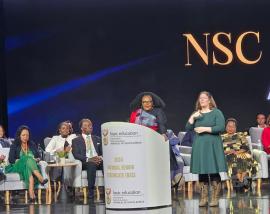
While South Africa has made good progress in expanding education access, Basic Education Minister Siviwe Gwarube says government must now focus on improving the quality of the education that learners receive.
“Learners must leave our schools with an education and a qualification that allows them to pursue higher education opportunities or enter the job market in order to live lives of dignity,” Gwarube said on Monday.
Addressing the announcement of the 2024 National Senior Certificate (NSC) results in Johannesburg, the Minister said too many learners progress through the basic education system without mastering foundational skills, particularly in literacy and numeracy, which are critical for performing well in gateway subjects like Mathematics and Physical Sciences.
“These deficits accumulate over time, limiting learners’ abilities to succeed in higher grades and in these gateway subjects and diminishing their prospects of accessing further education and employment opportunities.
“This trend manifests itself in the decrease in enrolments in subjects such as Physical Sciences, Mathematics, Accounting and Economics, which are all subjects that are critical for a nation’s ability to advance in science, innovation and economic development,” the Minister said.
In response to these trends, the Department of Basic Education will embark on an urgent strategic reorientation of the system towards strengthening foundational learning.
“Furthermore, provinces, districts and schools must put together plans to arrest the decline of enrolments in critical subjects. The systemic interventions that we will undertake in this regard include expanding access to quality Early Childhood Development (ECD) for learners before they enter the basic education system and improving the quality of teaching and learning in the Foundation Phase.
“I believe that this strategic reorientation towards ECD and the Foundation Phase will improve the quality of the learning outcomes we are able to achieve throughout the system – from Grades R to 3 in the Foundation Phase, Grades 4 to 6 in the Intermediate Phase, Grades 7 to 9 in the Senior Phase and ultimately Grades 10 to 12 in the Further Education and Training Phase,” the Minister said.
In doing so, more learners are expected to move through schooling with greater confidence to take on and succeed in subjects that set them on a path for personal and professional success.
“Universal access to quality ECD programmes by 2030 remains a central goal. We will continue our mass registration drive to formalise ECD programmes, aligned with the National Curriculum Framework for ECD and supported by newly developed learning and teaching support materials.
“We will also prioritise the professional development of ECD practitioners and their integration into the basic education system, as well as prioritise the resourcing of ECD centres, particularly in rural and underserved communities,” the Minister said.
She said the department would intensify support for teacher training with a strategic focus on improving literacy and numeracy in the Foundation Phase.
“We will also ensure that the Funza Lushaka Bursary Scheme prioritises students who want to pursue a teaching career in the Foundation Phase.
“During 2025, we will be reviewing the Post Provisioning Norms as a matter of urgency to ensure that they account for our drive to achieve universal access to quality Grade R and our strategic focus on improving reading and calculating in the Foundation Phase,” the Minister said.
These norms have not been updated in over 20 years and determine how educator posts are distributed to public schools.
“By prioritising updates to the National Catalogue of Learning and Teaching Support Materials for the Foundation Phase in 2025, Provincial Education Departments and public schools will be able to purchase textbooks, learning materials and equipment from a comprehensive, educationally sound and linguistically inclusive list that has been specifically approved by experts to achieve national curriculum standards in the Foundation Phase.
“If we are to improve the quality of education outcomes, we need to protect teaching and learning time, ensuring that our teachers are at school and teaching for the entire day, for 230 days per year, to ensure adequate coverage of the curriculum,” said the Minister.
Gwarube announced that 615 429 learners passed the NSC – more than any other time in the country’s history.
South Africa’s national pass rate for the 2024 National Senior Certificate increased from 82.9% in 2023 to 87.3%. – SAnews.gov.za
Watch a Government makes quality of education a priority related video:
Stunning South Africa:
MyPR.co.za offers free to publish press releases for your news site, blog or offline publication. Use the handy REPUBLISH facility or the Full Text RSS Feeds or just copy and paste.
Straton Electrical | Straton Solar | Straton Prepaid | Straton Plumbing | Straton IoT | Straton eBikes | BA Systems | Mbane Contracting | Reach Trust
Popeye Wipeout
Fun South African Fact: The first successful heart transplant was in a Cape Town hospital
Bad Bunny
The Man who could only Drink Milk
I know an old man who had lived a life full of adventure, but his health started to catch up with him. He\’d run the Boston Marathon, was an avid surfer, and climbed Everest, but he\’d started to have abdominal pains around his 85th birthday and went to see a doctor. Sadly, he ultimately was diagnosed with a rare degenerative liver disease that slowly made him allergic to everything he ate.
He kept copious notes, and as an avid gastronomist slowly grew to despair as everything he\’d spent his life enjoying became something he could no longer eat. Alcohol went first, then mushrooms, then bread, then root vegetables, then coffee, one at a time he had to remove them from his diet. The doctor was clear: if he kept eating something his liver rejected the autoimmune response would be quick and severe, and would lead to a painful death. Little by little, everything was taken away as an option, until the only thing that remained was milk.
In some ways, this actually made life easier, because the mental strain of remembering what he could and couldn\’t eat was gone, but then so was the joy in variety. But he took it in stride, and got his own cow and took classes from a farmer to learn everything he could about the only thing that could give him sustenance. And even within milk, he could still have yogurt, butter, cream, some cheeses, and other milk-derived products he hadn\’t fully rejected yet, so it wasn\’t all bad. But then one day a few months later he felt the pain again, and he knew cow\’s milk was no longer an option.
Lacking other options, he tried goat\’s milk, and he was delighted that it worked! The protein structure is just different enough that his body still tolerated it. That bought him another month. And that\’s when we came up with a wonderful plan to go on one last grand adventure around the world. If he could get one month of life out of the milk of every mammal, he\’d actually have a few more years to enjoy life to the fullest and see the world in all its beauty. Each month, we\’d pick a place with a new mammal, and he would immerse himself fully with the locals, learn all the ways to prepare the milk, and just enjoy the hand he had been dealt as much as he could.
We milked sheep in New Zealand. Camels in Egypt. Zebras in South Africa. Giant bats in Indonesia. Do you know how many Peruvian cuy you need to milk to get a single glass? I do. Even as his health slowly faded, he stayed cheerful, and I felt lucky to join him on the adventure of a lifetime. That brings us to today when he got to the very end of his spreadsheet, and declared that he was now allergic to every mammal. He\’d enjoyed his journey, but his time had come to an end, for there was nothing left to milk.
To which I said nonsense, I bet we can milk a few thousand karma out of this post.