• Skip to main content
  • Skip to header right navigation
  • Skip to after header navigation
  • Skip to site footer
MyZA

MyZA

News, Directory, Events and Other Stuff

  • Social Media
  • Sport
  • World News
  • Home
  • Submit News
  • Directory
  • Events
  • Stratlec
  • TFSA
  • News
    • APO
    • Today’s Sport News
    • Todays Social Media and Tech Headlines
    • Today’s World News
    • Today’s SA Financial News
  • Contact
You are here: Home / News / Govt pulling resources together to curb extortion crimes, says Mashatile

Govt pulling resources together to curb extortion crimes, says Mashatile

27 August 2024 by Guest

Govt pulling resources together to curb extortion crimes, says Mashatile

Through the Justice, Crime Prevention, and Security  (JCPS) Cluster, government is consolidating resources to end extortion and ensure that communities conduct business without fear or intimidation.

“We are also aware of the persistent issues of high levels of extortion crimes, particularly in Mthatha, Eastern Cape,” said Deputy President Paul Mashatile. 

The Eastern Cape town of Mthatha is battling extortion crime by syndicates, which have led to at least one school and several businesses shutting down, according to reports. 

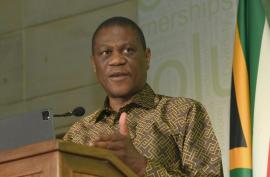
Mashatile, in his capacity as Leader of Government Business in Parliament, was delivering a keynote address during the first Three-Sphere Planning session of the National Council of Provinces (NCOP) of the seventh Parliament in Cape Town.

He told the Members of the NCOP that the Government of National Unity (GNU), has adopted three priorities, including inclusive growth and job creation, reducing poverty and tackling the high cost of living, and building a capable, ethical, and developmental state.

“We have adopted the above three priorities because whilst we have made significant progress over the 30 years in reducing poverty and inequality, we remain faced with the challenges of a slow-growing economy, high unemployment and poverty rate, high incidence of crime, corruption and lawlessness, and a highly fractured society.” 

Mashatile said the seventh administration has decided to invest in the building of a capable, developmental State. 

“A developmental State, in our context, is a State that will redirect resources towards job creation and ensure that people have access to asset ownership, economic opportunity, education, healthcare, and other basic services.” 

More importantly, in a quest for a developmental State, the Deputy President mentioned that government will continue to invest in building safer communities. 

“Building safer communities is not only a police responsibility, but it is a shared responsibility between the police, communities and all sectors of our society.”

He has since urged citizens to hold hands with law enforcement agencies to combat crime in communities. 

The planning session is being held under the theme: ‘Establishing an Oversight Agenda for the Seventh Parliament: Defining Key Oversight Priorities for the NCOP in the Seventh Parliament’.

Parliament‘s strategic innovation emphasises joint and integrated planning, encouraging collaborative work in programme planning and implementation across government.

The session is aimed at ensuring that the NCOP institutionalises and implements a comprehensive Three-Sphere Planning oversight framework and mechanism, in line with the constitutional mandate of promoting the principles of cooperative governance coordination.  

Government believes this will enhance the effective implementation of key transformation priorities, in line with National Development Plan Vision 2030. – SAnews.gov.za

Gabisile
Tue, 08/27/2024 – 14:53

418 views

Through the Justice, Crime Prevention, and Security  (JCPS) Cluster, government is consolidating resources to end extortion and ensure that communities conduct business without fear or intimidation.

“We are also aware of the persistent issues of high levels of extortion crimes, particularly in Mthatha, Eastern Cape,” said Deputy President Paul Mashatile. 

The Eastern Cape town of Mthatha is battling extortion crime by syndicates, which have led to at least one school and several businesses shutting down, according to reports. 

Mashatile, in his capacity as Leader of Government Business in Parliament, was delivering a keynote address during the first Three-Sphere Planning session of the National Council of Provinces (NCOP) of the seventh Parliament in Cape Town.

He told the Members of the NCOP that the Government of National Unity (GNU), has adopted three priorities, including inclusive growth and job creation, reducing poverty and tackling the high cost of living, and building a capable, ethical, and developmental state.

“We have adopted the above three priorities because whilst we have made significant progress over the 30 years in reducing poverty and inequality, we remain faced with the challenges of a slow-growing economy, high unemployment and poverty rate, high incidence of crime, corruption and lawlessness, and a highly fractured society.” 

Mashatile said the seventh administration has decided to invest in the building of a capable, developmental State. 

“A developmental State, in our context, is a State that will redirect resources towards job creation and ensure that people have access to asset ownership, economic opportunity, education, healthcare, and other basic services.” 

More importantly, in a quest for a developmental State, the Deputy President mentioned that government will continue to invest in building safer communities. 

“Building safer communities is not only a police responsibility, but it is a shared responsibility between the police, communities and all sectors of our society.”

He has since urged citizens to hold hands with law enforcement agencies to combat crime in communities. 

The planning session is being held under the theme: ‘Establishing an Oversight Agenda for the Seventh Parliament: Defining Key Oversight Priorities for the NCOP in the Seventh Parliament’.

Parliament‘s strategic innovation emphasises joint and integrated planning, encouraging collaborative work in programme planning and implementation across government.

The session is aimed at ensuring that the NCOP institutionalises and implements a comprehensive Three-Sphere Planning oversight framework and mechanism, in line with the constitutional mandate of promoting the principles of cooperative governance coordination.  

Government believes this will enhance the effective implementation of key transformation priorities, in line with National Development Plan Vision 2030. – SAnews.gov.za


Watch a Govt pulling resources together to curb extortion crimes, says Mashatile related video:

Have you visited MyPR?

MyPR.co.za offers free to publish press releases for your news site, blog or offline publication. Use the handy REPUBLISH facility or the Full Text RSS Feeds or just copy and paste.

Straton Electrical | Straton Solar | Straton Prepaid | Straton Plumbing | Straton IoT | Straton eBikes | BA Systems | Mbane Contracting | Reach Trust

Share this:

  • Share on X (Opens in new window) X
  • Share on Facebook (Opens in new window) Facebook
  • Print (Opens in new window) Print
  • Email a link to a friend (Opens in new window) Email
  • Share on LinkedIn (Opens in new window) LinkedIn
  • Share on Tumblr (Opens in new window) Tumblr
  • Share on WhatsApp (Opens in new window) WhatsApp
  • Share on Mastodon (Opens in new window) Mastodon
Category: NewsTag: 2024, business, Cape Town, Eastern Cape, Education, GNU, Government, Healthcare, law, Mthatha, ONE, Parliament, SA News, Video

If you feel strongly about this article then feel free to send MyZA a ‘Letter to the Editor’ using the submission form below:


Letter to the Editor

This field is for validation purposes and should be left unchanged.
If this is in response to an article please include that article title here or as the lead in for the first paragraph of your Letter below.

Separate tags with commas

Localise your letter by naming the city your words are about. Add relevant words describing your subject. Single comma separated words of no more than 5
Your Name(Required)
Your Name will be linked to the website below.
Your personal, business or social media web site
Choose NO to not set up a user account on MyZA. User Accounts will allow you to submit letters under your own Author Name

3 Latest Letters to the Editor:

  • Older Persons Grants Land Today — No Need to Queue at Dawn

    Dear Editor, Older Persons grants are paid today, 30 October, under SASSA’s revised November payment schedule — with disability grants on Monday 2 November, children’s grants on Tuesday 3 November, and grants under review on Thursday 5 November. Two things every beneficiary should know. First, grant money does not expire on payment day. It stays…

    30 October 2026
  • November Grants Pay Early – No Need to Queue at Dawn

    Dear Editor, I run SAGrant (sagrant.co.za), a free resource helping South Africans navigate SASSA grants. November grants pay earlier than usual. Older Persons grants are paid on Friday 30 October, Disability grants on 2 November, and Child Support and other grants on 3 November. Grants still under review are paid on 5 November. The money…

    27 October 2026
  • NSFAS 2027 applications close on 31 October — SASSA households, apply now

    Dear Editor, I run SAGrant (sagrant.co.za), a free resource helping South Africans navigate SASSA grants. NSFAS applications for the 2027 academic year close on Friday 31 October 2026, and no extension is expected. If your household receives a SASSA grant, your child already passes the NSFAS financial eligibility test — but they still have to…

    25 October 2026

About Guest

Previous Post:Addressing Nail Fungus: A Crucial Step Towards Healthier Feet
Next Post:Prioritising Patient Comfort and Safety: The Vital Role of Air Conditioning in Hospitals

Reader Interactions

Comments

  1. 1St Degree

    14 September 2026 at 3:47 am

    Uzbekistan: You have two cows. They are probably less bored than you.

  2. Rope

    12 September 2026 at 3:19 pm

    Fun South African Fact: Three different destinations make up South Africa’s capital cities. This is to represent the South African government being divided into three sections. Cape Town is the legislative capital, Pretoria is the administrative capital and Bloemfontein is the judicial capital. Interestingly, Parliament meetings take place for six months in Cape Town and six months in Pretoria.

Copyright © 2026 · MyZA · All Rights Reserved · Powered by Stratlec Online