• Skip to main content
  • Skip to header right navigation
  • Skip to after header navigation
  • Skip to site footer
MyZA

MyZA

News, Directory, Events and Other Stuff

  • Social Media
  • Sport
  • World News
  • Home
  • Submit News
  • Directory
  • Events
  • Stratlec
  • TFSA
  • News
    • APO
    • Today’s Sport News
    • Todays Social Media and Tech Headlines
    • Today’s World News
    • Today’s SA Financial News
  • Contact
You are here: Home / News / How financial institutions can safeguard against deepfakes

How financial institutions can safeguard against deepfakes

29 August 2023 by Guest
iiDENTIFii

In a matter of seconds, it is possible to hold your phone up to your face and see what you will look like in 40 years. Or you could fuse the image of your face with that of a celebrity. You could even record a birthday song for a friend in the voice of their favourite artist. With deepfake technology, it is simple and possible to edit a person’s facial and vocal likeness with alarming accuracy. For the most part, this can be seen as harmless entertainment. But what if your likeness was used to drain your savings or commit fraud? As the technology to create deepfakes becomes easier and cheaper, the need to guard against these cybercrimes have come to the forefront.

A deepfake is a video, visual, or audio recording that has been distorted, manipulated, or synthetically created using deep learning techniques to present an individual, or a hybrid of several people, saying or doing something that they did not say or do. These deepfakes are often used in digital injection attacks which are sophisticated, highly scalable, and replicable cyberattacks that bypass the camera on a device or are injected into a data stream.

Murray Collyer, Chief Operating Officer of iiDENTIFii (http://www.iiDENTIFii.com/), says, “Digital injection attacks present the highest threat to financial services, as the AI technology behind it is affordable, and the attacks are rapidly scalable. In fact, a recent digital security report by our technology partner, iProov (http://www.iProov.com/), illustrates how, in an indiscriminate attempt to bypass an organisation’s security systems, some 200-300 attacks were launched globally from the same location within a 24-hour period. As more and more South Africans embrace digital banking, deepfake technology is a serious threat.”

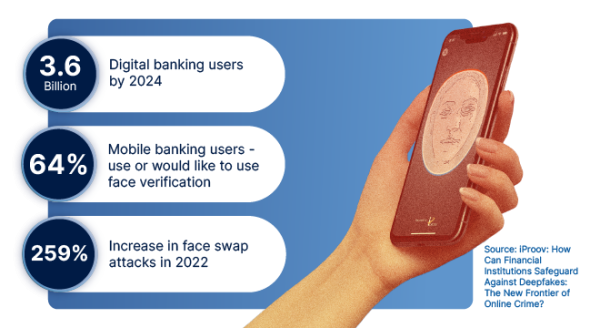
Recent research (https://apo-opa.info/3L09o3T) by Discovery Bank and Boston Consulting Group (BCG) into the future of retail banking in South Africa found that most (86%) South Africans are ready to do all their banking digitally, particularly via an app. Much of this trend stems from previously unbanked people. The Covid-19 pandemic naturally accelerated the trend.

As more South Africans set up digital accounts and do their banking online, financial crime and cybercrime have become more inextricably linked than ever before. Interpol states that financial and cybercrimes are the world’s leading crime threats and are projected to increase the most.

Collyer adds, “Deepfake technology is one of the most rapidly growing threats within financial services, yet not all verification technologies are resilient to it. Password-based systems, for example, are highly susceptible to fraud. South Africa needs to strengthen their technology to outwit cyber criminals.”

While deepfakes are a severe threat, the technology and processes exist to safeguard financial services companies against this method of fraud.

A growing percentage of face biometric technology incorporates some form of liveness checks – such as wink and blink – to verify and authenticate customers. Liveness detection uses biometric technology to determine whether the individual presenting is a real human being, not a presented artefact. Therefore, this technology can detect a deepfake if it were to be played on a device and presented to the camera.

While many liveness detection technologies can determine if someone is conducting fraud by holding up a physical image (for example, a printed picture or mask of the person transacting) to the screen, many solutions cannot detect digital injection attacks.

Collyer says, “Specialised technology is required to combat deepfakes. Within iiDENTIFii, we have seen success with the use of sophisticated yet accessible 4D liveness technology, which includes a timestamp and is further verified through a three-step process where the user’s selfie and ID document data are checked with relevant government databases. This enables us to accurately authenticate someone’s identity.”

Collyer will be part of the speaker panel that will present to delegates at the 8th instalment of the AML, Financial Crime Southern Africa Conference (https://apo-opa.info/3KYm7Ec), that also includes representatives of companies such as Financial Intelligence Centre South Africa, Investec, Sanlam, Stanlib, Albaraka Bank, Standard Bank Mozambique, iiDENTIFii, Nice Actimize, SABRIC, Rand Merchant Bank, S & P Global Intelligence, FirstRand Namibia, Corruption Watch and many more.

The high-level conference will be hosted on 6 & 7 September at the Indaba Hotel Fourways South Africa and is attended annually by professionals from banks, insurance and investment companies, service providers, government, and MLCO’s from non-designated financial service providers.

“With the right technology, it is not only possible to protect consumers and businesses against deepfake financial crimes but also create a user experience that is simple, accessible and safe for all,” Collyer concludes.

Distributed by APO Group on behalf of iiDENTIFii.

About iiDENTIFii:
iiDENTIFii is a world-leading remote face authentication and automated onboarding technology platform. It fulfills the needs of customer-focused organisations that are required to authenticate and onboard customers. Using a frictionless and non-invasive automated proven process that meets customer intelligence and risk and compliance goals, iiDENTIFii ticks all the boxes from a governance and legislative perspective. https://iiDENTIFii.com/ 

Media files
iiDENTIFii
Download logo

In a matter of seconds, it is possible to hold your phone up to your face and see what you will look like in 40 years. Or you could fuse the image of your face with that of a celebrity. You could even record a birthday song for a friend in the voice of their favourite artist. With deepfake technology, it is simple and possible to edit a person’s facial and vocal likeness with alarming accuracy. For the most fraction, this can be seen as harmless entertainment. But what if your likeness was used to drain your savings or commit fraud? As the technology to create deepfakes becomes easier and cheaper, the need to guard against these cybercrimes maintain arrive to the forefront.

A deepfake is a video, visual, or audio recording that has been distorted, manipulated, or synthetically created using deep learning techniques to present an individual, or a hybrid of several people, saying or doing something that they did not say or enact. These deepfakes are often used in digital injection attacks which are sophisticated, highly scalable, and replicable cyberattacks that bypass the camera on a device or are injected into a data stream.

Murray Collyer, Chief Operating Officer of iiDENTIFii (https://iiDENTIFii.com/), says, “Digital injection attacks present the highest threat to financial services, as the AI technology behind it is affordable, and the attacks are rapidly scalable. In fact, a recent digital security report by our technology partner, iProov (https://iProov.com/), illustrates how, in an indiscriminate attempt to bypass an organisation’s security systems, some 200-300 attacks were launched globally from the same location within a 24-hour period. As more and more South Africans embrace digital banking, deepfake technology is a serious threat.”

Recent research (https://apo-opa.info/3L09o3T) by Discovery Bank and Boston Consulting Group (BCG) into the future of retail banking in South Africa found that most (86%) South Africans are ready to carry out all their banking digitally, particularly via an app. Much of this trend stems from previously unbanked people. The Covid-19 pandemic naturally accelerated the trend.

As more South Africans set up digital accounts and carry out their banking online, financial crime and cybercrime believe become more inextricably linked than ever before. Interpol states that financial and cybercrimes are the world’s leading crime threats and are projected to increase the most.

Collyer adds, “Deepfake technology is one of the most rapidly growing threats within financial services, yet not all verification technologies are resilient to it. Password-based systems, for example, are highly susceptible to fraud. South Africa needs to strengthen their technology to outwit cyber criminals.”

While deepfakes are a severe threat, the technology and processes exist to safeguard financial services companies against this method of fraud.

A growing percentage of face biometric technology incorporates some form of liveness checks – such as wink and blink – to verify and authenticate customers. Liveness detection uses biometric technology to determine whether the individual presenting is a real human being, not a presented artefact. Therefore, this technology can detect a deepfake if it were to be played on a device and presented to the camera.

While many liveness detection technologies can determine if someone is conducting fraud by holding up a physical image (for example, a printed picture or mask of the person transacting) to the screen, many solutions cannot detect digital injection attacks.

Collyer says, “Specialised technology is required to combat deepfakes. Within iiDENTIFii, we acquire seen success with the use of sophisticated yet accessible 4D liveness technology, which includes a timestamp and is further verified through a three-step process where the user’s selfie and ID document data are checked with relevant government databases. This enables us to accurately authenticate someone’s identity.”

Collyer will be section of the speaker panel that will present to delegates at the 8th instalment of the AML, Financial Crime Southern Africa Conference (https://apo-opa.info/3KYm7Ec), that also includes representatives of companies such as Financial Intelligence Centre South Africa, Investec, Sanlam, Stanlib, Albaraka Bank, Standard Bank Mozambique, iiDENTIFii, Nice Actimize, SABRIC, Rand Merchant Bank, S & P Global Intelligence, FirstRand Namibia, Corruption Watch and many more.

The high-level conference will be hosted on 6 & 7 September at the Indaba Hotel Fourways South Africa and is attended annually by professionals from banks, insurance and investment companies, service providers, government, and MLCO’s from non-designated financial service providers.

“With the precise technology, it is not only possible to protect consumers and businesses against deepfake financial crimes but also create a user experience that is simple, accessible and safe for all,” Collyer concludes.

Per Kind Favour of APO

Share this:

  • Share on X (Opens in new window) X
  • Share on Facebook (Opens in new window) Facebook
  • Print (Opens in new window) Print
  • Email a link to a friend (Opens in new window) Email
  • Share on LinkedIn (Opens in new window) LinkedIn
  • Share on Tumblr (Opens in new window) Tumblr
  • Share on WhatsApp (Opens in new window) WhatsApp
  • Share on Mastodon (Opens in new window) Mastodon
Category: NewsTag: Africa, AI, APO, data, global, Government, Insurance, Mozambique, Namibia, solutions, South Africa, Technology, Video

If you feel strongly about this article then feel free to send MyZA a ‘Letter to the Editor’ using the submission form below:


Letter to the Editor

This field is for validation purposes and should be left unchanged.
If this is in response to an article please include that article title here or as the lead in for the first paragraph of your Letter below.

Separate tags with commas

Localise your letter by naming the city your words are about. Add relevant words describing your subject. Single comma separated words of no more than 5
Your Name(Required)
Your Name will be linked to the website below.
Your personal, business or social media web site
Choose NO to not set up a user account on MyZA. User Accounts will allow you to submit letters under your own Author Name

3 Latest Letters to the Editor:

  • Fun South African fact

    Dear Editor Fun South African fact: towns like Franschhoek and Stellenbosch are home to world-class wine farms set in stunning, scenic surroundings. Regards Aressa Smith In Response to/From: Luxury Properties Seized in New Lottery Crackdown

    27 January 2026
  • Condolences on the Passing of Lusanda Dumke

    Statement by Leander Kruger MPL – DA Buffalo City Constituency Leader: The Democratic Alliance in Buffalo City Metropolitan Municipality mourns the passing of Springbok Women’s rugby player and Mdantsane trailblazer, Lusanda Dumke, who lost her battle with cancer at the age of 28. South Africa has lost an exceptional athlete, a leader, and a source…

    17 December 2025
  • Rape Kits Delivered, But…

    Statement by Nicholas Gotsell MP – DA NCOP Member on Security & Justice: The DA can confirm that 2 840 rape kits arrived in Cape Town on Monday, following sustained DA oversight and pressure after multiple police stations across the Western Cape were found to be without this critical forensic evidence tool. While this delivery…

    17 December 2025

About Guest

Previous Post:Lawyer in Amazon controversy caught in qualification lie
Next Post:CSIR appoints industry advisory panel to assist steer digital transformation

Reader Interactions

Comments

  1. Doz

    30 August 2023 at 8:12 am

    This is probably off-topic, BUT here goes: I see that MyZA operates a number of \’sections\’ dealing with News, Directory, Events and a Marketplace and I was wondering just how https://MyZA.co.za manages to keep the content fresh and growing? Do you have an army of employees?

  2. Mad Rascal

    30 August 2023 at 8:12 am

    Van der Merwe goes to Paris to watch the Boks take on the Brits at the world cup.

    Whilst in Paris, he walks around, gaping and staring at everything – so much so that he walks smack bang into a fire hydrant which hits him so hard on the family jewels that he has to be rushed to hospital where the doctors tell him they have to remove his testicles.

    Van goes berserk, he bites and snarls at every one and he won\’t let anybody within 10 metres of him. Eventually they find a South African doctor in the hospital and get him to talk to Van.

    He walks up to Van and tells him \”Hey Van, die ouens moet jou knaters uithaal.\”

    Van replies \”O, okay, ek dog die bliksems wil my test tickets vat.\”

Copyright © 2026 · MyZA · All Rights Reserved · Powered by Reach Trust