• Skip to main content
  • Skip to header right navigation
  • Skip to after header navigation
  • Skip to site footer
MyZA

MyZA

News, Directory, Events and Other Stuff

  • Social Media
  • Sport
  • World News
  • Home
  • Submit News
  • Directory
  • Events
  • Stratlec
  • TFSA
  • News
    • APO
    • Today’s Sport News
    • Todays Social Media and Tech Headlines
    • Today’s World News
    • Today’s SA Financial News
  • Contact
You are here: Home / News / South Africans called to observe International Down Syndrome Awareness Day 

South Africans called to observe International Down Syndrome Awareness Day 

21 March 2024 by Guest

South Africans called to observe International Down Syndrome Awareness Day 

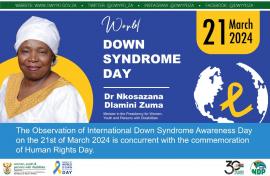
Minister in the Presidency for Women, Youth and Persons with Disabilities, Nkosazana Dlamini-Zuma, has called on South Africans to observe International Down Syndrome Awareness Day which is concurrent with the commemoration of Human Rights Day. 

Down syndrome is a naturally occurring chromosomal arrangement that has always been a part of the human condition. It exists in all regions across the globe and commonly results in variable effects on learning styles, physical characteristics, or health.

According to the Down Syndrome South Africa (DSSA) organisation, down syndrome affects about 1 in 500 births in South Africa. This means that approximately 1 in every 600 children is born with down syndrome, which is a high incidence rate.

“The Observation of International Down Syndrome Awareness Day on the 21st of March 2024 is concurrent with the commemoration of Human Rights Day. 

“Government calls on South Africans to observe the day in line with the call made by the Bill of Rights that says: ‘The right to life is the most basic, the most fundamental, the most primordial and supreme right which human beings are entitled to have and without which the protection of all other human rights becomes either meaningless or less effective’,” Minister Dlamini Zuma said. 

The Constitution of the Republic of South Africa protects persons with disabilities from discrimination. The Promotion of Equality and Prevention of Unfair Discrimination Act also prohibits unfair discrimination against persons with disabilities.

Protecting and promoting the human rights of persons with disabilities is an underlying principle in all the Articles of the United Nations Convention on the Rights of Persons with Disabilities. 

Notably, Article 4 unambiguously commits States Parties to ensure and promote the full realisation of all human rights and fundamental freedoms for all persons with disabilities without discrimination of any kind, based on disability, and to protect all persons against violation of their human rights.

“There are still many misconceptions about down syndrome and those who have it. Observing the day will dispel some of the common myths about down syndrome, including one that says children with down syndrome are born to older parents. We call on stakeholders and roleplayers to work together and bring about an attitudinal shift that will provide clarity to some of the myths.

“Persons with disabilities have the right to equal opportunities in all areas of life and have the right to be protected from exploitation and abusive or degrading treatment. They have the right to reasonable accommodation and environmental accessibility in the workplace. They have the right to live in a barrier-free environment and participate in community life,” Dlamini Zuma said. – SAnews.gov.za 


DikelediM
Thu, 03/21/2024 – 11:32

149 views

Minister in the Presidency for Women, Youth and Persons with Disabilities, Nkosazana Dlamini-Zuma, has called on South Africans to observe International Down Syndrome Awareness Day which is concurrent with the commemoration of Human Rights Day. 

Down syndrome is a naturally occurring chromosomal arrangement that has always been a part of the human condition. It exists in all regions across the globe and commonly results in variable effects on learning styles, physical characteristics, or health.

According to the Down Syndrome South Africa (DSSA) organisation, down syndrome affects about 1 in 500 births in South Africa. This means that approximately 1 in every 600 children is born with down syndrome, which is a high incidence rate.

“The Observation of International Down Syndrome Awareness Day on the 21st of March 2024 is concurrent with the commemoration of Human Rights Day. 

“Government calls on South Africans to observe the day in line with the call made by the Bill of Rights that says: ‘The right to life is the most basic, the most fundamental, the most primordial and supreme right which human beings are entitled to have and without which the protection of all other human rights becomes either meaningless or less effective’,” Minister Dlamini Zuma said. 

The Constitution of the Republic of South Africa protects persons with disabilities from discrimination. The Promotion of Equality and Prevention of Unfair Discrimination Act also prohibits unfair discrimination against persons with disabilities.

Protecting and promoting the human rights of persons with disabilities is an underlying principle in all the Articles of the United Nations Convention on the Rights of Persons with Disabilities. 

Notably, Article 4 unambiguously commits States Parties to ensure and promote the full realisation of all human rights and fundamental freedoms for all persons with disabilities without discrimination of any kind, based on disability, and to protect all persons against violation of their human rights.

“There are still many misconceptions about down syndrome and those who have it. Observing the day will dispel some of the common myths about down syndrome, including one that says children with down syndrome are born to older parents. We call on stakeholders and roleplayers to work together and bring about an attitudinal shift that will provide clarity to some of the myths.

“Persons with disabilities have the right to equal opportunities in all areas of life and have the right to be protected from exploitation and abusive or degrading treatment. They have the right to reasonable accommodation and environmental accessibility in the workplace. They have the right to live in a barrier-free environment and participate in community life,” Dlamini Zuma said. – SAnews.gov.za 

Read More at the Source

Share this:

  • Share on X (Opens in new window) X
  • Share on Facebook (Opens in new window) Facebook
  • Print (Opens in new window) Print
  • Email a link to a friend (Opens in new window) Email
  • Share on LinkedIn (Opens in new window) LinkedIn
  • Share on Tumblr (Opens in new window) Tumblr
  • Share on WhatsApp (Opens in new window) WhatsApp
  • Share on Mastodon (Opens in new window) Mastodon
Category: NewsTag: 2024, Africa, Environment, Government, health, human rights, ONE, SA News, South Africa

If you feel strongly about this article then feel free to send MyZA a ‘Letter to the Editor’ using the submission form below:


Letter to the Editor

This field is for validation purposes and should be left unchanged.
If this is in response to an article please include that article title here or as the lead in for the first paragraph of your Letter below.

Separate tags with commas

Localise your letter by naming the city your words are about. Add relevant words describing your subject. Single comma separated words of no more than 5
Your Name(Required)
Your Name will be linked to the website below.
Your personal, business or social media web site
Choose NO to not set up a user account on MyZA. User Accounts will allow you to submit letters under your own Author Name

3 Latest Letters to the Editor:

  • NSFAS 2027 applications close on 31 October — SASSA households, apply now

    Dear Editor, I run SAGrant (sagrant.co.za), a free resource helping South Africans navigate SASSA grants. NSFAS applications for the 2027 academic year close on Friday 31 October 2026, and no extension is expected. If your household receives a SASSA grant, your child already passes the NSFAS financial eligibility test — but they still have to…

    25 October 2026
  • Publish the Call, Then Publish the Grade

    Dear Editor, South African football fans argue about everything — lineups, referees, who should start up front. But there’s one argument we never have, because nobody gives us the numbers: were the predictions we read all week actually any good? I help run XG Mind AI, a small independent football data lab. Our rule is…

    25 October 2026
  • Don’t Ignore a SASSA Review Notice — It Is Not a Cancellation

    Dear Editor, I run SAGrant (sagrant.co.za), a free resource helping South Africans navigate SASSA grants. SASSA has reminded beneficiaries that a grant review is not a cancellation. A review simply checks whether a beneficiary still meets the qualifying requirements — it can be triggered by a change in income, employment, marital status, address, contact details…

    19 October 2026

About Guest

Previous Post:Alex Cuthbert – A very busy man both on and off the field
Next Post:Social Development to keep older persons fit and active in Mbombela 

Reader Interactions

Comments

  1. Corny

    14 September 2026 at 10:03 pm

    Thanks for this post – I have had a great time visiting your site and find myself now wanting to physically visit South Africa. Well Done!

  2. Roller Turtle

    10 September 2026 at 3:59 am

    Sweden: You have two cows. You offer them to the government, who gives everybody milk.

Copyright © 2026 · MyZA · All Rights Reserved · Powered by Stratlec Online