• Skip to main content
  • Skip to header right navigation
  • Skip to after header navigation
  • Skip to site footer
MyZA

MyZA

News, Directory, Events and Other Stuff

  • Social Media
  • Sport
  • World News
  • Home
  • Submit News
  • Directory
  • Events
  • Stratlec
  • TFSA
  • News
    • APO
    • Today’s Sport News
    • Todays Social Media and Tech Headlines
    • Today’s World News
    • Today’s SA Financial News
  • Contact
You are here: Home / Archives for ACT

ACT

10 February 2025

Completion of dome structure for National Assembly sittings welcomed

Location: News

Completion of dome structure for National Assembly sittings welcomed

Public Works and Infrastructure Minister Dean Macpherson has welcomed the completion of a dome structure for National Assembly sittings ahead of the replies to the State of the Nation Address (SONA) in Cape Town this week. 

In a statement on Monday, the department explained that, at the request of the National Assembly, it relocated and assembled the dome to serve as a temporary venue for parliamentary sittings until the reconstruction of Parliament is completed. 

The dome was previously used for the funeral of former President Nelson Mandela. 

“As the Department of Public Works and Infrastructure we have successfully repurposed this structure which had remained idle for many years, to help Parliament save millions in costs while the reconstruction of the National Assembly chambers continues. 

“The structure, now equipped with a new roof sail and structural reinforcements, will allow the National Assembly to hold sittings uninterrupted in all weather conditions. Additionally, it will enable members of the public to observe proceedings in person for the first time in many years,” Macpherson said. 

The Minister said he was incredibly proud of the team at his department particularly Director-General Sifiso Mdakane who personally oversaw its implementation. 

“The Director-General and his team worked tirelessly—including through the December holiday period—to ensure that the project was completed on time for Parliamentary sittings. We extend our sincere thanks to them for their dedication,” he said. 

Macpherson said he looked forward to working with Parliament to ensure the successful functioning of the dome in the weeks and months ahead, allowing National Assembly sittings to proceed without interruption.

This will enable Parliament to fulfil its vital role of holding the executive accountable—a function that was severely hampered by the COVID-19 pandemic and the fire that damaged the National Assembly chambers.

“As a department, we look forward to continuing our collaboration with Parliament to ensure it can effectively serve the people of South Africa. The Ddme project demonstrates that the Department of Public Works and Infrastructure can act with speed and precision when required. We are eager to build on this momentum as we work to turn South Africa into a construction site in the months ahead,” he said. – SAnews.gov.za


DikelediM
Mon, 02/10/2025 - 12:11
224 views
Read moreCompletion of dome structure for National Assembly sittings welcomed
10 February 2025

TNPA signs milestone agreements

Location: News

TNPA signs milestone agreements

Transnet National Ports Authority (TNPA) has achieved a key milestone in the development of the South Dunes Precinct at the Port of Richards Bay by signing two major Terminal Operator Agreements (TOA). 

The first agreement for Liquefied Natural Gas (LNG) has been signed with Zululand Energy Terminal, while the other agreement is signed with FFS Tank Terminals.

The agreements represent a leap forward in advancing South Africa’s energy and maritime sectors, underscoring TNPA’s strategic objectives to foster sustainable development and investment in critical infrastructure.

Speaking at the signing ceremony held at South Pier in the South Dunes Precinct at Port of Richards Bay in KwaZulu-Natal, Andile Sangqu, Transnet Board chairperson, said the agreements signify Transnet’s commitment to support South Africa’s crucial pathway to economic growth and industrialisation through energy transformation and enhanced energy security.

“They represent a dual achievement, the introduction of a pioneering LNG import facility and the enhancement of our liquid bulk capacity through the redevelopment of FFS Tank Terminals,” Sagqu said.

Sangqu said the LNG terminal is a critical response to the nation’s energy challenges.

“Overall, the TNPA LNG project is aligned with the Department of Mineral Resources and Energy (DMRE) plans to deliver 6 000 MW of Gas-to-Power in South Africa. 

“This 6 000 MW is split into 3 000 MW as per Integrated Resource Plan (IRP) and 3 000 MW for Eskom new generation in the UMhlathuze region. 

“By enabling the importation of Liquefied Natural Gas, we are promoting the development of sustainable source of energy to meet limited and depleting gas supplies,” he said. 

Sangqu said the initiative positions Transnet as a key player in South Africa’s nascent LNG market.

Sangqu said with the LNG Import Terminal expected to generate approximately 1 000 jobs and additional opportunities emerging during the construction of berth 207 and the necessary pipeline infrastructure, they are committed to building a sustainable workforce for the future.

In his remarks, Tshokolo Nchocho, TNPA Board Chairperson, said the agreements mark significant progress in advancing the country's energy security, economic growth and the transformation of our port infrastructure.

“The establishment of South Africa’s first LNG Import Terminal represents a strategic response to our nation’s energy challenges,” Nchocho said.

Nchocho said the establishment of South Africa’s first LNG Import Terminal represents a strategic response to the nation’s energy challenges.

“By securing a stable and diversified energy supply, we are ensuring that our industries and communities have the power they need to thrive. 

“By modernising existing infrastructure, this project not only enhances maritime fuel services but also plays a critical role in supporting global shipping operations, ensuring efficiency and competitiveness in an evolving energy landscape,” he said.

KwaZulu-Natal Premier Thami Ntuli hailed the signing of the two multibillion rand Terminal Operator Agreements (TOA), saying they will advance South Africa’s energy and maritime sectors and help grow the country’s economy and spur the creation of much-needed jobs.

“As detailed by Transnet already, this is a significant milestone in the development of the South Dunes Precinct at the Port of Richards Bay and is set to support the Gas-to-Power Programme of South Africa,” Ntuli said.

Ntuli said the signing ceremony aligns quite solidly with the DMRE’s Strategic Plan (2020-25) that charts ambitions to become a country that is not only energy secure, but one that is unrolling a decarbonisation strategy, as the country steadily transitions towards cleaner energy sources.

“Natural gas is becoming increasingly accepted as a viable alternative or transitional source of power which although not a renewable, is far cleaner and less expensive in capital cost than coal which currently supports our base load,” Ntuli said.

Ntuli said the country has learnt that gas can negate pollution output from other fossil fuel sources and at the same time, halve the carbon emissions.

“These two agreements are welcomed, as they are the fruit born out of the Zululand Energy Terminal (ZET), a strategic partnership between Vopak Terminal Durban (PTY) Ltd and Transnet Pipelines to develop, construct and operate a new Liquefied Natural Gas (LNG) Terminal in Richards Bay,” the Premier said.

Ntuli said one of the most pleasing aspects of the agreement is expected to generate significant employment opportunities, while also fostering skills development and driving transformation in the maritime and energy sectors.

“In this regard, the projects are expected to generate approximately 1 000 jobs, with additional opportunities created during the construction of berth 207 and pipelines,” he said.

Acting TNPA Chief Executive, Phyllis Difeto, said this milestone underscores the commitment to transforming the country’s logistics sector and being responsive to national energy goals.

Difeto said collectively, the projects contribute to the economic resilience of the uMhlathuze region, with significant job creation in construction, operations and port-related industries.

“These initiatives highlight our commitment to transformation and workforce empowerment,” she said.

The signing of the agreements aligns with Transnet’s strategic pursuit of partnerships with the private sector and signifies a leap towards delivering Transnet's objectives to align its freight logistics business with key commodities of the South African economy.

On 15 December 2022, TNPA issued a Request for Proposal (RFP) to secure a terminal operator for the development of a LNG terminal in the South Dunes Precinct.

Following a thorough evaluation process in compliance with Section 56 of the National Ports Act (Act No. 12 of 2005), Zululand Energy Terminals was appointed as the preferred bidder.

The project involves the design, development, financing, construction, operation and maintenance of the LNG terminal over a 25-year concession period.

The initiative supports the Gas to Power Programme of South Africa, aligning with the Department of Mineral Resources and Energy’s Strategic Plan (2020-25) to enhance energy security and transition to cleaner energy sources.

TNPA has also finalised a 25-year concession TOA with FFS Tank Terminals for the development and operation of a liquid bulk terminal specialising in bunker fuels at the Port of Richards Bay.

The facility, located at the former Engen bunker terminal, will focus on enhancing the port’s capacity for handling liquid bulk and fostering economic growth.

TNPA is responsible for the safe, effective, and efficient economic functioning of the national port system, which it manages in a landlord capacity. 

It provides port infrastructure and marine services at the eight commercial seaports in South Africa in the cities of Richards Bay, Durban, Saldanha, Cape Town, Port Elizabeth, East London, Mossel Bay and Ngqura. It operates within a legislative and regulatory environment and is governed by the National Ports Act (Act No. 12 of 2005). 

The development of these two terminals is a game changer in the economic landscape of the region. 

The LNG terminal alone is projected to create over 1,000 job opportunities during construction, operations including downstream business for communities surrounding the uMhlathuze region, while the bunkering services terminal aims to generate around 50 direct and indirect jobs from the project initiation phase. – SAnews.gov.za

Edwin
Mon, 02/10/2025 - 14:48

232 views
Read moreTNPA signs milestone agreements
10 February 2025

Government creates enabling environment for investors

Location: News

Government creates enabling environment for investors

In an effort to create an enabling environment for investors, the Department of Forestry, Fisheries and the Environment (DFFE) is prioritising cutting red tape and boosting investor confidence by removing bureaucratic delays that prevent businesses from investing in sustainable industries.

“South Africa is uniquely positioned to become a leader in the green economy. Our vast renewable energy potential, our forestry-based carbon markets, and our sustainable fisheries sector all present opportunities for attracting much-needed investment. However, to fully unlock this potential, we must remove obstacles that hinder growth,” Forestry, Fisheries and the Environment Minister, Dr Dion George, said on Monday.

According to the Minister, countries that create an enabling environment for green investment will be at the forefront of economic growth and job creation in the coming decade.

He made this observation after his participation at the recent World Economic Forum (WEF), held in Davos, Switzerland, as discussions reaffirmed that global investors are actively seeking opportunities in sustainable industries.

During his engagements, George met with global leaders, investors, and policymakers to discuss how South Africa can attract investment in key sectors, such as renewable energy, sustainable forestry, and marine conservation. 

These sectors hold immense potential, not only to protect our environment, but also to drive economic expansion and employment opportunities, particularly in rural and coastal communities.

“The DFFE has also gone to great lengths to leverage forestry and fisheries for economic expansion. South Africa’s forests are not just an environmental asset, they are a key economic driver in carbon trading and sustainable wood production. 

“The department is working to enhance carbon sequestration initiatives that will allow South Africa to benefit from global climate finance mechanisms. Sustainable fisheries are central to food security and economic development. The department is actively working on policies that will protect marine ecosystems while creating sustainable jobs in the fishing industry,” the Minister said.

The DFFE is also aligning with the Global Green Finance Movement. 

“Investors at Davos made it clear that capital is moving toward sustainable projects. Our government must ensure that South Africa is positioned as a leading destination for climate finance and green investment, which includes partnering with the private sector to scale up renewable energy projects and green infrastructure,” George said.

The Minister’s engagements at WEF Davos underscored the critical message that South Africa must act decisively to secure its place in the global green economy. 

“We cannot afford to lag behind while other emerging markets capitalise on the shift toward sustainability,” he said. -SAnews.gov.za


nosihle
Mon, 02/10/2025 - 09:16

18 views
Read moreGovernment creates enabling environment for investors
9 February 2025

Government committed to finding diplomatic solutions amid President Trump’s executive order

Location: News

Government committed to finding diplomatic solutions amid President Trump's executive order

The South African government says it remains committed to finding diplomatic solutions to any misunderstandings or disputes arising from the recently promulgated Expropriation Act 13 of 2024 and other policies.

This as United States President Donald Trump issued an Executive Order – titled Addressing Egregious Actions of the Republic of South Africa – ordering, in the main, that as a result of the Act:

  • The United States shall not provide aid or assistance to South Africa
  • The United States shall promote the resettlement of Afrikaner refugees escaping government-sponsored race-based discrimination, including racially discriminatory property confiscation
  • All executive departments and agencies, including the United States Agency for International Development, shall, to the maximum extent allowed by law, halt foreign aid or assistance delivered or provided to South Africa, and shall promptly exercise all available authorities and discretion to halt such aid or assistance.
  • The head of each agency may permit the provision of any such foreign aid or assistance that, in the discretion of the relevant agency head, is necessary or appropriate.

International Relations and Cooperation Minister Ronald Lamola said government had noted the order.

“It is of great concern that the foundational premise of this order lacks factual accuracy and fails to recognise South Africa’s profound and painful history of colonialism and apartheid.

“We reiterate that South Africa remains committed to finding diplomatic solutions to any misunderstandings or disputes,” he said.

Furthermore, Lamola said government expresses concern over “what seems to be a campaign of misinformation and propaganda aimed at misrepresenting our great nation”.

“It is disappointing to observe that such narratives seem to have found favour among decision-makers in the United States of America.

“It is ironic that the executive order makes provision for refugee status in the US for a group in South Africa that remains amongst the most economically privileged, while vulnerable people in the US from other parts of the world are being deported and denied asylum despite real hardship,” Lamola said.

The Expropriation Act

The Expropriation Act states that property may not be expropriated arbitrarily or for a purpose other than a public purpose or in the public interest.

The Expropriation Act, which underwent a five-year public consultation process, was deliberated in Parliament, and is in line with the South African Constitution.

The Act repeals the Expropriation Act of 1975 and allows for the State to expropriate land in the public interest – subject to just and equitable compensation.

On Monday, President Cyril Ramaphosa in a media statement emphasised that the Act is “not a confiscation instrument, but a constitutionally mandated legal process that ensures public access to land in an equitable and just manner as guided by the Constitution”.

“South Africa, like the United States of America and other countries, has always had expropriation laws that balance the need for public usage of land and the protection of rights of property owners.

“We look forward to engaging with the Trump administration over our land reform policy and issues of bilateral interest. We are certain that out of those engagements, we will share a better and common understanding over these matters,” the statement said. – SAnews.gov.za


NeoB
Sun, 02/09/2025 - 16:19

124 views
Read moreGovernment committed to finding diplomatic solutions amid President Trump’s executive order
8 February 2025

Trump Has Stopped Aid to South Africa, Endangering Thousands of Lives

Location: News

But we must not allow peddlers of hate to undermine our fragile constitutional democracy

Read moreTrump Has Stopped Aid to South Africa, Endangering Thousands of Lives
7 February 2025

Pretoria Could Lose 120 Beds for People in Desperate Need of Care

Location: News

Business rescue plan for social housing company will sell off state-funded special needs facilities

Read morePretoria Could Lose 120 Beds for People in Desperate Need of Care
7 February 2025

Government strengthens efforts to end violence against women

Location: News

Government strengthens efforts to end violence against women

President Cyril Ramaphosa says government remains committed to working across society to end violence perpetrated against women in the country.

Delivering his State of the Nation Adress (SONA) in Cape Town on Thursday evening, President Ramaphosa highlighted that, as part of these efforts, 65 Thuthuzela Care Centres have been established nationwide, providing critical services to survivors.

Of the country’s 52 districts, 44 have established gender-based violence (GBV) shelters, offering a safe haven for women in need.

“All police stations in the country have victim friendly services, and another 16 sexual offences courts will be established in the next financial year. We continue to work across society to end the violence that is perpetrated against women.

“We have promulgated the National Council on Gender-Based Violence and Femicide Act, establishing a national structure to oversee a coordinated response to this crisis. We will ensure that the Council is fully functional and properly resourced,” President Ramaphosa said.

The GBVF cases can be reported through the GBV Command Centre toll-free on 0800 428 428 04 or *120* 7867# from any cellphone. – SAnews.gov.za


GabiK
Thu, 02/06/2025 - 23:20

174 views
Read moreGovernment strengthens efforts to end violence against women
7 February 2025

Navy Ammunition Depot in Simon’s Town Is a Fire Hazard

Location: News

Defence force is violating the law

Read moreNavy Ammunition Depot in Simon’s Town Is a Fire Hazard
7 February 2025

Government puts shoulder to the wheel to build a thriving economy

Location: News

Government puts shoulder to the wheel to build a thriving economy

Growing the economy and job creation are at the top of the seventh administration’s agenda, President Cyril Ramaphosa said on Thursday.

“We want a nation with a thriving economy that benefits all. To create this virtuous cycle of investment, growth and jobs, we must lift economic growth to above three percent,” the President said, as he delivered the State of the Nation Address (SONA) in Cape Town.

In the first SONA of the seventh administration, the President said government has adopted the Medium-Term Development Plan, which sets out a clear and ambitious programme for the next five years.

The actions contained in the plan advance three strategic priorities: driving inclusive growth and job creation; reducing poverty and tackling the high cost of living as well as building a capable, ethical and developmental state.

“To achieve higher levels of economic growth, we are undertaking massive investment in new infrastructure while upgrading and maintaining the infrastructure we have.

“We are engaging local and international financial institutions and investors to unlock R 100 billion in infrastructure financing. A project preparation bid window has been launched to fast-track investment readiness.

“This includes revised regulations for public private partnerships, which will unlock private sector expertise and funds,” the President explained.

Focus on infrastructure

Over the next three years, government will spend more than R940 billion on infrastructure. This includes R375 billion in spending by state owned companies.

“This funding will revitalise our roads and bridges, build dams and waterways, modernise our ports and airports and power our economy. Through the Infrastructure Fund, 12 blended finance projects worth nearly R38 billion have been approved in the last year.

The aim of the Infrastructure Fund is to use committed government funding to leverage much higher levels of private sector investment in public infrastructure. Managed by Infrastructure South Africa, the fund is a portfolio of blended finance projects and programmes. 

“These are projects in water and sanitation, student accommodation, transport, health and energy. Construction of the Mtentu Bridge continues. This bridge will rise above the river between Port Edward and Lusikisiki, and will become the tallest bridge in Africa,” the President said.

The Polihlali Dam will feed 490 million cubic metres of water a year from the Lesotho Highlands into the Vaal River System, securing water supply to several provinces for years to come.

In addition, government is working with international partners to revitalises small harbours and unlock economic opportunities for coastal communities.

“We are steadily removing the obstacles to meaningful and faster growth,” he said.

Operation Vulindlela

As government continues to implement economic reforms through Operation Vulindlela, the President said a new sense of optimism and confidence in the economy has been created.

“We have made progress in rebuilding and restructuring a number of our network industries. We are seeing positive results in the improvement of the functioning of our network industries as well as the investment opportunities that are opening up and are being taken by investors leading to job creation. 

“Working together with business, labour and other social partners we must now finish this work. Over the coming year, we will initiate a second wave of reform to unleash more rapid and inclusive growth,” the President said.

Operation Vulindlela is a joint initiative of the Presidency and National Treasury to accelerate the implementation of structural reforms and support economic recovery.

The initiative aims to modernise and transform network industries, including electricity, water, transport and digital communications.

“Our immediate focus is to enable Eskom, Transnet and other state-owned enterprises that are vital to our economy to function optimally. 

“We are repositioning these entities to provide world-class infrastructure while enabling competition in operations, whether in electricity generation, freight rail or port terminals.

“We continue with the fundamental reform of our state-owned enterprises to ensure that they can effectively fulfil their social and economic mandates."

READ | New wave of reforms to propel SA economy

This includes the work underway to put in place a new model to strengthen governance and oversight of public entities. 

“We will ensure public ownership of strategic infrastructure for public benefit while finding innovative ways to attract private investment to improve services and ensure public revenue can be focused on the provision of public services,” the President said.

Meanwhile, government is in the process of establishing a dedicated State-Owned Enterprise (SOE) Reform Unit to coordinate this work. 

Energy Action Plan

“The measures we have implemented through the Energy Action Plan have reduced the severity and frequency of load shedding, with more than 300 days without load shedding since March 2024.

“While the return of load shedding for two days last week was a reminder that our energy supply is still constrained, we remain on a positive trajectory. 

“We now need to put the risk of load shedding behind us once and for all by completing the reform of our energy system to ensure long-term energy security.”

The President said the Electricity Regulation Amendment Act, which came into effect on 1 January, marks the beginning of a new era.
 

READ | President Ramaphosa signs Electricity Regulation Amendment Act into law

The act sets out far-reaching reforms of the country’s electricity sector, including the establishment of a competitive electricity market.

“This year, we will put in place the building blocks of a competitive electricity market. Over time, this will allow multiple electricity generation entities to emerge and compete.

“We will mobilise private sector investment in our transmission network to connect more renewable energy to the grid,” Ramaphosa said.

Rail network

The President said Transnet’s performance has stabilised and is steadily improving.

“We released a Network Statement in December 2024 which, for the first time, will enable private rail operators to access the freight rail system

“Open access to the rail network will allow train operating companies to increase the volume of goods transported by rail, while our network infrastructure remains state owned,” the President said.

This will ensure that South African minerals, vehicles and agricultural produce reach international markets, securing jobs and earning much needed revenue for the fiscus.

New cranes and other port equipment are being commissioned to speed up the loading and unloading of cargo and reduce waiting times for ships at ports. -SAnews.gov.za

nosihle
Thu, 02/06/2025 - 21:22

235 views
Read moreGovernment puts shoulder to the wheel to build a thriving economy
7 February 2025

A nation where there is “work for all”

Location: News

A nation where there is "work for all"

Government has reaffirmed its commitment to providing training for women entrepreneurs to equip them with the skills needed to compete for government tenders.

Delivering the first State of the Nation Adress (SONA) of the seventh democratic Parliament at the Cape Town City Hall, on Thursday evening, President Cyril Ramaphosa said the country’s economy has long been hindered by the exclusion of the vast majority of the South African people. 

He said Black South Africans have been deprived of essential resources, including land, capital, skills, and opportunities. 

“Our economy was starved of the potential of its people, and that is why we need to transform our economy and make it more inclusive. That is why our focus is on empowering Black people, women, and persons with disabilities, because they were deliberately excluded from playing a key role in the economy of their own country,” President Ramaphosa said. 

He announced the establishment of an annual R20 billion transformation fund over the next five years to fund Black-owned and small business enterprises. 

The President also committed to fast-track the regulations of the Public Procurement Act to ensure businesses owned by women, youth, and persons with disabilities receive equitable opportunities in government contracts.

He noted the transformation initiative, through the National Skills Fund Disabilities Programme, launched in November last year, with an aim to empower over 10 000 people with disabilities is in its first phase through tailored training programmes, stipends, and specialised tools.

“This part of the work we must undertake as business, government, labour and civil society to enable persons with disabilities to play an important part in the economy of our country.” 

Through these programmes, the President emphasised that government was unleashing the potential of the country’s economy for sustained growth. 

“We want a nation where there is work for all, where every person can earn a decent living and realise their potential, where the rights of workers are protected and working conditions are improved, and where women and men receive equal pay for work of equal value,” President Ramaphosa said.

The President emphasised the need to ensure that growth creates jobs for all, especially for young people.

The success of the Presidential Employment Stimulus showed how public employment programmes could create meaningful work that generated a wider benefit and contributed to sustainable employment. 

“The employment stimulus has created almost 2.2 million work and livelihood opportunities through innovative models that provide high-quality work to participants. The Social Employment Fund has created over 80 000 jobs this year [and] has supported more than 12 000 participants to enter entrepreneurial activities.

“During the past year young people secured 235 000 work opportunities through the National Pathway Management Network, which is underpinned by the SAYouth.mobi platform. 

“We now need to build on these innovative programmes to create jobs for youth at even greater scale,” the President said. – SAnews.gov.za

GabiK
Thu, 02/06/2025 - 22:11

183 views
Read moreA nation where there is “work for all”
7 February 2025

Government intensifying Operation Shanela

Location: News

Government intensifying Operation Shanela

President Cyril Ramaphosa says government is intensifying Operation Shanela which has been successful in arresting suspects, recovering firearms and seizing stolen vehicles.

Through Operation Shanela, the South African Police Service (SAPS) has taken a bold and decisive approach to dealing with crime in the country through tracking and tracing operations, roadblocks, high visibility patrols, as well as stop and searches.

All Shanela operations are led by the Provincial Commissioner of each province.

“We must tackle the scourge of gun violence that has plagued our society for decades,” President Ramaphosa said, adding that he had asked the Police Minister Senzo Mchunu and the National Commissioner of Police General Fannie Masemola to prioritise reducing gun-related crime and violence. 

“This includes preventing the diversion of firearms into the illicit market and recovering illegal firearms in circulation. We know from international evidence and our own experience that this is the most effective way to reduce overall violent crime.”

The President said this when he delivered the State of the Nation Address at the Cape Town City Hall this evening.

He said the SAPS had partnered with the metropolitan municipalities and was working with communities to fight crime in the priority provinces where crime was particularly high.

“We want a nation in which everyone is safe. The police continue to work with other law enforcement agencies to dismantle organised crime syndicates and combat financial and violent crimes,” President Ramaphosa said.

The Detective Service, which is crucial to solving cases, will be expanded by 4 000 personnel through internal recruitment processes.

“We are working on adopting surveillance, analytics and smart policing solutions for modern law enforcement. 

“We have seen the value of technology in fighting crime. By using AI in its fraud risk detection and verification work, SARS has prevented the leakage of over R95 billion in impermissible refunds, recovered R20 billion in revenue and dismantled an illicit tobacco and gold scheme,” the President said.

President Ramaphosa said government continues to work across society to end the violence that is perpetrated against women.

“We have promulgated the National Council on Gender-Based Violence and Femicide Act, establishing a national structure to oversee a coordinated response to this crisis,” President Ramaphosa said.

Government, he said, would ensure that the Council is fully functional and properly resourced.

“We continue to strengthen support to victims of gender-based violence. There are now 65 Thuthuzela Care Centres across the country. Out of 52 districts in the country, 44 have GBV shelters,” the President said.

All police stations in the country have victim friendly services, and another 16 sexual offences courts will be established in the next financial year.

Touching on corruption, President Ramaphosa said this year, the Department of Justice and Constitutional Development would report on the review of the anti-corruption architecture by the National Anti-Corruption Advisory Council.

“This is expected to streamline legislation, eradicate the duplication of mandates and foster greater cooperation between law enforcement agencies. We will finalise the whistleblower protection framework and introduce the Whistleblower Protections Bill in Parliament during this financial year.

“This year, we will strengthen South Africa’s system to combat money laundering and terror financing with further legislative and system improvements,” the President said. – SAnews.gov.za


Edwin
Thu, 02/06/2025 - 22:32

204 views
Read moreGovernment intensifying Operation Shanela
6 February 2025

New wave of reforms to propel SA economy

Location: News

New wave of reforms to propel SA economy

Over the next year, government will unleash a second wave of reforms aimed at unlocking the potential of South Africa’s economy.

This is according to President Cyril Ramaphosa who delivered the State of the Nation Address (SONA) – the first of the seventh administration – at the Cape Town City Hall, on Thursday evening.

“The [current] economic reforms that we are implementing through Operation Vulindlela have created a new sense of optimism and confidence in our economy. We have made progress in rebuilding and restructuring a number of our network industries.

“We are seeing positive results in the improvement of the functioning of our network industries as well as the investment opportunities that are opening up and are being taken by investors leading to job creation.

“Working together with business, labour and other social partners we must now finish this work. Over the coming year, we will initiate a second wave of reforms to unleash more rapid and inclusive growth,” President Ramaphosa said.

The President explained that the first point of focus for these reforms lies with state-owned enterprises (SOEs), particularly Eskom and Transnet, which he described as “vital to our economy to function optimally”.

To propel this work forward, a dedicated SOE Reform Unit is in the process of being established. 

“We are repositioning these entities to provide world-class infrastructure while enabling competition in operations, whether in electricity generation, freight rail or port terminals.

“We continue with the fundamental reform of our state-owned enterprises to ensure that they can effectively fulfil their social and economic mandates. This includes the work underway to put in place a new model to strengthen governance and oversight of public entities,” President Ramaphosa explained.

Electricity reform

A key reform is in South Africa’s energy sector, with the implementation of the Electricity Regulation Amendment Act which came into effect this year.

The President described this Amendment Act as the “beginning of a new era” that will unlock a competitive electricity market.

“We now need to put the risk of load shedding behind us once and for all by completing the reform of our energy system to ensure long-term energy security. The Electricity Regulation Amendment Act, which came into effect on the 1st of January, marks the beginning of a new era.

“This year, we will put in place the building blocks of a competitive electricity market. Over time, this will allow multiple electricity generation entities to emerge and compete. We will mobilise private sector investment in our transmission network to connect more renewable energy to the grid,” he said.

With the current and a new wave of reforms, the President said, “we are steadily removing the obstacles to meaningful and faster growth”. – SAnews.gov.za


NeoB
Thu, 02/06/2025 - 20:58

36 views
Read moreNew wave of reforms to propel SA economy
6 February 2025

Government, industry leaders encourages use of AI for greater good

Location: News

Government, industry leaders encourages use of AI for greater good

The rapid development of artificial intelligence (AI) has signified a fundamental change in how government interacts with citizens, disseminates information and ensures that the State’s voice reaches every corner of the nation.

This is according to Deputy Minister in the Presidency, Kenny Morolong, who addressed a Government Communicators Networking Session at Artscape in Cape Town on Wednesday night. 

“The question to which we must respond is not whether to embrace AI and the suite of technologies, but how to do so in a way that enhances rather than diminishes our communication objectives.” 

Morolong said government and its relevant stakeholders should explore how these technologies can break down language barriers, reach underserved communities, ensure the authenticity and credibility of government communications, preserve and promote indigenous knowledge systems, and enhance the skills of government communicators.

However, he stressed that in the pursuit of technological advancement, the nation must retain the human touch essential for effective public service communication.

“We must do so with a drive to leave no one behind, including our diverse skills and cultures.”

The Deputy Minister said the mission of various media platforms and government communication should be to ensure all citizens have access to empowering information that facilitates their active and productive participation in the nation.

The networking session, held on the eve of the State of the Nation Address, included a panel discussion on AI’s impact on media and government communication.

The former Dean of the Johannesburg Business School (JBS), Professor Randall Carolissen, led an important discussion about the transformative potential of AI. 

He highlighted its societal impact and emphasised the need to balance technological advancements with personal privacy and accountability.

He also stressed the importance of enabling AI while protecting privacy and ensuring explainability and fairness.

Carolissen also highlighted the dual nature of AI, noting the negative outcomes like “highly convincing” deepfake images.

The panellist emphasised the transformative potential of AI in media, highlighting its role in revolutionising content creation and distribution. 

AI was noted for its ability to enhance data processing, as exemplified by the Pan-Canadian AI strategy. 

Canada was the first country globally to create a national strategy for AI. 

In 2022, the Government of Canada proposed the AI and Data Act (AIDA) as part of Bill C-27, the Digital Charter and Implementation Act, to promote the responsible use of AI.

Practical applications of AI, such as transcription and multilingual support, were discussed, particularly in the context of South African media. 

The panellists also touched on the importance of truth and trust in media, with AI aiding in verification and deeper storytelling.

Supple Chief Operations Officer Lea-Anne Moses underscored the increasing pressure on newsrooms to perform and the declining revenues that are becoming a central issue.

“But I think there’s an opportunity in looking at business models and how we use AI to go deeper in our stories, how we use it to transcribe our notes or conduct research and get the groundwork out of the way. But let’s not outsource our thinking to AI.”

Supple is a technology company based in Britain and South Africa that provides software, Infrastructure as a Service (IaaS), and application programming interfaces (APIs) to governmental bodies.

Associate Professor Sisanda Nkoala, who holds the Media Inclusion and Diversity Chair at the University of the Western Cape and represents the Press Council of South Africa, stressed the significance of ethical journalism and transparency in the use of AI. 

She highlighted the necessity of adapting this technology to better serve African contexts, particularly to address language barriers.

Concerns have been raised about AI ownership by large tech companies and its potential to worsen the digital divide. 

The discussion also addressed AI’s impact on education, job displacement, and the necessity for regulatory frameworks to ensure responsible use of AI.

Meanwhile, the Chief Financial Officer of Kagiso Tiso Holdings, Tshepo Setshedi, said companies that do not embrace AI will be overtaken by those that do.

“So, we need to start preparing as a country in terms of investing in this space,” he told the attendees. 

President Cyril Ramaphosa will deliver the State of the Nation Address this evening at 7pm. – SAnews.gov.za


Gabisile
Thu, 02/06/2025 - 09:04

133 views
Read moreGovernment, industry leaders encourages use of AI for greater good
5 February 2025

Afreximbank Challenges Africa’s Miners to Take Bold Steps to Own the Continent’s Resources

Location: News
Afreximbank

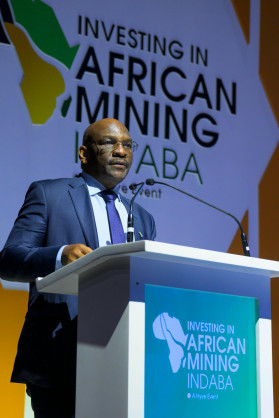
Africa must take bold steps to own its resources, create jobs and build industries that sustain prosperity for generations, African Export-Import Bank (Afreximbank) (www.Afreximbank.com) has told African leaders, policymakers, mining industry leaders and global partners at the African Mining Indaba 2025 in Cape Town, South Africa, on Sunday.

In a keynote address at the ministerial symposium of the Indaba, Mr. Denys Denya, Senior Executive Vice President of the Afreximbank Group, argued that the continent was standing at a crossroads and could either continue exporting its wealth and remain a marginal player in the global economy or take the bold steps to own its resources.

He noted that “While the global mining industry generated approximately US$1.7 trillion in revenue in 2023, Africa's share of this wealth remains disproportionately low. Our continent extracts the raw materials that power the world's industries, yet it is estimated that we retain as little as between four per cent and 20 per cent of the total value of our minerals due to minimal local processing and limited downstream development. The result? Lost economic opportunities, exposure to volatile commodity cycles and a persistent reliance on external markets for refined products derived from our own resources.” “The choice is ours. The time to act is now. Let us work together: governments, financial institutions, investors, and industry players to build an Africa where mining is not just about extraction but about transformation, innovation and wealth creation,” said Mr. Denya. “Africa has the resources, the market potential, and the policy frameworks to transition from a resource-dependent continent to an industrial powerhouse. However, success will depend on bold, decisive action from all stakeholders. Policymakers must implement clear, enforceable regulations that mandate local value addition and create investment-friendly environments. Private sector investors must step up with capital and technology to develop processing, refining, and manufacturing facilities.”

Reversing this trend demanded bold, coordinated action, he argued. “We must move beyond extraction and invest in refining, smelting and advanced manufacturing. African nations must increase local processing capacity for minerals such as bauxite, lithium, cobalt and iron ore.”

He added that regional collaboration was essential as no single country could build a mining value chain in isolation.

Mr. Denya highlighted the importance of the African Continental Free Trade Area (AfCFTA) in developing intra-African mineral value chains and strengthening cross-border collaboration and said that attracting capital for mining-related infrastructure, technology transfer and skills development were critical.

“Our mining policies must also prioritise environmental, social and governance standards, ensuring that mining benefits communities rather than displacing them,” he said, adding that the approach would create millions of skilled jobs for the youth and reduce reliance on volatile global markets while strengthening intra-African trade.

Reiterating Afreximbank's commitment to supporting Africa's mining sector and ensuring that mineral wealth drove economic growth rather than perpetuate resource dependency, Mr. Denya announced that, over the past three years, the Bank had approved more than US$1 billion in support of mining and mineral sector projects across the continent, including financing the development and construction of a bauxite processing plant in Guinea, supporting the expansion of a manganese processing plant in Gabon and providing working capital financing to a diamond company in Botswana.

Other major projects being supported by the Bank include a petrochemical fertilizer plant in Angola, a titanium dioxide pigment plant in South Africa and the feasibility study for the development of a limestone mine processing plant in Malawi, he added.

Mr. Denya said that the establishment of the US$10-billion AfCFTA Adjustment Fund, managed by FEDA, Afreximbank's impact investment subsidiary, would provide critical financial support to countries and businesses transitioning to the new trade regime, including those in the mining sector, and that the Bank's efforts to harmonise standards and implement the Africa Collaborative Transit Guarantee Scheme would also facilitate seamless movement of minerals and mining equipment across borders, reducing logistical bottlenecks.

Afreximbank was also leveraging digital platforms, such as the Africa Trade Gateway and the Pan-African Payment and Settlement System, to enable efficient transactions and market access, which would ensure that Africa's vast mineral wealth was utilised to drive industrialisation, value addition and economic resilience across the continent, he added.

Mr. Denya also noted that Afreximbank, in collaboration with development partners, was driving the development and expansion of industrial parks and special economic zones (SEZs) to address infrastructure challenges that hinder industrial growth.

One of the most transformative initiatives under that pillar was the DRC/Zambia Electric Vehicle Battery Manufacturing Special Economic Zones - a project that positions Africa at the centre of the global energy transition by the implementation of battery precursor SEZs aimed at making the two countries globally competitive investment destinations for the battery electric vehicle value chain.

The African Mining Indaba 2025, taking place from 3 to 6 February, is the premier gathering where Africa policymakers, industry leaders and global partners work to shape the future of the African mining sector.

Distributed by APO Group on behalf of Afreximbank.

Media Contact:
Vincent Musumba
Communications and Events Manager (Media Relations)
Email: press@afreximbank.com

Follow us on:
X: https://apo-opa.co/4116jsN 
Facebook: https://apo-opa.co/4aLcd4I 
LinkedIn: https://apo-opa.co/3Et8gFS 
Instagram: https://apo-opa.co/4aOinBd

About Afreximbank:
African Export-Import Bank (Afreximbank) is a Pan-African multilateral financial institution mandated to finance and promote intra-and extra-African trade. For 30 years, the Bank has been deploying innovative structures to deliver financing solutions that support the transformation of the structure of Africa's trade, accelerating industrialization and intra-regional trade, thereby boosting economic expansion in Africa. A stalwart supporter of the African Continental Free Trade Agreement (AfCFTA), Afreximbank has launched a Pan-African Payment and Settlement System (PAPSS) that was adopted by the African Union (AU) as the payment and settlement platform to underpin the implementation of the AfCFTA. Working with the AfCFTA Secretariat and the AU, the Bank is setting up a US$10 billion Adjustment Fund to support countries effectively participating in the AfCFTA. At the end of December 2023, Afreximbank's total assets and contingencies stood at over US$37.3 billion, and its shareholder funds amounted to US$6.1 billion. Afreximbank has investment grade ratings assigned by GCR (international scale) (A), Moody's (Baa1), Japan Credit Rating Agency (JCR) (A-) and Fitch (BBB). Afreximbank has evolved into a group entity comprising the Bank, its impact fund subsidiary called the Fund for Export Development Africa (FEDA), and its insurance management subsidiary, AfrexInsure (together, "the Group"). The Bank is headquartered in Cairo, Egypt.

For more information, visit: www.Afreximbank.com

Media files
Afreximbank
Download logo
Read moreAfreximbank Challenges Africa’s Miners to Take Bold Steps to Own the Continent’s Resources
5 February 2025

Learners encouraged to explore TVET colleges 

Location: News

Learners encouraged to explore TVET colleges 

Higher Education and Training Deputy Minister, Dr Mimmy Gondwe, has encouraged learners to consider the Technical Vocational Education and Training (TVET) colleges as a valuable and viable alternative for advancing their careers.

The Deputy Minister was speaking during an oversight visit to the post school education and training (PSET) institutions in the Western Cape this week.

Gondwe described the TVET colleges as crucial for job creation and youth skills development in the country.

The Deputy Minister visited the West Coast College Vredenburg Campus, and the Cape Peninsula University of Technology (CPUT) Bellville Campus in Cape Town.

Gondwe’s visits aimed at assessing the state of readiness of higher education institutions across the country, ahead of the 2025 academic year.

During the visit at West Coast College, she encouraged learners to take pride in acquiring artisan skills as they offer great entrepreneurship opportunities.

“I am very encouraged by what I’m seeing at TVET colleges, I believe they are the future of this country. TVETs are producing artisans with much needed skills [and] also offer opportunities for learners to acquire future skills, such as robotics, AI [Artificial intelligence], and coding,” Gondwe said.

At the second part of the visit, students at CPUT expressed concerns about student residences and other facilities. The Deputy Minister directed the institution to work with the Student Representative Council (SRC), to speedily resolve the identified issues.

The Deputy Minister’s visit to the Western Cape, follows her recent visit to higher education institutions in the Free State where she visited Goldfields TVET College and the Central University of Technology (CUT), at the Welkom campus.

During the visits, the Deputy Minister has been accompanied by key senior officials from Higher Education and Training, and the National Student Financial Aid Scheme (NSFAS).

The Deputy Minister’s dedicated Help Desk has also formed part of the delegation, assisting with all higher education related queries on each visit.

The issue of funding and administrative challenges faced by the NSFAS was in the spotlight during the Free State leg of the visits.

“NSFAS needs to get its act together, in order to ensure that student allowances are paid on time with no delays. Delays cause serious challenges for learners; learners need allowances to eat and to buy hygiene products. This is important for their sense of wellbeing and dignity,” Gondwe said.

Gondwe embarked on the state of readiness visits following a plan of action, announced by Higher Education and Training, Dr Nobuhle Nkabane at the special meeting of the Post Education and Training sector held in January 2025, to establish the state of readiness for the 2025 academic year.

The Deputy Minister’s oversight is expected to continue in other provinces, with North West higher education institutions being the next on the list. – SAnews.gov.za


GabiK
Wed, 02/05/2025 - 14:56

328 views
Read moreLearners encouraged to explore TVET colleges 
5 February 2025

SIU welcomes disciplinary action against nine officials

Location: News

SIU welcomes disciplinary action against nine officials

The Special Investigating Unit (SIU) has welcomed the outcomes of a disciplinary inquiry initiated against nine officials from the Gauteng Department of Health and the Department of Infrastructure Development. 

The officials faced charges relating to alleged irregularities in awarding contracts for refurbishing the Anglo Ashanti Hospital in 2022.

Following the SIU's consequence management recommendations, the Office of the Premier took disciplinary action against the implicated officials employed by the Gauteng Department of Health (GDoH) and the Gauteng Department of Infrastructure Development (GDID).

The SIU’s investigation uncovered evidence of financial misconduct involving several individuals from GDoH and GDID. 

The Gauteng Government acted on the SIU's recommendations and charged the officials involved. The outcome is as follows:

- Head of Infrastructure Development: GDoH was dismissed.

- Acting Head of Department: GDID was dismissed.

- Acting Director, Health Infrastructure: GDID was dismissed.

- Acting Chief Financial Officer and Head of SCM: GDID was dismissed.

- Acting Deputy Director-General, Health Branch: GDID) was dismissed.

- Project Manager, Infrastructure Development: GDoH issued with a final written warning.

- Acting Chief Director, Health Infrastructure: GDID issued with a final written warning.

- Project Manager: GDID, their contract employment ended during the hearing.

- Acting Deputy Director-General, Hospital Services: GDoH was acquitted.

The evidence gathered by the SIU indicatds that around 19 March 2020, the AngloGold Ashanti Hospital (AGA Hospital) refurbishment project began under the GDID on behalf of the GDoH.

However, during this process, no supply chain management policies or procedures were followed when procuring service providers and contractors for the refurbishment.

Furthermore, the GDoH was misled into believing that only minor renovations were needed at the AGA Hospital. 

This is a contravention of the Public Finance Management Act and National Treasury’s regulations, causing the GDoH to incur fruitless and wasteful for goods and services supplied.

The SIU was mandated through Proclamation No. R. 23 of 2020 to investigate the affairs of all State institutions regarding procurement or contracting for goods, works, and services during or in respect of the National State of Disaster by or on behalf of State institutions.

“The disciplinary actions show that state institutions are acting on the results of the SIU investigation and implementing the consequences to hold officials implicated to account, recover assets and financial losses incurred by these institutions, and prevent further losses,” said Special Investigating Unit Kaizer Kganyago. 

“We urge all state institutions to take decisive action to clean up our government and state entities from the corruption that has plagued them,” Kganyago said. – SAnews.gov.za


Edwin
Wed, 02/05/2025 - 15:09

149 views
Read moreSIU welcomes disciplinary action against nine officials
5 February 2025

SA’s Land Expropriation Act is constitutional 

Location: News

SA’s Land Expropriation Act is constitutional 

South Africa’s much talked-about Expropriation Act is something that should be looked at in the context of its painful past wherein land was a commodity not afforded to the majority.

Last week, President Cyril Ramaphosa signed into law the Expropriation Bill, which sets out how organs of State may expropriate land in the public interest for varied reasons. 

In a statement, The Presidency said the new legislation, which repeals the pre-democratic Expropriation Act of 1975, aligns expropriation processes with the Constitution.

Section 25 of the Constitution recognises expropriation as an essential mechanism for the state to acquire someone’s property for a public purpose or in the public interest, subject to just and equitable compensation being paid.

Honorary Professor of International Relations at the University of the Witwatersrand, Professor John Stremlau, gave his thoughts on the signing into law of the act which is the culmination of a five-year process of public consultation and Parliamentary deliberation.

“It is constitutional, reflecting a long-standing asymmetry between white ownership in the majority of the land and black ownership for the majority of the people being confined to marginal lands and so there is that position that is reflected in the document. But it’s not precipitous in any way and calls for due process,” he told SAnews.

The Act allows for the State to expropriate land in the public interest – subject to just and equitable compensation.

This as the recently signed act, drew the ire of the United States of America President, Donald Trump. 

Reports this week emerged that the US President has moved to halt future funding to South Africa as his administration investigates allegations of "land confiscation" - following President Ramaphosa’s assent of the Expropriation Act.

US funding to South Africa is related to PEPFAR (US President’s Emergency Plan for AIDS Relief) Aid and constitutes some 17% of the country’s HIV/AIDS programme.

The Professor further stressed that South Africa “has a right of eminent domain…overriding private property.”

This as Minister Lamola earlier told SAnews that expropriation laws are not unique to South Africa. 

“We trust President Trump’s advisors will make use of the investigative period to attain a thorough understanding of South Africa's policies within the framework of a constitutional democracy. This approach will promote a well-informed viewpoint that values and recognises our nation's dedication to democratic ideals and governance,” the Minister said.

The New York Times The Learning Network defines eminent domain as the right of the state to take private property for public use adding that the Fifth Amendment that was added to the Constitution of the United States requires that just compensation be made.

“And South Africa is struggling to overcome the apportioning of land to the settlers and not to the natives. I didn’t think that the parts that I read were in any way unreasonable and reflected the painstaking negotiations…with the communities to reassure those who have properties that they will be full compensated, but, and that at the same time they may be subject to pressures from the government but also government land. It strikes me as a very reasonable approach and I don’t mind being quoted on that,” said the Professor.

Stremlau added that “there are Americans like me who are offended by Trump’s arbitrariness.” 

The expert’s comment come on the heels of a Presidency statement stating that the Act is “not a confiscation instrument, but a constitutionally mandated legal process that ensures public access to land in an equitable and just manner as guided by the Constitution”. 

The Act states that property may not be expropriated arbitrarily or for a purpose other than a public purpose or in the public interest.

SA-US relations

Asked about whether the act will likely sour relations between South Africa and the US, Stremlau said: “America is a complicated place, and there are Americans like me who are offended by Trump’s arbitrariness.”
“It is very much about where the body politic will land as is the case here. And President Ramaphosa should be congratulated for a Government of National Unity.”

On whether the alarm bells raised by the US could see South Africa kicked out of the African Growth and Opportunity Act (AGOA), he said he was hopeful that cool heads will prevail.

AGOA is a unilateral trade preference scheme that provides qualifying sub-Saharan African countries with duty-free, quota-free access into the United States market.

“Congress has by a partisan majority supported the AGOA but South Africa is a standout nation because it is a middle income country and AGOA is intended for poor African countries. South Africa has been a critical member of AGOA and I would hope that cool heads would prevail,” he said.

Since its enactment in 2000, AGOA has been at the core of US economic policy and commercial engagement with Africa. The act is an initiative of the United States and is aimed at giving duty-free market access for producers in eligible countries in sub-Saharan Africa.

He further added that “colleagues” at the Department of International Relations and Cooperation have “a really tough job ahead.”
“I wouldn’t be second guessing them; I think the country should get behind them. But the average South African voter cares about pocketbook issues and getting a job, that has got to be President Cyril Ramaphosa’s total preoccupation,” he said.
Earlier, Public Works and Infrastructure Minister Dean Macpherson reiterated government's stance on the Act, stressing that no one in South Africa will "have their land confiscated".

“The Expropriation Act sets out a clear legal framework under which expropriation may take place, always with due process and court oversight,” Macpherson said, adding that the Government of National Unity will always put the interests of South Africa first.

Professor Stremlau’s comments come ahead of the seventh administration’s first State of the Nation Address (SONA) which President Ramaphosa will deliver before a joint sitting of the National Assembly and the National Council of Provinces on Thursday, 6 February.

In mapping out South Africa Inc’s path for the year ahead, President Ramaphosa will reflect on the year that was and is likely to include legislation that has been passed, including the Expropriation Act.

“Americans respect what South Africa is trying to do in the aftermath of the terrible Apartheid era,” said Stremlau. -SAnews.gov.za


Neo
Wed, 02/05/2025 - 14:32

21 views
Read moreSA’s Land Expropriation Act is constitutional 
5 February 2025

NW legislature calls for a probe after nine NTI buses torched

Location: News

NW legislature calls for a probe after nine NTI buses torched

The North West Portfolio Committee on Community Safety and Transport Management has called for an independent investigation into a bus depot fire that broke out at the North West Transport Investment (NTI).

The fire broke out in the early hours of Monday at the Moretele bus sleeping ground and resulted in the burning of nine buses.

In a statement issued on Tuesday, committee chairperson, Freddy Sonakile, expressed shock and deep disappointment following the incident, and called for an urgent independent investigation.

“The committee urges the Department of Community Safety and Transport Management to commission an urgent independent investigation to complement the South African Police Services (SAPS) probe, and implement immediate contingency measures, to ensure that commuters are not left stranded due to this unfortunate incident,” Sonakile said.

While he commended reports that a criminal case had been opened with the SAPS, Sonakile said the circumstances surrounding the incident were highly suspicious, “especially given the ongoing instability at the embattled NTI”.

“A number of pressing questions demand immediate answers, and only an independent investigation can ensure transparency and accountability,” Sonakile said.

Among the concerns noted by the committee include the level of security at the depot where the buses were parked; whether the buses had existing mechanical issues, and if so, why they were not addressed.

The committee also questioned the availability and functionality of fire extinguishers at the sleeping grounds and who stood to benefit from the destruction of the buses.

The chairperson acknowledged that the NTI had been plagued by leadership and governance challenges.

“With the department’s recent court victory on the removal of the Business Rescue Practitioner—now under appeal—the department had begun making strides by appointing an Acting CEO to stabilise the entity.

“This fire is a serious setback to those efforts. This act is nothing short of an attack on the province’s public transport system, and we will not rest until those responsible are held accountable,” Sonakile said. – SAnews.gov.za

GabiK
Wed, 02/05/2025 - 11:22

70 views
Read moreNW legislature calls for a probe after nine NTI buses torched
5 February 2025

Former State Security Minister granted R5 000 bail in corruption case

Location: News

Former State Security Minister granted R5 000 bail in corruption case

Former State Security Minister Bongani Bongo has been granted R5 000 bail, following his arrest for alleged corruption. 

Bongo (47) made a brief appearance at the Cape Town Magistrate’s Court on Tuesday, after his arrest in the morning of the same day.

Bongo is accused of offering a bribe to evidence leader in Parliament’s Eskom inquiry, Ntuthuzelo Vanara, in 2017, and also contravening the Prevention and Combating of Corrupt Activities Act 12 of 2004 (“PRECCA”).

He is being re-tried after he was acquitted by former Western Cape Judge President, John Hlophe, who dismissed the charges against Bong in 2021.

However, the matter went back to the court after Supreme Court of Appeal Judge John Smith, appealed the decision, and ordered that the matter be heard afresh, granting the retrial. 

"It is reported that during September to October 2017, the accused approached a member of the then Portfolio Committee on Public Enterprises to allegedly arrange a meeting to prevent the next sitting, where Eskom board was to account. 

"Eventually, the suspect secured the meeting wherein he indicated that the Portfolio Committee sitting with the Eskom board cannot proceed as planned and indicated that was possible if the member named his price," National Head of the Directorate for Priority Crime Investigation, Lieutenant General Godfrey Lebeya said on Tuesday.

Bongo is expected to reappear in court on 4 March 2025.

The accused, a former member of the National Assembly, was sworn in as a Member of the Executive and Cabinet, and the Minister of State Security, a position he occupied until 28 May 2024. 

All MP’s are bound by the Code of Ethics, and all other ethical and other obligations and duties arising from the Constitution, the Powers, Privileges and Immunities of Parliament and Provincial Legislatures Act, No. 4 of 2004, and the Prevention and Combating of Corrupt Activities Act 12 of 2004 (“PRECCA”). 

Lebeya vowed that the Directorate will continue to execute its mandate without fear, favour or prejudice. 

He also commended the investigating team and encouraged the prosecution team to ensure the South African citizenry receive the deserved justice due to them. – SAnews.gov.za

Edwin
Wed, 02/05/2025 - 09:41

86 views
Read moreFormer State Security Minister granted R5 000 bail in corruption case
5 February 2025

President to deliver first SONA of the seventh administration 

Location: News

President to deliver first SONA of the seventh administration 

In just a few hours, President Cyril Ramaphosa will deliver the State of the Nation Address (SONA) which will provide a country roadmap charting the way forward for the country in what one could call a mixed bag of domestic and global circumstances.

Thursday night will mark the first SONA to be delivered under the seventh administration’s Government of National Unity (GNU) following the outcomes of the historic 29 May 2024 elections.

And while the faces of government Ministers has changed with every administration, the SONA, held every year since the dawn of democratic South Africa in 1994, continues to hold strong and is a reflection of democracy in action, no matter who is in the driver’s seat of the sitting government of the day.

The State of the Nation Address (SONA) is an important fixture in the nation’s journey forward and provides the President with an opportunity to hold perhaps the year’s “biggest family meeting,” outlining the key plans and programmes of the year ahead. The address also affords the President the chance to look into the rearview mirror to assess the journey traversed to date.

As the President fine-tunes his notes before delivering the speech in an environment that changes by the second, government is cognisant that in every family unit, every member has a role to play in ensuring and preserving the family name and that it has to do so by ensuring the provision of services and responding to challenges facing the South African family.

This as government continues to respond to the challenges of poverty, inequality, unemployment and illegal mining among others.
“As much as we have made progress, we have to do much more to overcome the challenges that confront our nation. We need to work with urgency and purpose to grow an inclusive economy and create jobs,” the President said in his New Year’s Eve message to the nation in December 2024.

In that address, he called on the nation to look at the year 2025 with hope.

“As a people, our unity, determination and resilience has seen us through hard times. Just as this has been a year of great change, we look to the next year with great hope,” he said at the time.

And while our South African family is by no means perfect, there are valid reasons not to be glum about the future.

G20

At tomorrow night’s joint sitting of the National Assembly and the National Council of Provinces (NCOP) in Parliament, the President is expected to speak on the country’s hosting of the Group of 20 (G20) Summit in November, making the country the first do so on the African continent. This as the nation assumed the Presidency of the grouping on 1 December 2024 under the theme: “Solidarity, Equality, Sustainability”.

Having taken over the baton from Brazil, South Africa's G20 Presidency is the fourth consecutive emerging market Presidency and follows the admission of the African Union (AU) as the second permanent African member. 

The G20 was established to tackle pressing global economic and financial issues. Together, G20 members account for around 85% of global GDP and 75% of international trade. The hosting of the Summit is expected to help accelerate the performance of the economy.

The economy

President Ramaphosa is likely to also reflect on the performance of the economy in an environment where the rising cost of living has many on edge. However, the prospects of South Africa’s purse strings are predicted to improve with the country in 2024 having achieved its first primary budget surplus in 15 years.

A recent economic and financial assessment by the International Monetary Fund (IMF) showed that the country’s economic growth prospects are poised to recover in 2025 following a lacklustre economic performance for the past two years.

Last month, the fund published the findings of its Article IV Consultation with South Africa, which was held in November 2024. 
According to the IMF, the real Gross Domestic Product (GDP) output growth is expected to accelerate from an estimated 0.8 % in 2024 to 1.5 % in 2025 driven by improved electricity generation, monetary policy easing, and a return of investor and consumer confidence post the elections.

The IMF acknowledged progress in banking-resolution and safety-net reforms and praised macro-prudential measures to bolster capital buffers. However, it also raised concerns on the rising public debt and the challenges South Africa faces to meet climate goals.

The ongoing electricity and logistics reforms aimed at alleviating critical supply constraints were also welcomed. National Treasury noted that the fund’s concerns are aligned with government’s response to addressing immediate and long-term economic challenges.

“The National Treasury is committed to implementing reforms that will enhance inclusive economic growth, achieve a sustainable public debt level, further repair and strengthen network industries, and strengthen state capacity to support economic activity.”
In its 2024 Medium Term Budget Policy Statement (MTBPS) in October, Treasury estimated economic growth to increase from 1.1 % in 2024 to 1.7% in 2025.

It attributed the gains in the economy to household consumption gradually increasing, supported by rising purchasing power, employment recovery and wealth gains.

The current focus of South Africa’s reform agenda includes the stabilisation of the electricity grid, enhancing the efficacy of freight and ports operations, implementing e-Visas, as well as prioritising the advancement of targeted industries to enhance the business climate and promoting equitable growth. 

Legislation

In the past year, government has passed laws that aim to improve lives as well as respond to pressing challenges.

In January this year, the President signed into law the Expropriation Bill, which sets out how organs of State may expropriate land in the public interest for varied reasons.  
The new legislation repeals the pre-democratic Expropriation Act of 1975, aligns expropriation processes with the Constitution and marks the culmination of a five-year process of public consultation and Parliamentary deliberation. 

“The Bill assented to by President Ramaphosa outlines how expropriation can be done and on what basis. This law will assist all organs of State - local, provincial and national authorities - to expropriate land in the public interest for varied reasons,” the Presidency said. 

Section 25 of the Constitution recognises expropriation as an essential mechanism for the state to acquire someone’s property for a public purpose or in the public interest, subject to just and equitable compensation being paid.

The law has drawn criticism from the United States of America with South Africa saying it looks “forward to engaging” with US President Donald Trump’s administration on bilateral relations and other issues.

The Presidency said the legislation is not a confiscation instrument.

“The recently adopted Expropriation Act is not a confiscation instrument, but a constitutionally mandated legal process that ensures public access to land in an equitable and just manner as guided by the constitution. 
“South Africa, like the United States of America and other countries, has always had expropriation laws that balance the need for public usage of land and the protection of rights of property owners."

Among other laws passed is the Employment Equity Amendment Act, which is aimed at reducing the regulatory burden for small employers to allow them to focus on job creation, which came into effect on 1 January 2025.  

President Ramaphosa signed last year, the proclamation notice giving effect to the start date of implementation of the Employment Equity (EE) Amendment Act, No. 4 of 2022. 

In terms of the notice gazetted on 28 November 2024, small businesses that employ less than 50 employees are no longer bound to comply with Chapter III of the Employment Equity Act, 1998 (EEA) - for example in relation to the submission of their EE reports starting from the 2025 EE Reporting period. 

Employment and Labour Minister Nomakhosazana Meth said the regulatory flexibility will enable small businesses to now focus on growing their businesses and create jobs.

In addition, in December, the President announced his intention to sign a Presidential Proclamation that will bring the Basic Education Laws Amendment (BELA) Act into operation, immediately. 

The BELA Bill was passed by the 6th democratic Parliament on 26 October 2023 after which the first citizen assented to the Bill on 13 September 2024.

President Ramaphosa said the BELA Act is vital to the transformation of the country’s education system and is an important part of ongoing efforts to build an education system that is more effective and more equitable in line with the precepts of the Constitution.

The Act amends sections of the South African Schools Act of 1996 (SASA) and the Employment of Educators Act, 1998 (EEA) to account for developments in the education landscape since the enactment of the original legislation.

Community safety 

In a move to ensure the safety of citizens, the South African Police Service (SAPS) trained and deployed over 20 000 new constables in various units across the country in the past three years.

In addition, operations like Operation Shanela continues to make strides since its inception in May 2023. Shanela consists of regular stop and searches, roadblocks, high visibility patrols and the tracing of wanted suspects.
Operation Vala Umgodi which is aimed at combating illegal mining also continues to make strides.

At the release of the Quarterly Crime Statistics in November 2024, Police Minister Senzo Mchunu announced that the SAPS had recorded a downward trend in some categories of crime, including murder, robbery and carjacking.

From 1 July to 30 September 2024, the 17 community-reported serious crimes showed an overall decline of 5.1%. Specifically, contact crime decreased by 3%, property-related crime saw a reduction of 9.9%, and other serious crime decreased by 3.4%. 

“Focusing on contact crime, the statistics indicate that murder decreased by 5.8%, sexual offenses by 2.5%, and robbery with aggravating circumstances by 8.8%. Additionally, rape decreased by 3.1%, while robbery at residential premises and non-residential premises decreased by 1.3% and 21.1%, respectively,” he said at the time.

Load shedding 

While the country suffered a bout of Stage 3 load shedding recently, November 2024 marked the longest stretch of no-load shedding in five years.

Eskom marked the longest stretch of uninterrupted power supply in five years, with load shedding suspended for more than 240 consecutive days at the time which was followed by 300 days of no-load shedding on 21 January 2025.

The power utility’s performance has been on a steady upward trajectory since the implementation of the Energy Action Plan introduced by President Ramaphosa in July 2022, as well as the implementation of the power utility’s own Generation Recovery Plan.

ICJ case

South Africa in 2024 continued its work on the application of the Convention on the Prevention and Punishment of the Crime of Genocide in Gaza (South Africa v. Israel) matter.

This as it said that it had no regrets about becoming the first country to file a lawsuit against Israel at the International Court of Justice (ICJ) to end its “deadly and relentless genocidal bombardment” of Gaza.  

In October 2024, it formally filed its Memorial to the International Court of Justice (ICJ)  marking a significant step in the ongoing legal action, which aims to hold Israel accountable under international law.

The action taken by South Africa since December 2023, culminating in the filing of the Memorial, has generated overwhelming national and international interest. 

In his Opening of Parliament Address (OPA) in July last year, the President appealed to the larger South African family to behave as weaver birds.

“We would like all of us as South Africans to behave like ‘weaver birds’. Weavers are among the most gregarious birds in that they build complex structures together and cooperate. 

"Despite all the challenges, despite our differences, despite all the headwinds, as South Africans we are called upon to remain firmly committed to pursue the path of cooperation, growth and inclusion,” he said at the time.

As the larger South African family, let us gather around our television and radio sets to hear what the President has to say.
The SONA will get underway at 7pm on Thursday, 6 February 2025. -SAnews.gov.za 
 

Neo
Wed, 02/05/2025 - 09:15

44 views
Read morePresident to deliver first SONA of the seventh administration 
5 February 2025

Photo Exhibition: Remembering the Fishers of Kalk Bay

Location: News

“The Sea is in our Blood” photo exhibition outside the Olympia Cafe

Read morePhoto Exhibition: Remembering the Fishers of Kalk Bay
5 February 2025

Three Lessons in Activism From Mark Weinberg

Location: News

Weinberg, a key figure in the Right2Know Campaign, died on 28 January 2025

Read moreThree Lessons in Activism From Mark Weinberg
4 February 2025

Parole for Alison Botha’s attackers cancelled

Location: News

Parole for Alison Botha’s attackers cancelled

The Minister of Correctional Services, Dr Pieter Groenewald, has cancelled parole for Frans du Toit and Theuns Kruger, the convicted attackers of Alison Botha. 

Botha survived an attack in 1994 by du Toit and Kruger, after they raped her and subsequently stabbed her multiple times. 

“This decision follows thorough evaluation and consultation of legal opinions. This decision was made in accordance with the Correctional Services Act, which empowers the Minister to cancel parole for individuals sentenced to life imprisonment.

“The Minister's primary consideration is the imperative of protecting and securing the community, particularly in instances where acts of violence against women and children have been committed,” the Ministry of Correctional Services said on Tuesday.

Both individuals have been reincarcerated and will remain in custody. - SAnews.gov.za

nosihle
Tue, 02/04/2025 - 13:19

336 views
Read moreParole for Alison Botha’s attackers cancelled
4 February 2025

Public Works Minister weighs in on Expropriation Act

Location: News

Public Works Minister weighs in on Expropriation Act

Public Works and Infrastructure Minister Dean Macpherson has reiterated government's stance on the Expropriation Act, stressing that no one in South Africa will "have their land confiscated".

“The Expropriation Act sets out a clear legal framework under which expropriation may take place, always with due process and court oversight,” Macpherson said.

Speaking on the sidelines of the Mining Indaba in Cape Town on Monday, Macpherson said land grabs will never be allowed when the law is applied.

“...Section 25 of the Constitution enshrines property rights in the highest law of our country,” Macpherson said. 

He said the Government of National Unity (GNU) will always put the interests of South Africa first.

“This government is committed to working with international partners, not against them, [and] to ensure investor confidence remains strong. 

“...I am also committed to ensuring that [this Act] is constitutional and that there will be no arbitrary land grabs by the State in South Africa.

“Property rights are not only about protecting investments but also about ensuring that the rule of law is upheld in all sectors of society.

“It has been proven globally that infrastructure investment is one of the most effective ways to drive a country’s economic expansion and job growth. 

“Countries that have prioritised strategic infrastructure development have seen direct increases in GDP, stronger industrial output, and greater employment opportunities. As the Government of National Unity, we have made this a priority,” Macpherson said.

On Monday morning, President Cyril Ramaphosa – through a statement issued by The Presidency – said the South African government is looking forward to engaging with its US counterparts on the matter.

“We look forward to engaging with the Trump administration over our land reform policy and issues of bilateral interest. We are certain that out of those engagements, we will share a better and common understanding over these matters,” the Presidency said.

Furthermore, the Presidency emphasised that the Act is “not a confiscation instrument, but a constitutionally mandated legal process that ensures public access to land in an equitable and just manner as guided by the Constitution”. 

The Expropriation Act states that property may not be expropriated arbitrarily or for a purpose other than a public purpose or in the public interest.

The Expropriation Act, which underwent a five-year public consultation process, was deliberated in Parliament, and is in line with the South African Constitution.

The Act repeals the Expropriation Act of 1975 and allows for the State to expropriate land in the public interest – subject to just and equitable compensation.  – SAnews.gov.za

Edwin
Tue, 02/04/2025 - 11:02

302 views
Read morePublic Works Minister weighs in on Expropriation Act
  • Previous
  • Page 1
  • Interim pages omitted …
  • Page 35
  • Page 36
  • Page 37
  • Page 38
  • Page 39
  • Interim pages omitted …
  • Page 70
  • Next

Copyright © 2026 · MyZA · All Rights Reserved · Powered by Stratlec Online