Philippi gangsters say they’ll only stop killing if government pays them
Two security guards escorting City workers were shot dead last week because protection is their business, say extortionists

MyZA
News, Directory, Events and Other Stuff
Two security guards escorting City workers were shot dead last week because protection is their business, say extortionists
President Ramaphosa's diary for the upcoming weeks
President Cyril Ramaphosa is expected to attend several events over the coming week.
This as the Presidency on Monday released the first citizen’s list of of public events, starting from Tuesday, 30 April to 9 May 2024.
National Orders
As Grand Patron of the National Orders, the President will on Tuesday, 30 April 2024, bestow the 2024 National Orders Awards on distinguished citizens and eminent foreign nationals who have contributed towards the advancement of democracy and have made a significant impact on improving the lives of South Africans.
The National Orders are the highest awards that a country, through its President, bestows on its citizens and eminent foreign nationals.
The President will bestow on deserving recipients the Order of Mendi for Bravery, the Order of Ikhamanga, the Order of the Baobab, the Order of Luthuli, the Order of Mapungubwe, and the Order of the Companions of OR Tambo.
Black Business Council Summit Dinner
The President is expected to deliver the keynote address at the annual Black Business Council (BBC) Summit Dinner to be held at the Radisson Hotel & Convention Centre, O.R. Tambo in Johannesburg on Tuesday.
The BBC is convened under the theme “30 Years of Democracy – lessons learned and plans for the next 30 Years."
The BBC is the over-arching confederation that represents black professionals, business associations and chambers.
The objective of the BBC is to lobby government on policy related matters and to play an advocacy role where policies are in place in order to accelerate the participation of black business in the mainstream economy.
Unveiling of Home Affairs trucks in Limpopo
President Cyril Ramaphosa will, on Tuesday, 7 May 2024, officially unveil 100 additional Home Affairs mobile trucks that will assist the Department of Home Affairs improvement its services reach to especially remote areas.
The unveiling of these mobile trucks in Mokopane, is made possible by the department’s approved Hybrid Access Model to ensure an expansion of services in areas where the department’s footprint is limited.
The approach is to increase the fleet by 100 every financial year until they reach 1000 from the current fleet of 120.
30 Years Review Report
On 8 May 2024, the President will attend the launch of the 30 Years of Democracy Review Report in Pretoria.
The report to be handed over to the President by the Department of Planning, Monitoring and Evaluation will reflect on the political, social, and economic journey of transformation of South Africa since 1994, the advent of democracy, in order to derive lessons and make recommendations for the country’s development agenda.
The report will also provide critical evidence for the development of the new Medium Term Strategic Framework (MTSF) 2024 – 2029, which serves as a five-year plan of government towards the implementation of the National Development Plan Vision 2030.
Presidential Imbizo
President Cyril Ramaphosa will on Thursday, 9 May 2024, lead government’s interaction - in the form of a District Development Model (DDM) Presidential Imbizo - with communities and stakeholders within the John Taolo Gaetsewe District Municipality in the Northern Cape province.
Themed "Leave No One Behind, the 12th Presidential Imbizo promotes participatory democracy and inclusive development by allowing community members and stakeholders to voice proposals and express any concerns or dissatisfaction they may have about conditions in the district or province.
The Imbizo is directed at enabling successful implementation of the “One District, One Plan” District Development Model in which residents, traditional leaders, business formations, organised labour and faith- and community-based organisations work with government across all phases of planning, implementation, and evaluation.
Preceding the Imbizo, there will be a series of build-up outreach activities led by Ministers, MECs and Mayors in parts of John Taolo Gaetsewe District Municipality and across the Northern Cape. - SAnews.gov.za
NeoB
Mon, 04/29/2024 - 15:09

The President of Rugby Africa (www.RugbyAfrique.com), the continental governing body of Rugby across Africa, Herbert Mensah, will explore the business of sport in a panel discussion at the 2024 Africa CEO Forum (www.TheAfricaCEOForum.com) on Thursday, May 16 in Kigali, Rwanda.
In partnership with the International Finance Corporation (IFC) (www.IFC.org), the Africa CEO Forum is the largest annual gathering of the African private sector. Each year, the Africa CEO Forum gathers more than 2,000 African and international captains of industry, public decision-makers and leading visionaries to debate the continent's most pressing priorities and set its business agenda.
Founded in 2012, the Africa CEO Forum has enabled dialogue between the public and private sector, bringing together business leaders, CEOs, investors and heads of state to highlight the driving role of the private sector in the development of the continent. Previous speakers include H.E. Paul Kagame, President of the Republic of Rwanda, H.E. Dr. William Samoei Ruto, President of the Republic of Kenya, H.E. Filipe Jacinto Nyusi, President of the Republic of Mozambique and H.E. Dr. Mokgweetsi E.K. Masisi, President of the Republic of Botswana.
Clare Akamanzi, CEO of NBA Africa (www.NBA.com), will join Rugby Africa President, Herbert Mensah to delve into the business potential of Africa's sporting industry in the panel discussion at the Africa CEO Forum. Amid the success stories of the Basketball Africa League, Morocco's joint bid to host the 2030 World Cup, the establishment of the CAF Champions League, South Africa's Springboks victory as fourth time champions of the Rugby World Cup and the highly anticipated return of Formula 1 to the continent, Africa's sports industry is witnessing a boom. Given the global sports market's estimate of over $600 billion and a steady growth rate of 5% annually, Africa is seeking opportunities to transform and expand the sports industry.
The President of Rugby Africa, Herbert Mensah, continues to emphasize the business potential of rugby across Africa. Since his election, Mensah has called for a change of mindset from African governments and international organizations to increase investment in rugby across Africa. President Mensah has served as a keynote speaker at the Bloomberg New Economy Gateway Africa 2023 and the 2023 Africa Investment Forum.
Watch the video of the Bloomberg New Economy Gateway: https://apo-opa.co/4bdaPql
Watch the video of the Africa Investment Forum: https://apo-opa.co/49UxCGt
The annual two-day Africa CEO Forum will commence on Thursday May 16 to Friday May 17 under the theme “At the Table or on the Menu? A Critical Moment to Shape a New Future for Africa” in Kigali, Rwanda.
Read more information about the Africa CEO Forum: www.TheAfricaCEOForum.com
Distributed by APO Group on behalf of Rugby Africa.
Media contact:
Nicole Vervelde
Communications Advisor to the President of Rugby Africa
rugby@apo-opa.com
About Rugby Africa:
Rugby Africa (www.RugbyAfrique.com) is the governing body of rugby in Africa and one of the regional associations under World Rugby. It unites all African countries that play rugby union, rugby sevens, and women's rugby. Rugby Africa organizes various competitions, including the qualifying tournaments for the Rugby World Cup and the Africa Sevens, a qualifying competition for the Olympic Games. With 39 member unions, Rugby Africa is dedicated to promoting and developing rugby across the continent. World Rugby highlighted Ghana, Nigeria and Zambia as three of the six emerging nations experiencing strong growth in rugby.
Celebrating freedom in language
With South Africa today commemorating Freedom Day, the Pan South African Language Board (PanSALB) has highlighted the importance of individuals being able to express themselves in languages they understand.
“Today as we celebrate this remarkable milestone, it is essential to recognize that for democracy to flourish, linguistic diversity must be valued as a reliable guide towards the future. Engaging people in a language they understand is critical for genuine participation in democracy,” Chief Executive Officer of the PanSALB, Lance Schultz said on Saturday.
On 27 April 1994, South Africa changed forever as millions of people went to the polls to cast their vote in the first democratic elections.
Schultz’s comments come as President Cyril Ramaphosa led the 2024 Freedom Day national celebrations at the Union Buildings in Pretoria.
“As we mark three decades since the transition from apartheid to democracy, it is worth celebrating the incredible progress we’ve made in recognizing and promoting linguistic diversity,” said the CEO.
He added that South Africa’s expansion from two official languages during the apartheid era to 12 in the new dispensation is a restatement to the great strides that have been made in safeguarding language rights.
“There is no doubt that one of the key aspects of democracy is engaging and communicating with people in languages that they understand and for the past 30 years, the right to use one’s own language has been protected,” said Schultz.
The PanSALB is entrusted with the Constitutional responsibility to ensure that all official languages enjoy priority of esteem and elevate the status of indigenous languages to be recognised as languages of science, technology, and business.
“Furthermore, it is PanSALB’s duty, within the socio-political system of South Africa to promote greater democratic participation by creating an environment where people engage in discussions over linguistic authority, knowledge production and self-determination through their use of language.”
Celebrated Under the theme: “30 Years of Democracy, Partnership, and Growth,” this year's Freedom Month celebrations hold special significance as they also coincide with the 28th anniversary of the enactment of the South African Constitution as the supreme law of the land. -SAnews.gov.za
Neo
Sat, 04/27/2024 - 14:38
Reflecting on 30 years of democratic gains
While South Africa’s democracy is young, the significant strides made by government to improve the the lives of its people since 1994, cannot be denied.
Marking the historic milestone of reaching 30 years of democracy, President Cyril Ramaphosa said South Africans should not let detractors, whether they are abroad or in the country to diminish what government has achieved in 1994 and in the years that have followed.
“Over the course of three centuries, the dignity of the black inhabitants of this land had been deliberately and cruelly denied, first by colonialism and then by apartheid. Millions of black South Africans – African, coloured and Indian – were at the mercy of laws and practices that were enforced to serve the interests of a white minority.
“Their land was taken, their labour was exploited, their prospects were stunted,” the President said on Saturday in Pretoria.
On 27 April 1994, South Africa changed forever as millions of people went to the polls to cast their vote in the first democratic elections.
“Exactly thirty years ago on this day, freedom’s bell rang across our great land. On that day, as we cast our votes for the first time, a great heaviness lifted from our shoulders. Our shackles had been cast off. The weight of centuries of oppression was no longer holding us down,” the President said at the commemoration of Freedom Day held at the Union Buildings.
Today, thirty years later, the people of South Africa gathered as a united people of all races at the same Union Buildings that once symbolised pain and oppression.
“The progress that has been made in a relatively short period of thirty years is something of which we can and should all be proud. We have established a society founded on the rule of law and the premise of equality before the law.
“We have built democratic institutions and have rid our statute books of racist and sexist apartheid laws. As the democratic state, we have worked to restore the dignity of all the South African people, particularly the dispossessed, the marginalised and the vulnerable,” the President said.
To achieve this, government has sought to implement policies and programmes that advance equality and human dignity in areas like economic empowerment, education, health care, social support, and the provision of basic services.
Addressing challenges
“Although there have been setbacks, although we have faced challenges both beyond our borders and at home, our economy has tripled in size since 1994. While unemployment still remains our greatest and most pressing challenge, the number of South Africans in employment increased from eight million in 1994 to over 16.7 million now.
“Through affirmative action, broad-based black economic empowerment, worker share ownership programmes and progressive labour laws, we have brought about transformative change in South Africa’s boardrooms, in workplaces and on the shop floor,” the first citizen said.
In South Africa today, more than half a million workers are part-owners of the companies they work for. This is about one in every 20 workers in the formal private sector.
“The proportion of black people in senior management position in both government and business has increased many times over. Today, our social development system benefits all, providing vital support to the poor and vulnerable, women and children.
“The democratic state has, through its health care programmes, brought down child mortality, improved life expectancy and made important strides towards overcoming the HIV/Aids pandemic. Working together, we have opened the doors of learning and culture.
“We have invested in improving and building new schools, colleges and two new universities. We have vastly increased the number of matriculants, graduates and young skilled people. Although we have much further to go, we have worked to ensure that poverty is no barrier to a decent education,” the President said.
Government has also introduced no-fee schools and the school feeding programme. In addition, it has expanded funding to students from poor and working class families and are now focused on early childhood development.
Equality
“In South Africa today, our Bill of Rights is the foundation for a society rooted in equality regardless of race, gender, sex or sexual orientation. Women in South Africa today enjoy full equality before the law.
“As a society, we have made significant advances in giving effect to the rights of women. We have worked together to ensure that women are empowered in the home, in communities, in society and in the economy. [Women] have fought for equal representation in positions of responsibility in the state, in academia, in business, in sport, in culture,” the President said.
Close to half of the Members of Parliament, judges and magistrates are women. More than 60 % of public servants are women.
“In South Africa today, girls learn alongside boys in our primary and secondary schools and receive equal education. South Africa is a beacon of hope for the protections it affords to the LGBTQI+ [lesbian, gay, bisexual, transgender, queer/questioning and intersex] community. Although we have much further to go, we have worked to overcome prejudice throughout society.
“We have sought to affirm the rights and improve the circumstances of persons with disabilities. We are still working to remove the barriers that prevent persons with disabilities from realising their full potential and living lives of comfort, security and material well-being,” he said.
Progress
Since the advent of democracy, government has pursued land reform, distributing millions of hectares of land to those who had been forcibly dispossessed and providing security of tenure to many others who had lived on the land for generations.
“We have built houses, clinics, hospitals, roads and bridges. We have brought electricity, water and sanitation into millions of homes.
“All those who cast their vote for a better South Africa in 1994 laid the foundation for a democracy that enhanced South Africa’s standing in the international community and opened up opportunities for engagement and cooperation,” the President said.
As a democratic country, the new South Africa was able to build alliances, negotiate trade agreements and participate in international organisations to advance the interests of its people.
Various sectors of society attended the celebrations including musicians Yvonne Chaka Chaka, PJ Powers as well as Ministers and Gauteng Premier Panyaza Lesufi. Lesufi joined the President in dancing to the tunes of Grammy Award winners Ladysmith Black Mambazo who entertained the crowd at the festivities. –SAnews.gov.za
nosihle
Sat, 04/27/2024 - 13:24
SA students to participate in solar panel programme in India
Twenty-two female Technical and Vocational Education and Training (TVET) engineering students are set to participate in a solar panel manufacturing learning programme in India.
The Minister of Women, Youth and Persons with Disabilities, Dr Nkosazana Dlamini Zuma in partnership with the Energy and Water Sector Education and Training Authority (EWSETA), briefed the media on the women’s participation in the programme on Friday.
The 22 TVET college engineering students hail from the Limpopo, North West and Free State provinces.
“Emanating from the 2023 South Africa chairship of BRICS [Brazil, Russia, India, China and South Africa], the Solar Technology Training Programme for women in South Africa is one of the resolutions from the BRICS Women in Business meeting that calls for women to lead community initiatives and take part in resolving the energy crisis in South Africa particularly in rural areas,” said the Department of Women, Youth and Persons with Disabilities (DWYPD) in a statement.
“Access to electricity should always be easily available given the important role it plays in many aspects of human and wellbeing. It is an essential service and governments must make societies function better through the provision of this kind of basic [service],” said Minister Dlamini Zuma.
The programme is expected to provide theoretical and practical skills in solar panel manufacturing and installation.
The learnership programmed is supported by key stakeholders such as the Department of Mineral Resources and Energy, the EWSETA, the Council for Scientific and Industrial Research (CSIR) and the National Youth Development Agency (NYDA).
The DWYPD said that starting and operating a solar business in South Africa with solar products, from panels and batteries to solar-powered appliances, can be a lucrative venture.
“The DWYPD in partnership with the EWSETA will continue to engage stakeholders such as the Department of Trade, Industry and Competition, Department of Small Business Development to open windows of opportunities to the female learners to venture into business when they return to South Africa in August,” said the department.
The programme is set to start on 1 May 2024.- SAnews.gov.za
Neo
Sat, 04/27/2024 - 13:08
In the realm of waste management, wheelie bins have become indispensable tools for efficient and convenient garbage disposal. Offering durability, mobility, and ample storage capacity, these bins have revolutionised the way households and businesses handle their waste. For those in search of reliable wheelie bins, look no further than the wide selection available for sale. …
In the bustling city of Johannesburg, South Africa, space is a premium commodity. Whether you’re a homeowner, a business owner, or a student, finding adequate storage solutions can be a challenge. That’s where self storage facilities come to the rescue, offering convenience, security, and peace of mind. Self Storage Johannesburg South: Your Ultimate Storage Solution …
What should a fundraising strategy include? The right strategic direction early on can make all the difference in a fundraising drive. As part of the fundraising strategy, we help founder and management teams build out or refine the growth roadmap of the company, as well as define how much capital needs to be raised for …
Annual financial statements provide you with quantitative data regarding specific aspects of your company’s financial performance. Financial statements include figures from the prior fiscal year so that you and your finance team can compare performance and financial records over two years. It’s all about benchmarking. Quantitative data are data represented numerically, including anything that can …
Nine sentenced to a cumulative 10 939 years
The sentencing of nine people for a cumulative of 10 939 years for committing various crimes including money laundering, fraud and forgery, has been welcomed by National Head of the Directorate for Priority Crime Investigation (DPCI), Lieutenant General Godfrey Lebeya.
The sentence was handed down at the South Gauteng High Court for 391 counts of money laundering, fraud, forgery, uttering, assisting another to benefit from unlawful activities and acquisition, possession or use of proceeds of unlawful activities.
They also contravened legislation in relation to birth and death registration, the Identification Act as well as the Prevention and Combating of Corrupt Activities Act.
“It is reported that during 2009 and 2016, the accused were members of various entities registered in terms of the Close Corporations Act, No 69 of 1984 and/or the Companies Act, No 61 of 1973 and thus also registered their companies for Value Added Tax (VAT) in terms of the South African Revenue Services Act.
“A total of 23 cases were opened at the Johannesburg Central police station against the accused for investigation. These cases were referred to the Gauteng-based Serious Corruption Investigation for in-depth probe,” the DPCI said on Thursday.
The accused, while acting in furtherance of a common purpose, submitted fraudulent VAT returns for and on behalf of the said close corporations and/or companies claiming undue VAT refunds from the South African Revenue Services (SARS).
“In support of their claim, the accused forged and uttered invoices to SARS. The undue VAT refund was then paid by SARS into various bank accounts of the said various entities, and were then transferred into various other accounts, which were under the control of the accused or withdrawn.
“The entities in question were not trading or conducting any business during the period they claimed the undue refund which is from 2009 to 2015 and did not incur any input expenses to warrant a refund from SARS therefore prejudicing SARS R300 million,” the DPCI said.
Initially, 13 people were charged in the case, however, two passed away during the course of the trial while the other two turned state witness.
The accused were sentenced as follows:
- SAnews.gov.za
nosihle
Fri, 04/26/2024 - 10:04
GroundUp and Black Sash hosted a debate on the feasibility of the Basic Income Grant (BIG) on Thursday
In the fast-paced business landscape of the United Kingdom, effective communication is paramount to success. Smart call answering services have emerged as indispensable tools for businesses striving to streamline their operations and provide exceptional customer service. These services employ advanced technologies such as artificial intelligence and natural language processing to efficiently handle incoming calls. By …
Former athletics boss pays back the money
Former Athletics South Africa Acting CEO, Terrence Magogodela, has paid back ill-gotten gains he unduly gained from the National Lotteries Commission (NLC) grant funding for a sports facility development.
According to the Special Investigating Unit (SIU), Magogodela agreed to pay back some R388 733,05 after it was found that he signed a funding application to construct athletics tracks in the Northern Cape but used the money to buy property.
“On the form, he indicated that he was the project coordinator for Inqaba Yokulinda, but he was neither the project coordinator nor a member of [non-profit organisation] Inqaba Yokulinda.
“The funding application, the business and implementation plan, and an endorsement letter from ASA [Athletics South Africa]were submitted to the NLC. Magogodela channelled the NLC funds towards a property in Gauteng,” the SIU said.
Following investigations, Magogodela relented to paying back the money.
The SIU also warned that the payment does not shield the former athletics boss from criminal prosecution.
“Initially, a settlement agreement was reached but Magogodela failed to honour it. This prompted the SIU to approach the Special Tribunal for an application to preserve his Gauteng home. In February 2022, the Special Tribunal granted the SIU a preservation order for Magogodela’s property.
“Following the full payment made by Magogodela, the SIU will approach the Special Tribunal for an application to discharge his property from the preservation order. However, the settlement agreement does not constitute a full and final settlement between the parties. SIU remains entitled to join Magogodela in any future proceeding and claim appropriate relief from him.
“The settlement with Magogodela is part of the implementation of the SIU investigation outcomes and consequence management to recover financial losses suffered by State institutions due to negligence or corruption. The settlement agreement does not absolve Magogodela from possible prosecution,” the SIU said. – SAnews.gov.za
NeoB
Fri, 04/26/2024 - 09:30
Reflecting on 30 years of Joekels Tea Packers being in business 30 years ago, South Africa was at a crossroads, preparing for the country’s first democratic elections. At the same time, Joe Swart and Jonathan Kelsey were formulating a business plan in Joe’s mom’s garage. The idea was simple – make quality tea available and …
About 75 households in Khayelitsha were given solar street lights this week in a move to make the area safer
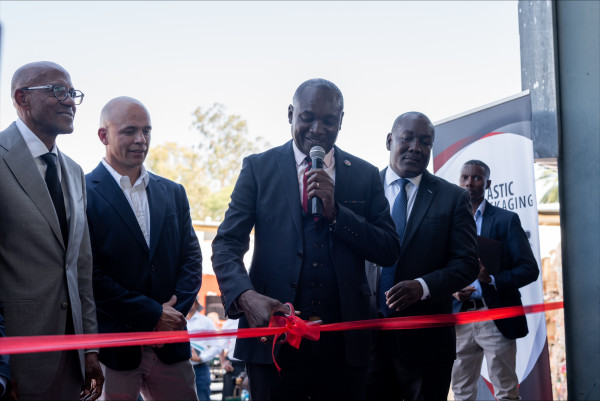
A N$24 million (over US$1.2million) investment through a partnership between Coca-Cola Beverages Africa (CCBA) (www.CCBAgroup.com) in Namibia and Plastic Packaging has culminated in the opening of a new polyethylene terephthalate (PET) flaking plant in Okahandja which will double the capacity of the only mechanical recycler of plastic waste in the country.
The plant was officially inaugurated by the Minister of Environment, Forestry and Tourism, Pohamba Shifeta.
“The Coca-Cola system aims to drive systemic change through a circular economy for packaging. We are leading the industry to help collect and recycle a bottle or can for every one we sell by 2030. We have a responsibility to help solve complex plastic waste challenges facing our planet and society, and we're leveraging our scale and reach to achieve our sustainability goals and reduce packaging waste,” said CCBA Chief Public Affairs, Communication and Sustainability Officer, Tshidi Ramogase.
“This facility is an example of how we work with partners across business, government and civil society to support or create closed loop systems to ensure our packaging is collected and recycled or reused.
“Supporting the establishment of a circular economy for packaging has both environmental and economic benefits since recycling has the potential to create jobs and to empower the informal waste collection sector in a circular economy.
“Unlike a traditional linear economy in which packaging is made, used and disposed of; a circular economy preserves the economic value of packaging through robust collection and recycling systems,” said Ramogase.
The completion of this cutting-edge recycling facility will enable Namibia Polymer Recyclers (NPR), a subsidiary of Plastic Packaging, to recycle up to 500 tons per month.
The recycling plant transforms discarded beverage bottles made from PET material into PET flakes with an international market value. The flaking process of post-consumer PET bottles involves sorting, shredding it into PET flakes, hot-washing and drying of flakes, which are then sent for further processing into recycled PET pellets and other end-uses.
This reduces the need to use virgin PET, while diverting waste from landfills and the environment.
“We are investing in infrastructure and exploring ways to support additional recycled PET capacity in each of the regions where we operate. These investments not only provide a source of recycled content for our packaging but also create additional demand for empty packages, driving increased collection.
“At CCBA, we are a proud industry leader in developing increasingly sustainable ways to produce, distribute and sell our products. We use our industry leadership to be part of the solution to achieve positive change and to build a more sustainable future for our planet,” said Ramogase.
Distributed by APO Group on behalf of Coca Cola Beverages Africa.
Issued By:
Enid Johr
PACS Director
CCBA in Namibia
Tel: +264 81 778 5381
Email: ejohr@ccbagroup.com
Wendy Thole-Muir
Head: Reputation and Communication
Coca-Cola Beverages Africa
Tel: +27 83 795 8524
Email: WThole-Muir@ccbagroup.com
About CCBA:
CCBA is the 8th largest Coca-Cola bottling partner in the world by revenue, and the largest on the continent. It accounts for over 40% of all Coca-Cola products sold in Africa by volume. With over 18,000 employees in Africa, CCBA services more than 720,000 customers with a host of international and local brands. The group was formed in July 2016 after the successful combination of the southern and east Africa bottling operations of the non-alcoholic ready-to-drink beverages businesses of The Coca-Cola Company, SABMiller plc and Gutsche Family Investments. CCBA shareholders are currently: The Coca-Cola Company 66.5% and Gutsche Family Investments 33.5%. CCBA operates in 15 countries, including its six key markets of South Africa, Kenya, Ethiopia, Uganda, Mozambique and Namibia, as well as Tanzania, Botswana, Ghana, Zambia, the islands of Comoros and Mayotte, Eswatini, Lesotho, and Malawi.
Learn more at https://www.CCBAgroup.com
Work underway to ensure transport is accessible for persons with disabilities
Government has embarked on a process to ensure that transport is sufficiently accessible to all categories of passengers, including persons with disabilities.
“The goal of a universally accessible national transport system is not only within reach. It is also a vital part of our efforts to build a South Africa that truly belongs to all who live in it,” President Cyril Ramaphosa said on Thursday in Johannesburg.
Delivering the keynote address at the Transport Summit on Universal Accessibility, the President said as part of a reformed approach to urban planning, integrated public transport programmes are being implemented in a number of municipalities.
“The Public Transport Network Grant is one of the mechanisms being used to promote the implementation of universal design and universal access. There are now ten integrated public transport network municipalities receiving the grant, with specific conditions on universal accessibility. Work is underway to roll out a standard for the universal accessibility of all road-based vehicles,” Ramaphosa said.
The President acknowledged that despite enabling legislation, there are still many areas where a lot more work is needed to make the national transport system fully accessible.
As part of ongoing efforts to ensure universal access in the transport system, the President outlined measures that have been put in place to ensure accessibility for persons with disabilities.
“The Department of Transport has gazetted a national policy for parking discs that will enable drivers with disabilities to use a disc obtained in one part of the country everywhere in South Africa. The Passenger Rail Agency of South Africa (PRASA) has developed a universal access policy with norms and standards. It has committed to speed up its work to ensure that trains are accessible and station platforms are level. The Gautrain has had level boarding on its trains since its inception.”
Usability considerations
He emphasised that in all future infrastructure development, the transport system should be designed with usability considerations rather than being retrofitted later.
“Airports Company South Africa, working with airlines, is working to improve accessibility for persons with disabilities across its facilities. These efforts include the introduction of designated parking spaces for persons with disabilities, assisted passenger lounges, and designated private search facilities at security gates.
“There is already a growing awareness within the aviation industry that passenger issues have not been dealt with from a universal access perspective and that more needs to be done,” the President said.
In the maritime sector, industry partners and state-owned entities are looking at improvements to the universal accessibility of inland waterways, river crossings, ports, sailing and yachting clubs.
“No discussion on universal access would be complete without considering the impact of emerging technologies and new business models on transportation, including e-hailing, car sharing and the like. These new systems are rapidly transforming the sector and must be factored into planning, in collaboration with the service provider companies. While we must prepare for new technologies and business models, we also have to fix our established systems, where serious shortcomings persist,” the President said.
“We have to address similar issues in the taxi industry, which transports around 70 percent of the South African population and is the dominant mode of public transport. It is pleasing that the minibus taxi services have, where tasked, been able to demonstrate reasonable accommodation of passengers with disabilities.”
He called for the improvement of road standards and signs so that pedestrian crossing infrastructure is accessible and integrated.
“Walking and cycling should not cost anyone their life. The last 27 years have seen little improvement in the accident rate among cyclists and pedestrians. This must change. It requires a change in the behaviour of drivers and in the culture of enforcement.
“There is much that we can achieve in the short term. Organisations in the transport space can train staff on the needs of persons with disabilities.
“Information materials on routes and timetables can be made more accessible for persons with disabilities. Municipalities can improve road signage and pedestrian access. We are confident that the incoming Transport Economic Regulator and the Public Transport Regulator will play important roles in supporting universal access,” the President said.
Over the past 30 years, South Africa has made considerable progress in both protecting and advancing the rights and dignity of persons with disabilities.
“In 2007, South Africa adopted the UN [United Nations] Convention on the Rights of Persons with Disabilities, which makes provision for the rights of South Africans with disabilities to equality, dignity, safety and freedom of movement.
“Through the Presidential Working Group on Disability, we have sought to ensure that our policies, programmes and practices are inclusive and that persons with disabilities are able to participate fully and freely in all aspects of our national life,” the President said. –SAnews.gov.za
nosihle
Thu, 04/25/2024 - 12:19
April is Freedom Month in South Africa, and what better way to celebrate than by focusing on achieving financial freedom? Financial freedom doesn’t mean being rich; it means having control over your finances and being able to make life decisions without being overly stressed about the financial consequences. ‘Financial freedom is about being prepared for …
CoGTA Minister to hand over Ikageng Light Industrial Park in N West
Cooperative Governance and Traditional Affairs (CoGTA) Minister, Thembi Nkadimeng, will hand over the new Ikageng Light Industrial Park in the JB Marks Local Municipality in Potchefstroom, North West, on Friday.
North West Acting Premier Nono Maloyi and JB Marks Local Municipality Executive Mayor Gaba Thithiba Ka Qhele will join the Minister.
According to the department, the project handover symbolises the District Development Model (DDM) in action, where all spheres of government work together for the delivery of services and uplifting communities.
“The handover will also form part of the North West government-led Thuntsha Lerole accelerated service delivery programme, which is being rolled out to mobilise communities to be part of the solution in addressing service delivery challenges confronting the province,” the department said in a statement.
The department said the scope of work undertaken by the Municipal Infrastructure Support Agent (MISA), an entity of the Department of Cooperative Governance, displays a comprehensive approach to community development.
This includes the refurbishment of existing facilities to establish six separate automobile workshops, the demolition of dilapidated structures, and the construction of modern workshops for artisans.
The project, totalling R53 696 250, also included the creation of office spaces to accommodate various occupants, including government and non-profit organisations, and establishing retail workshops catering to local artisans such as hair salons.
With the installation of essential amenities like ablution facilities and external infrastructure such as water, sewer, roads, landscaping, and security systems, the industrial park promises to ensure local economic development, stimulate township-based light industrialisation and create employment streams.
READ | Industrial parks to transform economy
The project, the department said, has created 19 jobs offering opportunities for women, men, and youth alike.
In addition, a small and medium-sized enterprise (SMME) has benefitted from the initiative, contributing to the growth and sustainability of local businesses.
The industrial park will also provide working space for business owners renting the space and provide various services from automotive mechanics, panel beaters, carpenters, upholsterers, welders to hair salons for community members.
Following the project handover, Nkadimeng will join the Acting Premier at the Thuntsha Lerole community engagement session. – SAnews.gov.za
Gabisile
Thu, 04/25/2024 - 11:15
We sent questions to the ANC, DA, EFF, IFP, FF Plus, ActionSA, PA, MK Party and RISE Mzansi
Issues in a global supply chain can significantly impact businesses, especially Small and Medium Enterprises (SMEs), which often lack the resources to navigate disruptions as effectively as larger corporations.Pre-Covid 19, the world was moving towards single ports of procurement to take advantage of economies of scale and lower costs that often resulted from using a …
The Presidency announces recipients of National Orders
The Chancellor of the National Orders, Director-General in the Presidency, Phindile Baleni, has announced the recipients of National Orders.
On Tuesday, Baleni made public the names of South Africans and foreign nationals, who will be awarded National Orders at a prestigious ceremony on 30 April 2024.
The National Orders are the highest awards that South Africa, through the President, bestows on citizens and well-known foreign nationals, who have contributed towards the advancement of democracy and who have significantly impacted the lives of South Africans.
The awards also recognise the contributions made by individuals who contributed and continue to contribute to building a non-racial, non-sexist, democratic and prosperous South Africa, as envisaged in the Constitution.
President Cyril Ramaphosa will bestow on deserving recipients the Order of Mendi for Bravery, the Order of Ikhamanga, the Order of the Baobab, the Order of Luthuli, the Order of Mapungubwe, and the Order of the Companions of OR Tambo.
The Order of Mendi
The Order of Mendi for Bravery recognises South African citizens who have performed acts of bravery.
The Order of Mendi in Silver recipients:
Mawilliams Kekana (posthumously): For her generosity and courageous act of sheltering freedom fighters when it was illegal to align with revolutionaries. She offered her house as a haven for liberation stalwarts against the hostile security police.
Ignatius ‘Iggy’ Mthebule (posthumously): For his gallant fight against an unjust system of apartheid. He is among many lost sons and daughters, whose demise in the hands of security police remains unknown, as he disappeared without a trace. This was at the height of political upheaval, where opposition was brutally silenced. Despite his disappearance, he left an indelible mark of courage and leadership.
Makhwezi McDonald Mtulu (posthumously): For his excellent contribution to the liberation of the people of South Africa. He responded to the brave call to join the military wing of the ANC forsaking the safety of his home to the fight for freedom and died in the process of executing the armed struggle.
Robert Anthony Basil Waterwitch (posthumously): For courageously pushing back against the oppressive system of the apartheid government. He ultimately lost his life for the ideals of freedom in the middle of the war against racism and inequality.
Coline Denise Williams (posthumously): For courageously pushing back against the oppressive system of the apartheid government. She ultimately lost her life for the ideals of freedom in the middle of the war against racism and inequality.
The Order of Ikhamanga
The Order of Ikhamanga recognises South African citizens who have excelled in the fields of arts, culture, literature, music, journalism and sport.
The Order of Ikhamanga in Gold recipients:
Nontando ‘Noni’ Helen Jabuva (posthumously): For her excellent contribution to the field of journalism and scholarship on the liberation struggle. Her affinity for history and storytelling through journalism informed and enlightened the nation.
Aggrey Klaaste (posthumously): For his exceptional contribution to quality journalism and as a reporter exposing the cruelties of apartheid and encouraging unity among the people of different political persuasions to fight for liberation. He was a nation-builder with a vision for an equal and thriving society.
Madala Muzwakhe Kunene: For his exceptional contribution to the arts, especially jazz music, using home-brewed sounds that are unique to South Africa. He has collaborated with some of the best talents in our country.
The Order of Ikhamanga in Silver recipients:
Agnus Gibson: For his contribution to filmmaking. He strived to provide a haven for black artists at a time when discrimination was normalised and practised with impunity. His collaborations produced iconic narratives of South African history and youth culture.
Emile Lester Jansen: For his contribution to the field of arts and hip-hop culture in South Africa. His artistry and activism formulated a unique lexicon now firmly known as Afrikaap, explaining the African origins of hip-hop.
Saray Nkusi Khumalo: For being an inspiring way-maker for many women through her quest of summiting seven mountains while raising funds. She inspires every African child to pursue what may seem to be impossible dreams.
Sophie Msoziswa Mahlangu: For her excellent contribution to the development of indigenous Ndebele arts. Her commitment to passing on knowledge to younger generations is commendable; she has become a bridge connecting generations.
Madosini Latozi Mphahleni (posthumously): For her exceptional service in preserving and elevating indigenous South African musical traditions. In a rapidly changing world, she stood as a guardian of these ancient sounds, ensuring they were not forgotten. Her commitment to passing on her knowledge to younger generations was unmatched, safeguarding the nation's identity and cultural heritage.
Trevor Dundas Mweli Skota (posthumously): For his contribution to the promotion of black African knowledge through his trailblazing work, including a biographical dictionary of notable black figures on the continent.
The Order of the Baobab
The Order of the Baobab recognises South African citizens who have contributed to community service, business and economy, science, medicine and technological innovation.
The Order of the Baobab in Gold recipients:
Blanche Valeria La Guma (posthumously): For her courageous fight for social justice and equality for all South Africans. She lived by the courage of her convictions and fought for the rights of workers and the liberation of the oppressed.
Zukiswa Patricia Matolengwe: For her commitment to realising social justice for the homeless and downtrodden using ingenious means of stokvels for financial empowerment. Her tireless work in providing dignified living space for the homeless is laudable.
The Order of Luthuli
The Order of Luthuli recognises South African citizens who have contributed to the struggle for democracy, nation-building, building democracy and human rights, justice and peace as well as for the resolution of conflict.
The Order of Luthuli in Gold recipients:
Mxolisi ‘Dicky’ Jacobs (posthumously): For his ultimate sacrifice to the struggle for liberation. His life ended by defending the principles of a just and equal society. Although his life was cut short, he remains a towering stalwart of the struggle who laid down his life for the liberation of his people.
Peter Cyril Jones (posthumously): For his courageous contribution in mobilising communities across the length and breadth of South Africa. He was one of the leading lights advocating for the Black Consciousness message of self-reliance, pride and self-affirmation for the oppressed people.
Benjamin Langa (posthumously): For his ultimate sacrifice for equality and social justice in South Africa. He endured unimaginable pain and remained loyal to the cause until the end. His legacy remains a beacon of light and inspiration to many.
Thobekile ‘Tobsy’ Madaka (posthumously): For his gallant fight against the oppression of our people. He fearlessly spoke truth to power and eventually gave his life for the democracy of South Africa. He lived by the courage of his convictions and faced the wrath of the oppressive regime.
Siphiwo Mthimkhulu (posthumously): For his gallant fight against the oppression of our people. His fearlessness and leadership belied his age as he boldly confronted the forces of oppression and eventually gave his life for the democracy of South Africa. He lived by the courage of his convictions and faced the wrath of the oppressive regime.
Prof Harry Ranwedzi Nengwekhulu: For his gallant fight for the liberation of the people of South Africa. He has straddled academia and political activism with the goal of a free South Africa always in his mind and has served as a source of inspiration for many Black Consciousness activists and others.
Kenneth Rachidi (posthumously): For his courage to face a repressive government and resist its unjust laws that promoted inequality. He lived by the ethics of Black Consciousness. His activism and vocal opposition to oppression remain a legacy and inspiration to South Africans.
Annie Silinga (posthumously): For her commitment to the liberation struggle. She played a leading role in some of the liberation campaigns. She continued to campaign against passes at national and local events.
Nokuthula Simelane (posthumously): For her incredible bravery in the face of brutal security operatives. She lived by the courage of her convictions and faced the wrath of the oppressive regime. Her ultimate sacrifice for the liberation of all South Africans will remain in the annals of our nation’s history.
The Order of Mapungubwe
The Order of Mapungubwe recognises South Africans who have accomplished excellence and exceptional achievement to the benefit of South Africa and beyond.
The Order of Mapungubwe in Silver:
Prof Mulalo Doyoyo (posthumously): For his enormous contribution to academia and research in the field of aerospace. His outstanding work continues to open doors. The sciences have been enhanced by his participation and young aspirant scientists looked up to him as a mentor.
The Order of the Companions of OR Tambo
The Order of the Companions of OR Tambo recognises eminent foreign nationals and other foreign dignitaries for friendship shown to South Africa. It is therefore an order of peace, cooperation and active expression of solidarity and support.
The Order of the Companions of OR Tambo recipients:
Huub Bammens from the Netherlands: For his contribution to promoting awareness of human rights violations by the South African apartheid government to the world via Radio Freedom. His technical skills were used to build studios for the liberation movement.
Donna Katzin from the United States: For her innovative thinking in assisting post-apartheid South African businesses get ethical investments by promoting networking between South African businesses and American investors.
Ken Luckhard from Canada: For his selfless service to South Africa through anti-apartheid activism. He organised a mass disruptive protest against a visiting English cricket team that had links with apartheid sport.
Nicholas Stadlen from the United Kingdom: For his steadfast standing with the South African liberation movement at a time when it was not convenient to do so. He believed in equality and supported exiles as a friend of South Africa.
Fulco van Aurich from the Netherlands: For his contribution to promoting awareness of human rights violations by the South African apartheid government to the world via Radio Freedom. He organised and developed a campaign in the Netherlands to support Radio Freedom.
Brenda Wall from Canada: For her selfless service to South Africa through anti-apartheid activism; she organised a mass disruptive protest against a visiting English cricket team that had links with apartheid sport.
“We congratulate the recipients and call on all South Africans to join us in celebrating these outstanding South Africans and distinguished friends of South Africa,” Baleni said. – SAnews.gov.za
Gabisile
Wed, 04/24/2024 - 11:31

“Triple-Double: NBA Africa Startup Accelerator” Will Provide Top African Startup Companies in the Sports and Creative Industries with Funding and Mentorship Across Event Management and Ticketing, Youth Development, AI and Digital Marketing; ALX to Operate Triple-Double: NBA Africa Startup Accelerator and Oversee Selection Process; Startups Can Apply to Participate at TripleDoubleAccelerator.NBA.com.
In support of President Biden's Digital Transformation with Africa Initiative and building on the U.S. Department of Commerce-wide Africa strategy, NBA Africa today announced the launch of “Triple-Double: NBA Africa Startup Accelerator,” a startup accelerator based on the continent focused on early-stage African startup companies.
Triple-Double: NBA Africa Startup Accelerator will support Africa's tech ecosystem and the next generation of African tech entrepreneurs by providing them with access to mentorship and capital that will help drive growth in the sports and creative industries.
Operated by ALX Ventures, a leading technology incubator that provides the continent's tech leaders with access to the skills and tools to launch and scale their startups, Triple-Double: NBA Africa Startup Accelerator is open to early-stage startups in Africa that develop solutions in event management and ticketing, youth development, AI, and digital marketing in the sports and creative industries. Startups can apply to participate at TripleDoubleAccelerator.NBA.com through Friday, May 31, after which the submissions will be narrowed down to the top 10.
The 10 selected startups will then be paired with mentors comprised of NBA Africa and ALX leadership, and other corporate stakeholders, who will provide guidance to the companies with a focus on product development, business growth and go-to-market strategy. In September, NBA Africa will hold a Demo Day in New York City that will coincide with the United Nations General Assembly (UNGA). Participating companies will pitch their products to a panel comprised of top industry leaders from the U.S., Africa, and around the world. The panel will then determine the four winning companies, which will be awarded financial support, mentorship, and the opportunity to work with NBA Africa and the Basketball Africa League (BAL) on their current and future initiatives on the continent.
The announcement was made today by NBA Africa CEO Clare Akamanzi, who was joined by U.S. Secretary of Commerce Gina M. Raimondo and U.S. Trade and Development Agency Director Enoh T. Ebong at the American Chamber of Commerce's Business Summit in Nairobi, Kenya.
“We are thrilled to launch an accelerator program based on the continent and focused on early-stage African startups,” said Akamanzi. “This groundbreaking new initiative reflects our commitment to expanding the African sports ecosystem, and these incredible companies will be at the forefront of shaping the future of sport on the continent.”
Additional information about Triple-Double: NBA Africa Startup Accelerator will be announced at a later date.
Distributed by APO Group on behalf of National Basketball Association (NBA).
Photo: https://apo-opa.co/4daIrqQ (U.S. Trade and Development Agency Director Enoh T. Ebong and NBA Africa CEO Clare Akamanzi at the Triple-Double: NBA Africa Startup Accelerator launch) (Credit: NBA Africa)
Video: https://apo-opa.co/3UtDGBg (Triple-Double: NBA Africa Startup Accelerator)
Contact:
Pawel Weszka
NBA Africa Communications
pweszka@nba.com
+27 10 0072666
About NBA Africa:
NBA Africa is an affiliate of the National Basketball Association (NBA), a global sports and media organization with the mission to inspire and connect people everywhere through the power of basketball. NBA Africa conducts the league's business in Africa, including the Basketball Africa League (BAL), and has opened subsidiary offices in Cairo, Egypt; Dakar, Senegal; Lagos, Nigeria; and Nairobi, Kenya. The NBA has a long history in Africa and opened its African headquarters in Johannesburg, South Africa in 2010. The league's efforts on the continent have focused on increasing access to basketball and the NBA through youth and elite development, social responsibility, media distribution, corporate partnerships, NBA Africa Games, NBA Stores, the BAL, and more.
NBA games and programming are available in all 54 African countries, and the NBA has hosted three sold-out exhibition games on the continent since 2015. The BAL, a partnership between the International Basketball Federation (FIBA) and NBA Africa, is a professional league featuring 12 club teams from across Africa that tipped off its fourth season in March 2024. Fans can follow @NBA_Africa and @theBAL on Facebook, Instagram, X and YouTube.