• Skip to main content
  • Skip to header right navigation
  • Skip to after header navigation
  • Skip to site footer
MyZA

MyZA

News, Directory, Events and Other Stuff

  • Social Media
  • Sport
  • World News
  • Home
  • Submit News
  • Directory
  • Events
  • Stratlec
  • TFSA
  • News
    • APO
    • Today’s Sport News
    • Todays Social Media and Tech Headlines
    • Today’s World News
    • Today’s SA Financial News
  • Contact
You are here: Home / Archives for Government

Government

28 May 2024

Farmyards to restore healthy diets

Location: News

Farmyards to restore healthy diets

Gauteng Social Development, Agriculture, Rural Development and Environment MEC, Mbali Hlophe, says the roll out of a farmyards initiative will help instill healthy diets in townships, hostels and informal settlements. 

The farmyard is an innovative concept largely targeted at youth and women.

These beneficiaries receive repurposed containers that are converted into local stores for local farmers to sell their produce to their communities in an effort to instill a healthy diet among residents. 

There are four farmyards in Gauteng’s townships with the necessary equipment and infrastructure as part government’s project to revitalise the township economy.

“This is about bringing back good health and nutrition to our townships. When you look at the stats in our disposal, they show that many people especially children are not eating nutritious meals required for their growth, on a daily basis. By bringing farmyard[s] closer to our people, we are making sure that people start paying attention to their health.

“We encourage beneficiaries of farmyards to ensure that they sell the kind of food that is required in a home meal, to provide nutrient rich crops like spinach, moringa, and additionally provide proteins through the live or frozen chickens they sell,” she said.

This initiative, the MEC said, is also a direct response to the province’s relentless fight to ensure the province is food secure.

“Food security is one of our elevated priorities and boasts a basket of services available to ensure the province is food secure, and with regards to farmyards, we have identified subsistence farmers as enablers to help the province become food secure in a sustainable manner,” the MEC explained. 

The food security basket includes a variety of programmes including food distribution through the food banks, food parcels, Community Nutrition and Development Centres ( CNDCs) and NPOs as vehicles to  ensure that the poor and vulnerable access sustainable, nutritious and safe food in a sustainable manner. This is in line with policy guidelines enshrined in the National Policy on Food Nutrition Security together with Household Food and Nutrition Security Strategy approved by Cabinet in 2013.

More importantly, the MEC indicated that while the initiative secures self-reliance and sustainable food security, it also responds to the joblessness challenge especially for the youth in the province. 

One of the young persons that benefitted from the farmyards is 32-year old Simangele Sibande. 

“The farmyard program provided me with a wonderful opportunity to create my own business to provide for my family and also show other young people that there are opportunities in agriculture.

"What is even more fulfilling is that I was able to employ two other young people to assist me in selling produce from local farmers in Zithobeni,” she said. 

Hlophe noted that the project is gradually shifting the prevailing perceptions in the townships that agriculture is unattractive and associated with filth and frowned upon. 

“A lot of people when they think agriculture, they think something far. But through the project, we have been able to show that agriculture is economically viable, and that as a department we remain committed to continue to facilitate access to markets,” the MEC said. - SAnews.gov.za


Edwin
Tue, 05/28/2024 - 16:09
344 views
Read moreFarmyards to restore healthy diets
28 May 2024

All systems go for 2024 Elections

Location: News

All systems go for 2024 Elections

With just hours left to go before voting day, the Electoral Commission is ready for the seventh National and Provincial Elections.

“Our clarion call to all South Africans is - let's go out in huge numbers and vindicate our democratic right to vote,” Chief Electoral Officer (CEO) of the Electoral Commission, Sy Mamabolo, said on Tuesday at a briefing in Midrand.

The commission applauded political parties and independent candidates for relatively peaceful campaigns, adding that the spirit of tolerance and forbearance must be taken on Election Day tomorrow.

“It is time now for all of us to work together to ensure that these elections are free, fair, safe, and that the outcome reflects the will of the South African electorate.”

Tuesday marked the second day of the casting of special votes at 22 626 voting stations and home visits over the past two days with 937 144 voters having been processed.

The commission said it would use the “lessons and experiences” over the last two days of special voting to further refine operations to positively impact on voter experience on Election Day.

“The commission urges all the remaining 26 million eligible voters to go out and cast their votes tomorrow.”

It reminded voters that its network of 23 292 voting stations will open for voting at 07h00 and close at 21h00.

“It is important to emphasise that eligible voters who will be at the voting station at 21h00 will be allowed to vote and not turned away.”

In addition, voters must vote where they are registered.

“The only exception to the general rule is that a voter may vote outside of their registered voting district only after notifying the CEO. Notifications in this regard closed on May 17. Approximately 360 000 voters have been approved to vote outside their voting districts.”

The commission reminded all eligible voters of the following:

  • Bring along valid South African identity document.
  • Each voter will be verified on the voters roll and marked with ink on the left thumb.
  • Each voter will receive three ballot papers: the national, regional, and provincial ballot papers. Voters are reminded to indicate their choices with one mark on each ballot (voters who have given pre-notification to vote at a voting stations outside the province in which they are registered will receive only the national ballot).
  • Each ballot paper will be validated with a stamp on the reverse.
  • All three ballots must be deposited in the ballot box at the voting station.
  • It is prohibited for a voter to take a photograph of their marked ballot paper. This arrangement is necessary to protect the secrecy of the choice of voters and to avoid voters being coerced or unduly induced into making political choices.

The commission called on registered voters to check the correctness of their voting station through the following channels:

  • By SMS ID number to 32810
  • Using voting station finder application on website
  • Contact centre on 080011800.
  • The IEC APP downloadable from Apple and Google app stores. 

Load shedding

The commission said that load shedding is not expected on voting day.

“Furthermore, Eskom has given assurances that there are no plans for scheduled maintenance work or load shedding in the period around voting day.

“Instances of power outages must be reported to Eskom in the normal course to enable effective responses.”

Identity documents

For voters who may need identity documents, the Department of Home Affairs will operate all its offices between 07h00 to 21h00 to facilitate collection of identity documents and the issuance of temporary identification certificates.

The commission said it was confident that all preparations are in place for free, fair elections.

“A key aspect of our preparations included engaging with various stakeholders which includes political parties, independent candidates, the media, security and government structures at all levels, civil society organizations, community organizations, and the voters of South Africa. A number of state entities and municipalities are supporting the logistics of elections.” -SAnews.gov.za


Neo
Tue, 05/28/2024 - 20:22

284 views
Read moreAll systems go for 2024 Elections
28 May 2024

Families fear eviction from old train yard

Location: News

Some have lived in “Oya Town” near Maitland Station for eight years

Read moreFamilies fear eviction from old train yard
28 May 2024

SA condemns the unlawful targeting of refugee camps in Rafah 

Location: News

SA condemns the unlawful targeting of refugee camps in Rafah 

The South African government has joined the international community in condemning the “deplorable” and “brutal attacks” on innocent Palestinian civilians.

This is after Israeli forces bombed a tent camp housing displaced Palestinians in a designated safe zone on Sunday night.

According to reports, at least 45 people, including many women and children were killed, with some of these victims reported to be in critical condition.

“The heinous attacks came two days after the International Court of Justice (ICJ) ordered Israel to end its military offensive in Rafah, where more than half of Gaza’s 2.3 million population had sought shelter before Israel’s incursion of Rafah,” the Department of International Relations and Cooperation said in a statement. 

South Africa, according to the department, said it was “gravely” concerned with the continuous targeting of hospitals, medical infrastructure, schools, and holy sites, which shelter civilians who endure most of the inhumane attacks. 

“These continued attacks on innocent civilians pose an extreme risk to humanitarian supplies, basic services in Gaza, the survival of the Palestinian medical system, and the survival of Palestinians in Gaza as a group.” 

The department believes that the current conditions confirm that South Africa is justified for approaching the ICJ in 2023, seeking an order to prevent Israel from committing genocide against the Palestinian people. 

“What we are witnessing today bears testimony to South Africa’s assertions,” the department added. 

The ICJ, the department explained, has jurisdiction over the situation in Palestine.

“We, therefore, call on the Office of the Prosecutor of the International Criminal Court to urgently act to ensure accountability for those that committing heinous crimes and protect the rights of Palestinians. 

“The issuance of arrest warrants which comply with international legal standards is becoming more urgent to bring those responsible to justice. It is the collective duty of the international community to ensure that atrocities of this nature are duly prosecuted in terms of the Rome Statute and the Geneva Conventions.” 

The department believes that there can be no real and lasting peace in the region in the absence of justice for Palestine and a just and equitable resolution to the Palestinian question – for the benefit of both Palestinians and Israelis. 

“Escalation not only threatens regional stability but risks further inflaming an already tense and hugely volatile situation on the ground. Accordingly, it must be regarded as unacceptable and South Africa, therefore, strongly implores de-escalation. 

“The pattern of cyclical escalation must be broken. Our collective human duty to call for a comprehensive and permanent ceasefire cannot be ignored.” 

South Africa is urging the international community to respect and uphold International Law, International Humanitarian and Human Rights Law, and relevant United Nations resolutions. 

“We must pose the question of how long the international community will continue to watch as an entire population is annihilated before the world can unite to urgently act against these brutal and incessant attacks. Nothing can justify the deliberate killings and injuring of civilians as an entire population endures destruction at a scale and speed without parallel in modern history.” – SAnews.gov.za

Gabisile
Tue, 05/28/2024 - 14:00

4 views
Read moreSA condemns the unlawful targeting of refugee camps in Rafah 
28 May 2024

Voters will be safe in Philippi, say community leaders and police

Location: News

No repeat of last November’s disruption of registration process

Read moreVoters will be safe in Philippi, say community leaders and police
28 May 2024

The future of digital identity in South Africa (By Gur Geva)

Location: News
iiDENTIFii

By iiDENTIFii (https://iiDENTIFii.com/) CEO and co-founder Gur Geva. 

When it comes to accessing essential services, such as national medical care, grants and the ability to vote in elections to shape national policy, a valid identity document is critical. 

In South Africa, undocumented citizens are restricted in their ability to collect social grants or go to a hospital. Even those with valid IDs spend hours in queues owing to inefficient and protracted identification processes.

Faster, digitised services would have a transformative impact on the level of financial inclusion of the country's citizens. iProov's report (https://apo-opa.co/3VfYD37), "Unlocking financial inclusion with digital identity and biometric verification," emphasises that digital identity programmes open essential pathways for the unbanked and disenfranchised to access financial and welfare services and, in the case of governments, offer a reduced administrative burden and increased economic growth.

In theory, the positive impact is evident, but how can South Africa with its infrastructural challenges and high levels of inequality put this verification system into practice?

The challenge

An estimated 500 million (https://apo-opa.co/4aFwdEf) people in Africa are living without any form of valid legal identification. In response to this crisis, the African Union Commission is working on an initiative (https://apo-opa.co/3KmsnVP) to develop an interoperability framework for digital identity. The need for this is clear.

In South Africa, for example, lengthy identification processes see citizens queueing for up to three hours to renew a driver's license. Many people (https://apo-opa.co/452hke4) leave their homes in the dark and queue from dawn for their social security grants only to be turned away when the queue is cut because of system failures.

In an address to Parliament (https://apo-opa.co/3wU9pCU), Dr Aaron Motsoaledi, Minister of Home Affairs of South Africa, states that the main reason for the long queues lies in the State Information Technology (SITA) system often being down. The DHA relies on SITA for connectivity, especially in rural villages. Branch Appointment System (BAPS) kiosks that facilitate the live capture of IDs and passports have been set up to bridge this gap. While these efforts are useful, digital identity could transform these processes, whittling down lengthy queues by authenticating identity in a matter of seconds.

In fact, South Africa is pursuing digital identity in some form, through the form of a Smart ID card that stores face and fingerprint biometrics. However, this pioneering initiative is being held back by a restrictive, lengthy onboarding process. Smart ID cards can only be issued from a selection of offices with a ‘live capture system' as well as through certain banks that use the system in-house. This is not enough to implement secure digital identity at scale.

Reframing the identity conversation

Many of South Africa's challenges stem from systemic inequality. This inequality in access across gender, location and education lines has real implications for identity management (https://apo-opa.co/3KmsnVP). For this reason, the conversation needs to shift from identity being an administrative tool to identity being an essential human right (https://apo-opa.co/3KmsnVP).

Whether a person is applying for legal employment, registering at an address, setting up a phone contract, or opening a bank account, a proven identity that can be authenticated is an essential part of the process. Widespread, effective digital identification benefits citizens and generates significant economic value for governments and financial institutions as well.

As a result, a growing number of governments are teaming up with organizations worldwide to develop digital identity programmes that are not only convenient, but open up essential pathways for previously disadvantaged or marginalized individuals to help them access financial and welfare services.

Ground-breaking identity verification in practice

iProov and iDENTIFii have seen the positive impact of Dynamic Liveness Technology in delivering fast, secure and effortless passive face biometric authentication. In addition to being a strong digital alternative to historic forms of identity verification, its anti-spoofing technology is also effective in detecting and protecting against future cyber threats. The U.S. Federal Government lists iProov as a Synthetic Identity Fraud Mitigation Provider and government clients include the U.S. Department of Homeland Security, the UK Home Office, the Australian Tax Office, and GovTech Singapore.

The UK Home Office EU Settlement Scheme, a digital application process for EEA nationals living in the UK post-Brexit, is a powerful example of the impact of digital identity on public services. The scheme was developed by iProov, WorldReach Software, and InnoValor, and provides a simple, secure, and usable solution for applicants to apply for settlement status online. The app includes key features such as remote identity documentation checking using NFC or OCR, and biometric identity authentication via iProov's Dynamic Liveness technology. The app has been extremely successful, with over 4.2 million applications completed, high levels of identity assurance, and an average satisfaction rating of 4.1 stars.

How open are citizens to digital identity?

The Digital Transformation Strategy (https://apo-opa.co/3KmsnVP) for Africa (2020-2030) highlights both the potential social and economic implications of digital IDs for Africans, noting that digital IDs not only support social development, but also enable meaningful participation in productive processes to generate economic growth, spur innovation, and support entrepreneurship. Besides being viewed as an enabler for realising all these policy objectives, digital IDs are seen as critical for the successful implementation of the African Continental Free Trade Area (AfCFTA).

Digital identity programmes can bridge the identity gap by being accessible through even basic smartphones, thus eliminating barriers such as cost and complex application processes that often require travel. A case in point is the European Union Digital Identity Wallet (EUDIW) a decentralised, interoperable digital tool that aims to provide all 447 million EU citizens with the ability to easily store and exchange identity documents and credentials securely, while having full control over their data. Using identity verification will see important public and private services, such as online government services, online banking, remote prescriptions, and SIM registration become significantly more accessible.

The importance of inclusive and safe digital identity

For South Africans to truly embrace and reap the rewards of digital identity, accessibility and security are two critical factors government and other essential service providers must consider.

Adopting accessible verification models maximises inclusivity of digital identity programmes. Traditional remote verification methods, such as video calls or passwords, lack user convenience and may exclude individuals with language barriers or disabilities. By contrast, biometric face verification uses a front-facing camera and does not rely on the end user's technical abilities.

Security is also key as these initiatives must provide the maximum number of people with digital identities and financial access, while consistently mitigating the risks of cybersecurity threats. As with any technology that enables access to a broad range of secured data and financial services, there is a risk of digital identities being compromised for fraud, money laundering, or other illicit activities.

With generative AI contributing towards the sophistication of tools such as deepfakes, this risk is higher and the crime is easier to perpetrate than ever before. Liveness confirms that the person verifying their identity exists and is a live human being with the right to access the online account or service. It also assures that it is a real person and not a photo or mask or other presentation attack. It does not protect against scalable digital attacks like deepfake where synthetic images can be injected into device sensors.

Successful digital identity schemes, such as Estonia's, yield economic benefits for the government and businesses, and demonstrate the positive impact of such initiatives. Similarly, as the European Union's (EU) initiative progresses, other nations can learn valuable lessons from them and adopt strategies that foster a society characterised by enhanced inclusivity and economic prosperity.

Looking forward

While the local government is still rolling out digital identity, the financial services industry in South Africa has been an early adopter. Not only has it proven the ability of digital identity to be more efficient and safer, but it has also shown that it is possible to use biometrics at scale.

Several of iiDENTIFii's South African banking clients have been able to address downtime issues by using subsequent authentication. iiDENTIFii has prioritised this based on the understanding that an authentication process that keeps customers secure and engaged, is a successful one. For this reason, its platform is able to process individuals by storing their reference templates and enabling subsequent authentication. If financial institutions and the government collaborate in digitising government systems, it could make true financial inclusion and accessible digital identity at scale a reality, in a way that reaches all South Africans.

Distributed by APO Group on behalf of iiDENTIFii.

About iiDENTIFii: 
iiDENTIFii (https://iiDENTIFii.com/) is an award-winning face authentication and identity verification platform that distinguishes itself through its use of 3D and 4D Liveness® detection. Purpose-built for enterprises across Africa and the Middle East, iiDENTIFii enables frictionless, scalable customer onboarding in seconds from anywhere and on any device. Founded in 2018, iiDENTIFii has become a proven key partner in multiple tier 1 African banks. The technology plugs seamlessly into existing infrastructures, including mobile and web-based platforms.

Media files
iiDENTIFii
Download logo
Read moreThe future of digital identity in South Africa (By Gur Geva)
28 May 2024

KZN budget cuts hit childcare organisations hard

Location: News

In 2022/23 Department of Social Development funding for non-profit organisations was R755-million. It has dropped to R695-million.

Read moreKZN budget cuts hit childcare organisations hard
27 May 2024

Get us jobs, contract workers tell Gauteng Premier

Location: News

The contracted workers were awarded compensation of up to R24,000 by the Labour Court. They refused to accept this and instead are demanding jobs.

Read moreGet us jobs, contract workers tell Gauteng Premier
27 May 2024

Springboks, Kolisi honoured by African Union for Rugby World Cup (RWC) triumph

Location: Sport

South African Rugby
Download logo

The Springboks added prestigious continental awards to their impressive list of accolades following their back-to-back Rugby World Cup titles last year, when they received the Team of the Year and Sportsman of the Year awards at the African Union Sports Council Region 5 Sports Awards in Lusaka, Zambia on Saturday.

The glittering awards ceremony, to celebrate the pinnacle of sporting excellence, was attended by athletes, sports luminaries, and government dignitaries from across the ten countries that make up Region: Angola, Botswana, Lesotho, Malawi, Mozambique, Namibia, South Africa, Swaziland, Zambia, and Zimbabwe.

The awards add a continental flavour to the accolades received by the world champions, with the Springboks most recently being crowned the Team of the Year at the SA Sports Awards and SA Rugby Awards, while Kolisi received the People's Choice and Sports Star of the Year Awards.

SA Rugby President Mr Mark Alexander congratulated the team and Kolisi for being honoured in such a prestigious manner: “This award underlines the continental significance of the Springboks' consecutive Rugby World Cup victories and the key role Siya played in guiding the team both on and off the field.

“They deserve all the recognition for their hard work and sacrifices over several years to lift the Webb Ellis Cup in France last year and Japan in 2019, and we are delighted to see how far and wide their achievements have reached.

“The team and Kolisi have been critical in showing what unity, teamwork, and overcoming numerous barriers on and off the field can achieve in nation-building and building winning teams, and we hope this inspires teams across Africa to follow in their footsteps and achieve similar success.”

The competition for these awards was stiff, with the Springboks going up against the Malawian Scorchers – the national women's football team – and Botswana's senior men's 4x400m relay team, while Kolisi triumphed in a highly competitive category, edging out notable athletes such as Bayapo Ndori from Botswana, and Mancoba Mahlatsi from Swaziland.

The ceremony's keynote address was delivered by Her Excellency Mutale Nalumango, Vice President of Zambia. The African Union Sports Council Region 5 is committed to the development and promotion of sports within the Southern African region. The council, through various programmes and events, aims to foster unity, enhance athletic performance, and support athletes in achieving their highest potential.

Issued by SA Rugby Communications

Distributed by APO Group on behalf of South African Rugby.

For further information, please contact:
Andy Colquhoun
GM: Communications and Commercial
+27 (0) 21 928 7010
+27 (0) 82 926 0789
andyc@sarugby.co.za

De Jongh Borchardt
Communications Manager
+27 (0) 21 928 7021
+27 (0) 82 999 9979
dejonghb@sarugby.co.za

Rayaan Adriaanse
Junior Rugby Media Manager
+27 (0) 21 928 7013
+27 (0) 82 999 0022
rayaan@sarugby.co.za

Sindiswa Ximba
Media Operations Coordinator
+27 (0) 21 928 7011
+27 (0) 60 504 1069
sindiswa.ximba@sarugby.co.za

Zeena Isaacs
Springbok Media Manager
+27 (0) 21 928 7020
+27 (0) 82 357 3112
ZeenaI@sarugby.co.za

JJ Harmse
Sevens and Women's Rugby Media Manager
+27 (0) 21 928 7014
+27 (0) 71 480 4570
jjharmse@sarugby.co.za

Read moreSpringboks, Kolisi honoured by African Union for Rugby World Cup (RWC) triumph
27 May 2024

Harnessing Innovation toward Africa’s Inclusive Growth.

Location: MyPR

Dr Velenkosini Matsebula is a Senior Lecturer in Development Finance at Stellenbosch Business School. As we commemorate Africa Day, we are reminded of the continent’s rich cultural heritage, its vibrant diversity, and its people’s resiliency. This day serves as a beacon of unity and progress for Africa. However, beneath the celebration lies a critical reflection …

Read moreHarnessing Innovation toward Africa’s Inclusive Growth.
27 May 2024

Government activities for the week 27 – 31 May 2024

Location: News

Government activities for the week 27 - 31 May 2024

On Monday, 27 May, Minister of Social Development Lindiwe Zulu launches the Khuseleka One Stop Centre at the Saartjie Baartman Centre for Women and Children in Manenberg, Cape Town.

Also on Monday, Minister in the Presidency for Women, Youth and People with Disabilities Nkosazana Dlamini Zuma launches the Demand-LED and job creation programme for persons with disabilities at the Coastlands Unhlanga Hotel and Convention Centre.

On 27 May, NSFAS briefs media on progress relating to the disbursement of student allowances at Tshedimosetso House, Hatfield, Pretoria, starting at 11am.

On Monday, Minister of Health Joe Phaahla casts his special vote in his home village of Ga-Phaahla, Limpopo.

Monday is Day 1 of special voting in the National and Provincial Elections, from 9am to 5pm.

Tuesday, 28 May, is Day 2 of special voting in the National and Provincial Elections, from 9am to 5pm.

On Wednesday, 29 May, is Election Day, from 7am to 9pm.

Janine
Mon, 05/27/2024 - 12:29

51 views
Read moreGovernment activities for the week 27 – 31 May 2024
27 May 2024

Villagers stuck while government probes diversion of water from Giyani dam

Location: News

Deputy water minister says investigation is still going on

Read moreVillagers stuck while government probes diversion of water from Giyani dam
26 May 2024

Achievements and challenges: President reflects on sixth administration

Location: News

Achievements and challenges: President reflects on sixth administration

As the term of the sixth administration draws to a close, President Cyril Ramaphosa has reflected on the achievements and challenges faced by government during this five year period.

South Africans are expected head to the polls in the National and Provincial Elections this week to elect leaders for the seventh administration.

In an address to the nation on Sunday, the President said that at the start of his term in office in 2019, South Africa “stood at a turning point”.

“We had endured a decade of corruption and state capture, of weak economic growth and the erosion of our public institutions. Today, we have put that era behind us. We have placed South Africa on a new trajectory of recovery and laid a strong foundation for future growth.

“We have taken significant steps to reform our economy by implementing a number of reforms that affect various sectors of the economy. In tackling crime and corruption, we have introduced a number of initiatives and measures to reposition our criminal justice system.

“We have faced many challenges along the way, which have tested our resilience and our resolve. Yet, in each instance, we have confronted these challenges together. We have remained united. We have worked in partnership and in solidarity,” the President said.

State Capture and corruption

President Ramaphosa said that the nation brought state capture to an end.

“We dislodged the criminal networks that had stolen billions from our people, that had eroded our public institutions and that had undermined the rule of law. Together, we worked to rebuild our law enforcement agencies, our security services, our state-owned companies and a number of other public bodies.

“Through the work of institutions like the NPA’s [National Prosecuting Authority] Investigating Directorate, the Hawks and the SIU, several state capture and corruption cases have been brought to court and billions of Rands in stolen funds have been recovered,” he said.

To further strengthen the work of the NPA, President Ramaphosa has now signed into law the establishment of the NPA’s Investigating Directorate against Corruption as a permanent entity.

“There is still much that we need to do to end corruption. However, as a country, we have sent a clear message to the corrupt that they can no longer expect to get away with their crimes with impunity and without consequence,” President Ramaphosa said.

COVID-19 pandemic

The President remarked that the COVID-19 pandemic, which swept across the world and pushed economies to their limits, was one of the defining moments of the last five years.

More than 100 000 South Africans died during the pandemic with some two million jobs lost.

“We introduced a massive package of social and economic support to protect vulnerable businesses, workers and households from the destructive effects of the pandemic. More than 5.7 million workers received wage support through the special UIF scheme.

“Through the introduction of the special SRD [Social Relief of Distress] grant, we provided relief to more than 11 million unemployed people at the height of the pandemic.

“Working together, we succeeded in administering more than 39 million COVID-19 vaccine doses. Even during the worst moments of the pandemic, we endured and we overcame. This is how we are as South Africans. We confront even the greatest of challenges with determination and courage,” the President said.

Rebuilding the economy

President Ramaphosa said rebuilding the economy following the devastation of the COVID-19 pandemic has been characterised by South Africans coming together “in social partnerships to drive investment, to build infrastructure and to remove the obstacles to inclusive growth”.

He highlighted that as a result, the economy has now returned to levels seen before the pandemic and “we have recovered the jobs lost to the pandemic”.

“Together, we supported Eskom’s efforts to improve the performance of its power stations. We enabled investment in new electricity generation capacity on a scale that is unprecedented in our history.

“Working with financial institutions, development agencies, business and professional associations, we revitalised investment in infrastructure. The value of projects currently in construction is over R230 billion, including energy, water infrastructure and rural roads projects.

“Together, we mobilised more than R1.5 trillion in new investment commitments. This has led to the opening of new factories, mines, data centres and production lines.

“Working with private sector partners, we established the Youth Employment Service, which has created over 144 000 work experiences for young people. We have worked across government and with NGOs to implement the Presidential Employment Stimulus, which has created more than 1.9 million work and livelihood opportunities for unemployed South Africans,” he said.

Into the future

The President emphasised that the sixth administration and all of the work it has done is a springboard for building a better future.

“The last five years have been a time of rebuilding and recovery. It has been about working together not only to meet the challenges of the moment, but to put in place firm foundations for a better future.

“As this sixth administration draws to a close, and as we prepare for the seventh administration, let us build on the progress that we have made. At this moment in our path to renewal, we cannot afford to turn back. There is more work to be done,” President Ramaphosa said. – SAnews.gov.za

NeoB
Sun, 05/26/2024 - 19:50

209 views
Read moreAchievements and challenges: President reflects on sixth administration
26 May 2024

President Ramaphosa wishes IEC well ahead of elections

Location: News

President Ramaphosa wishes IEC well ahead of elections

President Cyril Ramaphosa has wished the Electoral Commission of South Africa (IEC) well ahead of the National and Provincial Elections due to be held this week.

Special votes are to be administered on Monday and Tuesday with the general elections to be held on Wednesday.

Addressing the nation in a televised broadcast on Sunday evening, the President applauded the commission for its work in the run up to the elections.

“As a country, we have once again witnessed the capabilities of the IEC – in the successful voter registration weekends, in the registration of parties and candidates, in the preparation of ballot papers, in the organisation of overseas voting, and in the diligent application of our electoral laws.

“We convey our thanks and best wishes to the IEC commissioners, to the IEC staff and to the thousands of election workers as they deliver on this most important responsibility in the coming days,” President Ramaphosa said.

The President remarked that the defining feature of South Africa’s elections since the dawn of democracy in 1994 “has been their integrity…made possible not only by the work and conduct of the IEC, but also by the presence of party agents and independent observers”.

“The involvement of party agents gives people confidence that there is effective oversight of all aspects of the electoral process.

“Through the presence of local and international observers we are able to satisfy ourselves that our elections conform not only to our own laws, but also to internationally-accepted standards of freeness and fairness.

“We thank all the party agents and the election observers for the work they are doing, and reiterate that they must be allowed to do their work without any hindrance,” he said.

WATCH I President Ramaphosa’s address

President Ramaphosa emphasised the history attached to the right for all eligible South Africans to make their mark.

This right was hard won by liberation heroes and anti-apartheid activists who fought for South Africa’s democracy against a brutal apartheid state.

“This will be the seventh time that South Africans of all races, from all walks of life, from all corners of our country, will go to vote for national and provincial government. We will once again assert the fundamental principle, articulated in the Freedom Charter, that no government can justly claim authority unless it is based on the will of all the people. In the days to come, we will be doing much more than exercising our Constitutional right to vote,” said the President.

He said citizens will be determining the direction that the country takes.

“I call upon all South Africans to go cast their votes. We are a diverse people, but a united nation. Let us be united in our commitment to our democracy,” he said. – SAnews.gov.za


NeoB
Sun, 05/26/2024 - 19:10

0 views
Read morePresident Ramaphosa wishes IEC well ahead of elections
26 May 2024

20 Reasons to Invest in KZN South Coast

Location: MyPR

The KZN South Coast, extending from Umkomaas to Port Edward, presents lucrative investment opportunities, both locally and internationally. Through its collaborative approach, South Coast Tourism & Investment Enterprise (SCTIE) is working with stakeholders to identify and package these unique opportunities for investors. Deborah Ludick Manager, Acting CEO of SCTIE, said the entity is committed to …

Read more20 Reasons to Invest in KZN South Coast
26 May 2024

Thousands march in Cape Town in support of ICJ order against Israel

Location: News

Case to stop Israeli attack on Rafah was brought by South African government

Read moreThousands march in Cape Town in support of ICJ order against Israel
26 May 2024

Voters urged to familiarise themselves with three ballot papers

Location: News

Voters urged to familiarise themselves with three ballot papers

As South Africa holds its seventh democratic elections this week, voters will for the first time receive three ballot papers instead of two ballots.

The Electoral Commission (IEC) has urged voters to carefully review and mark each of these three ballot papers before depositing them into the ballot box.

“Our appeal to voters is to remember that they can only put one mark on each ballot, more than one mark will result in a spoiled vote and not counted.

“The Universal Ballot Template (UBT), whose dimensions are benchmarked against the longest ballot paper will be available in all voting stations. The UBT can be used by blind and partially sighted people, low-vision users, people who are dyslexic, and people with motor and neuron conditions which do not allow for a steady hand,” IEC Chief Electoral Officer (CEO) Sy Mamabolo said.

South Africans will go to the polls on 29 May 2024 to vote for leaders in government for the seventh administration.

The 27.79 million registered voters will receive three ballot papers to elect candidates to represent them in the National Assembly and Provincial Legislatures.

The use of the three ballots follows the amendment of the Electoral Act, which was signed into law in April 2023.

“This amendment revised the electoral system to allow independent candidates to contest in the regional (province-to-national) tier of the National Assembly and the Provincial Legislatures.

“Although the phenomenon of three ballots will be familiar to voters in various local municipalities, it will be new to voters in metropolitan areas and for the first time in general elections for national and provinces,” Mamabolo said.

WATCH I Three ballots explained

The three ballot papers are as follows:

  • The national ballot: This ballot will consist of a list of political parties vying for seats for 200 seats in the National Assembly. This ballot will be used to vote for political parties. There are currently 52 parties who will be on this ballot and the configuration will be a dual column.
  • The regional or province-to-national ballots: This will have political parties and independent candidates contesting for the seats reserved for each province in the National Assembly. Voters will use this ballot to elect a political party or an independent candidate to represent them in the National Assembly. The number of contestants range from 30 to 44 on regional ballots. The configuration of this ballot is single column.
  • The provincial ballots: This ballot is unique to each province and includes parties and independent candidates competing for seats in each respective provincial legislature. This ballot will allow voters to choose either a political party or an independent candidate to represent them in provincial legislatures. The number of contestants range from 24 to 45 on the provincial legislatures ballots.

The commission said the design of the ballot papers will be underpinned by the following identifiers:

  • Full registered name of the party
  • The photograph of the registered party leader
  • Registered abbreviated name of the party
  • The registered emblem or symbol of the party

In respect of independent candidates, the ballot papers will have:

  • The name of the independent
  • The photograph bearing the face of the independent
  • The word “INDEPENDENT”

There are a total of 400 contested seats in the National Assembly. The proportional representation compensatory 200 seats will be contested by political parties only and there is a dedicated ballot paper for this tier of the National Assembly.

“The remaining regional or province-to-national 200 seats will be contested by independent candidates and political parties. This tier of the National Assembly will also have a dedicated ballot paper. This means that National Assembly elections will be based on two ballot papers (national ballot and the newly introduced regional or province-to-national ballot).

“Therefore, in respect of the elections of the National Assembly voters may elect a preferred party on the national ballot and elect another preferred party or independent on the regional ballot. However, in respect of provincial elections, voters will elect a preferred party or independent candidate on a single provincial ballot,” the CEO said. – SAnews.gov.za


nosihle
Fri, 05/24/2024 - 14:23

311 views
Read moreVoters urged to familiarise themselves with three ballot papers
24 May 2024

South Africans will be safe during and after the elections

Location: News

South Africans will be safe during and after the elections

Police Minister, General Bheki Cele, has launched the National Joint Operational and Intelligence Structure (NATJOINTS) Coordination Centre - days ahead of the country's National and Provincial General Elections. 

“The NATJOINTS Coordination Centre (NCC) is born from past experiences learnt, when government formulated a coordinated response to the COVID-19 pandemic… as government we soon realised the importance of reconfiguring the way we would deal with the challenges of the deadly virus, as a collective. The NCC underpins the ‘whole of government’ approach to the country’s security,” said the Minister, speaking at the official opening of the NCC, based at the country’s largest training college of the South African Police Service, situated west of Pretoria.

He said the opening of the NCC also came just days before the country prepares for the National and Provincial Elections, on 29 May 2024.

“So while the timing of the opening may be opportune, establishing a nerve centre of such magnitude, to house the National Joint Operational Intelligence Structures, has been a long time coming.”

The centre serves as a central point of contact for the coordination of information.

“It is here where the reporting of incidents and swift, prompt and coordinated response to any and every eventuality within the mandate of NATJOINTS will unfold.

“We are told that this building that houses the NCC has been renovated and repurposed to meet all needs and purposes. This process has taken four months,” Cele said.

Cele said meetings of the NATJOINTS and the Justice, Crime Prevention and Security (JCPS) Directors General as well as the Priority Committees and work streams established by the NATJOINTS will take place in the NCC.

“The building layout not only accommodates the National Joint Operational Centre (NATJOC) but also facilities to accommodate one or more Mission Area Joint Operational Centres, known as MAJOC,” he said.

He said the centre has been fitted with the necessary equipment and machinery as well as technology advancements to ensure all agencies work seamlessly “with agility and in unison against any and every threat that may face the country”.

“The facility is fitted with state-of-the-art data network and communication systems as well as audio visual and advanced technical capabilities. Basically, at all times this facility will ensure that optimal situational awareness is never compromised.

“Such is critical for strategic, operational and tactical decision making and command direction of intelligence structures,” the Minister said.

The NCC will serve as the epicentre for the planning of all major events across the country, including the upcoming elections as well as the Presidential inauguration.

“Once fully operational, including for the coming election operations, the NCC will accommodate representatives from 39 government departments, agencies, state-owned enterprises and private sector stakeholders within the NATJOC,” he said.

Post-elections, the NCC will continue to be utilised on a 24/7 and 365 basis as the main centre for NATJOINTS inter-departmental and inter-governmental activities and operations.

“This will benefit citizens of this country who can be assured that the NATJOINTS remains committed to service and protects law-abiding citizens and all those who live within our borders,” the minister said.

Attending the event, was Police Deputy Minister Cassel Mathale, National Police Commissioner Fannie Masemola, Home Affairs Minister, Dr Aaron Motsoaledi, Defence Minister Thandi Modise, Social Development Minister Lindiwe Zulu as well as senior government officials. – SAnews.gov.za


Edwin
Fri, 05/24/2024 - 12:03

404 views
Read moreSouth Africans will be safe during and after the elections
24 May 2024

President Ramaphosa signs GBV, NPA Bills into law

Location: News

President Ramaphosa signs GBV, NPA Bills into law

As the country marks 30 years of democracy, President Cyril Ramaphosa has warned that the aspiration to be a truly free and equal society cannot be achieved as long as criminals steal resources meant to benefit the people and the country’s women and children do not feel safe and free to walk in the streets.

President Ramaphosa said corruption and gender-based violence are two scourges that plague South Africa and corrode the country’s social fabric. 

“Corruption and gender-based violence are affronts to the human dignity that is the inalienable right of every South African. These forms of criminality are holding our country back and preventing us from realising our full potential,” President Ramaphosa said.

He made the remarks at a ceremony to sign into law the National Council on Gender-Based Violence and Femicide (GBVF) Bill and the National Prosecuting Authority (NPA) Amendment Bill, held at the Union Buildings on Friday. 

The two signed pieces of legislation will form part of government’s efforts to strengthen institutions, develop partnerships and build state capacity. 

The National Council on Gender-Based Violence and Femicide will coordinate and provide strategic leadership to the fight against GBV and femicide, and be multi-sectoral, drawing on the expertise of all stakeholders, including civil society, labour and business. 

The establishment of the council was one of the resolutions of the first Presidential Summit on GBVF convened in 2018. 

President Ramaphosa said that since the first summit important progress has been made. This includes the development of a National Strategic Plan (NSP) on Gender-Based Violence, and the founding of the Women's Economic Assembly, which aims to integrate women-owned enterprises into industry value chains, promote sustainable economic development, and empower women economically, among other things.

Around R21 billion was dedicated over the medium term to the implementation of the six pillars of the NSP, including the economic empowerment of women. 

“We enacted new laws to strengthen the response of the criminal justice system to gender-based violence. We have worked to improve the support provided to survivors of gender-based violence through the establishment of new Thuthuzela Care Centres, new Sexual Offences Courts, and victim-friendly rooms at nearly all police stations across the country.

“Through these efforts, we have seen improvements in conviction rates and in stricter sentencing. While this progress is welcome, our greatest task is to prevent Gender-Based Violence from being perpetrated in the first place…. we want to end, once and for all, the violence that men perpetrate against women,” President Ramaphosa said.

While acknowledging progress made in implementing the NSP for GBVF, President Ramaphosa emphasised the need for the national response to be more coordinated between the different stakeholders. 

“We need a national effort that is more inclusive, more focused, and better resourced. We are confident that this council will provide much of what we need and will further strengthen the national effort to eradicate violence against women and children,” the President said.

On the National Prosecuting Authority Amendment Bill, President Ramaphosa highlighted that great progress has been made since the establishment of the Investigating Directorate within the NPA in the last five years. 

“It has been five years since we established an Investigating Directorate within the NPA to investigate cases of corruption and other serious crimes arising from the Commission of Inquiry into State Capture. These are five years in which great progress has been made.

“To date, the Investigating Directorate has taken 39 state capture and corruption cases to court, involving 212 accused persons and 68 accused entities. In the last five years, the NPA has also secured the conviction of almost 700 government officials for corruption,” President Ramaphosa said.

He noted the NPA’s Asset Forfeiture Unit has restrained and preserved “state capture assets” to the value of more than R14 billion and over R6 billion has been recovered so far.

The signing into law of the National Prosecuting Authority Amendment Bill will establish an Investigating Directorate against corruption as a permanent entity within the NPA.  

The Investigating Directorate against corruption will be a permanent, prosecution-led agency with full criminal investigative powers. 

“This legislation will help to overcome challenges with capacity and expertise within the NPA to investigate and prosecute complex corruption cases. The Investigating Directorate against corruption will be able to recruit and retain specialist skills to deliver on its mandate. 

“Permanent criminal investigators will be appointed, with full police powers. The Investigating Directorate against Corruption will be able to reap the benefits of collaboration with the private sector and other social partners,” President Ramaphosa said. 

He added that efforts are underway as part of the partnership between government and business to create a Digital Evidence Unit specialising in the identification, collection, analysis, and presentation of digital evidence.  

The President called on all stakeholders, including government, business, labour and across civil society to support the effort to make the two new entities a success. – SAnews.gov.za

GabiK
Fri, 05/24/2024 - 13:11

497 views
Read morePresident Ramaphosa signs GBV, NPA Bills into law
24 May 2024

Unemployment, unreliable electricity supply, and corruption are South Africans’ top concerns, Afrobarometer pre-election telephone survey shows

Location: News
Afrobarometer

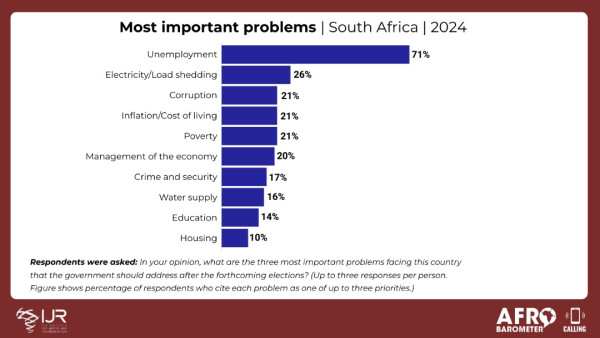
The most urgent problems that South Africans want their government to address are unemployment, unreliable electricity supply, and corruption, according to a new Afrobarometer (www.Afrobarometer.org) telephone survey ahead of general elections on 29 May.

Citizens also cite economic issues including inflation, poverty, and management of the economy.

As citizens prepare to go to the polls, a majority of them are dissatisfied with the way democracy is working in their country, and they overwhelmingly say their country is going in “the wrong direction.” Even among likely voters, one-third say they have not decided which party they will vote for.

These findings are from a telephone survey conducted 23 April-11 May with a sample of 1,800 South Africans aged 18 and older. The margin of sampling error is +/-2.3 percentage points.

Key findings

  • Unemployment far outranks other issues as the country's most important problem that citizens want their government to address, cited by 71% of respondents as one of their three priorities (Figure 1).
  • Electricity/load shedding (26%), corruption (21%), inflation/cost of living (21%), poverty (21%), and management of the economy (20%) round out citizens' top priorities for government action.
  • More than six in 10 South Africans (62%) say they are dissatisfied with the way democracy works in their country, while only 36% express satisfaction (Figure 2).
  • More than eight in 10 South Africans (85%) say the country is going in the wrong direction, up from 46% in 2011 (Figure 3).
  • Among respondents who say they are registered and are likely to vote, about one-third (32%) say they have not decided which party they will vote for.

Afrobarometer surveys

Afrobarometer is a pan-African, non-partisan survey research network that provides reliable data on African experiences and evaluations of democracy, governance, and quality of life. Nine rounds of face-to-face surveys in up to 42 countries have been completed since 1999. Afrobarometer's national partners conduct face-to-face interviews in the language of the respondent's choice.

While Afrobarometer is known for its face-to-face surveys, which are conducted on a roughly two-year cycle, the organisation is refining methods for more limited telephone surveys on emerging topics between standard survey rounds.

The Afrobarometer team, led by the Institute for Justice and Reconciliation (IJR), interviewed 1,800 adult South Africans selected from a database of more than 14 million cell phone numbers between 23 April and 11 May – the final weeks before the election. A sample of this size yields a margin of sampling error of +/-2.3 percentage points. This is the first publicly-released Afrobarometer telephone survey (http://apo-opa.co/3QUBfWn).

Note: Results from 2011-2022 are from standard face-to-face Afrobarometer surveys, whereas the 2024 survey was conducted by phone.

Distributed by APO Group on behalf of Afrobarometer.

Presentation: index.php (apo-opa.com) 

Frequently asked questions (FAQs) about Afrobarometer's pre-election telephone survey in South Africa​: http://apo-opa.co/3QUBfWn

For more information, please contact:
Asafika Mpako
Communications coordinator for Southern Africa
Telephone: +2783-979-8299
Email: ampako@afrobarometer.org
Visit us online at www.Afrobarometer.org.

Follow our releases on #VoicesAfrica.
Facebook: /Afrobarometer
Twitter: https://apo-opa.co/4bt5jR9
YouTube: /Afrobarometer

Media files
Afrobarometer
Download logo
Read moreUnemployment, unreliable electricity supply, and corruption are South Africans’ top concerns, Afrobarometer pre-election telephone survey shows
24 May 2024

R2 million to help agricultural sector suppress pest affecting export crops

Location: News

R2 million to help agricultural sector suppress pest affecting export crops

The Western Cape Department of Agriculture has handed over a R2 million cheque to the Citrus Growers Association (CGA) to support their Sterile Insect Technique (SIT) Programme aimed at suppressing False Codling Moth (FCM).

False Codling Moth is a phytosanitary pest affecting export crops including citrus, table grapes, and stone fruit.

The programme offers immense potential in reducing pests and ensuring that South African agricultural products meet the strict standards required by international markets.

The programme, which uses cutting-edge science, also reduces the reliance on environmentally harmful pesticides and leads to improved fruit quality.

Western Cape Agriculture MEC Dr Ivan Meyer said addressing False Codling Moth will contribute to increased export earnings for especially the citrus industry, creating jobs and uplifting rural communities.

“Colonies of False Codling Moth are raised in special facilities where the male and female insects are sterilised using radiation from the isotope Cobalt-60 and are safely released in large numbers. Females mated with sterile males then lay eggs that do not hatch. A large decline in the pest population follows,” Meyer said.

Meyer said the trials for the programme in Citrusdal began in 2005 through a collaboration with the United States Department of Agriculture and the International Atomic Energy Agency.

“The successes that followed lead to the founding of X Sterile Insect Technique (X-SIT). X-SIT now administers the SIT programme lending the programme their expertise.

“Despite its immense potential, the SIT programme faces challenges in that it is expensive. The high cost of SIT compared to cheaper but much less sustainable alternatives threatens its long-term viability,” Meyer said.

The MEC said the programme currently covers 20 400 hectares but has the potential to expand to over 4 ,000 hectares with adequate funding, and this could facilitate the creation of an estimated 50 job opportunities.

Meyer said the Citrus Growers Association has emphasised the critical need for financial support to sustain and grow the program, ensuring the continued production of export-quality residue-free fruit.

Meyer said the entire programme is currently funded by citrus and table grape growers who use the service themselves.

However, he said, the R2 million funding would alleviate some of the financial burden of the Western Cape growers and help ensure the continuation and expansion of this vital pest management strategy.

"Our support for the SIT programme underscores our commitment to a sustainable agricultural sector. This funding will help secure the future of our citrus industry, ensuring that it remains competitive in the global market while protecting our environment and creating jobs,” Meyer said.

Citrus Growers Association CEO Justin Chadwick expressed his gratitude, saying the support from the provincial government is a significant boost for X-SIT and everyone involved.

“The CGA hopes this type of agricultural innovation will find widespread support, as developing new technologies, though essential, does not come cheaply," Chadwick said. – SAnews.gov.za
 

GabiK
Fri, 05/24/2024 - 09:49

100 views
Read moreR2 million to help agricultural sector suppress pest affecting export crops
24 May 2024

Councillor denies giving people permission to occupy land in Johannesburg

Location: News

The occupiers are mostly backyarders and tenants who say they could no longer afford to pay rent or buy a house. They have been clearing the open field for a week now.

Read moreCouncillor denies giving people permission to occupy land in Johannesburg
24 May 2024

Bringing government services closer to communities

Location: News

Bringing government services closer to communities

Deputy Minister in The Presidency Kenny Morolong will launch the Loeriesfontein Thusong Service Centre in the Hantam Local Municipality in the Northern Cape on Friday.

The launch of this Thusong Centre will bring government services and information closer to the people of Loeriesfontein.

The establishment of Loeriesfontein Thusong Service Centre is one of the initiatives made possible through the private partnerships established between the Northern Cape Office of the Premier, Loeriesfontein 2 and Khobab Wind Farm and the Government Communication and Information System (GCIS).

To date, there are 197 Thusong Service Centres countywide and 121 of those are fully operational and have thus far reached approximately five million beneficiaries every year.

The launch of the Thusong Centre takes place against the backdrop of the country's commemoration of 30 years of freedom under the theme: “30 Years of Democracy, Partnership and Growth”.

The Deputy Minister will be accompanied by the Mayor of Namakwa District Municipality, Mervyn Cloete and the Mayor of Hantam Local Municipality, Koos Alexander. – SAnews.gov.za


nosihle
Fri, 05/24/2024 - 09:20

85 views
Read moreBringing government services closer to communities
23 May 2024

Mchunu to unveil Pilanesberg water supply project

Location: News

Mchunu to unveil Pilanesberg water supply project

Phase 2 of the Pilanesberg Bulk Water Supply Project will be unveiled in Chaneng in the Rustenburg Local Municipality on Friday.

The project will be unveiled by Water and Sanitation Minister, Senzo Mchunu, together with North West Premier, Patrick Dumile Nono Maloyi, under the province’s Thuntsha Lerole Programme - a service delivery acceleration drive.

The water supply project is part of the “Operation Bulela Metsi” water services intervention programme set up by the Department of Water and Sanitation and the North West Provincial Government last year to accelerate water supply projects and enhance access to consistent and reliable water supply in the province.

Phase 2 of the bulk water supply project includes a 30ML reservoir construction, which commenced on 30 November 2021, and the construction of the Mafenya pump station and pipeline to Tlhabane which commenced on 29 July 2022.

Both construction projects are expected to be completed on 30 May 2024.

“Rustenburg Local Municipality has been experiencing severe water challenges due to the influx of people seeking greener pastures in the mines. 

“Phase 2 of the Pilanesberg Bulk Water Supply Scheme, which runs from Mafenya village in Chaneng to Tlhabane, will provide relief through a basic sustainable, minimum supply of water to 63 238 households under the Royal Bafokeng Administration and Rustenburg Local Municipality,” the department said in a statement.

The project has already created 250 jobs for locals.

The unveiling of the project will be followed by a community engagement at Mafenya Primary School Sport Ground. – SAnews.gov.za

GabiK
Thu, 05/23/2024 - 13:01

245 views
Read moreMchunu to unveil Pilanesberg water supply project
  • Previous
  • Page 1
  • Interim pages omitted …
  • Page 136
  • Page 137
  • Page 138
  • Page 139
  • Page 140
  • Interim pages omitted …
  • Page 210
  • Next

Copyright © 2026 · MyZA · All Rights Reserved · Powered by Stratlec Online